Deuteronomy 7 carries the hardest command in Moses’ second sermon — seven nations, devoted to destruction, no treaty and no marriage (7:1–5) — and this study reports it plainly rather than stepping around it. But the chapter itself will not stop there, and neither should we. Six verses in, the sermon turns and says the thing it most wants heard: you are a people holy to the Lord, and “it was not because you were more in number than any other people that the Lord set his love on you and chose you, for you were the fewest of all peoples, but it is because the Lord loves you” (7:7–8). This study works Deuteronomy 7:1–26 — the ban and its stated reason, which is worship and not ancestry (7:4); the God who keeps covenant to a thousand generations; the word to people who are honestly afraid; and the conquest that comes “little by little.” The war is the setting. Being loved while you were the smallest is the sermon. See the method →
Deuteronomy 7:1–26 (selections)
Hebrew · LXX · ESVThe Shape of the Passage
ConcentricDeuteronomy 7 sits inside Moses’ second sermon on the plains of Moab. Chapter 6 has just given the Shema and the command to love God with everything (6:4–9) and warned of amnesia in the good land; chapter 8 will press that warning further. Between them stands this chapter: how the people who are to love God alone are to enter a land already full of other gods — and why God took them in the first place.
Author
The Torah of Moses, and here Moses is unmistakably preaching. Deuteronomy is not a law code filed for reference; it is a sermon delivered forty years on, east of the Jordan, to the children of the generation that died in the wilderness. Its verbs are remember, hear, love, choose, today. And its overall shape follows the ancient Near-Eastern suzerainty treaty — preamble, historical prologue, stipulations, witnesses, blessings and curses (so Kline and Weinfeld). That observation is genuinely useful for reading the book; it is also used on both sides of the dating debate, and this study does not try to settle that.
What the chapter actually does. Read as a whole, Deuteronomy 7 is a war-address that spends most of its energy talking the hearer out of self-confidence. It begins with a command whose severity nothing here softens (7:1–5). But it gives its own reason for that command in a single sentence about worship, not blood: “they would turn away your sons from following me, to serve other gods” (7:4). And then, before the reader can turn the command into a boast, the sermon takes everything back: God did not pick you because you were impressive. He picked you when you were the smallest thing on the map, and he did it because he loved you and had made a promise (7:7–8). Every reassurance that follows — the thousand generations, the blessing, “do not be afraid,” the slow pace of the conquest — hangs from that.
Audience
A small, frightened people at the edge of a land that is not empty. This is not a chapter addressed to an empire. Its hearers are the ones who will say in their hearts, “These nations are greater than I. How can I dispossess them?” (7:17). Moses answers the fear rather than scolding it: remember Pharaoh (7:18–19); God is in your midst (7:21); and it will not all happen at once — “little by little” (7:22). Deuteronomy 7 is spoken downward in strength and upward in comfort, which is the exact opposite of how conquest-rhetoric usually runs in the ancient world.
Hearing it honestly. The command to devote the seven nations to destruction is hard, and it should be allowed to be hard. This study does not soften it, skip it, or explain it away, and it does not treat it as a general principle. Scripture itself bounds it: to seven named peoples, in one land, at one moment, by direct divine command, as a judgment four centuries in the waiting (Gen 15:16) on practices the Torah describes without euphemism (Lev 18:24–28) — and Deuteronomy in the same breath forbids Israel to touch Edom, Moab and Ammon (Deut 2:4–5, 9, 19). It is not a licence anyone may pick up. The New Testament makes that unmistakable: “the weapons of our warfare are not of the flesh” (2 Cor 10:4), “we do not wrestle against flesh and blood” (Eph 6:12), and when two disciples proposed fire from heaven on a village that would not receive Jesus, “he turned and rebuked them” (Luke 9:54–55). And when Peter drew a sword for him, “Put your sword back into its place. For all who take the sword will perish by the sword” (Matt 26:52). No nation, no church, and no person today may read Deuteronomy 7 as permission. And the chapter’s own last word on ḥērem is aimed at Israel, not at anyone else (7:26).
Orient on ḥērem, the seven nations, election and covenant love, Asherim, and the “treasured possession.”
Search by topic: herem / ban / devoted thing, Canaan and the seven nations, election, covenant love (hesed), segullah / treasured possession, Asherah and Asherim, massebah / pillar, intermarriage, holy war.
Which articles are relevant?
- Anchor Bible Dictionary — “Ban (ḥerem),” “War, Holy,” “Canaan, Canaanites,” “Asherah,” “Pillar (Maṣṣebah),” “Election,” “Covenant,” “Marriage (Mixed).”
- Dictionary of the OT: Pentateuch — “Destroy, Utterly (ḥerem),” “Election,” “Love,” “Idolatry,” “Canaanite Religion,” “Warfare,” “Land.”
- NIDOTTE / TDOT — חֵרֶם (ḥērem, devoted thing), בָּחַר (bāḥar, choose), חָשַׁק (ḥāšaq, be attached to, set one’s love on), סְגֻלָּה (səgullāh, treasured possession), אָהַב (ʾāhaḇ, love), אֲשֵׁרָה (ʾăšērāh).
Bibliography surfaced:
- Peter C. Craigie (NICOT), Daniel I. Block (NIVAC), J. G. McConville (Apollos), Jeffrey H. Tigay (JPS), Duane L. Christensen (WBC), Moshe Weinfeld (Anchor) on Deuteronomy.
- Studies of ḥerem in Israel and in the Mesha Inscription; of ANE conquest rhetoric; and of the covenant/treaty form (Kline; Weinfeld).
- W. L. Moran, “The Ancient Near Eastern Background of the Love of God in Deuteronomy,” CBQ 25 (1963) — the classic study of covenant “love” as loyalty language.
- Beale & Carson, Commentary on the NT Use of the OT (Titus; 1 Peter; the Gospels).
The ban, the treaty, the Asherah — and how later readers handled a hard command.
Read the ḥerem and the “no covenant” clause against the ANE evidence, then watch what Second-Temple and rabbinic readers did with a command they could no longer perform — and let the New Testament set the terms.
Which parallels shed light on religion and worldview?
The ban was not unique to Israel. The Mesha Inscription (the Moabite Stone, c. 840 BC) uses the very same root. King Mesha reports taking Nebo from Israel and slaying its whole population, “for I had devoted them to destruction for (the god) Ashtar-Chemosh” (ANET 320; the inscription runs ANET 320–321). This matters two ways at once. It confirms that the language of the ban is genuine Iron-Age idiom and not a literary abstraction — and it also refuses to let anyone treat Israel’s ban as self-evidently righteous simply because Israel did it. In Moab the same practice is done for Chemosh. The question Deuteronomy forces is not whether the practice existed but who commanded this one, why, and within what limits.
“Make no covenant with them” is treaty language. Deuteronomy’s whole architecture matches the ANE suzerainty treaty, and the Hittite texts show what a vassal’s exclusive loyalty sounded like: “With my friend you shall be friend, and with my enemy you shall be enemy” (Mursilis–Duppi-Tessub, ANET 204; the Egyptian and Hittite treaties begin at ANET 199). Vassals could not make their own treaties with third parties — that was the great-king’s prerogative. Read there, “you shall make no covenant with them” (7:2) is not first a policy of cruelty but a clause of undivided allegiance, and marriage in that world was treaty (7:3): dynastic marriage sealed alliances, and alliances brought the partner’s gods along with the bride. Which is precisely the reason 7:4 gives.
Altars, pillars, Asherim. The four objects of 7:5 are the standard furniture of a Canaanite high place: the altar, the standing stone (מַצֵּבָה), the wooden Asherah pole, and the carved image. Asherah is known from the Ugaritic texts as Athirat, consort of El and mother of the gods; and the ninth/eighth-century Hebrew inscriptions from Kuntillet ʿAjrud and Khirbet el-Qom, which bless by “Yahweh… and his asherah,” show exactly the syncretism Deuteronomy is trying to prevent. That is the danger 7:4 names, and Israel proved the point: at Baal-Peor it was Moabite women and a Moabite god, not Canaanite armies, that cost Israel twenty-four thousand lives (Numbers 25).
- Mesha Inscription / Moabite Stone (Moabite, c. 840 BC; ANET 320–321) — “I had devoted them to destruction for Ashtar-Chemosh”: the ḥrm root outside Israel, done for another god. A witness, not Scripture.
- Treaty between Mursilis and Duppi-Tessub of Amurru (Hittite; ANET 203–205; the treaty section begins at ANET 199) — exclusive loyalty, no independent treaties: the world in which “make no covenant with them” is a covenant clause.
- Vassal-Treaties of Esarhaddon (Neo-Assyrian, 672 BC; ANET 534–541 — beyond our local scan, so cited without page verification) — the closest formal parallel to Deuteronomy’s stipulations and curses, and a text in which the vassal is required to “love” the sovereign.
- Ugaritic texts (Athirat) and the Hebrew inscriptions from Kuntillet ʿAjrud and Khirbet el-Qom — background to the Asherim of 7:5 and to the syncretism 7:4 anticipates.
- Wisdom of Solomon 12:3–11 (Apocrypha — a witness, not Scripture in the Protestant canon) — an extended Second-Temple meditation on exactly this chapter: God sent “wasps” (σφῆκας, cf. LXX Deut 7:20) to destroy them κατὰ βραχύ, “little by little” (cf. 7:22) — and “judging them little by little you gave them a place for repentance” (12:10).
- Jubilees 20:4; 22:20; 30:7–17 (Second-Temple — a witness, not Scripture) — hardens Deut 7:3 from seven named peoples into a blanket ban on marriage with any Gentile (see Jubilees 2). An early example of a bounded command being universalized — and a warning.
- Mishnah, Yadayim 4:4 (rabbinic-era — a witness, not Scripture) — Judah the Ammonite convert is admitted because “Sennacherib… came up and mixed all the nations”: the peoples of the Torah’s lists are no longer identifiable. Later halakhah (Maimonides, Hilkhot Melakhim 5:4) applies the same reasoning to the seven nations — the command has no possible object.
It is worth noticing what ancient readers did with Deuteronomy 7, because they did two opposite things. Jubilees took the marriage clause and stretched it past its stated limits into a wall against every Gentile — the command untethered from its reason. The rabbis went the other way and declared its object gone: after Sennacherib’s deportations the seven nations could no longer be identified, so the command could no longer be performed. And the Wisdom of Solomon, reading the same chapter, fastened on 7:20–22 and drew from “little by little” the conclusion that the slowness itself was mercy — God “gave them a place for repentance” (Wis 12:10). Scripture then settles the matter in its own way, by telling us who actually came out of Canaan alive: Rahab of Jericho and her household, and the Gibeonites, both spared inside the very campaign the ban governed; Ruth the Moabite, who walks into the genealogy of David and of Christ. And it tells us who did not: Achan, an Israelite who took the devoted thing and became ḥerem himself — which is precisely what Deuteronomy 7:26 had said would happen. The line was never drawn around blood. It was drawn around allegiance, and it ran straight through Israel.
The ban, the clinging love, the treasure, and the smallness that is the whole point.
Watch herem (devoted, and turned on Israel at the end); chashaq (God attached to them); segullah (treasure); meʿat (few — and “little by little”); ahav (covenant love with no cause outside God); and asherah, the thing that actually threatened them.
“Devoted thing / ban” — not a synonym for slaughter but a term of consecration: something handed over irrevocably to God and therefore withdrawn from all human use (cf. Lev 27:28–29). That is why plunder is forbidden (7:25) and why an Israelite who keeps a piece of it becomes ḥerem himself (7:26; Josh 7). The verb is doubled for emphasis in 7:2 — haḥărēm taḥărîm. The LXX renders it flatly here (ἀφανισμῷ ἀφανιεῖς) but sacrally at 7:26 (ἀνάθημα), the word-family behind Paul’s ἀνάθεμα (Rom 9:3; Gal 1:8). The same root stands on the Mesha Inscription — a real Iron-Age practice, here placed under a command that is bounded, named, dated, and never repeated.
“To be attached to, set one’s heart on” — a warm, almost physical verb of clinging desire, not the ordinary word for love. It is used of Shechem’s longing for Dinah (Gen 34:8) and of a captive woman a man desires (Deut 21:11); Deuteronomy uses it twice of God toward Israel (7:7; 10:15). The Greek has προείλατο, “chose in preference.” The Hebrew says God did not merely select Israel; he was taken with them — and 7:7 is careful to add that there was nothing about them to be taken with.
“Treasured possession” — a royal-treasury word for private property a king keeps back for himself, distinct from the crown holdings. It is cognate with Akkadian sikiltu, and a Hittite great king’s letter to the king of Ugarit calls his vassal his sglt — the emperor’s own valued possession. The LXX coins λαὸν περιούσιον, and that exact phrase reappears in Titus 2:14 of the church: “a people for his own possession.” First heard at Sinai (Exod 19:5).
“Few, little” — the hinge of the chapter. “You were haməʿaṭ, the fewest of all peoples” (7:7); and then the same little root sets the speed of everything that follows: məʿaṭ məʿāṭ, “little by little” (7:22; LXX κατὰ μικρὸν μικρόν). Against it stands rab, “many” — the nations are rabbîm (7:1) and the frightened heart says they are rabbîm (7:17). Deuteronomy’s answer is not that Israel is secretly large. It is that size was never the point.
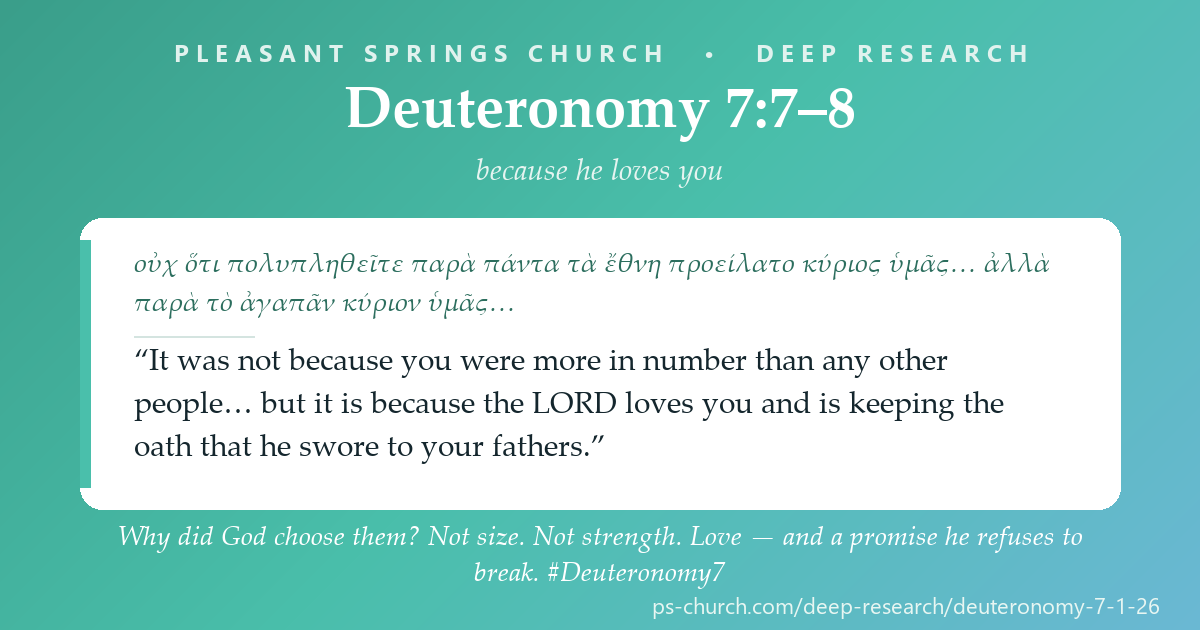
“To love” — in Deuteronomy a covenant word as much as an affectionate one. W. L. Moran showed that ANE treaties require a vassal to “love” his sovereign, meaning steady, exclusive loyalty. But the direction here is what startles: the great King says he loves the vassal, and gives no reason outside himself — “because the Lord loves you and is keeping the oath” (7:8; LXX παρὰ τὸ ἀγαπᾶν κύριον ὑμᾶς). Israel’s answering love (6:5) is a response, never a cause.
“Asherah / Asherim” — both the Canaanite goddess (Ugaritic Athirat) and the wooden pole or living tree that stood for her beside an altar; hence the verb in 7:5 is “chop down.” The LXX reads τὰ ἄλση, “the sacred groves.” The Kuntillet ʿAjrud inscriptions show Israelites blessing by “Yahweh and his asherah” — not abandoning the Lord but adding to him. That, not atheism, is the apostasy 7:4 foresees.
How the New Testament takes up Deuteronomy 7:
- Titus 2:14 — Christ gave himself “to purify for himself a people for his own possession”: λαὸν περιούσιον, the LXX phrase of Deut 7:6 and 14:2, now of the church.
- 1 Peter 2:9–10 — “a chosen race, a royal priesthood, a holy nation, a people for his own possession… once you were not a people, but now you are God’s people.” The logic of Deut 7:7–8 exactly: chosen out of nothing you brought.
- Ephesians 1:4–5 — chosen before the foundation of the world and, “in love,” predestined for adoption — “according to the purpose of his will” — and see Ephesians 2:1–10: “not a result of works, so that no one may boast.” Same sermon, new covenant.
- 2 Corinthians 10:3–5; Ephesians 6:12 — “the weapons of our warfare are not of the flesh”; “we do not wrestle against flesh and blood.” The war of Deuteronomy 7 does not carry forward into the church’s hands.
- Luke 9:51–56 — James and John ask for fire from heaven on an unwelcoming village; “he turned and rebuked them.” The disciples’ instinct was to generalize an Old Testament judgment. Jesus said no.
- Romans 8:31–39 — the New Testament’s own version of “because the Lord loves you”: nothing “will be able to separate us from the love of God in Christ Jesus our Lord” (see Romans 8:31–39).
From the ban to the love that is the chapter’s centre — and across the canon.
Trace three threads: the limits Scripture itself puts on the conquest; the “not because of you” refrain that runs through the whole book; and the thousand generations of steadfast love.
Which cross-references matter?
- Genesis 15:16 — “the iniquity of the Amorites is not yet complete”: four centuries of delay before the judgment of this chapter, and the reason given is moral, not tribal (see Genesis 15).
- Leviticus 18:24–28; 20:22–24 — the land “vomits out” its inhabitants for what they did, and will vomit Israel out for the same. The standard cuts both ways (see Leviticus 18).
- Deuteronomy 2:4–5, 9, 19 — God forbids Israel to take a foot of Edom, Moab or Ammon: the text’s own boundary on the conquest, in the same sermon (see Deuteronomy 1–3).
- Deuteronomy 9:4–6 — the twin of 7:7: “Not because of your righteousness… for you are a stubborn people.” Two disclaimers, one sermon — not for your size, not for your goodness.
- Exodus 19:5–6; 23:20–33 — “my treasured possession… a kingdom of priests” (see Exodus 19), and the earlier promise to drive the nations out “little by little” with the same reason about the beasts (Exod 23:29–30).
- Exodus 20:5–6; 34:6–7 — the asymmetry Deut 7:9–10 restates: iniquity visited “to the third and the fourth generation,” steadfast love to thousands (see Exodus 33:12–34:9).
- Numbers 25:1–18; 33:50–56 — the danger of 7:4 actually happening at Baal-Peor (Numbers 25), and the parallel command about images and high places (Numbers 33); for the same difficult material handled in the same way, see Numbers 31.
- Titus 2:14; 1 Peter 2:9–10; Ephesians 1:4–5 — the vocabulary of 7:6–8 carried into the church without the sword.
Deuteronomy 7:7 is one of the great anti-triumphalist sentences in Scripture, and it is placed exactly where triumphalism would otherwise grow. Israel has just been told it will dispossess seven nations “more numerous and mightier than you.” The obvious inference — we must be something — is cut off before it can be drawn. God did not love you because you were many; you were the fewest. He did not choose you because you were good; chapter 9 will say so in as many words. He loved you because he loved you, and because he had sworn something to Abraham. That is the entire ground, and it is outside you.
Two things follow, and the chapter draws them both. First, comfort: if the reason you were chosen was never your strength, then your present weakness cannot unchoose you. “These nations are greater than I” (7:17) is a true observation and an irrelevant one. Second, humility: a people loved for no reason in themselves has nothing whatever to boast of, and no ground to look down on anyone. Paul says the same thing in the same shape — “by grace you have been saved through faith… not a result of works, so that no one may boast” (Eph 2:8–9) — and Peter says it of the church in Deuteronomy’s own words (1 Pet 2:9–10). Election in Scripture is never a trophy handed to the impressive. It is a rescue handed to the small, and the only honest response to it is worship.
The scholarship on ḥerem, the conquest, and covenant election.
Craigie, Block, McConville, Tigay, Christensen and Weinfeld on Deuteronomy; Kline and Weinfeld on the treaty form; Moran on covenant love; Younger on ANE conquest rhetoric; Beale & Carson on the NT use.
Commentaries & studies:
- Peter C. Craigie, The Book of Deuteronomy (NICOT); Daniel I. Block, Deuteronomy (NIVAC); J. G. McConville, Deuteronomy (Apollos); Jeffrey H. Tigay, Deuteronomy (JPS); Duane L. Christensen, Deuteronomy (WBC); Moshe Weinfeld, Deuteronomy 1–11 (Anchor).
- Meredith G. Kline, Treaty of the Great King; Moshe Weinfeld, Deuteronomy and the Deuteronomic School — the suzerainty-treaty form and its bearing on the shape (not the date) of the book.
- W. L. Moran, “The Ancient Near Eastern Background of the Love of God in Deuteronomy,” CBQ 25 (1963).
- K. Lawson Younger Jr., Ancient Conquest Accounts (JSOTSup 98) — the stereotyped, totalizing rhetoric shared by Israelite, Assyrian, Egyptian and Hittite campaign reports.
- Christopher J. H. Wright, The God I Don’t Understand, and Paul Copan, Is God a Moral Monster? — two careful, non-evasive attempts to think through the Canaanite question theologically.
- G. K. Beale & D. A. Carson, eds., Commentary on the New Testament Use of the Old Testament (Titus; 1 Peter).
Interpretation notes worth keeping:
- Report the ḥerem; do not soften it and do not skip it. Deuteronomy 7:1–2 says what it says. Any reading that quietly deletes it is not reading Deuteronomy. Equally, any reading that stops there has not reached the chapter’s own centre, six verses later.
- The stated reason is religious, not ethnic. 7:4 gives it: “they would turn away your sons from following me.” The chapter never says the nations are of inferior stock, and Scripture immediately proves the point in the other direction — Rahab and the Gibeonites live, Ruth the Moabite enters the royal line, and Achan the Israelite becomes ḥerem (Josh 7), which is exactly what 7:26 warned. Reading these texts as a charter for ethnic hatred inverts them.
- It is bounded, and Scripture draws the boundary itself. Seven named peoples, one land, one generation, by explicit divine command, after four hundred years of delay (Gen 15:16) — and in the same sermon God forbids touching Edom, Moab and Ammon (Deut 2). It is not a general principle and never was. It is not a model for any nation, army, church or person today, and the New Testament closes the door explicitly (2 Cor 10:4; Eph 6:12; Luke 9:54–55; Matt 26:52).
- It is still hard, and saying so is honest. This study does not claim the difficulty dissolves. Judgment on a people is a terrible thing, and the chapter itself keeps company with a God who is “slow to anger,” who delays four centuries, who clears the land little by little, and who will later hand his own people over to the same kind of judgment for the same sins (Lev 18:28). We report the tension rather than resolve it, and we refuse to make it useful.
- A live scholarly question, not adjudicated here. Younger and others argue that ANE campaign reports (including Joshua’s) use conventional totalizing rhetoric — “all,” “none left,” “utterly” — and that Joshua’s own summaries (Josh 13:1; Judg 1) show survivors, so the language may be less absolute than it sounds. Others hold the language plainly. Both are serious readings; this page reports the debate and does not settle it.
- Do not turn 7:6–8 into a boast, in any direction. Election here is corporate, undeserved, and for the sake of a promise; it comes with no superiority and, as chapter 9 will make blunt, no righteousness. The New Testament hands the same vocabulary to the church (Titus 2:14; 1 Pet 2:9) and draws the same conclusion: no one may boast.
- Note the asymmetry in 7:9–10. Steadfast love reaches “a thousand generations”; recompense reaches those who hate him “to their face” — personally, in their own lifetime, not down the family line. Deuteronomy elsewhere makes that explicit: each dies for his own sin (Deut 24:16). Consequences run through generations; guilt does not.
From the hardest command in the book to the sentence that governs it.
Name what you learned, why it matters, and one concrete response.
What should we carry away — and do?
- You were never chosen for your size. “It was not because you were more in number… for you were the fewest of all peoples” (7:7). Whatever made God set his love on you, it was not your numbers, your record, or your usefulness. That is the most humbling and the most steadying fact you own.
- Therefore weakness cannot unchoose you. If smallness was the starting condition, smallness is not now a disqualification. “These nations are greater than I” (7:17) is true — and beside the point.
- Being loved is not being better. Deuteronomy hands the sentence to Israel and Peter hands it to the church, and both times the conclusion is worship, not superiority. A people loved for nothing in themselves has nothing to look down from.
- The real danger was never the armies. It was the quiet drift of 7:4 — the altar kept “just in case,” the god added rather than substituted, the loyalty divided at home. Israel lost more at Baal-Peor than in any battle of the wilderness years.
- God works little by little. The slow pace of 7:22 is not divine reluctance; it is care — the land would go wild if it emptied at once. He is unhurried with you for reasons you cannot see yet.
- And the sword is not ours. The war of this chapter was bounded, commanded, and finished. “The weapons of our warfare are not of the flesh” (2 Cor 10:4). When two disciples reached for fire from heaven, Jesus rebuked them (Luke 9:54–55). Anyone who quotes Deuteronomy 7 to justify harming a neighbour has read it exactly backwards.
Step in response: find the sentence you secretly use to explain why God is good to you — my faith, my record, my usefulness, my family, my church — and cross it out. Then put Deuteronomy 7:7–8 in its place, out loud, in the first person: it was not because I was more in number; I was the fewest; it is because the Lord loves me and is keeping his oath. Then go do the small, slow, unglamorous thing in front of you today — because that is how he works: little by little.
Deuteronomy 7:7–8 · to share
LXX + ESVEvery Deep Research page traces its passage across the whole sweep — the Old Testament, the Second-Temple world between the testaments (historical witnesses, not Scripture), and the New Testament. Follow the thread:
Pleasant Springs Church — Deep Research
Research method after Michael S. Heiser’s Bible Research Method (examine dictionaries → ancient literature → important words → textual connections → academic publications → share), with the Pleasant Springs “Author & Audience” foundation. Scripture set in the Hebrew, the Greek editions named on each page and the ESV (Old Testament), and the Greek New Testament and the ESV (New Testament), per the practice of Pleasant Springs Church. Deuteronomy 7 research grounded in Craigie, Block, McConville, Tigay, Christensen and Weinfeld, with Kline and Weinfeld on the suzerainty-treaty form, Moran on covenant “love,” Younger on ANE conquest rhetoric, and Beale & Carson on the New Testament use (Titus; 1 Peter). ANE background from the Mesha Inscription (ANET 320–321) and the Hittite treaties (ANET 199–206, the Mursilis–Duppi-Tessub clause at 204), with Esarhaddon’s vassal-treaties (ANET 534–541) cited beyond our verified range; Second-Temple and rabbinic witnesses (Wisdom of Solomon 12; Jubilees; Mishnah Yadayim; Maimonides) read as witnesses, not Scripture. Greek is Rahlfs; Deuteronomy 1–11 has no versification offset, so Hebrew, Greek and English agree verse for verse in this chapter. The ḥerem is reported plainly and located as a bounded, divinely commanded judgment in redemptive history — not a general principle, not a model for any nation or church, and no warrant for violence by anyone today (2 Cor 10:4; Eph 6:12; Luke 9:54–55; Matt 26:52); the difficulty is acknowledged rather than resolved, and the chapter’s own centre — chosen not for greatness but in love, while they were the fewest of all peoples — is where the study lands.
Scripture quotations marked ESV are from the ESV® Bible (The Holy Bible, English Standard Version®), © 2001 by Crossway, a publishing ministry of Good News Publishers. ESV Text Edition: 2016. Used by permission. All rights reserved. The ESV text may not be quoted in any publication made available to the public by a Creative Commons license, and the ESV may not be translated in whole or in part into any other language. www.esv.org
|
Did this study bless you today? 💚 Give to Support PS Church100% of gifts go to the General Fund — thank you. |