Two verses in Deuteronomy 7 are almost never underlined. In one, God sends the hornet ahead of Israel (7:20) — a word that appears only three times in the Hebrew Bible, and the last time Joshua says what it meant: “it was not by your sword or by your bow.” In the other, God says he will clear the land “little by little… lest the wild beasts grow too numerous for you” (7:22) — and for a while keeps the very nations he is removing in the land, to hold back the wild until his small people can fill it. This study follows those two animals through Scripture: the beasts that blessing holds back and the curse sends; the lions of Samaria; the clean and unclean animals that stood for the nations; Peter’s sheet; and the wolf lying down with the lamb while the nations come to Jesse’s son. It is also a fifteen-minute class, with free Leader and Disciple handouts. For the whole chapter, see Deuteronomy 7:1–26.
Deuteronomy 7:20–22
Hebrew · LXX · ESVThe Shape of the Passage
Frame and refrainThe first promise — and the look back
Hebrew · LXX · ESVDiscipleship School · A 15-Minute Class
Teach It Yourself — Free Class Materials
This study is also a fifteen-minute class, written to be taught in one sitting: the hornet, “little by little,” the animals that stood for the nations, and where they end up. Take both files and use them. They are free to print and copy for your church or group — no permission needed. The handouts are in English (ESV) only; the Hebrew and Greek stay here.
A 5-page workbook — the Scripture in full, blanks to fill in, room to write, and the questions.
⬇ Disciple HandoutLarge printThe full script with timings, what to say, what not to say, which section to cut, and where to stop.
⬇ Leader GuideLarge printThese verses sit inside the full chapter studied at Deuteronomy 7:1–26, in the part of Moses’ sermon that answers fear (7:17–24). This page follows only the two animals of 7:20 and 7:22 — first back to the promise at Sinai, then out through the rest of Scripture.
Author
The Torah of Moses, preached on the plains of Moab to the children of the generation that died in the wilderness. Here Moses is not issuing new law; he is re-preaching a promise their parents first heard at Sinai (Exod 23:27–30) — terror sent ahead, the hornet sent ahead, and “little by little.” Deuteronomy repeats the promise in its own words, and sharpens it: in Exodus the hornet will “drive out” the peoples (23:28); here it is sent “until those who are left and hide themselves from you are destroyed” (7:20). And it is now spoken to people who are about to cross, and are afraid.
What the two verses do. Verse 20 says God’s first weapon is small. Verse 22 says his pace is slow — and gives the reason, which is not weakness and not reluctance but the wild beasts. Between them, verse 21 gives the only reason the passage offers for not being afraid: “the Lord your God is in your midst.”
Audience
A small people, too small for the land they are promised. “you were the fewest of all peoples” (7:7), and Exodus is blunt about why the pace must be slow: “until you have increased and possess the land” (Exod 23:30). They were farmers and herders who knew exactly what happens to an abandoned field and an unguarded flock. “Lest the wild beasts grow too numerous for you” would have needed no explanation.
Hearing it honestly. The hornets are sent “until those who are left and hide themselves from you are destroyed” (7:20), and 7:23–24 continues in the same key. This study does not soften that. It holds it where the full chapter study does: a judgment bounded to seven named peoples, one land and one moment, by direct command, for a reason the chapter states — “they would turn away your sons from following me” (7:4) — and no warrant for anyone to harm anyone today (Luke 9:54–55; 2 Cor 10:4). What these two verses add is something readers rarely notice: even inside that judgment, God moves slowly, and keeps the nations in the land a little longer.
The hornet, the beast of the field, and the animals as signs.
Search by topic: hornet / wasp, wild animals (beasts), animals in the Bible, clean and unclean, conquest of Canaan, holy war, peaceable kingdom.
Which articles are relevant?
- Anchor Bible Dictionary — “Hornet,” “Zoology (Fauna),” “Clean and Unclean (OT),” “War, Holy,” “Conquest of Canaan.”
- Dictionary of Biblical Imagery — “Animals,” “Beast, Beasts,” “Wild Animals,” “Insects,” “Wilderness,” “Peaceable Kingdom”: the place to see the whole pattern at once.
- NIDOTTE / TDOT — צִרְעָה (ṣirʿāh, hornet), חַיָּה (ḥayyāh, living thing, wild beast), מְעַט (məʿaṭ, little, few), שָׁלַח (šālaḥ, send), בָּדַל (bāḏal, separate).
Bibliography surfaced:
- Craigie (NICOT), Tigay (JPS) and Block (NIVAC) on Deuteronomy 7:20–22; Stuart (NAC) on Exodus 23:28–30.
- John Garstang, Joshua–Judges (1931) — the older proposal that the “hornet” stands for Egyptian power in Canaan.
- Mary Douglas, Purity and Danger (1966) and Leviticus as Literature (1999); Jacob Milgrom, Leviticus (Anchor) — on the animal laws as a map of Israel among the nations.
- Richard Bauckham, Living with Other Creatures (2011) — on Mark 1:13 and the wild animals.
What a farmer knew about an empty field — and how one Jewish book read the hornet.
Set the verses against the ancient world they were heard in: an agrarian land where wild animals were a real danger, the ancient habit of reading animals as signs of peoples, and the one book of the Greek Old Testament held here that meditates on exactly these verses.
Which parallels shed light on the passage?
The wild beasts were not a metaphor. Lions, bears, leopards and wolves lived in the land through the whole biblical period. Samson meets a lion in the vineyards of Timnah (Judg 14:5); David has fought lion and bear for his father’s sheep (1 Sam 17:34–36); a lion kills the disobedient prophet on the road (1 Kgs 13:24); bears come out of the woods at Bethel (2 Kgs 2:24). In the law, a shepherd is not liable for an animal “torn by beasts” if he brings the remains as evidence (Exod 22:13 · MT/LXX 22:12). An abandoned countryside does not stay empty. That is the world in which “lest the wild beasts grow too numerous for you” is plain common sense — and in which 2 Kings 17:25–26 reads like the verse coming true: Assyria empties Samaria, settles foreigners in it, and “the Lord sent lions among them.” The report brought to the king of Assyria read it as a sign that the settlers did not know “the law of the god of the land” (17:26).
Animals as signs of peoples. The ancient world used animals for nations and kings: the lion for royal power, the bull for strength, beasts for empires. Israel’s own Scriptures do it openly. Jacob’s blessing calls Judah a lion’s cub and Benjamin a ravenous wolf (Gen 49:9, 27); Daniel sees four great beasts and is told “these four great beasts are four kings” (Dan 7:17; the Old Greek has βασιλεῖαι, “kingdoms”); and the law itself makes clean and unclean animals the daily picture of Israel set apart from the peoples (Lev 20:24–26).
- Wisdom of Solomon 12:8–11 (Apocrypha, 1st c. BC — a witness, not Scripture in the Protestant canon) — the one book of the Greek Old Testament held here that meditates on exactly these verses. Our rendering of the Greek: “Yet even these you spared, since they were human, and sent wasps (σφῆκας) as forerunners of your army, to destroy them little by little (κατὰ βραχύ). Not that you were unable to put the ungodly under the righteous in battle, or to wipe them out at a stroke by terrible beasts (θηρίοις δεινοῖς) or a stern word; but judging them little by little, you gave them a place for repentance…” (12:8–10a). Wisdom reads the slowness as mercy to the nations, not only care for Israel — though the same sentence adds that God knew “their origin was evil” and their thinking would never change, and 12:11 calls them “an accursed seed from the beginning” (σπέρμα γὰρ ἦν κατηραμένον ἀπ’ ἀρχῆς), a hereditary verdict Deuteronomy itself does not give (7:4 gives a religious reason) — and, interestingly, lists wild beasts among the weapons God chose not to use.
- Greek Joshua 23:5 (the Septuagint, B text) — a sentence the Hebrew does not have: “and he will send against them the wild beasts (τὰ θηρία τὰ ἄγρια) until he destroys them and their kings” (our rendering; the singular verb ἐξολεθρεύσῃ can also be read “until they [the beasts] destroy them,” since a Greek neuter plural subject takes a singular verb). In this Greek tradition the beasts change sides: no longer the danger the nations hold back, but one more thing God sends. It is a plus in one textual tradition, not the Hebrew text, and is reported here as such.
There is something in 7:22 that is easy to miss and hard to forget. The peoples under judgment in this chapter are, for a time, left to keep the land — tilling it, pruning it, holding back the thorn and the wild — until God’s small people can grow into it. Exodus says it outright: “until you have increased and possess the land” (23:30). Israel would inherit “great and good cities that you did not build, and houses full of all good things that you did not fill… vineyards and olive trees that you did not plant” (Deut 6:10–11). The sermon that commands the ban also tells Israel, in effect, that they will live off the labour of the very people it names. That is no reason to soften the ban. It is a reason for Israel never to boast — which is exactly what 7:7 has already said.
Hornet, beast of the field, few, and send.
Watch ṣirʿāh (three times only); ḥayyat haśśāḏeh (from Eden on); məʿaṭ (few — and little by little); šālaḥ (God sends the animals); and the New Testament’s thērion.
“Hornet” — three verses in the whole Hebrew Bible, and all three are about the same thing: God sending something ahead of Israel into Canaan. (Exhaustive over 23,204 verse units of the Masoretic text. The same consonants spell the town Zorah, Samson’s home — Judg 13:2 and elsewhere — which the vowels distinguish and which is not counted.) What it was is not settled: real insects; a figure for panic, since the verse before it in Exodus has God sending “my terror” with the same verb (23:27); or, in an older proposal, Egyptian campaigns in Canaan (Garstang). The last occurrence settles what it meant: “it was not by your sword or by your bow” (Josh 24:12).
The Greek translators’ word for the hornet, from σφήξ, “wasp.” Plural in Exodus and Deuteronomy (τὰς σφηκίας), singular in Joshua (τὴν σφηκιάν), matching the Hebrew’s collective “the hornet.” In the whole Greek Old Testament held here the word-family appears only in those three verses and in Wisdom 12:8, which uses the plain σφῆκας.
“The beast of the field” — the wild animal as opposed to livestock. The phrase stands in 24 verses (29 counting forms with a prefixed “and” or “in”) of the Masoretic text, and its first uses are in Eden: God forms “every beast of the field” and brings them to the man to name (Gen 2:19–20), and the serpent “was more crafty than any other beast of the field” (Gen 3:1). Israel entering the land is, in a small way, Adam again — given a garden to fill and keep, among creatures that will not keep their place on their own. The Greek of 7:22 renders it τὰ θηρία τὰ ἄγρια, “the wild beasts.”
“Little, few.” Said twice, məʿaṭ məʿāṭ, it means “little by little” (7:22; Exod 23:30). Fifteen verses earlier, Israel was haməʿaṭ, “the fewest of all peoples” (7:7). And in the covenant curse the same root returns as a verb: the wild beasts sent against Israel will “make you few” (וְהִמְעִיטָה, Lev 26:22). The Greek ties 7:7 and Lev 26:22 together as well, with ὀλιγοστοί / ὀλιγοστούς. God’s pace matches his people’s size — and unfaithfulness would make them smaller still.
“Send.” The verb that runs through every animal in this study. God sends his terror and sends the hornet ahead of Israel (Exod 23:27–28; Deut 7:20; Josh 24:12); he will let loose — the same verb — the beasts against an unfaithful Israel (Lev 26:22); and he sends lions into Samaria (2 Kgs 17:25). The animals are never loose in these texts. Whether they come or are held back is something God does.
“Wild beast.” In the Greek New Testament (SBLGNT) the word stands 46 times, 39 of them in Revelation — where “the beast” is an empire, drawn from Daniel’s beasts (Rev 13:2 combines Daniel’s leopard, bear and lion). Its only appearance in the four Gospels is Mark 1:13: Jesus “was with the wild animals.” Mark does not explain it; many readers have heard Isaiah 11 in it.
From the hornet at Sinai to the wolf and the lamb.
Trace three threads: the animals as part of the covenant (blessing holds them back, curse sends them); the animals as a picture of the nations; and the end of the story, where the beasts and the nations come home together.
The animals through the canon
Hebrew · LXX · ESVThe New Testament
SBLGNT · ESVWhich cross-references matter?
- Leviticus 26:6, 22 — the blessing: “I will remove harmful beasts from the land”; the curse: “I will let loose the wild beasts against you… and make you few.” Whether the wild stays in its place is a covenant matter (see Leviticus 26).
- 2 Kings 17:24–28 — the lions of Samaria: an emptied land, settlers who “did not fear the Lord,” and lions sent among them (see 2 Kings 14–17).
- Leviticus 20:24–26 — “I am the Lord your God, who has separated you from the peoples. You shall therefore separate the clean beast from the unclean.” The food laws are explicitly a picture of Israel among the nations (see Leviticus 20; and Deuteronomy 14).
- Daniel 7:17 — “These four great beasts are four kings”: the plainest place in Scripture where beasts are the nations’ empires (see Daniel 7:9–14). Revelation 13 takes it up.
- Acts 10:9–35 — Peter’s sheet of animals, “What God has made clean, do not call common,” and Peter’s own interpretation: “God has shown me that I should not call any person common or unclean” (10:28); “in every nation anyone who fears him and does what is right is acceptable to him” (10:35). Retold in Acts 11.
- Isaiah 11:6–10 — the wolf with the lamb, “they shall not hurt or destroy in all my holy mountain,” and in the same breath the nations coming to the root of Jesse (see Isaiah 8–11). Paul quotes 11:10 in Romans 15:12.
- Hosea 2:18 (MT/LXX 2:20) — a covenant “with the beasts of the field” and, in the same sentence, “I will abolish the bow, the sword, and war from the land” (see Hosea 1–3). The beasts and the sword end together.
- Mark 1:13 — Jesus “with the wild animals” in the wilderness.
Measured contact: Romans 15:12 and Isaiah 11:10
Paul’s quotation matches the Greek of Isaiah 11:10 word for word. The longest shared run is thirteen words, with a tie band of one — ἡ ῥίζα τοῦ Ἰεσσαί καὶ ὁ ἀνιστάμενος ἄρχειν ἐθνῶν ἐπ’ αὐτῷ ἔθνη ἐλπιοῦσιν — unbroken from “the root” to “hope.” Paul leaves out “in that day” before it and Isaiah’s closing clause, “and his rest shall be honour,” after it. No other verse of the Greek Old Testament comes close (the next best shares three words). And it is the Greek he is quoting: the Hebrew says the nations will inquire of him (יִדְרֹשׁוּ); the Greek, and Paul, that they will hope in him. Both are true of the nations in Isaiah 11; Paul’s argument uses the Greek wording, and this page says so rather than blending the two.
Scope: exhaustive over the 63 CATSS files screened (of 64 held; the Odes excluded) and the SBLGNT; one edition of the Greek Old Testament, not the whole Septuagint tradition.
Put the threads side by side and a pattern appears that no single verse states. At Sinai, clean and unclean animals become the daily picture of Israel set apart from the peoples (Lev 20:24–26). On the edge of Canaan, the wild beasts are the reason the nations are left in the land a little longer (Deut 7:22). In exile, beasts become the shape of empires (Dan 7). And on a rooftop in Joppa, God lets down a sheet of every kind of animal and tells Peter not to call common what he has cleansed — and Peter walks into a Gentile’s house and says, “God has shown me that I should not call any person common or unclean” (Acts 10:28). The picture that had kept Israel apart from the nations at every meal is the picture God used to send the gospel through a Gentile’s door.
And the prophets had already said where it was going. Isaiah puts the wolf with the lamb and the nations seeking Jesse’s root in one chapter (Isa 11:6–10); Hosea puts the covenant with the beasts and the end of the sword in one sentence (Hos 2:18). Deuteronomy 7 is the long road. The peaceable kingdom is where it goes.
Commentaries on the verses, the animal laws, and the peaceable kingdom.
Craigie, Tigay and Block on Deuteronomy; Stuart on Exodus; Douglas and Milgrom on the animal laws; Bauckham on Mark 1:13; Beale & Carson on Romans 15:12.
Commentaries & studies:
- Peter C. Craigie, The Book of Deuteronomy (NICOT); Jeffrey H. Tigay, Deuteronomy (JPS); Daniel I. Block, Deuteronomy (NIVAC).
- Douglas K. Stuart, Exodus (NAC), on 23:27–30.
- Mary Douglas, Purity and Danger; Jacob Milgrom, Leviticus 17–22 (Anchor) — Leviticus 20:24–26 and the animal laws as a symbol of Israel’s separation.
- Richard Bauckham, “Jesus and the Wild Animals (Mark 1:13),” in Jesus of Nazareth: Lord and Christ (1994), reprinted in Living with Other Creatures (2011).
- G. K. Beale & D. A. Carson, eds., Commentary on the New Testament Use of the Old Testament (Romans, on 15:12; Acts, on 10).
Interpretation notes worth keeping:
- Do not claim to know what the hornet was. Insects, panic, Egypt — each has had serious defenders, and none can be proved. The text’s own interpretation is the one to teach: “not by your sword or by your bow” (Josh 24:12).
- Keep the hard verse in view. 7:20 ends “until those who are left and hide themselves from you are destroyed,” and 7:23–24 continues in that key. A study of the hornet that prints only “God fights with small things” and never the end of the verse has softened the passage by leaving it out.
- “Little by little” is about land before it is about anything else. Applying it to the slow work of God in a believer (2 Cor 3:18; Phil 1:6) is application by analogy — a fair one, from the same God, but it should be named as application and not presented as what Moses meant.
- Mark 1:13 is not explained by Mark. Reading it as the peace of Isaiah 11 beginning (so Bauckham) is a strong and widely held reading; reading it as danger (the wilderness as a hostile place) has defenders too. Hold it with an open hand.
- Acts 10 interprets itself. Whatever the sheet means for food (compare Mark 7:19), Peter says what God showed him: “that I should not call any person common or unclean” (10:28). That is the meaning this study builds on.
- Report the Greek where it differs. The added clause at Deut 7:22; “twelve kings” at Josh 24:12; the wild beasts added at Josh 23:5; “devour you” at Lev 26:22; “hope” for “inquire” at Isa 11:10. None changes the teaching of this study, and all are printed so that no one argues from one text while reading the other.
Three things to carry out of two verses nobody underlines.
Name what you learned, why it matters, and one concrete response.
What should we carry away — and do?
- God fights with small things. The Lord of hosts sends a hornet ahead of Israel, and Joshua’s verdict is “it was not by your sword or by your bow.” “For whoever has despised the day of small things shall rejoice” (Zech 4:10).
- God works little by little, and the slowness is care. He held back the wild beasts for a people too small to hold the land. If some old enemy in your life is still standing, that is not proof he has stopped — “he who began a good work in you will bring it to completion” (Phil 1:6).
- Whether the wild stays in its place is in God’s hand. He sends, and he holds back. The animals are never loose in these texts.
- Call no one common. The animals were about the nations. Peter needed a vision before he would walk into a Gentile’s house. Whom have you quietly decided the gospel is not for?
- And the sword is not ours. The war of this chapter was bounded, commanded and finished. Jesus rebuked the disciples who wanted fire from heaven (Luke 9:54–55). The road from Deuteronomy 7 ends where Hosea says — the bow, the sword and war abolished — and where Isaiah says, with the wolf and the lamb.
Step in response: name one person you have, in practice, called common — and do one small thing toward them this week. A hornet is small. God sends it anyway.
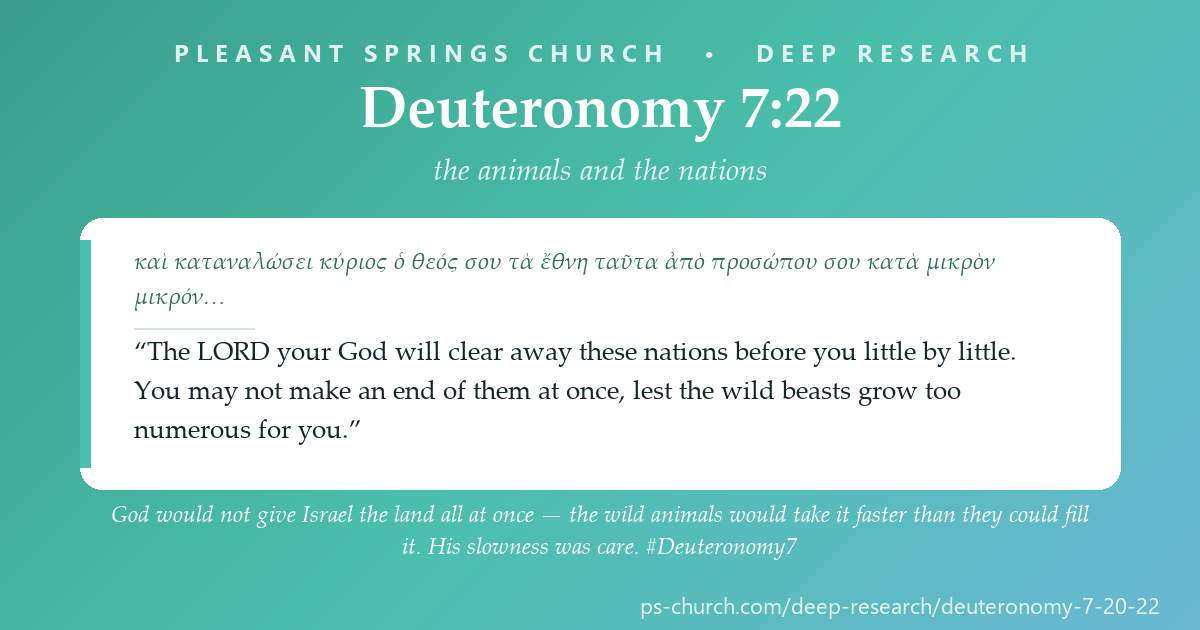
Deuteronomy 7:22 · to share
LXX + ESVEvery Deep Research page traces its passage across the whole sweep — the Old Testament, the Second-Temple world between the testaments (historical witnesses, not Scripture), and the New Testament. Follow the thread:
Pleasant Springs Church — Deep Research
Research method after Michael S. Heiser’s Bible Research Method (examine dictionaries → ancient literature → important words → textual connections → academic publications → share), with the Pleasant Springs “Author & Audience” foundation. Scripture set in the Hebrew, the Greek editions named on each page and the ESV (Old Testament), and the Greek New Testament and the ESV (New Testament), per the practice of Pleasant Springs Church. Deuteronomy 7:20–22 studied with Craigie, Tigay and Block, Stuart on Exodus 23, Douglas and Milgrom on the animal laws, Bauckham on Mark 1:13, and Beale & Carson on the New Testament use. Hebrew from the library’s Masoretic text; Greek Old Testament Rahlfs (CATSS; Joshua from the B text, 2 Kings as 4 Kingdoms); Greek New Testament SBLGNT; every line pulled from those files at build time. Counts measured on 9 October 2026, exhaustive over 23,204 Masoretic verse units, the 63 CATSS files screened (of 64 held) (Odes excluded) and the SBLGNT. Versification: no offset in Deuteronomy 7, Exodus 23, Joshua 23–24, Leviticus 20 and 26, or Isaiah 11; English Hosea 2:18 = MT/LXX 2:20; 2 Kings = 4 Kingdoms. Wisdom of Solomon is quoted in our own rendering of the Greek and read as a witness, not Scripture. The conquest is reported plainly and held as a bounded judgment in redemptive history, no warrant for violence by anyone today (Luke 9:54–55; 2 Cor 10:4). Leader and Disciple handouts: ESV English only.
Scripture quotations marked ESV are from the ESV® Bible (The Holy Bible, English Standard Version®), © 2001 by Crossway, a publishing ministry of Good News Publishers. ESV Text Edition: 2016. Used by permission. All rights reserved. The ESV text may not be quoted in any publication made available to the public by a Creative Commons license, and the ESV may not be translated in whole or in part into any other language. www.esv.org
|
Did this study bless you today? 💚 Give to Support PS Church100% of gifts go to the General Fund — thank you. |