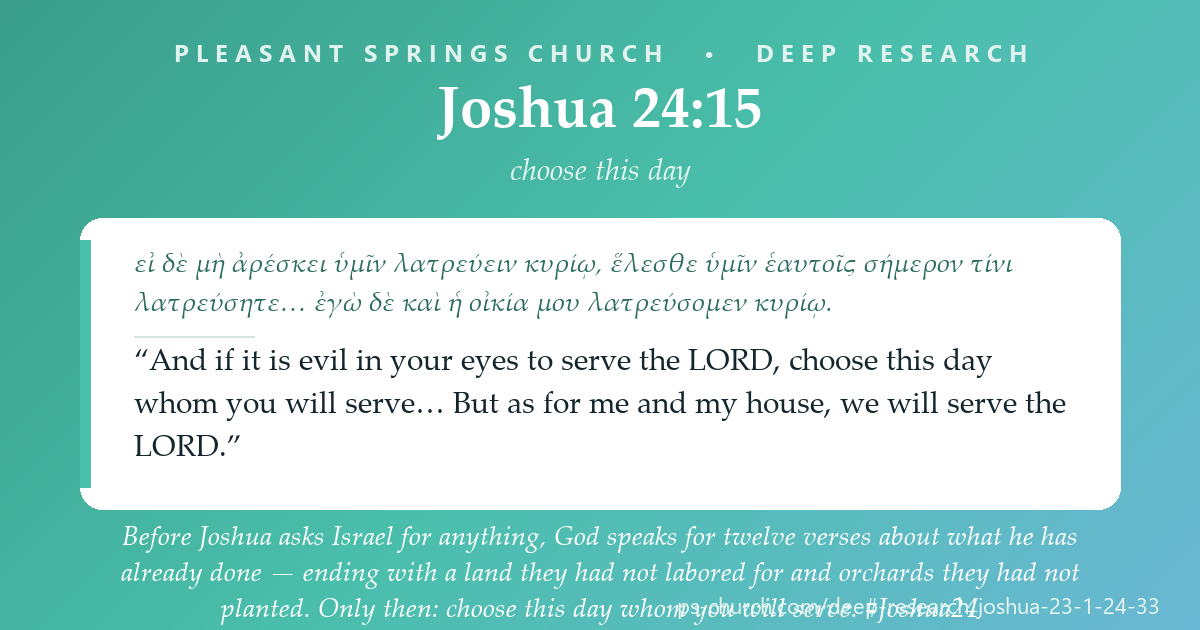
Choose this day. Joshua is old now — the same phrase that opened the long division of the land is used again to close the book — and he says two farewells. To the leaders he says: cling to the Lord, and know that “not one word has failed of all the good things that the Lord your God promised concerning you” (23:14) — and then, in the same breath, that the same God will bring the evil word too if they break covenant (23:15–16). Then he gathers all the tribes to Shechem, and what follows is a covenant ceremony in the recognizable ancient form: a preamble, a historical prologue, a stipulation, witnesses. And the prologue is in God’s own voice. It starts with Terah — Abraham’s own father, of whom it says “they served other gods” — and runs through Abraham and Isaac and Jacob, Egypt, the sea, the wilderness, Balaam and Jericho, and ends: “I gave you a land on which you had not labored, and cities that you had not built… You eat the fruit of vineyards and olive orchards that you did not plant” (24:13). The whole prologue is God speaking, in the first person, about what he has already done. Only then the demand — “choose this day whom you will serve… But as for me and my house, we will serve the Lord” (24:15) — and only then Joshua’s hard, honest answer to their yes: “You are not able to serve the Lord, for he is a holy God” (24:19). A great stone goes up under the terebinth, because it has heard. And the book that began “Moses my servant is dead” ends with three graves. This study works Joshua 23:1–24:33. See the method →
Joshua 23:1–24:33 (selections)
Hebrew · LXX · ESVThe Shape of the Passage
Covenant formThese are the last two chapters of Joshua. Behind them stand the crossing (chs 3–4), Jericho (ch 6), Ai and the covenant at Ebal (chs 7–8), the Gibeonites (ch 9), the two campaigns (ch 10; chs 11–12), the long division of the land (chs 13–19), and the cities of refuge and the altar of witness (chs 20–22). Ahead lies Judges — and the book knows it.
Author
Joshua belongs to the Deuteronomistic History (Joshua–Kings), the long narrative that tells Israel’s story from the Jordan to the exile with Deuteronomy’s theology as its measuring line. Nobody signs it. The book itself reports that Joshua wrote “these words in the Book of the Law of God” (24:26), and it plainly draws on older material; how much of the finished book is his and how much is later shaping is a question the text does not answer and this page will not pretend to settle.
Two farewells, not one. Chapter 23 is a speech to the leaders; chapter 24 is a covenant ceremony before all the tribes at another place entirely. Older criticism treated the doublet as a seam. It reads better as craft: the two speeches do different work. Chapter 23 is a warning built out of Deuteronomy’s own vocabulary — cling, love, do not turn aside, do not intermarry — and it ends on the threat. Chapter 24 is a ceremony, and it ends on a stone and three graves. Read together they say: here is what is at stake, and here is the moment you agreed to it.
The narrator’s last move is honesty. A book of conquest could have ended at 21:45 — “Not one word of all the good promises… had failed.” Instead it ends with a leader telling the people they cannot do what they have just promised (24:19), a stone set up in case they lie, and a graveyard. That is not a downbeat ending. It is an honest one, and it is the only kind that could survive being read in the exile.
Audience
Israel in the land — and every later Israel that read this book knowing how it turned out. The first hearers are people who have just received farms they did not clear and towns they did not build (24:13). The temptation in front of them is not atheism; it is the perfectly reasonable, neighbourly drift of adding the local gods to the God who brought them out. Joshua names the two directions the drift can go, and they are both backwards: the gods of the fathers beyond the River, or the gods of the Amorites in whose land you now live (24:15). Ancestry or assimilation. The past you came from or the culture you moved into.
They had heard this from Jacob first. “Put away the foreign gods that are among you” (24:23) is almost word for word what Jacob said to his household — and Jacob buried them “under the terebinth tree that was near Shechem” (Gen 35:2–4). Joshua is standing in the same place, using the same words, next to the same kind of tree. The audience is meant to feel the ground under their feet.
And the later reader knows what happened next. Judges 2 repeats Joshua 24:29–31 almost verbatim and then adds the sentence that breaks it: “And there arose another generation after them who did not know the Lord.” The Greek text of Joshua makes the join explicit, closing the book with Israel worshipping the Astaroth and falling under Eglon of Moab (LXX 24:33b). Either way, the reader who reaches the last verse of Joshua already knows that the stone under the terebinth was going to be needed.
Orient on Shechem, covenant and oath, the historical prologue, and the burials.
Search by topic: Shechem, covenant (berit), covenant renewal, treaty form, oath, witness, Terah and Ur/Haran, teraphim and household gods, holiness, jealousy of God, Timnath-serah, Joseph's bones, Eleazar and Phinehas, Deuteronomistic History.
Which articles are relevant?
- Anchor Bible Dictionary — “Shechem,” “Covenant,” “Covenant Renewal,” “Treaty,” “Oath,” “Witness,” “Joshua, Book of,” “Terah,” “Eleazar,” “Phinehas,” “Timnath-serah.”
- Dictionary of the OT: Historical Books — “Joshua, Book of,” “Covenant,” “Deuteronomistic History,” “Land,” “Idolatry,” “Sacred Space, Sacred Stones.”
- NIDOTTE / TDOT — עָבַד (ʿāḇaḏ, serve), בָּחַר (bāḥar, choose), בְּרִית (bərîṯ, covenant), עֵד (ʿēḏ, witness), דָּבַק (dāḇaq, cling), נַחֲלָה (naḥălāh, inheritance).
Bibliography surfaced:
- Richard S. Hess (TOTC), David M. Howard Jr. (NAC), Trent C. Butler (WBC), Robert G. Boling (Anchor), Marten H. Woudstra (NICOT), L. Daniel Hawk (Berit Olam) on Joshua.
- Emanuel Tov and Leonard J. Greenspoon on the Greek Joshua and its relation to the Masoretic Text.
- George E. Mendenhall, Klaus Baltzer, Meredith G. Kline on the ancient Near Eastern covenant/treaty form and its bearing on Joshua 24.
- G. Ernest Wright, Shechem: The Biography of a Biblical City, and the reports of the Tell Balatah excavations.
A treaty without a god-list, a standing stone at Shechem, and how the Second-Temple world remembered Joshua.
Read chapter 24 first against the shape of an ancient Near Eastern treaty document, then against the archaeology of Shechem, then against what Ben Sira, Josephus and the Greek translators did with this material.
Which parallels shed light on religion and worldview?
The shape of the document. Second-millennium Hittite suzerainty treaties run to a recognizable pattern: a preamble naming the great king, a historical prologue rehearsing what he has already done for the vassal, stipulations, provision for the text to be deposited and read, a list of divine witnesses, and curses and blessings. The treaty between Mursilis and Duppi-Tessub is the standard example (ANET 203–205), and the later Assyrian vassal-treaties of Esarhaddon (ANET 534–541, in the Supplement) drop the historical prologue and go straight to loyalty. Joshua 24 has the preamble (24:1–2a), a long historical prologue (24:2b–13), the stipulation (24:14, repeated at 24:23), witnesses (24:22, 27) and the deposit of the text (24:26). The correspondence is real and it is worth seeing; it is also partial, and it should not be oversold. Joshua 24 has no formal curse-and-blessing section, and the observation that the form resembles a second-millennium treaty has been pressed into the dating debate by scholars on both sides — a debate this page is not going to settle.
What is missing is the interesting part. The witness list of the Hittite treaty is a roll-call of deities — storm-gods, sun-gods, war-gods, city by city — and then, at the end, the natural world is called in too — the mountains and the rivers, “heaven and earth, the winds (and) the clouds” (ANET 205–206). Joshua cannot use that list. The whole point of his ceremony is that there is one God and the rest are to be put away. So he does something else: he makes the people the witnesses against themselves (24:22), and then sets up a stone — because a stone will still be standing there when everybody who swore is dead. It is the second witness-object in the last three chapters of this book, after the great altar the eastern tribes built by the Jordan — not for offering but, they said, “a witness between us and you” (22:26–34). Joshua keeps putting things in the ground so that nobody can later say they were not told.
Shechem. The site (Tell Balatah, at the pass between Mount Ebal and Mount Gerizim) is one of the most historically loaded places in the Bible: Abram’s first stop in Canaan and the first place he is told “to your offspring I will give this land” (Gen 12:6–7); the field Jacob bought (Gen 33:18–20) and where he buried the household gods (Gen 35:4); the mountains of blessing and curse (Deut 27; Josh 8:30–35); and later the place where the kingdom split (1 Kings 12:1). Excavations begun by Ernst Sellin (from 1913) and continued under G. Ernest Wright (Drew–McCormick, 1956–1964) uncovered a massive walled temple and, beside it, a large limestone massebah — a standing stone — which Wright re-erected. It is tempting to connect that stone with 24:26, or the temple with the “house of Baal-berith” and “the oak of the pillar at Shechem” in Judges 9:4, 6, 46. The connection is possible and it is not demonstrable, and the dating and interpretation of the Shechem sanctuary are debated. Name the possibility; do not build on it. Nothing in this chapter depends on identifying a particular stone.
- Treaty between Mursilis and Duppi-Tessub (ANET 203–205) and the Vassal-Treaties of Esarhaddon (ANET 534–541, in the Supplement) (ANE documents — witnesses, not Scripture) — the treaty pattern whose historical prologue and witness-list Joshua 24 both echoes and pointedly alters.
- The “Invocation of the Gods” in the same Hittite treaty (ANET 205) — storm-gods and war-gods by the dozen, then “the mountains, the rivers, the springs, the great Sea, heaven and earth, the winds (and) the clouds.” (The parallel god-list of the Suppiluliumas–Kurtiwaza treaty, ANET 206, calls in “the Tigris (and) the Euphrates” the same way.) Set that beside Joshua’s witnesses: a congregation and a rock.
- Shechem / Tell Balatah (archaeology — a witness, not Scripture) — Sellin’s and Wright’s excavations; the fortress-temple and the standing stone. Suggestive for 24:26 and Judges 9; not proof, and the interpretation of the site is contested.
- Sirach 46:1–8 (Second-Temple — a witness, not Scripture) — Ben Sira’s Joshua is entirely the warrior: “mighty in war,” the sun held back, hailstones at Beth-horon. The covenant at Shechem is not mentioned. The praise of a hero remembered chapter 10 and forgot chapter 24 — which is a useful warning about what we remember of any life.
- Josephus, Antiquities 5.1.28–29 (Whiston’s divisions) (Second-Temple — a witness, not Scripture) — Josephus has Joshua living at Shechem and, twenty years later, summoning the leaders and the senate to remind them of God’s benefits and exhort them to piety; he dies at 110 and is buried at Timnah, and Eleazar dies about the same time and is buried at Gabatha. But the covenant ceremony is gone: no “choose this day,” no “you are not able,” no stone. He has turned a covenant into a valedictory address.
- LXX Joshua 24:33a–33b (the Greek text itself — a witness to how this book was read) — the Greek does not stop at Eleazar’s grave. It carries on: Phinehas succeeds his father as priest, Israel scatters to its cities, Israel worships Astarte and the Astaroth, and the Lord (κύριος) hands them over to Eglon of Moab for eighteen years. Nearly every clause is Judges (cf. Judg 2:11–13; 3:12–14; 20:27–28).
If you want one place where the difference between the Hebrew and Greek Joshua becomes visible to an ordinary reader, it is the last verse. The Masoretic Text ends with Eleazar in the ground: “which had been given him in the hill country of Ephraim.” Full stop. The book closes on a grave, and the next scroll begins.
Rahlfs’ Greek keeps going for two more verses. 24:33a tells us Phinehas took over the priesthood and was buried in his own Gibeah, and that the sons of Israel carried the ark about among them. 24:33b tells us they went home to their own cities, worshipped τὴν Ἀστάρτην καὶ Ασταρωθ and the gods of the nations around them, and were handed over to Εγλωμ, king of Moab, for eighteen years. That is not a stray sentence; it is a bridge, welded on, carrying the reader straight into the events of Judges 3.
What do we do with it? Three things, in order. First, report it accurately — it is really there in Rahlfs, numbered exactly this way, and it is really absent from the Hebrew. Second, do not inflate it: nothing in it is new information; every element is already in Judges, which is why most scholars read it as a scribal or translational join rather than as lost original material. Third, notice what it tells you about ancient readers. Somebody in the Greek tradition could not bear to leave Joshua ending well. He had read the next book. He knew that the generation who swore at Shechem would be followed by a generation who “did not know the Lord,” and he pulled that knowledge back one page so that the oath and its failure would sit on the same sheet of papyrus. The Hebrew makes you turn the page to find out. The Greek does not let you leave the room.
Serve, choose, cling — and the word “witness,” which is what a stone is for.
Watch ʿabad run eighteen times from “your fathers served other gods” to “Israel served the LORD all the days of Joshua”; then bahar (choose), ʿed (witness), and dabaq (cling), the verb Deuteronomy uses for the whole of religion.
“Serve / work” (LXX λατρεύω) — the key word of the chapter, eighteen times in thirty-three verses. It covers worship, labour and slavery all at once, which is exactly the point: the fathers served other gods (24:2), the people confess they were brought out of a house of slaves (24:17, ʿăḇāḏîm, same root), Joshua dies the servant of the Lord (24:29). Nobody in the chapter is offered the option of serving nothing.
“Choose” — the verb usually has God as its subject in the Old Testament (God chose Israel, chose a place, chose David). Here Joshua hands it to the congregation: you choose. And then at 24:22 he throws it back — “you have chosen the Lord” — and makes them witnesses of their own choosing, which is a very different thing from letting them feel good about it.
“Sincerity and faithfulness” — literally wholeness and truth/steadiness; תָּמִים is the word for an unblemished sacrifice. Not intensity of feeling but integrity without a reserved corner. The Greek declines the metaphor and gives the sense: ἐν εὐθύτητι καὶ ἐν δικαιοσύνῃ, “in straightness and in righteousness.”
“Holy” — and the Hebrew is strange: a plural adjective with אֱלֹהִים and a singular pronoun, “a holy God… he.” Grammarians call it a plural of majesty or intensity; the effect is a kind of pile-up of holiness. This is the reason Joshua gives for saying they cannot do it — not that the standard is high, but that the God is holy, which is a different problem.
“Witness” — the legal word for the third party who can testify to what was said. Joshua needs one and has no gods to call, so he uses the congregation (“you are witnesses against yourselves”) and then a stone. Compare the altar named עֵד, “Witness,” in 22:34, and the heap Jacob and Laban piled up at Gen 31:48.
“Cling / hold fast” (LXX προσκολλάομαι) — the verb of the man who clings to his wife (Gen 2:24) and of skin sticking to bone. Deuteronomy uses it for the whole duty of Israel (Deut 10:20; 11:22; 13:4). It is a physical word, not a sentimental one: grip, and do not let go.
“Inheritance” — the word that has governed the whole second half of the book. It closes it too, three times over: the people go home each to his inheritance, Joshua is buried in his own inheritance, and Joseph’s burial plot “became an inheritance of the descendants of Joseph.” The book ends by putting people in the ground they were promised.
How the New Testament takes up this vocabulary:
- Matthew 6:24; Luke 16:13 — “No one can serve two masters… You cannot serve God and money.” Joshua 24:15 in one sentence: the question was never whether you serve.
- Romans 6:16–18 — “you are slaves of the one whom you obey, either of sin… or of obedience.” Paul argues the same anthropology Joshua assumes, in the same root-idea of service.
- 1 Thessalonians 1:9 — “you turned to God from idols to serve the living and true God”: a Gentile congregation doing exactly what Shechem asked. (Paul’s verb is δουλεύειν, where LXX Joshua 24 uses λατρεύειν; both belong to the Greek vocabulary that renders Hebrew ʿāḇaḏ.)
- Hebrews 11:22 — “By faith Joseph, at the end of his life, made mention of the exodus of the Israelites and gave directions concerning his bones.” The New Testament reads Joshua 24:32 as the payoff of a promise, and calls the waiting faith.
- Hebrews 4:8–9 — “For if Joshua had given them rest, God would not have spoken of another day later on. So then, there remains a Sabbath rest for the people of God.” The rest of Joshua 23:1 was real and it was not final (see Hebrews 4:14–16).
A promise made on a deathbed in Egypt, and kept four hundred years later.
Trace three threads: the covenant language back through Deuteronomy; the burial of Joseph's bones from Genesis 50 to Joshua 24; and the honest tension between “not one word has failed” and “there remains yet very much land to possess.”
Which cross-references matter?
- Deuteronomy 27; Joshua 8:30–35 — the stones and the altar on Ebal, at Shechem, with the blessing and the curse read aloud (see Deuteronomy 27 and Joshua 8). Chapter 24 is Israel standing in the same valley a lifetime later and saying yes again.
- Deuteronomy 29–30 — “you are standing today, all of you, before the Lord… that you may enter into the sworn covenant”; and then “I have set before you life and death… therefore choose life” (see Deuteronomy 29:1–30:20). Joshua 24:15 is that sermon turned into a ceremony.
- Deuteronomy 31; 32; 33–34 — Moses’ own farewell, the Song given as a witness against Israel, and the death and burial of the leader (see Deuteronomy 31, the Song, and Deuteronomy 33–34). Joshua 23–24 is deliberately built on that pattern — right down to God’s own blunt prediction to Moses that “this people will rise and whore after the foreign gods” (Deut 31:16), which is the sentence standing behind Joshua 24:19.
- Genesis 12:6–7; 33:18–20; 35:1–4 — Shechem before Joshua: the oak of Moreh and the first promise of the land (Genesis 12); the field Jacob bought for a hundred pieces of money (Genesis 33); and Jacob burying the foreign gods under the terebinth (Genesis 35). Joshua 24:23–26 repeats the command and the tree.
- Genesis 50:25; Exodus 13:19; Joshua 24:32 — the longest-running errand in the Bible: Joseph makes his brothers swear (Genesis 50), Moses carries the bones out on the night of the exodus (Exodus 13), and here they are finally buried, in one of the two pieces of Canaan that had been legally bought — Jacob’s field at Shechem, alongside Abraham’s cave at Machpelah (Gen 23:16–20).
- Numbers 22–24; 25 — Balaam, whom God “would not listen to” (24:9–10; see Numbers 22 and the oracles), and Phinehas, who ends this book as high priest (see Numbers 25).
- Judges 2:6–13 — the same three verses about Joshua’s death and burial, repeated almost word for word — with one letter-swap: Judges buries him at Timnath-heres (תִּמְנַת־חֶרֶס), Joshua at Timnath-serah (תִּמְנַת־סֶרַח) — and then the hinge: “there arose another generation after them who did not know the Lord.”
- Acts 7:15–16; John 4:5–6 — Stephen remembers a burial at Shechem in his last speech, and it does not line up neatly: he attributes the purchase to Abraham where Genesis 33:19 attributes it to Jacob, and he places the fathers’ burial at Shechem where Genesis 50:13 buries Jacob at Machpelah. Proposals abound (a telescoped summary of two purchases; a known variant); none is certain, and we report the difference rather than resolve it. And centuries later Jesus sits down tired at a well “near the field that Jacob had given to his son Joseph,” and tells a Samaritan woman that the hour is coming when worship will not be tied to that mountain at all.
This has to be faced here, because chapter 23 puts both halves of it in the same speech, ten verses apart, and a page that quoted only one half would be misrepresenting the text.
On one side: “not one word has failed of all the good things that the Lord your God promised concerning you. All have come to pass for you; not one of them has failed” (23:14) — which repeats 21:45 and stands alongside 11:23, “So Joshua took the whole land.” On the other side, in the same speech: “these nations that remain” (23:4), “the Lord your God will push them back before you” (23:5), “these nations remaining among you” whom Israel must not marry (23:7, 12). And behind it, 13:1: “You are old and advanced in years, and there remains yet very much land to possess” — which is the same phrase about Joshua’s age that opens chapter 23. And ahead of it, Judges 1, which lists the failures town by town.
Readers have made sense of this in several ways, and they are not all mutually exclusive. (1) The summaries are summaries — statements about the decisiveness of the campaign in the register ancient conquest accounts habitually use, not an inventory. (2) The gift is complete while the possession is progressive: the book keeps saying both “I have given” and “you shall drive out,” and 23:5 is exactly that — a promise still running. (3) The summaries speak of God’s side of the covenant, which is kept, while the lists speak of Israel’s follow-through, which is not. Chapter 23 arguably supports the third most directly, because that is precisely the distinction Joshua is drawing: God has done everything he said; the danger now is entirely on your side.
What remains in tension is the flat word all. “The Lord gave to Israel all the land” (21:43) and “there remains yet very much land” (13:1) are not smoothed out by the book, and we will not smooth them out either. It is more honest, and more interesting, to say that Joshua holds both and expects the reader to feel it.
The commentators, the Greek Joshua, the covenant form — and the hardest question in the chapter.
Hess, Howard, Butler, Boling, Woudstra and Hawk on Joshua; Tov and Greenspoon on the Greek; Mendenhall, Baltzer and Kline on the covenant form; and the standing pastoral question of how 24:15 and 24:19 are preached together.
Commentaries & studies:
- Richard S. Hess, Joshua (Tyndale OT Commentaries); David M. Howard Jr., Joshua (New American Commentary); Trent C. Butler, Joshua (Word Biblical Commentary); Robert G. Boling, Joshua (Anchor Bible); Marten H. Woudstra, The Book of Joshua (NICOT); L. Daniel Hawk, Joshua (Berit Olam).
- Emanuel Tov, Textual Criticism of the Hebrew Bible, and his essays on the Septuagint of Joshua; Leonard J. Greenspoon on LXX Joshua (and the translator’s introduction to Iesous in the NETS edition, which states the 4–5% figure and describes 24:33a–b as a link to Judges).
- George E. Mendenhall, Law and Covenant in Israel and the Ancient Near East; Klaus Baltzer, The Covenant Formulary; Meredith G. Kline, Treaty of the Great King — the treaty-form discussion, which is genuinely illuminating about shape and heavily contested as to date.
- G. Ernest Wright, Shechem: The Biography of a Biblical City — the excavation of Tell Balatah and the standing stone, with the cautions later scholarship has attached to identifying it.
Interpretation notes worth keeping:
- 24:15 and 24:19 must be preached together, and the order matters. This is the flashpoint of the chapter. “Choose this day whom you will serve” has been made into an altar call ten thousand times, and taken by itself it turns the covenant into a transaction Israel initiates. But it does not stand by itself. It comes after twelve verses of God speaking in the first person about what he has already done — I took… I gave… I sent… I brought… I destroyed… I gave you a land on which you had not labored — and it is followed, four verses later, by Joshua telling the people who have just said yes that they cannot do it: “You are not able to serve the Lord, for he is a holy God” (24:19). Grace is first, the summons is real and urgent, and the summons is beyond the strength of the people summoned. Any preaching that keeps one of those three and drops the others is preaching something other than Joshua 24.
- And it cuts the other way too. If a works-righteousness altar call is one error, emptying “choose this day” of its force is the other. Joshua is not conducting a thought experiment. He puts two real options in front of a real congregation, waits for an answer, makes them say it out loud, makes them witnesses against themselves, and sets up a stone in case they later deny it. The house reads God’s sovereignty in a Molinist frame — God knows what free creatures would do and orders history accordingly — and that is a framework for holding both, not a licence to flatten either. The text gives us a genuine summons inside a covenant of grace, and stops there; so do we.
- So what does 24:19 actually mean? Not that they should not try, since Joshua immediately goes on to conduct the ceremony anyway (24:25). Read in context it is a refusal to let a promise be cheap: you do not know what you are agreeing to. Serving this God is not adding a name to a list; he is holy and jealous and will not simply overlook covenant breach. The answer Joshua does not give is the one Deuteronomy already had: “the Lord your God will circumcise your heart… so that you will love the Lord your God with all your heart” (Deut 30:6; see Deuteronomy 29–30). What the people cannot do on their own terms, God undertakes to do to them. Joshua stops at the impossibility; the canon does not.
- Where warfare is summarized here, the book’s standing discipline applies. Chapters 23–24 do not narrate battles, but they summarize them: “the Lord has driven out before you great and strong nations” (23:9), “I gave them into your hand… and I destroyed them before you” (24:8), the hornet and the kings of the Amorites (24:11–12). Report it plainly and locate it precisely: a bounded, divinely commanded judgment at a unique moment in redemptive history, on nations whose iniquity was said to be at last complete (Gen 15:16), with Israel placed under the identical standard and eventually suffering it (23:15–16 says so in this very passage). Some of the difficulty has no answer we are given, and where Scripture gives no reason we say so and stop. And say the rest unmistakably: this licenses no violence, coercion, or ethnic hostility by anyone today. The church does not wrestle against flesh and blood (Eph 6:12); its weapons are not of the flesh (2 Cor 10:4); its Lord rebuked the disciples who wanted fire from heaven (Luke 9:54–55) and told Peter to put the sword away (Matt 26:52). These texts have been misused — to bless conquest, dispossession and colonization — and no reader of this page may use them that way.
- On the Shechem/Shiloh divergence, hold two things at once. That Rahlfs reads “Shiloh” at 24:1 and 24:25 is a fact about the Greek text, not a theory; that it arose because Shiloh was the tabernacle site (18:1) and Shechem was later Samaritan territory is a proposal, and a reasonable one, but it is a proposal. The honest statement is: the two traditions locate the ceremony at two different sanctuaries, the Hebrew’s Shechem is deeply embedded in the surrounding narrative (the terebinth, Joseph’s grave, Jacob’s field), and we print the Hebrew’s location while showing the Greek’s.
- Two farewell speeches is not a defect. Chapter 23 and chapter 24 have different settings, different audiences and different vocabulary, and critics have long read them as parallel accounts. Whether or not that is their prehistory, the finished book uses them to say two things that need saying separately: here is the danger, and here is the day you swore. Composite artistry is still artistry.
- The ending is deliberately quiet. No coronation, no monument, no summary of achievements. Three graves and a stone. A book that began “Moses my servant is dead” ends with Moses’ successor also dead — and the difference is that this one is buried in his own inheritance, in the land, and the bones somebody carried out of Egypt are in the ground beside him.
From “I gave you a land on which you had not labored” to “as for me and my house.”
Name what you learned, why it matters, and one concrete response.
What should we carry away — and do?
- Grace goes first, and it is not close. Before one thing is asked of Israel, God speaks for twelve verses about what he has already done, ending with a land they did not clear, towns they did not build and orchards they did not plant. Every serious call to obedience in Scripture stands downstream of a paragraph like that. If yours does not, check the order.
- The question was never whether you serve. Joshua does not offer the option of serving nothing. He offers the gods behind you and the gods around you — your family’s past or your culture’s present — and then names his own choice. Eighteen times the chapter says serve. Something has your Tuesday afternoons.
- “As for me and my house” is a household decision made out loud. It is quoted on a thousand plaques, and it is worth noticing that Joshua said it in public, in front of people who might not follow him, before they had answered. He did not wait for consensus.
- You are not able — and you are still summoned. Joshua refuses to let anyone sign this cheaply. Holding “choose this day” and “you are not able” together is not a contradiction; it is what drives a person to the God who promised to circumcise the heart (Deut 30:6) and did it in Christ.
- Somebody carried those bones for four hundred years. Joseph asked for it on a deathbed in Egypt; Moses picked them up on the night everything was happening; and a generation who never met either man put them in the ground in a field with a deed on it. Faithfulness is often an errand you will not see finished, done for someone who asked before you were born.
Step in response: say it out loud this week, to the people in your house, the way Joshua did — not as a slogan but as a decision with something attached to it: one thing that goes, and one thing that starts. Then set up a stone: write the date somewhere you will find it again, because you will need a witness that you said it. And ask yourself whose bones you are carrying — what unfinished, unglamorous, promised thing you are keeping on your shoulder for people who will bury it long after you are gone.
Joshua 24:15 · to share
LXX + ESVEvery Deep Research page traces its passage across the whole sweep — the Old Testament, the Second-Temple world between the testaments (historical witnesses, not Scripture), and the New Testament. Follow the thread:
Pleasant Springs Church — Deep Research
Research method after Michael S. Heiser’s Bible Research Method (examine dictionaries → ancient literature → important words → textual connections → academic publications → share), with the Pleasant Springs “Author & Audience” foundation. Scripture set in the Hebrew, the Greek editions named on each page and the ESV (Old Testament), and the Greek New Testament and the ESV (New Testament), per the practice of Pleasant Springs Church. Joshua 23–24 research grounded in Hess, Howard, Butler, Boling, Woudstra and Hawk, with Tov and Greenspoon on the Greek Joshua, and Mendenhall, Baltzer and Kline on the ancient Near Eastern covenant form (reported as an observation about the shape of chapter 24, partial and disputed, and not as a verdict in the dating debate). ANE background from the treaty between Mursilis and Duppi-Tessub, including its historical prologue and its “Invocation of the Gods” (ANET 203–206), and Esarhaddon’s vassal-treaties (ANET 534–541, in the Supplement); the archaeology of Shechem / Tell Balatah (Sellin; G. Ernest Wright) reported as suggestive and contested, never as proof; Second-Temple witnesses in Sirach 46:1–8 and Josephus, Antiquities 5.1.28–29 (Whiston’s divisions), read as witnesses, not Scripture. Texts: Hebrew from the Masoretic Text, Greek from Rahlfs. The Greek Joshua: the Old Greek of this book is about 4–5% shorter than the MT, with material also in a different order — stated once on every page of this book. Numbering: Joshua carries no chapter offset; MT, LXX and English agree throughout 23:1–24:33 except at the close, where LXX 24:29 = MT/ESV 24:31 and LXX 24:30–31 = MT/ESV 24:29–30, and where Rahlfs prints 24:31a, 24:33a and 24:33b with no Hebrew counterpart. Divergences at 23:14, 23:16 (the Greek lacks the MT’s closing clause), 24:1 and 24:25 (LXX Σηλω, Shiloh, for Shechem), 24:13 (the Greek’s third-person “he gave” for the Hebrew’s “I gave”), 24:14, 24:15 (the Greek plus “for he is holy”), 24:19, 24:26–27, 24:32 and 24:33 are reported on the page and were checked verse by verse rather than inferred from the book. The tension between “not one word has failed” (23:14; cf. 21:45) and “there remains yet very much land to possess” (13:1; cf. 23:4–13) is laid out and left standing rather than harmonised. Warfare summarized in these chapters is handled under the house’s conquest discipline: bounded, judicial, unrepeatable, and never a warrant for violence, coercion or ethnic hostility by anyone today.
Scripture quotations marked ESV are from the ESV® Bible (The Holy Bible, English Standard Version®), © 2001 by Crossway, a publishing ministry of Good News Publishers. ESV Text Edition: 2016. Used by permission. All rights reserved. The ESV text may not be quoted in any publication made available to the public by a Creative Commons license, and the ESV may not be translated in whole or in part into any other language. www.esv.org
|
Did this study bless you today? 💚 Give to Support PS Church100% of gifts go to the General Fund — thank you. |