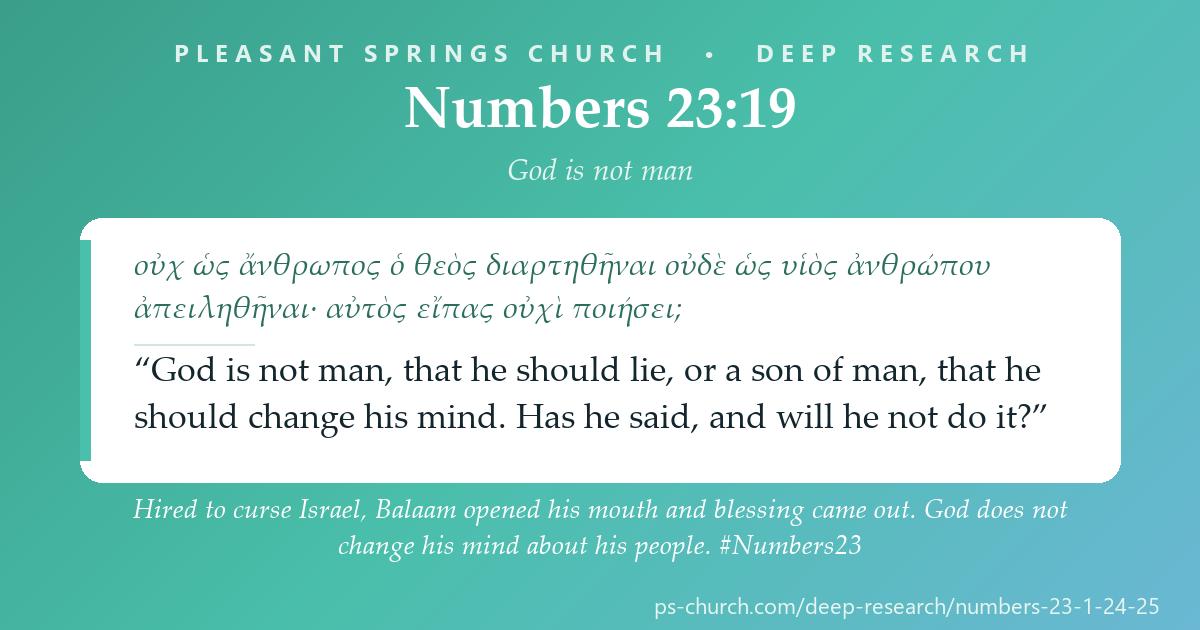
Seven altars, seven bulls, seven rams — and a blessing comes out. So they move to a different mountain and do it again. And again. Three times King Balak of Moab pays for a curse on Israel, and three times the hired diviner Balaam opens his mouth and blesses instead: “How can I curse whom God has not cursed?” (23:8); “God is not man, that he should lie… Has he said, and will he not do it?” (23:19); “Behold, I received a command to bless: he has blessed, and I cannot revoke it” (23:20). By the third oracle he has given up on omens altogether, the Spirit of God comes upon him, and the man on the payroll says, “How lovely are your tents, O Jacob” (24:5) — closing with Abraham’s own promise (24:9; cf. Gen 27:29 and, behind it, Gen 12:3). Then, fired and unpaid, he gives a fourth oracle anyway. This study works Numbers 23:1–24:25: the blessing that cannot be reversed, the immutability of God’s word, and the comedy of a king who could not out-argue a promise. See the method →
Numbers 23:8–24:25 (selections)
Hebrew · LXX · ESVThe Shape of the Passage
Parallel panelsIsrael is camped on the plains of Moab at the end of the wilderness road — past Arad, the bronze serpent, Sihon and Og (Numbers 21). Frightened, Balak king of Moab hires the diviner Balaam; the donkey sees what the seer cannot (Numbers 22). These two chapters are the payoff: three purchased attempts at a curse, and four oracles that all come out as blessing — the fourth given after Balak has stopped paying. What follows immediately after is Baal of Peor — the one wound Israel takes in this whole section, and it is self-inflicted.
Author
The Torah of Moses tells this story from an unusual camera angle. For two chapters Israel does not speak, does not act, and does not even know what is happening. The whole drama plays out on the ridgelines above the camp between a foreign king and a foreign seer — and Israel, asleep in its tents, is simply blessed. It is one of the few places in Numbers where the people cannot ruin anything, because nothing depends on them.
Four oracles, one shape. The pattern is deliberate and it tightens each time. Balak builds seven altars and offers a bull and a ram on each; Balaam withdraws; the word comes; the word blesses; Balak explodes; they move to a new place with a better view and start over (23:1–6, 13–17, 27–30; 24:1–2, 10–11). The repetition is the argument. And the comedy is real: a king paying for altar after altar to get a different answer out of a God who has already spoken, and a professional whose professional skill is the one thing that keeps failing him. By the third round Balaam does not even bother with the omens (24:1). The narrator lets the absurdity do the work without ever mocking God’s word in the process.
Audience
Israel on the plains of Moab — the second generation, about to cross. They are being told something they could not have learned from their own experience: that while they were doing nothing, a king was paying good money to have them destroyed by a word, and it did not work. Not because Balaam was incompetent, and not because Israel was impressive, but because “God is not man, that he should lie” (23:19).
How they heard it. Later Scripture keeps returning to this as a memory Israel is supposed to hold onto. “O my people, remember what Balak king of Moab devised, and what Balaam the son of Beor answered him… that you may know the righteous acts of the Lord” (Mic 6:5). Joshua repeats it in God’s own voice: “I would not listen to Balaam. Indeed, he blessed you” (Josh 24:9–10). Deuteronomy and Nehemiah both put it in a single clause — God “turned the curse into a blessing” (Deut 23:4–5; Neh 13:2). The point was never Balaam. The point was the God who could not be hired.
Orient on Balaam, blessing and cursing, divination, oracle forms, and the immutability of God.
Search by topic: Balaam, Balak, Moab, blessing and cursing, divination and omens, oracle (mashal), Spirit of God, immutability of God, Amalek, Kenites, Kittim.
Which articles are relevant?
- Anchor Bible Dictionary — “Balaam,” “Balak,” “Moab,” “Blessing and Cursing,” “Divination,” “Deir ʿAlla Texts,” “Amalek,” “Kenites,” “Kittim.”
- Dictionary of the OT: Pentateuch — “Balaam,” “Blessings and Curses,” “Divination and Magic,” “Poetry,” “God, Names of,” “Prophets and Prophecy.”
- NIDOTTE / TDOT — בָּרַךְ (bāraḵ, bless), אָרַר / קָבַב / זָעַם (the curse verbs), מָשָׁל (māšāl, oracle/discourse), נַחַשׁ (naḥaš, omen) and קֶסֶם (qesem, divination), נָחַם (nāḥam, relent).
Bibliography surfaced:
- Timothy R. Ashley (NICOT), Gordon J. Wenham (TOTC), R. Dennis Cole (NAC), Baruch A. Levine (Anchor Yale, Numbers 21–36), Jacob Milgrom (JPS), Dennis T. Olson (Interpretation) on Numbers.
- Studies of the Balaam pericope as poetry: the four meshalim, their archaic Hebrew, and their relation to Genesis 49 and Deuteronomy 33.
- The Deir ʿAlla plaster inscription — Baruch A. Levine’s edition in The Context of Scripture 2.27 (COS 2:140–145).
- Beale & Carson, Commentary on the NT Use of the OT (2 Peter and Jude; Revelation).
Hired curses, seven altars, and a seer named in the plaster of a Transjordanian shrine.
Read the hiring of Balaam against how the ancient world actually used curses and diviners, weigh the extraordinary extra-biblical attestation of the man himself, then let Israel’s later Scripture and the New Testament set the terms.
Which parallels shed light on religion and worldview?
A curse was a commodity. In the ancient Near East the spoken word of a qualified professional was thought to carry real force, and kings bought it. Diviners read entrails, watched birds and consulted omens on behalf of the crown; the prophetic letters from the Mari archives (ANET 482; Supplement 623 — the texts themselves are conveniently collected in M. Nissinen, Prophets and Prophecy in the Ancient Near East, SBLWAW 12) show intermediaries bringing divine messages to a king’s court as a normal instrument of statecraft. Balak is doing nothing unusual: he is procuring a service, on the reasonable assumption that the right specialist with the right ritual at the right vantage point can move the outcome. Numbers 23–24 is, among other things, a two-chapter demolition of that assumption. The altars are correct, the animals are correct, the fee is generous, the location is changed three times to improve the sightline — and the mechanism simply does not engage, because the God in question does not take instructions.
Balaam son of Beor, in the plaster. In 1967 excavators at Tell Deir ʿAlla, in the Jordan Valley east of the river, recovered a wall inscription written in ink on plaster, dated to roughly the late ninth or early eighth century BC. Its opening line introduces “Balaam son of Beor, a seer of the gods.” The text is not the Bible’s text and its religion is not Israel’s: it reports a night vision, a council of gods, and a coming disaster, and it belongs to Transjordanian religion, not to Yahwism. But the man is unmistakably the same figure — same name, same patronym, same profession, same region — attested outside the Bible, in his own neighborhood, centuries after Numbers places him there. That is a rare thing, and it is worth naming plainly: Balaam was a real, remembered, regionally famous seer. (The inscription is edited by Baruch Levine in COS 2.27; it was discovered and published too late to appear in Pritchard’s ANET, so no ANET page is cited here.)
The oracles as poetry. The four meshalim are dense, parallelistic verse, and a long line of scholarship (Albright onward) reads their Hebrew as archaic, placing them with the Pentateuch’s other great blessing-poems — Jacob’s in Genesis 49, Moses’ in Deuteronomy 33. The dating is debated; the poetic character is not. That matters for reading them: they are compressed, image-driven, and they escalate. The first is a refusal (“How can I curse…?”); the second is a theology (“God is not man…”); the third is a vision of the camp itself, seen from above and found beautiful; the fourth looks past the camp entirely, to a king who has not been born.
- Deir ʿAlla plaster inscription (Transjordan, c. late 9th–early 8th c. BC; COS 2.27 = COS 2:140–145, ed. B. A. Levine) — “Balaam son of Beor, a seer of the gods”: extra-biblical attestation of the figure. A historical witness, not Scripture, and its theology is not Israel’s.
- Mari letters (the Mari archives; ANET 482, Supplement 623; texts in M. Nissinen, Prophets and Prophecy in the Ancient Near East, SBLWAW 12) — diviners and prophetic intermediaries delivering messages to a king: the ordinary world of royal divination that Balak is operating in.
- Josephus, Antiquities 4.102–130 (Second-Temple — a witness, not Scripture) — retells the embassies, the donkey, the oracles, and Balak’s refusal to pay; at 4.126–130 Josephus has Balaam supply the counsel that leads to Peor.
- Philo, On the Life of Moses 1 (Second-Temple — a witness, not Scripture) — an extended Balaam section: the famous diviner who can utter nothing except what God gives him, and who later advises the stratagem against Israel.
- Mishnah, Sanhedrin 10:2; Avot 5:19 (rabbinic-era — witnesses, not Scripture) — Balaam listed among the four commoners with no share in the world to come; and “the disciples of Balaam the wicked” (an evil eye, a haughty spirit, a limitless appetite) set opposite “the disciples of Abraham our father.”
- b. Sanhedrin 105a–106b (rabbinic-era — a witness, not Scripture) — the long Balaam discussion: a tradition that he could time a curse to a moment of divine anger, and that the mercy of Mic 6:5 is that no such moment came; and R. Yoḥanan’s reading that from the blessings you can tell what he had meant to curse — he meant to say Israel would have no houses of prayer, and out came “How lovely are your tents, O Jacob.”
It is a funny passage, and the humor is not decoration. Balak’s anger climbs on a ladder: after the first oracle, “What have you done to me?” (23:11); after the second, a bargaining retreat — “Do not curse them at all, and do not bless them at all” (23:25), which is a man asking a prophet to please just be quiet; after the third he strikes his hands together and shouts, “I called you to curse my enemies, and behold, you have blessed them these three times” (24:10), and fires him with the marvelous line, “the Lord has held you back from honor” (24:11). Twenty-one bulls and twenty-one rams, three mountaintops, one increasingly desperate king, and the machinery keeps producing blessings. But notice what the comedy is about. Every element of the scene is a lever, and none of the levers are connected to anything. You cannot relocate to a better angle on God. You cannot outspend him. You cannot find the technician who knows the workaround. The laughter in Numbers 23–24 is the laughter of watching enormous effort applied to an immovable object — and the immovable object is God’s word of blessing over his people. That is a comforting thing to laugh at.
The vocabulary of oracle and curse, of lying and relenting, and of a blessing that cannot be turned back.
Watch mashal (the four set-piece oracles); the four curse verbs that never find an object; kazav and nacham in 23:19; the hiphil of shuv, “revoke”; and the omens Balaam abandons just before the Spirit arrives.
“Discourse, oracle, proverb” — each time the text says Balaam “lifted up his mashal” (LXX παραβολή, the same word behind the Gospels’ “parable”). It marks these as formal poetry, not conversation. The formula stands seven times in all: four long set pieces (23:7, 18; 24:3, 15), each introduced identically and each escalating on the last, then three short ones (24:20, 21, 23).
“To curse, execrate” — one of four different curse verbs stacked through these chapters (אָרַר ʾārar, קָבַב, זָעַם zāʿam ‘denounce,’ נָקַב). Hebrew has a whole vocabulary for this, and Balak works through it; the Greek flattens them all into ἀράομαι / καταράομαι. The point of 23:8 is that the verb has no object available: God has not cursed, so there is nothing for Balaam to say.
“To lie, prove false” — “God is not man, that he should lie.” The Greek goes a different way: διαρτηθῆναι, “to be misled, played false, held in suspense.” Both are true and they meet in the middle — God does not deceive, and God cannot be worked on. Titus 1:2 uses the flat Greek adjective for it: God “never lies” (ἀψευδής).
“To relent, change one’s mind” (hithpael yiṯneḥām) — “or a son of man, that he should change his mind.” The LXX reads it as ἀπειληθῆναι, “to be threatened” — God is not a man to be leaned on. The same verb is what Scripture elsewhere says God does (Exod 32:14; Jonah 3:10), and 1 Sam 15 says both in one chapter (15:11, 29). Handle both honestly: what does not change is God’s character, his word and his promise.
“To turn back” — in the hiphil, “to revoke”: “he has blessed, and I cannot revoke it” (ʾăšîḇennāh; LXX οὐ μὴ ἀποστρέψω). Paul says the same thing about God’s gifts and calling with one Greek adjective: ἀμεταμέλητα, “irrevocable” (Rom 11:29).
“Omen, divination” (paired with קֶסֶם, qesem) — “there is no enchantment against Jacob, no divination against Israel” (23:23). Then the narrator quietly reports that Balaam “did not go, as at other times, to look for omens” (24:1). The professional gives up his method one verse before the Spirit comes on him (24:2).
“The Spirit of God” — the same phrase used of Bezalel the craftsman (Exod 31:3); and it is the Spirit resting on the seventy elders that makes them prophesy (Num 11:25). Here it rests on a hired foreign diviner. Note the LXX’s two prepositions: at 23:7 (a Greek plus) the spirit is ἐπ’ αὐτῷ, “upon him”; at 24:2 it is ἐν αὐτῷ, “in him.”
How the rest of Scripture takes up these chapters:
- Deuteronomy 23:4–5; Joshua 24:9–10; Nehemiah 13:2; Micah 6:5 — four separate books remember the same event the same way: a curse was purchased, and God “turned the curse into a blessing.”
- Romans 11:29 — “For the gifts and the calling of God are irrevocable”: Numbers 23:20 in one Greek word.
- Titus 1:2; Hebrews 6:17–18; 2 Timothy 2:13 — “God, who never lies”; “it is impossible for God to lie”; “he cannot deny himself.” The New Testament states 23:19 as settled doctrine and then rests weight on it.
- 2 Peter 2:15–16; Jude 11; Revelation 2:14 — the New Testament’s own verdict on the man: “the way of Balaam… who loved gain from wrongdoing,” “Balaam’s error,” and “the teaching of Balaam, who taught Balak to put a stumbling block before the sons of Israel.”
From Abraham’s promise, through a hired mouth, to a God who cannot lie.
Trace three threads: the Abrahamic blessing quoted back from outside Israel; the immutability of God’s word; and the star oracle, which has its own study.
Which cross-references matter?
- Genesis 12:1–3; 27:29 — “I will bless those who bless you, and him who dishonors you I will curse” (see Genesis 12), and Isaac’s blessing on Jacob in the same shape (see Genesis 27). Balaam ends his third oracle by reciting Isaac’s form of that promise word for word (24:9 = Gen 27:29b, with the two lines reversed) — the Abrahamic blessing of Gen 12:3 as it was handed to Jacob, read back to Israel by a man Israel never hired.
- 1 Samuel 15:29 — “the Glory of Israel will not lie or have regret, for he is not a man, that he should have regret”: Numbers 23:19 quoted into the story of a king who did change.
- Malachi 3:6; James 1:17 — “I the Lord do not change”; “no variation or shadow due to change.” The doctrine that begins in a Moabite ravine is still standing at the end of the canon.
- Numbers 24:15–19 — the fourth oracle, the star out of Jacob and the scepter out of Israel, has its own study: A Star Shall Come Out of Jacob. It is introduced here and not duplicated.
- Numbers 24:20–24; Numbers 31:16; Revelation 2:14 — the closing oracles against Amalek, the Kenites, Asshur and Eber; and the darker sequel — the counsel that produced Peor is laid at Balaam’s door.
- Romans 8:31–39 — “If God is for us, who can be against us?” The New Testament’s longest answer to Balak’s question (see Romans 8:31–39).
This is one of the great sentences in Scripture about God’s truthfulness, and it is worth slowing down on. Its setting is not a seminar; it is a rebuke. Balak has just moved the operation to a new mountain hoping for a different result, and Balaam has to explain why that is not how any of this works. Men say things and then, for all sorts of reasons, do not do them: they lie, they are talked out of it, they lose their nerve, they are outbid. God is not a man. His speaking and his doing are the same act at two moments. “Has he said, and will he not do it? Or has he spoken, and will he not fulfill it?”
Two guardrails keep the verse from being flattened. First, this is not the claim that God is inert. Scripture also says the Lord “relented” (Exod 32:14), and says the same of God at Nineveh (Jonah 3:10) — using the very verb 23:19 denies him — and 1 Samuel 15 puts both in one chapter without embarrassment (15:11, 29). What does not change is God’s character, his word, and his promise; the relenting language describes his real, living response to changed human situations, not a mind that can be lobbied or a promise that can be broken. Second, 23:19 is not a blank check for whatever we happen to want. The thing that could not be revoked here was a blessing God had spoken. That is exactly why the New Testament can build on it: “it is impossible for God to lie” (Heb 6:18), “the gifts and the calling of God are irrevocable” (Rom 11:29), “all the promises of God find their Yes in him” (2 Cor 1:20). The security of a Christian is not the strength of the Christian’s grip. It is that the One who said it does not lie.
The scholarship on the Balaam oracles, the Deir ʿAlla text, and the theology of blessing.
Ashley, Wenham, Cole, Levine, Milgrom and Olson on Numbers; Levine and the Deir ʿAlla editions; Beale & Carson for the New Testament’s Balaam.
Commentaries & studies:
- Timothy R. Ashley, The Book of Numbers (NICOT); Gordon J. Wenham, Numbers (TOTC); R. Dennis Cole, Numbers (NAC); Baruch A. Levine, Numbers 21–36 (Anchor Yale); Jacob Milgrom, Numbers (JPS); Dennis T. Olson, Numbers (Interpretation).
- Baruch A. Levine, “The Deir ʿAlla Plaster Inscriptions,” in The Context of Scripture 2.27 (COS 2:140–145); the editio princeps of Hoftijzer & van der Kooij and the discussion it launched.
- Studies of the four meshalim as archaic Hebrew poetry alongside Genesis 49 and Deuteronomy 33; and of the Balaam figure’s later reception in Second-Temple, rabbinic and early Christian sources.
- G. K. Beale & D. A. Carson, eds., Commentary on the New Testament Use of the Old Testament (2 Peter, Jude; Revelation).
Interpretation notes worth keeping:
- The oracles are about God, not about Balaam. Numbers is not interested in rehabilitating him; it is showing that even a purchased mouth cannot bend a divine blessing. Let the New Testament’s own assessment (2 Pet 2:15–16; Jude 11; Rev 2:14) close the case on the man, rather than editorializing further.
- Note who is speaking in 24:9. The Abrahamic formula — “Blessed are those who bless you, and cursed are those who curse you” — is recited over Israel by a non-Israelite on a Moabite hilltop, on a king’s payroll. The promise to Abraham is confirmed from outside the family. That is deliberate and it is remarkable.
- The Spirit’s freedom is real and it is not an endorsement. “The Spirit of God came upon him” (24:2) says something about God’s sovereign liberty, not about Balaam’s standing. Gifting is not the same as godliness — a distinction the New Testament makes bluntly (Matt 7:22–23; 1 Cor 13:2).
- 23:19 is a statement about God’s truthfulness, not a philosophy of immobility. Read it with Exod 32:14, Jonah 3:10 and 1 Sam 15:11, 29 in view, and say what the text says: God does not lie, and God does not have to be managed.
- The closing oracles (24:20–24) are short and genuinely obscure. Amalek, the Kenites, Asshur, Eber, ships from Kittim — the referents are debated and the Hebrew is difficult. Where the text does not explain itself, say so and stop; the LXX itself struggled here, supplying “Og” at 24:23 and reading MT’s “Eber” as “the Hebrews” at 24:24.
From seven altars on a windy ridge to a blessing no one could buy back.
Name what you learned, why it matters, and one concrete response.
What should we carry away — and do?
- God’s word is not a negotiation. Twenty-one bulls, three mountaintops, one furious king, and nothing moved. “Has he said, and will he not do it?” (23:19). What God has spoken is not waiting on anyone’s approval, including yours.
- You were blessed while you were asleep. Israel never speaks or acts in these two chapters — it is only seen, from a ridge, by a man it never met. They never knew the negotiation was happening. The most important thing going on in your life this week may be something you had no part in and will never see.
- Nobody can revoke it. “He has blessed, and I cannot revoke it” (23:20) becomes, in Paul’s hands, “the gifts and the calling of God are irrevocable” (Rom 11:29). Your standing in Christ does not rest on your grip; it rests on the fact that God does not lie.
- Gifting is not godliness. The Spirit came on Balaam, and the New Testament still calls him a warning. Do not measure yourself, or a leader, by what comes out of the mouth alone. Measure by the life.
- Let the comedy do its work. The picture of a king moving mountains to get a different answer out of God is meant to make you laugh — and then to make you stop trying it yourself.
Step in response: name the “curse” you are most afraid of this week — a diagnosis, a reputation, a person who wishes you ill, an old failure you assume has the last word — and put over it not what you wish God had said but what he has said (Rom 8:38–39): the promise is his, not your wish, and God is not man, that he should lie. Then do the plain next thing in front of you, and let the ridgeline arguments go on without you.
Numbers 23:19 · to share
LXX + ESVEvery Deep Research page traces its passage across the whole sweep — the Old Testament, the Second-Temple world between the testaments (historical witnesses, not Scripture), and the New Testament. Follow the thread:
Pleasant Springs Church — Deep Research
Research method after Michael S. Heiser’s Bible Research Method (examine dictionaries → ancient literature → important words → textual connections → academic publications → share), with the Pleasant Springs “Author & Audience” foundation. Scripture set in the Hebrew, the Greek editions named on each page and the ESV (Old Testament), and the Greek New Testament and the ESV (New Testament), per the practice of Pleasant Springs Church. Numbers 23–24 research grounded in Ashley, Wenham, Cole, Levine, Milgrom and Olson, with Beale & Carson on the New Testament use (2 Peter, Jude, Revelation). Greek from Rahlfs; genuine LXX divergences are listed openly under the passage — including the Greek plus at 23:7 and “Agag” read as “Gog” at 24:7. Extra-biblical material — the Deir ʿAlla plaster inscription (COS 2.27), the Mari letters, Josephus, Philo, the Mishnah and b. Sanhedrin — is held as historical witness, never leveled with Scripture. The fourth oracle (24:15–19) is treated in its own study.
Scripture quotations marked ESV are from the ESV® Bible (The Holy Bible, English Standard Version®), © 2001 by Crossway, a publishing ministry of Good News Publishers. ESV Text Edition: 2016. Used by permission. All rights reserved. The ESV text may not be quoted in any publication made available to the public by a Creative Commons license, and the ESV may not be translated in whole or in part into any other language. www.esv.org
|
Did this study bless you today? 💚 Give to Support PS Church100% of gifts go to the General Fund — thank you. |