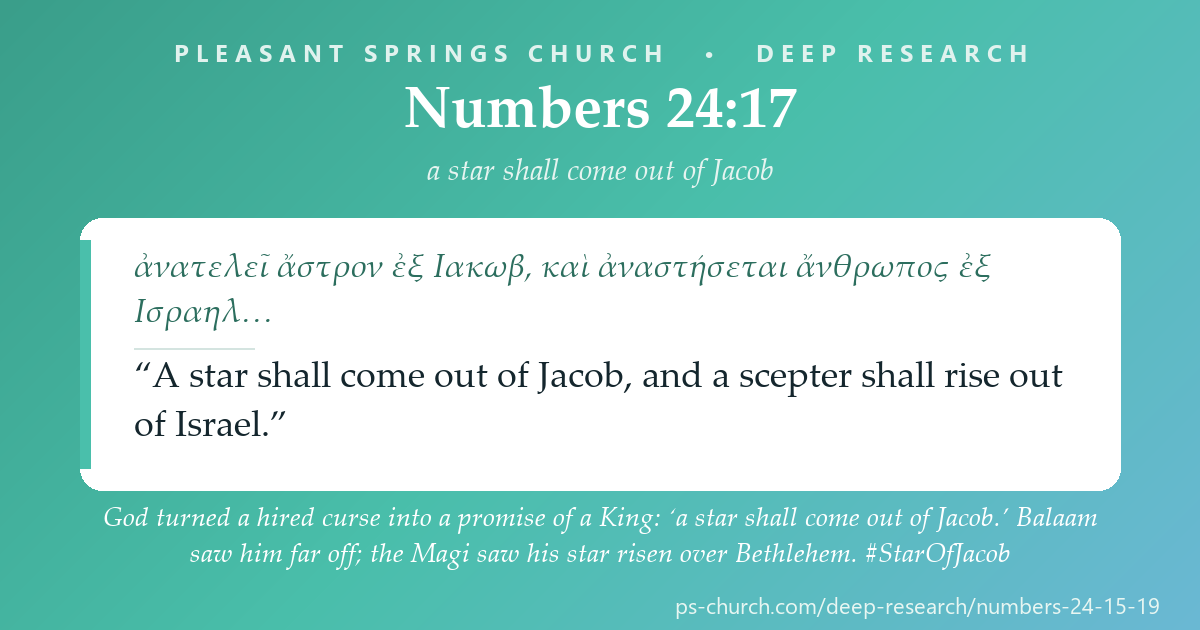
A star shall come out of Jacob, and a scepter shall rise out of Israel.” Hired to curse Israel, the pagan diviner Balaam can only bless — and his fourth oracle sees, far in the future, a rising King: a star, a scepter. Fulfilled in part by David, it became the great messianic text of the Dead Sea Scrolls, and its light rose over Bethlehem when Magi followed “his star” (Matt 2:2). A century later it was tragically pinned to a false messiah, “Bar Kokhba,” son of the star. This study works Numbers 24:15–19 — the near and far horizons of the star — from Balaam’s mouth to the manger. See the method →
Numbers 24:15, 17, 19 (same numbering in MT, LXX & English)
Hebrew · LXX · ESVThe Shape of the Passage
SequenceAs Israel camps on the plains of Moab, King Balak hires the diviner Balaam to curse them. Four times Balaam opens his mouth to curse and blessing comes out instead. This fourth oracle looks past Israel’s present to a coming king — a star and a scepter. See Israel’s wilderness journey in Numbers 21.
Author
The oracle comes through an unlikely mouth. Balaam son of Beor is a foreign seer, hired to curse Israel — and later remembered as a byword for the prophet who loved a wage (Num 31:16; 2 Pet 2:15–16; Jude 11; Rev 2:14). Yet God overrules him: “the man whose eye is opened” can only bless. In his fourth oracle he sees “him, but not now… not near” — a figure far in the future: “a star shall come out of Jacob, and a scepter shall rise out of Israel.”
Star and scepter. A rising star and a scepter are royal images — the birth of a king who will rule and conquer Israel’s enemies (Moab, Edom). The point is not astrology; the “star” is the king himself, ascending like a new light. That God speaks this through a hired pagan diviner is its own lesson: the Lord can put true prophecy even in a corrupt mouth, and no curse can stand against those he has blessed.
Audience
Israel on the threshold of the promised land — assured that the God who turned Balaam’s curses to blessings has a royal future for them. In its first horizon the oracle was fulfilled in David, who defeated Moab and made Edom his servants (2 Sam 8:2, 13–14) — the very nations named here.
How it was read. The star of Jacob became the messianic proof-text of Second-Temple Judaism: the Dead Sea Scrolls quote it (the Testimonia, the Damascus Document, the War Scroll) of a coming deliverer. When Magi came seeking the newborn “king of the Jews” because they had seen “his star” (Matt 2:2), they stood in that long expectation. And a century later the same verse was tragically misapplied — a failed revolt leader was hailed as “Bar Kokhba,” “son of the star” — a warning that a true messianic text can be pinned to a false messiah.
Orient on Balaam, the star and scepter, kingship, and the Messiah.
Search by topic: Balaam, star of Jacob, scepter, Messiah, Magi.
Which articles are relevant?
- Anchor Bible Dictionary — “Balaam,” “Star,” “Messiah,” “Magi.”
- Dictionary of the OT: Pentateuch — “Numbers, Book of,” “Balaam,” “Blessing and Cursing,” “Messiah / Royal Figure.”
- NIDOTTE / TDOT — כּוֹכָב (kôḵāḇ, star), שֵׁבֶט (šēḇeṭ, scepter/tribe), דָּרַךְ (dāraḵ, come forth/tread), מָחַץ (māḥaṣ, crush).
Bibliography surfaced:
- Gordon J. Wenham (TOTC), Timothy R. Ashley (NICOT), Baruch A. Levine (Anchor Yale, Numbers 21–36), Jacob Milgrom (JPS), R. Dennis Cole (NAC) on Numbers.
- John J. Collins, The Scepter and the Star: Messianism in Light of the Dead Sea Scrolls.
- Beale & Carson, NT Use of the OT (Matthew’s infancy narrative and the star).
The star, the scepter (or the man), and the reception of a great prophecy.
Hold the near and far horizons, weigh the “scepter/man” divergence, then follow the star to Bethlehem — and note where it was misused.
Which parallels shed light on religion and worldview?
A king like a rising star. In the ancient Near East a new king’s accession was hailed as the rising of a star, and a scepter was the emblem of rule. Balaam’s oracle uses both: a royal figure “rises” out of Jacob to crush Moab and the hostile peoples. It joins the Pentateuch’s other royal promise — “the scepter shall not depart from Judah… until tribute comes to him” (Gen 49:10) — and points toward the Davidic kingship and, beyond it, the Messiah.
‘Scepter’ or ‘a man’? A small but telling divergence: where the Hebrew reads “a scepter (shebet) shall rise,” the Greek reads “a man (ἄνθρωπος) shall rise out of Israel” — the translators personalizing the scepter as the ruler who holds it. The reading is interpretive but not wrong: the scepter is a person. Both witnesses are shown here, and both point the same way — to a coming king.
The star that ruled a century of hope. No Old Testament verse was read more messianically in the Second-Temple period. The Qumran Testimonia (4Q175) quote it in a chain of messianic proofs; the Damascus Document interprets the star and the scepter of coming figures; the War Scroll prays it before the final battle. That is the expectation the Magi entered — and, a century after Christ, the same verse was pinned to a false messiah when Rabbi Akiva hailed the revolt leader Simon as “Bar Kokhba,” “son of the star.” The revolt failed and the man died; the true Star had already risen.
- Genesis 49:8–10; 2 Samuel 8:2, 13–14 — the scepter of Judah; David subduing Moab and Edom: the royal promise and its near fulfillment.
- 4Q175 (Testimonia); Damascus Document (CD) 7:18–21; War Scroll (1QM) 11:6–7 (Dead Sea Scrolls — Second-Temple witnesses, not Scripture) — Numbers 24:17 as the great messianic proof-text (4Q175 pairs it with the prophet like Moses of Deuteronomy 18).
- Bar Kokhba / Rabbi Akiva (c. AD 132–135) (rabbinic-era reception, not Second-Temple) — Simon named “son of the star” after this verse: a cautionary false-messianic application.
- Numbers 22–24; 31:16; 2 Peter 2:15–16; Revelation 2:14 — Balaam the compromised diviner through whom God nonetheless spoke true prophecy.
Matthew opens the story of Jesus with a star: Magi from the east arrive in Jerusalem asking, “Where is he who has been born king of the Jews? For we saw his star when it rose” (Matt 2:2). Matthew does not formally quote Numbers 24 — his fulfillment citation in that chapter is Micah 5:2, “Bethlehem” (see Micah 5) — but the star-of-Jacob is the ancient and recognized background: the wise men, whatever their exact knowledge, come seeking the king whose star the Scriptures had promised out of Jacob. The New Testament makes the identification explicit at its very end: the risen Christ says, “I am the root and the descendant of David, the bright morning star” (Rev 22:16; cf. 2:28), joining Balaam’s star to David’s scepter in one Person. Peter, too, speaks of “the morning star” rising in our hearts (2 Pet 1:19). Balaam saw him “but not now… not near” — a light far off; the Magi saw it risen over Bethlehem. And the Bar Kokhba tragedy is the shadow that proves the point: a true star-prophecy fastened to a false messiah brings ruin, but the true Star, the son of David, reigns forever. The lesson of the whole passage is that God’s purpose cannot be cursed away — not by Balaam’s hire, not by any enemy: the Star will rise.
The vocabulary of the star, the scepter, and the rising king.
Watch the rising star and the scepter — the king who comes “but not now.”
“Star” — here a royal figure rising like a new light; not astrology but a king’s accession. Taken up of Christ, “the bright morning star” (Rev 22:16).
“Scepter, rod, staff” (also “tribe”) — the emblem of rule (cf. Gen 49:10). The Greek personalizes it as “a man” (ἄνθρωπος) — the ruler who wields the scepter.
“Tread, come forth” — “a star shall come forth (rise) out of Jacob.” The Greek renders “shall dawn/rise” (ἀνατελεῖ) — the same rising root (ἀνατέλλω / ἀνατολή) behind the Magi’s “when it rose” (Matt 2:2).
“Sons of Sheth” — genuinely uncertain: a specific people, or “sons of tumult” (Jer 48:45), or (via the LXX Σηθ) Adam’s son Seth = all humanity subdued under the coming ruler.
How the New Testament reads the star:
- Matthew 2:1–2, 9–10 — “we saw his star when it rose”: the Magi seeking the king (the recognized background to Numbers 24:17; Matthew’s formal citation is Micah 5:2).
- Revelation 22:16; 2:28 — “I am… the bright morning star”; “I will give him the morning star”: Balaam’s star claimed by Christ.
- 2 Peter 1:19 — “until… the morning star rises in your hearts”: the star-hope carried into Christian life.
- Luke 1:78–79 — “the sunrise (ἀνατολή) shall visit us from on high”: the dawning-light Messiah, the same rising-image.
From the star seen from afar to the star risen over Bethlehem.
Trace the royal star and scepter from the Pentateuch through David to Christ.
Which cross-references matter?
- Genesis 49:8–10; Numbers 24:17–19; 2 Samuel 8 — the scepter of Judah; the star and scepter; David subduing Moab and Edom: the royal promise and its first fulfillment.
- Micah 5:2–5; Isaiah 9:6–7; 11:1–10 — the ruler from Bethlehem; the child-king; the shoot from Jesse (see Micah 5, Isaiah 9).
- Matthew 2:1–12 — the Magi, the star, and the newborn king: the star of Jacob risen.
- Deuteronomy 18:15–19 — the prophet like Moses, paired with the star of Jacob at Qumran (4Q175) as messianic hope (see the Prophet like Moses).
- Revelation 22:16; 2 Peter 1:19 — the bright morning star: the star fulfilled and shining.
Numbers 24:17 had an outsized afterlife. Scholars of Second-Temple Judaism note that no single verse did more to shape messianic expectation: the “star” and “scepter” became shorthand for the coming deliverer, quoted at Qumran and echoed across the literature. Some communities even split the imagery into two figures — a priestly “star” and a royal “scepter” — reflecting a two-messiah expectation; the Christian confession gathers both into one Christ, priest and king. The oracle’s double horizon is the key to reading it well. It was genuinely fulfilled in David, who subdued the very nations Balaam names; and it was fulfilled far more deeply in David’s greater Son, over whose birth a star rose and who holds a scepter that will never depart. The Bar Kokhba episode, where the verse was fastened to a doomed rebel, is a sober reminder that messianic texts can be misapplied — and a foil that highlights the true fulfillment: not a warrior who died in a failed revolt, but the risen Lord who is himself “the bright morning star.” God turned a hired curse into the promise of a King — and the King has come.
The scholarship on Numbers 24:15-19.
The commentators on Numbers; the studies of the star/scepter and its Second-Temple reception.
Commentaries & studies:
- Gordon J. Wenham (TOTC), Timothy R. Ashley (NICOT), Baruch A. Levine (Anchor Yale, Numbers 21–36), Jacob Milgrom (JPS), R. Dennis Cole (NAC) on Numbers.
- John J. Collins, The Scepter and the Star; Martin Abegg, Peter Flint & Eugene Ulrich, The Dead Sea Scrolls Bible (4Q175, CD, 1QM).
- G. K. Beale & D. A. Carson, eds., Commentary on the NT Use of the OT (Matthew).
Interpretation notes worth keeping:
- Near and far. The oracle was fulfilled in David (who subdued Moab and Edom, 2 Sam 8) and, more deeply, in the Messiah; honor both horizons.
- Scepter or man. MT shebet (“scepter”) vs LXX ἄνθρωπος (“a man”) — the Greek personalizes the scepter as the ruler; both point to a coming king.
- The Magi, precisely. Numbers 24:17 is the recognized background to Matthew 2:2; Matthew does not formally cite it (his fulfillment quote there is Micah 5:2).
- Bar Kokhba, labeled. The “son of the star” naming (c. AD 132) is a later, rabbinic-era, false-messianic application — a caution, not a Second-Temple witness.
From a curse turned to blessing to the star risen over Bethlehem.
Name what you learned, why it matters, and one concrete response.
What should we carry away — and do?
- No curse can undo God’s blessing. Balaam was hired to curse Israel and could only bless. What God has blessed, no enemy’s hire can overturn — and in Christ you are blessed.
- The Star has risen. What Balaam saw “but not now… not near” the Magi saw over Bethlehem. The long expectation is answered: the King has come.
- Follow the true Star. A true prophecy can be pinned to a false messiah (Bar Kokhba). Test every hope against the risen Christ, “the bright morning star” — the only King who conquered death.
Step in response: when someone seems to have the power to “curse” your future — an enemy, a diagnosis, a failure — remember Balaam: God turns curses into blessing for his people. Fix your eyes this week on the Star already risen, and follow him as the Magi did, with worship and with gifts laid down.
Numbers 24:17 · to share
ESVEvery Deep Research page traces its passage across the whole sweep — the Old Testament, the Second-Temple world between the testaments (historical witnesses, not Scripture), and the New Testament. Follow the thread:
Pleasant Springs Church — Deep Research
Research method after Michael S. Heiser’s Bible Research Method (examine dictionaries → ancient literature → important words → textual connections → academic publications → share), with the Pleasant Springs “Author & Audience” foundation. Scripture set in the Hebrew, the Greek editions named on each page and the ESV (Old Testament), and the Greek New Testament and the ESV (New Testament), per the practice of Pleasant Springs Church. Numbers 24:15–19 research grounded in Wenham, Ashley, Levine, Milgrom, and Cole, with Collins’ The Scepter and the Star and the Dead Sea Scrolls Bible; the star/scepter as the great Second-Temple messianic proof-text, the Bar Kokhba naming labeled as later, false-messianic reception.
Scripture quotations marked ESV are from the ESV® Bible (The Holy Bible, English Standard Version®), © 2001 by Crossway, a publishing ministry of Good News Publishers. ESV Text Edition: 2016. Used by permission. All rights reserved. The ESV text may not be quoted in any publication made available to the public by a Creative Commons license, and the ESV may not be translated in whole or in part into any other language. www.esv.org
|
Did this study bless you today? 💚 Give to Support PS Church100% of gifts go to the General Fund — thank you. |