Three chapters of oracles have just ended with a blessing no king could buy: “he has blessed, and I cannot revoke it” (23:20). Then Israel camps at Shittim, accepts an invitation to a festival, and in a single chapter the people who could not be cursed from outside are very nearly destroyed from within — “Israel yoked himself to Baal of Peor” (25:3). A plague breaks out. The whole assembly is weeping at the door of the tent of meeting when a prince of Simeon walks past them with a Midianite chief’s daughter in full view; Phinehas rises, and the plague is stopped — twenty-four thousand already dead. God calls it jealousy for his own jealousy and gives him “my covenant of peace” (25:12). This study works Numbers 25:1–18: what the text actually indicts (covenant betrayal, not foreign blood), what God commends in Phinehas, why Psalm 106 counts it to him as righteousness — and why the New Testament, which knows this chapter well, forbids anyone to make it a licence for violence. See the method →
Numbers 25:1–18 (selections)
Hebrew · LXX · ESVThe Shape of the Passage
ConcentricNumbers 25 is placed where it is on purpose. The road has run from Kadesh (chs 13–14) through Korah (chs 16–17), Meribah and Aaron’s death (ch 20), the bronze serpent and the Transjordan victories (ch 21), and then three chapters in which a hired seer opens his mouth and blessing comes out anyway (ch 22; chs 23–24). Chapter 25 is the answer to that blessing from the other direction — and it is followed immediately by a new census (ch 26) and the securing of the next generation’s inheritance (ch 27). Read it in that frame, not on its own.
Author
The Torah of Moses sets this chapter directly against the four oracles that precede it, and the juxtaposition is the argument. Balak paid for a curse and could not get one: “How can I curse whom God has not cursed?” (23:8). No sorcery in the ancient world could touch this people. And then, one chapter later, without a single spear thrown at them, they are dying by the thousands — because they walked into it themselves. Numbers 31:16 will say out loud what chapter 25 only implies: the women of Midian acted “on Balaam’s advice.” The narrator lets the two chapters sit side by side and lets the reader do the arithmetic.
What the text actually indicts. It is easy to misread this chapter, and the misreadings have done real damage. The offense is not that the women were Moabite or Midianite — Moses’ own wife was a Midianite (Exod 2:21; 18:1–2), and Miriam and Aaron were rebuked for objecting to the foreign woman he had married (Num 12:1); Rahab and Ruth are in the Messiah’s line, and the law commands love for the sojourner (Lev 19:34). The offense is named in 25:2–3: eating the sacrifices of other gods, bowing to them, and being yoked to Baal of Peor. The sexual sin is the road in; the destination is apostasy. Every later summary reads it that way — “they yoked themselves to the Baal of Peor” (Ps 106:28), “what the Lord did at Baal-peor” (Deut 4:3), “they came to Baal-peor and consecrated themselves to the thing of shame” (Hos 9:10).
Audience
Israel on the plains of Moab — the generation that will actually cross. They are reading (or hearing) an account of how the generation ahead of them nearly ended, not at the hands of an army but at a festival. That is the pastoral force of the chapter for its first audience: you have just watched God refuse to let you be cursed. Do not do to yourselves what your enemies could not do to you.
How they heard it. Two names are given, and both are named on purpose: Zimri son of Salu, “chief of a father’s house belonging to the Simeonites,” and Cozbi daughter of Zur, whose father was “the tribal head of a father’s house in Midian” (25:14–15). This is not an anonymous couple caught in a crowd; it is a public act by a leader of Israel, in the sight of Moses and the whole assembly, at the door of the tent of meeting, while the congregation is weeping under a plague. Israel’s own prince is the covenant-breaker. The chapter refuses to let Israel externalize the blame — even while 25:16–18 addresses the counsel that set the trap.
Orient on Peor and Baal-peor, Shittim, Midian and Moab, divine jealousy, plague, and the priestly covenant.
Search by topic: Baal-peor / Beth-peor, Shittim (Abel-shittim), Midian, Moab, Balaam, jealousy of God, zeal, plague (maggephah), atonement, covenant of peace, Phinehas, Zadokite priesthood.
Which articles are relevant?
- Anchor Bible Dictionary — “Baal-peor,” “Peor,” “Beth-peor,” “Shittim,” “Midian, Midianites,” “Moab,” “Phinehas,” “Zimri,” “Cozbi,” “Zeal, Zealots.”
- Dictionary of the OT: Pentateuch — “Apostasy,” “Idolatry,” “Balaam,” “Priests and Levites,” “Covenant,” “Wrath,” “Atonement.”
- NIDOTTE / TDOT — צָמַד (ṣāmaḏ, be yoked/joined), קָנָא / קִנְאָה (qānāʾ / qinʾāh, be jealous/zealous), מַגֵּפָה (maggēṗāh, plague/blow), כָּפַר (kāṗar, make atonement), שָׁלוֹם (shālôm).
Bibliography surfaced:
- Timothy Ashley (NICOT), Gordon Wenham (TOTC), R. Dennis Cole (NAC), Baruch Levine (AB), Jacob Milgrom (JPS), Dennis Olson (Interpretation) on Numbers.
- Studies of the Peor tradition in the Old Testament (Deut 4:3–4; Josh 22:17; Ps 106:28–31; Hos 9:10) and of the Phinehas figure in Second-Temple literature.
- Beale & Carson, Commentary on the NT Use of the OT (1 Corinthians; Revelation).
Moab’s gods in Moab’s own words — and what later readers did with Phinehas.
First read “Baal of Peor” against the actual religion of the Transjordan; then watch how Second-Temple and rabbinic readers handled Phinehas — some as a model to imitate, some as a case to be fenced off — and let the New Testament set the terms.
Which parallels shed light on religion and worldview?
Moab in its own voice. We are not guessing about the world Israel camped in. The Moabite Stone (the Mesha Inscription, c. 830 BC; ANET 320–321, translated there by W. F. Albright) is a Moabite king’s own account of the same plateau: a high place is made “for Chemosh,” he explains an earlier defeat by saying “Chemosh was angry at his land,” he takes towns at Chemosh’s command, and he devotes the people of a captured town to destruction “for Ashtar-Chemosh.” He names Baal-meon and Nebo — the very towns of Numbers 32. A god tied to a place, a god who is angry with his own people, a god who is fed by sacrifice: that is the religious grammar of “Baal of Peor” — not a universal deity but the Baal of a particular hill, with a shrine at Beth-peor (Deut 3:29; 34:6). Israel did not convert to a rival philosophy. They joined a party.
A meal, not a doctrine. The mechanism in 25:2 is a shared sacrificial banquet — the people were “invited to the sacrifices of their gods,” and they ate. In the ancient Levant that meal was the act of allegiance; you cannot attend as a spectator. Psalm 106:28 sharpens it further: they “ate sacrifices offered to the dead” — which points toward the Northwest-Semitic banqueting society, the marzēaḥ, well attested at Ugarit and named in Israel’s own prophets (Amos 6:7; Jer 16:5), with its links to the cult of dead ancestors. Whatever the exact rite at Peor was, Scripture describes it as sitting down at another table (compare Leviticus 17 on sacrifice offered anywhere but to the Lord, and the Deuteronomy 32 worldview on what stands behind the other tables).
- The Moabite Stone (Mesha Inscription), c. 830 BC (ANET 320–321) — Moab’s own royal theology: Chemosh angry at his land, Chemosh commanding conquest, a whole captured town devoted to destruction for Ashtar-Chemosh, the towns of the Numbers itineraries named one by one.
- Sirach 45:23–24 (Second-Temple — a witness, not Scripture) — Phinehas is “third in glory” after Moses and Aaron, and to him “a covenant of peace was established” (διαθήκη εἰρήνης) with “the dignity of the priesthood forever” — and the same verb the LXX uses in Num 25:13, ἐξιλάσατο, “he made atonement.”
- 1 Maccabees 2:26, 54 (Second-Temple — a witness, not Scripture) — Mattathias kills at Modein and the narrator says he “was zealous for the law, as Phinehas did to Zambri son of Salom”; his deathbed roll-call adds, “Phinehas our father, because he was deeply zealous, received the covenant of an everlasting priesthood.” Here Numbers 25 is explicitly read as a precedent — and that reading is exactly what the New Testament will re-open (see Stage 4). Compare 4 Maccabees 18:12, where “Phinehas the zealot” is held up to children as an example.
- Josephus, Antiquities 4.126–155 (Second-Temple — a witness, not Scripture) — the fullest ancient retelling: Balaam, unable to curse, advises Balak to send the most beautiful young women toward the camp; the seduction succeeds; Zambrias defies Moses publicly; Phinehas acts. Josephus’ transmitted text gives the dead as fourteen thousand (some copies twenty-four thousand) — a reminder that ancient numbers travel badly, and that Scripture’s own figure is the one to hold.
- Philo, On the Life of Moses 1.294–304 (Second-Temple — a witness, not Scripture) — the same tradition, with Balaam coaching the women to withhold themselves until the men will sacrifice to their gods: the strategy aims past the body at the altar.
- Pseudo-Philo, Biblical Antiquities (LAB) 18 (Second-Temple — a witness, not Scripture) — again Balaam’s counsel as the hinge between the failed curse and the fall at Peor.
- Sifre Numbers 131 (on Num 25:1) and Mishnah, Sanhedrin 9:6; b. Sanhedrin 82a–b (rabbinic-era — witnesses, not Scripture) — the Mishnah preserves a rule about “zealots” derived from this chapter, and the Talmud immediately hedges it about until almost nothing is left: if a would-be zealot comes to ask permission, he is not told to act; if the offender has already stopped, killing him is murder; and had Zimri turned and killed Phinehas first, Zimri would not have been liable. Even the tradition most sympathetic to Phinehas refused to let him become a precedent anyone could invoke.
This is the sober lesson of Numbers 22–25 taken as one unit, and it is worth saying carefully. Sorcery failed. Seduction worked. Four times Balaam opened his mouth to curse and blessing came out, because the word of God cannot be reversed by anyone at any price (23:19–20; see 24:15–19). Israel was invulnerable to everything Balak could buy. What finally broke them was an invitation to dinner.
The New Testament makes exactly this connection and does not soften it: the risen Christ tells Pergamum that some there “hold the teaching of Balaam, who taught Balak to put a stumbling block before the sons of Israel, so that they might eat food sacrificed to idols and practice sexual immorality” (Rev 2:14), and Numbers itself says the women acted “on Balaam’s advice” (Num 31:16). So the warning is not primarily about hostile outsiders. It is about how a covenant people is actually lost: not by argument, and not by persecution, but by comfortable participation in what it once knew it could not share in.
Beginning and profaning, being yoked, jealousy, plague, peace, and atonement.
Watch how the vocabulary bends the story: the yoke of 25:3 (idolatry as harness), the triple jealousy of 25:11 (God’s, not a man’s), the passive verb in 25:8 (the plague was stopped), and the priestly word in 25:13 (made atonement) that the New Testament’s theology of peace will later fill out.
“And [the people] began” — from חלל, consonants that in Hebrew carry two lives, to begin and to profane (the lexicons split them into two roots). The MT points it as “began”; the LXX read the same consonants the other way and wrote ἐβεβηλώθη, “the people were profaned.” Both readings are true to what happens: it started as a beginning and it ended as a desecration.
“To be yoked / bound” — the word for animals harnessed together to one plough. Israel is not described as merely visiting Peor; Israel is hitched to it. The LXX chose the language of cultic initiation instead: ἐτελέσθη, “was initiated” (so also Ps 105:28 LXX). Idolatry is never a passing opinion; it is a harness.
“Jealousy / zeal” (LXX ζῆλος) — the same word does both jobs, and Numbers 25:11 uses it three times in one verse. God’s qinʾāh is not petulance; it is the exclusive love of a covenant that has been broken (Exod 20:5; see Exodus 20). The Greek word here is the ancestor of ζηλωτής, “zealot” — the very title a later movement would take from this chapter, and the very thing Paul says he had “not according to knowledge” (Rom 10:2).
“Plague / blow” — from נגף, “to strike” (LXX πληγή). Numbers has met it before: Korah’s aftermath, when Aaron ran with a censer and “stood between the dead and the living, and the plague was stopped” (16:48; see chs 16–17). The verb in 25:8 is passive — the plague was restrained. Numbers does not say a man defeated it; even in 25:11, where Phinehas is the subject, what he turns back is God’s own wrath.
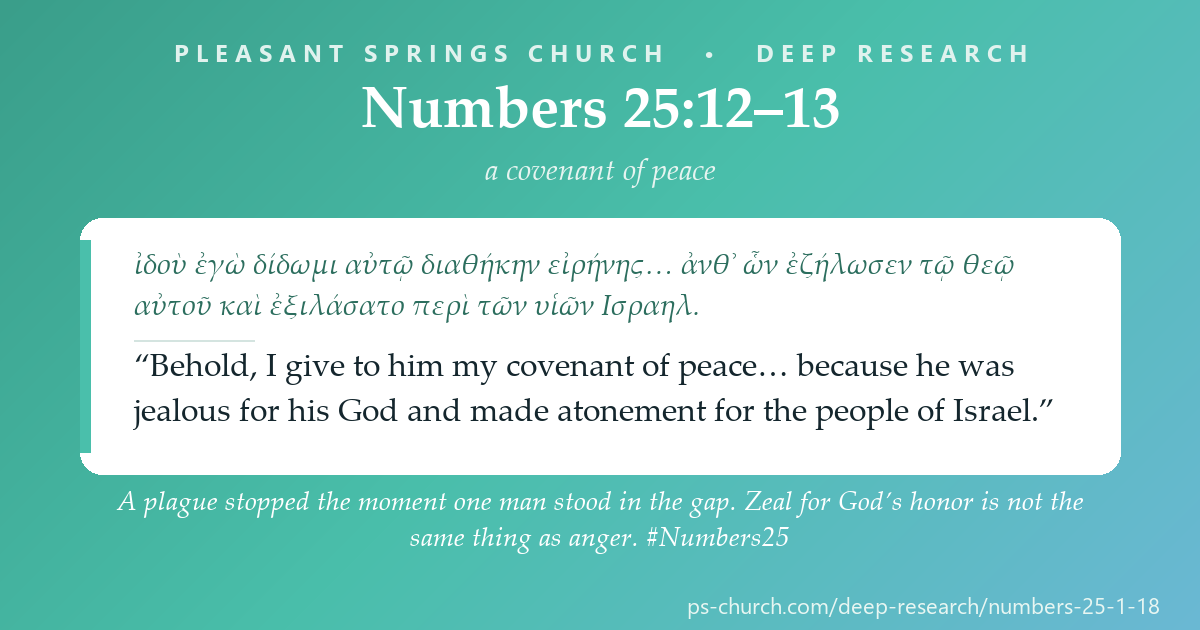
“Peace / wholeness” — in a chapter about a spear, God’s gift is called my covenant, peace (LXX διαθήκην εἰρήνης). The parallel is Mal 2:5, “My covenant with him was one of life and peace,” of Levi. What is restored is not a licence to strike but a relationship that had been about to end — the plague stayed, the people kept, the priesthood secured.
“To make atonement” (LXX ἐξιλάσατο) — and this is the surprise. The verse does not say Phinehas punished; it says he made atonement for the people of Israel, using the vocabulary of Leviticus 16. The LXX of Ps 106:30 · LXX 105:30 uses the same verb where the Hebrew says he “intervened.” The narrative is priestly before it is martial: what God commends is a priest standing between his people and death.
A scribal tradition worth knowing (and not over-reading):
In the Sephardic and Ashkenazic scroll traditions two letters in this passage are written oddly: the yod of פִּינְחָס in 25:11 is written small (yod zeʿira), and the vav of שָׁלוֹם in 25:12 is written broken (vav qeṭiʿa). These are later scribal conventions, not part of the inspired consonantal text, and no doctrine should be built on them. But they are an honest record of how carefully Jewish readers handled this chapter: even the copyists seem to have felt that this peace was granted, not earned in the ordinary way — and that the man’s name should be written with a small letter.
Peor across the canon — and the New Testament’s reframing of zeal.
Trace three threads: how the Old Testament remembers Peor; how Psalm 106 reads Phinehas; and how the New Testament handles both the seduction and the zeal.
Which cross-references matter?
- Numbers 31:16; Revelation 2:14 — both name the counsel behind the seduction: “these, on Balaam’s advice, caused the people of Israel to act treacherously against the Lord in the incident of Peor”; “the teaching of Balaam, who taught Balak to put a stumbling block before the sons of Israel.” See Numbers 22 and 23–24 for the oracles this undoes from the inside.
- Deuteronomy 4:3–4; Joshua 22:17; Hosea 9:10 — Peor became Israel’s standing shorthand for apostasy. Deuteronomy sets the two outcomes side by side: those who “followed the Baal of Peor” were destroyed, “but you who held fast to the Lord your God are all alive today.”
- Psalm 106:28–31 (LXX 105:28–31) — the canon’s own verdict: “Then Phinehas stood up and intervened, and the plague was stayed. And that was counted to him as righteousness from generation to generation forever.” The Greek of v. 31 (LXX 105:31), ἐλογίσθη αὐτῷ εἰς δικαιοσύνην, is word-for-word the Greek of Genesis 15:6 — the verse Paul builds Romans 4 on. The psalm is not making Phinehas a second way of salvation; it is saying that in that moment he, like Abraham, believed God about God when the whole camp did not.
- Numbers 16:46–50; Malachi 2:4–5; Numbers 18:19 — the priestly frame. Aaron with a censer stops a plague (chs 16–17); Malachi calls the covenant with Levi one “of life and peace”; Numbers calls the priestly grant “a covenant of salt forever” (ch 18). Phinehas’ line — the Zadokite line — will hold the high priesthood down to the exile, after an interruption under Eli and Abiathar (1 Sam 2:27–36; 1 Kgs 2:26–27, 35).
- 1 Corinthians 10:6–12 — Paul puts Peor in a list of wilderness warnings for the church: “We must not indulge in sexual immorality as some of them did, and twenty-three thousand fell in a single day” (10:8), with the conclusion, “let anyone who thinks that he stands take heed lest he fall” (10:12). On the number, see the note in Stage 5.
- Romans 10:1–3; John 16:2; Galatians 1:14; Philippians 3:6 — the New Testament’s reframing of zeal, and it could not be more pointed: Paul, who once described himself as “as to zeal, a persecutor of the church,” says of his own people that “they have a zeal for God, but not according to knowledge,” and Jesus warns that “the hour is coming when whoever kills you will think he is offering service to God.”
- 2 Corinthians 10:3–5; Ephesians 6:12 — and therefore the church’s own equipment: “the weapons of our warfare are not of the flesh”; “we do not wrestle against flesh and blood.” See Romans 5:1–11 for the peace that is now made, and how.
Report the text as it stands: Phinehas killed two people with a spear, and God commended him, stayed a plague, called it jealousy for his own jealousy, and gave him a covenant of peace and a perpetual priesthood (25:10–13). Psalm 106 counts it to him as righteousness. None of that is softened here. Numbers is describing an act of covenant judgment, inside the Old Testament theocracy, by a priest, in a moment when the whole nation stood under a plague and its leaders had gone silent — an act the narrative treats as sitting closer to Aaron’s censer than to any private vengeance.
And now the second thing, which must be said just as plainly: this is not a pattern for anyone today. Not for individuals, not for congregations, not for nations. There is no reader of this page for whom Numbers 25 licenses violence — not against a neighbour, not against an unbeliever, not against someone whose sin you can name. That is not a modern squeamishness imposed on the text; it is the New Testament’s own correction of a reading that was live in the first century. First Maccabees had already made Phinehas the charter of an armed movement, and by Jesus’ day “zealot” was a party name. Into that world Jesus says, “whoever kills you will think he is offering service to God” (John 16:2), and Paul — who had done exactly that — writes of zeal “not according to knowledge” (Rom 10:2). The church’s weapons are “not of the flesh” (2 Cor 10:4), and its real enemy is not flesh and blood at all (Eph 6:12). Even the rabbis, reading sympathetically, fenced Phinehas off so thoroughly that no one could claim his warrant (b. Sanhedrin 82a–b). What Numbers 25 asks of us is what God actually praises in it — that we care about his honour as much as he does, and that we stand between people and death rather than dealing it.
The scholarship on Peor, the Phinehas tradition, and the numbers.
Ashley, Wenham, Cole, Levine, Milgrom and Olson on Numbers; the Peor and Phinehas studies; Beale & Carson on 1 Corinthians and Revelation.
Commentaries & studies:
- Timothy R. Ashley, The Book of Numbers (NICOT); Gordon J. Wenham, Numbers (TOTC); R. Dennis Cole, Numbers (NAC); Baruch A. Levine, Numbers 21–36 (Anchor); Jacob Milgrom, Numbers (JPS); Dennis T. Olson, Numbers (Interpretation).
- Studies of the Baal-peor tradition across the canon, of the Phinehas figure from Ben Sira to the Maccabean literature, and of “zeal” as a religious category in Second-Temple Judaism and in Paul.
- G. K. Beale & D. A. Carson, eds., Commentary on the New Testament Use of the Old Testament (1 Corinthians; Revelation).
Interpretation notes worth keeping:
- The indictment is idolatry. 25:2–3 names it: the sacrifices, the bowing, the yoke. Read the chapter as a warning against foreign women and you have misread it and slandered a text that elsewhere commands love for the sojourner and puts Ruth the Moabite in the Messiah’s genealogy.
- Both parties are named, and one of them is a prince of Israel. Zimri is “chief of a father’s house” in Simeon (25:14). The chapter’s primary accusation runs inward, at Israel’s own leadership, not outward at Midian — even though 25:16–18 does address Midian’s counsel.
- The plague is stopped, not merely paused. Note the passive verb in 25:8 (the plague was stopped) and the priestly verb in 25:13 (made atonement) — and that even where 25:11 speaks actively of Phinehas, what he turns back is God’s wrath. Numbers frames the outcome as God relenting, not as a man winning.
- The twenty-three thousand of 1 Cor 10:8. Paul writes “twenty-three thousand fell in a single day”; Numbers 25:9 gives twenty-four thousand for the plague as a whole. Commentators note that Paul’s qualifier is “in a single day” and that Numbers also records executions (25:5) alongside the plague, so the two figures may count different things; older harmonizations are proposed and none is certain. It is better to say honestly that the difference is unresolved than to force it — Paul’s point does not depend on the arithmetic.
- Versification. MT 25:19 = ESV/Rahlfs 26:1. Cite the chapter break carefully when quoting Hebrew editions, and note that the LXX also arranges parts of the chapter 26 clan lists differently from the MT.
- Do not allegorize the spear. Where Scripture gives a reason, we give it; where it does not, we stop. The text says what God commended (jealousy for his jealousy, atonement made) and does not invite us to extend the method. The typological line that is drawn in Scripture runs the other way: a priest who stands between the living and the dead, and a covenant of peace — language the New Testament fills with Christ, and which we take here as a labelled devotional analogy, not as an argument.
From an invitation to dinner to a covenant of peace.
Name what you learned, why it matters, and one concrete response.
What should we carry away — and do?
- What cannot be cursed can still be seduced. Balak spent a fortune on sorcery and got four blessings. Then somebody set a table. The threats that actually take down a believing people are almost never the ones they were bracing for.
- Idolatry is a yoke, not an opinion. ṣāmaḏ is the word for two animals harnessed to one plough. Whatever we join ourselves to begins, quietly, to steer.
- God’s jealousy is love, not temper. A God who did not care what his people gave themselves to would not be kinder; he would be absent. Read 25:11 next to Exodus 20:5 and the covenant makes sense.
- Zeal needs knowledge. The one thing this chapter has been used to justify is the one thing the New Testament forbids. “They have a zeal for God, but not according to knowledge” (Rom 10:2); “the weapons of our warfare are not of the flesh” (2 Cor 10:4). If your zeal wants a weapon, it is not this chapter’s zeal.
- Stand between. What God actually commends is a priest who put himself between his people and a plague, and it is called atonement (25:13). The Christian version of that is intercession, confession, and staying — not striking.
Step in response: name one table you keep sitting at — one habit, feed, friendship, or appetite that you would not call a religion and that is quietly steering the plough. Then do the priestly thing rather than the violent one: bring it to God out loud this week, tell one trustworthy believer, and pray by name for someone whose faith is currently at Peor. Stand between them and it.
Numbers 25:3 · to share
LXX + ESVEvery Deep Research page traces its passage across the whole sweep — the Old Testament, the Second-Temple world between the testaments (historical witnesses, not Scripture), and the New Testament. Follow the thread:
Pleasant Springs Church — Deep Research
Research method after Michael S. Heiser’s Bible Research Method (examine dictionaries → ancient literature → important words → textual connections → academic publications → share), with the Pleasant Springs “Author & Audience” foundation. Scripture set in the Hebrew, the Greek editions named on each page and the ESV (Old Testament), and the Greek New Testament and the ESV (New Testament), per the practice of Pleasant Springs Church. Numbers 25 research grounded in Ashley, Wenham, Cole, Levine, Milgrom and Olson, with Beale & Carson on the New Testament use (1 Corinthians; Revelation); ANE background from the Moabite Stone (ANET 320–321); Second-Temple and rabbinic witnesses (Ben Sira, 1 and 4 Maccabees, Josephus, Philo, Pseudo-Philo, Sifre Numbers, the Mishnah’s Sanhedrin and b. Sanhedrin 82a–b), all read as witnesses, not Scripture. Greek from Rahlfs; the one versification seam (MT 25:19 = ESV/Rahlfs 26:1) is flagged in the codex note, and the LXX psalm numbering runs one behind the MT (MT Ps 106 = LXX Ps 105). Phinehas is reported as the text reports him and commended as the text commends him — and this page states without qualification that Numbers 25 is not a warrant for private, vigilante, or religious violence of any kind today: the New Testament reframes zeal itself (Rom 10:2; John 16:2) and the church’s weapons are not of the flesh (2 Cor 10:4; Eph 6:12).
Scripture quotations marked ESV are from the ESV® Bible (The Holy Bible, English Standard Version®), © 2001 by Crossway, a publishing ministry of Good News Publishers. ESV Text Edition: 2016. Used by permission. All rights reserved. The ESV text may not be quoted in any publication made available to the public by a Creative Commons license, and the ESV may not be translated in whole or in part into any other language. www.esv.org
|
Did this study bless you today? 💚 Give to Support PS Church100% of gifts go to the General Fund — thank you. |