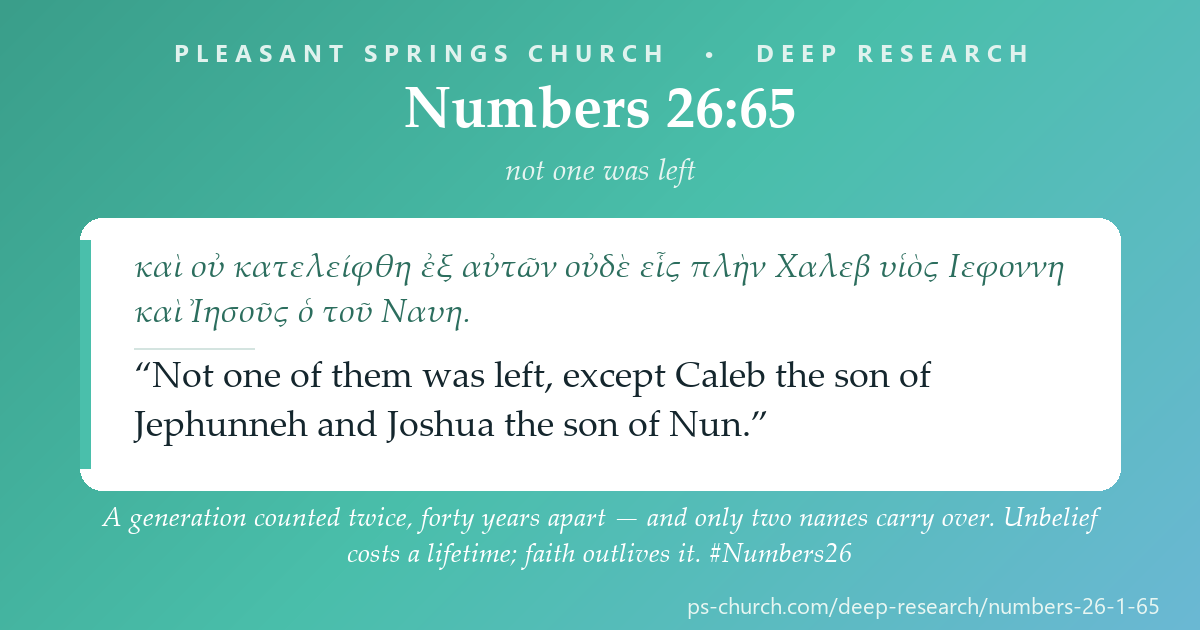
After the plague, God says: count them again. The order goes to Moses and Eleazar — Aaron is dead, and the leadership has turned over along with the people — and it is given not at Sinai but on the plains of Moab, one river from home. Tribe by tribe the new numbers come in: 601,730 (26:51), barely fewer than the 603,550 counted forty years earlier, and — but for two men — not one of the same men. The land is to be divided by lot (26:55); the Levites are counted apart because their portion is the Lord himself. Then the chapter closes with the quietest, heaviest sentence in the book: “Not one of them was left, except Caleb… and Joshua” (26:65). And in the middle of the list, one line of pure mercy: “But the sons of Korah did not die” (26:11). This study works Numbers 26:1–65 — judgment executed exactly, mercy running right alongside it, and a God who keeps counting. See the method →
Numbers 26:1–65 (selections)
Hebrew · LXX · ESVThe Shape of the Passage
InclusioNumbers is framed by two censuses. The first musters the generation that came out of Egypt (chs 1–2); at Kadesh that generation refuses to go in and is sentenced to the wilderness (chs 13–14); Korah’s revolt (chs 16–17), Meribah and Aaron’s death (ch 20), and the plague at Peor (ch 25) close it out. Chapter 26 counts the ones who are left — and then the book turns immediately to inheritance and succession (ch 27).
Author
The Torah of Moses does something here that looks like bookkeeping and is in fact the architecture of the whole book. Dennis Olson’s well-known study of Numbers (The Death of the Old and the Birth of the New) argues that the two census lists — chapter 1 and chapter 26 — are the book’s structural spine: everything between them is the story of the first generation, and everything after them belongs to the second. Chapter 26 is the seam. Read the two lists side by side and you are reading forty years at a glance.
Every detail of the frame has shifted. The first census was taken by Moses and Aaron “in the wilderness of Sinai” (1:1–3). This one is taken by Moses and Eleazar “in the plains of Moab by the Jordan at Jericho” (26:3, 63). Aaron has died on Mount Hor and his son wears the garments (20:26–28). The leadership has turned over along with the people; the wilderness took the priest as well as the congregation. And the mission has grown: chapter 1 counted men “able to go to war,” and so does this one — but this list is also the roll from which the land will be divided (26:52–56). They are counted not only to fight but to inherit.
Audience
The children of the people who said no. These are the ones their parents had called “a prey” (14:3, 31) — the ones God said he would bring in. They have buried their parents for four decades. Now they stand on the last stretch of ground before the Jordan and hear their own names read out, tribe by tribe, in a list that ends with the plain statement that nobody from the earlier list is standing there with them except Caleb and Joshua. It is a sobering way to be told that you are next.
How they heard it. Two things at once, and Numbers refuses to separate them. First: God does what he says. The sentence of 14:29–30 — “your dead bodies shall fall in this wilderness… not one shall come into the land… except Caleb… and Joshua” — is here reported as accomplished fact, almost word for word (26:64–65). Second: God keeps counting. The promise did not die with the generation that despised it. There are still six hundred thousand of them, still organized, still a people, still one river from home. Judgment ran its full course and the promise outlived it.
Orient on census and mustering, the plains of Moab, the lot, inheritance, the Korahites, and Eleazar.
Search by topic: census / numbering, plains of Moab (Abel-shittim), lot (goral), inheritance and land tenure, tribes of Israel, Korah and the Korahites, Eleazar, Zelophehad, Levites.
Which articles are relevant?
- Anchor Bible Dictionary — “Census,” “Numbers, Book of,” “Moab, Plains of,” “Lots, Casting of,” “Inheritance,” “Korah, Korahites,” “Eleazar,” “Zelophehad.”
- Dictionary of the OT: Pentateuch — “Census,” “Land,” “Levites and Priests,” “Tribes,” “Wilderness Wanderings,” “Numbers, Book of.”
- NIDOTTE / TDOT — פָּקַד (pāqaḏ, muster / list / attend to), גּוֹרָל (gōrāl, lot), נַחֲלָה (naḥălāh, inheritance), מַגֵּפָה (maggēp̱āh, plague), יָתַר / נוֹתַר (nōṯar, be left over).
Bibliography surfaced:
- Timothy Ashley (NICOT), Gordon Wenham (TOTC), R. Dennis Cole (NAC), Baruch Levine (Numbers 21–36, Anchor), Jacob Milgrom (JPS), Dennis Olson (Interpretation) on Numbers.
- Studies of the two census lists and their relationship; the ’elep (“thousand” / clan-unit) question; tribal-territory allotment in Joshua 13–19.
- Studies of the Korahite guild and the Korahite psalm superscriptions.
Musters, allotments, and the memory of a generation that did not arrive.
Read the census against ancient mustering practice, then the land-lot against how the ancient world used the lot, then listen to how later Jewish readers remembered both the wilderness generation and the sons of Korah — as witnesses, never leveled with Scripture.
Which parallels shed light on religion and worldview?
Counting fighting men was ordinary; counting them for an inheritance was not. Ancient states numbered their populations constantly — for taxes, corvée labor, and the army. The Mari archives (Old Babylonian, 18th c. BC) describe the tēbibtum, a tribal muster and registration; Egyptian and Assyrian scribes counted troops and deportees with the same bureaucratic calm. Numbers 26 shares that furniture exactly — “from twenty years old and upward… able to go to war” (26:2). What has no close parallel is the purpose clause that follows: “Among these the land shall be divided for inheritance according to the number of names” (26:53). The list is not a tax roll or a levy; it is a deed. A king counts you to take something from you. This count exists to give something to you — ANE musters could carry land-grants too (the Mari registration was tied to service-land, ilkum), but as conditional crown tenure, not as a permanent family patrimony given by God.
The lot — and who is holding the dice. “The land shall be divided by lot” (26:55). Casting lots was standard ANE procedure for decisions that had to be beyond dispute: the Assyrians used an inscribed clay die called a pūru to choose the annual eponym official (one such die, made for Yahali, chief steward under Shalmaneser III, survives from the 9th c. BC) — and that word travels into Hebrew as the pur of Esther. The mechanism was common; the theology was not. Israel is told to combine lot with proportion: the lot decides where, the census decides how much (26:54–56). Nobody can lobby for the good valleys, and nobody is cheated by his size. Proverbs 16:33 gives the reasoning out loud: “The lot is cast into the lap, but its every decision is from the Lord.”
The numbers, side by side. Sinai counted 603,550 (1:46); Moab counts 601,730 (26:51) — a net loss of 1,820 across forty years and a whole generation. Underneath that near-level total the tribes have moved dramatically. Simeon falls from 59,300 to 22,200, by far the steepest collapse; Manasseh climbs from 32,200 to 52,700, the steepest rise; Ephraim drops, Benjamin, Asher and Issachar grow, Judah remains the largest at 76,500. The Levites, counted separately from a month old, rise from 22,000 (3:39) to 23,000 (26:62). Scripture does not explain the individual swings and neither will we — the text draws no line from Simeon’s losses to Zimri the Simeonite of chapter 25, and where Scripture gives no reason it is better to stop than to invent one. The one arithmetic the text does comment on is the big one: after forty years of judgment, Israel is essentially the same size. God’s people did not shrink out of existence under his discipline.
- Mari archives (Old Babylonian, 18th c. BC — a witness, not Scripture) — the tēbibtum, a tribal census and muster: the ordinary ANE practice of registering fighting men that Numbers assumes.
- The Assyrian pūru die of Yahali (9th c. BC, reign of Shalmaneser III — a witness, not Scripture) — an inscribed lot-cube used to select the eponym year-official: hard evidence for the lot as a formal, public decision procedure in the ancient Near East (the same word behind the pur of Esther 3:7; 9:24).
- 4QNumb (4Q27) (Dead Sea Scrolls — a witness, not Scripture) — a substantial Qumran copy of Numbers whose expanded readings show how the book was being copied and read in the Second-Temple period.
- Mishnah, Sanhedrin 10:3 (rabbinic-era — a witness, not Scripture) — the famous dispute over whether “the generation of the wilderness” and “the congregation of Korah” have a share in the world to come: R. Akiva says no to both; R. Eliezer answers for the wilderness generation with Ps 50:5, “Gather to me my faithful ones,” and for Korah’s congregation with 1 Sam 2:6, “the Lord kills and brings to life.” The rabbis felt the weight of 26:64–65 and would not treat it lightly.
- b. Bava Batra 121a; b. Ta’anit 30b (rabbinic-era — witnesses, not Scripture) — the tradition that the dying of the wilderness generation finally ceased on the Fifteenth of Av, kept afterward as a day of gladness: the memory of a sentence that had an end.
- b. Sanhedrin 110a (rabbinic-era — a witness, not Scripture) — on “the sons of Korah did not die”: “a place was fortified for them in Gehenna, and they sat upon it and recited song.” Later midrash and targum explain their survival by repentance. Held as a witness, not as the meaning of the verse — but it shows how loudly that half-line rang in Jewish ears.
Put the two lists on one page. Chapter 1: 603,550 men, Moses and Aaron, the wilderness of Sinai. Chapter 26: 601,730 men, Moses and Eleazar, the plains of Moab. Nearly the same number — and, but for two men, not one of the same men. Forty years of funerals produced a nation the same size standing one river closer. That is the strange comfort of this chapter: God’s judgment on the fathers was not the end of the fathers’ God, and the promise did not thin out as it passed through the wilderness.
And then, tucked into the Reubenite clan list where nobody would look for it, one sentence: “But the sons of Korah did not die” (26:11). Their father had led a revolt and the ground had opened (16:31–33). His sons are alive. Numbers does not explain it — it simply records it, and then goes on counting. What we can say is what Scripture says elsewhere and what this church holds: guilt is not inherited. “The son shall not suffer for the iniquity of the father” (Ezek 18:20); “Fathers shall not be put to death because of their children… each one shall be put to death for his own sin” (Deut 24:16). We are born into a fallen race and bent by it — that is real, and it is why we need a Savior — but no one is condemned for an ancestor’s rebellion. The line that began at the mouth of the pit ends up leading Israel’s worship: eleven psalms carry the superscription “of the Sons of Korah” (Pss 42; 44–49; 84–85; 87–88), and the Chronicler puts Korahites among the temple singers and gatekeepers (1 Chr 6:31–38; 9:19; 26:1–19). The family that could have been a byword became a choir.
Mustering, plague, lot, inheritance, warning, and what was left.
Watch paqad carry the same people from sentence (14:29) to inheritance (26:53); goral and nachalah braid lot and portion together; and notar spend the language of the remnant on exactly two names.
“To muster / list / attend to” — the verb that runs the whole chapter, with its noun פְּקוּדִים (pəqūdîm, “those listed”); LXX ἐπισκέπτομαι / ἐπίσκεψις. It never means bare arithmetic. To pqd someone is to take account of him — to notice, review, appoint, and hold responsible. The same verb sentenced the fathers (14:29, “and of all your number, listed in the census…”) and now enrolls the children for an inheritance.
“Plague / blow” (LXX πληγή) — the last word of chapter 25 and the first phrase of chapter 26: “after the plague.” Twenty-four thousand had fallen at Peor. The census begins from the far side of a catastrophe, which is exactly where this chapter wants you standing when the numbers start.
“Lot” (LXX κλῆρος) — the pebble or marker cast to settle a matter beyond argument. In Israel the lot is not chance but deference: it takes the decision out of human hands and puts it in God’s (Prov 16:33). Note the pairing in 26:54–56 — the lot assigns the place, the census assigns the size. Neither favoritism nor arithmetic alone decides who gets what.
“Inheritance / heritage” (LXX κληρονομία, straight from klēros, “lot”) — not property bought but patrimony received. The land comes as a family estate from a Father, which is why 26:62 is so pointed: the Levites are counted but given no naḥălāh — their portion is the Lord himself (18:20). The Greek word is the one the New Testament will use for what believers receive in Christ.
“Sign / warning-standard” — of Korah’s company, “they became a warning” (LXX ἐγενήθησαν ἐν σημείῳ). The word normally means a raised banner or signal-pole; here the memory itself is hoisted where the next generation can see it. Numbers keeps its warnings in plain sight — and puts “the sons of Korah did not die” one verse later.
“Was left / remained” (from יָתַר; LXX καταλείπω) — the vocabulary of survivors and remnants, used here in the negative: “not one of them was left.” The verse spends its remnant language on an exception of two men, and their names are the last two words of the chapter.
How the vocabulary of counting and inheriting carries forward:
- Numbers 18:20; Deuteronomy 10:9 — “I am your portion and your inheritance among the people of Israel”: why the Levites are counted in 26:57–62 but given no allotment (see Numbers 18).
- Joshua 14–19 — the lot actually cast and the land actually divided, with Caleb (one of the two survivors of 26:65) claiming Hebron at eighty-five.
- Psalm 16:5–6 — “The Lord is my chosen portion and my cup; you hold my lot. The lines have fallen for me in pleasant places”: the census language of allotment turned into personal devotion.
- Ephesians 1:11, 14, 18; Colossians 1:12; 1 Peter 1:4 — the Greek κληρονομία of Numbers 26 becomes the New Testament’s word for the believer’s inheritance, “imperishable, undefiled, and unfading” (see Ephesians 2; Colossians 1).
- Luke 10:20; Revelation 20:12–15; 21:27 — the register that finally matters: “rejoice that your names are written in heaven.” A God who counts his people by name is not a New Testament innovation.
Chapter 14’s sentence, chapter 16’s mercy, and a book that keeps counting.
Trace three threads: the word of judgment from Kadesh reported as executed; the sons of Korah alive inside the list of the dead; and the roll that becomes a deed to the land.
Which cross-references matter?
- Numbers 14:22–23, 29–35 — the sentence itself: “your dead bodies shall fall in this wilderness, and of all your number, listed in the census from twenty years old and upward… not one shall come into the land… except Caleb the son of Jephunneh and Joshua the son of Nun.” Numbers 26:64–65 is that verdict read back as a completed fact, in the same vocabulary (see Numbers 13–14).
- Numbers 1:1–46; 3:39 — the first census, 603,550, with the Levites at 22,000: the list this chapter is deliberately written to be compared with (see Numbers 1–2).
- Numbers 16:31–35; 26:9–11 — Dathan, Abiram and Korah swallowed up, the 250 consumed, “and they became a warning” — and then, “but the sons of Korah did not die” (see Numbers 16–17).
- Numbers 25:1–18 — the plague that this census steps over on its way in; Eleazar’s son Phinehas has just been given a covenant of peace (see Numbers 25).
- Numbers 26:33; 27:1–11; 36:1–12 — the census itself plants the seed of the next chapter: “Zelophehad the son of Hepher had no sons, but daughters,” named here so that their case can be brought in chapter 27 and settled in chapter 36. A land-roll that lists five women by name is already telling you something.
- Deuteronomy 24:16; Ezekiel 18:2–4, 20; Jeremiah 31:29–30 — each person answers for his own sin: the ground on which “the sons of Korah did not die” stands.
- Psalms 42; 44–49; 84–85; 87–88; 1 Chronicles 6:31–38; 9:19; 26:1–19 — the Korahites in the sanctuary: singers, gatekeepers, and the superscriptions over eleven psalms.
- Hebrews 3:16–19; 1 Corinthians 10:1–12; Jude 5 — the New Testament’s own reading of the generation whose absence chapter 26 records.
Numbers 26 puts the question in the sharpest possible form and then answers it twice in one chapter. On the one hand, a whole generation dies under a sentence it earned: “not one of them was left” (26:65). Sin has consequences that outlast the moment and fall on real people. On the other hand, the sons of the chief rebel are alive and counted, and the text simply says so and moves on (26:11). Their father’s guilt was his own. They did not inherit it.
This is the position Scripture holds across the canon and the one this church teaches: we inherit a condition — a fallen nature and a world bent by sin, so that every one of us needs a Savior — but we do not inherit another person’s guilt. Ezekiel says it flatly: “The soul who sins shall die. The son shall not suffer for the iniquity of the father, nor the father suffer for the iniquity of the son” (18:20). Deuteronomy legislates it (24:16). Numbers narrates it. And then Scripture does something more than acquit: it puts the pen in the hands of the family that might have been erased. When Israel later sings “As a deer pants for flowing streams, so pants my soul for you, O God” (Ps 42:1), it is singing a song headed of the Sons of Korah. Judgment ran its exact course in this chapter. So did mercy, in the same paragraph, and neither cancelled the other.
The scholarship on the two census lists, the numbers, and the shape of Numbers.
Ashley, Wenham, Cole, Levine, Milgrom and Olson for Numbers; the literature on the census figures and on tribal allotment; the versification seam checked against BHS, the Aleppo tradition, and Rahlfs.
Commentaries & studies:
- Timothy R. Ashley, The Book of Numbers (NICOT); Gordon J. Wenham, Numbers (TOTC); R. Dennis Cole, Numbers (NAC); Baruch A. Levine, Numbers 21–36 (Anchor); Jacob Milgrom, Numbers (JPS).
- Dennis T. Olson, The Death of the Old and the Birth of the New: The Framework of the Book of Numbers and the Pentateuch, and his Numbers (Interpretation) — the two-census structure of the book.
- Studies of the wilderness census figures and the ’elep (“thousand” / clan-unit) question; studies of tribal territory and allotment in Joshua 13–19; work on the Korahite guild and the Korahite psalm collections.
Interpretation notes worth keeping:
- Mind the seam at 25:19 / 26:1. BHS and the Leningrad Codex number “And it came to pass after the plague” as 25:19, giving Hebrew chapter 25 nineteen verses; the ESV, the Aleppo-based Miqra according to the Masorah, and Rahlfs’ LXX all read it as the opening of 26:1. Nothing textual is at stake — the same words are in the same place — but a footnote citing “Num 25:19” and one citing “Num 26:1a” may be quoting the identical clause.
- The list is deliberately comparative. Chapter 26 is written to be laid beside chapter 1: same formula, same age threshold, nearly the same tribal sequence (Manasseh and Ephraim trade places), different officiants, different place, different men. Read either list alone and it is administration; read them together and it is a theology of judgment and continuity.
- The numbers debate is the same one as chapter 1. Whether ’elep means a literal “thousand” or a clan/military unit is a genuine, unresolved question, and this chapter does not settle it. Hold it with humility; the point of 601,730 does not depend on the resolution.
- Do not explain the tribal swings for the text. Simeon’s fall from 59,300 to 22,200 is striking and commentators have speculated (Peor, plague, absorption into Judah). Scripture assigns no cause. Report the figures; resist the sermon the text declines to preach.
- Who is exempt from 26:64–65, and why. The sentence of 14:29 fell on those “listed… from twenty years old and upward” — a group that by definition excluded the Levites, who were never in that count (1:47–49), as well as Moses, Eleazar, and the women. Caleb and Joshua are named as exceptions among the men under sentence. Commentators note this; the text’s own interest is not the fine print but the fulfillment.
- Rahlfs, not Brenton, for the totals. Brenton’s Vaticanus-based text differs from the MT at several tribal figures (Gad, Benjamin, Asher, Naphtali); Rahlfs agrees with the MT throughout, including the grand total of 601,730. Where the LXX genuinely diverges here it is in the clan lists (26:39, 43, 58), not the arithmetic.
Counted, named, and standing at the edge of the promise.
Name what you learned, why it matters, and one concrete response.
What should we carry away — and do?
- God keeps counting. A whole generation refused him and died on the way, and the book’s response is to open a new ledger. The promise is bigger than the failure of the people who received it — including, one day, ours.
- He does what he says — all of it. “Not one of them was left” (26:65) is Numbers 14 executed to the letter, and it should be read slowly. The same accuracy that makes his warnings weigh something is what makes his promises worth standing on.
- You do not inherit anyone else’s guilt. “But the sons of Korah did not die” (26:11). Whatever name you carry, whatever your family did, God deals with you for your own sin — and he has dealt with that at the cross. The Korahites ended up writing worship songs. Your family line is not your verdict.
- To be counted is to be known. This is a list of names, clan by clan, and God is the one who asked for it. Nobody in it is a statistic. “Rejoice that your names are written in heaven” (Luke 10:20).
- Your portion is assigned, not seized. Lot and proportion together (26:54–56) mean nobody grabbed and nobody was cheated. There is a place in God’s land for the small tribe and the large one, and the deciding is his.
Step in response: take five minutes and write the name of one thing you have inherited that you have been treating as a life sentence — a family pattern, a reputation, a failure that belonged to somebody before you. Then write “the sons of Korah did not die” underneath it, and one thing you will do this week as a person who is counted, named, and standing at the threshold rather than back in the wilderness.
Numbers 26:65 · to share
LXX + ESVEvery Deep Research page traces its passage across the whole sweep — the Old Testament, the Second-Temple world between the testaments (historical witnesses, not Scripture), and the New Testament. Follow the thread:
Pleasant Springs Church — Deep Research
Research method after Michael S. Heiser’s Bible Research Method (examine dictionaries → ancient literature → important words → textual connections → academic publications → share), with the Pleasant Springs “Author & Audience” foundation. Scripture set in the Hebrew, the Greek editions named on each page and the ESV (Old Testament), and the Greek New Testament and the ESV (New Testament), per the practice of Pleasant Springs Church. Numbers 26 research grounded in Ashley, Wenham, Cole, Levine and Milgrom, with Dennis Olson on the two-census framework of the book; ANE background from the Mari tēbibtum muster texts and the Assyrian pūru lot-die; Second-Temple and rabbinic witnesses (4QNumb, m. Sanhedrin 10:3, b. Sanhedrin 110a, b. Bava Batra 121a / b. Ta’anit 30b), all read as witnesses, not Scripture. The 25:19 / 26:1 versification seam is flagged: BHS and the Leningrad Codex number “after the plague” as 25:19, while the ESV, the Aleppo-based Miqra according to the Masorah, and Rahlfs’ LXX place it at 26:1; chapter 26 has 65 verses in every tradition. Greek quotations follow Rahlfs, which agrees with the MT on every tribal total here (Brenton’s Vaticanus-based text does not). The tribal fluctuations are reported without invented causes, and 26:11 is read with the house position: ancestral sin, not inherited guilt.
Scripture quotations marked ESV are from the ESV® Bible (The Holy Bible, English Standard Version®), © 2001 by Crossway, a publishing ministry of Good News Publishers. ESV Text Edition: 2016. Used by permission. All rights reserved. The ESV text may not be quoted in any publication made available to the public by a Creative Commons license, and the ESV may not be translated in whole or in part into any other language. www.esv.org
|
Did this study bless you today? 💚 Give to Support PS Church100% of gifts go to the General Fund — thank you. |