Balak king of Moab watched a nation camp on his border and decided the war could be won without a battle. He sent for the most famous seer in the East, with the fees for divination in his messengers’ hands: “he whom you bless is blessed, and he whom you curse is cursed” (22:6). God’s answer was not negotiable — “You shall not curse the people, for they are blessed” (22:12) — so Balak simply raised the offer, and Balaam, who had just said all the right words, asked again. What follows is the strangest scene in the Torah: a drawn sword in a mountain road, a donkey who sees what the seer cannot, three beatings, and then the Lord opening first her mouth and at last his eyes. This study works Numbers 22:1–41 — the God who cannot be hired, the blessing that cannot be revoked, and a man whose words were right and whose road was not. See the method →
Numbers 22:6–38 (selections)
Hebrew · LXX · ESVThe Shape of the Passage
ConcentricNumbers 22 opens the last long movement of the book. The wilderness generation has died; Aaron is buried and Meribah is behind them (ch 20); Arad, the bronze serpent (21:4–9), the Song of the Well and the defeat of Sihon and Og have brought Israel to the Jordan (ch 21). Now, for three chapters, the camera leaves Israel entirely. Israel does not know any of this is happening — and that is the point. Chapters 23–24 give the oracles Balak paid to prevent, and ch 25 shows what the enemy managed after the cursing failed.
Author
The Torah of Moses tells this episode with a storyteller’s patience and a theologian’s nerve. It is built on repetition: two embassies, two night visits from God, three turnings of the donkey, three beatings, three questions. And it is built on one irony held perfectly straight — the most famous seer in the East cannot see, and the animal under him can. The narrator never winks. He simply reports what happened and lets the arrangement of the facts do the work.
A portrait that refuses to flatten. Balaam is not a cardboard villain here. He genuinely consults God, genuinely reports what God says, and genuinely refuses to be bought outright (22:18). He is also a man who takes the fee-bearing embassy in for the night, asks a second time about a matter already settled, and rises early to saddle his own donkey (22:21). Numbers gives us the words and the actions and does not resolve them for us. The rest of Scripture will.
Audience
Israel on the plains of Moab — the new generation, camped “beyond the Jordan at Jericho” (22:1), one river from the land. They are the audience, and they are also the only people in the story who never appear on stage. While they pitched tents and cooked supper, a king was buying a curse against them and God was standing in a mountain road with a sword to stop it. They learned about it afterward, because Moses wrote it down.
How they heard it. As comfort of a very particular kind: you were being protected in a conversation you were not part of. Israel is not asked to fight Balak or out-bid him. The defense is entirely God’s, entirely offstage, and entirely sufficient. Later generations kept saying so — “the Lord your God turned the curse into a blessing for you, because the Lord your God loved you” (Deut 23:5); “remember what Balak king of Moab devised… that you may know the righteous acts of the Lord” (Mic 6:5).
Orient on Moab and Balak, Balaam of Pethor, divination, blessing and cursing, and the angel of the Lord.
Search by topic: Moab, Balak, Balaam, Pethor, Amaw, divination and the diviner’s fee, blessing and cursing in the ancient Near East, the angel of the Lord, Bamoth-baal, plains of Moab.
Which articles are relevant?
- Anchor Bible Dictionary — “Balaam,” “Balak,” “Moab,” “Pethor,” “Deir ‘Alla, Tell,” “Divination,” “Blessing and Cursing,” “Angel of the Lord,” “Bamoth-baal.”
- Dictionary of the OT: Pentateuch — “Balaam,” “Blessing and Cursing,” “Divination and Magic,” “Angel of the Lord,” “Moab, Moabites,” “Prophets and Prophecy.”
- NIDOTTE / TDOT — אָרַר (ʾārar, curse), קָבַב (qāḇaḇ, curse/execrate), בָּרַךְ (bāraḵ, bless), שָׂטָן (śāṭān, adversary), קֶסֶם (qesem, divination), גָּלָה (gālāh, uncover/reveal).
Bibliography surfaced:
- Timothy Ashley (NICOT), Gordon Wenham (TOTC), R. Dennis Cole (NAC), Baruch Levine (AB), Jacob Milgrom (JPS), Dennis Olson (Interpretation) on Numbers.
- The Balaam literature: the Deir ‘Alla plaster inscription and its bearing on the biblical figure; studies of blessing, cursing and professional divination in the ancient Near East.
- Beale & Carson, Commentary on the NT Use of the OT (2 Peter, Jude; Revelation).
A frightened king, a famous diviner — and a seer named in the dirt of Transjordan.
Read Balak’s move against how Moabite kings actually thought about their gods, weigh the extraordinary extra-biblical inscription that names Balaam, listen to how Second-Temple and rabbinic readers took him — and then let the New Testament give the verdict.
Which parallels shed light on religion and worldview?
Balak’s theology, in Moab’s own words. Hiring a curse is not superstition on the margins of the ancient world; it is ordinary statecraft. The Moabite Stone — king Mesha’s own inscription, a few centuries after Balak (ANET 320–321) — reads exactly like a man who believes wars are settled in the divine council before they are settled on the field: Omri of Israel humbled Moab for years, “for Chemosh was angry at his land”; and then Chemosh says, “Go, take Nebo from Israel!” and Mesha takes it. Balak is doing the same arithmetic with a different variable. If the gods decide battles, then the way to beat Israel is not to out-fight them but to out-source the curse to the best professional money can find. Numbers 22 lets that whole worldview walk on stage — and then puts a donkey in its way.
“Balaam son of Beor, a seer of the gods.” In 1967, excavators at Tell Deir ‘Alla in the Jordan Valley — in Transjordan, the very region of this chapter — found 119 fragments of a plaster wall inscription written in black and red ink, dated by laboratory testing to about 800 BC. Its opening line introduces “the account of Balaam son of Beor, a man who was a seer of the gods,” and goes on to describe a night vision in which the gods warn him of a coming disaster; he weeps and tells his people what he has seen. This is not a copy of Numbers, and its religion is not Israel’s: it is a Transjordanian tradition about the same named figure, surviving independently in the ground. It is one of the more remarkable extra-biblical attestations we possess of a person named in the Torah — a witness, not Scripture, and it settles no interpretive question by itself. But it does attest, independently and in the ground, a Transjordanian memory of the very man Numbers names — a seer called Balaam son of Beor, whose reputation people east of the Jordan still knew centuries later. Numbers has him summoned to Transjordan from Pethor by the River (22:5; Deut 23:4); Deir ‘Alla shows his name still current in the country he was summoned to.
- The Moabite Stone (Mesha Inscription) (Moabite, c. 830 BC; ANET 320–321, tr. W. F. Albright) — Moab’s own royal theology: Chemosh angry at his land, Chemosh commanding the attack, Chemosh giving the victory. Balak’s errand makes complete sense inside it.
- The Deir ‘Alla plaster inscription (Transjordan, c. 800 BC; text in The Context of Scripture 2.27, tr. B. A. Levine — it postdates ANET’s third edition and is not in ANET) — “Balaam son of Beor, a seer of the gods,” and his night vision. A witness, not Scripture.
- Josephus, Antiquities 4.100–130 (Second-Temple — a witness, not Scripture) — retells the embassies, the donkey and the angel, and the oracles; Josephus treats Balaam not as an idolater but as “the greatest of the Prophets at that time,” ill-disposed and self-interested, and he lays the Peor strategy squarely at Balaam’s door (cf. Num 31:16).
- Philo, On the Life of Moses 1.263–274 (Second-Temple — a witness, not Scripture) — the diviner “allured by the gifts” who alleges God’s command “but no longer with sincerity”; on the road, says Philo, “the man did not see it, which was a proof of his insensibility, for he was thus shown to be inferior to a brute beast in the power of sight, at a time when he was boasting that he could see, not only the whole world, but also the Creator of the world.”
- Mishnah, Sanhedrin 10:2; Avot 5:19; Numbers Rabbah 20 (rabbinic-era — witnesses, not Scripture) — the Mishnah lists Balaam among the commoners with no share in the world to come, and contrasts “the disciples of Abraham our father” (a generous eye, a humble spirit) with “the disciples of Balaam the wicked” (an evil eye, an arrogant spirit, a greedy soul). Later Jewish reading is overwhelmingly negative — and it is reading the same clues the New Testament reads.
It is a funny scene and we should not pretend otherwise. A world-famous seer, hired at enormous expense to see, is riding an animal that can see better than he can; he beats her for saving his life; and when she finally speaks, he argues with her instead of being astonished that she is speaking. Ancient readers caught it: Philo says the man was shown “inferior to a brute beast in the power of sight” at the very moment he was advertising himself as one who could see the Creator of the world.
But the comedy is doing serious work, and two things keep it from being a mere joke. First, the danger is real: there is a drawn sword in the road, and the angel says plainly, “surely just now I would have killed you and let her live” (22:33). The laughter dies in that sentence. Second, the donkey is treated by the narrator with more dignity than her owner is. She is the one who is faithful, the one who is patient, the one who has never done this before (22:30), and the one who is unjustly beaten while doing the right thing. Scripture is not making a pet joke; it is making a point about who was actually paying attention to God that morning — and it was not the prophet.
And the deepest point is the one the whole chapter is built on: God is free. He is not obligated to speak through the credentialed, and he is not limited to them. If he chooses to say a true word through a pagan diviner, he may. If the diviner will not listen, he can use the animal. The mouth God opens is the mouth God opens.
Cursing, blessing, the one who stands in the way, and the eyes that had to be uncovered.
Watch how ʾarar and qabab pile up against a single baruk; how satan functions as a role and not a name; how the rare yarat delivers God’s verdict on the road; and how galah pairs the opened mouth with the uncovered eyes.
“To curse” — the verb of Balak’s commission (אָרָה־לִּי, “curse for me”) and of God’s prohibition, “you shall not curse” (LXX καταράομαι). It is the word of Genesis 3 and of Genesis 12:3, “him who dishonors you I will curse” — which means Balak has hired a man to do to Abraham’s children precisely what God promised to do to anyone who tried.
A second word for cursing, used alongside the first (22:11, 17; and again in ch. 23). Ancient Hebrew has a small vocabulary of execration — אָרַר, קָבַב, זָעַם — and Numbers 22–24 works through it, as if piling up the professional terminology only to show that none of it has any purchase here.
“Blessed” — a passive participle, not a wish: not “may they be blessed” but “they are blessed,” a settled state of affairs (LXX ἔστιν… εὐλογημένος, a perfect participle: it has been done and it stands). God does not tell Balaam that cursing Israel would be wrong; he tells him it is already too late. The transaction Balak proposes is not immoral so much as impossible.
“Adversary, opponent” — here an ordinary noun for one who stands in the way to obstruct: the angel of the Lord takes his stand “as his adversary” (ESV) and says, “I have come out to oppose you” (22:32). Read it as the text uses it — a role, not a name; do not import the later personal usage into this verse. The LXX renders it with the διαβολ- root (ἐνδιαβάλλειν… εἰς διαβολήν σου), which shows the same range in Greek: to stand across someone’s path and block it.
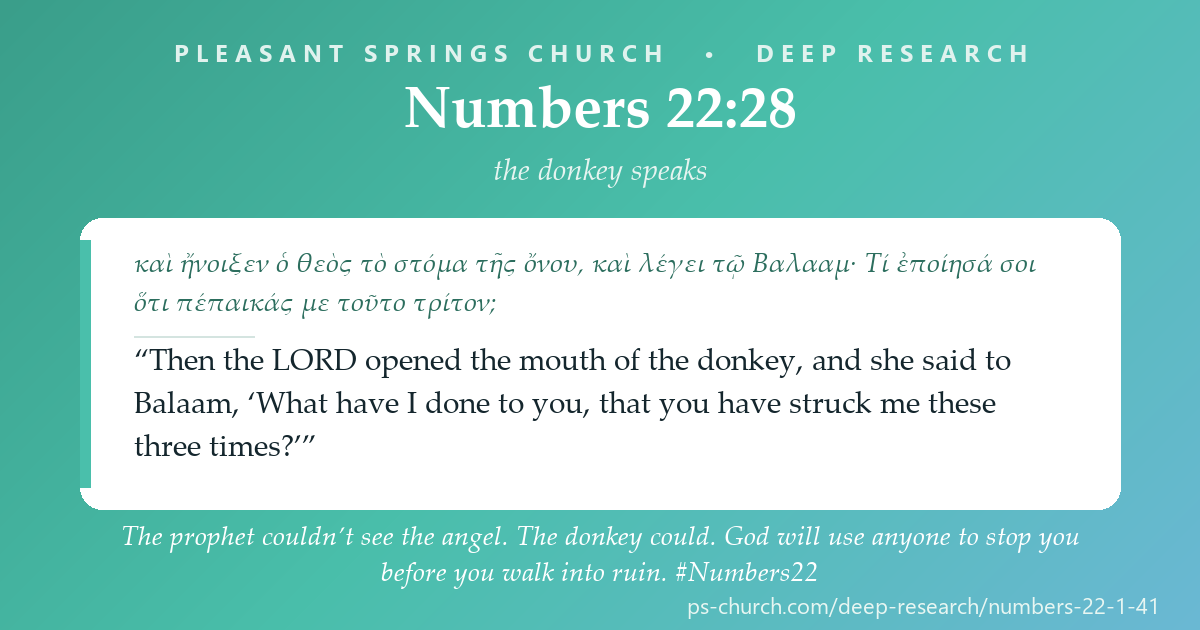
“She-donkey” — feminine throughout, and the narrator keeps her so (LXX ἡ ὄνος). She is not a device; she is a character, with a history of faithful service she can point to (“Am I not your donkey, on which you have ridden all your life long to this day?” 22:30). Peter, remembering the scene, calls her ὑποζύγιον ἄφωνον — “a speechless donkey” that “spoke with human voice and restrained the prophet’s madness” (2 Pet 2:16).
A rare verb — it appears only here and in Job 16:11 — rendered by the ESV “your way is perverse before me,” with the sense of a road that is headlong, reckless, thrown out of true. The LXX has οὐκ ἀστεία ἡ ὁδός σου, “your way is not seemly before me.” Either way it is God’s own verdict on a journey that God had just permitted — which is the whole difficulty of the chapter in one word.
“To uncover, reveal” — literally, the Lord uncovered Balaam’s eyes (LXX ἀπεκάλυψεν, the verb behind “apocalypse”). Set it beside the previous miracle: God opened (פָּתַח) the donkey’s mouth (22:28) and then uncovered the man’s eyes (22:31). Both organs belonged to God the whole time. Balaam will later describe himself as “the man whose eye is opened” (24:3–4) — a title he did not earn on this road.
How the New Testament takes up Numbers 22:
- 2 Peter 2:15–16 — “Forsaking the right way, they have gone astray. They have followed the way of Balaam, the son of Beor, who loved gain from wrongdoing, but was rebuked for his own transgression; a speechless donkey spoke with human voice and restrained the prophet’s madness.” Peter names the motive the narrative only hints at: gain.
- Jude 11 — “Woe to them! For they walked in the way of Cain and abandoned themselves for the sake of gain to Balaam’s error and perished in Korah’s rebellion.”
- Revelation 2:14 — “you have some there who hold the teaching of Balaam, who taught Balak to put a stumbling block before the sons of Israel” — the counsel of Numbers 31:16, working where the curse could not (see Numbers 25).
- Romans 8:31–39 — the New Testament’s own answer to Balak’s project: “If God is for us, who can be against us?” (see Romans 8:31–39).
The curse that could not be spoken — traced across the canon.
Trace three threads: the blessing of Abraham that Balak ran into; Israel’s long memory of what was done for it offstage; and the New Testament’s settled verdict on the man himself.
Which cross-references matter?
- Genesis 12:1–3 — “I will bless those who bless you, and him who dishonors you I will curse.” Balak hires a curse against the seed of Abraham and collides head-on with the promise. Numbers 22:12 is Genesis 12:3 in a mountain pass.
- Deuteronomy 23:4–5 — the reason Moab is kept at a distance: “they hired against you Balaam the son of Beor from Pethor of Mesopotamia, to curse you. But the Lord your God would not listen to Balaam; instead the Lord your God turned the curse into a blessing for you, because the Lord your God loved you.”
- Joshua 24:9–10; Nehemiah 13:2; Micah 6:5 — the same memory kept alive for a thousand years: “he sent and invited Balaam the son of Beor to curse you, but I would not listen to Balaam. Indeed, he blessed you”; “yet our God turned the curse into a blessing”; “remember what Balak king of Moab devised… that you may know the righteous acts of the Lord.”
- Numbers 23–24 — what Balak actually bought: four oracles of blessing, including “God is not man, that he should lie” (23:19) and the star out of Jacob (see Numbers 23:1–24:25 and Numbers 24:15–19).
- Numbers 31:8, 16; Joshua 13:22 — the end of the story, told plainly: “these, on Balaam’s advice, caused the people of Israel to act treacherously against the Lord in the incident of Peor”; and “Balaam also, the son of Beor, the one who practiced divination, was killed with the sword by the people of Israel among the rest of their slain.” Joshua’s word for him is not prophet.
- 1 Samuel 3:1–10; Job 16:11; 2 Kings 6:17 — the biblical grammar of seeing and not seeing: God opening what is closed, and closing what presumes on itself. “O Lord, please open his eyes that he may see.”
- 2 Peter 2:15–16; Jude 11; Revelation 2:14 — the New Testament’s final assessment, in three independent voices: the way, the error, and the teaching of Balaam.
The most uncomfortable sequence in the chapter is not the talking donkey. It is 22:12, 22:19–20 and 22:22 in a row. God says no with perfect clarity. Balak sends richer men with a bigger offer. Balaam — having just made a fine speech about not going beyond the command of the Lord his God — says, “…please stay here tonight, that I may know what more the Lord will say to me” (22:19). God gives him permission. And then God is angry that he went.
Readers have handled this in several ways, and the honest thing is to name them. Some take God’s permission in 22:20 as conditional and Balaam as having broken the condition — he was to go only if the men came to call him, and instead he rose early and saddled his own donkey (22:21), going eagerly rather than being fetched; William Whiston, annotating Josephus (Ant. 4.6.3), notices exactly this. Others take the permission as God giving a man over to a desire he has refused to let go of — a real permission that is also a judgment, in the manner of Romans 1:24; Josephus, on Whiston’s reading, takes the second permission as ironical — given so that Balaam would be deceived. Still others read the whole angel episode as a deliberately staged warning: God lets him go and then blocks the road, so that the seer arrives in Moab in no doubt about who is controlling his tongue.
The text does not adjudicate between these, and neither will we. What it does say is unmistakable: the way was perverse before God (22:32) even though God had permitted it. That distinction — between what God allows and what God approves — is worth carrying carefully. A door that opens is not automatically a door God is pleased for you to walk through, and “I asked again and got a different answer” is not a category the Bible commends. When God has spoken clearly once, asking again is rarely about information.
The scholarship on Balaam, Deir ‘Alla, and the theology of blessing and curse.
Ashley, Wenham, Cole, Levine, Milgrom and Olson for Numbers; the Deir ‘Alla publications for the inscription; Beale & Carson for the New Testament use.
Commentaries & studies:
- Timothy R. Ashley, The Book of Numbers (NICOT); Gordon J. Wenham, Numbers (TOTC); R. Dennis Cole, Numbers (NAC); Baruch A. Levine, Numbers 21–36 (Anchor); Jacob Milgrom, Numbers (JPS); Dennis T. Olson, Numbers (Interpretation).
- The Deir ‘Alla plaster inscriptions: the editio princeps of Hoftijzer and van der Kooij, and B. A. Levine’s translation and notes in The Context of Scripture 2.27.
- Studies of blessing and cursing, professional divination, and the “foreign prophet” motif in the Hebrew Bible and its neighbours.
- G. K. Beale & D. A. Carson, eds., Commentary on the New Testament Use of the Old Testament (2 Peter, Jude; Revelation).
Interpretation notes worth keeping:
- Balaam’s ambiguity is in the text, not imported into it. He says true things about God and does questionable things with them. Numbers reports both without comment; Deuteronomy, Joshua, Nehemiah and Micah report the rescue; Numbers 31:16, Joshua 13:22 and the New Testament report the man. Let the whole canon supply the verdict rather than reading it into ch. 22 prematurely — and then, having heard it, do not soften it either.
- Do not over-read the donkey. Scripture does not explain the mechanics and neither should we; it says the Lord opened her mouth and reports what she said. The narrative interest is not zoological but theological: God can make his point with whatever mouth he chooses. Where Scripture gives no reason, we stop.
- ‘The angel of the Lord’ here is God’s own emissary, speaking in the first person for God (22:32, 35) and receiving Balaam’s worship-posture (22:31). The LXX’s alternation between ἄγγελος τοῦ θεοῦ and ἄγγελος κυρίου is worth noting, not overbuilding.
- The permission of 22:20 and the anger of 22:22 are not a contradiction in the text’s own logic, but the text does not explain the relation. Report the options; do not pretend to certainty; and take the pastoral point that God’s permission is not God’s approval.
- The chapter is a comedy with a sword in it. Preach the humour — it is there on purpose — but never at the cost of 22:33, where the angel says he would have killed Balaam and spared the animal. A joke that removes the danger has removed the passage.
From a purchased curse to a blessing that cannot be revoked.
Name what you learned, why it matters, and one concrete response.
What should we carry away — and do?
- God cannot be hired. Balak sends twice and raises the price, and the answer never moves. Every religion of leverage — the right words, the right fee, the right professional — breaks on 22:12. God is free, and his freedom is our safety.
- A blessing already spoken cannot be un-spoken. “They are blessed” is a settled fact before Balaam ever saddles the donkey. That is the ground under Romans 8: “If God is for us, who can be against us?” No one can bill God for a curse against his people.
- You were defended in rooms you never entered. Israel cooked supper while this happened. Much of what God has done for you, you will not learn about until later — if ever. Deuteronomy’s summary is worth memorising: he “turned the curse into a blessing for you, because the Lord your God loved you” (Deut 23:5).
- Beware of asking again. When God has answered clearly, a second consultation is usually a negotiation. The permission you finally receive may be the most dangerous thing you get.
- Right words are not a heart. Balaam’s speech in 22:18 is theologically perfect. Peter, Jude and John still call his road what it was. It is possible to say true things about God for years while quietly steering toward the fee — and the honest response to that sentence is not to name someone else.
Step in response: name the one thing you have already asked God about and received a clear answer on — and have been re-asking ever since, hoping the answer will improve. Stop asking this week — where the answer is a plain word of Scripture and not an impression. (Scripture never discourages persistent prayer; Luke 18:1–8. It discourages re-litigating what God has already said.) Then thank him for one protection you know about only because someone told you afterward, and for the many you will never know about at all.
Numbers 22:12 · to share
LXX + ESVEvery Deep Research page traces its passage across the whole sweep — the Old Testament, the Second-Temple world between the testaments (historical witnesses, not Scripture), and the New Testament. Follow the thread:
Pleasant Springs Church — Deep Research
Research method after Michael S. Heiser’s Bible Research Method (examine dictionaries → ancient literature → important words → textual connections → academic publications → share), with the Pleasant Springs “Author & Audience” foundation. Scripture set in the Hebrew, the Greek editions named on each page and the ESV (Old Testament), and the Greek New Testament and the ESV (New Testament), per the practice of Pleasant Springs Church. Numbers 22 research grounded in Ashley, Wenham, Cole, Levine, Milgrom and Olson, with Beale & Carson on the New Testament use (2 Peter, Jude; Revelation); ANE background from the Moabite Stone (ANET 320–321) and the Deir ‘Alla plaster inscription (c. 800 BC; COS 2.27 — later than ANET’s third edition and not found there); Second-Temple and rabbinic witnesses (Josephus, Philo, the Mishnah’s Sanhedrin and Avot, Numbers Rabbah), all read as witnesses, not Scripture. Hebrew, LXX and English agree in versification throughout Numbers 22. Balaam’s ambiguity is left where the narrative leaves it, and the final assessment is taken from the New Testament’s own words rather than supplied by us; the talking donkey is reported, not explained.
Scripture quotations marked ESV are from the ESV® Bible (The Holy Bible, English Standard Version®), © 2001 by Crossway, a publishing ministry of Good News Publishers. ESV Text Edition: 2016. Used by permission. All rights reserved. The ESV text may not be quoted in any publication made available to the public by a Creative Commons license, and the ESV may not be translated in whole or in part into any other language. www.esv.org
|
Did this study bless you today? 💚 Give to Support PS Church100% of gifts go to the General Fund — thank you. |