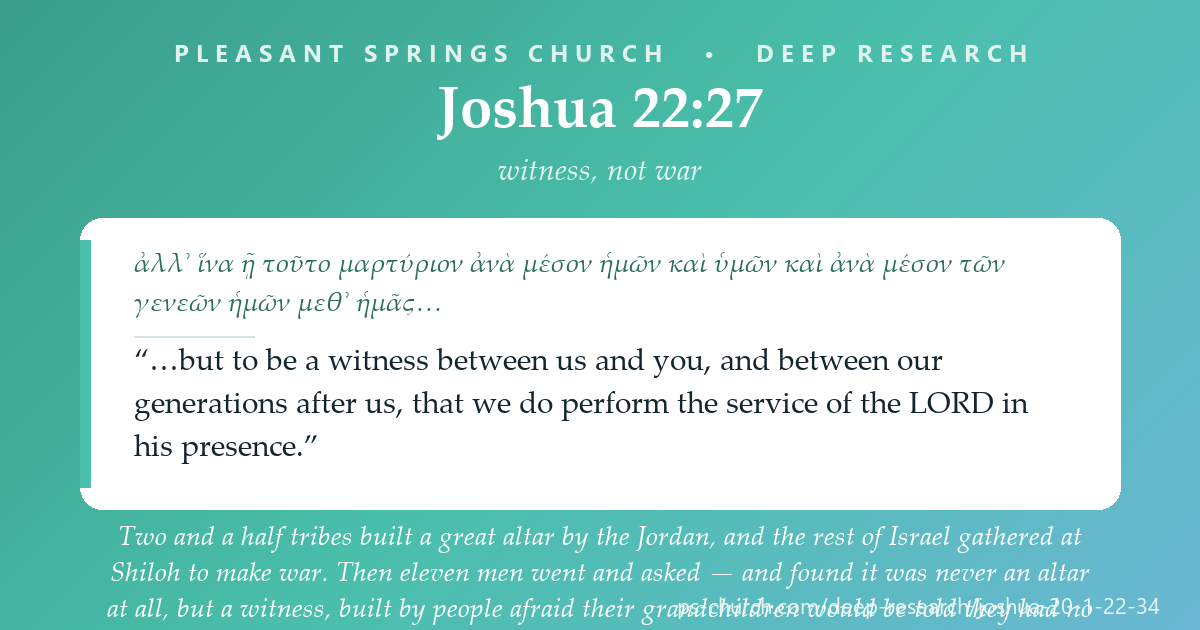
The fighting is finished and the land is divided. What is left is the quiet administration — and it turns out to be some of the most humane material in the Old Testament. Six towns are named where a man who has killed without intent can run, stand at the gate, state his case to the elders, be taken in and given a place, and stay alive “until he has stood before the congregation for judgment” (20:4–6). Forty-eight towns are handed to the tribe that owns no territory, scattered on purpose through everyone else’s inheritance (21:41) — the teachers of the law living on ordinary streets. And then one of the great summary sentences of Scripture: “Not one word of all the good promises that the Lord had made to the house of Israel had failed; all came to pass” (21:45) — a verse this page will set honestly beside 13:1 and Judges 1 rather than smooth over. Then chapter 22, which deserves the weight: the eastern tribes go home, build an altar “of imposing size” by the Jordan, and the whole assembly gathers at Shiloh to make war — until eleven men go and ask, and find out it was never an altar at all. See the method →
Joshua 20:2–22:34 (selections)
Hebrew · LXX · ESVThe Shape of the Passage
LeitwortThe campaigns are over and the surveying is done. Chapters 11–12 closed the fighting with a king list; 13–19 divided the land by lot at Shiloh and ended with Joshua receiving his own portion last of all. What is left is the part nobody preaches: the towns for the manslayer, the towns for the Levites, and one very nearly disastrous misunderstanding. Then Joshua says goodbye (chs 23–24).
Author
The narrator of Joshua is unnamed. The book itself reports that Joshua wrote the words of the Shechem covenant “in the Book of the Law of God” (24:26), and it repeatedly says “to this day” (15:63, 16:10, 22:3), looking back from a later vantage — so the material is old and the writing down of it is a process. Jewish tradition (b. Bava Batra 14b–15a) assigns the book to Joshua with the last verses added by Eleazar and Phinehas; that is a tradition, not a claim the book makes for itself, and we hold it loosely.
What the author is doing here is unmistakable, though. He is showing the law being carried out. Numbers 35 said six cities; chapter 20 names them. Numbers 35 said forty-eight; chapter 21 counts them, tribe by tribe, and the sub-totals add up (13 + 10 + 13 + 12 = 48). Numbers 32 and Joshua 1:12–18 made the eastern tribes promise to cross over armed and then go home; chapter 22 is their discharge. This is a writer who cares whether promises get kept — God’s (21:45) and Israel’s (22:2–3). Then he does something braver: he tells us how close the keeping came to collapsing over a monument nobody understood.
Audience
Israelites who now live somewhere. Not a marching camp any more — farmers, neighbours, in-laws, people with property lines. Two things follow, and these chapters are both of them. First, when neighbours live close together, somebody eventually kills somebody by accident, and the dead man’s brother will be at the door before nightfall. So: six towns, spaced out, with a court at the end of the road. Second, when a nation spreads out, the far edge starts to wonder whether it still counts — and that is exactly what the eastern tribes say out loud: “in time to come your children might say to our children… ‘You have no portion in the Lord’” (22:24–25).
And a people with a very short, very raw memory. The delegation’s speech does not reason abstractly; it names two disasters everyone in the audience had lived through. Peor — “have we not had enough of the sin at Peor… for which there came a plague upon the congregation” (22:17; see Numbers 25, where Phinehas himself had ended it with a spear). And Achan — “did not Achan the son of Zerah break faith… and wrath fell upon all the congregation of Israel? And he did not perish alone for his iniquity” (22:20). That last clause is the hard one, and it is the reason they were frightened; it is weighed at length in Joshua 7, where the house reading is corporate consequence, not transferred guilt. They are not being hysterical. They are being people who have watched what one household’s sin did to everybody. That is what makes their over-reaction so recognisable — and what makes it so important that they asked first.
Orient on asylum, the Levitical cities, Shiloh, the eastern tribes, and altars.
Search by topic: city of refuge, asylum, avenger of blood, manslayer, elders and the city gate, Levitical cities, pastureland (migrash), Shiloh, tabernacle, Transjordan / the eastern tribes, altar, high place (bamah), witness, treaty and covenant witnesses, Phinehas.
Which articles are relevant?
- Anchor Bible Dictionary — “Refuge, Cities of,” “Levitical Cities,” “Avenger (Blood),” “Asylum,” “Shiloh,” “Gate,” “Elder,” “Altar,” “Transjordan,” “Phinehas,” “Joshua, Book of.”
- Dictionary of the OT: Historical Books — “Cities of Refuge,” “Levitical Cities,” “Land,” “Tribes of Israel,” “Altars,” “Worship,” “Joshua, Book of,” “Textual Criticism.”
- NIDOTTE / TDOT — מִקְלָט (miqlāṭ, refuge), עֵדָה (ʿēḏāh, congregation), עֵד (ʿēḏ, witness), מִגְרָשׁ (migrāš, pastureland), מִזְבֵּחַ (mizbēaḥ, altar), מַעַל (maʿal, breach of faith), דָּבָר (dāḇār, word).
- On the Greek — the entries for φυγαδευτήριον, βωμός, θυσιαστήριον and μαρτύριον in Muraoka’s Greek–English Lexicon of the Septuagint repay the trip; so does the NETS introduction to Iesous (Joshua).
Bibliography surfaced:
- Richard S. Hess (TOTC), David M. Howard Jr. (NAC), Trent C. Butler (WBC), Robert G. Boling (Anchor), Marten H. Woudstra (NICOT), L. Daniel Hawk (Berit Olam) on Joshua.
- The long debate over the Levitical-city lists (Num 35 // Josh 21 // 1 Chr 6) — Albright, Mazar, Kallai, Auld and Na’aman set the terms; the commentaries survey it.
- Emanuel Tov and Leonard Greenspoon on the Greek Joshua; Michaël N. van der Meer and Kristin De Troyer on the relation of the Greek to the Hebrew.
- Alexander Rofé, “Joshua 20: Historico-Literary Criticism Illustrated,” in J. H. Tigay, ed., Empirical Models for Biblical Criticism (1985).
Gates, asylum, and what a monument was for in the ancient world.
Read the gate, the six towns and the altar against the practices of the world around Israel — then hear how Second-Temple and rabbinic readers worked the same texts.
Which parallels shed light on religion and worldview?
The gate was the courthouse. When 20:4 sends the fugitive to “the entrance of the gate of the city” it is not sending him to a doorway; it is sending him to the one public space every Israelite town had. City gates in the Iron Age Levant were built as chambered structures with benches, and the Old Testament treats the gate as where business is transacted and cases are heard — Boaz convenes ten elders at the gate (Ruth 4:1–2), Absalom intercepts litigants there (2 Samuel 15:2), and Amos indicts those who “hate him who reproves in the gate” (Amos 5:10). The law is not asking the man to knock on a temple door. It is asking him to walk into the town square, out of breath, with blood on him, and talk.
Asylum, and what Israel does differently. Sanctuary at a shrine was ordinary all over the ancient Mediterranean, and Israel knew that form too — the altar itself in Exodus 21:13–14, and later Adonijah and Joab grabbing its horns (1 Kings 1:50–53; 2:28–34). What Numbers 35 designed and Joshua 20 installs is different: asylum decentralised into ordinary towns and attached to a trial. The refuge is not a magic circle; it is a holding place until the congregation hears the case. And the towns are Levite towns — so the man waits among the people whose job is to teach the law he is about to be judged by.
Monuments and witnesses. The eastern tribes build something enormous and useless, and that is precisely the point of it. The ancient world knew this genre well. When a Hittite great king made a treaty, the document ended by summoning witnesses — and the list is not only gods: “the mountains, the rivers, the springs, the great Sea, heaven and earth, the winds (and) the clouds—let these be witnesses to this treaty and to the oath” (Treaty between Mursilis and Duppi-Tessub, ANET 203–205, the witness list at 205). The Egyptian–Hittite treaty says the gods “are with me as witnesses [hearing] these words” (ANET 199–201, at 201). Israel keeps the practice and empties it of the gods: Moses calls heaven and earth to witness (Deut 4:26; 30:19), Jacob and Laban pile up stones and name the heap “Witness” in two languages (Genesis 31:44–52), and here two and a half tribes build a replica altar so that nobody’s grandchildren can pretend the family line was ever broken. In the next chapter Joshua will set up a stone and say “it has heard all the words… it shall be a witness against you” (24:27). Two witness-objects, back to back.
- Treaty between Mursilis and Duppi-Tessub (ANET 203–205) — a suzerainty treaty whose closing section summons gods, mountains, rivers, springs, sea, heaven and earth, winds and clouds as witnesses to this treaty and to the oath (the list ends at ANET 205). The nearest ancient analogue to what the altar in Joshua 22 is for.
- Treaty between Hattusilis and Ramses II (ANET 199–201) — the gods of Hatti and of Egypt “are with me as witnesses [hearing] these words” (ANET 201); the treaty itself was inscribed on a silver tablet.
- Code of Hammurabi §§206–208 (ANET 175) and Hittite Laws §§1–4 (ANET 189) — the ANE way of settling a killing: an oath of non-intent and a payment. Israel’s alternative — a town, a road, and a trial — is the innovation.
- Josephus, Antiquities 5.1.24 (Second-Temple — a witness, not Scripture) — retells the allotment to the Levites with the arithmetic distributed his own way: thirty-eight cities given now, since “they had already received ten in the country of the Amorites,” three of them assigned to the manslayer.
- Josephus, Antiquities 5.1.26–28 (Second-Temple — a witness, not Scripture) — his version of Joshua 22. The altar is built “as a monument to posterity, and a sign of their relation to those that should inhabit on the other side”; the western tribes suppose it “to be by way of innovation, and for the introduction of strange gods”; Joshua and Eleazar restrain them and send Phinehas with ten men; and when Phinehas commends the answer, “Joshua was glad that he was under no necessity of setting them in array.”
- Mishnah, Makkot 2 (rabbinic-era — a witness, not Scripture) — the working-out of these very towns: the three Moses set aside across the Jordan did not absorb anyone until Joshua’s three in Canaan were chosen (2:4); roads were straightened and the court sent two scholars with the fugitive to talk the avenger down (2:5); a man in exile who is offered honour must say “I am a murderer” (2:8); and the exiles paid the Levites rent (2:8, disputed by R. Meir).
- b. Makkot 10a–b (rabbinic-era — a witness, not Scripture) — directly on Joshua 20–21. Are there only six? No: the other forty-two Levite towns admit as well, but only a man who came to them deliberately, knowing what they were. And how can Hebron be a refuge city when Caleb has it? Because “the field of the city and its villages they gave to Caleb” (Josh 21:12) — the fields to Caleb, the town to the priests. The Gemara also reports that מִקְלָט, “Refuge,” was posted at every crossroads so the runner would not lose the road (10b, from Deut 19:3).
It is worth slowing down over the order of events in 22:11–14, because the text is doing something deliberate. Israel hears a report (22:11 — note that the report is already slightly garbled: it says the altar was built “at the frontier of the land of Canaan… on the side that belongs to the people of Israel,” which is not quite what 22:10 said). On the strength of the report, “the whole assembly of the people of Israel gathered at Shiloh to make war against them” (22:12). The muster is not a threat; it is a mobilisation. And then, with the army already assembled, they send eleven men to go and ask a question.
Both halves are true of these people at once, and the narrator does not spare them either half. They were fast to believe the worst about their own brothers, and fast to arm. They were also, in the end, the sort of people who would rather find out than be right. The delegation is led by Phinehas — and every reader of Numbers 25 knows exactly what Phinehas did the last time Israel was openly committing apostasy — and that God commended him for it (Num 25:11–13, “my covenant of peace”). That is part of why he is the man they send. He did not ask then; the sin was in plain sight. Here it is not, and he asks.
That is not a criticism of Numbers 25 and it is not a rule for every case. It is simply what happened, and the outcome is stated flatly: the answer “was good in their eyes” (22:30, 33), and Israel “spoke no more of making war.” A very great deal in the Old Testament goes wrong. This did not, and the reason it did not is that somebody made the trip.
Refuge, congregation, pasture, altar, witness — and the small word that carries all three chapters.
Watch miqlat (a place, not a pardon); haʿedah, the congregation that must hear before it acts; migrash, the grazing ring that makes a landless tribe viable; mizbeach, one Hebrew word the Greek splits in two; ʿed, witness — and davar, the Leitwort.
“Refuge, asylum” — a noun that occurs in the Old Testament almost only in this law and its echoes (Num 35; Josh 20–21; 1 Chr 6). The Greek translator had no word for it and coined one: φυγαδευτήριον, a “place-for-the-fugitive.” Notice the shape of the mercy — not a pardon, but a place. Joshua 20 is where the place gets an address.
“Without intent, inadvertently” (LXX ἀκουσίως) — the term of Numbers 15:22–29 and Leviticus 4, over against sinning “with a high hand.” Joshua’s second phrase, בִּבְלִי־דָעַת, biḇlî ḏāʿaṯ, “without knowledge” — the ESV’s “or unknowingly” — is Deuteronomy’s word for the same thing (Deut 4:42; Deut 19:4), laid alongside Numbers’ bišgāgāh. Joshua 20:3 stacks the two older laws’ terms — two ways of saying he did not mean it, side by side, as though the writer wants no gap for a hard-hearted judge to slip through — and that doubling is exactly what makes the chapter read as Deuteronomic (see Stage 5). (It is one of the phrases the Old Greek does not represent.)
“The congregation” — the assembled community acting as a body, from the root יעד, “to appoint, to meet” (hence 20:9’s עָרֵי הַמּוּעָדָה, the “appointed” cities). LXX συναγωγή. It is the same body twice over on this page: the congregation before whom the accused must be allowed to stand (20:6), and the congregation that nearly goes to war and then sends a delegation instead (22:12–16). A community with the power to kill a man, and the obligation to hear him first.
“Pastureland, open ground” — the ring of common land around each Levite town, measured in Num 35:4–5. It appears in nearly every verse of Joshua 21, which is exactly why the chapter reads as it does: forty-eight towns, and forty-eight rings of grazing, because a landless tribe still has to keep animals alive. The Greek renders it two different ways in the one chapter — περισπόρια (“the sown land round about”) at 21:2–12 and 21:34–42, and ἀφωρισμένα (“the set-apart parts”) at 21:13–32.
“Altar” — literally a place of slaughter (from זבח). The Hebrew uses this one word for both altars in the story, the disputed one and the Lord’s, and lets the argument sort them out. The Greek translator refuses to wait. He uses βωμός — the ordinary word for a pagan altar-platform, used in the LXX for illegitimate altars (Balaam’s seven, Num 23:1–4) and sometimes for a “high place” — for the thing by the Jordan, eight times (22:10 twice, 11, 16, 19, 23, 26, 34); and he reserves θυσιαστήριον, the word for a legitimate altar of sacrifice, for the Lord’s altar (22:19, 28, 29) — and for the hypothetical rival altar the eastern tribes swear they did not build (22:29). Read that distribution and the Greek has already answered the chapter’s question in its vocabulary: whatever they put up, it was never a place to sacrifice.
“Witness” — a legal word, the same one behind “you shall not bear false witness” (Exod 20:16) and the two-or-three-witness rule (Deut 19:15). LXX μαρτύριον. An honest note about 22:34: the Masoretic Text as it stands gives the altar no name — it reads, flatly, “and the sons of Reuben and the sons of Gad called the altar, ‘For it is a witness between us that the Lord is God.’” The ESV supplies Witness (the NASB italicises it); the KJV supplies the Hebrew word itself, Ed. The Greek supplies no name either, and makes Joshua the one who names it. So the famous name of the altar is an inference from the sentence — a very good one, but the page should say plainly that it is one.
“Word, thing, matter” — the key word of these three chapters (see the shape of the passage, above). The fugitive speaks his words in the ears of the elders (20:4); “not one word of all the good word that the Lord spoke… failed” (21:45); Phinehas hears “the words they spoke” (22:30); the delegation “brought back word” (22:32); and “the word was good in the eyes of the people of Israel” (22:33). God’s word does not fall to the ground; and the way a war is avoided is that human words get spoken and heard.
How the New Testament takes up this material:
- Hebrews 6:18 — “we who have fled for refuge” (καταφεύγω) uses the LXX’s own verb for running to one of these towns (Josh 20:9, καταφυγεῖν). The New Testament reaches into this law for its language, and then names Jesus “a high priest forever” (6:20; see Hebrews 4:14–16).
- Matthew 18:15–17 — “go and tell him his fault, between you and him alone.” This is Joshua 22 as church procedure: before the assembly acts, someone goes. See also the study on Matthew 18:18.
- Acts 15:1–35 — a report reaches Jerusalem that something irregular is happening at the edge of the movement; instead of a ruling by rumour, they send men, hear the account, and write it down. The pattern is old.
- Ephesians 2:11–22 — “you who once were far off have been brought near… he himself is our peace… and has broken down in his flesh the dividing wall of hostility.” The fear behind the altar — one day they will tell our children they have no portion — is answered in Ephesians 2, and the answer is not a monument but a person.
- Romans 14:1–15:7 — Paul on believers who read one another’s practices as apostasy. “Why do you pass judgment on your brother?” is the New Testament’s version of the question Phinehas went and asked.
Law kept, promises weighed, and two piles of stones called Witness.
Trace four threads: the refuge law from Numbers and Deuteronomy into practice; the Levites’ strange vocation of landlessness; the summary of 21:43–45 held against 13:1 and Judges 1; and the biblical habit of building something to be a witness.
Which cross-references matter?
- Numbers 35:9–34 — the law itself: six towns, the avenger restrained, the trial, the release at the high priest’s death (Numbers 34–35). Joshua 20 is that law with place-names in it.
- Deuteronomy 4:41–43; 19:1–13 — Moses sets aside Bezer, Ramoth and Golan east of the Jordan (Deut 4), and Deuteronomy adds the roads and the distances, “you shall measure the distances… and divide into three parts” (Deut 19:3). Joshua 20:7–8 completes both halves of the map at once.
- Numbers 18:20–24; Deuteronomy 18:1–2 — “they shall have no inheritance among their brothers; the Lord is their inheritance” (Deut 18; Num 18). Joshua 21 is the arithmetic of that sentence: forty-eight addresses and not one square mile of territory.
- Genesis 49:5–7; Deuteronomy 33:8–11 — Jacob’s hard word over Levi, “I will divide them in Jacob and scatter them in Israel” (Gen 49), becomes in Moses’ blessing a calling: “they shall teach Jacob your rules” (Deut 33). The scattering stands; its meaning is transformed. Do not romanticise it — Judges 17–19 shows how badly a wandering Levite could go — but do not miss the design either.
- Numbers 32:16–32; Joshua 1:12–18 — the original bargain: the eastern tribes may settle across the river if they cross over armed and stay until their brothers have rest (Num 32; Josh 1). Joshua 22:1–4 is the discharge papers, and 22:2–3 is the commendation: “you have not forsaken your brothers these many days.”
- Numbers 25:1–13; Joshua 7 — Peor and Achan, the two precedents the delegation actually cites (22:17, 20). See Numbers 25 and Joshua 7.
- Leviticus 17:8–9; Deuteronomy 12:1–14 — why the report terrified them. Sacrifice belongs at the one place the Lord chooses (Lev 17; Deut 12). A second altar was not a matter of taste; it was, on the face of it, the end of the covenant. Their alarm was orthodox. It was also wrong about the facts.
- Genesis 31:44–52 — Jacob and Laban heap up stones at a border and name the heap “Witness” in two languages, Jegar-sahadutha and Galeed, “that it may be a witness between you and me” (Genesis 31). Joshua 22 is the same instinct, four hundred years later, at the same river.
- Joshua 24:26–27 — the great stone under the oak: “it has heard all the words of the Lord… it shall be a witness against you” (Joshua 23–24). Two witness-objects in two consecutive units of the book.
- Joshua 23:14 — the summary of 21:45 said again by Joshua himself, in the second person and with his death in view: “not one word has failed of all the good things that the Lord your God promised concerning you” — and then, in the same breath, a warning (23:15–16) that the same faithfulness runs the other way.
- 1 Chronicles 6:54–81 · MT 6:39–66 — the Levitical city list a second time, in the Chronicler’s own arrangement; the two lists differ in detail and are one of the standard comparisons in the scholarship.
- 2 Samuel 21:1–14; 1 Kings 2:28–34 — the later life of these institutions: an oath about Gibeon broken and answered with famine, and a man clinging to the horns of the altar who is killed there anyway. Asylum is fragile.
This has to be faced, because the same book says both. 21:43–45: “Thus the Lord gave to Israel all the land that he swore to give to their fathers… Not one word of all the good promises that the Lord had made to the house of Israel had failed; all came to pass.” And 11:23: “So Joshua took the whole land… And the land had rest from war.” Now set beside them 13:1: “Now Joshua was old and advanced in years, and the Lord said to him, ‘You are old and advanced in years, and there remains yet very much land to possess.’” And the allotment chapters themselves keep filing exceptions: the Jebusites “the people of Judah could not drive out… to this day” (15:63); “they did not drive out the Canaanites who lived in Gezer” (16:10); Manasseh “could not take possession of those cities” (17:12). And Judges 1 opens by cataloguing the failures in detail — Judah “could not drive out the inhabitants of the plain, because they had chariots of iron” (1:19); Benjamin “did not drive out the Jebusites… to this day” (1:21); Manasseh, Ephraim, Zebulun, Asher, Naphtali, Dan, one after another (1:27–36).
Three readings are worth laying out fairly, and each has real purchase. (1) ‘All’ as a summary, not an inventory. Ancient conquest reports are characteristically sweeping; 11:23 and 21:43 may be summing up the decisiveness of the campaign — no coalition stood, no king held — rather than auditing every valley. (2) Gift complete, possession progressive. The book itself puts “I have given” (1:3) beside “you shall drive out” (17:18; cf. 23:5) and “how long will you put off going in to take possession?” (18:3); on this reading the land is genuinely handed over and genuinely still to be entered, the way a deed and a move-in date are both real. (3) Two different subjects. The summaries are about what God did — a promise kept, rest given, no enemy standing; the exception-lists are about what Israel did next. 21:45 is precisely and only a statement about God’s word: not one of them fell.
What we should not do is pick one and pretend the others are not printed. Something does remain in tension, and it is worth naming exactly. It is not really “did they take the land or not” — every reading can hold both the victories and the leftovers. It is the flat universality of the summary sentences sitting a few chapters away from 13:1, where God himself says much remains. The book is not embarrassed by this and does not explain it, and neither will we. What Joshua wants us to carry away is stated in the verse itself — the promises did not fail — and what Judges wants us to carry away is that a promise kept by God still has to be lived in by people. Both are true. The seam between them is where the rest of the Old Testament happens.
One thing to say plainly while we are here. The conquest that 21:43–45 summarises was a bounded, divinely commanded judgment at a unique moment in redemptive history — the moment Genesis 15:16 had named in advance, when “the iniquity of the Amorites” was complete. It is not a model. It authorises no violence, no coercion and no ethnic hostility by anyone, ever, on any grounds. The New Testament could hardly be clearer: “the weapons of our warfare are not of the flesh” (2 Cor 10:4), “we do not wrestle against flesh and blood” (Eph 6:12), “put your sword back into its place” (Matt 26:52), and Jesus rebuking the disciples who wanted fire from heaven (Luke 9:54–55). These texts have been misused — to bless conquest, dispossession and worse — and no reader of this page may use them that way.
The Greek Joshua, the Levitical-city lists, and the archaeology of Shiloh.
Hess, Howard, Butler, Boling, Woudstra and Hawk for the commentary; Tov, Greenspoon, Rofé, van der Meer and De Troyer for the Greek; the standard survey literature for the city lists and for Shiloh.
Commentaries & studies:
- Richard S. Hess, Joshua (TOTC); David M. Howard Jr., Joshua (NAC); Trent C. Butler, Joshua (WBC); Robert G. Boling, Joshua (Anchor); Marten H. Woudstra, The Book of Joshua (NICOT); L. Daniel Hawk, Joshua (Berit Olam).
- Leonard J. Greenspoon, Textual Studies in the Book of Joshua (1983); Emanuel Tov’s essays on the Greek Joshua; Michaël N. van der Meer, Formation and Reformulation: The Redaction of the Book of Joshua in the Light of the Oldest Textual Witnesses (2004); Kristin De Troyer on the Joshua text traditions.
- Alexander Rofé, “Joshua 20: Historico-Literary Criticism Illustrated,” in J. H. Tigay, ed., Empirical Models for Biblical Criticism (1985) — the essay that made this chapter a standard test case.
- The Levitical-city debate (Num 35 // Josh 21 // 1 Chr 6): utopian blueprint, monarchic administration, or old tradition? Albright, Mazar, Kallai, Auld and Na’aman are the names to look for; the commentaries survey the state of play.
- On Shiloh: the Danish excavations under Hans Kjær (1926–32); Israel Finkelstein and others, Shiloh: The Archaeology of a Biblical Site (1993); and the renewed excavations at Khirbet Seilun from 2017 (Associates for Biblical Research, Scott Stripling).
Interpretation notes worth keeping:
- Joshua 20 is the most-discussed textual difference in the book, and it is worth understanding rather than being frightened of. The Old Greek lacks 20:4–6 entirely, and the material the Hebrew has there is written in the idiom of Deuteronomy 19 (the gate, the elders, “did not hate him in the past”). Critical scholars — Rofé classically, and Tov — take the shorter Greek to reflect an earlier Hebrew form, with the Deuteronomic paragraph added later. Others, van der Meer among them, argue the Greek translator abridged. We do not settle it here, and we do not need to: both forms of the chapter say the same thing about asylum, and the substance of 20:4–6 is in Deuteronomy 19 and Numbers 35 in any case. What the difference does teach is how manuscripts actually behave, and that the church has always read Scripture through copies.
- Do not read chapter 21 as filler. It is a list, and it is also an argument: the tribe that teaches the law is placed inside every other tribe’s territory. God does not concentrate his teachers in a capital. Whether the list reflects an early distribution, a monarchic administrative reality, or an ideal never fully realised is genuinely debated — the towns include places Israel demonstrably did not control in the period (Gezer, for one; compare 16:10). Hold the historical question open; the theological point stands either way.
- Shiloh matters and the archaeology is contested. Joshua 18–22 makes Shiloh the centre — the tent is there, the lot is cast there, the muster is there. The site (Khirbet Seilun) has been dug repeatedly and reads differently to different excavators; the date and character of the sanctuary, and how the Iron I remains relate to the biblical picture, are argued about now as much as ever. Name the positions and do not adjudicate. Faith does not hang on the outcome of a season’s dig, and neither “archaeology proves the Bible” nor a shrug is an honest response.
- Joshua 22 is a study in how misunderstanding actually works. Notice that the report Israel acts on (22:11) is not quite the event as narrated (22:10); that the delegation opens with an accusation before it asks a question (22:16); that the eastern tribes’ first words are a double oath (22:22) because they know how bad this looks; and that the explanation, when it finally comes, is about fear — “we did it from fear that in time to come your children might say to our children…” (22:24). A monument built out of the fear of being forgotten, read as apostasy, nearly answered with an army.
- And a caution about the altar itself. Do not turn the eastern tribes into simple heroes. They built a large, ambiguous religious structure on a fault line, told nobody, and then were astonished to be misread. Nor are the western tribes simple villains: they were defending the one thing that held Israel together, and they had two fresh corpses of precedent to cite. The text is generous to both sides and flatters neither. What it commends is the delegation.
- On the release at the high priest’s death (20:6). Joshua repeats the rule and, like Numbers, gives no reason for it. Where Scripture is silent it is best to be silent; ancient and modern interpreters have guessed (an expiatory weight to the priest’s death; simply the end of an era, like a royal amnesty), and the guesses are worth reading and not worth preaching as fact.
A gate you can be heard at, a teacher on your street, and a brother who came to ask.
Name what you learned, why it matters, and one concrete response.
What should we carry away — and do?
- Justice has an address. God did not merely command fairness; he put six towns on a map and told Israel to keep the roads to them clear. Mercy that cannot be reached is not yet mercy. What in your church is technically available and practically out of reach?
- Let the man at the gate speak. The oldest picture of due process in Scripture is a frightened person allowed to state his case, and a community obliged to listen before it decides. Most of us pass sentence daily on one account, usually the first one we heard. Joshua 20 says: not until he has stood before you.
- Teachers live on ordinary streets. Forty-eight towns, scattered on purpose, so that the tribe that knew the law lived next door to everybody. Not a compound, not a capital — neighbours. That is still the shape of a healthy church.
- God’s word does not fall to the ground. “Not one word of all the good promises… had failed” (21:45). Hold that honestly — the same book says much land remains — and hold it anyway. What God said, he did.
- Before you muster, go and ask. This is the most quietly useful passage in Scripture for a church, and it should be said plainly. A whole nation was armed and ready on the strength of a report, and the thing that stopped a civil war was eleven men making a trip and asking a question — and then being willing to hear an answer that made them wrong.
- And notice what they were afraid of. The altar was built by people terrified that one day someone would tell their grandchildren they had no share. Some of the strangest things people do in churches are built out of that fear. It is worth asking, gently, before you judge a monument: what were you afraid of?
Step in response: think of one person about whom you have believed a report you never checked — a relative, someone at church, someone online. This week, go and ask. Not to confront; to find out. And if you have built something out of the fear of being forgotten, say so out loud to God, who does not forget his people or his word.
Joshua 22:27 · to share
LXX + ESVEvery Deep Research page traces its passage across the whole sweep — the Old Testament, the Second-Temple world between the testaments (historical witnesses, not Scripture), and the New Testament. Follow the thread:
Pleasant Springs Church — Deep Research
Research method after Michael S. Heiser’s Bible Research Method (examine dictionaries → ancient literature → important words → textual connections → academic publications → share), with the Pleasant Springs “Author & Audience” foundation. Scripture set in the Hebrew, the Greek editions named on each page and the ESV (Old Testament), and the Greek New Testament and the ESV (New Testament), per the practice of Pleasant Springs Church. Joshua 20–22 research grounded in Hess (TOTC), Howard (NAC), Butler (WBC), Boling (Anchor), Woudstra (NICOT) and Hawk (Berit Olam), with Greenspoon, Tov, Rofé, van der Meer and De Troyer on the Greek Joshua, and the standard survey literature on the Levitical-city lists and on Shiloh. Ancient witnesses (never leveled with Scripture): the Treaty between Mursilis and Duppi-Tessub (ANET 203–205) and the Hattusilis–Ramses II treaty (ANET 199–201) for treaty witnesses; the Code of Hammurabi §§206–208 (ANET 175) and Hittite Laws §§1–4 (ANET 189) for ANE homicide law; Josephus, Antiquities 5.1.24 and 5.1.26–28; Mishnah Makkot 2 and b. Makkot 10a–b. Versification: Joshua 20, 21 and 22 carry no offset — MT, LXX and English number all three chapters alike. The Greek is Rahlfs; the Old Greek of Joshua runs some 4–5% shorter than the Masoretic Text overall, and in these chapters that shows up as the absence of 20:4–6 (reported, not padded) and, in the other direction, the four extra verses Rahlfs prints at 21:42a–d. The name “Witness” at 22:34 is supplied by the ESV; neither the Masoretic Text as printed nor the Greek gives the altar a name, and the page says so. The tension between “all the land… not one word failed” (11:23; 21:43–45) and “there remains yet very much land” (13:1) with Judges 1 is reported and left standing, not harmonised.
Scripture quotations marked ESV are from the ESV® Bible (The Holy Bible, English Standard Version®), © 2001 by Crossway, a publishing ministry of Good News Publishers. ESV Text Edition: 2016. Used by permission. All rights reserved. The ESV text may not be quoted in any publication made available to the public by a Creative Commons license, and the ESV may not be translated in whole or in part into any other language. www.esv.org
|
Did this study bless you today? 💚 Give to Support PS Church100% of gifts go to the General Fund — thank you. |