Few sentences in the Gospels have been claimed by more people. Popes have read it as the charter of an office; reformers as the preaching of the Word; Anabaptists as the rule of the gathered congregation; revivalists as permission to command the devil. Meanwhile the man who wrote it down put it in the middle of a chapter about a lost sheep and an unforgiven debt — and gave the words to everybody in the room, in the plural. This study lays out all eight readings with their sources, works through the four Greek words that have been argued over since 1939, and then asks the question that governs all of it: what did Matthew mean, and what did his congregation hear? See the method →
Matthew 18:15–20
Greek NT · ESVThe Shape of the Passage
SequenceBefore we ask what “binding and loosing” means to us, we ask what it meant to the man who wrote it down and the congregation that first heard it read aloud. Every interpretation below stands or falls on that question.
Author
Church tradition from Papias (early 2nd c.) forward names Matthew the tax collector (Matt 9:9; 10:3). His Gospel is the most self-consciously Jewish of the four, built around five great discourses. Matthew 18 is the fourth — the community discourse, the only sustained teaching in the Gospels on how a congregation is to handle sin in its own body.
Matthew is the only evangelist who uses the word ἐκκλησία (“church,” “assembly”) — twice, at 16:18 and here at 18:17. Both times it stands immediately beside the binding-and-loosing promise. That is not a coincidence: for Matthew, the saying is a charter for the assembly, not a private power.
He frames it deliberately. He plants the saying between a parable about God refusing to lose one straying sheep (vv.12–14) and a parable about a forgiven man thrown into prison for refusing to forgive (vv.21–35). Whatever authority verse 18 grants, Matthew has fenced it with mercy on both sides.
Audience
A largely Jewish-Christian congregation — often located at Antioch, writing c. AD 60s–80s — in the painful process of separating from the synagogue. They knew what it was to be put out: the ban (נִדּוּי, niddui) and the excommunication (חֵרֶם, ḥerem) were live realities, and John 9:22 remembers believers being made ἀποσυνάγωγος — “put out of the synagogue.”
What that means for verse 18. A community that has just been excluded is being handed the authority to exclude. That is a dangerous gift, and Matthew knows it. So he hedges it with the two- or three-witness rule of Deuteronomy 19:15, with a three-step procedure whose stated goal is to gain your brother, and with a promise (v.20) that the risen Jesus is standing inside the room while the verdict is read.
They also had no bishops yet. When Matthew writes “tell it to the church,” his readers do not picture a tribunal of clergy. They picture the room they are sitting in.
Get the lay of the land before forming an opinion — and notice how early the disagreements start.
Search by reference and by topic: binding and loosing, keys of the kingdom, discipline, excommunication, ban, reproof. Read at least two dictionaries that disagree.
Which articles are relevant?
- Anchor Bible Dictionary — “Binding and Loosing” (Dennis C. Duling), the standard survey; also “Excommunication,” “Discipline.”
- Dictionary of Jesus and the Gospels (IVP) — “Binding and Loosing,” “Church,” “Discipleship,” “Peter.”
- NIDNTTE and TDNT — δέω (bind) and λύω (loose); ἐκκλησία; ἐλέγχω (reprove).
- ISBE and the Lexham Bible Dictionary — “Binding and Loosing,” “Keys of the Kingdom,” “Church Discipline.”
- Encyclopaedia Judaica / Jewish Encyclopedia — “Bind and Loose,” “Herem,” “Niddui” — for the Jewish side of the vocabulary.
What the dictionaries already reveal:
Open two of them and you will find they do not agree. The older reference works route the phrase almost automatically through the rabbinic idiom of forbidding and permitting; a smaller stream routes it through excommunication; a still smaller one through the binding of evil spirits. That fork in the road is the whole problem, and it is worth naming at the outset rather than pretending the matter is settled.
Bibliography surfaced:
- W. D. Davies & Dale C. Allison, Matthew 8–18 (ICC) — the fullest technical treatment, with the ancient parallels laid out.
- Ulrich Luz, Matthew 8–20 (Hermeneia) — unmatched on the history of interpretation, century by century.
- R. T. France, Matthew (NICNT); Craig S. Keener, The Gospel of Matthew; John Nolland, Matthew (NIGTC); Donald Hagner, Matthew 14–28 (WBC).
- D. A. Carson, Matthew (EBC) — the most careful evangelical treatment of the Greek construction.
- Göran Forkman, The Limits of the Religious Community (ConBNT 5, 1972) — exclusion in Qumran, rabbinic Judaism and the early church.
Where else did first-century Jews “bind” and “loose” — and when?
Chronology is the whole ballgame here. Material written before or alongside Matthew (the Septuagint, the Dead Sea Scrolls, 1 Enoch, Jubilees, Tobit, the Testaments, Josephus) is background. Material written centuries after (the Mishnah, Talmud and Midrash) may still preserve older tradition — but it has to earn that, not be assumed.
A. The legal idiom — forbidding and permitting
In rabbinic Hebrew, to bind (אָסַר, ʾasar) a thing is to declare it forbidden; to loose (הִתִּיר, hittir) it is to declare it permitted. The pair runs through the Mishnah and Talmud as ordinary legal shorthand, and it can also cover release from a vow. Strack and Billerbeck's Kommentar (I:738–47) gathered the references, and through that collection the reading entered nearly every modern commentary.
The catch: the Mishnah was compiled around AD 200 and the Talmuds later still. The idiom may well be older than its earliest surviving attestation — legal shorthand usually is — but “may well be” is an argument, not a proof. This is the single most disputed methodological point in the whole discussion.
The one first-century witness: Josephus says that under Queen Alexandra the Pharisees held the power “to banish and to recall, to loose and to bind” (Jewish War 1.111). That is genuinely contemporary — but in context it reads as political and judicial power over persons (exile and restoration), not as classroom rulings about permitted foods.
B. The discipline of the community — the Dead Sea Scrolls
Here the parallel is startling, and it is pre-Christian. The Qumran community had a written procedure for confronting a sinning member that runs step for step alongside Matthew 18:15–17:
- Damascus Document (CD 9:2–8) — a man may not bring a charge against a brother unless he has first reproved him, before witnesses, in accordance with Leviticus 19:17. Unreproved accusation is itself the sin.
- Community Rule (1QS 5:24–6:1) — “they shall rebuke one another in truth, humility and charity… let no man speak to his brother in anger… nor bring a charge before the Many unless he has first rebuked him in the presence of witnesses.”
- 1QS 6:24–7:25 — a full penal code: graded periods of exclusion from the pure meal of “the Many” (ha-rabbim), with permanent expulsion for the incorrigible.
- The ban in Judaism — נִדּוּי (niddui, temporary exclusion) and חֵרֶם (ḥerem, full excommunication); cf. Ezra 10:8. John 9:22 shows the synagogue version in Jesus' own generation.
Lawrence Schiffman showed that at Qumran the reproof procedure was not merely pastoral etiquette — it was a legal prerequisite for punishment, formally recorded, derived from the command of Leviticus 19:17. Matthew 18:15–17 is that same procedure, in Greek, with the same Levitical root, in a community that met in houses instead of by the Dead Sea. Whatever else verse 18 means, the sentence before it is a judicial procedure and the sentence after it is a courtroom quorum.
C. Binding and loosing spirits — the Second Temple usage
And yet there is a second, entirely different stream in which the very same verbs appear — a stream that is demonstrably older than the rabbinic evidence, because it is Second-Temple Jewish literature (valuable historical witnesses, not Scripture):
- 1 Enoch 10:4–12 — God commands Raphael: “Bind Asael hand and foot and cast him into the darkness”; the fallen angels are bound for seventy generations. Cf. 1 Enoch 88 and 54:3–5.
- Jubilees 10:7–11 — the evil spirits are bound, and a tenth left loose; Noah is taught the remedies.
- Tobit 3:17; 8:3 — Raphael “bound” the demon Asmodeus; the afflicted are set free.
- Testament of Levi 18:12 — the new priest “shall bind Beliar” and give his children authority to trample the evil spirits; cf. T. Simeon 6:5–6; T. Zebulun 9:8.
- Aramaic incantation texts and the Greek magical papyri — δέω / λύω as the standard technical vocabulary for restraining and releasing spirits.
- In the New Testament itself — Jesus binds the strong man before plundering his house (Matt 12:29); the bent woman is one “whom Satan bound” and who must be loosed (Luke 13:16); Satan is bound with a key and a chain (Rev 20:1–3).
D. Heaven present in the assembly
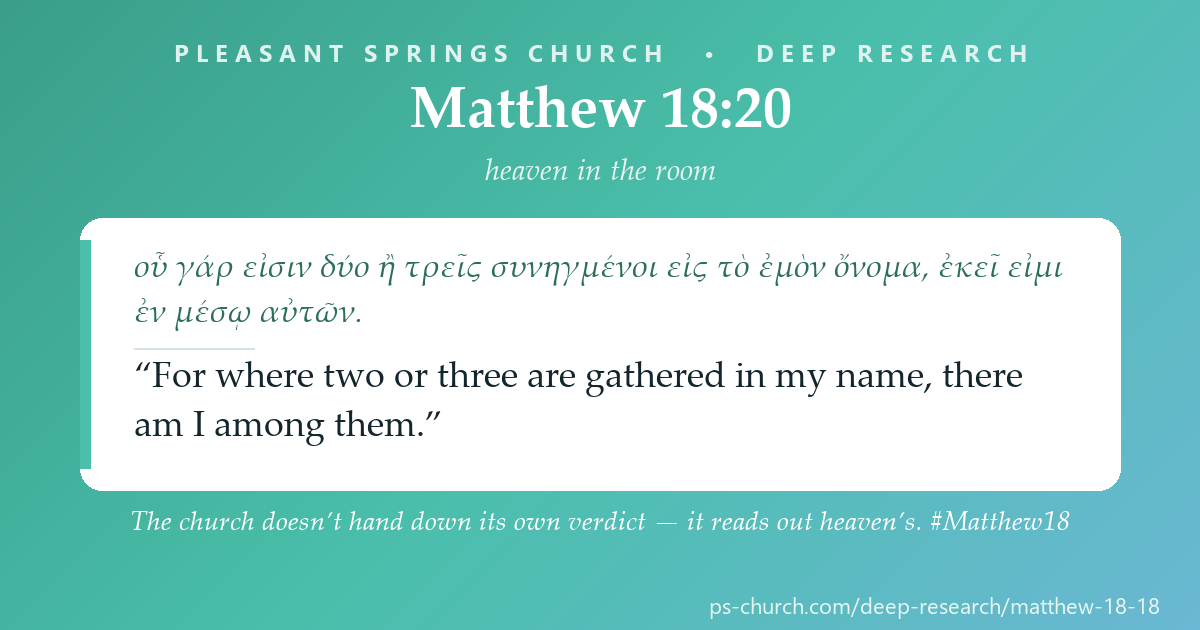
Verse 20 — “where two or three are gathered in my name, there am I among them” — has a close Jewish analogue: “if two sit together and words of Torah pass between them, the Shekhinah rests between them” (m. Avot 3:2, cf. 3:6). The saying is attributed to Rabbi Hananiah ben Teradion, a contemporary of the apostolic generation, though the Mishnah recording it is later.
The logic is identical and the substitution is enormous: what the rabbis said of the divine Presence and Torah, Matthew's Jesus says of himself and his name. That is the ground of verse 18. The verdict of the assembly holds in heaven because heaven is in the room.
Six words that carry the whole argument.
Look up every key term in a lexicon, then concord it — first in the New Testament, then in the Septuagint, then in Second Temple Greek. Do it in that order and the shape of the debate becomes visible.
“Bind” / “loose.” Ordinary Greek for tying and untying — used in the LXX and Second Temple texts for prisoners, vows, legal obligations and demons. The word itself does not decide the question; the context has to.
“Whatever things” — neuter plural. Often taken to mean things (rulings) rather than persons. But Carson answers that Greek regularly uses the neuter of people as classes, and that in 18:18 “the context demands that persons are meant.” Contested, and it matters.
Future of “to be” + perfect passive participle — a future perfect periphrastic. Literally “will be in a state of having been bound.” The centre of a ninety-year grammatical argument (see below).
“Reprove him” — the same verb as Leviticus 19:17 LXX: ἐλεγμῷ ἐλέγξεις τὸν πλησίον σου. Verse 15 is not general advice; it is Torah obedience.
“Assembly, church” — the LXX's word for Israel's קָהָל (qahal), the covenant congregation assembled. Only Matthew uses it in the Gospels (16:18; 18:17). Not a building and not a clergy: the gathered people.
“Gathered” — perfect passive participle: having been assembled. Same root as συναγωγή. A community that has been put out of one gathering is told that Christ himself constitutes theirs.
Two observations most readers miss:
- The verbs are plural — and the promise is repeated. In Matthew 16:19 Jesus says it to Peter alone (δήσῃς…λύσῃς, singular). In 18:18 he says the identical thing to the whole body (δήσητε…λύσητε, plural). Whatever Peter received, Matthew's second telling puts it into the hands of the assembly.
- Origen noticed something in the third century that most moderns skip. Matthew 16:19 has “in the heavens” (ἐν τοῖς οὐρανοῖς, plural); 18:18 has “in heaven” (ἐν οὐρανῷ, singular). Origen built a whole argument on it (Comm. Matt. 13.31) — probably more weight than the idiom will bear, but it shows how closely the ancients read this text.
Almost every dispute about Matthew 18:18 is really a dispute about what kind of thing is being bound: a rule, a person, a sin, a spirit, or an office. Here is the whole field, each view stated as its own best advocate would state it, with the honest objection and the names to read. Two of them the evidence supports strongly; several are partly right; one is a modern misreading.
Read a view's strongest form before you evaluate it. If your summary of a position would make its holders wince, you have not understood it yet.
Halakhic ruling — forbidding and permitting
To bind is to declare a thing forbidden; to loose is to declare it permitted. The church is given authority to make binding decisions about how Scripture applies.
- The case for it
- The rabbinic idiom ʾasar / hittir means exactly this — the schools of Hillel and Shammai are described in precisely these terms, Shammai binding much on the people and Hillel loosing — and the neuter ὅσα (“whatever things”) fits rulings more naturally than people. Matthew's community faced real halakhic questions — sabbath, food, marriage, Gentile inclusion — and Acts 15 shows the apostolic church doing precisely this: “it seemed good to the Holy Spirit and to us to lay on you no greater burden than these requirements” (Acts 15:28). Some things loosed, some things bound.
- The problem with it
- The clearest evidence for the idiom is centuries later than Matthew, and the immediate context (vv.15–17) is not a doctrinal question at all — it is one brother sinning against another. The neuter argument also cuts less cleanly than it looks: Greek routinely uses neuter forms of people as classes, and Carson judges that in 18:18 “the context demands that persons are meant.”
- Who holds it
- Strack–Billerbeck; Günther Bornkamm; Davies & Allison; Ulrich Luz; R. T. France; Craig Keener; Marcus Bockmuehl. This is the majority position in modern commentaries.
Church discipline — exclusion and restoration
To bind is to exclude the unrepentant from the fellowship; to loose is to forgive and restore. The assembly's verdict is ratified in heaven.
- The case for it
- This is what the paragraph is about. Verses 15–17 are a disciplinary procedure ending in “let him be to you as a Gentile and a tax collector”; verse 18 immediately ratifies it; verse 19 supplies the quorum. The pre-Christian parallel at Qumran (CD 9:2–8; 1QS 5:24–6:1) matches step for step. And the apostolic church did exactly this: 1 Corinthians 5:1–5 binds, 2 Corinthians 2:5–11 looses (“you should rather turn to forgive and comfort him”).
- The problem with it
- It does not by itself explain the neuter “whatever things,” nor the same saying in the very different setting of 16:19.
- Who holds it
- Göran Forkman; Lawrence Schiffman (on the Qumran reproof rule); Davies & Allison; Luz; Hagner; Nolland — and, among the ancients, Chrysostom (Hom. Matt. 60) and Augustine (Tractates on John 50.12): “when the Church excommunicates, the excommunicated person is bound in heaven; when one is reconciled by the Church, the person so reconciled is loosed in heaven.”
Forgiving and retaining sins
Binding and loosing is the authority to declare sins forgiven or unforgiven — the same gift as John 20:23.
- The case for it
- John 20:23 (“if you forgive the sins of any, they are forgiven… if you withhold forgiveness, it is withheld”) is formally parallel, and the very next verses of Matthew 18 are about forgiving “seventy times seven.” The whole penitential tradition of the church grew from this reading.
- The problem with it
- John 20:23 does not contain the words bind or loose; the identification is assumed rather than argued. And Matthew elsewhere expects believers to forgive without any authorization at all (5:23–26; 6:12–15; 18:21–35). If forgiveness needed a licence, the parable that follows would make no sense.
- Who holds it
- The dominant patristic and medieval reading; assumed by most sacramental traditions. Criticised on these grounds by Richard Hiers (JBL 1985). On John 20:23 itself, see Andrew Lincoln and J. Ramsey Michaels: the apostles announce forgiveness to those who receive their message, not by private sacerdotal power.
Exorcism — binding demons, loosing their captives
To bind is to restrain Satan and his spirits; to loose is to release their victims. The saying is a grant of authority over the powers of darkness.
- The case for it
- This is the usage the verbs actually carry in the literature closest to Matthew in time: 1 Enoch 10, Jubilees 10, Tobit 8:3, Testament of Levi 18:12, the incantation texts — and in the New Testament itself (Matt 12:29; Luke 13:16; Rev 20:1–3). In Matthew 16 the promise stands beside “the gates of Hades shall not prevail,” and the “keys” of 16:19 have their counterpart in the key of the abyss (Rev 20:1) and the keys of Death and Hades (Rev 1:18). Jesus had already given the Twelve authority over unclean spirits (Matt 10:1, 8).
- The problem with it
- Neither Matthew 16 nor Matthew 18 mentions demons, and in chapter 18 the surrounding paragraph is unambiguously about a sinning brother and a congregational hearing. The reading is far stronger at 16:19 than at 18:18.
- Who holds it
- Richard H. Hiers, “‘Binding’ and ‘Loosing’: The Matthean Authorizations,” JBL 104 (1985) 233–50 — the fullest argument; H. C. Kee, “The Terminology of Mark's Exorcism Stories,” NTS 14 (1968), and Community of the New Age, 108. Michael S. Heiser endorsed Hiers' case in full on the Naked Bible Podcast (Ep. 329, “Binding and Loosing,” 2020), arguing that commentators default to late rabbinic material and never run the search through Second Temple Greek.
The keys of Peter — jurisdiction and the magisterium
The authority given to Peter in 16:19 is a governing office, extended to the apostles and their successors in 18:18.
- The case for it
- 16:19 is addressed to Peter alone, in the singular, with the keys of Isaiah 22:22 — the steward's key of the house of David, which opens and no one shuts. Whatever else is true, Matthew records a personal commission before he records a corporate one.
- The problem with it
- Matthew 18:18 repeats the identical promise to the whole assembly in the plural, which is hard to square with a transferable office — a point pressed from the third century onward. Tertullian argued the opposite extreme (the gift was Peter's personally, not the church's), and Origen insisted the promise belongs “to everyone who becomes such as that Peter was” (Comm. Matt. 12.11).
- Who holds it
- Cyprian, On the Unity of the Church 4; the medieval canonists; Vatican I; Catechism of the Catholic Church §§553, 1444–45. Contrast Tertullian, On Modesty 21, and Augustine, who read Peter as representing the whole church.
The office of the keys — the Reformation reading
Binding and loosing is the public ministry of the Word: the gospel preached and applied, condemning the impenitent and absolving the penitent. The church declares heaven's verdict; it does not create it.
- The case for it
- It takes the Greek construction seriously (see below) and it explains how a fallible assembly can speak with heaven's authority: because it is not speaking on its own. Jerome had already made the point in the fourth century — the priest binding and loosing is like the Levitical priest with the leper (Lev 13–14): he does not make the man clean, he declares what God has determined.
- The problem with it
- It can be pressed until nothing actually happens in the room — which does not fit a text whose next verse convenes a quorum and whose previous verse renders a verdict.
- Who holds it
- Martin Luther, The Keys (1530, LW 40) and the Small Catechism's “Office of the Keys”; the Augsburg Confession; John Calvin, Institutes 3.4.14 and 4.11.1–2; the Reformed and Presbyterian books of discipline. Grammatically defended by J. R. Mantey, by Nigel Turner, and — most carefully — by D. A. Carson, who concludes that the disciples are “authoritative in binding and loosing because heaven has acted first.”
The Rule of Christ — congregational discernment
Matthew 18:15–20 is the church's ordinary practice for both reconciling offenders and discerning what is right — moral discernment done by the gathered body, not by a hierarchy.
- The case for it
- It fits Matthew's plural verbs and his conspicuous lack of any officer in the passage. In Matthew's own text the deciding body is simply “the church.” The Anabaptists made this text the centre of their ecclesiology, and Acts 15 shows a whole assembly — not one man — reaching a decision.
- The problem with it
- A congregation can be as wrong as a bishop; without the controls of verse 20 and the mercy of vv.12–14 and 21–35, “discernment” can become majority opinion with a proof text.
- Who holds it
- The Schleitheim Confession (1527), art. 2; Menno Simons; Marlin Jeschke, Discipling in the Church; John Howard Yoder, Body Politics, ch. 1 — the most-cited modern treatment, though Yoder's own record of abuse has rightly complicated his legacy; Rudy Baergen, Conrad Grebel Review 36 (2018).
Prayer warfare — “I bind you, Satan”
The believer may verbally bind demonic powers and loose blessings, health or finances, and heaven is obliged to comply.
- The case for it
- It is not wrong to say that Christ has given his people real authority over the powers (Luke 10:19; Eph 6:10–18; James 4:7), and view 4 above shows the vocabulary genuinely does belong to that world. The instinct that this text concerns spiritual conflict is not baseless.
- The problem with it
- The formula reverses the sentence. Verse 18 does not say heaven ratifies whatever we declare; the Greek points the other way — earth aligns with a verdict already settled in heaven. Nowhere in the New Testament does any believer say “I bind you, Satan”; Jude 9 pointedly shows Michael refusing to presume on his own authority. And the “loosing” of money or health has no footing in this text at all.
- Who holds it
- Widespread in popular deliverance and Word-of-Faith teaching. Criticised across the theological spectrum — by D. A. Carson, by cessationist and continuationist scholars alike, and implicitly by Hiers himself, whose exorcistic reading is about apostolic mission, not about formulas.
| View | What is bound | Best evidence | Verdict |
|---|---|---|---|
| 1. Halakhic ruling | Rules, cases, applications | Rabbinic ʾasar/hittir; neuter ὅσα; Acts 15:28 | Likely part of the sense; sources are late |
| 2. Church discipline | Persons — excluded or restored | vv.15–17 context; CD 9 / 1QS 5–7; 1 Cor 5 & 2 Cor 2 | Primary sense in Matthew 18 |
| 3. Forgiving / retaining sins | Sins | John 20:23; vv.21–35 | A true consequence, not the definition |
| 4. Exorcism | Demons and their captives | 1 Enoch 10; Tobit 8:3; T. Levi 18:12; Matt 12:29; Rev 20:1 | Strong at 16:19; secondary at 18:18 |
| 5. The keys of Peter | Jurisdiction | 16:19 singular; Isaiah 22:22 | Cannot account for the plural of 18:18 |
| 6. Office of the keys | Heaven’s verdict, declared | The future perfect periphrastic; Jerome on the leper | The right control on all of the above |
| 7. Rule of Christ | What the body discerns together | Plural verbs; no officer named; Acts 15 | Sound application |
| 8. Prayer warfare | Satan, on demand | — | Reverses the sentence; not in this text |
When an interpretive fight has run for ninety years over a single construction, learn the construction. You do not need Greek to follow it — only to see what is at stake.
What the Greek actually says
Verse 18 does not use a simple future. It uses ἔσται δεδεμένα — the future of “to be” plus a perfect passive participle. Greek grammarians call this a future perfect periphrastic. Woodenly: “shall be in the state of having been bound in heaven.”
Everything turns on whether that perfect carries its normal force of prior action. If it does, Jesus is saying: whatever you bind on earth will have already been bound in heaven — the church ratifies heaven’s decision. If it does not, he is simply saying heaven will back the church’s decision.
1939, and the argument that never ended. J. R. Mantey argued in the Journal of Biblical Literature that every English version had mistranslated the perfect, and that the true sense is “shall have been bound” (JBL 58 [1939] 243–49). In the very same issue, Henry J. Cadbury of Harvard replied that the Greek perfect does not always connote antecedent time, and concluded — fairly — that “the case for or against sacerdotalism does not rest upon disputable points of Greek grammar” (JBL 58 [1939] 251–54).
Where the discussion stands. The strongest argument for Mantey’s side is not Mantey’s. D. A. Carson concedes that on syntax alone “it seems impossible to reach a firm decision,” because plenty of Greek perfects carry something other than perfect force — and then asks a sharper question: why this form and not another? The verb λύω (“loose”) has a full range of participles available, so “it is difficult to see why Matthew did not use either the future or the present participle… if that was all he meant.” Carson concludes that the two verbs “must therefore be rendered ‘shall have been bound / loosed.’” Nigel Turner reached the same verdict (Syntax, 82–83). On the other side, Stanley Porter and other verbal-aspect scholars answer that the perfect grammaticalises state rather than time, so the construction stresses a settled condition without necessarily dating it. Notably, the Greek-speaking church seems to have heard the fuller force: when Theodoret retells Ambrose’s excommunication of the emperor Theodosius, he has the emperor quote this verse as “whatsoever ye bind on earth shall have been bound in heaven” (Eccl. Hist. 5.17).
What is safe to say. Even on the most cautious reading, the construction will not carry the popular idea that the church issues orders which heaven then obeys. Carson puts the limit exactly: the apostle “has no direct pipeline to heaven, still less do his decisions force heaven to comply; but he may be authoritative in binding and loosing because heaven has acted first.” Albright and Mann compressed it into a slogan — “the church on earth carries out heaven’s decisions, not heaven ratifying the church’s decisions” — which Carson thinks caricatures the options slightly, but which points the right way. Cadbury was right that the doctrine cannot be built on the participle alone; he was arguing against building it there, not for the reverse.
The web this verse gathers — backwards into Torah and forwards into apostolic practice.
Follow the quotations first (they are certain), then the allusions (they are strong), then the echoes (they are suggestive). Do not let an echo outrank a quotation.
Backwards — the Old Testament under the passage:
- Leviticus 19:17–18 — “you shall reason frankly with your neighbour, lest you incur sin because of him… you shall love your neighbour as yourself.” The LXX verb (ἐλέγξεις) is Matthew's verb in v.15. Verse 15 is a command to obey Leviticus, and the love command is the sentence it comes attached to.
- Deuteronomy 19:15 — “by the evidence of two or three witnesses shall a charge be established,” quoted almost verbatim in v.16. Matthew imports Israel’s court into the church.
- Isaiah 22:22 — the key of the house of David laid on Eliakim's shoulder: “he shall open, and none shall shut.” Behind the keys of Matthew 16:19, and quoted of Christ himself in Revelation 3:7.
- Ezra 10:8; Numbers 12:14–15 — exclusion from the congregation as an Old Testament reality, not a Christian invention.
- Psalm 82; Deuteronomy 32:8–9 — God standing in the divine council to judge. The pattern of a heavenly court whose verdicts are executed on earth is older than Matthew, and Paul turns it around: “do you not know that the saints will judge the world… that we are to judge angels?” (1 Cor 6:2–3).
Sideways — the two parallel sayings:
- Matthew 16:19 — the same promise to Peter alone, singular, with the keys, beside “the gates of Hades shall not prevail.” Carson's judgement is worth weighing: “the two passages are tightly joined: 18:18 is a special application of 16:19” — the ministry of the keys is the proclamation of the gospel, and discipline is one aspect of it.
- John 20:23 — forgiving and retaining sins; formally parallel but lexically different (no binding or loosing language). Often equated too quickly.
- Matthew 12:29 — “how can someone enter a strong man's house and plunder his goods, unless he first binds the strong man?” The one indisputable case of δέω in Matthew, and it is about Satan.
- Luke 13:16 — the woman “whom Satan bound for eighteen years” and who ought to be loosed. Both verbs, one sentence, no ambiguity.
Forwards — how the apostles actually used it:
- 1 Corinthians 5:1–5, 13 — the assembly gathered “with the power of our Lord Jesus,” delivering an unrepentant man to Satan “so that his spirit may be saved.” Binding, and note the aim.
- 2 Corinthians 2:5–11 — the same man restored: “you should rather turn to forgive and comfort him… so that we would not be outwitted by Satan.” Loosing, in Paul's own hand.
- Galatians 6:1; 2 Thessalonians 3:14–15; 1 Timothy 1:20; Titus 3:10; 2 John 10 — the full apostolic range, always with restoration in view: “do not regard him as an enemy, but warn him as a brother.”
- Acts 15:19–29 — the assembly deciding what to lay on the Gentiles and what to lift: “it seemed good to the Holy Spirit and to us.” Whatever binding and loosing looks like in practice, this is it.
- Revelation 1:18; 20:1–3 — the keys of Death and Hades in the hand of the risen Christ, and the key of the abyss used to bind the dragon. The keys belong to him first.
Views 2 and 4 are usually presented as rivals, and at 18:18 the disciplinary reading clearly wins the context. But look at what Paul actually does with an unrepentant member: he hands him over to Satan (1 Cor 5:5; 1 Tim 1:20), and he restores him lest the church “be outwitted by Satan” (2 Cor 2:11). For the apostles, putting someone outside the assembly and putting him in the domain of darkness were the same act described from two sides — and always, in Paul, with his salvation as the goal. The disciplinary reading and the cosmic reading are not competitors. They are the earth-side and the heaven-side of one event.
What to read, in the order worth reading it.
Start with a commentary that surveys the history of interpretation (Luz), add the technical one (Davies–Allison), then read the two or three journal articles that actually moved the discussion.
Commentaries:
- W. D. Davies & Dale C. Allison, A Critical and Exegetical Commentary on the Gospel According to Saint Matthew, vol. 2 (ICC, 1991) — on 18:18, the parallels laid out without special pleading.
- Ulrich Luz, Matthew 8–20 (Hermeneia, 2001) — the Wirkungsgeschichte: how this verse was used, and misused, through twenty centuries. Indispensable here.
- R. T. France, The Gospel of Matthew (NICNT, 2007); Craig S. Keener, A Commentary on the Gospel of Matthew (1999); John Nolland (NIGTC, 2005); Donald Hagner (WBC, 1995).
- D. A. Carson, “Matthew,” in The Expositor's Bible Commentary — the clearest evangelical handling of the periphrastic construction.
Journal articles & monographs:
- J. R. Mantey, “The Mistranslation of the Perfect Tense in John 20:23, Mt 16:19, and Mt 18:18,” JBL 58 (1939) 243–49 — and Henry J. Cadbury's reply, “The Meaning of John 20:23, Matthew 16:19, and Matthew 18:18,” JBL 58 (1939) 251–54.
- Richard H. Hiers, “‘Binding’ and ‘Loosing’: The Matthean Authorizations,” JBL 104 (1985) 233–50 — the case for the exorcistic background.
- Dennis C. Duling, “Binding and Loosing: Matthew 16:19, Matthew 18:18, John 20:23,” Forum 3 (1987) — the standard survey of options.
- Günther Bornkamm, “Die Binde- und Lösegewalt in der Kirche des Matthäus” (1970) — the classic argument for the halakhic reading.
- Göran Forkman, The Limits of the Religious Community (1972); Lawrence H. Schiffman, Sectarian Law in the Dead Sea Scrolls (1983) — on reproof as a legal prerequisite at Qumran.
- H. C. Kee, “The Terminology of Mark's Exorcism Stories,” NTS 14 (1968); Nigel Turner, A Grammar of New Testament Greek III: Syntax, 82–83, and Grammatical Insights into the New Testament, 80–82 — the grammarian who put the strongest case behind Mantey.
The ancient interpreters — read them in their own words:
- Origen, Commentary on Matthew 12.11, 14 and 13.31 — the only extended ancient exegesis of 18:18 itself. Origen ties the authority to character: “when one judges unrighteously, and does not bind upon earth according to the Word of God… the gates of Hades prevail against him”; and if a man “imagines as a Peter that he will so bind on earth… he is puffed up, not understanding the meaning of the Scriptures.”
- Tertullian, On Modesty 21 — the sharpest ancient dissent: the power was given to Peter personally, and “the right and arbitrament is the Lord's, not the servant's; God's Himself, not the priest's.”
- Chrysostom, Homilies on Matthew 60 — notices that Jesus does not address a church officer: “He did not say to the ruler of the church, ‘Bind such a man,’ but, ‘If thou bind’” — the whole procedure is entrusted to the wronged brother and the assembly, and its purpose is that the offender “may become more gentle.”
- Augustine, Tractates on John 50.12 — Peter receives the keys as the representative of the whole church: “when the Church excommunicates, the excommunicated person is bound in heaven; when one is reconciled by the Church, the person so reconciled is loosed in heaven.”
- Jerome, Commentary on Matthew (at 16:19) — the priest who binds and looses is like the Levitical priest with a leper (Lev 13–14): he does not make clean or unclean, he declares what God has already determined.
- Cyprian, On the Unity of the Church 4; Theodoret, Ecclesiastical History 5.17 — the emperor Theodosius, barred from communion by Ambrose, weeping in the palace: “for me the door of heaven is shut.” The verse in action, on the most powerful man alive.
Now the payoff question. Strip away twenty centuries of church politics and ask what a Greek-speaking Jewish congregation in the 70s, hearing this scroll read aloud in someone's house, would have understood.
They were not asking our question. We come to Matthew 18:18 wanting to know who runs the church, or whether we may command demons. They came to it with a much more immediate problem: a member of our house-church has wronged another member and will not stop, and we have already been thrown out of one assembly this year.
Here is what the sentence would have meant in that room.
1. “This is our Leviticus, and it still binds us.”
The first thing they heard was not a new power but an old command. Go and reprove him is Leviticus 19:17 in Greek, and every Jewish hearer knew what came next in that verse: lest you incur sin because of him — and what came one line later: love your neighbour as yourself. Silence about a brother’s sin was not politeness. It was participation. And the Qumran community down by the Dead Sea had drawn exactly the same conclusion from exactly the same verse, with exactly the same witnesses, a century earlier. Matthew’s procedure would have sounded not novel but recognisable: this is how a covenant community handles sin.
2. “We are a court, and we have a quorum.”
Verse 16 quotes Deuteronomy 19:15 — the two-or-three-witness rule from Israel’s law courts. Verse 17 escalates to the ἐκκλησία, the word the Greek Bible uses for Israel assembled before God. Verse 20 supplies the two or three again, now as those in whose midst Christ stands. Their rabbinic contemporaries said the Shekhinah rests between two who study Torah; Matthew says something far more startling — I am there. A congregation with no temple, no sanhedrin and no standing in the synagogue is told that its living room is a courtroom with heaven seated in it.
3. “Bound and loosed — we know that language, and it is not ours to invent.”
They heard a legal idiom and a cosmic one at once, and they would not have felt the need to choose. To bind was to declare a thing forbidden or a person excluded; to loose was to permit, release, restore. They also knew, from Enoch and Tobit and the Testaments, that God binds spirits and looses their captives — and they had watched Jesus bind the strong man and loose a daughter of Abraham whom Satan had tied up for eighteen years. When the church put someone out, they were not merely revising a membership roll. They were saying: this man is, for now, outside — and outside is where the enemy still has a claim. That is precisely how Paul spoke of it a few years earlier (1 Cor 5:5), and precisely why he hurried to reverse it (2 Cor 2:11).
4. “The verdict is heaven’s, and we are reading it out.”
This is where the grammar earns its keep. Jesus does not say “heaven will do whatever you decide.” He says that what you bind on earth will stand bound in heaven — and the perfect participle leans, as Mantey argued and Carson has argued at length, toward a state already settled there. A persecuted minority handed the terrifying power to exclude is being told two things at once: your decision is not trivial, and it is not yours. You are a herald reading a verdict, not a judge inventing one. Jerome’s picture is the right one — the priest inspecting the leper does not make him clean; he declares what God has determined.
5. “And the whole thing is aimed at getting him back.”
Matthew’s framing is the loudest thing in the chapter, and it is the thing most often ignored. Immediately before: a shepherd leaves ninety-nine sheep to go after one, “so it is not the will of my Father… that one of these little ones should perish” (18:14). Immediately after: Peter asks how often he must forgive, is told seventy times seven, and hears a parable in which the man who would not forgive is handed to the jailers (18:21–35). The stated goal of step one is you have gained your brother. Even the last step — “as a Gentile and a tax collector” — lands strangely in this Gospel, written by a tax collector, in which Jesus is repeatedly accused of eating with exactly those people. The door is shut in a way that leaves the shepherd free to go out after him.
To a small, recently-excluded Jewish-Christian congregation, Matthew 18:18 said: when this assembly, following the Torah’s own procedure of reproof and witnesses, and gathered in the name of the risen Jesus who is standing among you, declares a matter closed or a brother out — or declares him forgiven and back in — that verdict is not a human opinion. It is heaven’s verdict, spoken on earth. The authority is real, corporate rather than personal, derived rather than autonomous, exercised under the Torah’s procedures and the Lord’s presence — and its entire purpose is to gain the brother back, not to win the case.
What it did not mean to them: that a church may bind whatever it likes and heaven must comply; that one man holds the keys alone; or that a believer may issue commands to Satan and expect them enforced. Those readings all arrived later, and all of them run against either the plural verbs, the perfect participle, or the parable on either side.
From the study to the room you actually worship in.
Name what you learned, why it matters, and one concrete response.
What should we carry away — and do?
- Go first, go alone, go to him. The step almost nobody takes is step one, and it is the only step with a stated success condition: you have gained your brother. Most of what passes for church conflict is people executing step three without ever attempting step one.
- The authority is real — and it is borrowed. A church that will not exclude anyone has not understood verse 18; a church that excludes easily has not understood verses 12–14 or 21–35. The same paragraph says both.
- Loosing is the harder half. Every tradition has practised binding. Paul had to command a church to reinstate a repentant man before Satan gained the advantage (2 Cor 2:5–11). Ask which half your congregation finds difficult.
- Two or three is enough. The verse most often quoted to comfort a small attendance is, in context, about a quorum for the hardest thing a church ever does — which makes it a far better promise than the one we usually get from it.
Step in response: think of one relationship in which you have taken step three (telling others) without ever taking step one (going alone). Take step one this week — and read Matthew 18 straight through in a single sitting first, so that the sheep and the unforgiving servant are still ringing in your ears when you knock.
Matthew 18:20 · to share
Greek NT + ESVEvery Deep Research page traces its passage across the whole sweep — the Old Testament, the Second-Temple world between the testaments (historical witnesses, not Scripture), and the New Testament. Follow the thread:
Pleasant Springs Church — Deep Research
Research method after Michael S. Heiser’s Bible Research Method (examine dictionaries → ancient literature → important words → textual connections → academic publications → share), with the Pleasant Springs “Author & Audience” foundation. Scripture set in the Hebrew, the Greek editions named on each page and the ESV (Old Testament), and the Greek New Testament and the ESV (New Testament), per the practice of Pleasant Springs Church. Matthew 18:18 research grounded in Davies–Allison, Luz, France, Keener, Nolland, Hagner and Carson; the 1939 JBL exchange between Mantey and Cadbury; Hiers, JBL 104 (1985); Duling, Forum 3 (1987); Forkman and Schiffman on exclusion and reproof at Qumran; and the ancient interpreters read in their own words — Origen, Tertullian, Chrysostom, Augustine, Jerome, Cyprian and Theodoret.
Scripture quotations marked ESV are from the ESV® Bible (The Holy Bible, English Standard Version®), © 2001 by Crossway, a publishing ministry of Good News Publishers. ESV Text Edition: 2016. Used by permission. All rights reserved. The ESV text may not be quoted in any publication made available to the public by a Creative Commons license, and the ESV may not be translated in whole or in part into any other language. www.esv.org
|
Did this study bless you today? 💚 Give to Support PS Church100% of gifts go to the General Fund — thank you. |