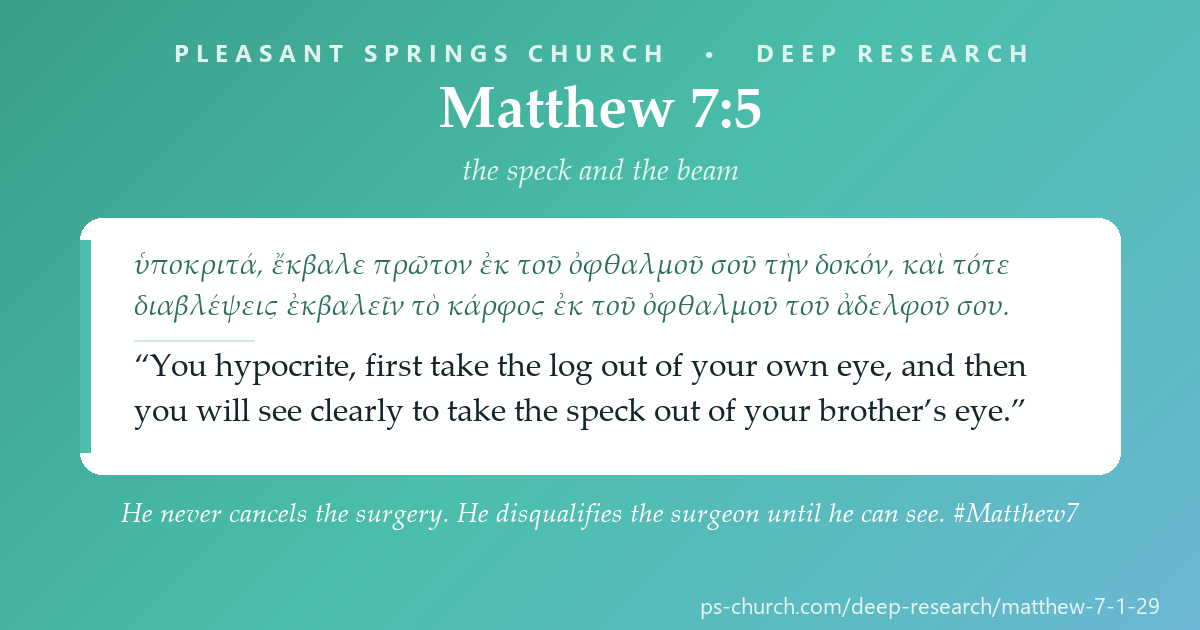
A man walks up to his brother with a roof-beam sticking out of his own eye, offering to remove a speck of chaff from his brother’s. It is physically impossible, and it is meant to be — a builder’s joke from a builder’s son. But the joke has a hook in it: everyone who hears it thinks first of somebody else who does this, which is the trap closing. This study takes Matthew 7 all the way down — the Greek behind the picture, the Leviticus command Jesus is guarding rather than abolishing, the four pairs that end the sermon, and the medieval scholar who decided that “Judge not” should start a chapter. See the method →
Matthew 7:1–29
Greek NT · ESVThe Shape of the Passage
Frame & four pairsWho wrote this, to whom, in what situation? Matthew 7 is the last movement and the epilogue of the Sermon on the Mount — and the people being warned about criticism are the people already doing the criticising.
Author
Church tradition from Papias (early 2nd c.) onward names Matthew the tax collector (Matt 9:9; 10:3) as the evangelist. His Gospel is the most deliberately Jewish of the four, built around five great discourses (chs. 5–7, 10, 13, 18, 23–25), each sealed with the same formula: “when Jesus finished these sayings” (7:28; 11:1; 13:53; 19:1; 26:1).
Matthew tells you where his seams are. He opens the sermon by staging it (5:1–2: the mountain, the seated teacher, the opened mouth) and closes it with that formula at 7:28–29. Between them he sets one more marker: “the Law and the Prophets” at 5:17 and again at 7:12. Those are the author’s divisions. The chapter numbers came a thousand years later — see Why Is This a Chapter?
Audience
A largely Jewish-Christian community (often located at Antioch, writing c. 60s–80s AD), living through the painful parting from the synagogue. The immediate audience inside the story is doubled: the disciples came to him (5:1), and the crowds were still listening at the end (7:28). The foil throughout is the scribes and Pharisees (5:20; 7:29).
The man with the beam is not a villain — he is helping. He has volunteered for eye surgery on his brother. This is aimed at the religiously sincere. And the word that lands on him, ὑποκριτά, is the same word Jesus used three times in the previous chapter for showy piety (6:2, 5, 16). Same disease, second symptom: the man who blows a trumpet for his almsgiving is the man who inspects his brother’s eye.
Orient on judging, hypocrisy, the Two Ways, and false prophets.
Search by reference and by topic: judging, hypocrite, Sermon on the Mount, Golden Rule, false prophet, two ways.
Which articles are relevant?
- Dictionary of Jesus and the Gospels (IVP) — “Sermon on the Mount,” “Judging,” “Hypocrisy,” “Golden Rule,” “False Prophet.”
- Anchor Bible Dictionary — “Sermon on the Mount,” “Golden Rule,” “Two Ways.”
- NIDNTTE — κρίνω, ὑποκριτής, κάρφος, δοκός, ἀνομία, καρπός.
- Dictionary of New Testament Background (IVP) — “Rabbinic Literature,” “Reproof,” “Qumran: Community Rule” — for the reproof procedure behind Lev 19:17.
Bibliography surfaced:
- W. D. Davies & Dale Allison, Matthew 1–7 (ICC) — the fullest technical treatment of the epilogue and its parallels.
- R. T. France, The Gospel of Matthew (NICNT); Craig Keener, The Gospel of Matthew; John Nolland (NIGTC).
- Hans Dieter Betz, The Sermon on the Mount (Hermeneia); Robert Guelich, The Sermon on the Mount.
- Jonathan Pennington, The Sermon on the Mount and Human Flourishing.
The speck-and-beam proverb, the reproof rule, and the Two Ways — all older than the sermon.
Jesus is not inventing this vocabulary. Set each piece beside its Second-Temple and rabbinic neighbours and watch what he keeps and what he turns.
Which parallels shed light on religion and worldview?
The speck and the beam was already a proverb. A saying attributed to Rabbi Tarfon (late 1st / early 2nd c. AD) laments that no one in his generation accepts reproof: say “remove the splinter from your eye” and the answer comes back, “remove the beam from your eye” (b. Arakhin 16b; cf. b. Bava Batra 15b). Read this carefully: the Talmud was compiled centuries after Matthew, so this is not a source Jesus quoted — it is evidence that the splinter/beam idiom belonged to a shared stock of Jewish proverbial speech. In the rabbinic form the complaint is about the hearer who deflects reproof. Jesus turns the same image against the reprover.
Reproof was a commandment, and a regulated one. Leviticus 19:17 obliges the Israelite to reprove his neighbour. At Qumran that command became a written procedure: the Community Rule requires reproof “in truth, humility, and loving-kindness,” not in anger and not before witnesses have been brought (1QS 5:24–6:1), and the Damascus Document makes reproof-before-witnesses a precondition of any charge (CD 9:2–8). A first-century Jewish hearer did not need to be told that correction was required; he needed to be told who is fit to give it.
The Golden Rule in its negative form was current. ὃ μισεῖς, μηδενὶ ποιήσῃς — “what you hate, do to no one” (Tobit 4:15, a Second-Temple witness outside the 66-book canon), and the famous reply of Hillel: “What is hateful to you, do not do to your neighbour” (b. Shabbat 31a).
The Two Ways was a whole tradition. Deuteronomy 30:15–19 and Jeremiah 21:8 set life and death before the hearer; Qumran’s Community Rule develops the two spirits and two paths (1QS 3:13–4:26); and the Didache opens with it flatly: “There are two ways, one of life and one of death” (Did. 1:1).
Every element in this chapter existed before him. What is new is the order. The proverb about beams was a complaint about people who will not receive correction; Jesus makes it a disqualification of those who rush to give it. The reproof rules at Qumran regulated the procedure; Jesus goes behind procedure to the eye of the man holding the tweezers. And where Tobit and Hillel say do not do, Jesus says do (7:12) — the difference between an abstention and an obligation.
The vocabulary that carries the chapter — and the joke that is built into it.
Two pairs do most of the work: κάρφος/δοκός (the absurd size gap) and βλέπω/κατανοέω (the absurd attention gap). Then watch the sight-words run from v.5 to v.20.
A dry twig, a bit of chaff or straw — something you would blink out. The smallest speck the language has a word for.
Not a large splinter: a load-bearing beam, a roof-joist. A builder’s word, from a builder’s son (Matt 13:55, ὁ τοῦ τέκτονος υἱός). The image is deliberately impossible.
The irony sits in the verbs. He looks at (βλέπω) the tiny thing, but fails to notice (κατανοέω — the stronger verb, “perceive attentively”) the enormous one. Scrutiny for the speck; no attention at all for the beam.
Vocative of ὑποκριτής — originally the stage actor, the one who plays a part. The same word Jesus used at 6:2, 6:5 and 6:16 for public piety, now aimed at public criticism.
“You will see clearly” — δια- intensive, to see through. Future indicative, not a prohibition: sight is promised back, and with it the speck-removal Jesus never cancels.
The measure. “With the measure you use it will be measured to you” — a divine passive: God is the unnamed one doing the measuring. Turned positive, this becomes the Golden Rule of v.12.
“You will recognise them” — future, twice, bracketing the false-prophet unit. The sight restored in v.5 is now commanded to be used.
“Lawlessness” — the sentence-word. οἱ ἐργαζόμενοι τὴν ἀνομίαν is lifted verbatim from Psalm 6:8 ESV (LXX/MT 6:9).
Why the analogy, and why first?
Because a picture makes the hearer render the verdict before he learns he is the defendant. This is the mechanism of Nathan’s parable in 2 Samuel 12: David condemns the man who stole the ewe lamb, and only then hears “You are the man.” Everyone hearing Matthew 7:3–4 thinks first of someone else who does this — and that reaction is the trap closing. The analogy performs v.2 in real time: the measure you just used has been measured back to you. A bare rule cannot do that.
Because it is a mercy. Notice the order: the image comes first (vv.3–4), then the verdict “hypocrite” (v.5a), then the remedy (v.5b), then the restored ministry (v.5c). He lets a man convict himself privately before the word is said out loud. That is itself an application of v.12 — he corrects the way he would want to be corrected.
Because you cannot obey a picture; you can only recognise yourself in it. A rule can be kept externally, which is precisely the disease being named. An image gets underneath the performance in a way a rule never does.
Two verses before this — on the far side of our chapter division — Jesus said: “The eye is the lamp of the body… if your eye is bad (πονηρός), your whole body will be full of darkness” (6:22–23). The man with a beam in his eye is that man: by definition he cannot see. Luke makes the same connection explicit by arrangement — in the Sermon on the Plain the speck-and-log saying sits directly beside “Can a blind man lead a blind man?” (Luke 6:39–42). Read continuously, 6:22 and 7:3 are one thought. Read as chapters, they are two.
The Old Testament under the chapter — especially the Leviticus command Jesus is guarding.
Trace the OT texts under each unit in the Septuagint, note where the Greek and English verse numbers differ, then follow the echoes outward into the New Testament.
Which cross-references matter?
- Leviticus 19:15–18 is the passage standing under vv.1–5, and it settles the “never judge” misreading from the Torah’s own side. v.15 LXX: ἐν δικαιοσύνῃ κρινεῖς τὸν πλησίον σου — “in righteousness shall you judge your neighbour.” v.17 LXX: οὐ μισήσεις τὸν ἀδελφόν σου… ἐλεγμῷ ἐλέγξεις τὸν πλησίον σου καὶ οὐ λήμψῃ δι’ αὐτὸν ἁμαρτίαν — “You shall not hate your brother… you shall reason frankly with your neighbour, lest you incur sin because of him.” Note ἀδελφός: the same word Jesus uses three times in vv.3–5. Torah commands reproof and warns in the same breath that you can sin in the doing of it. Matthew 7:1–5 is not the abolition of that command; it is the guard on it.
- Psalm 6:8 ESV · LXX/MT 6:9 stands behind v.23. LXX: ἀπόστητε ἀπ’ ἐμοῦ, πάντες οἱ ἐργαζόμενοι τὴν ἀνομίαν. Matthew: ἀποχωρεῖτε ἀπ’ ἐμοῦ οἱ ἐργαζόμενοι τὴν ἀνομίαν. Stated honestly: the clause οἱ ἐργαζόμενοι τὴν ἀνομίαν is verbatim, but the verb differs (ἀποχωρεῖτε for the LXX’s ἀπόστητε) — so this is a strong allusion, not a formula quotation. The English and Greek verse numbers differ because the Hebrew and the Septuagint both count the psalm’s superscription as verse 1.
- Deuteronomy 30:15–19 and Jeremiah 21:8 stand under vv.13–14. Jer 21:8 LXX: ἰδοὺ ἐγὼ δέδωκα πρὸ προσώπου ὑμῶν τὴν ὁδὸν τῆς ζωῆς καὶ τὴν ὁδὸν τοῦ θανάτου — “the way of life and the way of death.” (Jeremiah’s Greek and Hebrew diverge sharply in chapter order later in the book, but not here.)
- Isaiah 28:16 under vv.24–27 — the tested foundation stone; and Psalm 1, whose two ways and fruit-bearing tree are the whole epilogue in miniature.
- Luke 6:37–42 — the same sayings in the Sermon on the Plain, arranged differently: judge-not, then the blind guide, then the speck and the log, then the tree and its fruit. Luke’s order independently confirms that sight and fruit belong together.
- Matthew 18:15–20 — where the beam-free brother finally does the speck-removal, by procedure: go and tell him his fault, then take witnesses. See also Binding and Loosing.
- Romans 2:1–3; James 4:11–12; 1 Corinthians 4:3–5 — the apostles preaching this chapter onward: you condemn yourself in judging, there is one Lawgiver and Judge, and the Lord will bring the hidden things to light in his own time.
Verse 2 and verse 12 are the same principle facing opposite directions. “With the measure you use it will be measured to you” is the warning; “whatever you wish that others would do to you, do also to them” is the same arithmetic turned generous. And the second one carries the tag — this is the Law and the Prophets — that closes what 5:17 opened. Reciprocity is not a threat hanging over the sermon; it is the sermon’s summary.
The commentaries, and the disputed verse nobody has settled.
Davies–Allison and Betz for the technical spade-work; then face the two genuine cruxes honestly rather than smoothing them over.
Commentaries & studies:
- Davies & Allison, Matthew 1–7 (ICC) — every ancient parallel to the epilogue, and the fullest discussion of 7:6.
- R. T. France (NICNT); Craig Keener; John Nolland (NIGTC); Grant Osborne (ZECNT); D. A. Carson, Matthew (EBC).
- Hans Dieter Betz, The Sermon on the Mount (Hermeneia) — the sermon as a composed literary whole with its own epilogue.
- Classic: Augustine, On the Sermon on the Mount; Chrysostom, Homilies on Matthew 23–24; Bonhoeffer, Discipleship.
Text & interpretation notes:
- Verse 6 is the crux of the chapter. “Do not give dogs what is holy” has no agreed referent. The main readings: (a) it is the counterweight to vv.1–5 — forbidding condemnation is not forbidding discernment; (b) “dogs” and “pigs” are outsiders, so vv.1–5 govern the ἀδελφός inside and v.6 governs those outside; (c) it guards the gospel from contemptuous handling; (d) some propose an Aramaic wordplay behind “what is holy.” Reading (a) with (b) fits the flow best — and it is what we teach here — but the honest position is that this verse remains genuinely disputed.
- “Judge not” is a present imperative (μὴ κρίνετε), which frames the prohibition as a settled practice rather than a single act. The older grammatical claim that this must mean “stop doing what you are already doing” has been qualified by later verbal-aspect studies (Fanning, Porter); the modest and defensible point is that Jesus addresses a habit, not one lapse.
- Verses 13–14 show minor variation among manuscripts (τί or ὅτι at v.14; a few witnesses omit ἡ πύλη). Nothing in the sense turns on it.
- “I never knew you” (v.23) is relational, not informational — γινώσκω in the covenant sense of acknowledging as one’s own (cf. Amos 3:2). The sobering point of vv.21–23 is that the works listed are real works, done in his name.
From the beam to Monday.
Name what you learned, why it matters, and one concrete response.
What should we carry away — and do?
- The chapter distinguishes a critic from a disciple. The critic sees others, says “Lord, Lord,” even prophesies in his name — and builds on sand. The disciple sees himself first, asks the Father, bears fruit, does the words. Same confession in the mouth; different foundation under the house.
- The speck is real, and it still has to come out. Jesus never cancels the operation — he disqualifies the surgeon until the surgeon can see. “Judge not” is not a licence for indifference; ten verses later he requires you to recognise wolves by their fruit.
- You cannot remove your own beam. That is why vv.7–11 follow: ask, seek, knock. The Father gives bread, not a stone. The prayer paragraph is not a change of subject — it is the answer to the impossible command just given.
- There is a Judge, so you do not have to be one. Verse 1 takes the bench away from you; vv.22–23 show you who actually holds it. That is a relief, not a threat.
Step in response: before you next raise a concern about someone — in a meeting, a message, or your own head — write down one sentence naming the beam in your own eye on the same subject. Then decide whether to speak. And read Matthew 5:1 through 7:29 in one sitting, without looking at the chapter numbers, to hear the sermon the way its first audience did.
Matthew 7:5 · to share
Greek NT + ESVA study is stronger for being read by someone else. This reading of Matthew 7 was contributed by Dwight Morrison, and it asks a question the six stages above never put: if this is a lesson, what exactly are they blind to? We set it out in his own terms, then test it the way we test everything here — against the author and the audience.
The reading, contributed by Dwight Morrison. He begins from the fact that Jesus is teaching, and presses on the content of the metaphor rather than its force:
If He is talking to the audience as a lesson, then what are they blind to? Blindness was often an analogous term for ignorance… judging what one does not have true knowledge of makes one a hypocrite, pretending to have knowledge that they do not possess; therefore, they must remove that which is blinding them (ignorance) in order to judge more accurately.Dwight Morrison
The reading in brief
- Blindness stands for ignorance — a standard biblical metaphor, not a novel one.
- The chapter’s own later material supplies the referent. The warning about false prophets (ψευδοπροφήτης, 7:15) tells you what the blindness is about; and the same word appears in the parallel sermon at Luke 6:26 — …ἐποίουν τοῖς ψευδοπροφήταις οἱ πατέρες αὐτῶν.
- Jesus uses the same blindness-language of the Pharisees at Matthew 15:14: τυφλοί εἰσιν ὁδηγοὶ τυφλῶν — “they are blind guides of the blind.”
- The imagery lands with a working audience — people who knew timber, and a landscape that put grit in your eye.
- Therefore the hypocrite is a pretender to knowledge. To judge what you do not truly know is to perform an expertise you do not have; the beam to be removed is the ignorance itself, and its removal is what makes accurate judgment possible.
Testing it against the author
Matthew supports this reading, and more strongly than the citations given. Of the four evangelists, Matthew has by far the densest blindness motif aimed at religious leaders: beyond 15:14 he stacks it five times in a single chapter — ὁδηγοὶ τυφλοί and τυφλοὶ at 23:16, 17, 19, 24 and 26.
And Matthew makes the same move twice, in the same words. Compare the two commands:
ἔκβαλε πρῶτον… τὴν δοκόν — “first take out the log” (7:5, to the ὑποκριτής)
Φαρισαῖε τυφλέ, καθάρισον πρῶτον τὸ ἐντὸς τοῦ ποτηρίου — “blind Pharisee, first clean the inside of the cup” (23:26)
Same construction, same πρῶτον, same kind of addressee — and in 23:26 Matthew calls him blind where in 7:5 he calls him hypocrite. The author treats the two words as describing one man.
Decisively, Matthew glosses sight as understanding himself. At 13:14–15 he quotes Isaiah 6:9–10 at length: βλέποντες βλέψετε καὶ οὐ μὴ ἴδητε — “seeing you will see and not perceive” — and closes with τῇ καρδίᾳ συνῶσιν, “understand with their heart.” Matthew’s own proof text equates failing to see with failing to understand. Morrison’s premise is the evangelist’s.
Testing it against the audience
An audience formed on the Septuagint would hear this immediately — and the Greek is even more explicit than the Hebrew. Isaiah 56:10 LXX describes Israel’s watchmen: ἴδετε ὅτι πάντες ἐκτετύφλωνται, οὐκ ἔγνωσαν φρονῆσαι — “they have all been blinded, they do not know how to understand.” The Septuagint sets blindness and not-knowing in apposition inside a single clause. That is Morrison’s thesis, stated by the Greek Old Testament the church reads.
And the subject of that verse matters: watchmen — men whose entire office is to see on everyone else’s behalf. Isaiah 42:19 does the same with the servant. These are the texts about sighted offices going blind, which is exactly the false-prophet problem of 7:15–20. An audience carrying Isaiah would connect the beam to the failed watchman without being told.
Paul makes the identical linkage explicitly. In Romans 2 he opens with the judging problem in words that track Matthew 7:1 — “you have no excuse, O man, every one of you who judges” (2:1) — and then, in the same argument, names the fault: πέποιθάς τε σεαυτὸν ὁδηγὸν εἶναι τυφλῶν, “you are confident that you are a guide to the blind” (2:19). The earliest interpreter we have puts presumptuous judging and blind-guiding in one breath.
The trade vocabulary holds. δοκός is a load-bearing timber, and the sermon is preached by a τέκτων’s son in a building economy. Morrison is right that the picture is drawn from the audience’s working world.
Where the reading needs adjusting
Three qualifications — none of which sink it, and the first two sharpen it.
- The sand belongs to verse 26, not verse 3. The speck is κάρφος — a dry twig, chaff, a bit of straw: vegetable matter, not mineral. Sand (ἄμμος) does arrive in this chapter, but eleven verses later, under the foolish man’s house (7:26). The underlying instinct is nevertheless sound, and arguably better than stated: both images come from the building trade, and they stand at opposite ends of the chapter — a beam at the start, a foundation at the finish.
- “Pretender to knowledge” is a fair gloss on ὑποκριτής, but not the only one a Jewish-Greek ear would carry. The word’s theatrical background (the actor playing a part) is real and supports the reading. But in the Septuagint ὑποκριτής renders ḥānēp, “godless, profane” (Job 34:30; 36:13) — so a hearer steeped in the Greek Old Testament may hear impious at least as loudly as play-actor. The pretence reading stands; it should not be pressed as the word’s only freight.
- Ignorance cannot account for every hypocrite in Matthew. At 6:2, 6:5 and 6:16 the hypocrites know precisely what they are doing — the trumpet before the almsgiving is calculated, not ignorant. So blindness-as-ignorance is the dominant strand in this passage and its neighbours, not a master key to all thirteen of Matthew’s uses. Matthew’s hypocrite is the man whose outside and inside diverge; that divergence is moral in chapter 6 and epistemic in chapter 7.
One observation, offered as nothing more: Isaiah 56:10 LXX places blinded watchmen and κύνες (“dogs”) in a single verse, and Matthew 7:5–6 places the blinded eye and κυσίν in consecutive verses. We have not seen this argued as an allusion and do not claim it as one — dogs are common currency in both literatures. It is noted so a reader can weigh it, not lean on it.
Taken with the qualifications above, this is a real gain, and it answers something the moral reading leaves loose. If the beam is only moral inconsistency, the chapter’s ending does not follow — why would repenting of hypocrisy equip anyone to identify a wolf in sheep’s clothing? If the beam is ignorance, the movement is exact: sight is restored at v.5 (διαβλέψεις), and eleven verses later its use is commanded (ἐπιγνώσεσθε, vv.16, 20). The chapter stops being two subjects and becomes one.
The tightening we would add: the ignorance is most precisely ignorance of oneself. That is why the man can look hard at a speck yet fail to κατανοέω a roof-beam — the one thing a beam in your own eye guarantees is that you cannot inspect it. And it explains the remedy. If the cure for ignorance were information, verses 7–11 would prescribe study; instead they prescribe asking a Father, who gives good things to those who ask. You do not research your way out of self-deception. Someone else has to take the beam out.
This second view now has a study of its own. The reading above is worked out at full length on Matthew 7:1–6 — Blindness as Ignorance, contributed by Dwight Morrison: the six verses in Greek and ESV, the blindness metaphor traced from Deuteronomy 16 and Isaiah 56 through Romans 2 to Revelation 3, and the three places the reading needs care. Read the second view →
Why Is This a Chapter?A question the six stages do not ask, but this passage forces: who decided that “Judge not” begins something? The answer is not the evangelist, and the reasons were not exegetical.
Who divided the Bible into chapters and verses?
The earliest manuscripts have no chapters, no verses, and no spaces between words. Division systems did exist — but none of them look like ours:
- Codex Vaticanus (4th c.) divides Matthew into about 170 sections.
- The κεφάλαια system, with its τίτλοι (chapter headings), used in Alexandrinus and later manuscripts, gives Matthew 68 chapters.
- The Eusebian canons (Eusebius of Caesarea, early 4th c.) cut Matthew into 355 Ammonian sections so the four Gospels could be cross-referenced in ten tables.
- Our 28 chapters are credited to Stephen Langton (c. 1150–1228), working on the Latin Vulgate while lecturing at Paris in the early 1200s, before he became Archbishop of Canterbury. (An older attribution to Hugh of Saint-Cher persists; Hugh’s actual contribution was the concordance that used the divisions.)
- Verse numbers are later still: the Old Testament follows the Masoretic tradition, while the New Testament verses come from Robert Estienne (Stephanus) in his Greek New Testament of 1551. The Geneva Bible (1560) was the first complete English Bible to carry them.
Any system with 68 or 170 or 355 divisions necessarily cuts the Sermon on the Mount somewhere other than we do. Our divisions are one option among several the church has used.
So why does a chapter begin at 7:1?
Honestly: we do not know, and no one at the time claimed to. There is no surviving statement from Langton explaining any individual break. What we do know is the purpose of the whole system — citation, indexing, and concordance-building for the medieval university, where masters needed to point precisely to a text in a gloss or a disputation. The divisions are a finding aid. Nobody was asserting that “Judge not” begins a new argument.
As a topical cut it is defensible: 7:1 opens with a fresh imperative and a memorable line. And some of Matthew’s breaks are genuinely good — 6:1 is a real heading (“Beware of practicing your righteousness before other people”), and 7:28–29 falls exactly on Matthew’s own discourse formula, so the 7/8 break is nearly perfect.
The break at 7:1 is the weak one, and it costs two things:
- It hides the eye. The “bad eye” of 6:22–23 and the beam-blinded eye of 7:3 are two verses apart in Matthew and a chapter apart in our Bibles.
- It let 7:1 float loose. Severed from v.5’s “and then you will see clearly to take the speck out of your brother’s eye,” “Judge not” became the most-quoted verse among people who quote no other verse — a slogan for exactly the moral indifference the rest of the chapter forbids.
A division made so that people could find the verse has helped generations misuse it. That is not an argument against chapter numbers — they are one of the most useful tools the church has ever built, and this very page depends on them to tell you where to look. It is an argument for knowing what they are: a medieval reference apparatus, not part of the inspired text, and never a claim about where a thought begins or ends. When the numbers and the author disagree about where the seam falls, the author wins. Matthew put his seams at 5:1, 5:17, 7:12 and 7:28. Read to those.
Every Deep Research page traces its passage across the whole sweep — the Old Testament, the Second-Temple world between the testaments (historical witnesses, not Scripture), and the New Testament. Follow the thread:
Pleasant Springs Church — Deep Research
Research method after Michael S. Heiser’s Bible Research Method (examine dictionaries → ancient literature → important words → textual connections → academic publications → share), with the Pleasant Springs “Author & Audience” foundation. Scripture set in the Hebrew, the Greek editions named on each page and the ESV (Old Testament), and the Greek New Testament and the ESV (New Testament), per the practice of Pleasant Springs Church. Matthew 7:1–29 research grounded in Davies–Allison, France, Keener, Nolland, Betz and Carson; Second-Temple reproof texts per 1QS 5:24–6:1 and CD 9:2–8; chapter-division history per the standard accounts of Stephen Langton and Robert Estienne. The section “A Second Reading — Blindness as Ignorance” presents a reading of this chapter contributed by Dwight Morrison, quoted and credited there; the supporting texts and the qualifications set beside it are ours.
Scripture quotations marked ESV are from the ESV® Bible (The Holy Bible, English Standard Version®), © 2001 by Crossway, a publishing ministry of Good News Publishers. ESV Text Edition: 2016. Used by permission. All rights reserved. The ESV text may not be quoted in any publication made available to the public by a Creative Commons license, and the ESV may not be translated in whole or in part into any other language. www.esv.org
|
Did this study bless you today? 💚 Give to Support PS Church100% of gifts go to the General Fund — thank you. |