You have seen. That is where Moses starts — the plagues, the signs, the great wonders, forty years of clothes that did not wear out and sandals that did not wear through (29:2–6). And then the sentence nobody expects in the middle of a covenant ceremony: “But to this day the Lord has not given you a heart to understand or eyes to see or ears to hear” (29:4). He stands the whole nation up anyway — heads and elders and officers, wives and little ones, the sojourner, the woodcutter, the water-carrier — and swears them into a covenant that also binds “whoever is not here with us today” (29:15). He warns about the root that bears poison and the man who blesses himself in his heart, “I shall be safe, though I walk in the stubbornness of my heart” (29:19). And he fences the whole thing with one of the great sentences of Scripture: “The secret things belong to the Lord our God, but the things that are revealed belong to us and to our children forever” (29:29). Then chapter 30 turns, and the word that turns it is shuv — return — sounding again and again: you return to him, and he returns your fortunes. And at the centre, the promise that answers the old command of 10:16: “the Lord your God will circumcise your heart and the heart of your offspring, so that you will love the Lord your God… that you may live” (30:6). The law is not in heaven and not across the sea; “the word is very near you, in your mouth and in your heart” (30:14). And so the last summons: “I have set before you today life and good, death and evil… therefore choose life… for he is your life and length of days” (30:15–20). This study works Deuteronomy 29:1–30:20. See the method →
Deuteronomy 29:1–30:20 (selections) — ⚠ English 29 = MT/LXX 29 minus one
Hebrew · LXX · ESVThe Shape of the Passage
Parallel panelsThese two chapters follow the blessings and curses of chapter 28 and the twelve Amens of chapter 27 (see Deut 27 and Deut 28) and stand just before Moses’ last acts — the succession, the book, and the Song (ch 31; ch 32). Behind them lies the whole sermon on the first commandment (the Shema; ch 8; chs 9–10), whose unanswered command — “circumcise therefore the foreskin of your heart” (10:16) — is finally answered here as a promise (30:6). The nearest parallel outside Deuteronomy is Leviticus 26:40–45, where the same movement runs from exile to confession to remembered covenant.
Author
Moses, on the plains of Moab, swearing a covenant he knows they will break. This is preached law at its most exposed. Moses is not drafting; he is officiating — and the ceremony he officiates has an unusual feature. He tells the congregation, to their faces and in the middle of the oath, that they do not yet have what the oath requires: “to this day the Lord has not given you a heart to understand or eyes to see or ears to hear” (29:4). Forty years of miracle is behind them, itemized in the previous breath, and it has not produced the organ that could take it in. Nobody preaching for a decision says that. Moses says it because he intends to end somewhere else.
The covenant document that binds the absent. The oath is sworn in a field by a named, ranked assembly — heads of tribes, elders, officers, every man of Israel, wives, little ones, the sojourner, down to “the one who chops your wood” and “the one who draws your water” (29:10–11). And then it reaches past the field: “It is not with you alone… but with whoever is standing here with us today… and with whoever is not here with us today” (29:14–15). Ancient treaties do bind a vassal’s sons and grandsons; that is standard. What is not standard is the pastoral use Deuteronomy makes of it — the covenant is written so that a child not yet born, reading it later, is inside the sentence.
And a sentence that limits the preacher. Between the curse-recital and the promise stands 29:29: “The secret things belong to the Lord our God, but the things that are revealed belong to us and to our children forever, that we may do all the words of this law.” It is not a shrug and it is not a ban on thinking. It is a division of labour, and the second half is the working half: what God has disclosed is enough to obey with, and what he has not disclosed is not ours to legislate. This page tries to keep that fence.
Audience
A second generation, and everyone after them. The people in the field had not seen Egypt with adult eyes; their parents had, and their parents died in the wilderness. So the sermon does two things at once. It hands them their parents’ memories as their own — you have seen, your clothes did not wear out — and then it hands the covenant forward to people not yet alive. A congregation is being taught to read itself into a document it did not sign.
People who are going to fail, being told in advance what to do then. Chapter 30 does not begin “if” but “when all these things come upon you, the blessing and the curse” (30:1). The exile is assumed. What is given in advance is the road home: bring it back to your heart, return, obey — and then the road home turns out to have been built from the other end, because the returning itself is what God promises to make possible by cutting the heart (30:6). This is the reason Deuteronomy has never functioned as a book of despair for the people who lived through the exile. Somebody had already written down what to do afterwards.
And ordinary people, told the law is not out of reach. “It is not in heaven… neither is it beyond the sea” (30:12–13). Those are the two directions an ancient person could not go. Israel is not being asked to send an expert up or a ship out; the word is already “in your mouth and in your heart” (30:14) — that is, recited and memorized, in the congregation’s possession. The Torah was heard in this culture far more often than it was read (31:10–13). Deuteronomy is claiming that God has already closed the distance, and the last word is therefore a real one: choose.
Orient on covenant and sworn curse, the heart, repentance, restoration, hidden and revealed, and the two ways.
Search by topic: covenant (berit), oath and curse (alah), covenant ceremony, heart (leb / lebab), circumcision of the heart, repentance (shuv, teshuvah), restoration of fortunes, exile and return, revelation and mystery, the two ways, life and death, witnesses (heaven and earth), sojourner.
Which articles are relevant?
- Anchor Bible Dictionary — “Covenant,” “Curse,” “Oath,” “Heart,” “Circumcision,” “Repentance,” “Exile,” “Restoration,” “Revelation,” “Two Ways, The.”
- Dictionary of the OT: Pentateuch — “Deuteronomy, Book of,” “Covenant,” “Blessings and Curses,” “Heart,” “Repentance,” “Grace,” “Election,” “Life,” “Land.”
- NIDOTTE / TDOT — לֵבָב (lēḇāḇ, heart), שׁוּב (šûḇ, turn/return), אָלָה (ʾālāh, sworn curse), מוּל (mûl, circumcise), סָתַר (sāṯar, hide), בָּחַר (bāḥar, choose), חַיִּים (ḥayyîm, life).
Bibliography surfaced:
- Peter C. Craigie (NICOT), Daniel I. Block (NIVAC), J. G. McConville (Apollos), Jeffrey H. Tigay (JPS), Duane L. Christensen (WBC), Richard D. Nelson (OTL), S. R. Driver (ICC), Patrick D. Miller (Interpretation), Eugene H. Merrill (NAC) on Deuteronomy.
- Meredith G. Kline, Treaty of the Great King, and Moshe Weinfeld, Deuteronomy and the Deuteronomic School, on the covenant/treaty form — used on both sides of the dating debate, and not adjudicated here.
- Studies of “circumcision of the heart” from Deut 10:16 and 30:6 through Jeremiah and Ezekiel to Paul; and of the idiom shuv shevut, “restore the fortunes.”
- G. K. Beale & D. A. Carson, eds., Commentary on the New Testament Use of the Old Testament (Romans; Hebrews); Richard B. Hays, Echoes of Scripture in the Letters of Paul, on Romans 10 and Deuteronomy 30.
A covenant field, an oath that binds the unborn, and a law that is not in heaven.
Read the ceremony of 29:10–15 against the ANE treaty oath and its self-curse; then watch a Second-Temple community stage this very chapter as liturgy; then follow “it is not in heaven” into the literature that made it famous.
Which parallels shed light on religion and worldview?
An oath sworn by the whole population, and by people who are not there. Ancient Near Eastern treaties are sworn assemblies, and they routinely bind the vassal’s descendants: the Hittite treaties preserved for us — Hattusilis and Ramses II, Mursilis and Duppi-Tessub (ANET 199–206) — oblige “sons and grandsons” and are read out and deposited before the gods. The Assyrian succession treaties of Esarhaddon (VTE) extend the same obligation to future generations in almost the same breath, and their long curse-sequence is the closest formal analogue anywhere to Deuteronomy 28 (the standard ANET pagination for VTE lies past the portion of the volume we can verify locally, so we cite it by name rather than by page). Deuteronomy uses that shape and then does something with it that no treaty does: it names the woodcutter and the water-carrier and the resident foreigner inside the oath (29:10–11), and it extends both halves — the covenant and its sworn curse (הָאָלָה / ἀρά) — to a party that cannot answer for itself, so that the promise of 29:13 and the obligation of 29:14 reach forward together (29:14–15 · MT/LXX 29:13–14).
Deuteronomy 29 as a liturgy people actually performed. The Community Rule from Qumran opens with a covenant-entry ceremony in which everyone crosses over “into the covenant” in rank — priests, Levites, then all the people, “thousands, hundreds, fifties and tens” — the priests bless and the Levites curse and all answer “Amen, Amen.” And at its centre, 1QS 2:11–18 quotes our passage almost word for word: the man who enters the covenant while “the idols of his heart” remain, and who on hearing the words of the covenant blesses himself in his heart saying “Peace be with me, though I walk in the stubbornness of my heart” — against him all the curses of this covenant will cling, and his name will be blotted out. Deuteronomy 29:18–20 was not an archive document to that community. It was the script.
“Not in heaven, not beyond the sea” — a line with a long afterlife. The two impossible errands of 30:12–13 were already a stock way of talking about unreachable wisdom. Baruch 3:29–30 asks, τίς ἀνέβη εἰς τὸν οὐρανὸν καὶ ἔλαβεν αὐτὴν καὶ κατεβίβασεν αὐτὴν ἐκ τῶν νεφελῶν; τίς διέβη πέραν τῆς θαλάσσης καὶ εὗρεν αὐτήν; — “Who has gone up into heaven and taken her and brought her down from the clouds? Who has crossed to the other side of the sea and found her?” — and answers that God gave her to Israel. That is Deuteronomy 30 read as a poem about Wisdom, a century or two before Paul read it as a poem about Christ. Later, the rabbis turned the same clause into a principle of interpretation: in the famous dispute over the oven of Akhnai (b. Bava Metzia 59b, rabbinic-era) a voice from heaven backs one opinion and R. Joshua stands up and answers with three words of this chapter — lōʾ baš-šāmayim hîʾ, “It is not in heaven” (30:12).
The desolated land (29:22–28). The traveller’s question — “Why has the Lord done thus to this land?” — and the answer, a land of brimstone and salt like the overthrow of Sodom, belongs to a recognized ANE treaty-curse repertoire in which a broken oath leaves a countryside sown with salt and a name blotted out. It is stated here soberly and briefly, as the text states it, and it is not the point the chapter is travelling toward. Two guardrails belong on it. First: these are covenant sanctions on a covenant nation, sworn to by that nation’s own oath in this very chapter. Second: this material has been misused, with real historical harm, as an explanation of some later people’s suffering. No reader may aim it at anyone — not at a nation, not at a neighbour, and not at a stranger whose troubles are none of our business. The chapter itself forbids the attempt eight verses later, in 29:29.
- Hittite suzerainty treaties (ANET 199–206; Hattusilis–Ramses II at 199–201, Mursilis–Duppi-Tessub at 203–205) (ANE documents — witnesses, not Scripture) — the sworn assembly, the binding of sons and grandsons, the deposit and public reading. The form Deuteronomy 29 is using.
- The Vassal-Treaties (Succession Treaties) of Esarhaddon (ANE document — a witness, not Scripture) — oaths imposed on a whole population and its descendants, with the ancient world’s longest curse-sequence. A genuine parallel of literary form; it does not settle when Deuteronomy was written, and both sides of that debate appeal to it.
- Rule of the Community, 1QS 1:16–2:23 (Dead Sea Scrolls — a witness, not Scripture) — a covenant-entry liturgy built out of Deuteronomy 27–29, with 29:18–20 cited almost verbatim against the man who “blesses himself in his heart.”
- 1QS 5:5; 4Q504 (Words of the Luminaries); Jubilees 1:22–23 (Second-Temple — witnesses, not Scripture) — the covenanters vow to circumcise “the foreskin of the inclination and of the stiff neck”; and Jubilees also puts the knife in God’s hand, though in the reverse order from Deut 30:6: “after this they will turn to Me… and I will circumcise the foreskin of their heart and the foreskin of the heart of their seed” (Jub 1:23; see Jubilees 1).
- Baruch 3:29–30 (Second-Temple — a witness, not Scripture) — Deut 30:12–13 already turned into a riddle about Wisdom, in Greek, with the same two errands: up to the clouds, and across the sea.
- b. Bava Metzia 59b; b. Sanhedrin 43b (rabbinic-era — witnesses, not Scripture) — “It is not in heaven” used to close a debate against a heavenly voice; and a discussion of the scribal dots over “to us and to our children” in 29:29, weighing what a community can and cannot be held responsible for.
- Targum Neofiti and Targum Pseudo-Jonathan on Deut 30:12–13 (rabbinic-era — witnesses, not Scripture) — the two errands filled in with figures: no Moses is needed to go up and no Jonah to go down, for the word is very near. An instructive comparison for what Paul does with the same verses, and a caution against assuming he invented the technique.
It is worth sitting with what this sentence actually does, because it is usually quoted as a way of ending an argument and it was written to make one possible. The Hebrew sets two participles against each other: han-nistārōṯ, “the hidden things,” and han-niglōṯ, “the uncovered things.” One column is assigned to God. The other column is assigned to us — “and to our children forever” — and it comes with a purpose clause that is the whole point: that we may do all the words of this law. Revelation is not given to satisfy us; it is given to be obeyed. Everything else is God’s business.
Read in its place, the restraint is pointed. Moses has just described a devastated land and a watching world asking why, and he has just told the congregation that they do not yet have the heart the covenant requires. Both invite exactly the kind of speculation the next verse forecloses: who exactly, and why that one and not this one, and how the heart not given in 29:4 squares with the choosing in 30:19. Deuteronomy does not answer, and it does not apologize for not answering. Where Scripture gives no reason, the honest thing is to say so and stop — and then to go and do the part that was handed to us and to our children, which is not hidden at all.
The heart, the returning, the sworn curse, the hidden things, the knife in God’s hand, and the choice.
Watch lebab (heart) run from “not given” at 29:4 to “circumcised” at 30:6 and “in your heart” at 30:14; shuv (return) beat seven times through 30:1–10 in both directions; and bachar (choose) land once, at the end, on life. ⚠ Verse numbers in chapter 29 are given both ways — English first, then MT/LXX — because the two systems differ by one throughout that chapter. Chapter 30 needs no conversion.
“Heart” — in Hebrew the seat of thought and will more than of feeling (LXX καρδία throughout). Two forms of the same noun are in play, the short lēḇ at 29:4 and again at 29:19, the long lēḇāḇ elsewhere; they are interchangeable. It is the key word of the whole unit and it changes hands halfway: a heart not given (29:4), a heart that turns away (29:18), a man who blesses himself in his heart (29:19) — and then a heart brought back (30:1), returned with all your heart (30:2, 10), circumcised by God (30:6, where it occurs three times), and the word set in your heart (30:14). Count the occurrences and you have the argument.
“Turn, return, go back” (LXX ἐπιστρέφω) — sounding seven times in ten verses, and deliberately in both directions. You return to the Lord (30:2, 8, 10); he returns your fortunes and gathers you (30:3) and “will again take delight” in you (30:9). This is the Old Testament’s ordinary word for repentance, and Deuteronomy will not let it be a one-way transaction: the turning is answered by a turning.
“Restore the fortunes” — literally “turn the turning,” a fixed idiom (Job 42:10; Jer 29:14; Ps 126:1–4 · LXX Ps 125) whose two words share a root with the chapter’s šûḇ, so the promise puns on the command. Older translations heard “bring back the captivity”; the wider idiom means a full reversal of condition. Rahlfs takes a different road entirely: ἰάσεται κύριος τὰς ἁμαρτίας σου, “the Lord will heal your sins.”
“Sworn curse, oath” (LXX ἀρά) — not a spell but the self-maledictory half of an oath: the sanction a party calls down on itself if it breaks faith. The ESV renders the pair bərîṯ + ʾālāh as “this sworn covenant” (29:12, 14). It matters for how the curses of chs 27–28 are read: Israel is not being cursed by an outsider. Israel is standing in a field agreeing to the terms.
“The hidden things” (LXX τὰ κρυπτά), set against han-niglōṯ, “the uncovered things” (τὰ φανερά). Neither noun says what is hidden, and the verse refuses to specify. Note the Masoretic scribes’ puncta extraordinaria — dots written above “to us and to our children” — an ancient marginal signal whose purpose is itself no longer certain: a small monument, in the manuscript, to the verse’s own subject.
“To circumcise” — the covenant sign of Genesis 17, and here the verb has God for its subject: ûmāl YHWH ʾĕlōheḵā ʾeṯ-ləḇāḇeḵā, “and the Lord your God will circumcise your heart.” At 10:16 the same image is an imperative to Israel; here it is a promise about God. The Greek declines the surgical metaphor and gives the sense instead: περικαθαριεῖ, “he will thoroughly cleanse” — whereas at 10:16 the Greek had kept the verb and changed the object (περιτεμεῖσθε τὴν σκληροκαρδίαν ὑμῶν, “circumcise your hardness of heart”); at 30:6 it drops the metaphor altogether.
“Choose” — ûḇāḥartā baḥayyîm, “and you shall choose life” (LXX ἔκλεξαι τὴν ζωήν, a plain imperative). It is the same verb Deuteronomy uses over and over for God’s choosing — of Israel (7:6–7), of the place for his name (12:5), of a king (17:15). The one time it is turned around and handed to the people, the object is not a career or a god but life; and the verse before it has already told us who set both options on the table.
Where the New Testament stands in these two chapters:
- Romans 10:6–8 — Paul takes up 30:12–14 and reads it of Christ and of “the word of faith that we proclaim.” Report what he actually does: he prefixes “Do not say in your heart” from Deut 9:4, drops the “for us” of the LXX, replaces “who will cross to the other side of the sea?” with “who will descend into the abyss?”, and quotes 30:14 without its final clause (the Greek there reads “and in your hands, to do it”). Each phrase then gets a running gloss, “that is…” See Romans 3:21–26 for where his argument has come from.
- Hebrews 12:15 — “that no root of bitterness springs up and causes trouble”: the wording follows the Greek of Deut 29:18 · MT/LXX 29:17, ῥίζα ἄνω φύουσα ἐν χολῇ καὶ πικρίᾳ, and applies it exactly as Moses did — to one person inside the congregation whose private defection will damage many.
- Acts 8:23 — Peter to Simon: “you are in the gall of bitterness and in the bond of iniquity,” echoing the same Greek phrase from 29:18 · MT/LXX 29:17. The man who thinks the covenant can be entered on his own terms is a recognizable Deuteronomy 29 figure.
- Romans 2:28–29; Colossians 2:11; Philippians 3:3 — “circumcision is a matter of the heart, by the Spirit”; “a circumcision made without hands.” Not a metaphor Paul invented: it is 10:16 commanded, 30:6 promised, and here reported as done (see Colossians 1:15–20).
- Mark 12:30 and parallels — “love the Lord your God with all your heart and with all your soul” is the language of 30:6 and 30:10 as much as of 6:5; and 30:6 is the only place in the Torah where that love is something God undertakes to produce.
- Ephesians 2:8–10 — the shape of 30:6 in New Testament words: what God does first is what makes the obeying possible, and the obeying is still ours to do (see Ephesians 2:1–10).
From a command that could not be kept to a promise that keeps it — and back to a real choice.
Trace three threads: the heart-circumcision from command to promise to prophecy to fulfilment; the exile-and-return pattern that Deuteronomy writes down before there is an exile; and the “two ways” that end this sermon and reappear at the end of the New Testament.
Which cross-references matter?
- Deuteronomy 10:16 → 30:6 — the hinge of the whole book. “Circumcise therefore the foreskin of your heart” (a command to Israel) becomes “the Lord your God will circumcise your heart” (a promise about God). Same image, opposite subject (see Deut 9–10).
- Jeremiah 4:4; 9:25–26; 31:31–34 — Jeremiah repeats the command, diagnoses the whole nation as uncircumcised in heart, and then announces a covenant with the law written on the heart: the prophetic form of Deut 30:6 (see Jeremiah 31:31–34).
- Ezekiel 11:19–20; 36:24–28; 37:1–14 — “I will give them one heart… I will remove the heart of stone… and cause you to walk in my statutes.” The same promise with a different surgical image, and with the Spirit named (see Ezekiel 36 and Ezekiel 37).
- Leviticus 26:40–45 — the closest structural parallel: exile, then confession and an “uncircumcised heart” humbled, then “I will remember my covenant.” Deuteronomy 30 is the same movement preached (see Leviticus 26).
- Deuteronomy 4:25–31 — Moses had already sketched this arc at the start of the book: scattered among the nations, and “from there you will seek the Lord your God and you will find him, if you search after him with all your heart… for the Lord your God is a merciful God” (see Deuteronomy 4).
- 1 Kings 8:46–53; Nehemiah 1:8–9; Daniel 9:1–19 — Solomon at the dedication, Nehemiah in Susa and Daniel in Babylon all pray Deuteronomy 30 back to God by name. When the exile came, this chapter was the script for what to do about it.
- Deuteronomy 31–32 — the same forecast in narrative and in poetry: the covenant will be broken, and the Song is given as a witness (see ch 31, ch 32, and the Deuteronomy 32 worldview).
- Deuteronomy 11:26–28; 27–28; Psalm 1; Matthew 7:13–14 — the “two ways” frame that Deuteronomy sets up (blessing and curse, life and death) and that the wisdom tradition and Jesus both keep (see Deut 27 and Deut 28).
- Deuteronomy 26:16–19 — the covenant summary immediately before the ceremony chapters: “you have declared today… and the Lord has declared today” (see Deuteronomy 26).
This is worth doing slowly, because it is one of the places readers most often assume an apostle is playing loose, and it repays a careful look. Paul writes: “the righteousness based on faith says, ‘Do not say in your heart, “Who will ascend into heaven?”’ (that is, to bring Christ down) ‘or “Who will descend into the abyss?”’ (that is, to bring Christ up from the dead). But what does it say? ‘The word is near you, in your mouth and in your heart’ (that is, the word of faith that we proclaim).” Four things are happening. (1) He opens with a phrase not from chapter 30 at all but from Deut 9:4 — μὴ εἴπῃς ἐν τῇ καρδίᾳ σου, the sentence Moses used to forbid a claim of merit. (2) He keeps the first errand, the ascent to heaven. (3) He replaces the second: Moses said “who will cross to the other side of the sea?”; Paul says “who will descend into the abyss?” — a substitution the Greek Old Testament itself makes elsewhere between the far sea and the deep, and one that lets the pair become down-and-up, incarnation and resurrection. (4) He stops the quotation of 30:14 one clause early, before the Greek’s “and in your hands, to do it.”
Label it plainly: this is Paul’s own reading, made in the running-commentary style his contemporaries also used on these very verses (compare Baruch 3:29–30 applying them to Wisdom, and the Targums filling in Moses and Jonah). It is not a claim that Moses was talking about the resurrection. It is a claim about the logic of the passage — that the covenant God has always been the God who closes the distance himself rather than setting an errand no one can run — and Paul thinks the Deuteronomy that promised to circumcise the heart (30:6) was already saying so. What he does not do is pit the two halves of Deuteronomy against each other; he quotes Lev 18:5 and Deut 30:14 in the same paragraph and treats the second as the voice of faith. Beale & Carson, and Richard Hays in Echoes of Scripture, are the places to follow the argument further.
The scholarship on the Moab covenant, the versification seam, and the circumcised heart.
Craigie, Block, McConville, Tigay, Christensen, Nelson, Driver, Miller and Merrill on Deuteronomy; Kline and Weinfeld on the covenant form; Beale & Carson and Hays on Romans 10.
Commentaries & studies:
- Peter C. Craigie, The Book of Deuteronomy (NICOT); Daniel I. Block, Deuteronomy (NIVAC); J. G. McConville, Deuteronomy (Apollos); Jeffrey H. Tigay, Deuteronomy (JPS); Duane L. Christensen, Deuteronomy 21:10–34:12 (WBC); Richard D. Nelson, Deuteronomy (OTL); S. R. Driver, Deuteronomy (ICC); Patrick D. Miller, Deuteronomy (Interpretation); Eugene H. Merrill, Deuteronomy (NAC).
- Meredith G. Kline, Treaty of the Great King; Moshe Weinfeld, Deuteronomy and the Deuteronomic School — the treaty/covenant form, including the standing question whether 28:69 / 29:1 is a subscription closing the curses or a superscription opening the Moab covenant. Commentators divide, and the numbering traditions have quietly taken sides.
- G. K. Beale & D. A. Carson, eds., Commentary on the New Testament Use of the Old Testament (Romans; Hebrews); Richard B. Hays, Echoes of Scripture in the Letters of Paul — on Rom 10:6–8 and Deut 30.
- Studies of “circumcision of the heart” across Deut 10:16 / 30:6, Jeremiah, Ezekiel, Qumran and Paul; and of the idiom shuv shevut (“restore the fortunes”) and its range beyond literal captivity.
- On the Greek: the Rahlfs text of Deuteronomy, with the notable departures at 29:18–19 · MT/LXX 29:17–18, 30:3, 30:6 and 30:16 — the last of which the ESV itself follows against the Hebrew, with a footnote.
Interpretation notes worth keeping:
- The versification is not a footnote; it changes what the sentence does. If “These are the words of the covenant” is MT/LXX 28:69, it closes the blessings and curses. If it is English 29:1, it opens a new address. Rahlfs follows the Hebrew here and prints 28:69; Swete and the Göttingen edition (Wevers) number the same sentence 29:1, with twenty-nine verses in chapter 29, agreeing with the English. Every LXX label on this page follows Rahlfs. Nothing doctrinal hangs on it — but it is a clean example of how a number quietly makes an interpretive decision for a reader who never sees it being made.
- 29:4 and 30:19 must be held together, not traded off. The same sermon says God has not yet given them a heart to understand, and says “therefore choose life.” Deuteronomy sets both down without harmonizing them, and 29:29 sits between them on purpose. The house reading is that grace goes first and makes the choosing possible — 30:6 is God’s act, not the wage of a decision — and that the summons in 30:19 is nonetheless a real summons addressed to real people who really answer.
- Do not turn ‘choose life’ into a works-righteousness altar call, and do not empty it out either. Both mistakes are available. The first makes 30:19 the ground of God’s favour and forgets that the chapter has already put the decisive verb in God’s hands. The second uses 30:6 to explain away the imperative until nothing is asked of anyone. The text does neither: it promises the new heart and then says choose, and the honest preacher says both sentences in the same breath.
- The curses in 29:20–28 are covenant sanctions, sworn to by the nation itself in this chapter. They are stated here and not lingered over, and they are never to be aimed at a modern person, nation or group. That misuse has done real historical harm. The canon’s own resolution is not an escape hatch but this chapter’s neighbour: the curse falls on Christ (Gal 3:13, quoting Deut 21:23), and the covenant’s own answer to its own diagnosis is 30:6.
- ‘The secret things’ is not anti-intellectual. It licenses the study of everything God has revealed — that is the whole second half of the verse — and forbids only the building of doctrine on what he has not. It is a fence around speculation, not around thought; and the purpose clause makes obedience, not curiosity, the test of whether we have used the revealed things well.
- Deuteronomy 30 was written before the exile it assumes, and used during it. Whatever one concludes about the book’s composition, its canonical function is plain: Solomon, Nehemiah and Daniel all pray it back. A congregation that has failed is not outside this chapter. It is the chapter’s intended reader.
- Not too hard, not far off — and not therefore easy. 30:11 says the commandment is not too extraordinary for them and not remote; it does not say obedience costs nothing. The claim is about access, not about ease: God has not hidden his will in the sky or overseas, and no one will be able to plead that the terms were unavailable.
From a heart not yet given to a heart God undertakes to cut — and then: choose.
Name what you learned, why it matters, and one concrete response.
What should we carry away — and do?
- The diagnosis is not the end of the sermon. “To this day the Lord has not given you a heart to understand” (29:4) is the most discouraging sentence in the chapter, and it is answered thirty verses later by the most hopeful: God will do the cutting himself (30:6). If you have been told the truth about your own heart, you are exactly where this passage starts, not where it stops.
- Watch the sentence said in the heart. “I shall be safe, though I walk in the stubbornness of my heart” (29:19) is never said out loud, which is why it is dangerous. It is the private arrangement by which a person keeps the covenant’s comforts and reserves one area for himself. Deuteronomy calls it a root, because it is underground and it grows. And it does not leave the sentence unanswered: of that man the text says plainly that “the Lord will not be willing to forgive him” and that his name will be blotted out (29:20 · MT/LXX 29:19).
- Say ‘I do not know’ when that is the true answer. 29:29 gives permission and sets a limit. Give away everything God has revealed — freely, to your children, forever — and refuse to invent the rest. A teacher who never says “that belongs to the secret things” is eventually going to say something that is not true.
- Repentance is a road that was built from the far end. Shuv sounds seven times in ten verses and it moves both ways: you return, and he returns. Nobody in this chapter turns toward a God who is standing still.
- The word is near. Not in heaven, not across the sea — in your mouth and in your heart (30:14). Whatever else is hard about obedience, finding out what God wants is not the hard part. The book is open on the table.
- Then choose. “I have set before you today life and good, death and evil… therefore choose life” (30:15, 19). Grace goes first; that is why the command is not cruel. And the command is still a command, addressed to you, today.
Step in response: take a piece of paper and write down the one area of your life you have quietly exempted — the private “I shall be safe” of 29:19. Then write beside it the one thing God has plainly revealed about it; that is the “revealed thing” that belongs to you. Do that one thing this week, and pray 30:6 over the part you cannot reach: circumcise my heart, that I may love you. That is the order this passage teaches — his act, then ours.
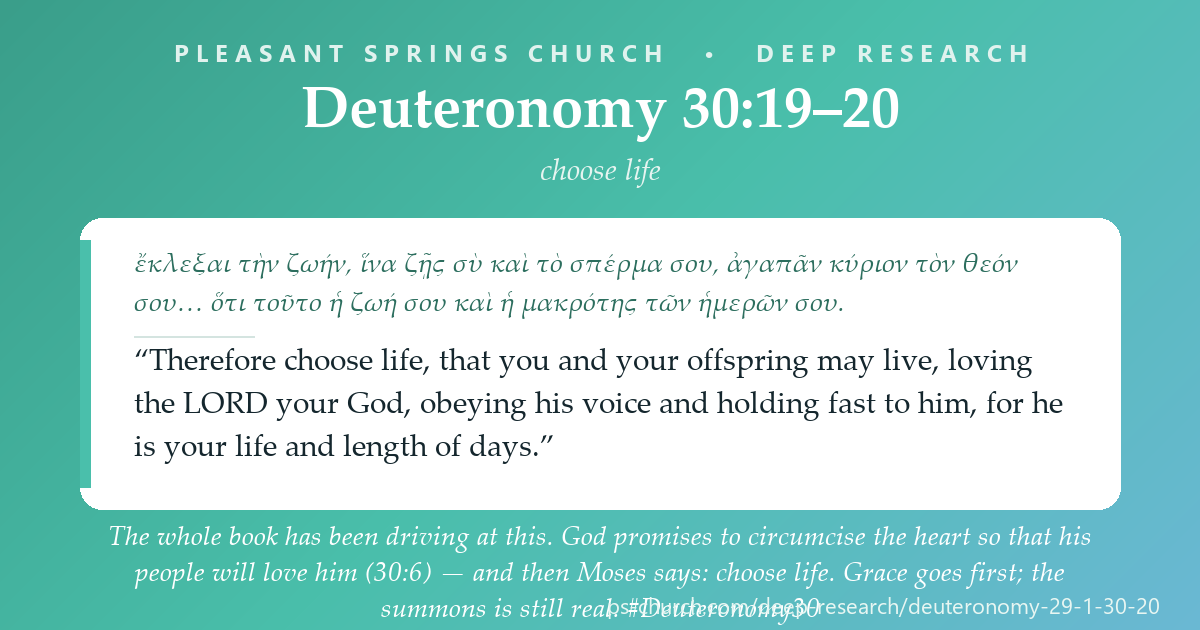
Deuteronomy 30:19–20 · to share
LXX + ESVEvery Deep Research page traces its passage across the whole sweep — the Old Testament, the Second-Temple world between the testaments (historical witnesses, not Scripture), and the New Testament. Follow the thread:
Pleasant Springs Church — Deep Research
Research method after Michael S. Heiser’s Bible Research Method (examine dictionaries → ancient literature → important words → textual connections → academic publications → share), with the Pleasant Springs “Author & Audience” foundation. Scripture set in the Hebrew, the Greek editions named on each page and the ESV (Old Testament), and the Greek New Testament and the ESV (New Testament), per the practice of Pleasant Springs Church. Deuteronomy 29–30 research grounded in Craigie, Block, McConville, Tigay, Christensen, Nelson, Driver, Miller and Merrill, with Kline and Weinfeld on the covenant/treaty form (reported as the shape of the book, never as a verdict in the dating debate) and Beale & Carson together with Richard Hays on Romans 10:6–8. ANE background from the Hittite suzerainty treaties (ANET 199–206) and the Succession (Vassal) Treaties of Esarhaddon, cited by name because the standard ANET pagination for that text lies past the portion of the volume verifiable here. Second-Temple and rabbinic witnesses — the covenant-entry liturgy of 1QS 1:16–2:23 (which cites Deut 29:18–20 almost verbatim), 1QS 5:5, Jubilees 1:22–23, Baruch 3:29–30, the Targums on 30:12–13, and b. Bava Metzia 59b and b. Sanhedrin 43b — are read as witnesses, never leveled with Scripture. ⚠ Versification: English 29:1 = MT/LXX 28:69, the Hebrew and the Greek both attaching “These are the words of the covenant” to the end of chapter 28, so that English 29:2–29 = MT/LXX 29:1–28 and MT/LXX chapter 29 has only twenty-eight verses; every chapter-29 reference in the codex, the structure diagram and the word list is labelled both ways. The interpretive consequence is stated rather than hidden: the two traditions disagree about whether that sentence closes the Moab curses or opens a new discourse. Chapter 30 carries no offset — MT, Rahlfs LXX and English all read 30:1–20 alike. (Elsewhere in the book: English 12:32 = MT/LXX 13:1, so English 13:1–18 = MT/LXX 13:2–19; English 22:30 = MT/LXX 23:1, so English 23:1–25 = MT/LXX 23:2–26.) Greek from Rahlfs; the notable departures from the Hebrew at 29:5–6 · MT/LXX 29:4–5, 29:18–19 · MT/LXX 29:17–18, 30:3, 30:6, 30:14 and 30:16 are reported rather than smoothed — including the fact that the ESV’s opening clause at 30:16 follows the Septuagint against the Masoretic text, as its own footnote says. The Masoretic puncta extraordinaria at 29:29 (MT 29:28) are noted as an ancient scribal signal of disputed purpose. Doctrinally the page holds the genuine summons of 30:19 together with the house position that grace precedes and enables it, since 30:6 is God’s act and not the reward of a decision; the curse-recital of 29:20–28 is stated soberly as covenant sanction on a covenant nation by that nation’s own oath, is never aimed at any modern person, nation or group, and is left with the canon’s own resolution in Gal 3:13 and Deut 30:6. Where Scripture gives no reason — above all in the tension between 29:4 and 30:19 — the page says so and stops, on the authority of 29:29.
Scripture quotations marked ESV are from the ESV® Bible (The Holy Bible, English Standard Version®), © 2001 by Crossway, a publishing ministry of Good News Publishers. ESV Text Edition: 2016. Used by permission. All rights reserved. The ESV text may not be quoted in any publication made available to the public by a Creative Commons license, and the ESV may not be translated in whole or in part into any other language. www.esv.org
|
Did this study bless you today? 💚 Give to Support PS Church100% of gifts go to the General Fund — thank you. |