“You heard the sound of words, but saw no form; there was only a voice” (4:12). That one sentence is the theology behind the second commandment, and Deuteronomy 4 is the sermon built on it. Moses turns from remembering to pleading — and now, listen; keep the statutes; add nothing to the word and take nothing away (4:1–2) — and tells them what the watching nations will say: what great nation has a god so near to it, whenever we call (4:7)? Then the warning: make no carved image of anything, and do not be drawn away to the sun and moon and stars (4:16–19). Then the honesty: you will corrupt yourselves and lose the land and serve gods of wood and stone that neither see nor hear (4:25–28). And then, underneath it all, the mercy: “from there you will seek the Lord your God and you will find him” (4:29). This study works Deuteronomy 4:1–49 — a God who is heard rather than seen, nearness as Israel’s real distinctive, exile named in advance, and the plain confession that the Lord is God and there is no other. See the method →
Deuteronomy 4:2–39 (selections)
Hebrew · LXX · ESVThe Shape of the Passage
LeitwortDeuteronomy 4 is the turn from story to sermon. Chapters 1–3 retold the wilderness road from Horeb to the plains of Moab; here Moses stops retelling and starts pleading — and the plea runs straight into the Ten Words of chapter 5 and the Shema of chapter 6. The passage he preaches from is Horeb itself (Exodus 19–20), and the failure he is guarding against already has a name: the golden calf.
Author
The Torah of Moses gives us here what the book itself calls preaching: “Moses undertook to explain this law” (1:5). The verbs are a preacher’s verbs — listen, keep, take care, remember, know, do — and the adverb is today. The opening word sets the hinge: וְעַתָּה (wəʿattāh), “and now” — the standard move in Hebrew from recital to application. Everything that has been remembered is about to be asked for.
The shape of a covenant document. Read whole, Deuteronomy follows the outline of an ancient Near Eastern suzerainty treaty: preamble, historical prologue, stipulations, deposit and public reading, witnesses, blessings and curses (Mendenhall; Kline, Treaty of the Great King; Weinfeld). Chapter 4 sits exactly where such a document turns from prologue to stipulation, and it even summons the treaty’s witnesses — “I call heaven and earth to witness against you today” (4:26). It is worth saying plainly that this observation is about the form of the book, not a settled argument about its date: the treaty parallels have been pressed by scholars on both sides of the dating debate, and this page does not adjudicate it.
A preacher who names his own loss. In the middle of the appeal Moses says it again: the Lord “was angry with me because of you… I must die in this land” (4:21–22; cf. Numbers 20). He does not soften it and he does not sulk. He preaches the land he will never enter. God’s holiness is real, Moses is honoured to the last verse of the Torah, and nothing here is petty.
Audience
The children of the wilderness generation, standing on the plains of Moab. Most of them were not adults at Horeb — some were not born — and yet Moses says you: “you heard the sound of words… you saw no form” (4:12, 15). That is not a slip. Deuteronomy habitually collapses the generations into one congregation (“…did the Lord make this covenant… with us, who are all of us here alive today,” 5:3), because covenant memory is not private property. What God did for the fathers is handed to the children as their story, to be handed on again (4:9).
And a people who would one day need 4:25–31. The sermon says the unsayable out loud: you will corrupt yourselves, you will lose the land, you will be scattered, and you will end up serving gods of wood and stone (4:25–28). No preacher says that to flatter an audience. But he does not stop there, and the pivot is the small word from there: “But from there you will seek the Lord your God and you will find him” (4:29). Israel in exile would read that sentence as a lamp left burning in an empty house — and Jeremiah would say it again in a letter to the exiles (Jer 29:13–14).
Neighbours watching. One more audience stands just off-stage: the nations. They will hear these statutes and say, “Surely this great nation is a wise and understanding people” (4:6). Israel’s distinctive is not its size, its armies or its temples — it is that its God comes near when it calls, and that its law is just (4:7–8). The witness of the covenant people is meant to be visible from outside.
Orient on form and image, the voice at Horeb, the host of heaven, exile, and the cities of refuge.
Search by topic: image / idol, aniconism, theophany, Horeb / Sinai, voice of God, host of heaven, astral worship, covenant and treaty form, exile and restoration, mercy, cities of refuge, monotheism.
Which articles are relevant?
- Anchor Bible Dictionary — “Idol, Idolatry,” “Images,” “Theophany,” “Horeb,” “Host of Heaven,” “Covenant,” “Exile,” “Asylum / Cities of Refuge,” “Monotheism.”
- Dictionary of the OT: Pentateuch — “Idolatry,” “Theophany,” “God, Names of,” “Deuteronomy, Book of,” “Land,” “Blessings and Curses,” “Cities of Refuge.”
- NIDOTTE / TDOT — תְּמוּנָה (təmûnāh, form/likeness), קוֹל (qôl, voice/sound), פֶּסֶל (pesel, carved image), חָלַק (ḥālaq, apportion), דָּרַשׁ (dāraš, seek), רַחוּם (raḥûm, merciful).
Bibliography surfaced:
- Peter C. Craigie (NICOT), Daniel I. Block (NIVAC), J. G. McConville (Apollos), Jeffrey H. Tigay (JPS), Duane L. Christensen (WBC), Moshe Weinfeld (Anchor) on Deuteronomy.
- Meredith G. Kline, Treaty of the Great King; George Mendenhall on the covenant form; studies of Israelite aniconism and of the “host of heaven” texts.
- Beale & Carson, Commentary on the NT Use of the OT (Acts; Romans; Colossians; Hebrews).
A world full of images — and a covenant with a voice and no statue.
Read the sermon against the ANE treaty documents it resembles and the cult-statue religion it refuses, then let the Second-Temple witnesses show how Jews explained an imageless God to a world of images.
Which parallels shed light on religion and worldview?
The treaty and its witnesses. Ancient Near Eastern vassal treaties end by summoning witnesses, and the lists are long: the Hittite treaty between Suppiluliuma and Kurtiwaza runs through storm-gods, moon-gods and warrior-gods, then the mountains and rivers, then “heaven and earth, the winds (and) the clouds” — all of them summoned to be present, to listen, and to serve as witnesses (ANET 205–206; the Mursilis–Duppi-Tessub treaty is at ANET 203–205). Deuteronomy uses the same legal move and cuts the list to two: “I call heaven and earth to witness against you today” (4:26; again at 30:19; 31:28; 32:1). The form is borrowed; the theology is not. There are no other gods to call.
“Add nothing, take nothing away.” The clause of 4:2 is a recognizable document-integrity formula. Treaty and inscription texts across the ANE protect their own wording, and the Neo-Assyrian Vassal-Treaties of Esarhaddon (VTE; ANET 534–541 — a text beyond the reach of our local scan, so the page reference is given from the standard edition rather than checked here) bind the vassal not to change or alter the word of the king, and back it with a torrent of curses. Israel’s version guards not a king’s tablet but the covenant word itself — and it comes back at Deut 12:32 (MT/LXX 13:1) and Prov 30:6, and at the very end of the Christian canon in Revelation 22:18–19.
A world that made its gods visible. In Mesopotamia and Egypt the god was present in the statue. Cult images were carved, then consecrated by a ritual of mouth-washing and mouth-opening (mîs pî / pīt pî) that made the image able to eat, smell and hear; they were fed, clothed, processed and, in defeat, carried off as prisoners of war. Against that background 4:15–19 is not a fussy rule but a claim about how God is known — and 4:28 is a deliberate reversal of the ritual’s whole point: gods “that neither see, nor hear, nor eat, nor smell.”
The sun, the moon and the stars. The heavenly bodies were not scenery in the ancient world; they were deities — Shamash, Sin, Ishtar in Mesopotamia; the great Egyptian hymn to the Aton addresses the solar disk as sole creator (ANET 369–371). Deuteronomy 4:19 knows exactly what it is warning about, and Israel later fell to it anyway (2 Kgs 21:3–5; 23:5; Jer 8:2). Genesis 1:14–19 had already demoted them to lamps on a timetable; here they are things the Lord allotted — and Israel’s own allotment is different (4:20; cf. Deut 32:8–9 and the Deuteronomy 32 worldview).
- Egyptian and Hittite treaties (ANET 199–206), the suzerainty documents among them at 203–206 — preamble, historical prologue, stipulations, deposit and reading, witness lists, blessings and curses; the witness formula at ANET 205–206 stands directly behind the legal shape of Deut 4:26 (ANE witnesses, not Scripture).
- Vassal-Treaties of Esarhaddon (ANET 534–541) — the Neo-Assyrian succession oath: do not change or alter the word of the king; the curse repertoire that Deut 28 parallels. Cited from the standard edition; not verified against our local scan.
- Hymn to the Aton (Egyptian; ANET 369–371) — the sun addressed as the sole maker of all: the astral piety Deut 4:19 warns against, in its own words. Cited from the standard edition; not verified against our local scan.
- Josephus, Against Apion 2.190–192 (Second-Temple — a witness, not Scripture) — explaining Jewish worship to Greeks and Romans: “All materials, let them be ever so costly, are unworthy to compose an image for him; and all arts are unartful to express the notion we ought to have of him” (Whiston). Josephus also retells Moses’ farewell addresses in Antiquities 4.
- Philo, On the Decalogue 52–66; 66–81 (Second-Temple — a witness, not Scripture) — denounces those who deified “the four elements” and “the sun and moon, and… the other planets and fixed stars” (53), and then the deeper folly of craftsmen “praying and sacrificing to the very things which have been made by them” (72). Deut 4:16–19 read out loud in Alexandria.
- 4QDeut manuscripts (Qumran) (Dead Sea Scrolls — witnesses, not Scripture) — Deuteronomy is among the most-copied books at Qumran, with roughly thirty copies identified (counts differ by how fragments are assigned), alongside phylactery and mezuzah texts. 4QDeutn (4Q41, the “All Souls Deuteronomy”) preserves an excerpted, liturgical selection — evidence that these chapters were being recited, not merely archived.
- Sifre Deuteronomy §82 (on Deut 13:1, English 12:32 — the parallel to 4:2), with the later Talmudic discussion (e.g. b. Rosh Hashanah 28b) (rabbinic-era — witnesses, not Scripture) — the derivation from 4:2 (with 12:32, MT/LXX 13:1) of the twin rules bal tosif and bal tigraʿ, “do not add” and “do not subtract,” which became a fixed principle of halakhah.
Set 4:12 beside 4:28 and the sermon’s wit shows. At Horeb: a voice and no form. In exile: forms and no voice — “gods of wood and stone, the work of human hands, that neither see, nor hear, nor eat, nor smell.” The whole ancient technology of religion existed to make a god present and responsive: carve the body, open its mouth, set food before it. Israel is told that its God has done the opposite — he has refused an image of himself and spoken instead (which is not a claim that God will never be seen, as the rest of the canon will show) — and the sermon insists this is not a lesser arrangement but the greater one, because a word can be obeyed, and a statue can only be handled. That is why the medium matters so much to Deuteronomy. An image puts God where you can see him, which means where you can position him, decorate him, carry him and eventually sell him. A voice puts him where he must be heard, which means where you are the one who has to move. “What great nation has a god so near to it… whenever we call?” (4:7) — nearness, in this chapter, is not something you build. It is something he does.
Form and voice, the carved thing, the allotment, the search, and “there is no other.”
Watch temunah (form) and qol (voice) trade places through the chapter; then pesel (the made thing), chalaq (allotted), darash (seek), rachum (merciful), and the flat confession ein od.
“Form, likeness, shape” (LXX ὁμοίωμα) — the key word of the chapter, five times over, and the ground of the second commandment (Exod 20:4; Deut 5:8 use the same term). It is a rare word: outside these texts the Torah has it only at Num 12:8, where Moses alone “beholds the form of the Lord” (see Numbers 12) — an exception the text treats as an honour given to one prophet, not a licence for a nation with chisels.
“Voice, sound” (LXX φωνή) — the word that stands where the image is not. Israel heard qôl dəḇārîm, “a sound of words” (4:12), and the astonishment of 4:33 is that a nation heard “the voice of a god speaking out of the midst of the fire… and still live[d].” The same word is what obedience is made of: to “obey his voice” (4:30) is literally to hear it.
“Carved image” (LXX γλυπτόν) — from a root meaning to hew or chisel; the word names the manufacture. Deuteronomy never argues that the image is ugly or that the craft is poor; the objection is that the thing was made, and the God of Horeb was not (4:28; cf. Isaiah 44:9–20; Acts 17:29).
“To divide, apportion, allot” (LXX ἀπένειμεν) — the sun, moon and stars are things the Lord “allotted to all the peoples.” Whether that means allotted for their benefit (so many commentators) or allotted to them in the sense of Deut 32:8–9 is genuinely debated; either way the next verse is the point — Israel’s portion is not a star but the Lord himself, who “has taken you… to be a people of his own inheritance” (4:20).
“To seek, search out, enquire of” (LXX ἐκζητέω), paired here with בָּקַשׁ (bāqaš, to look for). Not idle curiosity but the sustained pursuit of someone you intend to find — “with all your heart and with all your soul,” the same total measure the Shema will ask for (Deut 6:5). Jeremiah repeats the promise almost word for word to people already in Babylon (Jer 29:13).
“Merciful, compassionate” (LXX οἰκτίρμων) — built on רֶחֶם (reḥem), “womb.” It is the first adjective of God’s own self-revelation at Sinai (“merciful and gracious,” Exod 34:6; see Exodus 33:12–34:9), and Moses reaches for it at exactly the point where the sermon has just described the worst that can happen.
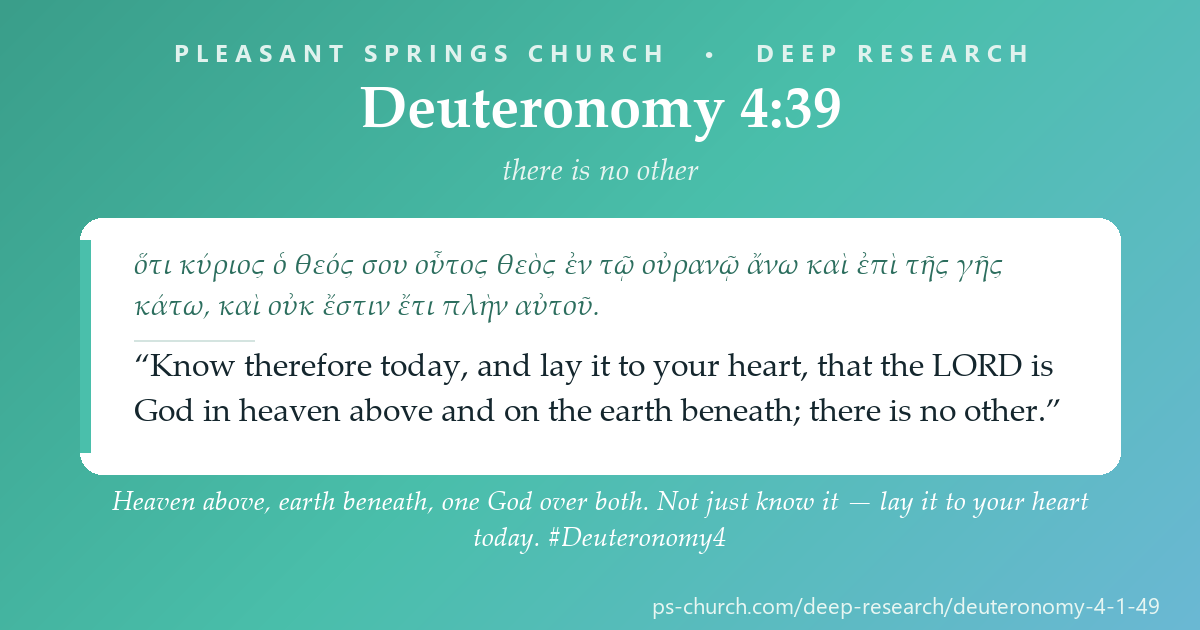
“There is no other / none besides” (LXX οὐκ ἔστιν ἔτι πλὴν αὐτοῦ) — the plainest monotheistic sentence in the Torah, and the exact formula Isaiah will make a refrain (Isa 45:5–6, 18, 22). Note how Deuteronomy gets there: not by argument but by evidence — “To you it was shown, that you might know” (4:35).
How the New Testament picks this up:
- Acts 17:24–29 — Paul in Athens argues from the same two moves as Deuteronomy 4: God made everything and “is actually not far from each one of us,” so “we ought not to think that the divine being is like gold or silver or stone, an image formed by the art and imagination of man.” Nearness first, then no images — the order of 4:7 and 4:15–19.
- Romans 1:20–23 — the exchange of “the glory of the immortal God for images resembling mortal man and birds and animals and creeping things”: Paul’s catalogue is Deuteronomy’s — man, bird, beast, creeping thing — though he reorders it and drops the fish.
- Colossians 1:15 — “He is the image (εἰκών) of the invisible God”: the New Testament does not lift the prohibition, it announces that God has given his own Image, which no one carved (see Colossians 1:15–20).
- Hebrews 12:18–29 — Horeb revisited: “a blazing fire and darkness and gloom and a tempest, and the sound of a trumpet and a voice whose words made the hearers beg…”, closing with Deut 4:24 itself — “our God is a consuming fire.”
- 1 John 5:21; Revelation 22:18–19 — “Little children, keep yourselves from idols,” and a closing warning against adding to or taking from the words of the book (cf. Deut 4:2).
From the fire at Horeb to the Image no one carved.
Trace four threads: the voice without a form; the allotment of the host of heaven; exile named and mercy promised; and “there is no other.”
Which cross-references matter?
- Exodus 19:16–20; 20:1–6; Deuteronomy 5:6–10 — the event Moses is preaching from, and the commandment he is grounding: no carved image, no təmûnāh of anything (see Exodus 19, Exodus 20 and Deuteronomy 5).
- Exodus 32:1–6; 33:20 — the calf made forty days after the voice, and “you cannot see my face, for man shall not see me and live” (see Exodus 32 and Exodus 33:12–34:9). Deuteronomy 4 is the sermon that failure made necessary.
- Numbers 12:6–8; 25:1–9 — Moses beholds “the form of the Lord” (Numbers 12), and Baal-peor — the very recent memory Moses opens with in 4:3 (Numbers 25).
- Genesis 1:14–19; Deuteronomy 32:8–9 — sun, moon and stars as appointed lamps (Genesis 1:14–19), and the allotment of the nations against which 4:19–20 is read (Paul and the Deuteronomy 32 worldview).
- Numbers 35:9–34 — the law of the cities of refuge that 4:41–43 puts into effect east of the Jordan: Bezer for the Reubenites, Ramoth in Gilead for the Gadites, Golan in Bashan for the Manassites (4:43; see Numbers 34–35).
- Jeremiah 29:13–14; 1 Kings 8:46–53; Nehemiah 1:8–9; Daniel 9:4–19 — later Israel praying Deuteronomy 4:29–31 back to God from exile: “you will seek me and find me, when you seek me with all your heart” — Solomon anticipates it at the temple’s dedication, and Nehemiah and Daniel pray it as men whose people are already scattered.
- Isaiah 44:9–20; 45:5–6, 22 — the prophetic satire on image-making, and “I am the Lord, and there is no other”: Deuteronomy 4:35, 39 turned into a refrain.
- Hebrews 1:1–4; Colossians 1:15 — the God who spoke has spoken “by his Son” (see Hebrews 1:1–4), and the Son is the visible Image of the invisible God (Colossians 1:15–20).
The New Testament’s handling of Deuteronomy 4 is careful, and it moves in one direction. It never softens the prohibition: Paul in Athens repeats it almost verbatim (“we ought not to think that the divine being is like gold or silver or stone, an image formed by the art and imagination of man,” Acts 17:29), and Romans 1 diagnoses the whole human religious crisis as the swap Deuteronomy warned about — glory for images, drawn from the same catalogue as 4:16–18. Nor does it abandon the primacy of hearing: “faith comes from hearing” (Rom 10:17), and Hebrews opens by saying that the God who spoke in many ways “has spoken to us by his Son” (Heb 1:1–2). What it adds is one sentence, and it is not our analogy but the apostles’ own claim: “He is the image of the invisible God” (Col 1:15); “No one has ever seen God; the only God, who is at the Father’s side, he has made him known” (John 1:18). Israel was told it saw no form because there was none to see and none to copy. The church confesses that the God who kept himself unseen has now given himself a face — not carved, not commissioned, not ours to manufacture, and not a loophole in the second commandment but its fulfilment. The order still holds: he is heard first, and known because he speaks.
The scholarship on Deuteronomy 4, aniconism, and the covenant form.
Craigie, Block, McConville, Tigay, Christensen and Weinfeld on Deuteronomy; Kline and Mendenhall on the treaty form; Beale & Carson on the New Testament use.
Commentaries & studies:
- Peter C. Craigie, The Book of Deuteronomy (NICOT); Daniel I. Block, Deuteronomy (NIVAC); J. G. McConville, Deuteronomy (Apollos); Jeffrey H. Tigay, Deuteronomy (JPS); Duane L. Christensen, Deuteronomy 1:1–21:9 (WBC); Moshe Weinfeld, Deuteronomy 1–11 (Anchor).
- Meredith G. Kline, Treaty of the Great King; George E. Mendenhall on ANE covenant forms; studies of Israelite aniconism and of the concentric analyses of Deut 4:1–40 (Lohfink, Braulik).
- G. K. Beale & D. A. Carson, eds., Commentary on the New Testament Use of the Old Testament (Acts; Romans; Colossians; Hebrews).
Interpretation notes worth keeping:
- The argument is from memory, not metaphysics. Deuteronomy 4 never says God has no form or reasons about divine simplicity. It says: on that day, you heard and did not see — so do not carve. The second commandment is grounded in an event the congregation is held to remember, which is why 4:9 (“lest you forget the things that your eyes have seen”) is not a detour but the mechanism.
- 4:19 is genuinely disputed. Does the Lord “allot” the heavenly bodies to the nations (as objects of worship permitted to them, and read alongside Deut 32:8–9), or allot them for all peoples’ benefit as light and calendar? Commentators divide, and the Hebrew verb will carry either. What the passage plainly does say is that these things are made, allotted and not Israel’s portion (4:20) — and that worshipping them is forbidden. Beyond that the text does not explain itself, and this page does not pretend it does.
- The treaty form is an observation about shape, not a dating argument. Deuteronomy is laid out like a suzerainty treaty, and 4:26 summons its witnesses. Scholars have used that same parallel to argue for a second-millennium setting and for a first-millennium one. Report the form; leave the date alone.
- “Latter days” in 4:30 should not be over-read. בְּאַחֲרִית הַיָּמִים can mean simply “in days to come,” and here its stated horizon is exile and return. It becomes a loaded eschatological phrase later in the canon; do not import the later freight back into this verse without saying that is what you are doing.
- Hold 4:29 and 4:31 together. And hold 4:24 with 4:31 — the same chapter calls him a consuming fire and a merciful God, seven verses apart, and neither cancels the other. The promise is genuinely conditional in its form (“if you search after him with all your heart”) and genuinely unconditional in its ground (“for the Lord your God is a merciful God… he will not… forget the covenant”). The search is real; so is the fact that God’s keeping of his oath is what makes the search possible and its outcome sure. Preach both clauses, and in that order.
- 4:2 guards a covenant document, not curiosity. “Add nothing, take nothing away” is a document-integrity clause about the covenant word Israel received — it is not a prohibition on exposition, application or study. Deuteronomy itself is a book-length exposition of earlier law, delivered by the man who wrote the clause.
From “there was only a voice” to “you will seek… and you will find him.”
Name what you learned, why it matters, and one concrete response.
What should we carry away — and do?
- God is heard before he is seen. The medium of revelation in this chapter is a word, not a picture — and that is why Scripture read, preached and obeyed sits at the centre of Christian worship rather than a spectacle at the front of it. Ask what actually forms you week to week: a voice you have to obey, or a scene you get to watch.
- An idol is anything you can manage. The problem with the carved image was never craftsmanship. It was control — a god you can position, carry and put away. Name the version you keep making: the God who exists to approve what you had already decided.
- Nearness is the distinctive. “What great nation has a god so near to it… whenever we call?” (4:7). Not our size, our buildings or our reputation — the fact that he answers. Watching neighbours are supposed to be able to see the difference (4:6–8).
- Honest preaching names the worst and still ends in mercy. Moses tells them they will fail, be scattered, and end up among gods that cannot hear — and then says from there you will seek him and find him (4:29). Do not shorten either half. The people who most need 4:29 are the ones already living in 4:28.
- Say the confession plainly. “The Lord is God… there is no other” (4:39). Deuteronomy does not reach it by argument but by evidence: “to you it was shown” (4:35). Rehearse what you have actually been shown.
Step in response: take one week and change the diet — read a chapter of Scripture out loud each day before you read anything about it, and let the voice go first. Then write down the one “form” you have been carving: the picture of God you find easier to live with than the God who speaks. Bring it to him in the words of 4:29 — from here, I will seek you, with all my heart — and let 4:31 be the reason you expect to be found.
Deuteronomy 4:29 · to share
LXX + ESVEvery Deep Research page traces its passage across the whole sweep — the Old Testament, the Second-Temple world between the testaments (historical witnesses, not Scripture), and the New Testament. Follow the thread:
Pleasant Springs Church — Deep Research
Research method after Michael S. Heiser’s Bible Research Method (examine dictionaries → ancient literature → important words → textual connections → academic publications → share), with the Pleasant Springs “Author & Audience” foundation. Scripture set in the Hebrew, the Greek editions named on each page and the ESV (Old Testament), and the Greek New Testament and the ESV (New Testament), per the practice of Pleasant Springs Church. Deuteronomy 4 research grounded in Craigie (NICOT), Block (NIVAC), McConville (Apollos), Tigay (JPS), Christensen (WBC) and Weinfeld (Anchor), with Kline and Mendenhall on the covenant form and Beale & Carson on the New Testament use (Acts; Romans; Colossians; Hebrews). Hebrew from the Masoretic Text; Greek from Rahlfs; English from the ESV (2016). Deuteronomy 1–11 has no versification offset — Hebrew, LXX and English all number this chapter 4:1–49 — so no double citation is required here; later in the book they diverge (English 12:32 = MT/LXX 13:1; English 29:1 = MT/LXX 28:69). ANE background from the Egyptian and Hittite treaties and their witness lists (ANET 199–206, verified against our local scan; the suzerainty documents among them at 203–206) and the Egyptian Hymn to the Aton (ANET 369–371, cited from the standard edition and likewise beyond our local scan); the Vassal-Treaties of Esarhaddon (ANET 534–541) are cited the same way. Second-Temple and rabbinic material (Philo, Josephus, the Qumran Deuteronomy manuscripts, Sifre Deuteronomy) is read as witness, never levelled with Scripture. The disputed sense of 4:19 is reported as disputed; the treaty-form parallel is reported as a matter of literary shape and not used to settle the book’s date; and “the latter days” in 4:30 is left with the horizon the chapter gives it.
Scripture quotations marked ESV are from the ESV® Bible (The Holy Bible, English Standard Version®), © 2001 by Crossway, a publishing ministry of Good News Publishers. ESV Text Edition: 2016. Used by permission. All rights reserved. The ESV text may not be quoted in any publication made available to the public by a Creative Commons license, and the ESV may not be translated in whole or in part into any other language. www.esv.org
|
Did this study bless you today? 💚 Give to Support PS Church100% of gifts go to the General Fund — thank you. |