The last book of the Torah opens with a sermon, not a statute. It is the fortieth year; the camp is on the plains of Moab, one river short of everything promised; and the men and women in front of Moses are the children of the generation that refused. “These are the words” (1:1). He takes them back to Horeb and God’s command to break camp — “you have stayed long enough at this mountain” (1:6) — through the judges appointed because one man could not carry a nation, and into the long, unsparing retelling of Kadesh, quoted back to them in their own words: “you murmured in your tents… because the Lord hated us” (1:27). And the answer is a memory: “the Lord your God carried you, as a man carries his son” (1:31). This study works Deuteronomy 1:1–3:29 — forty years in a sentence, the lands God forbids Israel to touch, Sihon and Og, the Transjordan allotment, and Moses’ own refused prayer: “Enough from you” — and then a mountain to see it from. See the method →
Deuteronomy 1:1–3:27 (selections)
Hebrew · LXX · ESVThe Shape of the Passage
LeitwortDeuteronomy is preached law — Moses’ sermons on the plains of Moab, forty years on. Chapters 1–3 are the looking-back: everything they have already lived through, told again by the man who lived it with them. The road behind them runs through Kadesh, Meribah and Aaron’s death, Sihon and Og, and the Transjordan settlement; the road ahead runs into the great sermon of chapter 4 and the Ten Words of chapter 5.
Author
The Torah of Moses gives this book a Hebrew name taken from its first line: Dəḇārîm, “Words.” And that is what chapters 1–3 are — not a chronicle but an address. Everything in them has already been told once, in Exodus and Numbers. What makes them new is that a preacher is telling them, and a preacher selects. Robert Alter taught a generation of readers to watch for “repetition with variation”: when a story is told twice in Scripture, the changes are the message. Here the narrator retelling the story is a character inside it, which sharpens the point further.
Watch what he keeps and what he drops. The appointment of judges (1:9–18) never mentions Jethro, whose advice prompted it (Exodus 18); the sermon wants the burden and the courts, not the backstory — and the choosing moves: in Exodus Moses chose the able men (Exod 18:25); in the sermon he tells the congregation, “Choose for your tribes wise, understanding, and experienced men, and I will appoint them as your heads” (1:13). The people are handed a share in their own courts. The spy story does not merely add; it reassigns. In Numbers the Lord commands the mission (Num 13:1–2); in the sermon the people ask for it — “then all of you came near me and said, ‘Let us send men before us’” (1:22) — so that the reconnaissance itself is already a hesitation; and the twelve names, the grapes of Eshcol and Moses’ long intercession are dropped. Thirty-eight years of wandering get a single verse of travel notice (2:1) and one verse of accounting (2:14). And the failure is not softened by leaving the preacher out of its consequences: “Even with me the Lord was angry on your account” (1:37; cf. 3:26). Whatever else this is, it is honest.
Audience
The children of the generation that died. Almost no one in front of Moses was an adult at Kadesh; the men of war “had perished from the camp” (2:14–16). And yet he says you — you murmured, you would not believe, you were rebellious. That is not sloppy history; it is preaching. Deuteronomy will make the move explicit two chapters later: “Not with our fathers did the Lord make this covenant, but with us, who are all of us here alive today” (5:3). The congregation is being handed a past to own.
The shape they were hearing. Ancient hearers in the second and first millennia BC knew a document that began exactly like this: a suzerainty treaty — a great king naming himself, then rehearsing at length everything he had already done for the vassal, before a single stipulation is laid down. Chapters 1–3 sit in that slot: the historical prologue. The commands do not arrive until the grace has been recited. That is the grammar of the whole book, and it is worth noticing before the first “you shall.”
Orient on Horeb, Kadesh-barnea, Edom, Moab, Ammon, the Amorite kings, the Rephaim, and the treaty form.
Search by topic: Deuteronomy (book of), covenant / suzerainty treaty, Horeb-Sinai, Kadesh-barnea, Arabah, Seir and Edom, Moab, Ammon, Amorites, Sihon, Heshbon, Og, Bashan, Rephaim, Transjordan, Pisgah, Nebo, herem.
Which articles are relevant?
- Anchor Bible Dictionary — “Deuteronomy, Book of,” “Covenant,” “Treaty,” “Kadesh-barnea,” “Edom,” “Moab,” “Ammon,” “Amorites,” “Sihon,” “Heshbon,” “Og,” “Bashan,” “Rephaim,” “Pisgah.”
- Dictionary of the OT: Pentateuch — “Deuteronomy,” “Covenant,” “Historical Prologue,” “Land,” “Wilderness Wanderings,” “War,” “Moses.”
- NIDOTTE / TDOT — דָּבָר (dāḇār, word/matter), נָשָׂא (nāśāʾ, carry/bear), יְרֻשָּׁה (yəruššāh, possession), גָּרָה (gārāh, contend/engage), עָבַר (ʿāḇar, cross over / be furious).
Bibliography surfaced:
- Peter C. Craigie (NICOT), Daniel I. Block (NIVAC), J. G. McConville (Apollos), Jeffrey H. Tigay (JPS), Duane Christensen (WBC), Moshe Weinfeld (Anchor) on Deuteronomy.
- Meredith G. Kline, Treaty of the Great King; George Mendenhall and Moshe Weinfeld on the ANE treaty form and its Deuteronomic use.
- David A. Dorsey, The Literary Structure of the Old Testament; Robert Alter, The Art of Biblical Narrative (for repetition with variation).
A great king’s prologue, a Moabite king’s stele, and a bed of iron.
Read chapters 1–3 against the treaty documents whose shape they share, then against Moab’s own royal inscription, then against how later Jewish readers heard the sermon’s opening and its closing refusal.
Which parallels shed light on religion and worldview?
The historical prologue. Hittite vassal treaties of the second millennium BC open with a preamble naming the great king and then a historical prologue reciting what he has already done for his vassal — rescued him, installed him, defended him — before any obligation is stated. (The first-millennium Neo-Assyrian succession treaties share the oath, the stipulations and the curses but characteristically lack the historical prologue — which is exactly why the same parallels are pressed by scholars on both sides of the dating debate.) The treaty between Mursilis and Duppi-Tessub (ANET 203–205, in the treaty section that runs ANET 199–206) is the classic specimen; Esarhaddon’s vassal treaties (ANET 534–541, past our local scan) supply the closest parallels to Deuteronomy’s curse repertoire in chapter 28. Deuteronomy 1–3 stands in exactly the prologue’s place. That observation is genuine and useful (Kline, Weinfeld, Craigie) — and it should be reported as the shape of the book, not as a settled argument about when the book was written: the same treaty parallels are pressed by scholars on both sides of the dating debate, and this page does not adjudicate it.
Moab answers back — in the same vocabulary. The Moabite Stone (the Mesha inscription, ANET 320–321) was raised by a king of Moab some centuries later, and it names the very country of Deuteronomy 2–3: the Arnon, Aroer, Dibon, Medeba, Ataroth, Nebo, Jahaz. Its theology is startlingly parallel in form: Mesha explains Israel’s long domination of Moab by saying that his god Chemosh had been angry with his own land; he reports that Chemosh then sent him to take Nebo; and he accounts for the slaughter of the town by saying he had “devoted them to destruction for Ashtar-Chemosh” (Albright’s rendering, ANET 320) — the Moabite cognate of Hebrew ḥērem. The parallel is worth facing honestly and it is worth reading carefully: the forms of ancient royal war-report are shared, and it is precisely the God of Deuteronomy 2 who then forbids Israel to take Moab’s land at all.
Og, the Rephaim, and a bed of iron. The note in 3:11 — “his bed was a bed of iron… nine cubits was its length” — is the narrator’s aside, not a doctrine, and the text does not explain it. Suggestions range from a basalt sarcophagus (basalt is common in Bashan and was called “iron” in some ancient usage) to a cultic bed of the kind attested in ANE temples. The word “Rephaim” itself has a cognate in the Ugaritic texts from Ras Shamra, where rpʾum names a class of departed heroes or shades. Read it soberly: Deuteronomy uses the term for pre-Israelite populations of the Transjordan (2:11, 20; 3:11, 13) and its interest is not anthropology but the size of what God handed over.
- Hittite suzerainty treaties (ANE — witnesses, not Scripture) — ANET 199–206, esp. Mursilis–Duppi-Tessub (203–205): preamble, then a long recital of the great king’s past kindness, then stipulations. The literary slot Deuteronomy 1–3 occupies.
- Vassal-Treaties of Esarhaddon (ANET 534–541, cited from the standard pagination — a witness, not Scripture) — the Neo-Assyrian succession treaty; its curse-lists are the closest known parallels to Deuteronomy 28.
- The Moabite Stone / Mesha inscription (ANET 320–321 — a witness, not Scripture) — a Moabite king’s own account of the Arnon country, and the same “devoted to destruction” language in a rival god’s name.
- Josephus, Antiquities 4.85–100, 4.176–193 (Second-Temple — a witness, not Scripture) — the defeat of Sihon (4.85–95) and then Og (4.96–100, the earliest witness to expand the Og notice: he reports the king’s size and the iron bed kept at Rabbath, 4.98, which is Deuteronomy 3:11 already growing in the retelling); then Moses’ farewell address to the assembly, which Josephus recasts as the giving of a national constitution.
- Sifre Deuteronomy, piska 1 (rabbinic-era — a witness, not Scripture) — reads the strange string of place-names in 1:1 as coded rebuke: each name recalls a failure (the wilderness, the Sea, the manna, Hazeroth, and Di-zahab as the gold of the calf). A reading, not the plain sense — but it hears rightly that 1:1 is an indictment as well as an itinerary.
- Deuteronomy Rabbah on 3:23–26 (rabbinic-era — a witness, not Scripture) — the famous midrash that Moses prayed 515 prayers, the numerical value of wāʾeṯḥannan (“and I pleaded”), until God said raḇ-lāḵ — “enough.”
- The Dead Sea Scrolls (witnesses, not Scripture) — Deuteronomy is among the most copied books at Qumran (roughly thirty manuscripts, the 4QDeut group), and the phylactery and mezuzah texts from the caves show which of its passages were most used.
The single most under-preached thing in these chapters is what Israel is forbidden to take. Three times, before Sihon is ever mentioned, God draws a line: do not contend with the sons of Esau, “not so much as for the sole of the foot to tread on” (2:5); do not harass Moab (2:9); do not harass Ammon (2:19). And the reason given each time is the same reason given for Israel’s own land — I have given it to them as a possession. The same Hebrew word, yəruššāh, covers Esau’s hill country, Lot’s sons’ territory, and Canaan. The antiquarian notes tucked into these paragraphs (2:10–12, 20–23) drive it home: the Emim, the Horites, the Zamzummim and the Avvim were displaced too, and God is the one who did it, and Israel is nowhere in the story. Amos will say it flatly — “Did I not bring up Israel from the land of Egypt, and the Philistines from Caphtor and the Syrians from Kir?” (Amos 9:7). So the conquest in Deuteronomy is not an open licence with a national name on it. It is a bounded, dated, divinely-limited act, fenced on three sides by God’s prior gifts to Israel’s cousins — and the fence is in the text, at the front, before the fighting starts.
Words, “enough,” carrying, possession, and the verb that means both crossing and fury.
Watch rav-lak (“enough”) turn from a starting-gun into a closed door; watch nasa (carry) move from Moses’ shoulders to God’s; and watch yerushah (possession) get spent on Edom, Moab and Ammon before it is ever spent on Israel.
“Word / matter / thing” (LXX λόγος / ῥῆμα). The plural gives the book its Hebrew name, Dəḇārîm: “These are the words” (1:1). The same noun closes our passage from the other side — “do not speak to me of this matter again” (3:26). A book of words opens with Moses speaking and ends this section with Moses told to stop.
“Enough for you / long enough” — a blunt, almost colloquial idiom, rendered all three times by the LXX with ἱκανούσθω, “let it be sufficient.” Twice God uses it to break camp (stop sitting at Horeb, stop circling Seir) and once to close a subject (“enough from you,” to Moses). The same two words can mean go and stop; only the speaker decides which.
“To lift, carry, bear.” Moses uses it of himself and cannot manage it — “I am not able to bear (śəʾēṯ) you by myself” (1:9), and “How can I bear by myself the weight and burden (maśśāʾ) of you and your strife?” (1:12). Twenty verses later the same root is God’s: “the Lord your God carried you, as a man carries his son” (1:31). The load that broke one man is what God had been doing the whole time.
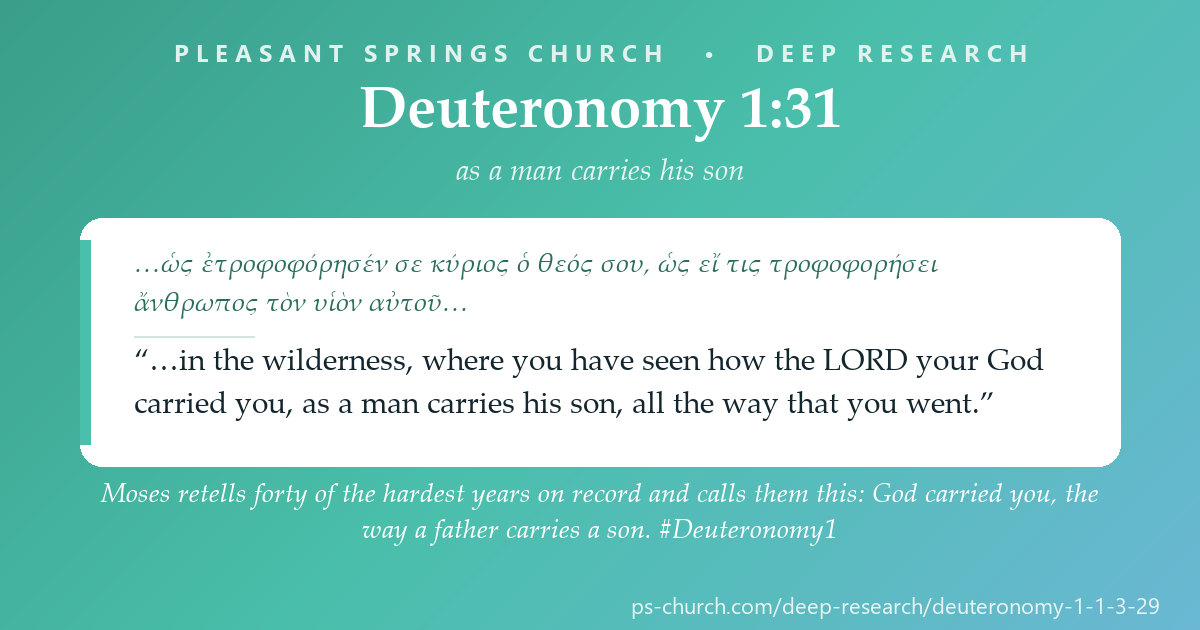
The Greek chosen for “carried” — not a plain word for lifting but one built on τροφός, a nurse: to carry and feed as a nurse carries a child (cf. the same image in Num 11:12). An old variant spelling, τροποφορέω (“to put up with someone’s ways”), is the difference of one letter, and the same two readings compete in the manuscripts of Acts 13:18, where Paul is alluding to this very verse. Rahlfs prints ἐτροφοφόρησεν here: God nursed them along the road.
“Possession, inherited holding” (LXX κλῆρος / κληρονομεῖν, an allotted portion). The key to the fence in chapter 2: Mount Seir is Esau’s yəruššāh, Ar is the yəruššāh of Lot’s sons, Ammon’s land is theirs — given by the same God, in the same word, as Canaan is given to Israel.
“To cross over” — and, in the reflexive stem, “to be furious.” The pun is right on the surface of the refusal: wayyitʿabbēr, the Lord was crossed with Moses (3:26), and therefore lōʾ taʿăḇōr, “you shall not cross over this Jordan” (3:27). The same three consonants carry both the anger and the border. It is the verb of the whole book’s geography: everyone else goes over; Moses does not.
How the New Testament and the wider canon pick these chapters up:
- Acts 13:18 — in the synagogue at Pisidian Antioch, Paul’s sketch of the wilderness years reaches for Deuteronomy 1:31; the manuscripts divide over exactly the same two Greek verbs the LXX tradition divides over (“he bore with them” / “he carried them as a nurse”).
- Hebrews 3:7–4:11 — the wilderness generation and the rest they did not enter. Deuteronomy 3:20 is the same theme from the other end: the Transjordan tribes may not settle down “until the Lord gives rest to your brothers.” See Hebrews 4:14–16.
- Isaiah 46:3–4; 63:9; Hosea 11:3 — God as the one who carries: “borne by me from before your birth… even to your old age I am he”; “he lifted them up and carried them all the days of old”; “Yet it was I who taught Ephraim to walk; I took them up by their arms.”
- 2 Corinthians 10:3–4; Ephesians 6:12 — the church’s warfare is explicitly not of this kind: “the weapons of our warfare are not of the flesh”; “we do not wrestle against flesh and blood.” The conquest chapters license no violence by anyone today.
- Deuteronomy 34:10 — the book’s own last word on the man who was refused: “there has not arisen a prophet since in Israel like Moses, whom the Lord knew face to face.” Refused, and honoured. See also the prophet like Moses.
The same events, told twice — and the God who carries.
Set each retold episode beside its first telling and read the differences as the sermon; then follow the two great images, the carrying and the fence, out across the canon.
Which cross-references matter?
- Numbers 13–14 // Deuteronomy 1:19–46 — Kadesh told twice. Numbers gives the twelve names, the cluster of Eshcol, the stoning threat and Moses’ intercession; Deuteronomy keeps the fear, the grumbling, the sentence and the rout. The two tellings differ at three points and this page will not smooth them: who proposed the mission (Num 13:1–2, the Lord; Deut 1:22, the people — “you came near me and said, let us send men”); what the spies said (an evil report, Num 13:31–33; “it is a good land,” Deut 1:25, with the discouragement placed in the people’s own mouths at 1:28); and who routed them (“the Amalekites and the Canaanites,” Num 14:45; “the Amorites,” Deut 1:44). Each account is told for its own purpose, and the differences are where the sermon is doing its work. See Numbers 13:1–14:45.
- Exodus 18:13–27; Numbers 11:16–17 // Deuteronomy 1:9–18 — the judges. Jethro is not named here; the sermon wants the burden, the chosen heads, and the charge to the courts: “you shall not be partial in judgment… for the judgment is God’s” (1:17). See Exodus 18.
- Numbers 20:1–13 // Deuteronomy 1:37; 3:23–29 — the exclusion of Moses. Numbers locates it at Meribah and names unbelief before the eyes of the people; Deuteronomy’s sermon says “on your account.” See Numbers 20.
- Numbers 21:21–35 // Deuteronomy 2:24–3:11 — Sihon and Og, told as narrative there and as testimony here. See Numbers 21.
- Numbers 32 // Deuteronomy 3:12–20 — the Transjordan allotment and the condition attached to it: the settled tribes cross over armed at the head of their brothers and do not go home until there is rest for everyone. See Numbers 32.
- Genesis 12:7; 15:18–21; 22:16–18 — “the land that the Lord swore to your fathers, to Abraham, to Isaac, and to Jacob” (1:8). The sermon’s first appeal is not to Israel’s worthiness but to an oath. See Genesis 12:1–9.
- Deuteronomy 32:8–9 — the nations and their allotted boundaries; the same theology of a God who apportions lands stands behind the Edom/Moab/Ammon fence. See Paul and the Deuteronomy 32 worldview.
It is worth stopping on 1:31, because of where it sits. Moses has just quoted the people’s worst sentence back at them — “because the Lord hated us he has brought us out of the land of Egypt” (1:27) — and the answer he gives is not an argument. It is a memory: you have seen how the Lord your God carried you, as a man carries his son. The Greek makes the picture even warmer, choosing a verb built on the word for a nurse. Israel had been reading the wilderness as evidence of hatred. Moses tells them they were being carried the whole time and did not know it — that a father with a tired child on his shoulder is not punishing the child. This is the one image in the chapter with no argument attached, and it is the one the church has kept: “even to your old age I am he, and to gray hairs I will carry you” (Isa 46:4); “he lifted them up and carried them all the days of old” (Isa 63:9). Whatever else memory is for in Deuteronomy, it is for this. You are asked to remember being carried, so that you will believe it the next time you cannot feel it.
The scholarship on Deuteronomy’s prologue, the treaty form, and the conquest chapters.
Craigie, Block, McConville, Tigay, Christensen and Weinfeld on the text; Kline and Weinfeld on the treaty form; Alter for the craft of the retelling; and a disciplined, honest handling of the war material.
Commentaries & studies:
- Peter C. Craigie, The Book of Deuteronomy (NICOT); Daniel I. Block, Deuteronomy (NIVAC); J. G. McConville, Deuteronomy (Apollos); Jeffrey H. Tigay, Deuteronomy (JPS); Duane L. Christensen, Deuteronomy 1:1–21:9 (WBC); Moshe Weinfeld, Deuteronomy 1–11 (Anchor).
- Meredith G. Kline, Treaty of the Great King; George E. Mendenhall on covenant forms; Moshe Weinfeld, Deuteronomy and the Deuteronomic School — the treaty-form discussion from more than one direction.
- Robert Alter, The Art of Biblical Narrative (repetition with variation); David A. Dorsey, The Literary Structure of the Old Testament.
Interpretation notes worth keeping:
- The retelling is the sermon. Do not read chapters 1–3 as a redundant summary. What is kept, what is dropped, what is expanded, and whose words are quoted back — that is the preaching. “You murmured in your tents” (1:27) is a preacher putting the congregation’s own sentence in their mouths.
- The prohibitions are the text’s own limit. Deuteronomy 2 forbids war against Edom, Moab and Ammon and gives the same theological reason it gives for Canaan. Any account of the conquest that skips 2:4–5, 9 and 19 is not reporting this passage.
- Sihon and Og are bounded, not paradigmatic. Report the campaigns plainly — they are grim, and 2:34 and 3:6 say so — and locate them where the text does: a specific, divinely-commanded judgment at a particular moment in redemptive history. Report the sequence as it stands: the command to fight Sihon comes first (2:24–25), then the embassy with words of peace (2:26–29), then Sihon’s refusal — which the text itself attributes to God (“the Lord your God hardened his spirit,” 2:30; cf. Num 21:21–23). Og is not asked for passage at all; he comes out to battle (3:1). It is hard, and saying it is hard is honest. It is also not a template for anyone’s violence today; the New Testament explicitly re-aims the church’s warfare (2 Cor 10:3–4; Eph 6:12).
- Moses’ exclusion: two tellings, held together without a glib harmony. Numbers 20:12 names what happened at the rock; Deuteronomy 1:37 and 3:26 say “on your account” and set Moses inside the fate of his generation. Both stand. God’s holiness is real and leaders are not exempt from it — and God is not petty: the same book that records the refusal records the honour (34:10–12) and the mercy of the view from Pisgah.
- The treaty form: report the shape, decline the verdict. That Deuteronomy is built like an ANE covenant document is a real and illuminating observation. That the parallels settle the book’s date is not: the second-millennium Hittite treaties and the seventh-century Assyrian ones are both invoked, by scholars arguing opposite conclusions. Show the shape; leave the dating question open.
- Grace inside discipline. 3:23–29 refuses Moses, and then gives him a mountain, a horizon, and a successor to bless. Discipline in Deuteronomy is never the end of the relationship.
From “you have stayed long enough” to “he carried you, as a man carries his son.”
Name what you learned, why it matters, and one concrete response.
What should we carry away — and do?
- Memory is the engine of obedience. Deuteronomy does not begin by telling Israel what to do. It begins by telling them what happened. Every command in this book is bolted to a story, and a people who forget the story will not keep the commands — they will only resent them.
- Tell it honestly, including your own place in it. Moses names the people’s failure and then reports, without explaining it away, that the sentence fell on him too — “Even with me the Lord was angry on your account” (1:37; cf. 3:26). He does not use the pulpit to exempt himself. Leaders who can only narrate other people’s sins are not preaching; they are prosecuting.
- You were being carried. The generation that said “the Lord hated us” was, at that very moment, being carried like a child (1:27, 31). Feelings about the wilderness are not evidence about God’s heart.
- God fences his own commands. Before Israel is told to fight, it is told three times where it may not go. The God of this passage is not a licence; he sets limits, and the limits are as much his word as the commands.
- ‘Enough’ is not abandonment. Moses asked, and God said no, and then took him up the mountain and showed him the whole land. A refused prayer from this God still comes with a view, and a successor, and a place in the story.
Step in response: write down, in plain sentences, three things God has actually done for you — not felt, done — and read them aloud before you pray about the thing you are afraid of. That is the order Deuteronomy uses: history first, then obedience. And if you are carrying a “no” that has not changed in years, go stand somewhere high and look at what he has given you; then go do what Moses did next, and strengthen the person who gets to walk into it (3:28).
Deuteronomy 1:31 · to share
LXX + ESVEvery Deep Research page traces its passage across the whole sweep — the Old Testament, the Second-Temple world between the testaments (historical witnesses, not Scripture), and the New Testament. Follow the thread:
Pleasant Springs Church — Deep Research
Research method after Michael S. Heiser’s Bible Research Method (examine dictionaries → ancient literature → important words → textual connections → academic publications → share), with the Pleasant Springs “Author & Audience” foundation. Scripture set in the Hebrew, the Greek editions named on each page and the ESV (Old Testament), and the Greek New Testament and the ESV (New Testament), per the practice of Pleasant Springs Church. Deuteronomy 1–3 research grounded in Craigie (NICOT), Block (NIVAC), McConville (Apollos), Tigay (JPS), Christensen (WBC) and Weinfeld (Anchor), with Kline and Mendenhall on the suzerainty-treaty form and Alter on repetition with variation; ANE witnesses from the Hittite treaties (ANET 199–206, Mursilis–Duppi-Tessub at 203–205), Esarhaddon’s vassal treaties (ANET 534–541, cited from the standard pagination) and the Moabite Stone (ANET 320–321); Second-Temple and rabbinic witnesses (Josephus, Antiquities 4; Sifre Deuteronomy; Deuteronomy Rabbah) and the Qumran Deuteronomy manuscripts, all read as witnesses, not Scripture. Versification: Deuteronomy 1–11 shows no offset — MT, Rahlfs LXX and the English agree verse for verse throughout this passage; the divergences later in the book (English 12:32 = MT/LXX 13:1; English 22:30 = MT/LXX 23:1; English 29:1 = MT/LXX 28:69) do not affect it. The treaty-form observation is reported as the shape of the book and not used to settle its date, since the parallels are pressed on both sides of that debate. The conquest of Sihon and Og is reported plainly and located as a bounded, divinely-commanded judgment in redemptive history, alongside the same chapters’ explicit prohibitions against touching Edom, Moab and Ammon; it is never a warrant for violence today (2 Cor 10:3–4; Eph 6:12). Moses’ exclusion is handled with the dignity of Numbers 20 — God’s holiness is real, Moses is honoured (Deut 34:10–12), and where Scripture gives no further reason this page does not supply one.
Scripture quotations marked ESV are from the ESV® Bible (The Holy Bible, English Standard Version®), © 2001 by Crossway, a publishing ministry of Good News Publishers. ESV Text Edition: 2016. Used by permission. All rights reserved. The ESV text may not be quoted in any publication made available to the public by a Creative Commons license, and the ESV may not be translated in whole or in part into any other language. www.esv.org
|
Did this study bless you today? 💚 Give to Support PS Church100% of gifts go to the General Fund — thank you. |