Two tribes with enormous herds looked at the open country east of the Jordan and saw exactly what they needed. So they asked — and one sentence in the asking changed everything: “Do not take us across the Jordan” (32:5). Moses heard Kadesh happening all over again. “Shall your brothers go to the war while you sit here? Why will you discourage the heart of the people of Israel from going over into the land…?” (32:6–7). But notice what he never says: he never calls the request itself sin, and in the end he grants it. What he will not allow is a family in which some are settled while the rest are still fighting — so Reuben and Gad answer with a promise so specific you could check it: we go first, armed, ahead of everyone, and we do not come home until the last tribe has its inheritance (32:17–18). This study works Numbers 32 — the request, the rebuke, the counter-offer, “be sure your sin will find you out” (32:23) read in the context that actually produced it, and the towns they went back and rebuilt. See the method →
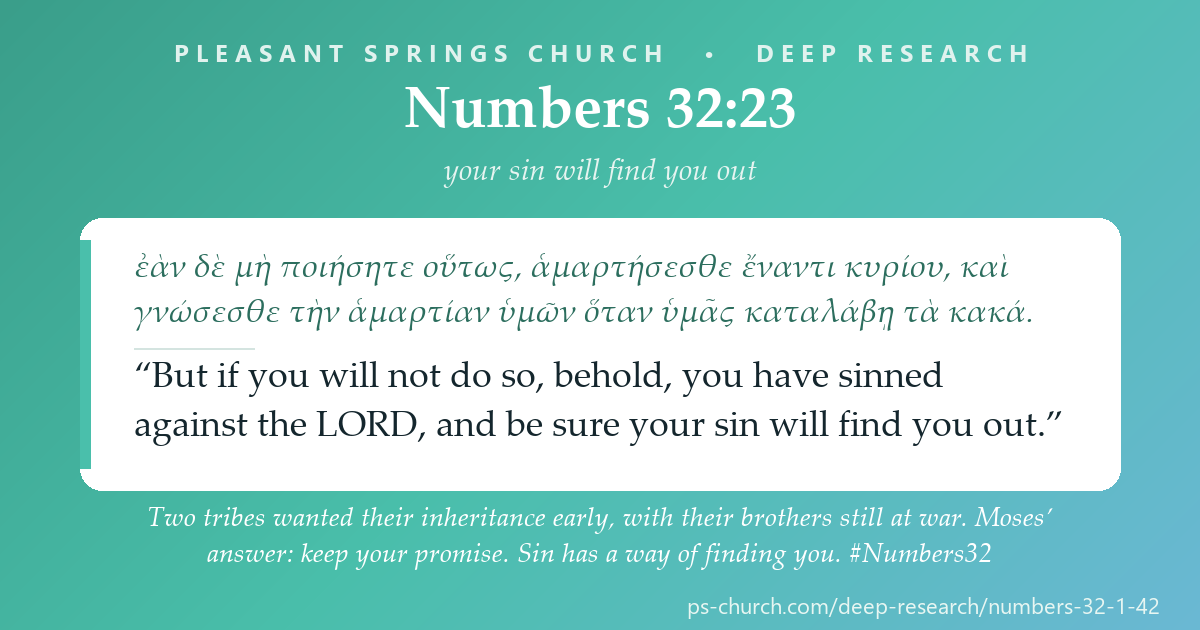
Numbers 32:1–24 (selections)
Hebrew · LXX · ESVThe Shape of the Passage
LeitwortChapter 32 sits on the plains of Moab with the Jordan in sight. The land in question was taken in chapter 21 — Sihon of Heshbon and Og of Bashan — and the tribes have just been counted for the allotment in chapter 26, where the whole point of the census was that “the land shall be divided.” Chapter 27 has already settled one inheritance question (the daughters of Zelophehad), and chapter 36 will settle its sequel. Between them stands this one: what happens when part of the family wants its share on this side of the river? And behind every line of Moses’ answer is Kadesh.
Author
The Torah of Moses tells this as a negotiation, in five clean moves: a request (32:1–5), a rebuke (32:6–15), a counter-proposal (32:16–19), a conditional agreement with a warning (32:20–24), a formal acceptance and a public record (32:25–32) — and then the deeds and the town lists that show it actually happened (32:33–42). Notice how much room the narrator gives the tribes to speak. They are not a foil; they answer, and their answer is good enough to change the outcome.
Watch what Moses does not say. He never says that wanting good pasture is sin. He never denies that the east bank is theirs to ask for — God gave Israel that land in chapter 21, and Moses himself will hand it over in 32:33. What he attacks is one sentence — “do not take us across the Jordan” — and what it would do to everyone else: “Why will you discourage the heart of the people of Israel?” (32:7). His fear is contagion, not livestock. And when the danger is removed by a promise, he says yes.
A loose thread the text leaves loose. Only Reuben and Gad ask (32:1–2, 6, 25, 29, 31). The half-tribe of Manasseh appears without introduction at 32:33, and the chapter closes with Machir, Jair and Nobah taking Gilead and Bashan on their own initiative (32:39–42). Commentators have long noticed the seam; Scripture does not explain it, and neither will we.
Audience
The new generation, one river short of everything. These are the children their own fathers had written off as “a prey” (Num 14:3, 31), now grown, counted, and camped where their parents should have been forty years ago. For them, the request of Reuben and Gad is not an abstraction. It is the first real test of whether twelve tribes are actually one people when the interests of two of them point the other way.
How they heard it. As a workable answer to a hard question — and as a boundary. Israel could accommodate difference: different land, different terrain, different economy. Israel could not accommodate desertion. So the settlement is built out of a promise with a deadline (“we will not return to our homes until each of the people of Israel has gained his inheritance,” 32:18), a witness list (32:28), and a named consequence (32:23). That is what a covenant between brothers looks like when both sides mean it.
And how later readers heard it. Everyone downstream of this chapter knew that the east-bank tribes kept the promise — Joshua discharges them with the words, “You have not forsaken your brothers these many days” (Josh 22:3) — and also that the arrangement left a permanent seam in Israel, a river running through the middle of the family (Josh 22:10–34; Judg 5:16). Numbers 32 records the agreement; the rest of the canon records how hard such agreements are to keep.
Orient on the Transjordan, Gilead and Jazer, Reuben and Gad, the armed vanguard, and the tribal covenant.
Search by topic: Transjordan, Gilead, Jazer, Bashan, the Mishor / tableland, Reuben, Gad, Machir and Manasseh, pastoralism and livestock, tribe and tribal league, oath and promise, holy war and the armed muster, Dibon, Ataroth, Heshbon, Aroer.
Which articles are relevant?
- Anchor Bible Dictionary — “Transjordan,” “Gilead,” “Jazer,” “Bashan,” “Reuben,” “Gad,” “Manasseh,” “Machir,” “Jair,” “Dibon,” “Ataroth,” “Heshbon,” “Mesha Stele.”
- Dictionary of the OT: Pentateuch — “Land,” “Inheritance,” “Tribes of Israel,” “Oaths and Vows,” “War,” “Pastoral Nomadism,” “Moses.”
- NIDOTTE / TDOT — חָלַץ (ḥālaṣ, to be armed/equipped), מִקְנֶה (miqneh, livestock), נוּא (nūʾ, to restrain, discourage, annul), נָקִי (nāqî, clear of obligation), אֲחֻזָּה (ʾăḥuzzāh, holding), טַף (ṭap̱, little ones).
Bibliography surfaced:
- Timothy Ashley (NICOT), Gordon Wenham (TOTC), R. Dennis Cole (NAC), Baruch Levine (AB), Jacob Milgrom (JPS), Dennis Olson (Interpretation) on Numbers.
- Studies of Transjordanian settlement and the Iron-Age Moabite plateau; the archaeology of Dibon, Ataroth, Heshbon and Aroer; the Mesha Inscription.
- Studies of the conditional land grant and of oath language in Israel and the wider ancient Near East.
Good grass on the plateau, a stone that names Gad, and a vassal who had to show up armed.
Read the request against the actual geography and economy of the Transjordan, test the town list against an independent inscription, look at how the ancient world tied land tenure to military service, then weigh the Second-Temple and rabbinic readings.
Which parallels shed light on religion and worldview?
They were not imagining the grass. The tableland east of the Dead Sea — the מִישׁוֹר (mishor) of Deut 3:10 and Josh 13:9 — together with Gilead to the north and Bashan beyond it, is open, well-watered upland: the classic sheep-and-cattle country of the region. Later Scripture takes the point for granted. Mesha of Moab pays tribute in “100,000 lambs and the wool of 100,000 rams” (2 Kgs 3:4); Amos names “you cows of Bashan” (Amos 4:1). When Reuben and Gad say “the place was a place for livestock” (32:1), they are reading the land correctly. The chapter’s question is never whether they saw well. It is what they proposed to do about what they saw.
A stone that names Gad in one of these towns. Numbers 32:34 says the people of Gad built “Dibon, Ataroth, Aroer,” and 32:38 adds “Nebo, and Baal-meon… and Sibmah.” Some six centuries later, Mesha king of Moab put up a victory stela in that same country (ANET 320–321; the text as translated by W. F. Albright). He calls himself “the Dibonite,” boasts of taking Nebo, Jahaz, Aroer, Baal-meon and Medeba — and, in one of the most striking lines in Palestinian epigraphy, says: “Now the men of Gad had always dwelt in the land of Ataroth.” An enemy king, writing to glorify Chemosh, independently places the tribe of Gad in exactly the town Numbers 32 assigns to it, and treats their presence there as ancient. This is a witness, not Scripture — but it is a witness worth noticing.
Land held on condition of showing up armed. The bargain Moses strikes would have sounded entirely ordinary in the second millennium BC. Across the ancient Near East a grant of territory routinely carried a military obligation, and the obligation was written down and sworn. The Hittite treaty of Mursilis with Duppi-Tessub of Amurru (ANET 203–205) puts it plainly in its “Military Clauses”: the vassal keeps his father’s place and his land, and in return, when the overlord campaigns, he must “remain loyal together with your foot soldiers and your charioteers” and “fight wholeheartedly” — and the treaty names gods as witnesses (a sister Hittite treaty, Suppiluliumas with Kurtiwaza, ANET 205–206, adds that the tablet is deposited in a temple and read aloud at regular intervals). Numbers 32 has the same architecture: a holding (32:22), a stated obligation (32:20–21), named witnesses (32:28), and a consequence for default (32:23, 30). What is not the same is who the parties are. This is not an emperor binding a subject. It is a family arguing about whether it will fight together, and settling it in the open.
- The Moabite Stone / Mesha Inscription (Moabite, c. 830 BC; ANET 320–321, trans. W. F. Albright; the Gad line at 320) — “Now the men of Gad had always dwelt in the land of Ataroth”; Mesha “the Dibonite” also names Nebo, Jahaz, Aroer, Baal-meon and Medeba — the same map as Num 32:34–38.
- Treaty between Mursilis and Duppi-Tessub of Amurru (Hittite, 14th c. BC; ANET 203–205, “Military Clauses” at 204) — a holding confirmed on condition of turning out “together with your foot soldiers and your charioteers” and fighting “wholeheartedly,” with the gods named as “witnesses to this treaty and to the oath” (205). The deposit-and-periodic-reading clause often quoted alongside it belongs to the next document on the page, the Suppiluliumas–Kurtiwaza god list (ANET 205–206), not to this treaty.
- Josephus, Antiquities 4.7.3 (Whiston chapters; Second-Temple — a witness, not Scripture) — retells the request for the Amorite country because “it was fruitful, and good for feeding of cattle,” reports Moses’ suspicion that the real motive was fear of the wars ahead, and records that he granted it once they undertook to fight alongside their kinsmen.
- Bamidbar (Numbers) Rabbah 22:9 (later rabbinic midrash — a witness, not Scripture) — reads 32:16 against 32:24 and charges the two tribes with “rendering the primary secondary and the secondary primary,” because “they valued their property more than lives”; Moses answers by putting the children first: “build cities for your children,” and then folds for the flocks.
- 2 Kings 3:4; Amos 4:1 — the later biblical picture of Moab and Bashan as premier pasture, confirming the tribes’ read of the land (Scripture, cited here for the geography).
The rabbis fastened on something a careful reader can see in the English. The tribes say: “sheepfolds here for our livestock, and cities for our little ones” (32:16). Moses gives the permission back with the nouns swapped: “cities for your little ones and folds for your sheep” (32:24). Bamidbar Rabbah 22:9 calls that “rendering the primary secondary,” and it is hard to read the verses side by side and not see the correction. But keep it in proportion, because the chapter itself does. Moses does not refuse them, does not lecture them about greed, and does not cancel the arrangement. He simply reorders the sentence and moves on — and then, in the same breath, tells them to keep their word. That is a remarkably gentle thing to do with a real fault. It is worth learning from twice: once for the fault (what goes first in your sentence usually goes first in your life), and once for the correction (a good leader can fix a priority without breaking a person).
The vocabulary of the muster, the discouraged heart, and a word that goes out of your mouth.
Watch ḥālaṣ (armed for war), the sevenfold spine of the agreement; nūʾ, the verb for cancelling someone else’s courage; nāqî, the legal “clear” that names both God and Israel; māṣāʾ, the sin that catches up; and the vow idiom in 32:24 that ties this chapter to Numbers 30.
“To be armed, equipped for battle” — the verb that carries the whole agreement. The root means to draw off or draw out, hence to be stripped for action; the passive participle חָלוּץ (ḥālūṣ) is “an armed man” (32:21). The LXX splits it into a small arsenal of words — ἐνοπλίζομαι, ἐξοπλίζομαι, ὁπλίτης. Seven times between 32:17 and 32:32: the promise is not a mood, it is a muster.
“In haste, hurrying” — from חוּשׁ (to hurry). “We will arm ourselves hastening before the people of Israel.” The Greek translator heard a military rank instead and wrote προφυλακή, “an advance guard” — which is exactly what Joshua 4:12–13 shows them being. Both readings land in the same place: out front, not behind.
“To restrain, hinder, discourage” — hiphil תְנִיאוּן (tenîʾūn), “why will you discourage the heart” (32:7; LXX διαστρέφω, “twist aside”). It is a rare verb, and its other home in the Torah is the vow law one chapter over — the father or husband who “opposes” and so annuls a vow (Num 30:5, 8, 11; MT/LXX 30:6, 9, 12; see Numbers 30). To do this to your brothers’ courage is to cancel something in them.
“Sheepfolds” — dry-stone enclosures (LXX ἐπαύλεις). An entirely honest thing to build, and the word does not carry a slur. But it comes back with an edge in Deborah’s song, where Reuben stays home: “Why did you sit still among the sheepfolds, to hear the whistling for the flocks?” (Judg 5:16 — a different Hebrew noun, but the same verb yāšaḇ, “sit,” that Moses used in 32:6).
“Clear, free of obligation” (LXX ἀθῷος) — a legal word for being quit of a sworn duty, the same term used when Abraham’s servant is released from his oath (Gen 24:41) and when Rahab’s spies define the limits of theirs (Josh 2:17, 19). Note where it stands: you are clear “before the Lord and before Israel” (32:22). A promise made to your brothers is also a matter before God.
“To find, reach, overtake” — “know your sin, that it will find you” (32:23). The picture is a pursuer catching up, not a detective uncovering a secret; the LXX interprets the pursuer as the consequence — ὅταν ὑμᾶς καταλάβῃ τὰ κακά, “when the evils overtake you.” And note the irony with 32:5: they began by asking Moses to “find favor” (māṣāʾ ḥēn). One way or another, something finds you.
“That which goes out of your mouth” — the ESV’s “do what you have promised” is an idiom, and it is the idiom of the vow: “he shall do according to all that proceeds out of his mouth” (Num 30:2 = MT/LXX 30:3; LXX πάντα ὅσα ἐὰν ἐξέλθῃ ἐκ τοῦ στόματος αὐτοῦ ποιήσει; cf. Deut 23:23; Judg 11:36). Moses is not inventing a rule for these two tribes. He is applying the law he had just given (Numbers 30) to a promise made to brothers.
A note on 32:23 — “be sure your sin will find you out”:
This is one of the most quoted half-verses in the Old Testament, and one of the most regularly torn loose from its moorings. In Numbers it is not a general announcement that hidden wrongdoing is always exposed, and it is certainly not a club to hold over an anxious conscience. Read the sentence whole: “But if you will not do so” — if you do not cross over armed as you have just said you would — “behold, you have sinned against the Lord, and be sure your sin will find you out” (32:23). The sin in view has a name and an address: a promise left unkept, made publicly, to your brothers, before God. And the warning is about consequence catching up with default — the LXX says so outright, “when the evils overtake you.”
Read that way the verse is not less serious; it is more useful. It says that a commitment you have made to other people is not a private matter you can quietly let lapse, because God heard it too (32:22). It does not say that God is scanning you for something to expose. If you belong to Christ, your sin has already been found — found by him, and dealt with at the cross (Rom 3:21–26). What remains is the plain apostolic instruction this verse actually supports: keep your word (Matt 5:37; Jas 5:12).
From a request at the Jordan to a church told to bear one another’s burdens.
Trace three threads: Kadesh, which Moses preaches back at them; the promise, followed from Numbers 32 through Deuteronomy and Joshua to the altar of witness; and the New Testament’s way of talking about not leaving your brothers to fight alone.
Which cross-references matter?
- Numbers 13–14 — the whole middle of Moses’ speech (32:8–13) is a retelling of Kadesh, down to the phrase “they have not wholly followed me” (32:11) and the two who did (32:12). His accusation is not “you are greedy” but “you are about to do that again.”
- Numbers 21:21–35 — the land under discussion is the kingdom of Sihon and the kingdom of Og, already given (see Numbers 21); 32:33 simply hands it over. The request was for a real inheritance, not a private annex.
- Numbers 30 — the law of vows stands two chapters back, and 32:24 speaks its language: what goes out of your mouth, you do (Num 30:2 = MT/LXX 30:3; see Numbers 30).
- Deuteronomy 3:12–20 — Moses’ own retelling of this settlement: “All your men of valor shall cross over armed before your brothers, the people of Israel” (3:18), while “your wives, your little ones, and your livestock… shall remain in the cities that I have given you” (3:19) — and note the order inside v.19, the wives and the little ones named before the herds — “until the Lord gives rest to your brothers, as to you” (3:20).
- Joshua 1:12–18; 4:12–13; 22:1–9 — Joshua holds them to it, about forty thousand cross over “ready for war” ahead of the rest, and years later he sends them home with the sentence that vindicates the whole arrangement: “You have not forsaken your brothers these many days, down to this day” (22:3). They kept the promise.
- Joshua 22:10–34 — and yet the river remained. The east-bank tribes build a great altar by the Jordan, the west bank musters for war over it, and the explanation is a fear of exactly what this chapter risked: “your children might say to our children, ‘What have you to do with the Lord, the God of Israel?’” They name the altar Witness.
- Judges 5:15–17; 1 Chronicles 5:18–26; 2 Kings 15:29 — the long aftermath. Deborah’s song asks Reuben, “Why did you sit still among the sheepfolds?” and notes that “Gilead stayed beyond the Jordan”; Chronicles remembers the east-bank tribes as brave fighters who later “broke faith,” and they are the first Israelites carried into exile.
- Matthew 5:33–37; James 5:12 — the New Testament’s way of saying 32:24: “let what you say be simply ‘Yes’ or ‘No.’” A word given is a word owed.
- Romans 15:1–3; Galatians 6:2; 1 Corinthians 12:26; Philippians 2:4; Hebrews 10:24–25 — “We who are strong have an obligation to bear with the failings of the weak, and not to please ourselves”; “Bear one another’s burdens”; “If one member suffers, all suffer together.” Moses’ question in 32:6 is the Old Testament form of the same instinct.
The sentence is not really about geography, and the chapter proves it: two verses after Moses says it, the same men are given the very land they asked for. What Moses refuses is not the east bank. It is the picture of Israel that the request implied — some of us settled, some of us still marching; some of us with the fighting behind us, some of us with it still ahead. He will not have it, and he says so in a single question that has never needed updating. The tribes’ answer is the model. They do not argue about whether the accusation is fair. They give a specific, costly, checkable promise: we will go first, we will stay until the last tribe is settled, and only then will we come home (32:17–18). Not “we support you.” Not “we will pray for you.” A date, a duty, and a place in the line. Solidarity that costs nothing and specifies nothing is not what this chapter means by solidarity. Devotional reading, labeled as such: the New Testament never quotes Numbers 32, but it repeatedly says the same thing in its own words — “bear one another’s burdens” (Gal 6:2), “let us consider how to stir up one another… not neglecting to meet together” (Heb 10:24–25). We take the connection as an application of a shared principle, not as prophecy fulfilled.
The scholarship on the Transjordanian settlement, the conditional grant, and the seam in Numbers 32.
Ashley, Wenham, Cole, Levine, Milgrom and Olson for Numbers; Transjordan geography and Iron-Age archaeology for the town lists; treaty and oath studies for the shape of the agreement.
Commentaries & studies:
- Timothy R. Ashley, The Book of Numbers (NICOT); Gordon J. Wenham, Numbers (TOTC); R. Dennis Cole, Numbers (NAC); Baruch A. Levine, Numbers 21–36 (Anchor); Jacob Milgrom, Numbers (JPS); Dennis T. Olson, Numbers (Interpretation).
- Studies of the Transjordanian tribal territories and their relation to the parallel lists in Deuteronomy 3, Joshua 13 and Joshua 22, including the “half-tribe of Manasseh” problem at 32:33 and 32:39–42.
- Iron-Age archaeology and epigraphy of the Moabite plateau: Dibon, Ataroth (Khirbat ‘Ataruz), Aroer, Heshbon, Medeba; the Mesha Inscription and the debates over its historical geography.
- Comparative treaty and oath studies: the Hittite vassal treaties (ANET 199–206) and the conditional land grant in the ancient Near East.
Interpretation notes worth keeping:
- The request is never condemned in itself. Moses does not say that wanting pasture is sin, or that the east bank is second-class territory — it is land God gave Israel (Num 21; 32:33), and Deuteronomy calls the same arrangement good (Deut 3:12–20). What he attacks is one clause, “do not take us across the Jordan,” and its effect on everyone else (32:7). Sermons that flatten this into “they settled for less” are preaching a different chapter.
- The outcome is a covenant, not a rebuke. The chapter ends in agreement, allotment and town-building. Both sides moved: the tribes added an obligation they had not offered, and Moses granted a request he had just called dangerous. That is what a healthy negotiation inside a covenant people looks like.
- 32:23 is about a promise left unkept. Read in context, “your sin will find you out” names the consequence of defaulting on a public commitment. It is not a general theory of exposure, and it should not be used as a free-floating guilt-club — least of all with people whose consciences already accuse them more than the text does.
- Do not read the later history back into the chapter. Joshua 22:3 says plainly that they kept their word, and Numbers reports the deal as workable. Judges 5:16, Joshua 22:10–34 and 1 Chronicles 5:25–26 belong to the long aftermath and are worth preaching — but as what happened later, not as a verdict the narrator of Numbers 32 has passed.
- The half-tribe of Manasseh is a genuine puzzle. Manasseh is absent from the negotiation and appears only in the grant (32:33) and in the freelance conquests of Machir, Jair and Nobah (32:39–42). Proposals abound; the text does not adjudicate, and neither should a study of it.
- Numbers is quietly recording a real map. The town lists of 32:34–42 are not decoration. Seven centuries of Transjordanian history — including an enemy king’s stela naming Gad at Ataroth — run through these names.
From “do not take us across” to “we will go before our brothers, armed.”
Name what you learned, why it matters, and one concrete response.
What should we carry away — and do?
- Ask Moses’ question about your own life. “Shall your brothers go to the war while you sit here?” (32:6). Not “is your situation comfortable?” — comfort was never the charge — but “is anyone still in the fight who was counting on you?”
- Beware of settling early, not just settling short. The east bank was real land, honestly given. The danger was stopping at the point where your need was met while the family’s work was unfinished.
- Make the promise specific. The tribes did not say “we’re with you.” They said: we go first, we stay until the last man has his inheritance, then we come home (32:17–18). Vague loyalty is the kind that quietly evaporates.
- Put the children before the sheep. Moses handed their sentence back with the nouns in the right order (32:16, 24). Look at how you describe your own year and see which noun you put first.
- Your word is a matter before God. “Free of obligation to the Lord and to Israel” (32:22) — both, together. What you promised your church, your spouse, your friend, you also promised in his hearing.
- Hear 32:23 rightly. It is a warning about defaulting on a commitment, not a searchlight hunting your secrets. Christians who are in Christ have already been found — and forgiven. Now go do what you said you would do.
Step in response: name one commitment you made out loud in the last year and have quietly let lapse — a person you said you would help, a role you agreed to, a promise to your family. Do not renegotiate it in your head. Either keep it this week, or go to the person, say plainly that you did not keep it, and set a date. That is what “do what you have promised” (32:24) looks like on a Tuesday.
Numbers 32:6 · to share
LXX + ESVEvery Deep Research page traces its passage across the whole sweep — the Old Testament, the Second-Temple world between the testaments (historical witnesses, not Scripture), and the New Testament. Follow the thread:
Pleasant Springs Church — Deep Research
Research method after Michael S. Heiser’s Bible Research Method (examine dictionaries → ancient literature → important words → textual connections → academic publications → share), with the Pleasant Springs “Author & Audience” foundation. Scripture set in the Hebrew, the Greek editions named on each page and the ESV (Old Testament), and the Greek New Testament and the ESV (New Testament), per the practice of Pleasant Springs Church. Numbers 32 research grounded in Ashley, Wenham, Cole, Levine, Milgrom and Olson; ANE background from the Mesha Inscription (ANET 320–321) and the Hittite treaty of Mursilis with Duppi-Tessub (ANET 203–205); Second-Temple and rabbinic witnesses (Josephus, Antiquities 4.7.3, and Bamidbar Rabbah 22:9), read as witnesses, not Scripture. Hebrew, LXX and English agree in versification throughout Numbers 32 — there is no offset here — but English 30:1–16 = MT/LXX 30:2–17, so the vow references on this page carry both numbers. The request for the east bank is presented as the text presents it: not condemned in itself, and settled by a workable covenant; and “be sure your sin will find you out” (32:23) is read in its own context, as a warning about a promise left unkept.
Scripture quotations marked ESV are from the ESV® Bible (The Holy Bible, English Standard Version®), © 2001 by Crossway, a publishing ministry of Good News Publishers. ESV Text Edition: 2016. Used by permission. All rights reserved. The ESV text may not be quoted in any publication made available to the public by a Creative Commons license, and the ESV may not be translated in whole or in part into any other language. www.esv.org
|
Did this study bless you today? 💚 Give to Support PS Church100% of gifts go to the General Fund — thank you. |