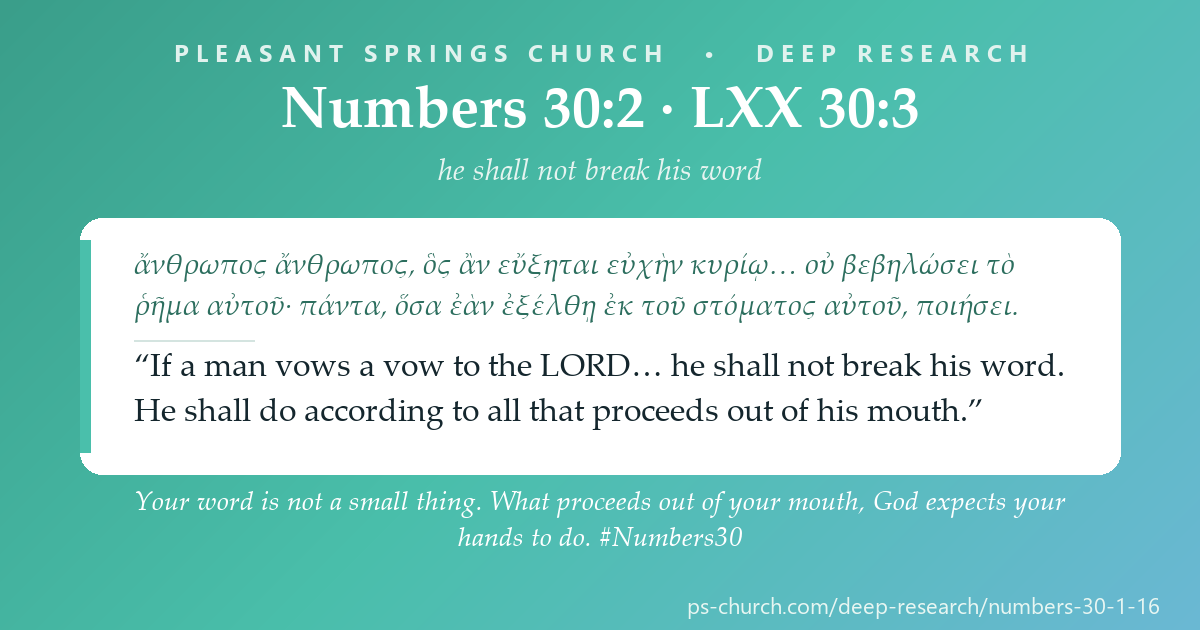
A single sentence governs this chapter, and it is about the cheapest and most dangerous thing a person owns: “He shall not break his word. He shall do according to all that proceeds out of his mouth” (30:2). Nobody is required to vow — Deuteronomy says refraining is no sin at all — but a word given to God has become a holy thing, and the Hebrew says breaking it is profaning it. Then Numbers turns to the hard household question: what happens when one member’s vow binds the whole house? The answer is graded, and it is not what it is usually said to be. Her vow stands by default; the objection is good for one day only; silence confirms it; a widow’s or divorced woman’s vow stands with no review at all; and if a man annuls it late, “he shall bear her iniquity” (30:15). This study works Numbers 30:1–16 — MT/LXX 30:2–17, since the Hebrew and Greek chapter opens one verse earlier — in Hebrew, Septuagint and ESV, set honestly in its own world, and carried to the place the New Testament takes it: a disciple whose plain yes needs no oath behind it. See the method →
Numbers 30:1, 2, 4, 5, 9, 14, 15, 16 (English) = MT/LXX 30:2, 3, 5, 6, 10, 15, 16, 17
Hebrew · LXX · ESVThe Shape of the Passage
Parallel panelsNumbers 30 sits between the calendar of offerings (chs 28–29) and the war with Midian (ch 31) — and the chapter seam itself is worth pausing over. In the Hebrew and the Greek the vows chapter opens with the sentence the English prints as 29:40: “So Moses told the people of Israel everything just as the Lord had commanded Moses” (MT/LXX 30:1). The law about keeping your word begins with a man who kept his.
Author
The Torah of Moses gives this law on the plains of Moab, to the second generation, and it is addressed unusually: not “to the people of Israel” but “to the heads of the tribes” (30:1 · MT/LXX 30:2). That address tells you what kind of text this is. It is not devotional counsel about vowing; it is case law for the men who will have to rule on disputed vows — and every clause in it constrains them. The head of a household is told exactly how narrow his window is (one day), exactly what his silence means (consent), and exactly what happens if he waits and then overrules anyway (the guilt becomes his).
Two halves, one point. Verse 2 (MT/LXX 30:3) states the principle without qualification — a vow to the Lord is binding, full stop. Everything after it is the hard practical question a household economy actually faced: what happens when a vow made by one member obligates goods, labor, food or freedom that the whole house depends on? Numbers does not answer by making her word worthless. It answers by making the moment of hearing decisive, and then by putting the whole weight of a late reversal on the man who tried it.
Audience
Households, not individuals. Ancient Israel was an agrarian, patrimonial society in which the bêt ʾāb — the “father’s house” — held land, herds, labor and legal standing in common. A vow could take a lamb out of the flock, a field out of production, a person out of the workforce (the Nazirite vow), or money out of the house (Leviticus 27’s valuations). Nobody in that world vowed privately, because nobody in that world owned privately. That is the setting; naming it is not the same as excusing anything.
How they heard it — and what it actually says. Notice what the law assumes before it regulates anything: women vow to the Lord, and their vows are real. A vow only needs annulling if it binds. The chapter’s standing position is that her vow stands (30:4, 7, 11) — the annulment is the exception, it is available for one day only, and saying nothing is saying yes (30:14). A widow or a divorced woman vows with no qualification at all (30:9). And the last word of the section is not about her at all: it is a warning to him (30:15). This is a law that limits the head of the house; it is not a charter for controlling, silencing, or overruling women, and it must never be preached as one.
Orient on vows and oaths, the “binding pledge,” and the household in Israelite law.
Search by topic: vow, oath, Nazirite vow, corban, the ‘binding pledge’ (issar), household / father’s house (bêt ʾāb), inheritance and legal standing of widows and divorced women, self-affliction (fasting), annulment. Check every article’s verse citations against the numbering — reference works differ on whether they cite English 30:2 or MT/LXX 30:3.
Which articles are relevant?
- Anchor Bible Dictionary — “Vow,” “Oath,” “Nazirite,” “Family (Israelite),” “Widow,” “Divorce,” “Women (Old Testament).”
- Dictionary of the OT: Pentateuch — “Vow,” “Oaths,” “Family Relationships,” “Women,” “Law,” “Sacrifices and Offerings.”
- NIDOTTE / TDOT — נֶדֶר (neḏer, vow), אִסָּר (ʾissār, binding pledge), חָלַל (ḥālal, profane/break), חָרַשׁ (ḥāraš II, be silent), נוּא (nūʾ, restrain/oppose), פָּרַר (pārar, break/annul).
- Article cross-checks: “Corban” (for Mark 7:9–13) and “Day of Atonement” (for the idiom “to afflict herself,” 30:13 · MT/LXX 30:14).
Bibliography surfaced:
- Timothy Ashley (NICOT), Gordon Wenham (TOTC), R. Dennis Cole (NAC), Baruch Levine (Anchor, Numbers 21–36), Jacob Milgrom (JPS), Dennis Olson (Interpretation) on Numbers.
- Tony W. Cartledge, Vows in the Hebrew Bible and the Ancient Near East (JSOTSup 147) — the standing monograph on the subject.
- Studies of the Israelite household (bêt ʾāb) and the legal standing of widowed and divorced women; the Second-Temple reworkings of this law (the Temple Scroll; the Damascus Document) and the Mishnah’s tractate Nedarim.
A world that knew vows were dangerous — and the readers who wrestled with this chapter after Moses.
First ask what a vow was in the ancient Near East and what it cost; then watch how Second-Temple and rabbinic readers handled the annulment clause; then let the New Testament set the terms. All extra-biblical material below is a witness, never leveled with Scripture.
Which parallels shed light on religion and worldview?
An unpaid vow was a live wire. The Ugaritic Legend of King Keret (ANET 142–149) turns on exactly this. On the road to win Hurriya, Keret stops at “the shrine of Asherah of Tyre, even that of Elath of Sidon,” and vows: “If Hurriya to my house I take… her double I’ll give in silver, and her treble in gold” (ANET 144–145). He gets the bride, the sons and daughters are born — and then the line that would make any ancient hearer’s stomach drop: “And Asherah remembers his vows… ‘Look, now. Doth Ker[et], then, [break], or [the king] alter vows?’” (ANET 146). The king falls mortally ill. The pagan story and the Torah agree on the danger and disagree on everything else: Keret’s goddess is a creditor who collects; Israel’s Lord is a God who never asked for the vow in the first place and says plainly that not vowing is no sin at all (Deut 23:22 · MT/LXX 23:23).
What money a vow could cost. Josephus preserves the practical end of it: those who dedicate themselves to God as korban — “which denotes what the Greeks call a gift” — and then wish to be released “are to lay down money for the priests; thirty shekels if it be a woman, and fifty if it be a man” (Ant. 4.73, summarizing Leviticus 27:1–8). Vows were not sentiment; they were liabilities with a price list. That is precisely why a household law existed.
And what a vow could cost a daughter. The dark counter-story is Jephthah (Judg 11:30–40). Josephus retells it and refuses to admire it: Jephthah “sacrificed his daughter as a burnt-offering, offering such an oblation as was neither conformable to the law nor acceptable to God” (Ant. 5.266). Numbers 30 stands over that story like a rebuke: a rash vow is not sanctified by being kept, and the man in Judges 11 had no father, husband or priest anywhere in the frame.
- The Legend of King Keret (Ugaritic, KRT; ANET 142–149 — the vow to Asherah of Tyre at 144–145, and “Asherah remembers his vows” at 146) — the ancient Near East’s own parable of an unpaid vow. A witness to the world’s assumptions, not to God’s character.
- Philo, On the Special Laws 2.24–25 (Second-Temple — a witness, not Scripture) — reads Num 30 as removing from unmarried and married women “the power of making vows independently, pronouncing the parents of the one class, and the husbands of the other, their lords,” and notes that a widow, having neither, is bound by whatever she vows. Philo’s reasoning is his own Hellenistic-Jewish argument, and it is harder than the biblical text, which never says her vow is invalid — only that it may be annulled, and only on the day it is heard.
- Josephus, Antiquities 4.73; 5.263–266 (Second-Temple — a witness, not Scripture) — the redemption prices for a person vowed as korban (Lev 27), and his blunt verdict on Jephthah’s sacrifice.
- The Temple Scroll (11QT), cols. 53–54 (Dead Sea Scrolls — a witness, not Scripture) — reworks Deut 23:22–24 (English 23:21–23) and Numbers 30 into a single continuous divine speech, keeping the “silence confirms it” rule intact.
- Damascus Document (CD) 16:10–12 (Dead Sea Scrolls — a witness, not Scripture) — a striking restriction on the annulling husband: he is not to annul an oath if he does not know whether it ought to stand or be annulled; if it violates the covenant he should annul it, otherwise let it stand. The same rule is applied to the father. Qumran read Num 30 as limiting the man’s discretion, not licensing it.
- Mishnah, Nedarim (esp. chs. 10–11); Ḥagigah 1:8 (rabbinic-era — witnesses, not Scripture) — an entire tractate on vows. Nedarim 11:1–2 restricts a husband’s annulment to vows “of self-affliction” and matters “between him and her” — i.e. exactly the class Num 30:13 (MT/LXX 30:14) names — and not to her vows generally. Ḥagigah 1:8, by contrast, admits that the later machinery by which a sage could dissolve a vow has almost no scriptural anchor: such rulings “fly in the air and have nothing to support them.” A rare rabbinic confession that a practice had outrun its text.
The most quietly devastating verse in the chapter is 30:14 (MT/LXX 30:15): “if her husband says nothing to her from day to day, then he establishes all her vows… because he said nothing to her on the day that he heard of them.” The law will not let a man keep his options open. He may object — once, on the day, out loud. If he says nothing, he has not stayed neutral; he has agreed, and the Hebrew says so with the causative: he has caused her vows to stand. And if he lets the day go by and then reverses her anyway, verse 15 lands the whole weight on him: “he shall bear her iniquity” — the Greek, from the other side, “he shall bear his own sin.” Whatever else this chapter is, it is not a text that flatters authority. It gives a man one day and one word, and then it holds him to it exactly as strictly as verse 2 holds anyone else.
Vow, pledge, profane, silence, objection, annulment — and who bears the guilt.
Watch neḏer and ʾissār (what is bound, and to whom); yaḥēl (“profane” — not merely “break”); heḥĕrîš (silence that confirms); hēnîʾ (a one-day objection); hēp̱ēr (annulment, a covenant-word); and nāśāʾ ʿāwōn (bearing the guilt). Because English and MT/LXX diverge through the whole chapter, each entry gives both verse numbers.
“Vow” — a voluntary promise made to the Lord, usually to give something (a sacrifice, a gift, a person) or to abstain from something. LXX εὐχή, which in Greek covers both “prayer” and “vow” — a useful ambiguity, since a vow is a kind of prayer with your future attached to it. Nothing compels the vow — Deut 23:21–22 (MT/LXX 23:22–23) is emphatic that refraining from it is no sin at all. Everything compels its payment.
“Binding pledge / obligation” (from אָסַר, to bind or imprison) — a rare noun that occurs in the Hebrew Bible essentially only in this chapter, about a dozen times; its Aramaic cousin turns up in Daniel for the king’s binding “interdict” (Dan 6:7–8 English = MT 6:8–9). The LXX renders it ὁρισμός, a “boundary-setting” — a line you draw around your own life and then may not cross. The idiom is always ʾissār ʿal-napšō, “a pledge upon his soul”: what is pledged is not just property but the self.
“He shall not break his word” — but the root is חלל, to profane, the very verb used of desecrating the Sabbath and the sanctuary. The LXX hears it exactly so: οὐ βεβηλώσει τὸ ῥῆμα αὐτοῦ, “he shall not profane his word.” Breaking a promise made to God is not merely unreliability; the text files it under desecration. Your word, once given to him, has become a holy thing.
“To be silent / say nothing” — the hinge verb of the whole chapter (LXX παρασιωπάω, and at 30:14 the emphatic σιωπῶν παρασιωπήσῃ). Four times the text says that if he hears and says nothing, her vows stand. Silence here is not neutrality and not oversight; it is legally an act of confirmation, and the text says so outright: “he has established them, because he said nothing” (30:14).
“To oppose / restrain / hold back” — the verb for the father’s or husband’s objection, rendered by the LXX with the vivid gesture-verb ἀνανεύω, to toss the head back in refusal. It is rare, and its other famous appearance is two chapters later, when Moses asks the Transjordan tribes, “Why will you discourage the heart of the people of Israel?” (Num 32:7, 9) — the same word for the same act: standing in the way of someone else’s obedience. The law permits it here in one narrow case, for one day, and puts a price on getting it wrong.
“To make void / annul” — a heavy verb: it is what one does to a covenant (Gen 17:14; Lev 26:15). The LXX chooses περιαιρέω, to strip a thing off and take it away. The chapter never treats annulment as trivial housekeeping. It is the removal of something that had real weight — which is why the man who does it after the day of hearing does not simply lose an argument; he inherits the guilt.
“He shall bear her iniquity” — the technical Levitical idiom for carrying the liability for a wrong (Lev 5:1, 17; 17:16; Num 18:1). Here it is aimed at the head of the house: annul her vow late and her guilt for the unkept vow transfers to him. The Greek says it from the other direction — λήμψεται τὴν ἁμαρτίαν αὐτοῦ, “he shall bear his own sin” — because by then it is his own. The last sentence of the law is a liability clause pointed at the man with the power.
How the New Testament takes up the law of vows:
- Matthew 5:33–37 — Jesus quotes the very rule of Num 30:2 / Deut 23:21–23 (“You shall not swear falsely, but shall perform to the Lord what you have sworn”) and then goes past it: “Do not take an oath at all… Let what you say be simply ‘Yes’ or ‘No’” (5:34, 37; Greek ἔστω δὲ ὁ λόγος ὑμῶν ναὶ ναί, οὒ οὔ). This is not the abolition of Numbers 30 but its destination: a disciple whose plain word already carries the weight an oath was invented to supply.
- James 5:12 — “But above all, my brothers, do not swear… but let your ‘yes’ be yes and your ‘no’ be no, so that you may not fall under condemnation” (ἤτω δὲ ὑμῶν τὸ Ναὶ ναὶ καὶ τὸ Οὒ οὔ). The oldest apostolic echo of the Sermon on the Mount — and note the reason given: not that vows do not matter, but that they matter so much they can condemn you.
- Mark 7:9–13 // Matthew 15:3–6 — the abuse Numbers 30 could not foresee: declaring a thing Corban (a vowed gift) in order to escape the duty of honoring father and mother. Jesus’ verdict is that a vow used to cancel a commandment has made the word of God void. A vow is never a shortcut around obedience.
- Acts 18:18; 21:23–26 — Paul cuts his hair at Cenchreae, “for he was under a vow,” and later pays the expenses of four men under one. The apostolic church did not treat vows as abolished; it treated them as serious.
- Galatians 3:28 — “There is neither Jew nor Greek, there is neither slave nor free, there is no male and female, for you are all one in Christ Jesus.” Whatever a household’s legal structure in the ancient world, a believer’s standing before God is not mediated by a father or a husband. Nobody stands between a Christian and Christ.
Across the canon — the vow that is paid, the vow that should never have been made, and the word that needs no oath.
Trace three threads: the Torah’s own law of vows; the narratives that show it working and failing; and the wisdom and prophetic warnings that carry it into the New Testament. Cite dual numbering wherever the Hebrew, the Greek and the English diverge — and in Deuteronomy, Ecclesiastes and the Psalms they do.
Which cross-references matter?
- Deuteronomy 23:21–23 (English) = MT/LXX 23:22–24 — the twin text: “If you make a vow to the Lord your God, you shall not delay fulfilling it… But if you refrain from vowing, you will not be guilty of sin. You shall be careful to do what has passed your lips.” The Hebrew phrase there, מוֹצָא שְׂפָתֶיךָ (“what has gone out of your lips”), is the same idiom Num 30:12 (MT/LXX 30:13) uses of her lips. Note the offset carefully: Deuteronomy 23 in the Hebrew and Greek runs one verse ahead of the English from the start of the chapter.
- Ecclesiastes 5:4–5 (English) = MT/LXX 5:3–4 — “When you vow a vow to God, do not delay paying it, for he has no pleasure in fools. Pay what you vow. It is better that you should not vow than that you should vow and not pay.” (English Eccl 5:1 is MT/LXX 4:17, so the whole passage runs one verse behind in the Hebrew and Greek.) Qohelet’s advice is Numbers 30 in a single sentence.
- Psalm 15:4 (LXX Ps 14:4); Psalm 50:14 (LXX Ps 49:14) — who may dwell on God’s holy hill? The one “who swears to his own hurt and does not change” — where the LXX reads ὁ ὀμνύων τῷ πλησίον αὐτοῦ καὶ οὐκ ἀθετῶν, “who swears to his neighbor and does not set it aside.” And “perform your vows to the Most High” (ἀπόδος τῷ ὑψίστῳ τὰς εὐχάς σου). (LXX psalm numbers run one behind the Hebrew from Ps 9/10 on.)
- Proverbs 20:25 — “It is a snare to say rashly, ‘It is holy,’ and to reflect only after making vows.” The order matters: reflect, then vow.
- Judges 11:30–40 — Jephthah’s vow, the one Old Testament story every reader of Numbers 30 should hold beside it. A vow kept is not automatically a vow God wanted.
- 1 Samuel 1:11, 21–28 — Numbers 30 in action, and beautifully. Hannah vows her son to the Lord; when the moment comes, Elkanah does the one thing this chapter most wants a husband to do: “Do what seems best to you… only, may the Lord establish his word” (1:23). That verb is Num 30’s own קוּם — he confirms rather than annuls, and Israel gets Samuel.
- Numbers 6:1–21; Leviticus 27 — the two great vow texts on either side: the Nazirite vow, which men and women take (6:2), and Leviticus 27’s valuations, which put a redemption price on what was vowed.
- Numbers 15:3, 8; 21:2; 29:39 — vows woven through the book: offerings “to fulfill a vow” (ch 15), Israel’s own vow at Hormah (21:2), and the calendar’s closing clause — “These you shall offer to the Lord at your appointed feasts, in addition to your vow offerings” (29:39 — the last verse of chapter 29 in the Hebrew and Greek too, standing immediately before MT/LXX 30:1).
- Numbers 30:13 (MT/LXX 30:14) — “to afflict herself” — the same idiom (עָנָה נֶפֶשׁ) as the Day of Atonement’s “you shall afflict yourselves” (Lev 16:29, 31; Lev 23:27, 32; Num 29:7). The vows in view are largely fasts and self-denials — the kind that touch a whole household’s table.
- Numbers 27:1–11 and 36:1–13 — read this chapter alongside the daughters of Zelophehad (ch 27; ch 36). The same book that grades a daughter’s vow also hears five women out in open court and changes the inheritance law of Israel because “the daughters of Zelophehad are right” (27:7). Numbers is not flat on this subject, and a fair reading holds both texts.
Everything in the chapter has been building to 30:15 (MT/LXX 30:16), and it is easy to miss because it is one short clause. If the head of the house lets the day of hearing pass — if he says nothing, and her vow therefore stands — and then afterward makes it void anyway, the law does not scold her for the unpaid vow. It transfers the liability: “then he shall bear her iniquity.” The Greek makes the same point from the other end: λήμψεται τὴν ἁμαρτίαν αὐτοῦ, “he shall bear his own sin.”
Hold that beside the shape of the whole: her vow is assumed to be real and binding; it stands by default; the objection window is a single day; silence is consent; and a widow’s or divorced woman’s vow is not subject to review at all. Whatever a modern reader’s discomfort with the household structure — and it is honest to feel it — the chapter’s pressure runs consistently in one direction: against a man who would use his position to undo a woman’s word to God. Numbers 30 has been quoted to silence women. Read straight through, it is one of the last texts in the Bible that can bear the weight of that use.
The scholarship on vows, the household, and this chapter’s difficulties.
Ashley, Wenham, Cole, Levine, Milgrom and Olson for Numbers; Cartledge for vows as an institution; the Qumran and rabbinic reworkings for reception history; Beale & Carson for the New Testament’s use of the oath texts.
Commentaries & studies:
- Timothy R. Ashley, The Book of Numbers (NICOT); Gordon J. Wenham, Numbers (TOTC); R. Dennis Cole, Numbers (NAC); Baruch A. Levine, Numbers 21–36 (Anchor); Jacob Milgrom, Numbers (JPS); Dennis T. Olson, Numbers (Interpretation).
- Tony W. Cartledge, Vows in the Hebrew Bible and the Ancient Near East (JSOTSup 147) — the conditional-vow form, its ANE parallels, and Num 30 within it.
- Studies of the Israelite household and women’s legal capacity; and of the Second-Temple reception of this law (the Temple Scroll cols. 53–54; CD 16; the Mishnah’s Nedarim).
- G. K. Beale & D. A. Carson, eds., Commentary on the New Testament Use of the Old Testament (Matthew; James).
Interpretation notes worth keeping:
- Get the versification right before you quote anyone. English 30:1–16 = MT/LXX 30:2–17 throughout, because MT/LXX 30:1 is the sentence the English prints as 29:40. Commentaries working from BHS or Rahlfs will cite the higher number; English-language sermons will cite the lower. Neither is wrong; conflating them is.
- The default is that her vow stands. Three times the text states the standing case before it states the exception (30:4, 7, 11), and a fourth time it states that silence establishes the vow (30:14). Any reading that makes annulment the norm has inverted the chapter.
- One day, out loud. The objection is valid only “on the day that he hears of it” (30:5, 8, 12). There is no standing veto, no retroactive review, and no delegating it to a mood. After sundown the question is closed.
- The widow and the divorced woman are outside the system entirely. “Any vow of a widow or of a divorced woman… shall stand against her” (30:9) — flat, unqualified, no reviewer named. Philo (Spec. 2.25) reads this as a deprivation; the text itself simply reads as legal standing. Either way it is decisive against any theory that a woman’s vow is intrinsically less binding.
- The class of vow in view is limited. Verse 13 (MT/LXX 30:14) specifies “any binding oath to afflict herself” — the fasting and self-denial idiom of the Day of Atonement. The Mishnah’s Nedarim 11 draws the same boundary. This is household-impact law, not a general license over her religion.
- Do not preach it as a warrant, and do not preach it as a scandal. Two failures are equally common. One turns the chapter into a charter for a man’s authority over a woman’s spiritual life — which the text’s own liability clause (30:15) forbids. The other scolds an ancient household law for not being a modern one, and so never hears what it actually says. Report it plainly, locate it honestly in its world, and let its own emphases stand.
- The abiding point is the weight of a word given to God. Verse 2 governs the chapter and outlives its social setting: what leaves your mouth toward God is not disposable. The New Testament’s move is not to lower that bar but to raise the ordinary word to it (Matt 5:33–37; Jas 5:12).
From a vow that must be paid to a word that needs no oath at all.
Name what you learned, why it matters, and one concrete response.
What should we carry away — and do?
- Your word to God is a holy thing. The Hebrew does not say “he shall not fail his word” but “he shall not profane it” (30:2; LXX βεβηλώσει). Promises made in a hospital corridor, a prayer meeting, or the small hours of a bad night are not disposable.
- It is not a sin to refrain from vowing. “But if you refrain from vowing, you will not be guilty of sin” (Deut 23:22 · MT/LXX 23:23). God never asked for the vow. Be slower to promise and quicker to pay.
- Silence is a decision. Numbers 30 will not let a man say nothing and call it neutrality (30:14). Wherever you have real authority — a home, a team, a class — your unspoken non-objection is an answer, and you will be held to it.
- Do not stand in the way of someone else’s obedience. The verb for the father’s objection is the verb Moses uses for discouraging the people (Num 32:7, 9). If someone in your house has made a costly promise to God, the default posture of this chapter — and of Elkanah — is let it stand (1 Sam 1:23).
- In Christ, no one stands between you and God. Whatever the household structures of the ancient world, a believer’s vows, prayers and standing are not mediated by a father or a husband (Gal 3:28; Heb 4:14–16).
- Aim at the word that needs no oath. “Let what you say be simply ‘Yes’ or ‘No’” (Matt 5:37; Jas 5:12). The goal is not a better vow-system; it is a person whose plain sentence can be leaned on.
Step in response: think back over the last year and name one thing you told God you would do — give it, quit it, start it, forgive them — that is still unpaid. Either do it this week, or take it to God as what it is. The Torah made provision for exactly this — a rash oath is confessed, not quietly dropped (Lev 5:4–6) — and the same provision is ours in Christ: “If we confess our sins, he is faithful and just to forgive us our sins and to cleanse us from all unrighteousness” (1 John 1:9). Do not make a bigger promise to cover a broken one; confess the broken one and receive mercy. Then, for the next seven days, keep every small ordinary promise you make to another person exactly as spoken, so that your yes can start to mean yes.
Numbers 30:2 (English) = MT/LXX 30:3 · to share
LXX + ESVEvery Deep Research page traces its passage across the whole sweep — the Old Testament, the Second-Temple world between the testaments (historical witnesses, not Scripture), and the New Testament. Follow the thread:
Pleasant Springs Church — Deep Research
Research method after Michael S. Heiser’s Bible Research Method (examine dictionaries → ancient literature → important words → textual connections → academic publications → share), with the Pleasant Springs “Author & Audience” foundation. Scripture set in the Hebrew, the Greek editions named on each page and the ESV (Old Testament), and the Greek New Testament and the ESV (New Testament), per the practice of Pleasant Springs Church. Numbers 30:1–16 research grounded in Ashley, Wenham, Cole, Levine, Milgrom and Olson, with Cartledge on vows as an ancient institution and Beale & Carson on the New Testament use (Matthew; James). Versification flagged throughout: English 30:1–16 = MT/LXX 30:2–17 (English 29:40 = MT/LXX 30:1); likewise Deut 23:21–23 = MT/LXX 23:22–24, Eccl 5:4–5 = MT/LXX 5:3–4, Ps 15:4 = LXX Ps 14:4, Ps 50:14 = LXX Ps 49:14, and Dan 6:7–8 = MT 6:8–9. The Greek column is Rahlfs; its divergences are noted (“forgive” → καθαριεῖ, “cleanse”; ἀνανεύω for the objection; περιαιρέω for annulment; “her iniquity” → “his own sin”). The Legend of King Keret (ANET 142–149; the vow at 144–145), Philo Spec. 2.24–25, Josephus Ant. 4.73 and 5.263–266, the Temple Scroll cols. 53–54, the Damascus Document 16:10–12, and the Mishnah’s Nedarim and Ḥagigah are cited as witnesses, not Scripture. The household cases are reported plainly and set in their world: the text’s own emphases — that her vow stands by default, that only a same-day objection annuls it, that silence confirms it, that a widow’s or divorced woman’s vow stands absolutely, and that a late annulment makes the guilt his — are kept in the foreground, and the chapter is not presented as a warrant for controlling or silencing women.
Scripture quotations marked ESV are from the ESV® Bible (The Holy Bible, English Standard Version®), © 2001 by Crossway, a publishing ministry of Good News Publishers. ESV Text Edition: 2016. Used by permission. All rights reserved. The ESV text may not be quoted in any publication made available to the public by a Creative Commons license, and the ESV may not be translated in whole or in part into any other language. www.esv.org
|
Did this study bless you today? 💚 Give to Support PS Church100% of gifts go to the General Fund — thank you. |