The book of Numbers ends with a follow-up question. The heads of the fathers’ houses of Gilead, of the tribe of Manasseh, come to Moses about the ruling that gave Zelophehad’s daughters their father’s land: and when they marry? Then “their inheritance will be taken from the inheritance of our fathers” (36:3). Moses answers at the word of the Lord with the very word God had spoken over the sisters — “right” (36:5; cf. 27:7) — and rules that they may marry “whom they think best, only… within the clan of the tribe of their father” (36:6). Nothing is taken back. The women keep the land, the tribe keeps the land, and the choosing stays theirs. Mahlah, Tirzah, Hoglah, Milcah and Noah are named one more time as they marry their cousins (36:11) — and then the book stops, exactly where Israel is standing: “in the plains of Moab by the Jordan at Jericho” (36:13). This study works Numbers 36 — and closes our reading of the book. See the method →
Numbers 36:1–13 (selections)
Hebrew · LXX · ESVThe Shape of the Passage
Parallel panelsNumbers 36 is the last chapter of the book, and it is deliberately a sequel. It reopens the case of chapter 27 from the other side, inside the land-allotment framework of the second census (ch 26), the itinerary and inheritance instructions of chapter 33, and the boundaries, Levitical cities and cities of refuge of chapters 34–35. Read it as the closing brace on a long legal paragraph about land — and on the book that carried Israel from Sinai to the edge of the Jordan.
Author
The Torah of Moses ends Numbers the way a careful lawgiver ends a statute: by asking what the statute will do next. Chapter 27 had settled that a sonless man’s daughters inherit. Chapter 36 asks the question that only surfaces once the ruling is on the books — what happens when those daughters marry? The narrator does not treat this as an embarrassment. He records the objection, records that God calls it right, records the refinement, and records that the women complied. Law in Numbers is not handed down finished and untouchable; it is worked out in public, in front of witnesses, with real people’s futures attached to it.
Symmetry on purpose. Chapter 27 opens with five women coming near (וַתִּקְרַבְנָה) and speaking; chapter 36 opens with the clan elders coming near (וַיִּקְרְבוּ) and speaking. Both parties are answered with the same Hebrew word, כֵּן — “right” (27:7; 36:5). God does not take one side of Israel against another here. He tells both petitions the truth and then writes a rule that holds them together.
Audience
Israel on the plains of Moab, counted, mapped and about to cross. For them nothing in this chapter is abstract. A tribal allotment was a family’s food, name and future; a holding that drifted to another tribe did not come back, and no lot would be re-drawn. The elders of Gilead are not being petty. They are asking the question a farmer asks: in two generations, whose ground is this?
How they heard it. They heard that the God who had said “the daughters of Zelophehad are right” had not changed his mind, and also had not forgotten the tribe. They heard that five women would keep what they had been given, and choose their own husbands within a wide circle of kin. And they heard the last sentence of the book locate them exactly — “in the plains of Moab by the Jordan at Jericho” (36:13). Behind them, forty years and a whole generation of graves. In front of them, a river, and a book of sermons (Deut 1:1–5) before they cross it.
Orient on inheritance and land tenure, clan and tribe, endogamy, the jubilee, and the closing colophon.
Search by topic: inheritance (nachalah), land tenure, clan (mishpachah) and tribe (matteh), heiress daughters, endogamy and cousin marriage, jubilee, Manasseh, Gilead, plains of Moab, colophon / subscription formulas.
Which articles are relevant?
- Anchor Bible Dictionary — “Inheritance,” “Land, Tenure of,” “Family,” “Marriage,” “Zelophehad,” “Manasseh,” “Gilead,” “Machir,” “Jubilee, Year of,” “Moab, Plains of.”
- Dictionary of the OT: Pentateuch — “Inheritance,” “Land,” “Women,” “Marriage,” “Family Relationships,” “Law,” “Numbers, Book of” (structure and ending).
- NIDOTTE / TDOT — נַחֲלָה (naḥălāh, inheritance), מַטֶּה (maṭṭeh, tribe/staff), מִשְׁפָּחָה (mišpāḥāh, clan), סָבַב (sāḇaḇ, turn about), דָּבַק (dāḇaq, cling), יוֹבֵל (yôḇēl, jubilee).
Bibliography surfaced:
- Timothy Ashley (NICOT), Gordon Wenham (TOTC), R. Dennis Cole (NAC), Baruch Levine (AB), Jacob Milgrom (JPS), Dennis Olson (Interpretation) on Numbers.
- Studies of Israelite land tenure and the inalienable family holding; the Zelophehad case as a two-stage legal precedent (Num 27 + Num 36 + Josh 17:3–6); the literary shape and ending of Numbers.
- Beale & Carson, Commentary on the NT Use of the OT (Ephesians; Hebrews; 1 Peter) on inheritance language in the New Testament.
Daughters, dowries and the ground a family cannot afford to lose.
Set the ruling beside the actual inheritance law of the ancient Near East, check the clan names against Israelite epigraphy, listen to how Second-Temple and rabbinic readers heard the marriage restriction, and let the New Testament’s own inheritance language set the terms at the end.
Which parallels shed light on religion and worldview?
The ordinary ancient answer: give her the use, keep the land. The problem of chapter 36 was not peculiar to Israel, and other systems solved it in a way worth comparing. The Code of Hammurabi devotes a block of laws (§§178–184; ANET 174) to what a consecrated daughter — a nun, hierodule or votary — receives from her father’s estate, and it keeps landing on the same sentence: she may have field and orchard, food, oil and clothing, and “she shall have the usufruct… as long as she lives, without selling (it or) willing (it) to another, since her patrimony belongs to her brothers” (§178; cf. §§180–181). Only if the father wrote her a sealed document granting “full discretion” could she “give her heritage to whomever she pleases” (§179). The Babylonian instinct is to protect the family line by limiting the daughter’s title. Numbers 36 protects the same interest by a different route: the title is not touched. The daughters keep the holding outright (27:7); what is regulated is the marriage. The land stays with the clan and the women stay owners — and, notably, they are not assigned husbands.
Why the ground mattered so much. In Israel a נַחֲלָה was not an investment; it was a family’s standing in the covenant, and it was not supposed to be tradable — “The land shall not be sold in perpetuity, for the land is mine” (Lev 25:23), with the jubilee as the reset that Numbers 36:4 explicitly reckons with. That is exactly why Naboth can refuse a king to his face: “The Lord forbid that I should give you the inheritance of my fathers” (1 Kgs 21:3) — and why the prophets treat land-grabbing as a sin against the covenant, not merely against the neighbor (Mic 2:1–2; Ezek 46:18). Chapter 36 is the same conviction working itself out one generation ahead of time.
Their names in the ground. The Samaria Ostraca — 63 inked potsherds from the palace at Samaria, assigned to the reign of Jeroboam II, c. 786–746 BC (ANET 321) — are administrative dockets for wine and oil coming in from districts in the hill country of Manasseh, valuable, ANET notes, for “personal names, topography… and clan distribution.” The printed specimens include a delivery “from Shemida” (a Manassite clan; cf. Num 26:32), and the wider corpus preserves district names that scholars read as Hoglah and Noah. Centuries after this chapter, in receipts for oil, names from Zelophehad’s family are still attached to ground in Manasseh. Whatever the exact relation of district to person, the plain sense of 36:12 held: “their inheritance remained in the tribe of their father’s clan.”
- Code of Hammurabi §§178–184 (Old Babylonian, 18th c. BC; ANET 174) — a consecrated daughter’s share of the paternal estate (nun, hierodule, votary, lay priestess), capped again and again at a life-interest, “since her patrimony belongs to her brothers” (§178); §179 allows a father to grant her full discretion by sealed document.
- Nuzi and Emar family archives (2nd-millennium cuneiform; not in ANET’s selection) — adoption and heirship documents by which a sonless father could keep an estate in the family through a daughter; the same problem Numbers 36 addresses, solved by contract rather than statute.
- The Samaria Ostraca (Israelite, c. 786–746 BC; ANET 321) — palace dockets from the districts of Manasseh; the printed specimens name Shemida, and the wider corpus preserves names read as Hoglah and Noah.
- Tobit 6:12–13; 7:11–13 (Second-Temple — a witness, not Scripture; in the LXX, not in the ESV canon) — the law of Numbers 36 living inside a story: Raguel “has no male heir and no daughter except Sarah only, and you, as next of kin to her, have before all other men a hereditary claim on her. Also, it is right for you to inherit her father’s possessions” — and Raguel cannot give her to another man “according to the decree of the book of Moses.”
- Josephus, Antiquities 4.7.5 (Whiston chapters; Second-Temple — a witness, not Scripture) — “the chief men of the tribe of Manasseh came to Moses… whose name was Zelophehad, who left no male children, but left daughters”; the ruling summarized as: marry within the tribe and carry the estate with you, marry outside and leave it behind. Josephus then adds that Moses “ordained, that every one’s inheritance should continue in his own tribe.”
- b. Bava Batra 119b (rabbinic-era — a witness, not Scripture) — “The daughters of Zelophehad are wise, they are interpreters of verses, and they are righteous”; the tradition that they “did not rush to marry, but rather waited to marry those fit for them.”
- b. Bava Batra 120a (rabbinic-era — a witness, not Scripture) — the two name-lists compared (36:11 by age, 27:1 by wisdom); Shmuel’s reading that “whom they think best” is the ruling and the clan clause is “good advice”; and Rava’s derivation from “this is the matter” (36:6) that the restriction “will not be practiced except in this generation.”
- m. Ta’anit 4:8 with b. Ta’anit 30b (rabbinic-era — witnesses, not Scripture) — the fifteenth of Av remembered as one of the two most joyful days in the year, in part because it was “the day on which the members of different tribes were permitted to enter one another’s tribe, by intermarriage” — the barrier of Numbers 36 understood as lifted once the allotment was settled.
It is worth saying plainly, because the chapter is often read as a quiet retraction: nothing is taken back from the daughters of Zelophehad. The verdict of 27:7 stands untouched — they own the holding. What 36:6 adds is a condition on whom they marry, and it is a condition that runs in their favor as much as the tribe’s, because it is the only thing that keeps the land they were just given from evaporating in a generation. A right that cannot survive its own consequences is not much of a right. Notice, too, what the ruling does not do. It does not choose husbands for them; it does not hand them over to the elders who raised the objection; it does not make them wards. The operative clause is “whom they think best” — literally, “to the good in their eyes” — and the restriction is a boundary drawn around a genuine choice, inside a clan large enough to contain one. Be honest about the boundary: it is a real restriction, and it is a restriction that fell on women who had asked for nothing but their father’s name. It is also not a private ruling about five people — 36:8 generalizes it to every heiress-daughter in Israel, so the burden and the protection are the same for all. The rabbis themselves read it as temporary, tied to the one generation that divided the land (b. Bava Batra 120a; b. Ta’anit 30b). And the chapter ends by telling us that the sisters did it, and by naming all five again while it does. They are not objects in someone else’s settlement; they are the last named actors in the book of Numbers.
The vocabulary of a holding, a subtraction feared, a verdict repeated, and a choice left standing.
Watch naḥălāh, the portion that must not move; yiggārēaʿ, the subtraction both sides fear; kēn, the verdict God gives to both petitions; laṭṭôḇ bəʿênêhem, “whom they think best”; tissōḇ, land circulating from tribe to tribe; and yiḏbəqû, Israel clinging to its ground with the verb of Genesis 2:24.
“Inheritance, patrimony” (LXX κληρονομία) — the word beats through this short chapter more than a dozen times. Not an estate you accumulate but a portion you receive: the land God gives, assigned by lot (33:54), unsellable in perpetuity (Lev 25:23), and returned at the jubilee. To lose your nachalah was to lose your place in the story.
“Will be taken away / diminished” — niphal of גָּרַע (gāraʿ, to subtract, clip off). This is the daughters’ own word from 27:4: “Why should the name of our father be taken away?” Now the clan elders use it of themselves. The same fear of subtraction is on both sides of the table — which is exactly why the ruling protects both.
“Right, rightly, so” — the verdict word. God said it of the sisters in 27:7 and says it of the tribe of Joseph here. The Greek makes the ambiguity visible: at 27:7 the LXX chose ὀρθῶς, “correctly,” and here it chose οὕτως, “thus” — but the Hebrew is the same word, and the ESV rightly hears the verdict in both.
“To the good in their eyes” — ESV “whom they think best.” The idiom leaves the judgment with them; the LXX keeps the sense of preference, οὗ ἀρέσκει ἐναντίον αὐτῶν, “to whom it is pleasing before them.” The ruling constrains the field and leaves the choosing to the five women themselves — a small phrase, easy to skip, and the hinge of how this chapter should be read.
“Shall not turn about / be transferred” — from סָבַב (sāḇaḇ, to go around); LXX περιστρέφω. The picture is of a holding circulating from tribe to tribe like a coin. Israel’s land was not to move. The map God gave was meant to still be recognizable in a hundred years.
“They shall cling / hold on to” — דָּבַק (dāḇaq), the verb of Genesis 2:24, “a man shall leave… and hold fast to his wife” (Gen 2:24) — and the LXX uses the very same Greek verb here that it uses there, προσκολλάω. A chapter about marriage says that Israelites are to be married to their ground. Read it as vocabulary, not allegory; but the vocabulary is telling.
“In the plains of Moab” — the flat steppe east of the Jordan opposite Jericho, and the standing address of the last third of Numbers (22:1; 26:3; 33:48–50; 35:1). The LXX reads the phrase as a compass point — ἐπὶ δυσμῶν Μωαβ, “west of Moab” — but the location is the same, and the book ends by naming it: a people camped at the threshold.
A note on the two lists of names:
The five sisters are named four times in Scripture — in the census (Num 26:33), when they come forward (Num 27:1), here when they marry (36:11), and when they collect their land (Josh 17:3). Two different orders appear: Mahlah, Noah, Hoglah, Milcah, Tirzah in 26:33 and 27:1, and Mahlah, Tirzah, Hoglah, Milcah, Noah in 36:11. The rabbis noticed and offered an explanation — one list by age, the other by wisdom (b. Bava Batra 120a) — which is a homily rather than a proof, and they knew it. The Rahlfs LXX adds a third arrangement at 36:11, rotating the Hebrew list by one so that Mahlah (Μααλα) comes last. Nothing doctrinal hangs on the sequence. What is worth noticing is the repetition itself: four times the text stops and spells out all five names, in a book that elsewhere counts men by the ten thousand.
From a case reopened to a book closed — and an inheritance that cannot be lost.
Trace three threads: the Zelophehad case from census to allotment; the theology of the inalienable holding across the Old Testament; and the New Testament’s transposition of “inheritance” into a different key.
Which cross-references matter?
- Numbers 26:33; 27:1–11; 36:1–12; Joshua 17:3–6 — the whole arc: named in the census, granted the holding by oracle (ch 27), the ruling refined here, and finally delivered — “So according to the mouth of the Lord he gave them an inheritance among the brothers of their father” (Josh 17:4). Case, refinement, delivery. Nothing was lost between the promise and the deed.
- Numbers 26:52–56; 33:50–56; 34:1–29 — the allotment framework this chapter protects: land divided by lot according to the number of names (ch 26), the command to take possession and destroy the idols (ch 33), the borders and the men appointed to divide it (chs 34–35).
- Leviticus 25:8–28; Numbers 36:4 — the jubilee is not decoration in this argument. Because holdings return to their families in the fiftieth year, a transfer made in the meantime would be made permanent by the very law meant to undo transfers (see Leviticus 25). The elders had read their law carefully.
- 1 Kings 21:1–19; Micah 2:1–2; Ezekiel 46:18 — what the doctrine of the inalienable holding looks like when it is defied: Naboth’s “the Lord forbid,” the prophets’ woe on those who “covet fields and seize them,” and Ezekiel’s prince who may not take the people’s inheritance by eviction.
- Genesis 24:1–4; 28:1–5 — marriage within the kindred is old family practice long before it is law (Isaac and Rebekah; Jacob sent to Paddan-aram). The cousins of 36:11 are not a punishment; in that world they are an ordinary, honorable match.
- Deuteronomy 1:1–5; 34:1–12 — where 36:13 leaves us. “These are the words that Moses spoke to all Israel beyond the Jordan” (Deut 1:1) picks up the sentence Numbers just finished; the Torah still has one book of preaching to go before anyone crosses (see Deuteronomy 6:4–9 and 18:15–19).
- Ephesians 1:11–14, 18; Romans 8:17; 1 Peter 1:3–5; Hebrews 11:8–16 — the New Testament keeps the word and moves the deed: “heirs of God and fellow heirs with Christ” (Rom 8:17), “an inheritance that is imperishable, undefiled, and unfading, kept in heaven for you” (1 Pet 1:4) — and see Ephesians 2:1–10 for the same logic of sheer gift.
The New Testament’s vocabulary of inheritance is not a metaphor invented by the apostles; it is the Septuagint’s word for a plot of ground in Manasseh. κληρονομία is what the elders of Gilead are worried about in 36:3, and it is what Paul says the Spirit guarantees in Eph 1:14. The apostolic writers keep three things from the Old Testament use and change one. They keep that an inheritance is received, not earned; that it is allotted by God, not seized; and that it defines who you are, not merely what you own. What changes is the one thing Numbers 36 is anxious about — loss. Israel had to legislate against a holding drifting away, and the legislation could only do so much: the land was eventually lost anyway. So Peter reaches for three negatives that no clause of Numbers could have promised — “imperishable, undefiled, and unfading, kept in heaven for you” (1 Pet 1:4), and Hebrews says the patriarchs were “looking forward to the city that has foundations” (Heb 11:10). Devotional reading, clearly labeled as such: Numbers ends with a law that guards a portion so it cannot slip out of the family. It is a fair and gentle thing to hear in that the shape of a later promise — a portion held for us by someone who does not lose things (cf. John 10:28; Rom 8:38–39). But hear it the way the apostles draw the line, and not further: this chapter is about real ground and real families, and it deserves to be read as that first.
The scholarship on the Zelophehad precedent, endogamy and land tenure, and the ending of Numbers.
Ashley, Wenham, Cole, Levine, Milgrom and Olson for Numbers; land-tenure and family-law studies for the marriage restriction; Beale & Carson for the New Testament’s inheritance vocabulary.
Commentaries & studies:
- Timothy R. Ashley, The Book of Numbers (NICOT); Gordon J. Wenham, Numbers (TOTC); R. Dennis Cole, Numbers (NAC); Baruch A. Levine, Numbers 21–36 (Anchor); Jacob Milgrom, Numbers (JPS); Dennis T. Olson, Numbers (Interpretation).
- Studies of the Zelophehad material as a two-stage legal precedent (Num 27 + 36 + Josh 17:3–6), of heiress-daughter endogamy, and of the nachalah as an inalienable family holding.
- Comparative family law: the Code of Hammurabi’s daughters’-inheritance provisions (§§178–184) and the Nuzi / Emar heirship documents.
- Literary studies of the ending of Numbers and the seam into Deuteronomy (Olson especially, on the book’s two-generation structure and its close on the plains of Moab).
- G. K. Beale & D. A. Carson, eds., Commentary on the New Testament Use of the Old Testament (Ephesians; Hebrews; 1 Peter).
Interpretation notes worth keeping:
- Completion, not retraction. The holding granted in 27:7 is never revoked, reduced, or held in trust for anyone. Only the marriage pool is bounded, and 36:12 reports the outcome as a success: “their inheritance remained in the tribe of their father’s clan.” Read the two chapters as one ruling in two stages.
- Both petitions are called ‘right.’ The same Hebrew word answers the sisters (27:7) and the elders (36:5). Numbers is not staging a contest between women and clans; it is showing a law that can hear two true claims and satisfy both.
- The agency clause is load-bearing. “Whom they think best” (36:6) is not a throwaway. Compare the ANE alternative, where a father had to write a sealed document before a daughter could dispose of her heritage at all (CH §179). Here the choice is simply theirs, inside a boundary.
- Do not over-read the restriction, and do not under-read it either. It is a genuine constraint, and it fell on women. It is also universal to heiress-daughters (36:8), practical rather than punitive, and understood by later Jewish tradition as belonging to the generation that divided the land (b. Bava Batra 120a). Say all of that, and resist both the impulse to scold the text and the impulse to decorate it.
- The ending is deliberate. Numbers does not end with a climax but with a colophon and an address: “in the plains of Moab by the Jordan at Jericho” (36:13). Olson’s reading of the book around two generations lands here — the generation that died in the wilderness is gone, the new one is counted, mapped and legislated for, and the book stops one river short on purpose.
- Watch the LXX at 36:1 and 36:13. The Greek adds Eleazar to the hearing and expands the closing formula to three terms; neither changes the sense, but both show a translator harmonizing this chapter with 27:2 and with the standard Deuteronomic triad. Rahlfs is our base text; the divergences are flagged with the passage above.
From a follow-up question to a people at the threshold.
Name what you learned, why it matters, and one concrete response.
What should we carry away — and do?
- A right granted is also a right protected. God’s law does not stop at the ruling; it follows the ruling downstream and guards it against its own consequences. That is not fine print. That is care.
- Two people can both be right. The sisters were right in chapter 27 and the elders are right in chapter 36, and God says so out loud to both. Most church conflicts are not a contest between a true claim and a false one; they are two true claims looking for a rule that holds them together.
- The choice stayed theirs. “Whom they think best.” Whatever else this chapter does, it does not hand five women over to be disposed of. Notice how carefully the text protects that, and be at least as careful with the people in your care.
- Say the names. Mahlah, Tirzah, Hoglah, Milcah, Noah — four times in Scripture, all five, every time. In a book of censuses, God keeps stopping to spell out the names of five women who asked him for something. He is not in a hurry to get past you either.
- Most obedience is quiet. The book of Numbers ends not with fire or a sea opening but with a sentence: “The daughters of Zelophehad did as the Lord commanded Moses” (36:10). That is what faithfulness usually looks like on the last page.
Step in response: this study closes the book of Numbers — forty years, two censuses, a generation buried, and a people finally standing on the plains of Moab by the Jordan at Jericho, one river short of everything promised. Take one evening this week and stand where they are standing: write down the wilderness you have actually come through, and the one thing you are waiting on God to open. Then do the small, ordinary, unheroic obedience in front of you today — the way five women did, on the last page of the book — and leave the river to him.
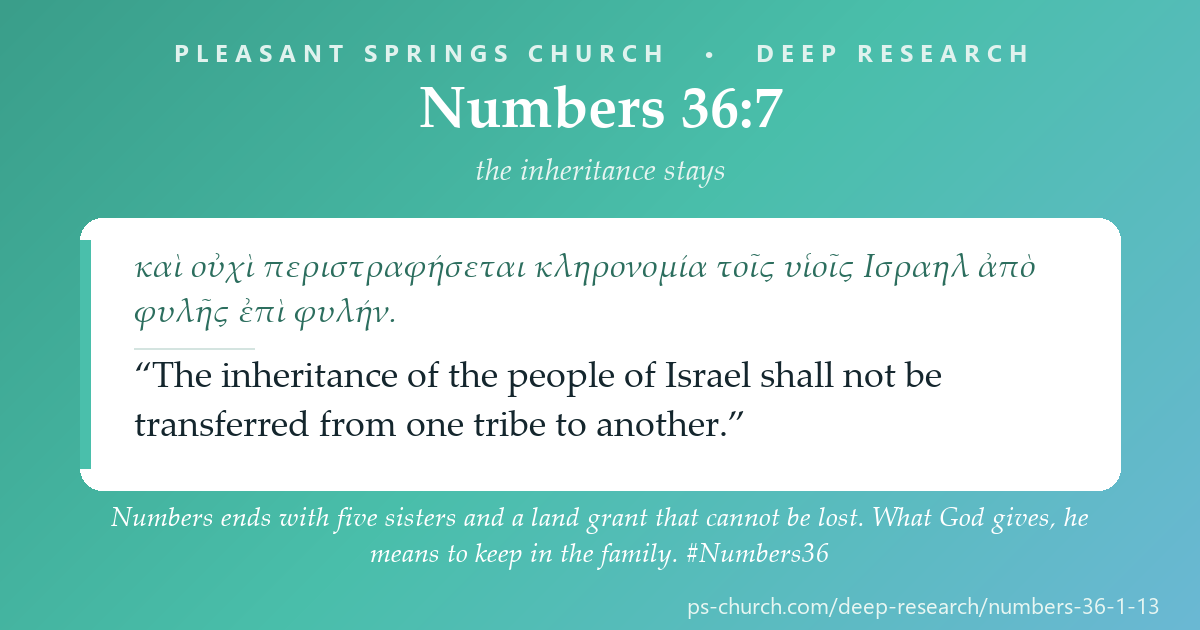
Numbers 36:6 · to share
LXX + ESVEvery Deep Research page traces its passage across the whole sweep — the Old Testament, the Second-Temple world between the testaments (historical witnesses, not Scripture), and the New Testament. Follow the thread:
Pleasant Springs Church — Deep Research
Research method after Michael S. Heiser’s Bible Research Method (examine dictionaries → ancient literature → important words → textual connections → academic publications → share), with the Pleasant Springs “Author & Audience” foundation. Scripture set in the Hebrew, the Greek editions named on each page and the ESV (Old Testament), and the Greek New Testament and the ESV (New Testament), per the practice of Pleasant Springs Church. Numbers 36 research grounded in Ashley, Wenham, Cole, Levine, Milgrom and Olson, with Beale & Carson on the New Testament’s inheritance vocabulary (Ephesians; Hebrews; 1 Peter); ANE background from the Code of Hammurabi §§178–184 (ANET 174) and the Samaria Ostraca (ANET 321), with the Nuzi and Emar heirship documents; Second-Temple and rabbinic witnesses (Tobit, Josephus, b. Bava Batra 119b–120a, and m. Ta’anit 4:8 with b. Ta’anit 30b), all read as witnesses, not Scripture. Hebrew, LXX and English agree in versification throughout Numbers 36 — 13 verses in each — while the offsets in the book fall at English 16:36–17:13 = MT/LXX 17:1–28 and at English 29:40 = MT/LXX 30:1, so that English 30:1–16 = MT/LXX 30:2–17; genuine Greek divergences are flagged with the passage. The chapter is presented as the completion of Numbers 27 rather than its retraction: the daughters’ holding is never revoked, the marriage clause is reported plainly as the real restriction it is, and the agency the text preserves (“whom they think best”) is left where the text leaves it. Inheritance language is carried into the New Testament only along the line the apostles themselves draw, labeled as devotional reading. This page closes our verse-by-verse study of the book of Numbers.
Scripture quotations marked ESV are from the ESV® Bible (The Holy Bible, English Standard Version®), © 2001 by Crossway, a publishing ministry of Good News Publishers. ESV Text Edition: 2016. Used by permission. All rights reserved. The ESV text may not be quoted in any publication made available to the public by a Creative Commons license, and the ESV may not be translated in whole or in part into any other language. www.esv.org
|
Did this study bless you today? 💚 Give to Support PS Church100% of gifts go to the General Fund — thank you. |