Before Israel crosses the Jordan, God draws lines. Chapter 34 walks the perimeter of Canaan — south, west, north, east — and names the men who will divide it: Eleazar the priest, Joshua the son of Nun, and one chief from every tribe. Chapter 35 then gives the landless Levites forty-eight cities, scattered on purpose through everyone else’s territory — and sets six of them apart as cities of refuge. There a man who has killed without intent can outrun the avenger of blood and stay alive “until he stands before the congregation for judgment” (35:12). What follows is one of the great passages of biblical justice: murder distinguished from accident by instrument, motive and prior enmity; no conviction on one witness (35:30); no ransom for a murderer’s life (35:31); and the ground of it all — blood pollutes the land, and “I the Lord dwell in the midst of the people of Israel” (35:34). See the method →
Numbers 34:2–35:34 (selections)
Hebrew · LXX · ESVThe Shape of the Passage
Parallel panelsThese two chapters sit near the very end of Numbers, on the plains of Moab. The second census has been taken and the land is to be divided by lot (ch 26); the daughters of Zelophehad have won their inheritance and Joshua has been commissioned before Eleazar (ch 27); Reuben, Gad and half-Manasseh have settled east of the Jordan on condition that they cross over armed (ch 32); and the whole road from Rameses has been written down stage by stage (ch 33). Now come the borders, the Levites’ cities, and the refuge law — and then one last case of inheritance closes the book (ch 36).
Author
The Torah of Moses here does something that looks dull and is not: it draws lines. Chapter 34 is a survey document — a perimeter walked in words, corner by corner, with real place-names (the ascent of Akrabbim, Kadesh-barnea, Hazar-addar, the Brook of Egypt, Mount Hor, Lebo-hamath, Ziphron, Hazar-enan). Chapter 35 is a legal document — a city list, a survey rule of two thousand cubits on each side (35:5), and then a homicide code. The seam between them is the point: the land is a gift, and it comes with law. You do not get one without the other.
Who does the dividing. The text is careful about authority. God gives the boundaries; the lot decides the portions (26:52–56); and the commission is shared — Eleazar the priest first, then Joshua, then a chief from every tribe, each named (34:17–29) — and the first name on that list is Caleb the son of Jephunneh of Judah (34:19), the man who forty years earlier had said “we are well able” (13:30). He lived to help draw the boundary. No one man holds the map. That is not administrative trivia; it is a doctrine of accountable power written into a land-registry.
Audience
A second generation at the Jordan — people who have never owned a field, who are about to become neighbours instead of a marching camp. Camp life had one court: Moses. Settled life will have towns, roads, distances, and a hundred quarrels no one can bring to the tent of meeting. So before a single boundary stone is set, God builds them a system: cities where a man can run, a congregation that must hear him, a rule of evidence, and a fixed refusal to let money buy a life.
How they heard it. In their world, when blood was spilled the dead man’s nearest kinsman came for you, and he came fast. Chapter 35 does not abolish him — it outruns him. Six cities, and Deuteronomy later requires the land divided in three with the roads prepared (Deut 19:3), mean that the accused reaches a courtroom instead of a knife. To a people who had watched a plague stopped and a rebellion judged, the message was plain: God cares what happens to the man everyone has already decided about.
Orient on the borders of Canaan, the Levitical cities, asylum, the avenger of blood, and homicide law.
Search by topic: boundaries / borders of the promised land, tribal allotment, Levitical cities, pastureland (migrash), city of refuge, asylum, avenger of blood (goʾel), manslayer, homicide, witnesses, ransom, high priest, land defilement.
Which articles are relevant?
- Anchor Bible Dictionary — “Refuge, Cities of,” “Levitical Cities,” “Avenger (Blood),” “Asylum,” “Boundaries,” “Canaan (Place),” “Lebo-hamath,” “Kadesh-barnea,” “Eleazar,” “High Priest.”
- Dictionary of the OT: Pentateuch — “Cities of Refuge,” “Levites,” “Land,” “Murder / Manslaughter,” “Judges and Judicial Procedure,” “Blood,” “Atonement.”
- NIDOTTE / TDOT — מִקְלָט (miqlāṭ, refuge), גָּאַל (gāʾal, redeem / act as kinsman), רָצַח (rāṣaḥ, kill / murder), שְׁגָגָה (šəgāgāh, inadvertence), כֹּפֶר (kōṗer, ransom), מִגְרָשׁ (migrāš, pastureland), שָׁכַן (šāḵan, dwell / tabernacle).
Bibliography surfaced:
- Timothy Ashley (NICOT), Gordon Wenham (TOTC), R. Dennis Cole (NAC), Baruch Levine (Anchor, Numbers 21–36), Jacob Milgrom (JPS), Dennis Olson (Interpretation) on Numbers.
- Studies of the Levitical-city lists (Num 35 // Josh 21 // 1 Chr 6) and their historical setting; studies of asylum and blood-vengeance in Israel and the ancient Near East.
- Nili Wazana, All the Boundaries of the Land (2013) — how ancient border descriptions actually worked.
- Beale & Carson, Commentary on the NT Use of the OT (Hebrews).
Blood-vengeance, asylum, and the price of a life in the world around Israel.
Read chapter 35 against the actual homicide law of the ancient Near East, then hear how Second-Temple and rabbinic readers worked it out, and let the New Testament set the final terms.
Which parallels shed light on religion and worldview?
Everyone in the ancient world knew the problem. A man is dead; a family wants blood; the killer says it was an accident. What every code around Israel had to decide was who settles it and what it costs. The Code of Hammurabi §§206–208 handles a killing in a brawl by oath and payment: the man swears “I did not strike him deliberately,” pays the physician, and if the victim dies pays a half or a third of a mina of silver (ANET 175). The Hittite Laws §§1–4 divide the very cases Numbers divides — killing “in a quarrel” versus a death where “(only) his hand doing wrong” — and settle both with compensation, four persons for the first, two for the second (ANET 189). Numbers knows the same distinction and draws it even more finely: iron, stone, wood, a shove, a thrown object, “lying in wait,” “enmity,” “without seeing him” (35:16–23).
And then Israel refuses the going rate. The Middle Assyrian Laws A §10 hand the killer over to the head of the victim’s household: “if he chooses he may put them to death, or… he may spare (them but) take [their property]” (ANET 181). That is exactly the arrangement Numbers 35:31 forbids: “you shall accept no ransom for the life of a murderer.” In the surrounding world a life had a price and a wealthy family could pay it. In Israel it does not, because the life was never the family’s property to sell — it bore the image of God (Gen 9:5–6). Two things change at once: the accidental killer may not be killed, and the murderer may not be bought off. Mercy and justice are tightened in the same breath.
Asylum without a shrine. Sanctuary at a holy place was familiar all over the ancient Mediterranean, and Israel had known it too — the altar itself (Exod 21:13–14; and later Adonijah and Joab grabbing its horns, 1 Kings 1:50–53; 2:28–34). Numbers 35 does something different: it decentralises asylum into six ordinary towns and attaches a trial to it. The refuge is not a magic circle; it is a holding place until “the congregation shall judge” (35:24). That is the innovation.
- Code of Hammurabi §§206–208 (ANET 175; the collection runs ANET 163–180) — a killing in a brawl settled by an oath of non-intent and a money payment.
- Hittite Laws §§1–4 (ANET 189; collection at ANET 188–197) — killing “in a quarrel” distinguished from a death where “(only) his hand doing wrong,” both compensable in persons.
- Middle Assyrian Laws A §10 (ANET 181; collection at ANET 180–188) — the killer handed to the victim’s household, who may execute or take payment instead: the very ransom Numbers 35:31 refuses.
- Josephus, Antiquities 4.4.3; 4.7.4 (Second-Temple — a witness, not Scripture) — the forty-eight Levitical cities with suburbs measured two thousand cubits from the wall, and the three Transjordan cities for “those that slew any person involuntarily,” with banishment lasting the life of the high priest.
- Philo, On Flight and Finding (De fuga et inventione) 87–118 (Second-Temple — a witness, not Scripture) — an extended reading of the six cities and the high priest’s death; Philo allegorises the high priest as the divine Logos (108–109). Fascinating, and far beyond what Numbers says; we note it and keep the text’s own restraint.
- Damascus Document (CD) 9:16–23 (Dead Sea Scrolls — a witness, not Scripture) — a sectarian working-out of the evidence rule: a single witness cannot convict in a capital matter; he reports to the Overseer, and testimony accumulates.
- Mishnah, Makkot 2 and b. Makkot 10b; Mishnah, Sanhedrin 4:5 (rabbinic-era — witnesses, not Scripture) — the six cities do not function until all six are ready (m. Mak. 2:4); the exile stays put, “there shall be his dwelling” (2:7); the mothers of the high priests supplied the exiles with food and clothing so they would not pray for their sons’ deaths (2:6). The Talmud adds that מִקְלָט, “Refuge,” was posted at every crossroads so the runner would not lose the way (b. Mak. 10b, from Deut 19:3). Sanhedrin 4:5 preserves the charge to witnesses in a capital case — a single false word and “the blood of the accused and the blood of his offspring” are on you.
- Sifre Numbers 160–161 (rabbinic-era — a witness, not Scripture) — the earliest sustained commentary on these verses: 35:12 is read as forbidding the avenger to strike before the trial, and 35:31 as blocking the analogy with the ransom permitted for a goring ox (Exod 21:30).
It is easy to miss how strange this law is. Refuge alone is not new; the ancient world was full of altars and shrines where a desperate man could cling. Vengeance is not new either. What is new is the sentence in the middle: the manslayer “may not die until he stands before the congregation for judgment” (35:12). Israel’s asylum is not an escape from justice but a delay imposed on it — a legally protected pause long enough for facts to be heard. And notice who is protected: not the innocent-looking, but the man with blood on his hands whose guilt is not yet established. The law assumes he might turn out to be a murderer (35:16–21). It shelters him anyway, until it knows. Any society that has ever lynched a man who turned out to be innocent has met the reason for Numbers 35.
Refuge, the kinsman-redeemer of blood, intent, ransom, and the God who tents in the middle.
Watch miqlat (a place, not a pardon); the goʾel haddam as a legal figure rather than a mob; the single Hebrew word rotseach that covers both manslayer and murderer; bishgagah (without intent); the kopher that is twice refused; and shakhan, the tabernacle verb that grounds the whole law.
“Refuge, asylum” — from a root meaning to take in, to receive. The word occurs in the Old Testament almost only in this law and its echoes (Num 35; Josh 20–21; 1 Chr 6). The LXX coins a word for it: φυγαδευτήριον, literally a “place for the fugitive” (with the by-form φυγάδιον at 35:15). Note the shape of the mercy — not a pardon, but a place.
“The avenger of blood” — but the noun is גֹּאֵל, the kinsman-redeemer: the same word for the relative who buys back land or a person in Leviticus 25, and the word Job and Isaiah use of God. He is not a vigilante in the text’s eyes but the family’s legal representative — which is precisely why he must be restrained by a court rather than merely condemned. The LXX renders him functionally: ὁ ἀγχιστεύων τὸ αἷμα, “the one acting as next-of-kin for the blood.”
The participle of רָצַח — the verb of the sixth commandment, “You shall not murder” (Exod 20:13). English needs two words here, “manslayer” and “murderer,” because Hebrew uses one for both and lets the case law do the sorting. That is the chapter’s method: the same word walks into the city of refuge and only the evidence decides which man he is. The LXX has no single equivalent either: it renders the participle now as ὁ φονεύσας / ὁ φονεύων, now as φονευτής, and uses both of the accidental killer and of the murderer alike (35:11, 16, 25, 30) — the Greek is as undifferentiated as the Hebrew.
“Without intent, inadvertently” (LXX ἀκουσίως) — the same term as the “unintentional” sin of Lev 4 and Numbers 15:22–29, over against sinning “with a high hand” (15:30). Torah keeps insisting that what a person meant is part of what a person did — and 35:16–24 turns that principle into workable evidence: the instrument used, whether there was prior enmity, whether he lay in wait, whether he saw the man at all.
“Ransom, a covering-price” (LXX λύτρα) — a legitimate thing elsewhere: the price accepted for the owner of a goring ox (Exod 21:30), the half-shekel “ransom for his life” at the census (Exod 30:12). Twice here it is flatly refused — no ransom to spare a murderer’s life (35:31), and no ransom to buy the manslayer an early exit from his city (35:32). Money may settle many things in Israel. It may not settle blood.
“To dwell, to tent” — the root behind mishkan, the tabernacle, and behind the later Jewish word Shekhinah. It is the last word of the law and its whole foundation: “I dwell in the midst of the people of Israel.” The LXX hears the tent in it and translates κατασκηνώσω… κατασκηνῶν, “I will pitch my tent… tenting in the midst” — the same verb family the New Testament reaches for when the Word “dwelt among us” (John 1:14, ἐσκήνωσεν).
How the New Testament takes up this material:
- Hebrews 6:18 — “we who have fled for refuge might have strong encouragement to hold fast to the hope set before us.” The verb is καταφεύγω, the LXX’s own word for running to a city of refuge (Num 35:25–28, κατέφυγεν… καταφυγῆς). This is the New Testament’s own use of the image, and it is the safest place to stand.
- Matthew 18:16; 2 Corinthians 13:1; 1 Timothy 5:19; Hebrews 10:28; John 8:17 — the two-or-three-witness rule of Numbers 35:30 and Deuteronomy 19:15 becomes standing procedure in the church. It is not a technicality; it is a fence around a person’s reputation and life.
- Acts 3:17; 1 Timothy 1:13 — “you acted in ignorance,” “I received mercy because I had acted ignorantly in unbelief.” The category of the unintentional does not disappear in the New Testament; it becomes a door for mercy.
- Revelation 21:3 — “Behold, the dwelling place of God is with man. He will dwell with them” (ἡ σκηνὴ τοῦ θεοῦ… σκηνώσει). Numbers 35:34 is not a footnote to the law; it is the sentence the whole Bible is walking toward.
Blood, land, Levites, and the high priest — four threads running through the canon.
Trace four threads: the sanctity of life and the blood that cries from the ground; the Levites scattered as a vocation; the borders promised and the borders held; and the death of the high priest.
Which cross-references matter?
- Genesis 4:10–12; 9:5–6 — “the voice of your brother’s blood is crying to me from the ground” (see Genesis 4); “whoever sheds the blood of man, by man shall his blood be shed, for God made man in his own image” (Genesis 9). Numbers 35:33 is the legal form of that sentence: blood does something to the ground it falls on.
- Exodus 21:12–14 — the older, briefer form: God “will appoint for you a place to which he may flee” when it was not premeditated, but the presumptuous murderer is taken “from my altar” (see Exodus 21). Numbers 35 is that promise built out into a national system.
- Leviticus 17:11 — “the life of the flesh is in the blood… it is the blood that makes atonement by the life” (Leviticus 17). Why blood pollutes land, and why only blood can answer for it, is not arbitrary; it is anthropology.
- Numbers 18:20–24; 3:5–13 — the Levites have “no inheritance in their land… I am your portion” (Numbers 18; chs 3–4). Numbers 35 is how a landless tribe still lives somewhere — forty-eight towns, spread thin on purpose.
- Genesis 49:5–7; Deuteronomy 33:8–11 — Jacob’s hard word over Levi, “I will divide them in Jacob and scatter them in Israel,” becomes in Moses’ blessing a calling: “They shall teach Jacob your rules and Israel your law.” The scattering stands; its meaning is transformed.
- Numbers 20:22–29; 25:6–13; 27:18–23 — Aaron dies and Eleazar receives the garments (ch 20); Phinehas turns back wrath and is given “a covenant of peace” (ch 25); Joshua is commissioned to stand before Eleazar (ch 27). The high priest whose death releases the exile is a man these readers can name.
- Deuteronomy 4:41–43; 19:1–13; Joshua 20–21 — Moses sets aside Bezer, Ramoth and Golan east of the Jordan; Deuteronomy adds “You shall measure the distances and divide into three parts the area of the land” (19:3 — the Hebrew is literally “you shall prepare the road”); Joshua 20 names Kedesh, Shechem and Kiriath-arba (Hebron) west of it, and Joshua 21 lists all forty-eight Levitical towns. The law of Numbers 35 is actually carried out.
- Numbers 26:52–56; 33:50–56; 36:1–13 — the land divided by lot (ch 26), the command to clear it of idols with its warning about “barbs in your eyes” (ch 33), and the closing case that protects both a woman’s inheritance and a tribe’s (ch 36).
- Ezekiel 47:13–48:35 — the prophet redraws these same borders for a restored people, and ends with the city named “The Lord Is There.” Boundaries in Scripture always end in presence.
- Hebrews 6:18–20 — “we who have fled for refuge… a hope… that enters into the inner place behind the curtain, where Jesus has gone as a forerunner on our behalf, having become a high priest forever.” See also Hebrews 4:14–16.
Here is the detail readers always stop at. The manslayer is not released by serving a term, by paying a fine, or by the avenger’s forgiveness. He goes free at the death of the high priest (35:25, 28) — a death he had nothing to do with, on a day he could not schedule. Something ends that was not his to end. It is a striking pattern, and Christian readers have heard Christ in it for a very long time.
We should say clearly what this is and is not. Numbers itself gives no reason for the rule; the text simply states it, and where Scripture is silent we should be too. Ancient and modern interpreters have guessed — that the high priest’s death has an expiatory weight (so Jacob Milgrom), or that it simply marks the end of an era, like a royal amnesty. The rabbis, reading the same silence, drew a very human conclusion: the exiles must have prayed for the high priest to die, so his mother fed and clothed them (m. Makkot 2:6). Numbers does not settle it.
So we offer this as a labeled devotional analogy, not a typological proof: a death that releases the guilty is exactly the shape of the gospel, and the New Testament itself reaches into this law for its language — “we who have fled for refuge” (Heb 6:18), in a passage that then names Jesus “a high priest forever” (6:20). That much is the Bible’s own move. What we should not do is press the details until they break: the manslayer in Numbers is really guilty of a death, really restricted, and really waiting; Christ’s death is not the passing of a term but the bearing of a penalty; and the analogy runs one way only. Held loosely, it preaches. Forced, it misrepresents both texts.
The scholarship on asylum, the Levitical-city lists, and the theology of bloodguilt.
Ashley, Wenham, Cole, Levine, Milgrom and Olson for Numbers; Greenberg and the asylum literature; Wazana on ancient border texts; Beale & Carson for Hebrews.
Commentaries & studies:
- Timothy R. Ashley, The Book of Numbers (NICOT); Gordon J. Wenham, Numbers (TOTC); R. Dennis Cole, Numbers (NAC); Baruch A. Levine, Numbers 21–36 (Anchor); Jacob Milgrom, Numbers (JPS); Dennis T. Olson, Numbers (Interpretation).
- Moshe Greenberg, “The Biblical Conception of Asylum,” JBL 78 (1959) — still the standard starting point for how Israel’s asylum differs from altar-sanctuary.
- The long debate over the Levitical-city lists (Num 35 // Josh 21 // 1 Chr 6) — utopian blueprint, monarchic administration, or ancient tradition? Albright, Mazar, Kallai, Auld and Na’aman set the terms; the commentaries survey it.
- Nili Wazana, All the Boundaries of the Land: The Promised Land in Biblical Thought in Light of the Ancient Near East (2013) — border descriptions as a recognisable ANE genre.
- G. K. Beale & D. A. Carson, eds., Commentary on the New Testament Use of the Old Testament (Hebrews).
Interpretation notes worth keeping:
- The refuge is not a loophole. Read 35:16–21 before preaching 35:11. A murderer who runs to a city of refuge is handed over (35:24–25 presupposes a verdict, and Deut 19:11–13 says it outright). The system protects the accused from lynching, not the guilty from justice.
- Nor is the exile a mere technicality. The manslayer loses his land, his work and his home for an unknown span. Numbers takes the death of a human being seriously even when no one is a murderer. Modern readers who feel the injustice of this are feeling something real — and so is the family that buried someone.
- ‘Blood pollutes the land’ is objective language, not superstition. The point of 35:33–34 is stated in 35:34: the land is where God has pitched his tent. Unpunished murder is not merely a crime against a person; it is a defilement of the place where God lives with his people. Jacob Milgrom’s image of the sanctuary absorbing the nation’s sin is worth reading here, and worth reading soberly — the text speaks of pollution, not of a mechanism.
- Two witnesses, and the reason. Numbers 35:30 is a rule of evidence with a theology behind it: because the penalty is irreversible, the standard of proof is raised, and one voice — however sincere or however powerful — is never enough. Deuteronomy adds the sanction for the false witness (19:16–21). This is the seedbed of what we now call due process.
- The Levites scattered. Forty-eight towns spread through every tribe means the teaching tribe lives everywhere and owns nothing (Deut 33:10; Num 18:20). Do not romanticise it — Judges and 1 Samuel show how badly it could go — but do not miss the design: God does not concentrate his teachers in a capital.
- On the borders, hold the map loosely. The boundaries of chapter 34 describe the land of Canaan west of the Jordan — and Israel never held the whole of it. The chapter is a promise and a charge, not a modern property deed, and it should not be pressed into contemporary political conclusions it was never written to settle.
From a surveyor’s line to “I dwell in the midst of the people of Israel.”
Name what you learned, why it matters, and one concrete response.
What should we carry away — and do?
- Justice is a road you can run down. God did not merely say “be fair.” He built six towns, spaced them, and told Israel to keep the roads clear. Mercy that is not reachable is not yet mercy. Ask what in your church or town is technically available and practically out of reach.
- Wait for the second witness. “No person shall be put to death on the testimony of one witness” (35:30). Most of us will never sit on a jury; all of us pass sentence on people daily, on one account, usually the first one we heard. Numbers says: not yet.
- Intent matters, and so does the body. The manslayer is spared and displaced. Torah refuses both cruelties — treating an accident as murder, and treating a death as nothing. Hold those together when someone you love has done real harm they did not mean.
- Some things are not for sale. “You shall accept no ransom for the life of a murderer” (35:31). Every society is tempted to let money decide who answers for what. Israel was told, in writing, that it may not.
- The reason under everything: he lives here. Not “keep the land clean because blood is unhygienic,” but “because I dwell in the midst” (35:34). Holiness in Scripture is never an abstraction; it is what living with God does to a neighbourhood.
- And there is a refuge. Hebrews takes this law and puts it in the present tense for us: “we who have fled for refuge” (Heb 6:18). Not a shrine to cling to, but a person to run to.
Step in response: think of one person you have already convicted on a single witness — one story, one text message, one bad afternoon. Before the week is out, go and hear them out; let them “stand before the congregation for judgment” before you pass sentence. And name one place where you have been running: say it plainly to God, and then read Hebrews 6:18 out loud.
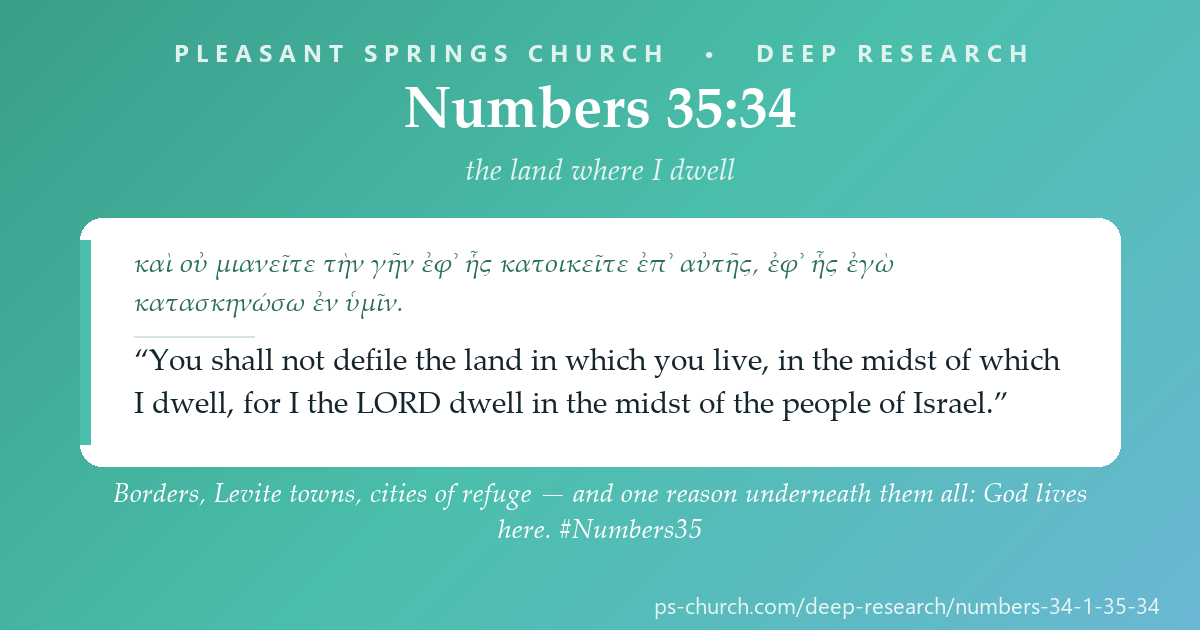
Numbers 35:34 · to share
LXX + ESVEvery Deep Research page traces its passage across the whole sweep — the Old Testament, the Second-Temple world between the testaments (historical witnesses, not Scripture), and the New Testament. Follow the thread:
Pleasant Springs Church — Deep Research
Research method after Michael S. Heiser’s Bible Research Method (examine dictionaries → ancient literature → important words → textual connections → academic publications → share), with the Pleasant Springs “Author & Audience” foundation. Scripture set in the Hebrew, the Greek editions named on each page and the ESV (Old Testament), and the Greek New Testament and the ESV (New Testament), per the practice of Pleasant Springs Church. Numbers 34–35 research grounded in Ashley, Wenham, Cole, Levine, Milgrom and Olson, with Greenberg on biblical asylum, Wazana on ancient border texts, and Beale & Carson on the New Testament use (Hebrews); ANE homicide and ransom law from the Code of Hammurabi §§206–208 (ANET 175), the Hittite Laws §§1–4 (ANET 189) and Middle Assyrian Laws A §10 (ANET 181); Second-Temple and rabbinic witnesses (Josephus, Philo, the Damascus Document, Mishnah Makkot and Sanhedrin, b. Makkot, Sifre Numbers), all read as witnesses, not Scripture. Versification: Numbers 34 and 35 carry no offset — MT, LXX and English agree throughout both chapters — though just before them English 29:40 = MT/LXX 30:1 and English 30:1–16 = MT/LXX 30:2–17; the Greek follows Rahlfs. The release of the manslayer at the high priest’s death is offered as a clearly labeled devotional analogy grounded in Hebrews 6:18–20, not as a typological proof, and Numbers’ own silence about the reason is left standing.
Scripture quotations marked ESV are from the ESV® Bible (The Holy Bible, English Standard Version®), © 2001 by Crossway, a publishing ministry of Good News Publishers. ESV Text Edition: 2016. Used by permission. All rights reserved. The ESV text may not be quoted in any publication made available to the public by a Creative Commons license, and the ESV may not be translated in whole or in part into any other language. www.esv.org
|
Did this study bless you today? 💚 Give to Support PS Church100% of gifts go to the General Fund — thank you. |