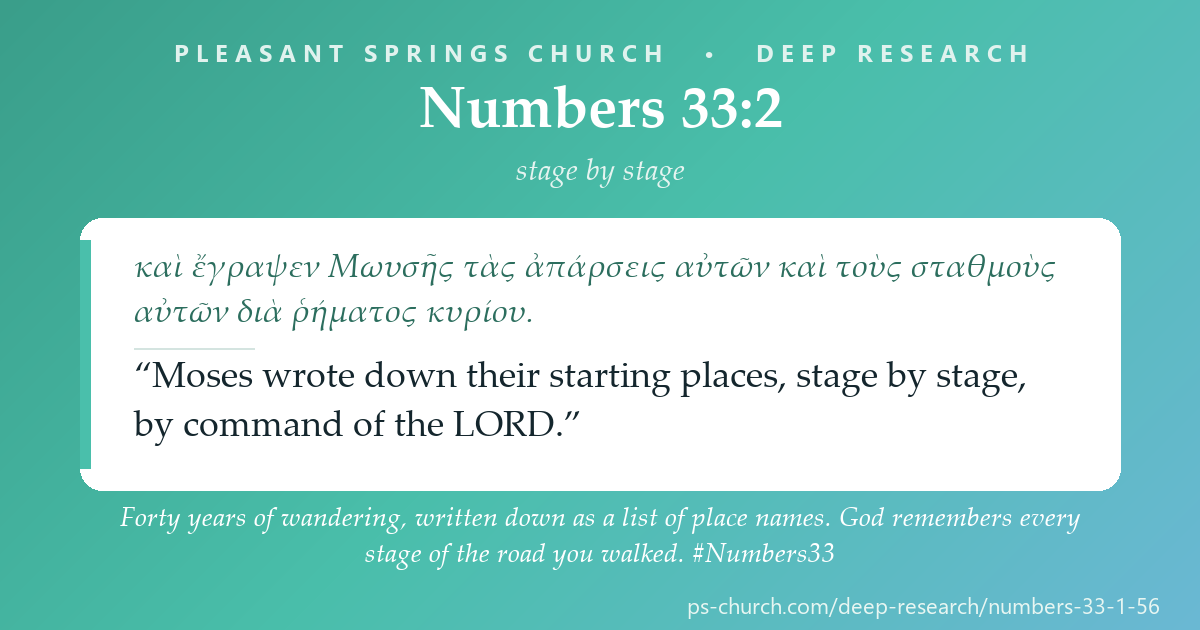
Forty-two place-names. That is most of Numbers 33 — a column of towns and wells and mountains, many of which no one can find today. It is easy to skim. But look at how it begins: “Moses wrote down their starting places, stage by stage, by command of the Lord” (33:2). God told him to write it down. All of it — Rameses on the day after the Passover, the sea, Marah, Elim, Sinai, Kibroth-hattaavah (the graves of craving), Kadesh where they refused to go in, Mount Hor where Aaron died, and at last the plains of Moab by the Jordan at Jericho. The hard places are in the record. So are the long stretches where nothing seems to have happened. Then the Lord speaks at the threshold (33:50–56): drive them out, destroy the images and the high places, divide the land by lot — and what you let remain will be barbs in your eyes and thorns in your sides. This study works Numbers 33:1–56 in Hebrew, the Septuagint and the ESV. See the method →
Numbers 33:1–55 (selections)
Hebrew · LXX · ESVThe Shape of the Passage
SequenceNumbers 33 is the book looking back before it looks over. Everything the reader has walked through is here again in one column of names — the ordered camp (chs 1–2), the Passover and the cloud (ch 9), the setting out from Sinai (ch 10), the graves of craving (ch 11), Kadesh (chs 13–14), Aaron’s death on Mount Hor (ch 20), the road up through Moab (ch 21) and Peor (ch 25). Then the chapter turns forward, to boundaries (chs 34–35) and the last ruling of the book (ch 36).
Author
The chapter names its own author and its own authorization in one sentence: “Moses wrote down their starting places, stage by stage, by command of the Lord” (33:2). This is the only place in the Torah where Moses is said to have written a record of the journey itself. It is not a travel diary kept for sentiment; it is a commanded document. God wanted the road on paper.
A deliberate literary shape. The list is framed: it opens “when they went out of the land of Egypt” (33:1) and closes “in the plains of Moab by the Jordan at Jericho” (33:48–49) — the same phrase the whole book ends on (36:13). Two dated notices interrupt the names: the departure from Rameses on the day after the Passover (33:3) and Aaron’s death on Mount Hor in the fortieth year (33:38–39). Between them the same pair of verbs repeats some forty times — they set out… and camped — and the repetition is the point. Then the Lord speaks (33:50), and the chapter that has been all past tense becomes all future tense.
Audience
The second generation, camped at the Jordan. Most of them were children when the list began; many of the names on it are places they cannot remember, and some are places where their parents are buried. The list is handed to them as an inheritance before the land is. Before Israel is told what to do in Canaan, Israel is told where it has been.
How they heard it. Not as geography — as testimony. Forty-two names is what forty years of being carried looks like when you write it down. Deuteronomy says it outright to the same people in the same camp: “you shall remember the whole way that the Lord your God has led you these forty years in the wilderness” (Deut 8:2), and “the Lord your God carried you, as a man carries his son” (Deut 1:31). Then, having heard the whole road read back to them, they hear the warning: the danger in the land will not be giants. It will be the images and the high places they decide to live with (33:52, 55).
Orient on the wilderness itinerary, the route of the exodus, the named stations, and the “high places.”
Search by topic: exodus route, wilderness wanderings, itinerary, Rameses, Marah and Elim, Kibroth-hattaavah, Kadesh-barnea, Hor (Mount), Ezion-geber, Punon, Dibon, plains of Moab, high place, molten image, lot (casting of).
Which articles are relevant?
- Anchor Bible Dictionary — “Exodus, Route of,” “Wilderness Wanderings,” “Rameses,” “Kadesh-barnea,” “Hor, Mount,” “Ezion-geber,” “Punon,” “Dibon,” “High Place.”
- Dictionary of the OT: Pentateuch — “Numbers, Book of,” “Wilderness, Desert,” “Land,” “Idolatry,” “Travel and Communication.”
- NIDOTTE / TDOT — נָסַע (nāsaʿ, pull up stakes / set out) and the noun מַסָּע (massāʿ, stage), מוֹצָא (môṣāʾ, going-out / starting place), יָרַשׁ (yāraš, possess / dispossess), מַשְׂכִּית (maśkîṯ, figured stone), בָּמָה (bāmāh, high place).
Bibliography surfaced:
- Timothy Ashley (NICOT), Gordon Wenham (TOTC), R. Dennis Cole (NAC), Baruch Levine (AB), Jacob Milgrom (JPS) on Numbers.
- Graham I. Davies, The Way of the Wilderness (SOTS Monograph Series) and his study of the wilderness itineraries — the standard comparison of Numbers 33 with Egyptian and Mesopotamian itinerary texts.
- Dennis T. Olson, The Death of the Old and the Birth of the New — on how Numbers is organized around the passing of one generation and the rise of another.
- Site-identification surveys of the Sinai, the Arabah and Transjordan; the historical geography handbooks on the exodus route.
Kings kept itineraries too — and theirs read very differently.
Set Numbers 33 beside the actual itinerary documents of the ancient world, then read the dispossession command (33:50–56) against what Canaanite and Moabite religion looked like in its own words. Second-Temple and later witnesses are heard as witnesses, never as Scripture.
Which parallels shed light on religion and worldview?
The itinerary was a real ancient genre. Egyptian and Mesopotamian scribes kept dated, stage-by-stage march records, and one of the best is the Annals of Thut-mose III at Karnak (ANET 234–238): “Year 22, 4th month of the second season, day 25 — [his majesty passed the fortress of] Sile”; then day 4, Gaza; day 5, “departure from this place”; day 19, “the town of Aruna” — and the text says of the campaign that everything “is set down by the individual day, by the individual expedition… on a roll of leather in the temple of Amon today” (ANET 237). Numbers 33 is doing recognizably the same kind of thing. Graham Davies’ work on the wilderness itineraries showed how closely the formula — they set out from X and camped at Y — matches the ancient documents.
And yet the contents are the opposite. A royal itinerary exists to make a king look invincible; it lists conquests. Israel’s itinerary lists Kibroth-hattaavah, the graves of craving (33:16; Numbers 11), and Kadesh, where the nation refused to go in (33:36–37; Numbers 13–14), and Mount Hor, where the high priest died outside the land (33:38). No king wrote a stela about the day his army wept all night. This record was commanded by God, and God kept the failures in it.
What ‘high places’ actually were. The dispossession command names the images and the shrines first (33:52), and we are not left to guess what it meant. The Moabite Stone — set up by Mesha of Moab about 830 bc, from Dibon, a town on this very itinerary (33:45) — opens: “I (am) Mesha… king of Moab, the Dibonite — my father (had) reigned over Moab thirty years… (who) made this high place for Chemosh in Qarhoh” (ANET 320). The same inscription records Mesha taking Nebo and killing everyone in it “for I had devoted them to destruction for (the god) Ashtar-Chemosh” (ANET 320). That is the world Israel was walking into: gods with high places, and kings who fought their neighbors in those gods’ names. It is also a sober reminder that the language of Numbers 33 was not unique to Israel — which is exactly why what Israel meant by it has to be read from Scripture’s own framing, and not assumed from the neighbors.
- Annals of Thut-mose III (Egyptian, 15th c. bc; ANET 234–238, the dated itinerary entries at 235–236 and the leather roll at 237) — a dated, stage-by-stage march record: the closest genre-parallel to Numbers 33.
- The Moabite Stone (Mesha Inscription), c. 830 bc (ANET 320–321) — Dibon, Nebo, Medeba and Ataroth; a “high place for Chemosh”; and a king devoting a captured town to destruction for his god. Background to 33:45–47 and to 33:52.
- Papyrus Anastasi I (the “Satirical Letter,” Egyptian, 13th c. bc) — an Egyptian scribe quizzed on the roads and towns of the Levant; evidence that itinerary knowledge was professional scribal stock-in-trade.
- Josephus, Antiquities 4.82–84 (Second-Temple — a witness, not Scripture) — Aaron ascends the mountain in sight of the whole army, hands the priestly garments to Eleazar, and dies at 123 (cf. 33:38–39).
- Temple Scroll (11QTa) col. II (Dead Sea Scrolls — a witness, not Scripture; the column is fragmentary and reconstructed) — rewrites Exodus 34:10–16 together with Deuteronomy 7:25–26: the covenant, the driving out of the nations, and the tearing down of their altars, pillars and Asherim. The Qumran community read the dispossession command, as Numbers 33 does, as fundamentally a command about idolatry.
- Eusebius, Onomasticon (early 4th c. ad), the pilgrimage of Egeria (c. 381–384) and the Madaba mosaic map (6th c.) — the earliest sustained attempts to put the stations of Numbers 33 on the ground. Their disagreements are themselves evidence of how early the memory of many sites had faded.
- Midrash Tanhuma, Masei 3 (rabbinic-era — a witness, not Scripture) — the parable of a king who took his sick son far away to be healed, and on the way home recounted the stops: “Here we slept. Here we cooled off. Here you had a headache.” An old reading of why the list is in the Bible at all — though the midrash’s own application is sterner than the parable sounds (‘recount to them all the places where they provoked Me’); its second answer, that the stations themselves will be rewarded, is the generous one.
It should be said plainly, because a Bible-study page that pretends otherwise is not worth much: we cannot locate most of the forty-two stations. A handful are secure or near-secure — Rameses in the eastern Nile Delta, Ezion-geber near the head of the Gulf of Aqaba (33:35), Punon in the copper country of the Wadi Feinan (33:42), Dibon-gad at modern Dhiban in Jordan (33:45), and the plains of Moab opposite Jericho (33:48–49). Kadesh is usually placed at ‘Ain el-Qudeirat, and Mount Hor is disputed. For a large number of the rest — Rithmah, Rissah, Kehelathah, Mount Shepher, Haradah, Makheloth, Tahath, Terah, Mithkah — we have a name and nothing else. Even the route as a whole is debated: a southern Sinai road, a central one, or a northern one, depending largely on where one locates Mount Sinai. This is worth sitting with rather than solving. Two-thirds of the road God commanded Moses to write down is, to us, just names. That does not make the record false; it makes it a record kept for them, and for God’s own reasons, rather than for our maps. And it quietly matches the pastoral point of the chapter: most of the places where God carried you will never be famous, and some of them you will not be able to find again yourself.
Pulling up stakes, starting places, the mouth of the Lord, and what gets left in.
Watch massāʿ (a stage = a striking of camp) and môṣāʾ (a starting place); the twin occurrences of ʿal-pî YHWH in 33:2 and 33:38; the untranslated shame of Kibroth-hattaavah; and the vocabulary of images, high places, barbs and thorns in 33:52–55.
“Stage / setting out” — from נָסַע (nāsaʿ), whose root sense is to pull up the tent pegs. Israel’s word for a leg of the journey is a word for striking camp. The LXX renders it σταθμός, a “station” or day’s march. Forty years of life reduced to forty-two pullings-up of stakes — and every one of them recorded.
“Starting place / going-out” (plural môṣāʾêhem), from יָצָא, the same verb that gives Israel the word for the exodus itself (33:1, 3, 38). The LXX has ἀπάρσεις, “departures.” Note what God told Moses to write down: not the destinations, but the departures — the places they had to leave.
“At the mouth of the Lord” — ESV “by command of” / “at the command of”; LXX διὰ ῥήματος κυρίου and διὰ προστάγματος κυρίου. The phrase occurs twice in this chapter, and it is worth noticing where: the writing of the record (33:2) and Aaron’s death on the mountain (33:38). The same word of God that ordered the journey ordered the page it was written on — and was there at its hardest stop.
“Graves of craving” — the place named in Numbers 11:34 for those buried there after the quail. The LXX does not transliterate it; it translates it: Μνήματα τῆς ἐπιθυμίας, “the Tombs of Craving.” God did not edit it out of the itinerary. The record of his faithfulness includes the name of Israel’s appetite.
“Figured stone” (ESV) — a carved or engraved stone image; the word is related to a root for seeing, and the LXX heard exactly that, rendering it σκοπιάς, “lookout places.” Alongside it stand ṣalmê massēḵōṯām, “their metal images,” and בָּמוֹת (bāmôt), “high places” (LXX στήλας, “pillars”) — the very word Mesha of Moab used of the shrine he built for Chemosh.
“Barbs” — a rare word, paired with צְנִינִם (ṣenînim), “thorns.” The LXX gives σκόλοπες, splinters or stakes, “in your eyes,” and βολίδες, darts, “in your sides.” σκόλοψ is the same word Paul later uses of his own “thorn in the flesh” (2 Cor 12:7). The image is not of an enemy army; it is of something small, lodged, and always there.
Where the New Testament stands in relation to this chapter:
Numbers 33 is not quoted in the New Testament — that should be said honestly rather than papered over. But its two themes are everywhere in the apostolic writings, and they are picked up in ways that govern how the church may and may not use this chapter.
- Hebrews 11:13–16 — “strangers and exiles on the earth… they desire a better country, that is, a heavenly one.” A written itinerary is the literary form of a pilgrim people. Cf. 1 Peter 2:11.
- 1 Corinthians 10:11–14 — the wilderness generation as an example “written down for our instruction,” ending in the command that names Numbers 33’s own concern: “Therefore, my beloved, flee from idolatry.”
- 2 Corinthians 6:16–17; 1 John 5:21 — “What agreement has the temple of God with idols?”; “Little children, keep yourselves from idols.” The command of 33:52 arrives in the church as a command about the heart’s allegiance, not about anyone’s land.
- Ephesians 6:12; 2 Corinthians 10:3–4; Luke 9:54–55 — the church wrestles “not against flesh and blood”; its weapons “are not of the flesh”; and Jesus rebukes the disciples who want to call down fire. This is the New Testament’s own fencing of the conquest material.
- Revelation 2:20 — “you tolerate that woman Jezebel.” The risen Christ’s complaint against a church is precisely the warning of 33:55: what you let remain will shape you.
The road written down — and the warning that came true.
Trace three threads: God keeping the record of a life; the stations that already have their own chapters; and the warning of 33:55, which the historical books quote back with the tense changed.
Which cross-references matter?
- The stations, chapter by chapter — Rameses and Succoth (Exodus 12; Exodus 13), the sea (Exodus 14), Marah and Elim (Exodus 15:22–27), the wilderness of Sin (Exodus 16), Rephidim (Exodus 17), Sinai (Exodus 19), Kibroth-hattaavah and Hazeroth (Numbers 11), Kadesh (Numbers 13–14), Mount Hor (Numbers 20), the Transjordan road (Numbers 21), and the plains of Moab (Numbers 25). Read the list with the chapters open and it stops being a list.
- Deuteronomy 1:31; 2:7; 8:2 — the same camp, the same forty years, read pastorally: “the Lord your God carried you, as a man carries his son”; “He knows your going through this great wilderness… You have lacked nothing”; “you shall remember the whole way.”
- Psalm 139:16 (LXX Ps 138:16) — “in your book were written, every one of them, the days that were formed for me, when as yet there was none of them.” And Psalm 56:8 (LXX Ps 55:9) — “You have kept count of my tossings; put my tears in your bottle. Are they not in your book?” The itinerary is not a one-off kindness; it is how God keeps a life.
- Numbers 26:52–56; 34:13 — the land divided by lot, larger inheritance to the larger tribe (33:54; see Numbers 26 and Numbers 34). The lot removes the allocation from human favouritism; the sizing keeps it just.
- Exodus 23:31–33; 34:12–16; Deuteronomy 7:1–5, 25–26 — the same command each time, and each time the stated reason is the same: “for they would turn away your sons from following me, to serve other gods” (Deut 7:4).
- Joshua 23:12–13; Judges 2:1–3 — the warning of 33:55 quoted back after the fact: “they shall be a snare and a trap for you, a whip on your sides and thorns in your eyes”; “they shall become thorns in your sides, and their gods shall be a snare to you.” Judges is the book-length demonstration.
- Psalm 106:34–36 (LXX Ps 105:34–36) — the verdict: “They did not destroy the peoples, as the Lord commanded them, but they mixed with the nations and learned to do as they did. They served their idols, which became a snare to them.” The chapter’s own stated concern, confirmed by Israel’s history.
The end of this chapter is dispossession language, and it deserves the same careful handling as the war with Midian in Numbers 31. Four things need saying together. First, report it plainly. God commands Israel to drive out the inhabitants of Canaan, to destroy their figured stones and metal images, and to demolish their high places (33:52). The text is not softer than that, and pretending otherwise helps nobody. Second, notice what the chapter itself says the concern is. The images and the shrines are named first, and the threat in 33:55 is not military defeat but corrosion — barbs, thorns, trouble — the slow reshaping of a people by what it agreed to live with. Everywhere this command appears, the reason given is the same: they will turn your sons away to serve other gods (Exod 34:16; Deut 7:4). Peor had just proved it (Numbers 25). And the chapter’s last word turns the whole threat back on Israel — “And I will do to you as I thought to do to them” (33:56). Nothing here is about blood; the standard falls on Israel too. Third, locate it precisely. This is a bounded, divinely commanded act at a unique point in redemptive history, concerning one land and one moment. It is not a general principle, not a model for any nation, church or movement, and not a warrant for anyone’s violence today — and any use of it that way is a misuse. Scripture itself closes that door: our struggle is “not against flesh and blood” (Eph 6:12), our weapons “are not of the flesh” (2 Cor 10:4), and Jesus rebuked the two disciples who wanted fire from heaven (Luke 9:54–55). Fourth, be honest that it is hard. Scholars discuss the conventions of ancient war rhetoric and the elasticity of ancient totals, and that discussion is worth knowing — but it is not an escape hatch, and it does not dissolve the difficulty. Some of the weight here stays heavy. Where Scripture gives a reason, we give it; where it does not, we say so and stop.
The itinerary genre, the route question, and the theology of a list.
Ashley, Wenham, Cole, Levine and Milgrom on Numbers; Davies on the wilderness itineraries; Olson on the shape of the book; the historical-geography literature on the route.
Commentaries & studies:
- Timothy R. Ashley, The Book of Numbers (NICOT); Gordon J. Wenham, Numbers (TOTC); R. Dennis Cole, Numbers (NAC); Baruch A. Levine, Numbers 21–36 (Anchor); Jacob Milgrom, Numbers (JPS).
- Graham I. Davies, The Way of the Wilderness: A Geographical Study of the Wilderness Itineraries in the Old Testament, and his article-length treatment of the wilderness itineraries — the standard case that Numbers 33 belongs to a recognized ANE documentary genre.
- Dennis T. Olson, The Death of the Old and the Birth of the New: The Framework of the Book of Numbers and the Pentateuch, and his Numbers (Interpretation).
- The historical-geography literature on the exodus route and the identification of the stations (southern, central and northern Sinai reconstructions), and the archaeology of Feinan/Punon, Dhiban/Dibon and ‘Ain el-Qudeirat.
Interpretation notes worth keeping:
- The list is a document, not a summary. 33:2 claims a written source made at God’s command, and the genre parallels support the claim that such records were actually kept. Whatever one concludes about the transmission history, the chapter presents itself as an archive, and reads like one.
- Forty-two stations, and only two dates. The narrator dates exactly two moments: the departure from Rameses (33:3) and Aaron’s death (33:38–39). The first is the beginning of the redeemed life; the second is the end of the first generation’s leadership. Everything else is undated — ordinary time, and kept anyway.
- Kadesh appears once. The great stopping-place of the book (chs 13–20) gets a single line in the list (33:36–37). Scholars debate which of the earlier names (Rithmah is the usual candidate) covers the long stay. The disproportion is itself instructive: the chapter is not weighting the stations by how much happened there.
- Do not over-map it. Confident route reconstructions outrun the evidence. Hold the identifications loosely; the theological point of the chapter does not depend on any of them.
- The command is about worship. Read 33:50–56 with Exod 34:12–16 and Deut 7:1–5 and the stated rationale is unmistakably religious, not ethnic or territorial: the shrines corrupt Israel’s worship. Judges 2:1–3 and Ps 106:34–36 (LXX Ps 105:34–36) record the outcome when the command was not kept.
- Bounded, and not transferable. The consistent position of this series: the conquest material is a specific, divinely commanded, redemptive-historical event, not a template for any people today. See the note at Stage 4, and Numbers 31.
A list of place-names is a record of forty years of being carried.
Name what you learned, why it matters, and one concrete response.
What should we carry away — and do?
- God has the whole road written down. Not the highlights — the stages. Forty-two of them, at his own command (33:2). If he told Moses to write down Rithmah and Mithkah and Haradah, places nobody can even find now, he is not going to forget the years you cannot account for.
- He kept the failures in the record. Kibroth-hattaavah is on the list — the graves of craving, named for a sin and a burial. God did not edit it out, and he did not stop the journey there either. It is a station, not a terminus. The place where you failed him is written down as a place you set out from.
- The long stretches count too. Most of the forty-two names have no story attached. Nothing happened there that anyone recorded. Those years were still written down, still commanded, still carried. Ordinary time is not lost time.
- Every stage began with pulling up stakes. The Hebrew word for a stage of the journey means striking camp. God’s people have always had to leave places they had gotten comfortable in — some good, some not.
- What you tolerate will shape you. The warning at the end is not about armies but about images and high places left standing (33:52, 55). Barbs and thorns are small, lodged things. Judges is the book-length proof, and the risen Christ says the same thing to a church: “you tolerate…” (Rev 2:20). The apostolic form of this command is “flee from idolatry” (1 Cor 10:14) and “keep yourselves from idols” (1 John 5:21) — never a warrant against any people.
Step in response: write your own itinerary. Not the highlights — the stages. Ten or twelve places, in order, including the hard ones and the ones where nothing happened, and beside each one a sentence about where God was. Then look at the list and read 33:2 over it. Then name the one thing you have decided to live with — the image, the habit, the arrangement — and deal with it this week, before it is a thorn.
Numbers 33:2 · to share
LXX + ESVEvery Deep Research page traces its passage across the whole sweep — the Old Testament, the Second-Temple world between the testaments (historical witnesses, not Scripture), and the New Testament. Follow the thread:
Pleasant Springs Church — Deep Research
Research method after Michael S. Heiser’s Bible Research Method (examine dictionaries → ancient literature → important words → textual connections → academic publications → share), with the Pleasant Springs “Author & Audience” foundation. Scripture set in the Hebrew, the Greek editions named on each page and the ESV (Old Testament), and the Greek New Testament and the ESV (New Testament), per the practice of Pleasant Springs Church. Numbers 33 research grounded in Ashley, Wenham, Cole, Levine and Milgrom, with Graham I. Davies on the wilderness itineraries and Dennis T. Olson on the framework of the book; ANE background from the Annals of Thut-mose III and the Moabite Stone (ANET 234–238, 320–321), with Papyrus Anastasi I; Second-Temple, rabbinic and early-Christian witnesses (Josephus, the Temple Scroll, Midrash Tanhuma, Eusebius’ Onomasticon, Egeria and the Madaba map), all read as witnesses, not Scripture. Numbering: Hebrew, Rahlfs LXX and English agree exactly throughout Numbers 33 — no offset; the book’s one divergence is at English 29:40 = MT/LXX 30:1 (hence English 30:1–16 = MT/LXX 30:2–17), and Psalms are cited with both numbers (e.g. Ps 106 = LXX Ps 105). The dispossession command of 33:50–56 is handled as a bounded, divinely commanded act in redemptive history whose stated concern is idolatry — never as a template for anyone today.
Scripture quotations marked ESV are from the ESV® Bible (The Holy Bible, English Standard Version®), © 2001 by Crossway, a publishing ministry of Good News Publishers. ESV Text Edition: 2016. Used by permission. All rights reserved. The ESV text may not be quoted in any publication made available to the public by a Creative Commons license, and the ESV may not be translated in whole or in part into any other language. www.esv.org
|
Did this study bless you today? 💚 Give to Support PS Church100% of gifts go to the General Fund — thank you. |