This is the hardest chapter in Numbers, and this study will neither soften it nor step around it. God gives Moses a last commission — “Avenge the people of Israel on the Midianites. Afterward you shall be gathered to your people” (31:2) — and twelve thousand men go out with Phinehas, the sanctuary vessels and the alarm trumpets. The five kings of Midian fall, and Balaam with them (31:8). Moses is angry that the women were spared and names why: it was these who, “on Balaam’s advice,” led Israel into the treachery at Peor (31:16); and what he commands next, in 31:17–18, is the hardest thing in the book. Then the chapter turns and spends most of its remaining verses on something else entirely: seven days outside the camp, water and fire, plunder divided and taxed for the Lord, and officers bringing gold “to make atonement for ourselves.” We will report what the text says, locate it exactly — a specific, commanded, bounded judgment at a closed moment in redemptive history, never a model for any nation or church and never a warrant for violence by anyone today — and let the New Testament say what our warfare now is. See the method →
Numbers 31:1–54 (selections)
Hebrew · LXX · ESVThe Shape of the Passage
InclusioNumbers 31 does not stand alone, and reading it alone is how it gets misused. It is the sequel to one specific event: the seduction at Peor (ch 25), which the narrator has already traced back to Balaam (chs 22–24; see 24:15–19) and to the word in 25:16–18. It comes after the second census (ch 26) and after Moses has been told he will die and has laid hands on Joshua (ch 27). It is followed by the settlement east of the Jordan (ch 32) and the itinerary that closes the wilderness (ch 33). Every question this chapter raises has to be asked inside that frame.
Author
The Torah of Moses reports this campaign as a commanded, bounded judicial act, and it is careful to say so three times over: the command comes from God (31:1–2), the war is fought “as the Lord commanded Moses” (31:7), and the stated cause is a named crime — Peor (31:16; cf. 25:16–18). It is not a land war; Israel does not take Midianite territory, and the surviving Midianites reappear as a recognizable people in the time of the judges (Judg 6–8). It is not opportunistic; the plunder is inventoried, taxed for the Lord, and shared with those who never left camp. And it is not a triumph: the army comes home to a week of quarantine.
The hard verses, stated plainly. We will not skip them. Moses is angry that the women were kept alive (31:14–15), and orders: “Now therefore, kill every male among the little ones, and kill every woman who has known man by lying with him. But all the young girls who have not known man by lying with him keep alive for yourselves” (31:17–18). Thirty-two thousand such young women are counted among the spoil (31:35). That is what the text says. It is hard to read, it has been hard to read for a very long time, and a study that pretends otherwise is not being reverent — it is being dishonest. What we can say is where the text puts the weight: on the specific crime of Peor, on those who carried it out, and on a purification so total that the victors themselves are treated as unclean.
Audience
Israel on the plains of Moab, at the end of the wilderness and the end of Moses’ life. This is the last thing God tells him to do (31:2), and the chapter sits in a book that is teaching a second generation how to belong to a holy God. To that audience the message is not “go and do likewise” — it is “what happened at Peor was not a small thing.” The camp that nearly died of an invitation to dinner is being shown the cost of that invitation from the other side.
How they heard it — and how we must not. Ancient Israel heard a story about God’s judgment on a specific act of religious sabotage, executed once, under prophetic command, in a particular season of redemptive history that is closed. It was never given as a rule for how nations behave, and it is not one now. There is no reader of this page for whom Numbers 31 authorizes violence — not against a neighbour, not against an enemy, not against anyone. That is not a modern nicety pasted over the text; it is where the canon itself lands, in the words of the Lord Jesus and his apostles (Stage 4). We will report the chapter honestly and refuse to weaponize it, and we will not pretend the two are in tension.
Orient on Midian, the vengeance formula, herem and holy war, corpse impurity, and the spoils law.
Search by topic: Midian and the Midianites, Balaam, Peor, vengeance (naqam), herem / devoted to destruction, holy war and the divine warrior, corpse impurity and the water for impurity, spoils of war and their division, atonement money, Phinehas.
Which articles are relevant?
- Anchor Bible Dictionary — “Midian, Midianites,” “Balaam,” “Peor,” “War, Holy War,” “Ban (herem),” “Purity and Impurity,” “Booty,” “Phinehas.”
- Dictionary of the OT: Pentateuch — “War,” “Vengeance,” “Ethics,” “Clean and Unclean,” “Atonement,” “Priests and Levites,” “Numbers, Book of.”
- NIDOTTE / TDOT — נָקָם (nāqām, requital), מַעַל (maʿal, sacrilege / breach of faith), חָרַם (ḥāram, devote to destruction), חָטָא in the hithpael (ḥāṭāʾ, de-sin, purify oneself), מַלְקוֹחַ (malqôaḥ, plunder), כָּפַר (kāṗar, make atonement).
Bibliography surfaced:
- Timothy Ashley (NICOT), Gordon Wenham (TOTC), R. Dennis Cole (NAC), Baruch Levine (AB), Jacob Milgrom (JPS), Dennis Olson (Interpretation) on Numbers.
- Studies of herem and ancient Near Eastern conquest rhetoric; of corpse impurity and the red-heifer water (Num 19); and of the biblical spoils legislation.
- The standing theological literature on the “hard texts” of the Old Testament — Christopher J. H. Wright, The God I Don’t Understand; Paul Copan, Is God a Moral Monster?; and the critical responses to both — read together rather than selectively.
How ancient kings wrote about war — and what the ancients did with this chapter.
Read the chapter first against how war was actually written about in the ancient Near East, then note where Israel’s account is conventional and where it is not, and let later readers — Qumran, Josephus, the rabbis — show what they saw in it. Historical witnesses, never leveled with Scripture.
Which parallels shed light on religion and worldview?
The genre, in a neighbour’s own words. We are not speculating about how ninth-century kings on this plateau described a campaign. The Mesha Inscription (the Moabite Stone, c. 830 BC; ANET 320–321, translated there by W. F. Albright) is a Moabite king’s own account, and the vocabulary is startlingly familiar. Chemosh commands the attack — “Go, take Nebo from Israel!” Mesha takes it and reports killing “all, seven thousand men, boys, women, girls and maid-servants, for I had devoted them to destruction for (the god) Ashtar-Chemosh.” He drags off “the [ … ] of Yahweh” — the noun is broken away, and is usually restored as the vessels — before his god. And earlier in the same inscription he announces that “Israel hath perished for ever!” — while the kingdom of Israel in fact went on for more than another century. Divine command, total-sounding numbers, devoted spoil, sweeping claims of annihilation: this is the standing form of royal war report in that world, and Numbers 31 is written in a recognizable dialect of it.
What that does and does not settle. Scholars have long argued from parallels like this that ancient conquest accounts use conventional, hyperbolic and formulaic totals, and that reading them with modern statistical literalism misreads the genre. That observation is worth taking seriously; it is not special pleading invented for the Bible, and it bears on the numbers here (the Hebrew אֶלֶף, ʾeleṗ, can mean a “thousand” or a military unit, a question that runs through the census chapters as well — see Numbers 1–2). But we will not use it as an escape hatch. The command in 31:17 is still there, and it still means what it says. Genre criticism can tell us how a campaign report was conventionally written; it cannot make an unwelcome sentence go away, and a study that reaches for it in order to stop feeling the weight of the text has stopped doing exegesis. Hold both: the report is written in an ancient idiom, and the thing reported is genuinely hard.
Where Israel’s account is not conventional. Two features have no good parallel in the royal inscriptions. First, the victors are unclean. Mesha comes home to build a high place; Israel’s army camps outside the camp for seven days, and every man who killed or touched a corpse goes through the same purification as anyone else defiled by death (31:19–20; Numbers 19). No ancient king ever wrote that. Second, the plunder is legislated, taxed and shared — half to the twelve thousand who fought, half to the congregation that stayed home, with a tribute for the Lord from each half (31:25–47). Victory does not belong to the strong; it is distributed, and part of it is God’s.
- The Mesha Inscription / Moabite Stone, c. 830 BC (ANET 320–321) — Chemosh commands a campaign; captives “devoted to destruction” for Ashtar-Chemosh; a round seven thousand; and the flatly hyperbolic boast “Israel hath perished for ever!” The single best control on how such reports were written.
- Assyrian royal annals and Egyptian victory texts (the Kurkh Monolith of Shalmaneser III, ANET 278–279, within the Shalmaneser inscriptions at 276–281; the Egyptian campaign records from Thut-mose III onward, ANET 234–264) — the same conventions of divine mandate, comprehensive claims and inventoried spoil; the wider genre against which Numbers 31 should be read.
- The War Scroll (1QM), esp. cols. VII–IX (Dead Sea Scrolls — a witness, not Scripture) — a Second-Temple community’s imagined holy war, with priests sounding the trumpets from a distance and forbidden to go among the slain “so as to defile themselves with their unclean blood.” Numbers 31:6 and 31:19 are clearly in view. Note the irony worth naming: the group that most literally rehearsed this chapter never fought the war it imagined.
- Josephus, Antiquities 4.6.6–13; 4.7.1 (Second-Temple — a witness, not Scripture) — Balaam, unable to curse, counsels Balak to send the Midianite women, “and when Balaam had suggested counsel to them, he went his way”; Josephus then says outright that this “was the cause why Moses was provoked to send an army to destroy the Midianites,” and narrates the campaign with Phinehas as commander and the five kings named. He also stresses that the army “had received no harm” — the detail of 31:49 mattered to ancient readers too.
- Sifre Bemidbar 157 (rabbinic-era — a witness, not Scripture) — the classical midrash on Num 31:1–21: why Midian and not Moab is named, and the observation that Moses moved to obey at once even though 31:2 told him his own death would follow.
- b. Avodah Zarah 75b (rabbinic-era — a witness, not Scripture) — “Rava says: It is derived from that which the verse states with regard to utensils captured in the battle against the Midianites: ‘Anything that may tolerate the fire, you shall make to go through the fire, and it shall be pure’ (Numbers 31:23).” The whole later Jewish practice of purging vessels is built on this one verse; cf. Mishnah, Avodah Zarah 5:12.
Read 31:19 slowly, because it is the strangest sentence in the chapter. The soldiers have done exactly what God told them to do — and they may not come home. Seven days outside the camp. The same purification rite as a man who has touched a grave. Their clothes, their leather, their goat’s hair, their wooden bowls, their metal, and the people they brought back: all of it through water, and what can bear it through fire.
No triumphal arch. No parade. Israel’s obedient army is quarantined. Whatever else this chapter is doing, it is not celebrating. The text lets a divinely commanded act and a genuine defilement stand in the same paragraph without resolving them, and it makes the men who obeyed carry the second one for a week. Anyone who reads Numbers 31 and comes away exhilarated has read it against its own grain.
Requital, sacrilege, de-sinning, the water for impurity, the roll call, and atonement.
Follow the chapter’s own vocabulary rather than our categories. It moves from naqam (judicial requital, God’s not ours) through maʿal (the named crime at Peor) into the purification words of Numbers 19 — and it ends, remarkably, on kipper. Numbers 31 has no versification offset: the Hebrew, Rahlfs and the ESV all use the same numbers, so every verse cited in these boxes reads the same in a Greek concordance.
“Vengeance / requital” (LXX ἐκδίκησις) — and watch how the two verses share it out. God says “the vengeance of the people of Israel” (31:2); Moses relays it as “the Lord’s vengeance on Midian” (31:3). In Hebrew this is not private revenge but judicial requital, and Israel is told repeatedly that it belongs to God: “Vengeance is mine, and recompense” (Deut 32:35) — the verse Rom 12:19 quotes precisely in order to take it out of the believer’s hands.
“Treachery / sacrilege” — the technical word for misappropriating what is holy (Lev 5:15) and for the covenant infidelity of Numbers 5:6, 12. This, and not ethnicity, is the charge in 31:16: Peor was a breach of faith against the Lord himself. The LXX declines to translate the idiom and paraphrases with two verbs of defection, ἀποστῆσαι καὶ ὑπεριδεῖν.
In the hithpael, “to de-sin oneself” — the purification verb of Numbers 19, used of anyone defiled by a corpse (LXX ἁγνίζομαι, “to be purified”). Numbers uses it here of the victorious army. The vocabulary itself refuses to distinguish an obedient soldier from a mourner at a graveside: contact with death defiles, full stop.
“Water for impurity” (LXX ὕδωρ τοῦ ἁγνισμοῦ) — the ashes of the red heifer mixed with running water (Num 19:9, 17–19). Its only use is to cleanse the defilement of death. That this is the rite prescribed for the returning army is the chapter’s quiet theological verdict on war: it is handled as a death-contamination to be washed away, not a glory to be displayed.
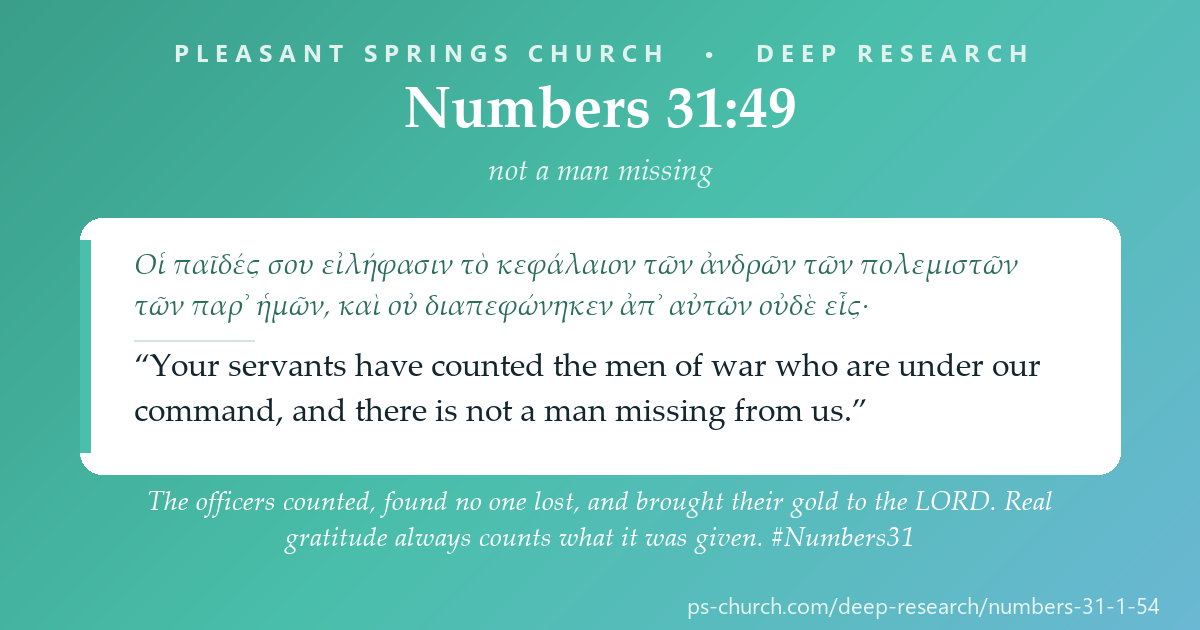
“To muster / attend to” — in the niphal, “to be missing” from a count. The officers report wəlōʾ-niṗqad mimmennû ʾîsh, “there is not a man missing from us.” The LXX reaches for διαπεφώνηκεν, literally “sounded out of tune” — absent when the roll was called. It is the same root that names the census (Numbers 26): God counts people, and knows when one is gone.
“To make atonement” (LXX ἐξιλάσασθαι) — and this is where the chapter ends. The officers do not bring a victory trophy; they bring gold “to make atonement for ourselves before the Lord.” The same verb as Leviticus 16 and as the census ransom of Exod 30:12–16. Men who have just been told they did what God commanded ask, all the same, to be covered.
A word this chapter does not use:
It is worth noticing what is absent. The great conquest term חֵרֶם (ḥērem), “devoted to destruction” — the word Mesha uses of Nebo, and the word that governs Jericho and Achan (Josh 6–7; cf. Leviticus 27:28–29) — never appears in Numbers 31. Nor does the chapter use the land-grant language of conquest. Israel takes no Midianite territory, founds no city, and installs no governor; the spoil is inventoried and the army goes home. Midian is not annihilated in fact either: Midianites are a recognizable people again in Gideon’s day (Judg 6–8), which is one more reason the totalizing idiom of ancient war reports should not be pressed as a body count. This is presented as a punitive expedition for a specific crime, not a war of possession — a distinction the text itself is making, and one worth holding on to.
Where the canon takes this — and where it refuses to let us take it.
Three threads: backward to Peor and Balaam; sideways to the purity law that governs the aftermath; and forward to the New Testament, which knows this material well and speaks about it directly.
Which cross-references matter?
- Numbers 25:16–18 — the command this chapter executes: “Harass the Midianites and strike them down, for they have harassed you with their wiles, with which they beguiled you in the matter of Peor.” Numbers 31 is the discharge of a stated, dated, specific order (see Numbers 25).
- Numbers 22–24; Revelation 2:14; 2 Peter 2:15; Jude 11 — Balaam. The seer who could not curse taught the strategy that worked, and 31:16 says so; the New Testament names “the teaching of Balaam” as a live danger to churches (see Numbers 23–24).
- Numbers 19:11–22 — the water for impurity, applied here to soldiers and spoil alike (Numbers 18–19). The aftermath of 31:19–24 is not improvised; it is the standing corpse-impurity law being applied without exemption.
- Numbers 10:8–9 — the alarm trumpets Phinehas carries: “And when you go to war… you shall sound an alarm with the trumpets, that you may be remembered before the Lord your God” (Numbers 10). The war is framed as an act of remembrance before God, not a display of force.
- Exodus 30:11–16; Numbers 31:50 — the census ransom “to make atonement for your lives” stands directly behind the officers’ gold. Counting men and coming through a battle both put a people in God’s debt, not in his credit.
- Deuteronomy 21:10–14 — the Torah’s own limit on what may be done with a woman taken in war: a month of mourning for her parents, marriage and not concubinage, and release rather than sale — “nor shall you treat her as a slave, since you have humiliated her.” It does not dissolve 31:18, but it is the law under which 31:18 was heard, and it forbids the reading a modern reader reaches for first.
- Deuteronomy 32:35; Romans 12:19–21 — “Vengeance is mine, and recompense.” Paul quotes the Song of Moses in order to remove requital from the Christian’s hands entirely: “never avenge yourselves… overcome evil with good” (see the Deuteronomy 32 worldview).
- Luke 9:51–56; Ephesians 6:10–12; 2 Corinthians 10:3–5; John 18:36 — the New Testament’s own settlement, quoted in full in the note below.
James and John have just been refused hospitality by a Samaritan village, and they know their Bibles. “Lord, do you want us to tell fire to come down from heaven and consume them?” (Luke 9:54). It is a perfectly good scriptural precedent — Elijah did exactly that. And the text says simply, “But he turned and rebuked them” (Luke 9:55). Jesus does not argue the exegesis. He rebukes the instinct. When Peter later draws a sword in the garden, the answer is the same: “Put your sword back into its place” (Matt 26:52), “My kingdom is not of this world. If my kingdom were of this world, my servants would have been fighting” (John 18:36).
So the apostles write to churches in a violent empire and describe a different battlefield altogether: “For we do not wrestle against flesh and blood, but against the rulers, against the authorities, against the cosmic powers over this present darkness, against the spiritual forces of evil in the heavenly places” (Eph 6:12), and “the weapons of our warfare are not of the flesh but have divine power to destroy strongholds” (2 Cor 10:4). Requital itself is taken out of our hands and handed back to God (Rom 12:19). This is not the New Testament being embarrassed by the Old; it is the same God, at a different point in the same story, telling his people what their warfare now is — and it is not this.
Two things follow, and they must be said together. First: Numbers 31 is not a template. Not for a state, not for a church, not for a person — not by analogy, not by application, not ‘in principle.’ No cause, no grievance, no enemy, and no reading of prophecy licenses a Christian to take up this chapter as a warrant. Anyone who has ever used a text like this one to justify harming people has misused it, and the Lord Jesus said so first. Second: we do not therefore delete it. It stands in the book God gave, it tells us that he takes the corruption of his people with terrible seriousness, and it leaves us with a difficulty we are permitted to feel. Scripture does not explain everything it records. Where it gives no reason, we stop — and we bring the discomfort to God rather than to a slogan.
The commentaries, the debate about the numbers, and the ethics literature.
Ashley, Wenham, Cole, Levine, Milgrom and Olson on the chapter itself; the conquest-rhetoric literature for the genre question; and the theological literature on the hard texts — read with its critics, not selectively.
Commentaries & studies:
- Timothy R. Ashley, The Book of Numbers (NICOT); Gordon J. Wenham, Numbers (TOTC); R. Dennis Cole, Numbers (NAC); Baruch A. Levine, Numbers 21–36 (Anchor); Jacob Milgrom, Numbers (JPS); Dennis Olson, Numbers (Interpretation).
- K. Lawson Younger Jr., Ancient Conquest Accounts — the standard study of the shared literary conventions of Assyrian, Hittite, Egyptian and biblical campaign reports.
- Christopher J. H. Wright, The God I Don’t Understand; Paul Copan, Is God a Moral Monster?; Copan & Flannagan, Did God Really Command Genocide? — and, read alongside them, their critics (e.g. Randal Rauser and Wesley Morriston on the hyperbole and accommodation arguments). No responsible study of this chapter cites only one side.
- Jacob Milgrom, Studies in Cultic Theology and Terminology, and the literature on corpse impurity and the red-heifer rite behind Num 31:19–24.
- G. K. Beale & D. A. Carson, eds., Commentary on the New Testament Use of the Old Testament (Revelation, on the Balaam tradition).
Interpretation notes worth keeping:
- The stated cause is Peor, and it is named in the text. 31:16 is the chapter’s own explanation, and it is not ethnic: it is a specific act of religious sabotage that killed twenty-four thousand Israelites (25:9). Any reading that turns this into a general licence against a people has left the text behind.
- This is a punitive expedition, not a conquest. No herem vocabulary, no land taken, no settlement founded — and Midian exists again in Judges 6. The distinction matters and the text makes it.
- The war-rhetoric argument helps, and it is not a solvent. Ancient campaign reports really are formulaic and hyperbolic, as the Mesha Inscription shows on its own terms. That is a genuine gain for reading the numbers. It does not remove the command of 31:17, and it should never be deployed to make a difficult passage stop being difficult. Say what it explains and say where it stops.
- Do not soften and do not sensationalize. Two opposite failures haunt preaching on this chapter: the sermon that hurries past 31:17–18 as though it were not there, and the sermon that lingers on the violence for effect. Both mishandle the text. Report it, locate it, and move to what the chapter itself spends most of its words on — purification, division, and atonement.
- The chapter’s own centre of gravity. Count the verses. Roughly six are given to the fighting; thirty-six to purification, inventory, division and offering. The narrator is not interested in the battle. He is interested in what a people must do afterward to remain fit to live near a holy God.
- Versification is clean here. Numbers 31 runs 1–54 in the Hebrew, in Rahlfs and in the ESV alike — no offset in either direction. The nearby seam is in the previous chapters: ESV 29:40 = MT/LXX 30:1, hence ESV 30:1–16 = MT/LXX 30:2–17 (see Numbers 28–29 and Numbers 30).
From a commanded war to a week outside the camp and a gift of gold.
Name what you learned, why it matters, and one concrete response — soberly. This is not a chapter to be enthusiastic about.
What should we carry away — and do?
- Read hard texts whole, or not at all. Numbers 31 taken by itself becomes either an embarrassment to hide or a weapon to swing. Taken with chapter 25 in front of it and Luke 9 behind it, it is a bounded act of judgment inside a story that is going somewhere else.
- Peor was not a small thing. The chapter exists because a people nearly ended at a dinner table. Whatever we think of the response, we are not permitted to be casual about the offence — God was not.
- Vengeance is God’s, and he has said so to us in writing. “Never avenge yourselves… ‘Vengeance is mine, I will repay, says the Lord’” (Rom 12:19). If a text about God’s judgment leaves you readier to deal it out, you have read it backwards.
- Even obedience can leave you needing washing. Seven days outside the camp, water and fire, for men who did what they were told. There are faithful things in this life that still leave a mark, and Scripture is not squeamish about saying so — nor about providing the cleansing.
- Bring the gold, not the trophy. The officers had a spotless casualty report and asked for atonement anyway (31:49–50). That instinct — we came through; cover us — is the most Christian sentence in the chapter.
- It is allowed to find this hard. You do not have to manufacture peace about Numbers 31 to be a faithful reader of it. Say so honestly, keep reading, and take the difficulty to God. Scripture does not require us to pretend.
Step in response: take the honest question this chapter raises in you — not a rehearsed answer, the actual question — and pray it this week instead of burying it. Then do the one thing the chapter unambiguously commends: ask to be cleansed rather than congratulated. And if there is a grievance you have been quietly holding as your own to settle, put it down where Romans 12 says it belongs.
Numbers 31:23 · to share
LXX + ESVEvery Deep Research page traces its passage across the whole sweep — the Old Testament, the Second-Temple world between the testaments (historical witnesses, not Scripture), and the New Testament. Follow the thread:
Pleasant Springs Church — Deep Research
Research method after Michael S. Heiser’s Bible Research Method (examine dictionaries → ancient literature → important words → textual connections → academic publications → share), with the Pleasant Springs “Author & Audience” foundation. Scripture set in the Hebrew, the Greek editions named on each page and the ESV (Old Testament), and the Greek New Testament and the ESV (New Testament), per the practice of Pleasant Springs Church. Numbers 31 research grounded in Ashley, Wenham, Cole, Levine, Milgrom and Olson, with Younger on ancient conquest rhetoric and the hard-texts literature (Wright, Copan, Copan & Flannagan) read together with its critics; ANE background from the Mesha Inscription (ANET 320–321) and the Assyrian and Egyptian campaign records; Second-Temple and rabbinic witnesses (the War Scroll 1QM, Josephus Ant. 4.6.6–13 and 4.7.1, Sifre Bemidbar 157, b. Avodah Zarah 75b), all read as witnesses, not Scripture. Greek from Rahlfs. Versification: Numbers 31 runs 1–54 identically in the Hebrew, in Rahlfs and in the ESV — no offset — while the nearby seam is ESV 29:40 = MT/LXX 30:1, hence ESV 30:1–16 = MT/LXX 30:2–17. This page reports the chapter plainly, including 31:17–18, and locates it as a specific, bounded, divinely commanded judgment on Midian for the seduction at Peor at a unique and closed moment in redemptive history. It is not a general principle, not a model for any nation or church, and not a warrant for violence by anyone today: the church wrestles not against flesh and blood (Eph 6:12), our weapons are not of the flesh (2 Cor 10:4), vengeance is God’s alone (Rom 12:19), and the Lord Jesus rebuked the disciples who wanted to call down fire (Luke 9:54–55).
Scripture quotations marked ESV are from the ESV® Bible (The Holy Bible, English Standard Version®), © 2001 by Crossway, a publishing ministry of Good News Publishers. ESV Text Edition: 2016. Used by permission. All rights reserved. The ESV text may not be quoted in any publication made available to the public by a Creative Commons license, and the ESV may not be translated in whole or in part into any other language. www.esv.org
|
Did this study bless you today? 💚 Give to Support PS Church100% of gifts go to the General Fund — thank you. |