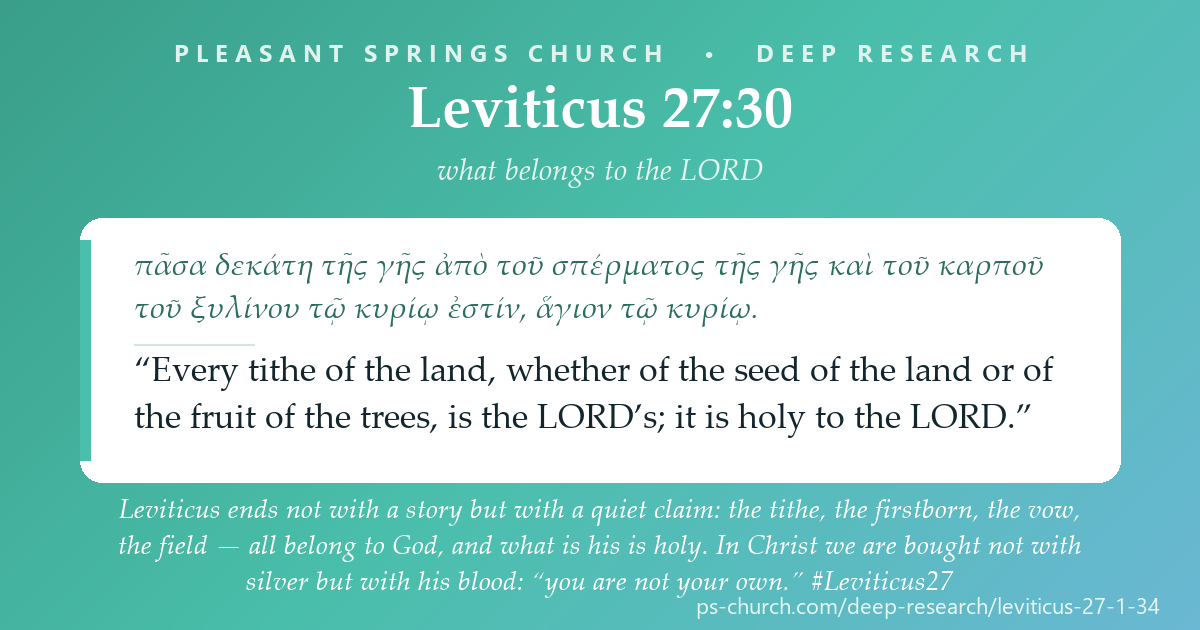
Leviticus ends not with a story but with a quiet claim on everything. Its last chapter gathers the free gifts of a grateful people — the vow that no one is forced to make yet must keep once made; the priest’s fair valuation, lowered for the poor “according to what the vower can afford” (27:8); the dedicated animals, houses, and fields; the firstborn already the Lord’s; the devoted thing that is “most holy”; and the tithe that “is the Lord’s; it is holy to the Lord” (27:30). It closes on Mount Sinai (27:34). This study works Leviticus 27:1–34 — and points to the redemption that is not by silver but by “the precious blood of Christ,” by which we now belong wholly to God. See the method →
Leviticus 27:2–34 (selections)
Hebrew · LXX · ESVThe Shape of the Passage
SequenceLeviticus 27 is the closing appendix of the book — after the covenant blessings and curses of ch 26, a final chapter on vows and dedicated things. It rounds off the Torah of Moses begun in Exodus, where the glory filled the tabernacle (Exod 40) and Leviticus then taught a redeemed people how to live with a holy God (see the Holiness Code, ch 19).
Author
The Torah of Moses ends Leviticus with what can look, at first, like an afterthought — a technical chapter of prices and pledges. But its placement is deliberate. Chapter 26 has just set the covenant before Israel with its blessings and curses, closing on remembered mercy (26:40–45). Chapter 27 then answers a quieter question: what of the free, voluntary gifts a grateful people brings — the vows, the dedicated animals and houses and fields, the firstborn, the tithe? The book about how sin is atoned and holiness lived out finishes by naming the Lord’s claim on everything.
A fitting close. A vow (neḏer) is never commanded — no one must vow — but a vow made to God is binding and must be kept. The priest sets a fair valuation, and even the poor may give what they can afford (27:8). Persons, produce, land, the firstborn, the tithe: all ultimately belong to God, and to dedicate them is simply to confess what is already true. Leviticus ends, appropriately, not with a narrative but with the standing claim of a holy God upon a people and their whole life — sealed “on Mount Sinai” (27:34).
Audience
Israel — a redeemed people whose gratitude overflows into free gifts. The chapter governs the ordinary piety of vowing: a parent dedicating a child’s service, a farmer pledging a field, a worshiper devoting an animal. It protects such vows from being made rashly and then broken, and it protects the poor from being shut out — the priest values “according to what the vower can afford” (27:8). Grace for those who cannot pay runs through the whole book, right to its end.
How they heard it. This is holiness reaching the purse and the pledge. To vow to the Lord and then withhold was to treat God’s name lightly; to keep the vow was worship. The tithe was “holy to the Lord” (27:30), the firstborn already his (27:26), the devoted thing “most holy” (27:28). A people who had received everything — rescue, atonement, a place near God — learned that everything, in return, was already his.
Orient on vows, valuations, the devoted thing (cherem), the firstborn, and the tithe.
Search by topic: vow, valuation / redemption, devoted thing (herem/ban), firstborn, tithe, dedication, Jubilee.
Which articles are relevant?
- Anchor Bible Dictionary — “Vow,” “Ban (Herem),” “Tithe,” “Firstborn,” “Redemption (OT),” “Jubilee.”
- Dictionary of the OT: Pentateuch — “Vow,” “Sacrifices and Offerings,” “Holiness,” “Firstborn,” “Tithes.”
- NIDOTTE / TDOT — נֶדֶר (neḏer, vow), עֵרֶךְ (ʿēreḵ, valuation), חֵרֶם (ḥērem, devoted thing / ban), מַעֲשֵׂר (maʿăśēr, tithe), גָּאַל (gāʾal, redeem).
Bibliography surfaced:
- Gordon Wenham (NICOT), Jacob Milgrom (AB), Mark Rooker (NAC) on Leviticus.
- Studies of the vow and the ʿērek-valuations; the ḥerem / ban; the OT tithe and its later reception.
- Beale & Carson, Commentary on the NT Use of the OT (redemption; 1 Peter; the Gospels).
Vows, dedications, the ban, and tithes in the ancient world.
Read the chapter against ANE vow-and-dedication practice, weigh the “devoted” thing carefully (never a warrant for human sacrifice), then follow “you belong to God” to its fulfillment in Christ.
Which parallels shed light on religion and worldview?
Vows and dedications. Across the ancient Near East people made vows to their gods — conditional promises (“if you grant this, I will give that”) and free dedications of persons, animals, land, and money to a temple. Israel shares this furniture but reframes it: the vow is to the one Lord, it is entirely voluntary, and once made it is morally binding (Deut 23:21–23; Eccl 5:4–5). Leviticus 27 does something the surrounding cultures rarely did — it fixes fair, public valuations so a vow could be honestly discharged, and it lowers the price for the poor (27:8) so that poverty never barred a person from giving to God.
The tithe. Giving a tenth to temple or crown was widespread in the ancient world (Mesopotamian and Ugaritic temple tithes; cf. Gen 14:20; 28:22). In Israel the tithe of land and herd is declared “holy to the Lord” (27:30–32) and given to sustain the Levites and the sanctuary (Num 18:21–24). The Mishnah works out the details in whole tractates — Ma’aserot and Ma’aser Sheni for the tithe, Arakhin for the valuations of this chapter, Bekhorot for the firstborn, Temurah for the exchange of a dedicated animal.
The devoted thing (ḥerem) — read with care. The ḥerem is something irrevocably handed over to God, placed beyond ordinary use — sometimes given to the sanctuary (a field, a house), sometimes, in the wars of conquest, an enemy already under God’s judgment placed under the ban (Josh 6–7; 1 Sam 15). The Moabite Mesha Stele shows a neighboring king “devoting” a captured town to his god Chemosh — the same vocabulary, a different deity. Leviticus 27:29 is not a licence to vow a human being to death: the Law elsewhere utterly forbids offering people in sacrifice (“you shall not worship the Lord your God in that way,” Deut 12:31), and Jephthah’s rash vow (Judg 11) is told as tragedy, not model. The verse concerns persons already justly under a sentence of death or the ban — who could not then be bought back by a payment — not a warrant to create such a claim.
- Mesha Stele / Moabite Stone (9th c. BC — a witness, not Scripture) — King Mesha “devotes” (ḥrm) a captured Israelite town to Chemosh: the same ban-vocabulary in a pagan mouth, sharply reframed in Israel.
- Ugaritic and Mesopotamian temple records (ANE — witnesses, not Scripture) — vows, dedicated property, and temple tithes: shared cultic practice, differently grounded.
- Mishnah, Arakhin (rabbinic-era) — the tractate on the very valuations of Leviticus 27; with Ma’aserot, Bekhorot, and Temurah on tithes, firstborn, and dedicated animals.
- Philo, Special Laws 1–2; Josephus, Antiquities 4.4.4 (Second-Temple — witnesses, not Scripture) — the law of vows, first-fruits, and tithes, and its humane provision for the poor.
Leviticus 27 turns on redemption-price: a dedicated animal or house or field could, in most cases, be bought back with silver (the priest’s valuation plus a fifth, 27:13,15,19,31). The chapter thus teaches that we and all we have already belong to God, and that what is his is holy. The New Testament takes up exactly this language and transforms it (a devotional reading on the apostles’ own terms): we were ransomed “not with perishable things such as silver or gold… but with the precious blood of Christ, like that of a lamb without blemish or spot” (1 Pet 1:18–19). Christ “redeemed us from the curse of the law” (Gal 3:13). And so the believer is a dedicated thing wholly the Lord’s: “you are not your own, for you were bought with a price” (1 Cor 6:19–20) — the fitting response being not a valuation in silver but the presenting of “your bodies as a living sacrifice, holy and acceptable to God” (Rom 12:1).
The vocabulary of vow, valuation, the devoted thing, the tithe, and redemption.
Watch neder (vow) and its ʿerek (valuation), the herem that is not redeemed, the maʿaser (tithe) that is holy, and the gaʾal (redeem) that points to Christ.
“Vow” — a voluntary promise or dedication to God (LXX εὐχή). No one is compelled to vow; but a vow, once made, is binding: “it is better that you should not vow than that you should vow and not pay” (Eccl 5:5; cf. Deut 23:21–23).
“Valuation / assessment” (LXX τιμή) — the fixed price the priest sets for a person specially vowed, scaled by age and sex — and lowered for the poor “according to what the vower can afford” (27:8). Grace is written into the price.
“Devoted thing / ban” (LXX ἀνάθεμα) — something irrevocably given over to God, “most holy,” not sold or redeemed. Used both of property dedicated to the sanctuary and, in the conquest, of what fell under God’s judgment — never a warrant for human sacrifice (Deut 12:31).
“Tithe” — a tenth of land and herd (LXX δεκάτη), declared “holy to the Lord” (27:30) and given to sustain the Levites and the sanctuary (Num 18:21–24; cf. Gen 14:20; 28:22).
“To redeem / buy back” — to reclaim a dedicated thing by paying its valuation plus a fifth (LXX λυτρόω). The kinsman-gōʾēl who redeems land and family (see Leviticus 25) points to Christ our Redeemer.
“Holy” — set apart, belonging to God. The tithe “is holy to the Lord”; the devoted thing is “most holy” (qōḏeš qŏḏāšîm, 27:28). To dedicate is to confess what is already his.
How the New Testament takes up vows, tithes, and redemption:
- 1 Peter 1:18–19 — ransomed “not with perishable things such as silver or gold… but with the precious blood of Christ”: the redemption-price of Leviticus 27 transformed.
- 1 Corinthians 6:19–20 — “you are not your own, for you were bought with a price”: the believer as a dedicated thing wholly the Lord’s.
- Romans 12:1 — “present your bodies as a living sacrifice, holy and acceptable to God”: dedication in the key of grace.
- Matthew 5:33–37; 23:16–22 — Jesus on oaths and vows: let your “yes” be yes; do not evade a vow by hair-splitting over what is holy.
From vows and tithes to the redemption that is by blood.
Trace the vow and the tithe through the Torah and Wisdom, and the redemption-price to the “precious blood of Christ.”
Which cross-references matter?
- Numbers 30; Deuteronomy 23:21–23; Ecclesiastes 5:4–5 — the law and wisdom of vows: freely made, but binding — “better not to vow than to vow and not pay.”
- Genesis 14:20; 28:22; Numbers 18:21–24; Malachi 3:8–10 — the tithe from Abram and Jacob to the Levites; withholding it is to “rob God.”
- Leviticus 25:23–28 — the Jubilee reckoning of fields and the kinsman-redeemer, which governs the redemption of dedicated land here (see Leviticus 25).
- Leviticus 23:9–22 — the firstfruits and the tithe of harvest set in the calendar of the feasts (see Leviticus 23).
- 1 Peter 1:18–19; 1 Corinthians 6:19–20; Romans 12:1 — redemption not by silver but by the blood of Christ; the redeemed belong wholly to God.
The New Testament does not merely leave the price-laws of Leviticus 27 behind; it lifts their very logic to a higher key (a reading the apostles themselves make). The chapter is built on redemption-price — the silver, plus a fifth, by which a dedicated thing was bought back (27:13–31). Peter takes exactly that vocabulary and says our redemption was not paid in the perishable metals of any priestly valuation but “with the precious blood of Christ, like that of a lamb without blemish” (1 Pet 1:18–19), joining this closing chapter of Leviticus to the Passover lamb and the Day of Atonement (see Leviticus 16). Paul draws the conclusion: because we were “bought with a price,” we “are not our own” (1 Cor 6:19–20) — a devoted thing, ḥerem in the best sense, wholly the Lord’s. What Leviticus valued in shekels, the gospel prices in blood; and the answering vow is a whole life laid on the altar (Rom 12:1). Fittingly, the book that opened with sacrifice ends by claiming everything — and the New Testament shows the One who paid everything to make that claim good.
The scholarship on vows, valuations, the ban, and the tithe.
Wenham and Milgrom for Leviticus; studies of the vow, the ʿerek-valuations, the herem, and the tithe; Beale & Carson for the New Testament use.
Commentaries & studies:
- Gordon J. Wenham, The Book of Leviticus (NICOT); Jacob Milgrom, Leviticus (Anchor, esp. vol. 3 on ch 27); Mark F. Rooker (NAC).
- Studies of the vow and the valuation-scale; the ḥerem / ban in law and narrative; the OT tithe and its later Jewish and Christian reception.
- G. K. Beale & D. A. Carson, eds., Commentary on the New Testament Use of the Old Testament (1 Peter; the Gospels).
Interpretation notes worth keeping:
- Vows are free, then binding. No one must vow; but a vow to God is a word given to God, and to break it is to profane his name (Eccl 5:4–5; Deut 23:21–23). Freedom and seriousness held together — not a burden of ritual, but the weight of honesty before God.
- Grace for the poor is built into the price. The priest values “according to what the vower can afford” (27:8): poverty never shut a worshiper out. The same mercy that runs through Leviticus (the graduated offerings; the gleanings; the Jubilee) reaches the very last chapter.
- 27:29 is not a warrant for human sacrifice. The ḥerem “devoted for destruction” concerns persons already justly under a death-sentence or the ban of holy war, who could not be ransomed by a fee — not a power to vow a human life away. The Law condemns child-sacrifice outright (Deut 12:31; 18:10); Jephthah’s vow is narrated as tragedy.
- The tithe is holy, not merely useful. “It is holy to the Lord” (27:30) — not a tax but a confession that the land and its increase are God’s gift; giving acknowledges the Giver.
From the quiet claim of God on everything to a life wholly his.
Name what you learned, why it matters, and one concrete response.
What should we carry away — and do?
- Everything already belongs to God. Persons, produce, land, the firstborn, the tithe — to dedicate them is only to confess what is already true. Leviticus ends by naming the Lord’s claim on the whole of life.
- Keep your word to God. No one must vow — but a vow made is a vow to be kept. Let your “yes” be yes; do not offer God rash promises you will not honor.
- You were bought with a price. Not with silver or gold, but with the precious blood of Christ. The believer is a devoted thing, wholly the Lord’s — “you are not your own.” The fitting answer is a living sacrifice.
Step in response: name one thing you have been holding back from God — a commitment half-kept, a resource, a part of your life fenced off as your own — and dedicate it to him this week, gladly, as one who has already been bought at the highest price. Then let the close of Leviticus become your own confession: it is holy to the Lord.
Leviticus 27:30 · to share
LXX + ESVEvery Deep Research page traces its passage across the whole sweep — the Old Testament, the Second-Temple world between the testaments (historical witnesses, not Scripture), and the New Testament. Follow the thread:
Pleasant Springs Church — Deep Research
Research method after Michael S. Heiser’s Bible Research Method (examine dictionaries → ancient literature → important words → textual connections → academic publications → share), with the Pleasant Springs “Author & Audience” foundation. Scripture set in the Hebrew, the Greek editions named on each page and the ESV (Old Testament), and the Greek New Testament and the ESV (New Testament), per the practice of Pleasant Springs Church. Leviticus 27 research grounded in Wenham, Milgrom, and Rooker, with Beale & Carson on the New Testament use (1 Peter; the Gospels); ANE vow-and-dedication and ban (herem) background (the Mesha Stele; Ugaritic and Mesopotamian temple records) and Second-Temple / rabbinic reception (Mishnah Arakhin, Ma’aserot, Bekhorot, Temurah; Philo and Josephus), all read as witnesses, not Scripture. The difficult 27:29 is read in its own context — the ban on persons already under a just sentence, never a warrant for human sacrifice, which the Law forbids (Deut 12:31) — and the civil order of ancient Israel is not read as a template for church or state.
Scripture quotations marked ESV are from the ESV® Bible (The Holy Bible, English Standard Version®), © 2001 by Crossway, a publishing ministry of Good News Publishers. ESV Text Edition: 2016. Used by permission. All rights reserved. The ESV text may not be quoted in any publication made available to the public by a Creative Commons license, and the ESV may not be translated in whole or in part into any other language. www.esv.org
|
Did this study bless you today? 💚 Give to Support PS Church100% of gifts go to the General Fund — thank you. |