Leviticus closes the Holiness Code the way an ancient covenant closes — with blessings for faithfulness and curses for rebellion. The blessings crest in a promise that is the heartbeat of the whole Bible: “I will make my dwelling among you… and I will walk among you and will be your God, and you shall be my people” (26:11–12). The curses escalate “seven times more” until the land lies waste and Israel is scattered among the nations (26:33) — and then, astonishingly, the chapter turns to mercy: “I will not spurn them… so as to… break my covenant with them, for I am the Lord their God” (26:44). This study works Leviticus 26:1–46, and lets the chapter end where the text ends — on remembered mercy. See the method →
Leviticus 26:3–44 (selections)
Hebrew · LXX · ESVThe Shape of the Passage
Escalating panels · inclusioLeviticus 26 is the covenant epilogue of the Holiness Code (chs 17–26): after the laws of holiness in ch 19 and the appointed feasts and the Jubilee (ch 25), Moses sets before Israel the two ways — blessing and curse — and grounds both in the exodus already given (26:13,45) and in God’s remembered mercy.
Author
The Torah of Moses closes the Holiness Code with a chapter shaped like an ancient covenant document: after the stipulations come the sanctions — blessings for faithfulness and curses for rebellion. This is the pattern of the great suzerainty treaties of the ancient Near East, and it appears again, at length, in Deuteronomy 28. Leviticus 26 is its earlier, tabernacle-centered form: the same God who filled the tent with glory now spells out what it means to live — or refuse to live — as his covenant people.
Not a formula, but a covenant. The chapter is easily misread as a prosperity ledger (obey and prosper, sin and suffer). But its own frame forbids that: the blessing and the curse rest on a relationship already established by grace — “I am the Lord your God, who brought you out of the land of Egypt… and I have broken the bars of your yoke” (26:13). The discipline is a father’s, not a tyrant’s; and the last word is not the curse but the mercy that will not let the covenant be finally broken (26:44–45).
Audience
Israel — a redeemed people standing at Sinai, hearing in advance the whole arc of their story. The blessings describe a land at peace under God’s presence; the curses, read soberly, foresee the very history that came: famine, sword, and at last the land “laid waste” and the people “scattered among the nations” (26:33) — the exile of 587 BC. In the synagogue this curse-section (the tochecha) came to be read in a lowered voice, so heavy was its weight.
How they heard it — and where it ends. The chapter does not end in the ash of exile. It turns: “But if they confess their iniquity… if then their uncircumcised heart is humbled” (26:40–41), then God will remember his covenant with Jacob, Isaac, and Abraham (26:42), and — even in the land of their enemies — will not utterly destroy them or break faith. The heartbeat of the whole book sounds here: God dwelling with his people (26:11–12), a hope no exile can cancel, carried forward to the remnant, the new covenant, and at last the city where “the dwelling place of God is with man” (Rev 21:3).
Orient on covenant, blessing and curse, discipline, exile, and the divine presence.
Search by topic: covenant, blessing and curse, treaty, discipline / chastisement, exile, remnant, presence of God / dwelling.
Which articles are relevant?
- Anchor Bible Dictionary — “Covenant,” “Blessings and Curses,” “Treaty,” “Exile,” “Remnant.”
- Dictionary of the OT: Pentateuch — “Blessings and Curses,” “Covenant,” “Holiness,” “Land,” “Presence of God.”
- NIDOTTE / TDOT — בְּרִית (bĕrîṯ, covenant), מִשְׁכָּן (miškān, dwelling), זָכַר (zāḵar, remember), קֶרִי (qerî, hostility/contrariness).
Bibliography surfaced:
- Gordon Wenham (NICOT), Jacob Milgrom (AB), Mark Rooker (NAC) on Leviticus.
- Studies of the covenant blessing-curse form and its ANE treaty background; the tochecha and the theology of exile-and-return.
- Beale & Carson, Commentary on the NT Use of the OT (2 Corinthians; Revelation; Romans on the remnant).
The suzerainty treaty, its curses, and the God who keeps covenant.
Read the blessing-and-curse form against the ancient treaties, weigh the sober reality of the curses, then follow the covenant to the mercy where the chapter ends.
Which parallels shed light on religion and worldview?
The treaty form. Ancient Near Eastern suzerainty treaties — a great king binding a vassal — typically closed with lists of blessings for loyalty and curses for breach: fertility and peace on one side; famine, plague, wild beasts, sword, siege, and scattering on the other. The Hittite treaties (ANET pp. 199–206) and especially the Neo-Assyrian Vassal Treaties of Esarhaddon (ANET pp. 534–541) supply close verbal parallels to the curse-lists of Leviticus 26 and Deuteronomy 28. Israel’s Scripture takes up this shared political-religious form — but the Suzerain is the Lord himself, the covenant rests on his redeeming grace, and the curses are not a rival deity’s spite but the covenant God’s discipline, aimed at repentance and return.
The agricultural year. The blessings speak the language of rain “in its season,” threshing that overtakes the vintage, and bread eaten to the full (26:4–5,10). The tenth-century Gezer calendar — a schoolboy’s ledger of the farming months — shows the world these promises addressed: a people whose life hung on the rains and the harvest, for whom God’s blessing was daily bread and God’s displeasure could turn the very “heavens like iron” (26:19).
The curses read in a whisper. Later Jewish practice honored the weight of this section: the tochecha (the “reproof,” Lev 26:14–39; cf. Deut 28) was traditionally read aloud in a lowered voice and without pause. It was never read as God’s delight in punishment but as the terrible seriousness of covenant unfaithfulness — and always with the turn of 26:40–45 in view.
- Vassal Treaties of Esarhaddon (Neo-Assyrian, 7th c. BC; ANET pp. 534–541 — a witness, not Scripture) — long curse-lists on a treaty-breaking vassal: the closest formal parallel to the Levitical and Deuteronomic curses.
- Hittite suzerainty treaties (ANET pp. 199–206 — witnesses, not Scripture) — the blessing-and-curse sanctions that close a great-king / vassal covenant.
- The Gezer calendar (10th c. BC Hebrew inscription) — the agricultural year of sowing and harvest that Leviticus 26’s blessings and curses assume.
- Mishnah, Megillah 3–4 (rabbinic-era) — the synagogue reading of the Torah, within which the tochecha came to be read soberly and in a low voice.
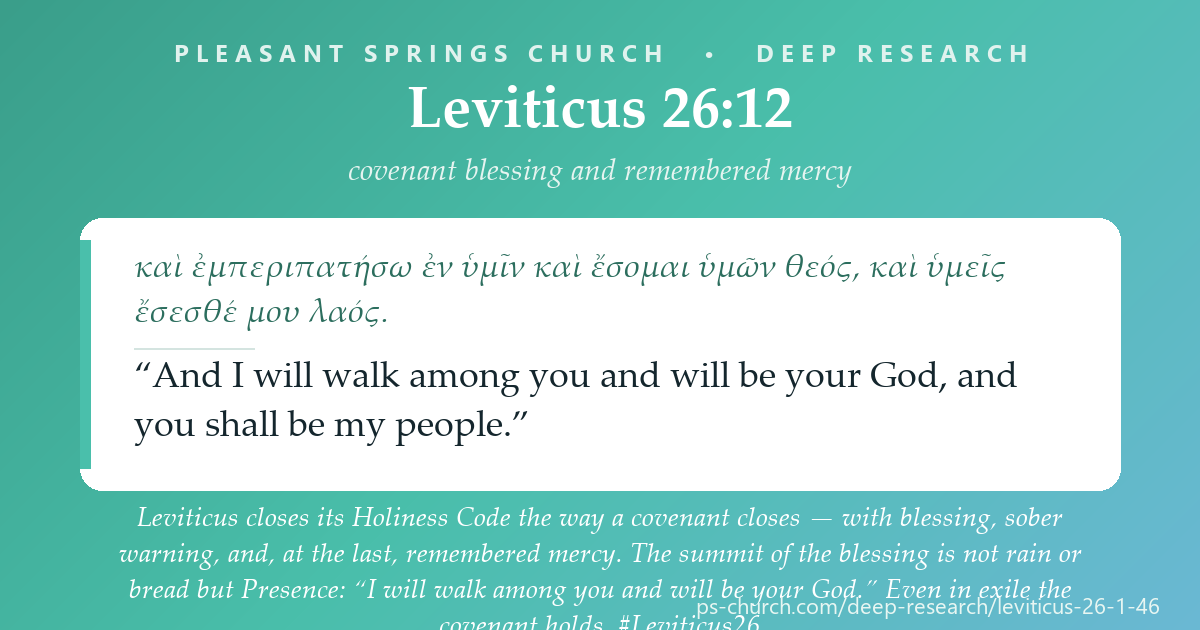
The summit of the blessing is not produce or peace but Presence: “I will make my dwelling among you… And I will walk among you and will be your God, and you shall be my people” (26:11–12). The words reach back to Eden, where God “walked” in the garden (Gen 3:8), and forward through the tabernacle promise — “I will dwell among the people of Israel and will be their God” (Exod 29:45; see Exodus 29) — to the church, in whom Paul hears this very verse fulfilled: “I will make my dwelling among them and walk among them, and I will be their God, and they shall be my people” (2 Cor 6:16). And it lands at last in the new creation: “Behold, the dwelling place of God is with man. He will dwell with them, and they will be his people” (Rev 21:3). This one sentence — God with us — is the pulse running from the garden to the city, and the whole point of the blessing.
The vocabulary of covenant, dwelling, hostility, remembrance, and sevenfold discipline.
Watch bĕrîṯ (covenant) frame the whole; miškān (dwelling) at its heart; qerî (hostility) and ševaʿ (sevenfold) drive the curses; and zāḵar (remember) open the door of mercy.
“Covenant” — the binding relationship God establishes and keeps (LXX διαθήκη). It frames the whole chapter: God confirms it in blessing (26:9), the people break it (26:15), yet God will not “break” it in exile (26:44) but “remember” it (26:42,45).
“Dwelling / tabernacle” — “I will set my dwelling among you” (usually LXX σκηνή; here the LXX reads διαθήκη, “covenant”). The heartbeat of Leviticus: the holy God with his people.
“Contrariness / hostility” — a rare word (only in this chapter): to “walk qerî” with God is to walk in defiant opposition. God answers like-for-like (26:24) — not caprice, but covenant justice provoked by persistent rebellion.
“To remember” — not mere recollection but covenant faithfulness in action. God “remembers” his covenant with the patriarchs (26:42) and “the covenant with their forefathers” (26:45): the ground of hope beyond the curse.
“Seven / sevenfold” — “I will discipline you again sevenfold for your sins.” The refrain marks the escalating cycles of the curse: full, complete measure — yet still aimed, throughout, at bringing a stubborn people home.
How the New Testament takes up Leviticus 26:
- 2 Corinthians 6:16 — “I will make my dwelling among them and walk among them, and I will be their God, and they shall be my people” (Lev 26:11–12; Ezek 37:27): the church as God’s temple.
- Revelation 21:3 — “the dwelling place of God is with man… they will be his people”: the covenant formula consummated in the new creation.
- Hebrews 12:5–11 — “the Lord disciplines the one he loves”: the covenant discipline of Leviticus 26 read as a father’s, not a tyrant’s.
- Romans 11:1–5, 25–29 — “God has not rejected his people”; a remnant preserved, “for the gifts and the calling of God are irrevocable”: the mercy of Lev 26:44–45.
From the covenant sanctions to the God who dwells with his people.
Trace the blessing-and-curse form to Deuteronomy, the dwelling-promise from Eden to the new creation, and the remembered mercy to the remnant and the new covenant.
Which cross-references matter?
- Deuteronomy 28 — the fuller covenant blessings and curses, the same treaty form spelled out on the plains of Moab; Leviticus 26 is its tabernacle-centered twin.
- Exodus 29:45–46 — “I will dwell among the people of Israel and will be their God”: the tabernacle promise that Lev 26:11–12 restates (see Exodus 29).
- Genesis 3:8; 17:7–8 — God “walking” in the garden, and the covenant “to be God to you and to your offspring”: the roots of the dwelling-formula (see Genesis 1–3).
- Jeremiah 31:31–34; Ezekiel 37:26–27 — the new and everlasting covenant, “My dwelling place shall be with them”: the hope Lev 26:44–45 keeps alive through exile.
- 2 Corinthians 6:16; Revelation 21:3; Romans 11 — the dwelling fulfilled in the church, consummated in the new creation, and the remnant of Israel preserved by irrevocable mercy.
The New Testament does not shelve Leviticus 26; it reads Israel’s whole later history — blessing, exile, and return — through it, and gathers its hope into Christ. The curse of the broken covenant is real, and Paul says Christ “became a curse for us” to redeem us from it (Gal 3:13). The discipline is a father’s: “the Lord disciplines the one he loves” (Heb 12:6), not to destroy but to yield “the peaceful fruit of righteousness” (12:11). And the mercy — “I will not spurn them… so as to… break my covenant with them” (26:44) — becomes Paul’s ground for insisting that “God has not rejected his people,” that a remnant remains, and that “the gifts and the calling of God are irrevocable” (Rom 11:1–5,29). Above all, the blessing’s summit — “I will walk among you and will be your God” — is heard by the apostle as the charter of the church (2 Cor 6:16) and by the seer as the sound of the new creation (Rev 21:3). The covenant is not a bargain but a marriage, and its last word is not wrath but God with us.
The scholarship on the covenant epilogue.
Wenham and Milgrom for Leviticus; the treaty studies (Mendenhall, Weinfeld) for the blessing-curse form; Beale & Carson for the New Testament use.
Commentaries & studies:
- Gordon J. Wenham, The Book of Leviticus (NICOT); Jacob Milgrom, Leviticus (Anchor); Mark F. Rooker (NAC).
- George E. Mendenhall and Moshe Weinfeld on the ANE suzerainty-treaty form; studies comparing Lev 26 / Deut 28 with the Esarhaddon vassal treaties.
- G. K. Beale & D. A. Carson, eds., Commentary on the New Testament Use of the Old Testament; G. K. Beale, The Temple and the Church’s Mission (the dwelling-of-God theme).
Interpretation notes worth keeping:
- Covenant, not prosperity gospel. The blessings and curses are covenant sanctions grounded in grace already given (26:13,45), addressed to the nation Israel under the Sinai covenant. They are not a mechanical promise that personal obedience yields wealth, nor that suffering proves sin — a reading Job and the cross both forbid.
- Discipline in love. The escalating “sevenfold” cycles are corrective, not merely punitive: each turn calls Israel to repent (“if in spite of this…”). Hebrews 12 reads exactly this as fatherly discipline — severe, but for their good.
- The chapter ends in mercy. Read Leviticus 26 to its own conclusion: not the desolation of exile but the remembered covenant of 26:40–45. God preserves a remnant, does not utterly destroy, and does not break faith — the seed of the new-covenant and resurrection hope (Jer 31; Ezek 37; Rom 11).
- The goal is Presence. Every blessing serves one end — “I will walk among you and will be your God” (26:12). The story that begins with God walking in Eden ends with God dwelling with humanity (Rev 21:3); Leviticus 26 is a hinge in that one long promise.
From covenant blessing and sober warning to remembered mercy.
Name what you learned, why it matters, and one concrete response.
What should we carry away — and do?
- The blessing is Presence. The best gift of the covenant is not rain or bread but God himself — “I will walk among you and will be your God.” Everything else serves that; and that is what the gospel finally gives (2 Cor 6:16; Rev 21:3).
- Covenant is serious — and it is love. The curses are neither empty threats nor a tyrant’s cruelty; they are a father’s discipline (Heb 12:6), grounded in grace and aimed at return. God takes our loyalty seriously because he takes us seriously.
- Mercy has the last word. The chapter ends not in exile but in “I will not spurn them… I will remember my covenant.” When you fail, that is where to look — not to a God waiting to destroy, but to a God who keeps faith and brings the humbled home.
Step in response: if you are under discipline — a hard season that feels like the “heavens like iron” of 26:19 — do what 26:40 says: confess, and let your heart be humbled rather than hardened. And whatever the season, set your hope on the covenant’s summit: God with you. Draw near this week to the One who has made his dwelling among us in Christ, and will dwell with us forever.
Leviticus 26:12 · to share
LXX + ESVEvery Deep Research page traces its passage across the whole sweep — the Old Testament, the Second-Temple world between the testaments (historical witnesses, not Scripture), and the New Testament. Follow the thread:
Pleasant Springs Church — Deep Research
Research method after Michael S. Heiser’s Bible Research Method (examine dictionaries → ancient literature → important words → textual connections → academic publications → share), with the Pleasant Springs “Author & Audience” foundation. Scripture set in the Hebrew, the Greek editions named on each page and the ESV (Old Testament), and the Greek New Testament and the ESV (New Testament), per the practice of Pleasant Springs Church. Leviticus 26 research grounded in Wenham, Milgrom, and Rooker, with Beale & Carson on the New Testament use (2 Corinthians; Revelation; Romans on the remnant); the ANE suzerainty-treaty background (Mendenhall and Weinfeld; the Hittite treaties and the Vassal Treaties of Esarhaddon, ANET pp. 199–206, 534–541); the Gezer calendar for the agricultural year; and later Jewish reception of the tochecha (Mishnah Megillah), all read as witnesses, not Scripture. The covenant blessings and curses are read as sanctions grounded in grace already given, not as a prosperity formula; the discipline as a father’s (Heb 12); and the chapter’s own last word — remembered mercy — is held as the seed of the new-covenant hope. The civil and theocratic order of ancient Israel is not read as a template for church or state.
Scripture quotations marked ESV are from the ESV® Bible (The Holy Bible, English Standard Version®), © 2001 by Crossway, a publishing ministry of Good News Publishers. ESV Text Edition: 2016. Used by permission. All rights reserved. The ESV text may not be quoted in any publication made available to the public by a Creative Commons license, and the ESV may not be translated in whole or in part into any other language. www.esv.org
|
Did this study bless you today? 💚 Give to Support PS Church100% of gifts go to the General Fund — thank you. |