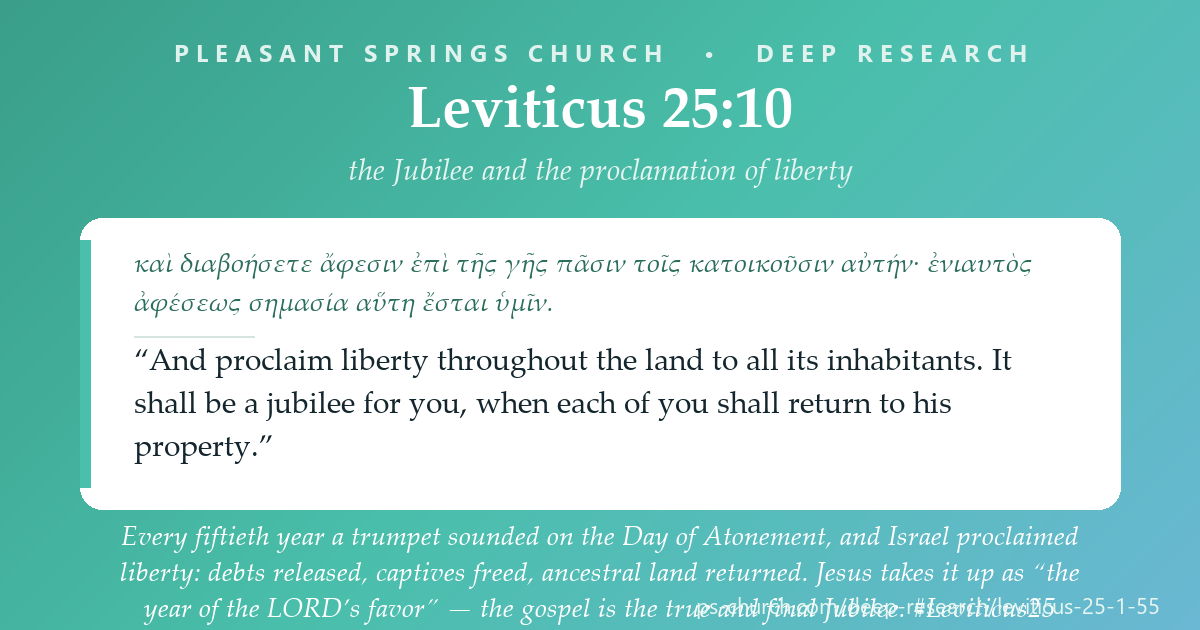
Every seventh year the land itself rested; every fiftieth, a trumpet sounded on the Day of Atonement and Israel was to “proclaim liberty throughout the land to all its inhabitants” (25:10) — debts released, bond-servants freed, ancestral land returned to the family that had lost it. Beneath it all lay one truth: “the land is mine… you are strangers and sojourners with me” (25:23). This study works Leviticus 25 — the Sabbath year and the Jubilee, the kinsman-redeemer, and God’s mercy toward the poor — up to the Jubilee Jesus takes up as “the year of the Lord’s favor.” See the method →
Leviticus 25:4–55 (selections)
Hebrew · LXX · ESVThe Shape of the Passage
SequenceLeviticus 25 belongs to the Holiness Code (chs 17–26): after the ethics of ch 19 and the sacred calendar of ch 23, sacred time now reshapes land, labor, and debt — and the Jubilee trumpet is sounded on the Day of Atonement (ch 16), the day of release.
Author
The Torah of Moses, spoken to Moses “on Mount Sinai” (25:1), extends the logic of Sabbath from the week to the years. As the seventh day is holy, so is the seventh year — and the year after seven sevens, the fiftieth, is the crown of the whole system. The chapter is carefully built: sabbatical year (25:1–7), the count to Jubilee (25:8–12), the return of land and its just pricing (25:13–22), then a cascade of redemption laws — for land, for houses, for the impoverished brother, and for the Israelite sold into servitude (25:23–55).
Ownership and mercy. The theological hinge is 25:23: “the land is mine… you are strangers and sojourners with me.” Israel does not own the land absolutely; they hold it as tenants of the Lord. From that single truth flows a whole economy of mercy: no permanent sale of land, no permanent poverty, no permanent slavery among the covenant people — because the God who redeemed them from Egypt (25:38, 42, 55) will not let his people be permanently dispossessed.
Audience
Israel — an agrarian people about to receive land, addressed as farmers, lenders, kinsmen, and the poor. The laws presuppose real hardship: a brother “becomes poor,” sells his field, even sells himself (25:25, 35, 39, 47). To such a people the Jubilee is good news: no debt, no loss, no bondage is forever. Every fiftieth year the clock is reset and each family comes home to its inheritance.
Faith in the provision of God. The Sabbath year asked Israel to trust: what will we eat if we do not sow (25:20)? The answer is grace — “I will command my blessing on you in the sixth year, so that it will produce a crop sufficient for three years” (25:21). The whole system trains a people to hold land, wealth, and even their labor with open hands, remembering that it all belongs to the God who brought them out of Egypt.
Orient on the Sabbath year, Jubilee, redemption, and the kinsman-redeemer.
Search by topic: Jubilee, Sabbath / sabbatical year, redemption, kinsman-redeemer (go’el), debt and slavery, land tenure, poor.
Which articles are relevant?
- Anchor Bible Dictionary — “Jubilee,” “Sabbatical Year,” “Redemption (OT),” “Slavery (OT),” “Land.”
- Dictionary of the OT: Pentateuch — “Sabbath, Sabbatical Year, Jubilee,” “Kinsman-Redeemer,” “Poor and Poverty,” “Slavery.”
- NIDOTTE / TDOT — יוֹבֵל (yôḇēl, jubilee/ram’s-horn), דְּרוֹר (dərôr, liberty/release), גָּאַל (gāʾal, redeem), אֲחֻזָּה (ʾăḥuzzâ, possession).
Bibliography surfaced:
- Gordon Wenham (NICOT), Jacob Milgrom (AB), Mark Rooker (NAC) on Leviticus.
- Studies of the Jubilee and sabbatical year; the go’el / redemption laws; Leviticus 25 and biblical economics.
- Beale & Carson, Commentary on the NT Use of the OT (Luke; Galatians).
Land, debt, and release in the ancient Near East.
Read the Jubilee against ANE debt-release edicts and the agricultural year, weigh the Second-Temple witnesses, then follow the trumpet of liberty to its fulfillment in Christ.
Which parallels shed light on religion and worldview?
Release edicts in the ANE. Ancient kings occasionally proclaimed a mīšarum (“equity”) or andūrarum — a decree cancelling debts, freeing debt-slaves, and restoring forfeited land, often at a king’s accession. The Edict of Ammi-Ṣaduqa (Old Babylonian) is the classic example; the Akkadian andūrarum is the very cognate of Hebrew דְּרוֹר (dərôr, “liberty,” 25:10). But where a king’s edict was occasional and political — a favor granted from the throne — Israel’s release is fixed by God, recurring on a set calendar, grounded not in royal generosity but in the Lord’s ownership of the land and his redemption of the people.
The agricultural year. The Gezer calendar (10th c. B.C.) lists the farmer’s months of sowing, harvest, and vine-tending — the very rhythm the Sabbath year interrupts. To leave a field unsown for a whole year (25:4–5) was an act of costly trust in a subsistence economy, answered by the promised blessing of the sixth year (25:21).
Second-Temple observance. The sabbatical year was actually kept in later Israel — Josephus notes years when the land lay fallow, and the Mishnah devotes the tractate Sheviit to its detail; Arakhin works out the Jubilee valuations. The book of Jubilees even reorganizes all of history into “jubilees” of forty-nine years. And at Qumran, 11QMelchizedek reads the Jubilee release of Leviticus 25 together with Isaiah 61 as the great eschatological liberty a coming deliverer would proclaim — strikingly close to how Jesus would read it.
- Edict of Ammi-Ṣaduqa; the mīšarum / andūrarum release-decrees (ANE — witnesses, not Scripture) — royal cancellations of debt and restorations of land; the cognate of dərôr. Cf. ANET pp. 526–528.
- Gezer calendar (10th c. B.C. — a witness, not Scripture) — the eight-season farming year the Sabbath year suspends. Cf. ANET p. 320.
- Mishnah, Sheviit and Arakhin (rabbinic-era) — the detailed law of the seventh year and of the Jubilee valuations (Lev 25; 27).
- Jubilees; 11QMelchizedek (11Q13) (Second-Temple — witnesses, not Scripture) — history counted in jubilees; and the Jubilee of Lev 25 + Isa 61 read as the coming eschatological release.
When Jesus stood in the synagogue at Nazareth, he read from Isaiah 61 — itself steeped in the language of Leviticus 25 — “to proclaim liberty to the captives… to proclaim the year of the Lord’s favor” — then said, “Today this Scripture has been fulfilled in your hearing” (Luke 4:18–21). The Jubilee’s dərôr, its release, was never merely economic; it was a picture of the greater release God would bring. Jesus announces himself as the one who proclaims the true and final Jubilee — liberty to captives, release to debtors, the poor brought home to their inheritance. As a devotional reading grounded in Jesus’ own words, the whole institution points beyond itself: the gospel is the Jubilee that does not end at the fiftieth year but sets free forever.
The vocabulary of rest, jubilee, liberty, and redemption.
Watch the Sabbath of the land (shabbaton) open onto the Jubilee (yobel) and its deror, liberty — secured by the go’el who redeems (ga’al) and the return to the achuzzah, the ancestral holding.
“Solemn rest” — a Sabbath of Sabbaths for the land itself (LXX σάββατα ἀνάπαυσις). Every seventh year the fields lie fallow, teaching Israel that the land, like the seventh day, belongs to the Lord.
“Jubilee” — from the ram’s-horn trumpet (yōḇēl) blown to announce the fiftieth year. Our word “jubilee” comes from it; the LXX calls it ἄφεσις / ἀφέσεως σημασία, the “signal of release.”
“Liberty / release” (LXX ἄφεσις) — the word inscribed on the Liberty Bell (“proclaim liberty throughout the land”). Cognate of Akkadian andūrarum, a royal debt-release; here a release fixed by God.
“To redeem” — the גֹּאֵל (gōʾēl), the kinsman-redeemer, buys back a relative’s lost land or freedom (LXX ἀγχιστεύω, λυτρόω). The picture behind Boaz (Ruth), the Redeemer of Isaiah (59:20), and Christ (Gal 3:13; 4:5).
“Possession / holding” — the ancestral land-grant each family receives and, in the Jubilee, returns to: “each of you shall return to his property” (25:10). Held from the Lord, never sold in perpetuity (25:23).
How the New Testament takes up the Jubilee and redemption:
- Luke 4:16–21 — Jesus reads Isaiah 61 (the Jubilee’s “liberty” and “the year of the Lord’s favor”) and declares it fulfilled in himself.
- Galatians 3:13; 4:4–5 — Christ “redeemed” (ἐξηγόρασεν) us from the curse of the law — the go’el who buys back the enslaved.
- 1 Peter 1:18–19 — “ransomed… not with perishable things such as silver or gold… but with the precious blood of Christ”: redemption not by money but by blood.
- Romans 8:21–23; Ephesians 1:7,14 — “the redemption of our bodies,” creation set free from bondage: the Jubilee reaching its cosmic end.
From the land that is God’s to the Redeemer who buys us back.
Trace God’s ownership of the land and the go’el’s redemption from the Sabbath years through Ruth and Isaiah to Christ our Redeemer.
Which cross-references matter?
- Exodus 21:2–6; 23:10–11; Deuteronomy 15:1–18 — the seventh-year release of debts and Hebrew slaves: the Sabbath-year mercy Leviticus 25 crowns with the Jubilee (see Exodus 24).
- Leviticus 26:34–35, 43 — the land will “enjoy its Sabbaths” in exile: the sabbatical law taken with terrible seriousness (see Leviticus 26).
- Ruth 4:1–10; Isaiah 59:20; 43:1 — the kinsman-redeemer in action, and the Lord himself as Israel’s Redeemer: “a Redeemer will come to Zion.”
- Isaiah 61:1–2; Luke 4:18–19 — “liberty to the captives… the year of the Lord’s favor”: the Jubilee on the lips of Jesus.
- Galatians 3:13; 4:5; 1 Peter 1:18–19 — Christ the Redeemer who buys back the enslaved, not with silver but with his blood.
The New Testament does not turn the Jubilee into a program for land reform; it reads it as a God-given picture that Christ fulfills. Isaiah had already lifted the Jubilee’s dərôr into a promise of the age to come (Isa 61); Jesus takes that text as his own manifesto and announces its arrival “today” (Luke 4:21) — the true release of the captive and the poor. Paul presses the go’el language further still: Christ “redeemed” those under the law’s curse and enslaved to sin, buying them back into the family and inheritance of God (Gal 3:13; 4:4–7). And Peter names the price: not the redemption-silver of Leviticus but “the precious blood of Christ” (1 Pet 1:18–19). The land that was always God’s, the debtor always able to be redeemed, the servant always destined for release — all of it was a shadow whose substance is a Redeemer who brings his people home for good.
The scholarship on the Jubilee and the redemption laws.
Wenham and Milgrom for Leviticus; studies of the Jubilee, sabbatical year, and go’el; Beale & Carson for the New Testament use.
Commentaries & studies:
- Gordon J. Wenham, The Book of Leviticus (NICOT); Jacob Milgrom, Leviticus (Anchor); Mark F. Rooker (NAC).
- Studies of the Jubilee and sabbatical year (ANE release-edicts; the dərôr / andūrarum link); the kinsman-redeemer and biblical economics.
- G. K. Beale & D. A. Carson, eds., Commentary on the New Testament Use of the Old Testament (Luke; Galatians).
Interpretation notes worth keeping:
- God owns the land. The Jubilee rests on 25:23 — “the land is mine… you are strangers and sojourners with me.” Israel are tenants, not absolute owners; this, not any political theory, is the ground of the whole institution.
- Mercy built into the calendar. The reset of debt, land, and servitude curbs permanent poverty and the endless concentration of land. It dignifies the poor and the debtor without erasing property; it is grace structured into time.
- The go’el is a picture, not a policy. The kinsman-redeemer who buys back what a brother lost is read by the New Testament as a shadow of Christ our Redeemer (Gal 3:13; 4:5) — a labeled devotional typology, not a claim that the Jubilee is a modern economic blueprint.
- Do not politicize the Jubilee. It is neither a partisan program nor a prosperity promise. Its point is God’s ownership and mercy, fulfilled in Christ, who proclaims the true “year of the Lord’s favor.”
From the trumpet of liberty to a people who hold all things in open hands.
Name what you learned, why it matters, and one concrete response.
What should we carry away — and do?
- It is all God’s. “The land is mine… you are strangers and sojourners with me.” We are tenants and stewards, not owners — of land, of money, of our very selves. Hold it all with open hands.
- Mercy is meant to be structural. The Jubilee builds release into the calendar so the poor are not crushed forever. God cares that debt, loss, and bondage have limits — and his people should too.
- Christ is our Redeemer. The go’el who buys back the lost is fulfilled in Jesus, who proclaims the true Jubilee: liberty to captives, release to debtors, the poor brought home — not by silver, but by his own precious blood.
Step in response: ask where you are gripping something as though you owned it — money, property, a resentment, a debt someone owes you — and take one Jubilee step this week: forgive a debt, release a grudge, give to someone who cannot repay. Then rest in the deeper release: you were bought back at the highest price, and brought home to the inheritance of God.
Leviticus 25:10 · to share
LXX + ESVEvery Deep Research page traces its passage across the whole sweep — the Old Testament, the Second-Temple world between the testaments (historical witnesses, not Scripture), and the New Testament. Follow the thread:
Pleasant Springs Church — Deep Research
Research method after Michael S. Heiser’s Bible Research Method (examine dictionaries → ancient literature → important words → textual connections → academic publications → share), with the Pleasant Springs “Author & Audience” foundation. Scripture set in the Hebrew, the Greek editions named on each page and the ESV (Old Testament), and the Greek New Testament and the ESV (New Testament), per the practice of Pleasant Springs Church. Leviticus 25 research grounded in Wenham, Milgrom, and Rooker, with Beale & Carson on the New Testament use (Luke; Galatians); ANE release-edict background (the mīšarum / andūrarum decrees and the Edict of Ammi-Ṣaduqa; the Gezer calendar) and Second-Temple / rabbinic reception (Mishnah Sheviit and Arakhin; the book of Jubilees; 11QMelchizedek), all read as witnesses, not Scripture. The Jubilee is read for its theology — God’s ownership of the land and his built-in mercy — fulfilled in Christ our Redeemer, not as a modern political or economic program; the go’el typology is labeled as devotional, grounded in the New Testament’s own reading.
Scripture quotations marked ESV are from the ESV® Bible (The Holy Bible, English Standard Version®), © 2001 by Crossway, a publishing ministry of Good News Publishers. ESV Text Edition: 2016. Used by permission. All rights reserved. The ESV text may not be quoted in any publication made available to the public by a Creative Commons license, and the ESV may not be translated in whole or in part into any other language. www.esv.org
|
Did this study bless you today? 💚 Give to Support PS Church100% of gifts go to the General Fund — thank you. |