Pure oil keeps the lamp burning “from evening to morning before the Lord regularly” (24:1–4), and twelve loaves of the bread of the Presence are set out each Sabbath as “a covenant forever” (24:5–9): worship that never stops. Between and after them stands a hard story — a man who “blasphemed the Name, and cursed,” held in custody until the Lord’s will was known (24:10–16) — and the law of measured justice: “fracture for fracture, eye for eye, tooth for tooth” (24:20), with “the same rule for the sojourner and for the native” (24:22). This study works Leviticus 24:1–23 — continual light and bread, the holiness of the Name, and the talion rightly understood as a limit on vengeance, deepened by Jesus toward the turned cheek. See the method →
Leviticus 24:2–22 (selections)
Hebrew · LXX · ESVThe Shape of the Passage
ChiasmLeviticus 24 sits inside the Holiness Code (chs 17–26), just after the sacred calendar of ch 23 and just before the sabbatical year and Jubilee of ch 25: two ordinances of ceaseless worship (lamp and bread) enclose the one sustained narrative in the whole code — the case of the man who cursed the Name.
Author
The Torah of Moses sets this chapter as a deliberate diptych of worship and judgment. Two commands for continual service open it: the pure beaten oil that keeps the golden lampstand burning “from evening to morning… regularly” (24:1–4), and the twelve loaves of the bread of the Presence, renewed every Sabbath on the table of pure gold as “a covenant forever” (24:5–9). Then the chapter breaks into narrative — the only real story in the Holiness Code — the man who “blasphemed the Name, and cursed” (24:10–16,23).
A designed juxtaposition. The placement is not accidental: the Name that Israel is to hallow in ceaseless light and bread is the very Name this man profaned. And into the judgment the text folds a general law — life for life, and “fracture for fracture, eye for eye, tooth for tooth” (24:17–22) — not a license for private vengeance but a rule of measured, equal justice, binding on native and sojourner alike (24:22).
Audience
Israel — a people learning to live around a holy God. The lamp and bread taught them that worship is not occasional but continual: light ever burning, bread ever set before the Lord. The narrative taught them that the Name is not to be trifled with — and that when a hard case arose, Moses did not react but waited “till the will of the Lord should be declared” (24:12): judgment sought from God, not seized by the mob.
How they heard it. The son of an Israelite woman and an Egyptian man stands, pointedly, both inside and outside the camp — and the law that follows insists there is one rule for him as for the native (24:22). Israel heard a double lesson: reverence for the Name that holds the covenant together, and equal justice that protects the vulnerable and restrains the strong. The “eye for eye” they heard not as cruelty but as a limit — the punishment must fit, and no more.
Orient on the lampstand, the bread of the Presence, blasphemy, and lex talionis.
Search by topic: lampstand / menorah, showbread / bread of the Presence, blasphemy, the Name (Tetragrammaton), talion / eye for eye, sojourner (ger).
Which articles are relevant?
- Anchor Bible Dictionary — “Lampstand,” “Bread of the Presence,” “Blasphemy,” “Name of God,” “Talion, Law of,” “Sojourner.”
- Dictionary of the OT: Pentateuch — “Tabernacle,” “Priests and Levites,” “Holiness,” “Law,” “Crimes and Punishments.”
- NIDOTTE / TDOT — נֵר (nēr, lamp) / תָּמִיד (tāmîḏ, continual), לֶחֶם הַפָּנִים (leḥem happānîm, bread of the Presence), נָקַב (nāqaḇ, pronounce / blaspheme) & קָלַל (qālal, curse), גֵּר (gēr, sojourner).
Bibliography surfaced:
- Gordon Wenham (NICOT), Jacob Milgrom (AB), Mark Rooker (NAC) on Leviticus.
- Studies of the tabernacle furniture (lampstand, table), the divine Name and blasphemy, and the biblical talion as a principle of proportion.
- Beale & Carson, Commentary on the NT Use of the OT (the Gospels; Hebrews).
Continual light and bread, the holy Name, and talion in the ancient world.
Read the lamp and bread against ANE temple service, weigh the blasphemy narrative soberly, then set “eye for eye” among the ancient law codes — and hear how Jesus takes it up.
Which parallels shed light on religion and worldview?
Light and bread before the god. Ancient temples kept lamps burning and set bread before the deity as the god’s “food.” Israel keeps the same furniture but empties it of that idea: the Lord neither eats nor needs (Ps 50:12–13). The bread is a memorial and a sign of covenant — the twelve loaves for the twelve tribes, Israel held perpetually before God’s face; the frankincense, not the loaves, goes up as a food offering, and the bread is eaten by the priests (24:7–9). The lamp is not to feed a god but to signify continual worship and witness.
The Name and blasphemy. The offender “blasphemed the Name, and cursed” (24:11); the narrative is handled with striking restraint — he is placed “in custody, till the will of the Lord should be declared” (24:12), and only then judged. The LXX of 24:16 reads the crime as ὀνομάζων… τὸ ὄνομα Κυρίου, “pronouncing the Name of the Lord” — a rendering that lies behind the later Jewish practice of never uttering the Tetragrammaton, saying Adonai (“my Lord”) or ha-Shem (“the Name”) instead. Whether the sin is cursing-with-the-Name or misusing the Name itself, the point is the same: the Name that anchors the covenant is holy.
Talion among the codes. “Eye for eye, tooth for tooth” (24:20) belongs to a wide ancient family of talion law — the Code of Hammurabi likewise prescribes eye for eye and bone for bone (§§196–197). But two things distinguish Israel’s law. Hammurabi graded the penalty by class — an eye put out counted for less if the victim was a commoner or a slave — whereas Leviticus insists on one rule for “the sojourner and… the native” (24:22). And the formula functions as a ceiling: the response may equal the injury but never exceed it, breaking the ancient spiral of escalating blood-vengeance. It is a charter of measured, equal justice, not a warrant for cruelty.
- Code of Hammurabi §§196–201 (ANE law — a witness, not Scripture) — “eye for eye, bone for bone,” but with penalties graded by social class: the parallel that throws Israel’s one-rule-for-all into relief.
- Mishnah, Menachot 11 (rabbinic-era) — the preparation and weekly renewal of the twelve loaves of the bread of the Presence (Lev 24:5–9).
- Mishnah, Sanhedrin 7:5 (rabbinic-era) — the sober rabbinic definition of the capital blasphemy: only pronouncing the Name itself; the court’s extreme caution around this case (Lev 24:16).
- Bava Kamma 83b–84a (rabbinic-era) — the classic Jewish reading of “eye for eye” as monetary compensation of proportional value, not literal mutilation: talion understood as a measure of equity.
- Philo, On the Special Laws 1.234–238; Josephus, Antiquities 3.199–257 (Second-Temple — witnesses, not Scripture) — the lamp, the loaves, and the humane reach of the Mosaic law.
In the Sermon on the Mount Jesus takes this very verse in hand: “You have heard that it was said, ‘An eye for an eye and a tooth for a tooth.’ But I say to you, Do not resist the one who is evil… if anyone slaps you on the right cheek, turn to him the other also” (Matt 5:38–42). He does not call the law cruel — it was God’s just limit on retaliation in the courts of Israel. What he forbids is the private heart that seizes the courtroom rule as a license for personal revenge. Where the talion capped vengeance, Jesus deepens it toward non-retaliation and love of enemy, fulfilling the law’s intent rather than abolishing it (Matt 5:17; cf. Rom 12:19–21). And the two continual signs meet in him: he is “the light of the world” (John 8:12) and “the bread of life” (John 6:35) — the lamp that never goes out and the bread ever before the Father’s face. (Devotional reading on the New Testament’s own lines.)
The vocabulary of continual worship, the Name, and proportionate justice.
Watch ner tamid (the continual lamp) and leḥem happanim (bread of the Presence), the Name that is pronounced or profaned, and the taḥat (“in place of”) that makes justice measured.
“A lamp… regularly” — the tāmîḏ (“continual, perpetual”) light kept burning “from evening to morning before the Lord” (LXX διὰ παντός). Continual worship: light that never goes dark before God.
“Bread of the Presence” — literally “bread of the face,” twelve loaves (one per tribe) set before the Lord each Sabbath as “a covenant forever” (24:8). The bread David’s men ate (1 Sam 21; Mark 2:26).
“To pronounce / blaspheme” — the man “nāqaḇ the Name” (paired with קָלַל, qālal, “to curse,” 24:11). The LXX renders it ὀνομάζων, “naming” the Name — behind later reverence for the unspoken Name.
“The Name” — ha-šēm, standing for the Tetragrammaton itself. To hallow the Name is covenant loyalty; to profane it, a covenant offense. Jesus teaches us to pray, “hallowed be your name” (Matt 6:9).
“Eye for eye” — the talion formula: taḥaṯ (“in place of”) marks strict proportion. A limit on vengeance and a rule of equal justice (LXX ὀφθαλμὸν ἀντὶ ὀφθαλμοῦ), the same for native and sojourner (24:22).
How the New Testament takes up these themes:
- Matthew 5:38–42 — “You have heard… ‘An eye for an eye’… But I say to you, Do not resist the one who is evil”: the talion’s limit deepened toward non-retaliation.
- John 8:12; 9:5 — “I am the light of the world”: the continual lamp answered in Christ (devotional reading).
- John 6:35,48–51; Matthew 12:3–4; Mark 2:25–26 — the bread of the Presence that David ate, and “I am the bread of life” (devotional reading).
- Matthew 6:9; John 17:6,26; Romans 2:24 — “hallowed be your name”; the Name made known, and the Name blasphemed among the nations: the holiness of the Name across the canon.
From the tabernacle lamp and table to the light and bread of the world.
Trace the lamp and the bread back to the tabernacle furniture and forward to Christ; trace the Name and the talion through the Law to the Sermon on the Mount.
Which cross-references matter?
- Exodus 25:23–40; 27:20–21; 40:22–25 — the golden lampstand and the table of the bread of the Presence, made and set up in the tabernacle (see Exodus 40); Leviticus 24 gives the ongoing service.
- Exodus 20:7; Deuteronomy 5:11 — “you shall not take the name of the Lord your God in vain”; the Name to be revered (see Deuteronomy 6:4–9, the Shema).
- Exodus 21:23–25; Deuteronomy 19:21 — the same talion formula (“life for life, eye for eye…”) in the covenant law: proportion, not escalation.
- Leviticus 19:33–34; 24:22 — “one rule” and “you shall love him as yourself” for the sojourner: equal justice for the outsider (see Leviticus 19).
- Leviticus 16:2,12–15 — “outside the veil” where the lamp burned, over against the mercy seat within (see Leviticus 16, the Day of Atonement).
The New Testament reads the tabernacle’s continual signs as shadows whose substance is Christ (cf. Col 2:16–17; Heb 8:5). The lamp that must never go dark “before the Lord” becomes, on Jesus’ lips, “I am the light of the world; whoever follows me will not walk in darkness” (John 8:12) — and his church a lampstand bearing that light (Rev 1:12–20). The bread of the Presence, held perpetually before the Father’s face and eaten by the priests, is taken up when Jesus — defending his disciples with the story of David and the holy bread (Mark 2:25–26) — declares, “I am the bread of life” (John 6:35). And the Name whose profaning brought judgment in Leviticus 24 is the Name Jesus says he has “made known” and will make known (John 17:6,26), and taught his people to hallow (Matt 6:9). These are devotional connections drawn along the New Testament’s own lines — light, bread, and Name, once kept in a tent, now embodied in the Son who is himself the presence of God.
The scholarship on Leviticus 24 and the law of talion.
Wenham and Milgrom for Leviticus; the studies of blasphemy, the divine Name, and biblical talion; Beale & Carson for the New Testament use.
Commentaries & studies:
- Gordon J. Wenham, The Book of Leviticus (NICOT); Jacob Milgrom, Leviticus (Anchor); Mark F. Rooker (NAC).
- Studies of the lex talionis in ANE and biblical law (its function as a limit and a principle of proportion); the divine Name and the crime of blasphemy.
- G. K. Beale & D. A. Carson, eds., Commentary on the New Testament Use of the Old Testament (Matthew; John; Hebrews).
Interpretation notes worth keeping:
- ‘Eye for eye’ is a ceiling, not a floor. The talion limits retaliation to strict proportion and forbids escalation; ancient Jewish law (Bava Kamma) read it as monetary compensation of equal value. It is a charter of measured justice — do not caricature it as barbaric, and do not read it as a warrant for private revenge.
- One law for all. Where Hammurabi graded penalties by class, Leviticus 24:22 insists the sojourner and the native fall under the same rule. The dignity of equal justice for the outsider is written into the very case of a half-Egyptian offender.
- The Name handled soberly. The narrative shows judgment sought from God (custody “till the will of the Lord should be declared,” 24:12), not seized by a crowd. This is ancient theocratic law for Israel’s courts — a witness to the holiness of God’s Name, not a template for modern penalties.
- Light, bread, and Name are one witness. Continual lamp, perpetual bread, and hallowed Name all say the same thing: God is present with his people, and that presence is holy. The New Testament gathers all three in Christ (John 6; 8; 17).
From the continual lamp and bread to a life of reverence and equal justice.
Name what you learned, why it matters, and one concrete response.
What should we carry away — and do?
- Worship is continual. The lamp burned every night, the bread was set out every Sabbath — light and communion kept ceaselessly before God. Christ is that light and that bread; abiding in him is a daily, not occasional, thing.
- The Name is holy. The chapter takes the profaning of the Name with utmost seriousness — and teaches us to hallow it. “Hallowed be your name” is the first petition Jesus put on our lips.
- Justice is measured and equal. “Eye for eye” limited vengeance; “one rule for the sojourner and the native” makes justice blind to status. And Jesus takes us further still — past the courtroom limit to the surrendered right, the turned cheek, the love of enemy.
Step in response: pick one — keep a “continual” place of worship this week (a light that does not go out); guard your speech about God’s Name and hallow it; and where you are tempted to exact more than justice, stop at the limit, and then, for Christ’s sake, let the offense go. Light, bread, Name, mercy: let them shape the day.
Leviticus 24:22 · to share
LXX + ESVEvery Deep Research page traces its passage across the whole sweep — the Old Testament, the Second-Temple world between the testaments (historical witnesses, not Scripture), and the New Testament. Follow the thread:
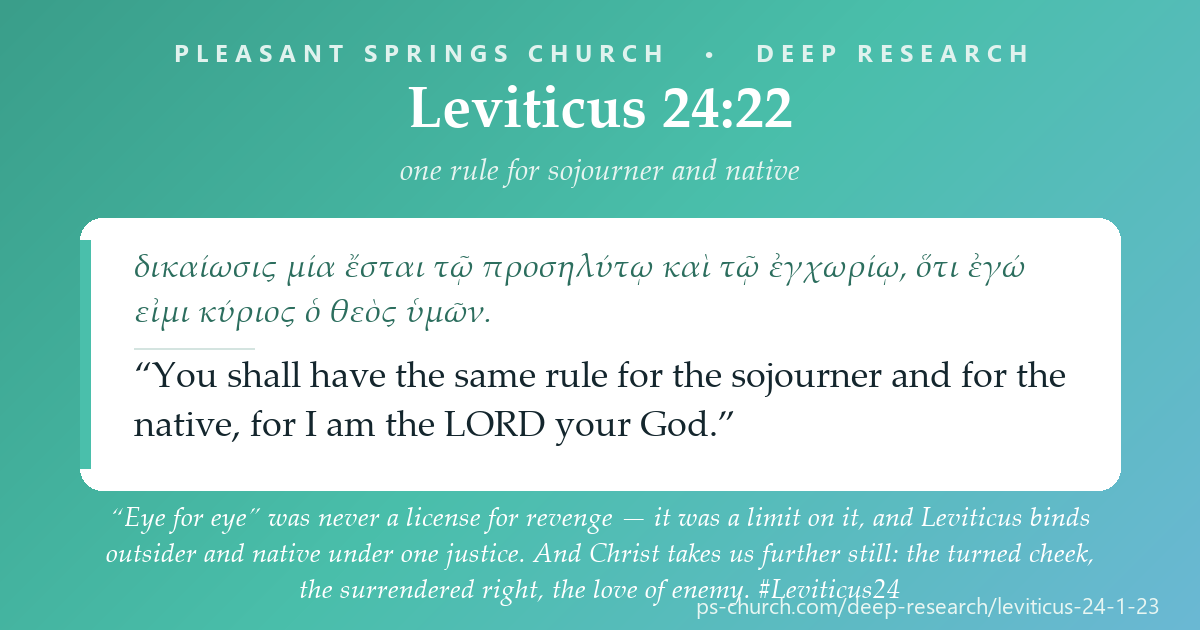
Pleasant Springs Church — Deep Research
Research method after Michael S. Heiser’s Bible Research Method (examine dictionaries → ancient literature → important words → textual connections → academic publications → share), with the Pleasant Springs “Author & Audience” foundation. Scripture set in the Hebrew, the Greek editions named on each page and the ESV (Old Testament), and the Greek New Testament and the ESV (New Testament), per the practice of Pleasant Springs Church. Leviticus 24 research grounded in Wenham, Milgrom, and Rooker, with Beale & Carson on the New Testament use (Matthew; John; Hebrews); ANE legal background (Code of Hammurabi §§196–201) and Second-Temple / rabbinic reception (Mishnah Menachot and Sanhedrin; Bava Kamma on the talion; Philo and Josephus on the lamp and loaves), all read as witnesses, not Scripture. The lex talionis is presented as a limit on vengeance and a rule of equal, proportionate justice — not a warrant for private revenge — which Jesus deepens toward non-retaliation (Matt 5:38–42); the light/bread/Name connections to Christ are drawn as devotional readings along the New Testament’s own lines; and the theocratic penalties of ancient Israel are not read as a template for church or state.
Scripture quotations marked ESV are from the ESV® Bible (The Holy Bible, English Standard Version®), © 2001 by Crossway, a publishing ministry of Good News Publishers. ESV Text Edition: 2016. Used by permission. All rights reserved. The ESV text may not be quoted in any publication made available to the public by a Creative Commons license, and the ESV may not be translated in whole or in part into any other language. www.esv.org
|
Did this study bless you today? 💚 Give to Support PS Church100% of gifts go to the General Fund — thank you. |