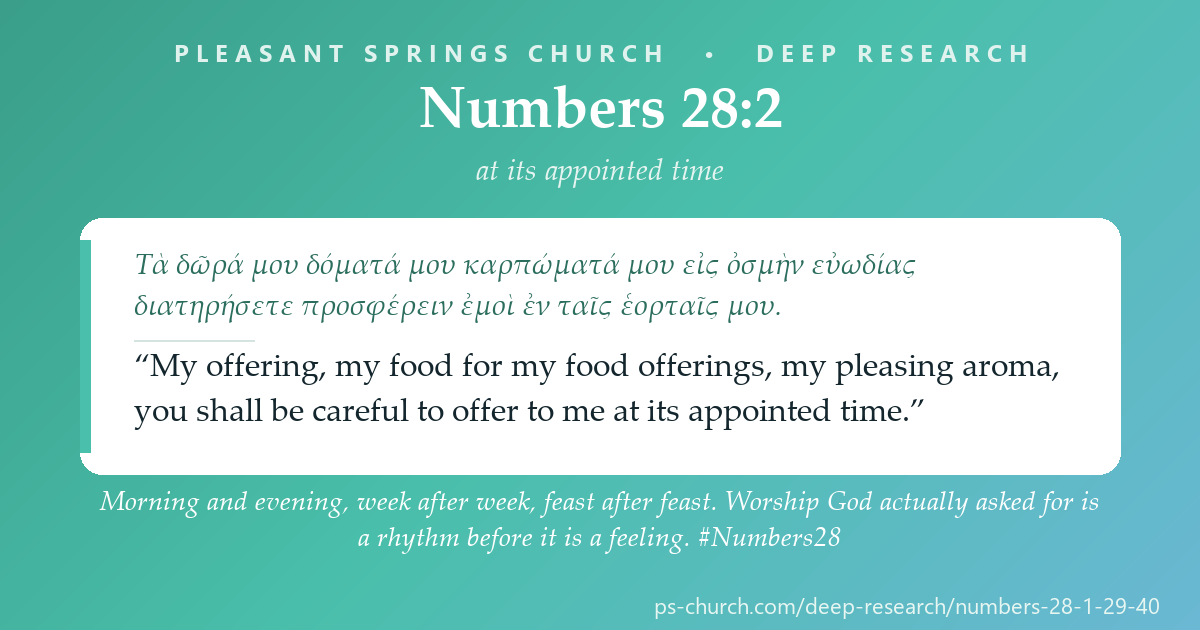
A new generation stands on the plains of Moab, counted and led, one river from everything promised — and the next thing God gives them is not a map but a calendar. “My offering… you shall be careful to offer to me at its appointed time” (28:2). A lamb in the morning and a lamb at twilight, every day, with its flour, its oil and its wine. Two more on the Sabbath. More at every new moon. Passover, Unleavened Bread, the day of firstfruits at Weeks, the day of the trumpet blast, the Day of Atonement with its afflicting of souls, and seven days of Booths whose bulls count down thirteen, twelve, eleven… with an eighth-day assembly to close them. This study works Numbers 28:1–29:40 — ordered, costly, continual worship as the shape of a life with God, given to a people who did not yet own an acre. It closes: “So Moses told the people of Israel everything just as the Lord had commanded Moses” — a line the Hebrew and the Greek both number 30:1. See the method →
Numbers 28:2–29:40 (selections)
Hebrew · LXX · ESVThe Shape of the Passage
Ascending sequence · inclusioNotice where these chapters sit. The second generation has just been counted (ch 26); the daughters of Zelophehad have been heard and Joshua has been commissioned (ch 27). The land is one river away. And the very next thing God gives them is not a battle plan but a liturgy — and immediately after it, the law of vows (ch 30), to which 29:39 has already pointed.
Author
The Torah of Moses gives these two chapters as the quantitative companion to the festival calendar of Leviticus 23. Leviticus names the days and what they mean; Numbers 28–29 names the animals, the flour, the oil and the wine — how much, how often, and in what order. Read side by side they are one thing seen from two angles: Leviticus from the sanctuary’s side, Numbers from the altar’s ledger.
The architecture is deliberate. It moves outward from the smallest unit of time to the largest: every day, every seventh day, every new moon, every year. And every single festival offering is prescribed “besides the regular burnt offering” (28:10, 15, 23–24, 31; 29:6, 11, 16, 19…). The tamid — the daily lamb — is the floor under everything. Feasts are added to it; nothing is ever subtracted from it. The literary effect of all that repetition is not tedium but rhythm: the text sounds the way a faithful life sounds.
Audience
A new generation on the plains of Moab — children of the wilderness who had never seen the land and, for much of forty years, had lived a life the book itself describes as suspended. To them God gives a calendar. Worship precedes possession. Before they own an acre, they are told what the mornings and evenings of every day in that land will look like, and what the first of every month and the middle of the seventh will cost them.
How they heard it. As an enormous act of hope, and an enormous bill. The daily offering alone is two lambs a day — more than seven hundred a year — and Booths adds seventy bulls in a single week. A people with no fields yet are handed a schedule that assumes fields, flocks, flour, oil and wine. The calendar is a promise in the form of an accounting: you will be a settled people, and this is how a settled people will keep time with God.
Orient on the regular offering, the festival calendar, and the sacrificial vocabulary.
Search by topic: tamid / continual burnt offering, sacrifice and offering, festivals and feasts, calendar, new moon, Passover, Weeks / Pentecost, Trumpets, Day of Atonement, Booths / Tabernacles, grain offering, drink offering, solemn assembly.
Which articles are relevant?
- Anchor Bible Dictionary — “Sacrifice and Sacrificial Offerings,” “Tamid,” “Feasts and Festivals,” “Calendar,” “New Moon,” “Booths, Feast of,” “Atonement, Day of.”
- Dictionary of the OT: Pentateuch — “Sacrifices and Offerings,” “Festivals and Feasts,” “Sacred Time,” “Worship,” “Numbers, Book of.”
- NIDOTTE / TDOT — מוֹעֵד (môʿēḏ, appointed time), תָּמִיד (tāmîḏ, continual), אִשֶּׁה (ʾiššeh, food/fire offering), נֶסֶךְ (neseḵ, drink offering), תְּרוּעָה (terûʿāh, blast), עֲצֶרֶת (ʿăṣereṯ, assembly).
Bibliography surfaced:
- Timothy Ashley (NICOT), Gordon Wenham (TOTC), R. Dennis Cole (NAC), Baruch Levine (Numbers 21–36, Anchor), Jacob Milgrom (JPS), Dennis Olson (Interpretation) on Numbers.
- Studies of the Israelite festal calendar and its relation to Leviticus 23, Exodus 23 and 34, and Deuteronomy 16; the tamid in the Second Temple.
- Beale & Carson, Commentary on the NT Use of the OT (Hebrews).
Feeding the gods, or keeping an appointment: what a daily offering meant.
Set the daily offering beside the daily temple meals of Israel’s neighbors, then follow the calendar into the Second-Temple world where it was actually kept — and lost.
Which parallels shed light on religion and worldview?
Every ancient temple had a schedule. Mesopotamian sanctuaries set out meals for the gods twice a day, morning and evening, each with a first and second course — the Seleucid-era ritual text usually titled Daily Sacrifices to the Gods of the City of Uruk specifies the bread, the beer, the wine and the cuts of meat, and even the singers who accompanied the service. The forms look very like Numbers 28: two set times, fixed portions, an unbroken round. The theology does not. In Mesopotamia the ritual answers a need in the god; the gods eat because they are hungry. Israel’s Scripture cuts that nerve: “If I were hungry, I would not tell you, for the world and its fullness are mine” (Ps 50:12, LXX Ps 49:12). The daily lamb is not dinner. It is an appointment — God fixing a time and keeping it with a people.
An agricultural year underneath. The three pilgrim feasts sit on the farming seasons of the Levant: barley behind Passover and the first sheaf, wheat behind Weeks, and the autumn ingathering behind Booths. The tenth-century Gezer calendar lists exactly those months of sowing, harvest, and vine-tending. What Numbers adds is the invoice: the flour, oil and wine of every offering come from those same harvests. Worship is paid for out of the crop God gave.
How it was actually kept — and what it cost when it stopped. By the Second Temple the daily offering had become the pulse of Jerusalem: the Mishnah devotes a whole tractate, Tamid, to walking through the morning service step by step, and Ta’anit 4:2 describes the ma’amadot, lay delegations who stood by in shifts so that Israel was represented at its own sacrifice. Josephus tells a Roman audience what the offerings were (Antiquities 3.224–257) — and then records the day the pulse stopped: during the siege of A.D. 70, on the seventeenth of Panemus, “the sacrifice called the daily sacrifice had failed… for want of men to offer it,” and the people were “grievously troubled at it” (Jewish War 6.94). Whole communities also fought over when the calendar fell: the Temple Scroll and Jubilees defend a 364-day reckoning against the lunar one, and the Temple Scroll even adds festivals of New Wine, New Oil and the Wood Offering to the list in Numbers 28–29.
- Daily Sacrifices to the Gods of the City of Uruk (late Babylonian ritual text — a witness, not Scripture) — the twice-daily temple meals, in fixed portions, of an ANE sanctuary; the closest formal parallel to the tamid, and the sharpest theological contrast.
- The Gezer calendar (10th c. BCE inscription; ANET 320 — a witness, not Scripture) — the agricultural months of sowing, harvest, vine-tending and summer fruit that underlie the pilgrim feasts and supply the grain, oil and wine of these offerings.
- Josephus, Antiquities 3.224–257 (Second-Temple — a witness, not Scripture) — the daily lambs at dawn and dusk, the Sabbath and new-moon additions, the seventh-month days, and the descending bulls of Booths, described for a Roman readership.
- Josephus, Jewish War 6.94 (Second-Temple — a witness, not Scripture) — the failure of the daily sacrifice on 17 Panemus, A.D. 70, for want of men to offer it.
- Philo, On the Special Laws 1.168–171; 2.145–214 (Second-Temple — a witness, not Scripture) — the daily offering read as thanksgiving for day and night, and an exposition of the festivals from Passover to Booths.
- Temple Scroll (11Q19) cols. XIII–XXIX; Jubilees 6:23–38; the Qumran calendrical texts (Second-Temple — witnesses, not Scripture) — a rewritten and expanded festival calendar, the “days of remembrance” at the new moons of the first, fourth, seventh and tenth months, and the 364-day solar reckoning defended against the lunar year.
- Mishnah — Tamid; Ta’anit 4:2; Yoma; Rosh Hashanah; Sukkah; Menahot (rabbinic-era — witnesses, not Scripture) — the daily whole-offering service, the lay ma’amadot, and the keeping of the seventh-month feasts.
- Sifre Numbers (Pinḥas), on Numbers 28–29 (rabbinic-era — a witness, not Scripture) — the halakhic midrash that works through the calendar of offerings verse by verse.
It is easy to read Numbers 28–29 as the dullest chapters in the Bible: the same formula, over and over, with the numbers changed. That reaction is worth pausing on, because the monotony is doing theological work. God does not ask Israel for one magnificent gesture. He asks for a lamb this morning, and a lamb this evening, and a lamb tomorrow morning, for the rest of their national life — and then, on top of that floor, a Sabbath, a new moon, a Passover, a harvest, a fast, a week of booths. The Hebrew word for it is tamid: continual, without interruption. What forms a people is not intensity but continuity. And the shape of the calendar teaches something about God as well as about Israel: he is not a deity to be visited in a crisis but one who sets a standing time and keeps it. Josephus lets us feel what its loss meant — when the daily sacrifice failed in the summer of A.D. 70, the city grieved as at a death.
Appointed time, continual, food offering, drink offering, blast, assembly.
Watch two words carry the section: moed (appointed time) opens and closes it (28:2; 29:39), and tamid (continual) runs underneath every single feast. Then note where the LXX interprets rather than mirrors — teruah as “signalling,” atzeret as “finale.”
“Appointed time” — a meeting God fixes. The programmatic word of the section: offer it to me “at its appointed time” (28:2), and “these you shall offer… at your appointed feasts” (29:39). The LXX has ἑορτή in both places, turning the singular of 28:2 into a plural: ἐν ταῖς ἑορταῖς μου, “at my feasts.” Same root as the “tent of meeting” — a set place and now a set time.
“Continual / regular” — the drumbeat of both chapters, and the noun that gave the daily offering its later name, the tamid. Every festival is measured “besides the regular burnt offering.” The LXX renders it with the adverb ἐνδελεχῶς, the noun ἐνδελεχισμός and the phrase διὰ παντός — “unceasingly.” Daniel will speak of the day it is “taken away” (Dan 8:11–13; 12:11).
“Food offering” (older versions: “offering made by fire”) — the gift that goes up in smoke to God rather than to the priests’ table. The LXX chooses κάρπωμα, a “fruit-gift,” and pairs it with the standing phrase εἰς ὀσμὴν εὐωδίας, “for a pleasing aroma” (רֵיחַ נִיחֹחַ). The idiom is anthropomorphic and the Old Testament knows it: God is not fed (Ps 50:12 / LXX Ps 49:12); he is pleased.
“Drink offering” — wine (28:14) or, with the daily lamb, שֵׁכָר (šēḵār, strong drink) poured out in the Holy Place (28:7); LXX σπονδή. The measures are prescribed by animal — a half, a third, a quarter of a hin — the same scale laid down in Numbers 15:1–12. Paul reaches for the verb behind this word for his own life: “I am already being poured out as a drink offering” (2 Tim 4:6).
“Blast / shout” — the first of the seventh month is literally “a day of teruah” for you. The text does not say who blows or why, and Numbers does not explain it; the trumpets of Numbers 10:10 are sounded over the offerings “at your appointed feasts and at the beginnings of your months… a reminder of you before your God.” The LXX interprets: ἡμέρα σημασίας, “a day of signalling.”
“Solemn assembly” — from a root meaning to restrain or hold back, so: a day on which the people are held one more day before going home. It closes Booths on the eighth day. The LXX reads it as ἐξόδιον, the “finale” or exit-piece of the festival — and readers have long connected it with the day John calls “the last day of the feast, the great day” (John 7:37), though John does not say whether he means the seventh day or the eighth.
“To afflict the soul” — the Day of Atonement command, “and afflict yourselves” (LXX κακώσετε τὰς ψυχὰς ὑμῶν). Understood in Israel as fasting and self-denial (cf. Lev 16:29–31; 23:27–32; Isa 58:3–5). It is the one day in the whole calendar where the appointed act is subtraction — and even then the daily lamb still burns.
How the New Testament takes up the language of the daily offering:
- Hebrews 10:11–12 — “And every priest stands daily at his service, offering repeatedly the same sacrifices, which can never take away sins. But when Christ had offered for all time a single sacrifice for sins, he sat down at the right hand of God.” The contrast is standing daily against sat down.
- Hebrews 10:1, 14 — the law has “a shadow of the good things to come”; “by a single offering he has perfected for all time those who are being sanctified.” The quotation at Heb 10:5–7 is Psalm 40:6–8 (MT 40:7–9; LXX Ps 39:7–9), cited in its Greek form.
- Romans 12:1 — “present your bodies as a living sacrifice, holy and acceptable to God, which is your spiritual worship”: the vocabulary of the altar carried into ordinary Christian life.
- Philippians 2:17; 2 Timothy 4:6 — for his own life and death Paul uses the cognate verb σπένδομαι, “I am poured out as a drink offering” (see Philippians 2).
The daily lamb across the canon, and the calendar in the church’s hearing.
Trace three threads: where the tamid is first commanded and later interrupted; how Numbers 28–29 completes Leviticus 23 and Numbers 15; and how the New Testament reads repeated sacrifice.
Which cross-references matter?
- Exodus 29:38–42 — the daily offering first commanded at the tabernacle’s consecration, with the promise that goes with it: “where I will meet with you, to speak to you there… and it shall be sanctified by my glory” (29:42–43; see Exodus 29). Numbers 28 does not invent the tamid; it re-issues it to a new generation.
- Leviticus 23 — the same feasts from the sanctuary’s side: the days, the convocations, and their meaning, where Numbers 28–29 supplies the quantities (see Leviticus 23); Leviticus 1 for the burnt offering itself (see Leviticus 1) and Leviticus 16 for the Day of Atonement (see Leviticus 16).
- Numbers 15:1–16 — the sliding scale of grain and drink offerings by animal that these chapters simply apply (see Numbers 15); Numbers 9:1–14 — the Passover kept in the wilderness, and the provision for those who could not keep it on time (see Numbers 9); Numbers 10:1–10 — the silver trumpets blown over these very offerings (see Numbers 10).
- Numbers 29:39 → Numbers 30 — “in addition to your vow offerings and your freewill offerings” is the hinge into the law of vows in the next chapter (see Numbers 30). Note the versification: English 29:40 is MT/LXX 30:1, so English 30:1–16 = MT/LXX 30:2–17.
- 2 Chronicles 2:4; 8:12–13; 31:3; Ezra 3:3–6; Nehemiah 10:32–33 — the calendar of Numbers 28–29 organizing Solomon’s temple, and the first thing the returned exiles restore: they set up the altar and offer the daily burnt offerings before the foundation of the house is laid.
- Daniel 8:11–13; 11:31; 12:11 — the tamid “taken away”: in the prophets the interruption of the daily offering is the sign that something has gone catastrophically wrong; Ezekiel 45:17; 46:1–15 — the offerings restored in the visionary temple.
- Psalm 141:2 (LXX Ps 140:2) — “Let my prayer be counted as incense before you, and the lifting up of my hands as the evening sacrifice!” The hours of the daily offering became the hours of prayer (cf. Ezra 9:4–5; Daniel 9:21; Acts 3:1).
- Hebrews 10:1–14 — the New Testament’s own reading of repeated sacrifice; Romans 12:1 — the whole life offered.
The New Testament makes its own use of this calendar, and we should follow it exactly as far as it goes and no further — so we label this plainly as devotional and typological, drawn from the letter to the Hebrews rather than from Numbers itself. Hebrews fastens on the one feature these two chapters cannot stop repeating: again. “Every priest stands daily at his service, offering repeatedly the same sacrifices, which can never take away sins. But when Christ had offered for all time a single sacrifice for sins, he sat down at the right hand of God” (Heb 10:11–12). No priest ever sat down in the tabernacle; there were no chairs, because the work was never finished. “By a single offering he has perfected for all time those who are being sanctified” (10:14). Two guardrails. First, Hebrews is not sneering at the liturgy God himself gave. It calls the law “a shadow of the good things to come” (10:1) — a shadow is cast by something real, and God commanded this one. Israel’s daily lamb was genuine obedience, genuine worship, and genuine mercy for a people who needed atonement every single day. Second, the “once for all” does not abolish rhythm; it changes what the rhythm carries. The church still gathers on a day, still keeps a table, still prays at set hours — not to add anything to the finished offering, but because creatures are formed by repetition and always have been. What ends is the anxious re-purchasing of acceptance. What remains is the appointment.
The scholarship on the calendar of offerings and its place in Numbers.
Ashley, Wenham, Cole, Levine, Milgrom and Olson for Numbers; the festival-calendar studies for the relation to Leviticus 23; Beale & Carson for Hebrews.
Commentaries & studies:
- Timothy R. Ashley, The Book of Numbers (NICOT); Gordon J. Wenham, Numbers (TOTC); R. Dennis Cole, Numbers (NAC); Baruch A. Levine, Numbers 21–36 (Anchor); Jacob Milgrom, Numbers (JPS); Dennis T. Olson, Numbers (Interpretation).
- Studies of the Israelite festal calendar and the literary relation of Numbers 28–29 to Leviticus 23, Exodus 23:14–17 / 34:18–23, and Deuteronomy 16; the tamid in the Second Temple and at Qumran.
- G. K. Beale & D. A. Carson, eds., Commentary on the New Testament Use of the Old Testament (Hebrews).
Interpretation notes worth keeping:
- Not a duplicate of Leviticus 23 but its complement. Leviticus gives the days, the convocations, and the meaning; Numbers gives the quantities and the order of service. Reading either alone leaves the calendar half-built.
- Placement is argument. These chapters follow the second census (ch 26) and Joshua’s commissioning (ch 27), and precede the laws of vows (ch 30) and the settlement of the land (chs 32–36). Olson’s reading of Numbers as the book of two generations makes the point sharply: the new generation is handed a liturgy before an inheritance.
- The tamid is the load-bearing wall. Every festival offering is legislated “besides the regular burnt offering.” Feast days add; they never replace. Whatever else a day held, two lambs still burned.
- The descending bulls of Booths are not explained. Thirteen on the first day down to seven on the seventh — seventy in all — then one on the eighth. The text gives no reason. The familiar rabbinic reading that the seventy correspond to the seventy nations of the world (b. Sukkah 55b) is a beautiful and ancient witness, not the text’s own statement; commentators also note the plain effect of a diminishing series closing a feast. Where Scripture is silent about a reason, the honest thing is to say so and stop.
- Cost is part of the message. Reckon the year: more than seven hundred lambs for the daily offering alone, plus Sabbaths, new moons, and the festival totals — a very large claim on the produce of a land they did not yet own. Ordered worship in Scripture is never cheap, and the text does not apologize for it.
- Handle Hebrews 10 carefully. The contrast the New Testament draws is between repeated and once for all, not between a bad system and a good one. Numbers 28–29 is God’s own gift to Israel; Hebrews says the shadow has met its substance, not that the shadow was a mistake.
From the daily lamb to a life that keeps its appointments with God.
Name what you learned, why it matters, and one concrete response.
What should we carry away — and do?
- Worship comes before possession. God gives a new generation the shape of its worship while it is still camped outside the land. What we do with God is not the reward for arriving; it is how we travel.
- “At its appointed time” (28:2). God fixes the hour and keeps it. Devotion in Scripture is not primarily a mood you catch but an appointment you keep — and the keeping shapes the mood far more often than the reverse.
- Continual beats spectacular. Tamid: a lamb this morning, a lamb this evening, for a lifetime. The chapters are repetitive on purpose. So is a formed life.
- The feasts are added, never substituted. High days sit on top of ordinary faithfulness. A great Sunday does not excuse a hollow Tuesday; in Israel the festival offering was always “besides the regular burnt offering.”
- And then he sat down. Hebrews reads the endless again of these chapters against Christ’s single offering (Heb 10:11–14). We keep our rhythms not to buy acceptance but because we already have it — which is exactly what makes the rhythm restful instead of anxious.
Step in response: pick two appointments this week and keep them the way Israel kept the lamb — morning and evening, short, unspectacular, and on time. Five minutes of Scripture and prayer when you wake, five when you stop. Do not upgrade them when you feel devout or skip them when you don’t. Let the calendar carry you when your feelings will not.
Numbers 28:2 · to share
LXX + ESVEvery Deep Research page traces its passage across the whole sweep — the Old Testament, the Second-Temple world between the testaments (historical witnesses, not Scripture), and the New Testament. Follow the thread:
Pleasant Springs Church — Deep Research
Research method after Michael S. Heiser’s Bible Research Method (examine dictionaries → ancient literature → important words → textual connections → academic publications → share), with the Pleasant Springs “Author & Audience” foundation. Scripture set in the Hebrew, the Greek editions named on each page and the ESV (Old Testament), and the Greek New Testament and the ESV (New Testament), per the practice of Pleasant Springs Church. Numbers 28–29 research grounded in Ashley, Wenham, Cole, Levine, Milgrom and Olson, with Beale & Carson on the New Testament use (Hebrews); ANE background from the late-Babylonian daily temple-meal ritual for Uruk and the Gezer calendar (ANET 320); Second-Temple and rabbinic witnesses (Josephus, Antiquities 3.224–257 and Jewish War 6.94; Philo, Special Laws 1.168–171 and 2.145–214; the Temple Scroll, Jubilees 6 and the Qumran calendrical texts; the Mishnah’s Tamid, Ta’anit, Yoma, Rosh Hashanah and Sukkah; b. Sukkah 55b; Sifre Numbers), all read as witnesses, not Scripture. Versification: Numbers 28 and 29:1–39 show no offset — Hebrew, Greek and English agree verse for verse — but the MT and the LXX both end chapter 29 at v. 39, so English 29:40 is MT/LXX 30:1, and English 30:1–16 = MT/LXX 30:2–17. Psalms are cited with both numbers (Ps 50:12 / LXX Ps 49:12; Ps 141:2 / LXX Ps 140:2; Ps 40:6–8 / MT 40:7–9 / LXX Ps 39:7–9). The Greek is Rahlfs (verified against the CATSS morphological text of Rahlfs and cross-checked with Swete and the Apostoliki-Diakonia edition, which differ at a few points — Swete’s pascha Kyriou at 28:16 and heortasate… Kyriou at 29:12, the ecclesiastical singulars holokautōma at 28:11 and karpōma at 29:13 — none of which changes the sense); the Hebrew is the Masoretic consonantal text with pointing, accents omitted. The New Testament reading of repeated sacrifice against Christ’s once-for-all offering (Heb 10:1–14) is labeled as devotional and typological, drawn from Hebrews’ own argument, and deliberately does not disparage the liturgy God himself gave Israel. Where the text gives no reason — notably for the descending count of bulls at Booths — that silence is reported rather than filled.
Scripture quotations marked ESV are from the ESV® Bible (The Holy Bible, English Standard Version®), © 2001 by Crossway, a publishing ministry of Good News Publishers. ESV Text Edition: 2016. Used by permission. All rights reserved. The ESV text may not be quoted in any publication made available to the public by a Creative Commons license, and the ESV may not be translated in whole or in part into any other language. www.esv.org
|
Did this study bless you today? 💚 Give to Support PS Church100% of gifts go to the General Fund — thank you. |