Noah steps off the ark onto a washed world, builds the Bible’s first altar, and God swears a “never again.” The Genesis 1 blessing is spoken afresh over a new Adam; human life is fenced with the sanctity of God’s image; and the covenant is sealed with a sign in the sky. That sign is a war-bow (the ordinary Hebrew word) — which many interpreters read as hung up in the cloud and turned away from the earth: the Divine Warrior laying down his weapon. This study works the widest of God’s covenants, from the altar to the rainbow round the throne. See the method →
Genesis 8:20–9:17 (selections)
Hebrew · LXX · ESVThe Shape of the Passage
InclusioSame Author and audience as Genesis 1:1 — and the flood ends where a new world begins: at an altar, with a blessing, and under a bow.
Author
The Torah of Moses makes Noah a new Adam. He steps onto a washed earth, builds an altar (the first in the Bible), and God, smelling the “pleasing aroma,” resolves “never again” to curse the ground in flood. Then the Genesis 1 blessing is spoken afresh — “be fruitful and multiply and fill the earth” (9:1, echoing 1:28) — and a covenant is formally established with Noah, his descendants, and every living creature.
Life, blood, and the image. The new order guards human life with the highest sanction: to shed human blood is to assault the image of God (9:6). And the covenant is sealed with a sign in the sky: God’s war-bow, hung up in the cloud — a weapon laid down.
Audience
Israel — a people whose whole life ran on covenant and sacrifice, and who would receive laws about blood, life, and the “pleasing aroma” of offerings (Lev 1–7). The Noahic covenant is the widest of all God’s covenants: made not with Israel alone but with all flesh and the earth itself — the stable stage on which every later covenant would be enacted.
How they heard it. The world is secured by God’s promise, not by human goodness (which the flood had just judged). Seedtime and harvest, the seasons, the very reliability of nature, rest on the “never again” of a covenant-keeping God — and every rainbow is his own reminder.
Orient on the covenant, the rainbow, and the sanctity of life.
Search by topic: covenant (Noahic), rainbow/bow, blood, image of God, sacrifice.
Which articles are relevant?
- Anchor Bible Dictionary — “Covenant,” “Rainbow,” “Blood,” “Noah.”
- Dictionary of the OT: Pentateuch — “Covenant,” “Noahic Covenant,” “Image of God,” “Sacrifice.”
- NIDOTTE / TDOT — בְּרִית (bərîṯ), קֶשֶׁת (qešeṯ), אוֹת (ʾôṯ, sign), נִיחֹחַ (nîḥōaḥ).
Bibliography surfaced:
- William Dumbrell, Covenant and Creation; Wenham, Genesis 1–15 (WBC); Hamilton (NICOT).
- Paul Williamson, Sealed with an Oath: Covenant in God’s Unfolding Purpose.
- Gordon Hugenberger and others on the covenant-sign of the bow.
The hung-up war-bow, the divine treaty, and the sanctity of blood.
Compare the ANE imagery of the divine warrior’s bow and the treaty-sign, then note the Second-Temple reading of the Noahic laws.
Which parallels shed light on religion and worldview?
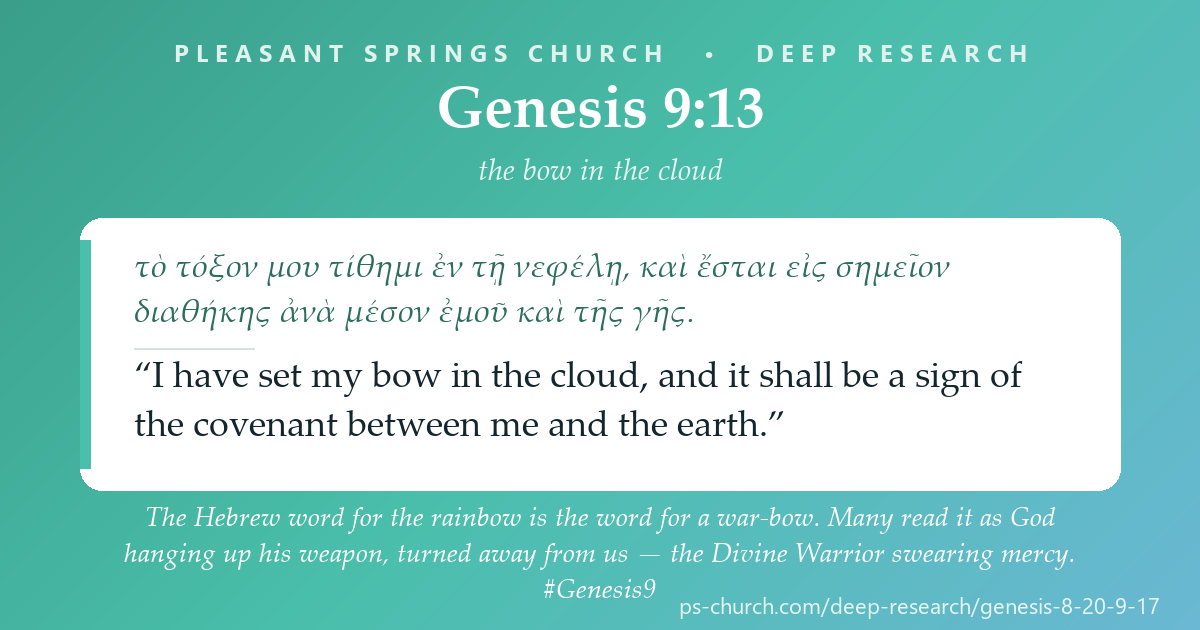
The warrior’s bow. Across the ANE the storm-god wields a bow as his weapon (Marduk against Tiamat; the Ugaritic and Mesopotamian war-gods; and the flood-waters had poured through the “windows of heaven,” Gen 7:11). For God to set his bow in the cloud — on the disarmament reading, turned away from the earth — is a striking image of the Divine Warrior laying down his weapon. The instrument of the storm becomes the sign of peace.
The treaty-sign. ANE covenants and grants were sealed with signs and oaths. The Noahic covenant is a divine grant: God binds himself (“I establish… my bow… I will remember”), with no conditions laid on humanity — sheer promise to sustain the world.
- Enuma Elish & ANE war-god imagery — the deity’s bow as weapon (Marduk’s bow is even set in the heavens as a constellation): the backdrop to God hanging up his bow.
- Jubilees 6:1–22 (Pseudepigrapha — a witness, not Scripture) — expands the Noahic covenant into the feast of Shavuot and a calendar of oaths; the “Noahide” framework in seed.
- The rabbinic “Seven Noahide Laws” — later Judaism drew from Genesis 9 a set of universal commands binding on all humanity: an early reading of this covenant as for the nations.
- Ezekiel 1:28 — “like the appearance of the bow… in the cloud… so was the appearance of the brightness” of the Lord’s glory: the rainbow drawn up into throne-vision.
On a reading rooted in rabbinic exegesis (Nachmanides) and argued afresh by recent scholars, the rainbow is not a gentle afterthought but a disarmament: God takes the war-bow — the very weapon of the storm that had just drowned the world — and hangs it in the sky, turned away from the earth. On this reading the covenant sign says: judgment is real, but restraint is now sworn; the world is held not by human merit but by the patience of a God who has laid down his bow. When John sees the throne of heaven, “a rainbow… around the throne” (Rev 4:3) crowns the God who keeps his word.
The vocabulary of altar, image, and bow.
Watch the sacrifice-word’s play on Noah’s name, the image grounding life’s value, and the war-bow become a covenant sign.
“Pleasing aroma” — the technical term for an accepted sacrifice (Lev 1:9). A wordplay on Noah’s name (Nōaḥ / nîḥōaḥ): the rest-bringer’s offering brings God’s favor.
“I will not again” — the “never again” of divine restraint. The world’s stability rests on God’s self-binding promise, not on improved humanity (“for the intention of man’s heart is evil”).
“In the image of God” — the ground of human dignity from 1:27. Murder is an assault on God’s image; the image survives the fall and the flood.
“Bow” — the war-bow (LXX τόξον), not a special “rainbow” word. God’s weapon, hung up and pointed away: the Warrior’s peace.
“Sign of the covenant” — like the sabbath (Exod 31:13) and circumcision (17:11), a visible token. The rainbow is God’s reminder to himself: “I will see it and remember.”
“Everlasting covenant” — unconditional and universal, with all flesh and the earth. The widest of God’s covenants, the stable stage for all the rest.
How the New Testament reuses the Noahic covenant:
- Ephesians 5:2 — Christ gave himself “a fragrant offering… to God”: the true “pleasing aroma” that Noah’s altar anticipated.
- James 3:9; Acts 17:26 — the image of God (9:6) grounding the dignity of every person and the unity of the human race.
- Revelation 4:3; 10:1 — “a rainbow around the throne”; the covenant-sign lifted into the vision of the reigning God who keeps his word.
- 2 Peter 3:5–13; Matthew 24:37–39 — the “never again” by water underscores the coming judgment by fire — and the new heavens and new earth beyond it.
From the bow in the cloud to the rainbow round the throne.
Trace the covenant, the image, and the bow across the canon — then note the Beale & Carson trajectory at Revelation 4.
Which cross-references matter?
- Genesis 1:27–28 — the image of God and the “be fruitful” blessing, both renewed with Noah as a new Adam (9:1, 6).
- Genesis 6:18; 15; 17; Exodus 24; 2 Samuel 7; Jeremiah 31 — the covenant story the Noahic covenant opens: Abraham, Sinai, David, and the New Covenant.
- Leviticus 17:11; Deuteronomy 12:23 — “the life is in the blood”: the sanctity-of-blood principle of 9:4–6 developed in the law.
- Isaiah 54:9–10 — “as the waters of Noah… so… my steadfast love shall not depart”: the Noahic “never again” as the pledge of God’s enduring mercy.
- Ezekiel 1:28; Revelation 4:3; 10:1 — the bow drawn into the glory-vision and set round the heavenly throne.
The commentary’s Revelation treatment reads the “rainbow around the throne” (4:3) as the Noahic covenant-sign transposed into the vision of God’s reign: the God who judges is encircled by his own pledge of mercy. The bow Noah saw in the storm-cloud crowns the throne of the universe — a permanent reminder that the Judge is also the covenant-keeper, and that beyond every judgment stands his sworn faithfulness, secured at last in Christ, the true fragrant offering (Eph 5:2).
The scholarship on the Noahic covenant.
Dumbrell and Williamson for the covenant; the commentaries for the bow and the blood laws.
Commentaries & studies:
- William Dumbrell, Covenant and Creation; Paul Williamson, Sealed with an Oath.
- Wenham (WBC), Hamilton (NICOT), Sarna (JPS), Mathews (NAC).
- Studies on the war-bow motif (e.g., Turner, Wenham) and on the Noahide-law reading of Genesis 9.
Interpretation notes worth keeping:
- “Bow” = weapon, not a coined “rainbow” word — קֶשֶׁת is the ordinary war-bow (this much is secure). The disarmament reading (Warrior laying down his bow, turned away from earth) is rooted in rabbinic exegesis (Nachmanides) and argued afresh by recent scholars (van Wolde), though disputed by others (Westermann); the bow’s orientation is an inference, not stated in the text.
- The covenant is unilateral and universal — God binds himself, with all flesh and the earth, laying no conditions on humanity. (On Dumbrell’s reading, the verb הֵקִים suggests God upholds the created order rather than founding a new relationship — a nuance others dispute.)
- 9:6 grounds capital sanction and human dignity alike in the image of God — the same ground later cited against cursing people (Jas 3:9): the image is the reason life is inviolable.
From the rainbow to your own security.
Name what you learned, why it matters, and one concrete response.
What should we carry away — and do?
- The world is held by promise, not by our goodness. God swore “never again” knowing the human heart was still evil. Our stability rests on his covenant-keeping, not our improvement.
- Every person bears the image — still. The flood did not erase it; 9:6 reaffirms it. Human life is inviolable because it images God, the ground of all justice and dignity.
- God hung up his bow. The Divine Warrior laid his weapon in the sky, pointed away from us. The rainbow round the throne (Rev 4:3) says the Judge is also, and finally, the keeper of his word.
Step in response: next time you see a rainbow, read it as God intends — his own reminder of a sworn mercy — and let one relationship this week be governed by the sanctity of the image of God in the other person.
Genesis 9:13 · to share
LXX + ESVEvery Deep Research page traces its passage across the whole sweep — the Old Testament, the Second-Temple world between the testaments (historical witnesses, not Scripture), and the New Testament. Follow the thread:
Pleasant Springs Church — Deep Research
Research method after Michael S. Heiser’s Bible Research Method (examine dictionaries → ancient literature → important words → textual connections → academic publications → share), with the Pleasant Springs “Author & Audience” foundation. Scripture set in the Hebrew, the Greek editions named on each page and the ESV (Old Testament), and the Greek New Testament and the ESV (New Testament), per the practice of Pleasant Springs Church. Genesis 8:20–9:17 research grounded in Dumbrell, Williamson, Wenham, Hamilton, and Sarna; ANE war-bow imagery per Enuma Elish and the divine-warrior tradition; Second-Temple material per Jubilees 6 and the later Noahide-law reading (read as witnesses, not Scripture).
Scripture quotations marked ESV are from the ESV® Bible (The Holy Bible, English Standard Version®), © 2001 by Crossway, a publishing ministry of Good News Publishers. ESV Text Edition: 2016. Used by permission. All rights reserved. The ESV text may not be quoted in any publication made available to the public by a Creative Commons license, and the ESV may not be translated in whole or in part into any other language. www.esv.org
|
Did this study bless you today? 💚 Give to Support PS Church100% of gifts go to the General Fund — thank you. |