After the flood, a new beginning — and, heartbreakingly, a new fall. Noah, a man of the soil like Adam, plants a vineyard, drinks, and lies exposed. Ham sees his father’s shame and broadcasts it; Shem and Japheth walk backward and cover him. Noah’s oracle falls not on Ham but on Canaan — pointing to the Canaanite nations, not to any race or skin color (the “curse of Ham” used to justify slavery is a lie against Scripture). It is Eden retold: garden, fruit, nakedness, curse and blessing. The flood washed the world; it did not wash the heart. This study works Genesis 9:18–29. See the method →
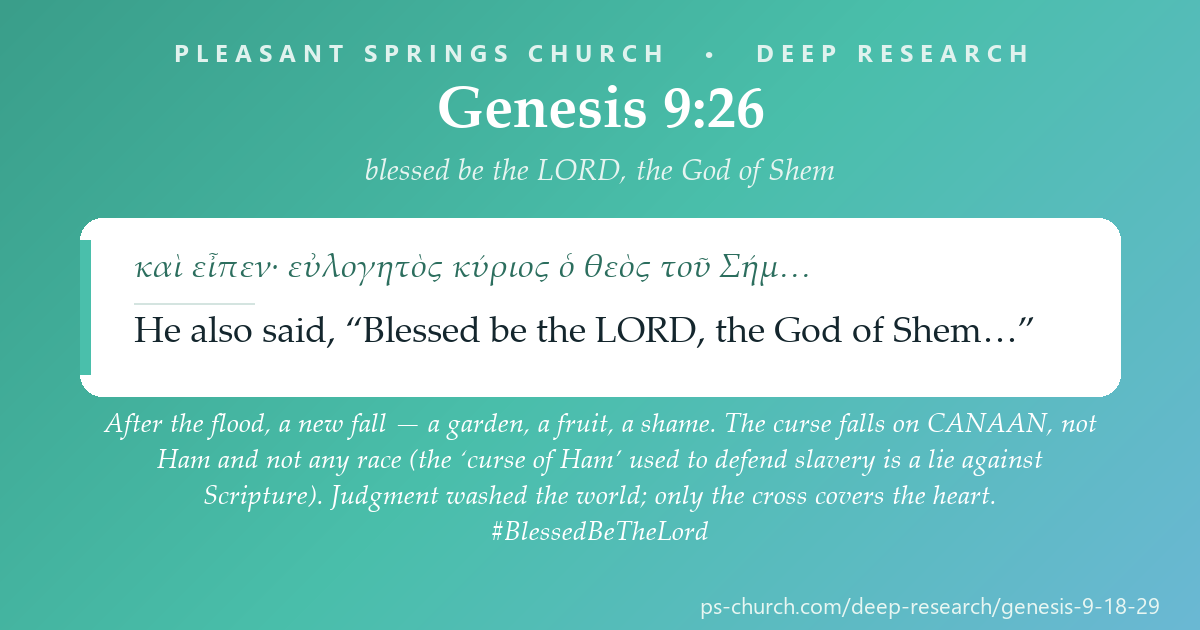
Genesis 9:21–23, 25–26
Hebrew · LXX · ESVThe Shape of the Passage
ConcentricThis passage closes the story of Noah (the toledot of 6:9–9:29). It is one of the most misread texts in the Bible — abused for centuries to justify race-based slavery. Read carefully, in its own words, it says something very different: a new Adam falls in a new garden, and the curse lands precisely on Canaan.
Author
Moses tells the story as a deliberate echo of Eden. Noah is called “a man of the soil” (’ish ha’adamah, 9:20) — the very language used of Adam, formed from the adamah (2:7) and sent to work the cursed adamah (3:17–19). He plants a garden (a vineyard), and there is fruit, and a taking, and a nakedness (’erwah, the word of Eden’s shame), and the covering, and a curse. The flood was a kind of re-creation — the waters receding, the dove, the new command to “be fruitful and multiply” (9:1) — and now, tragically, a new fall. Judgment cleansed the earth of violent men, but it did not cleanse the human heart. Even the flood’s one righteous survivor sins.
Ham dishonored; his brothers covered. The offense turns on a contrast of postures. Ham “saw the nakedness of his father and told his two brothers outside” (9:22) — the verb suggests not an accident but a broadcasting, a mockery, a shaming of his father. (The text’s language of “nakedness” is the vocabulary of the later honor laws; whatever exactly occurred, its heart is a son’s dishonoring of his father.) Shem and Japheth do the opposite: they take a garment, lay it across both their shoulders, walk backward so as not to look, and cover their father — the text stressing twice that “they did not see” (9:23). Here, in seed form, is the honor a child owes a parent (later the fifth commandment): where Ham exposed, his brothers covered. Love “covers” (Prov 10:12; 1 Pet 4:8); scorn exposes.
The oracle — and who is cursed. Waking and knowing what was done, Noah speaks a prophetic oracle over his grandsons’ nations. And here the text must be read with care, because it has been so gravely abused. Noah does not curse Ham. He says, “Cursed be Canaan” (9:25) — Ham’s son, and the ancestor of the Canaanite peoples. The narrator prepares us for this from the start, noting twice that “Ham was the father of Canaan” (9:18, 22). The oracle is etiological and prophetic: it foresees the moral corruption and eventual subjugation of the Canaanite nations — the peoples Israel would later encounter in the land, whose practices Leviticus 18 condemns. It is not a curse on Ham, not on his other sons (Cush, Egypt, Put), not on any race, and not on skin color. And the blessing side is telling: “Blessed be the Lord, the God of Shem” (9:26) — the blessing is on God, and reaches Shem through his covenant relation to the Lord. From Shem will come Abraham, Israel, and the Messiah; of Japheth it is said, “may God enlarge Japheth, and let him dwell in the tents of Shem” — read since ancient times as a promise of Gentile inclusion in Shem’s blessing.
Audience
Israel — about to enter a land filled with Canaanites. The oracle helped them understand that the moral degradation they would meet in Canaan had deep roots, and that the promise ran through Shem, their own line. But the passage speaks with special urgency to a later audience, because of how badly it has been abused.
A word about the “curse of Ham.” For centuries this passage was twisted into a so-called “curse of Ham” and used to justify the enslavement of Africans, race-based chattel slavery, segregation, and apartheid. This reading is false at every level. (1) The curse falls on Canaan, not Ham — and the Canaanites were a Semitic people of the Levant, not Africans. (2) The text says nothing whatever about skin color; it concerns the moral history of specific ancient nations. (3) A prophetic oracle describing what would happen to the Canaanite peoples confers no warrant for anyone to enslave anyone — Scripture roundly condemns man-stealing (Exod 21:16; 1 Tim 1:10). The abuse of this text to prop up racism is a grievous sin against the Word of God and against people made in his image (Gen 1:27; 9:6). In Christ there is no Jew or Greek, slave or free (Gal 3:28), and the gospel gathers a people “from every tribe and language and people and nation” (Rev 5:9).
Grace on the far side of the fall. The passage is sober, but it is not without hope. The same “covering” that Shem and Japheth offered their father points, faintly, toward the God who “covers” sin — who clothed Adam and Eve (3:21) and who, in Christ, covers our shame not with a borrowed garment but with the righteousness of his Son (Rom 4:7–8; 2 Cor 5:21). And the closing note — “all the days of Noah were 950 years, and he died” (9:29) — sounds again the refrain of Genesis 5: even the flood’s righteous survivor dies. The judgment washed the world; it did not conquer death. That victory waits for another Son of Adam.
Orient on Noah, the nations, the curse, and honor.
Search by topic: Noah, Canaan / Canaanites, curse and blessing, nakedness / honor, Table of Nations.
Which articles are relevant?
- Anchor Bible Dictionary — “Noah,” “Canaan,” “Ham,” “Curse.”
- Dictionary of the OT: Pentateuch — “Noah,” “Blessing and Cursing,” “Nakedness,” “Nations.”
- NIDOTTE / TDOT — ’arar (curse), ’erwah (nakedness), kasah (cover), ’ebed (servant).
Bibliography surfaced:
- Gordon Wenham (WBC), Victor Hamilton (NICOT), Kenneth Mathews (NAC), Bruce Waltke, Nahum Sarna (JPS) on Genesis.
- David M. Goldenberg, The Curse of Ham (the history of the text’s racist abuse and its refutation).
- Beale & Carson, Commentary on the NT Use of the OT.
A new Adam, a new fall, and the honor of covering.
Read the Eden echoes, the honor/shame of nakedness, and the oracle on the nations against their Ancient Near Eastern backdrop.
Which parallels shed light on religion and worldview?
Eden, retold. The scene is built to remind us of the garden. Noah, like Adam, is a “man of the soil”; he plants a garden and eats its fruit (here, the fermented fruit of the vine); there is a shameful nakedness; there is a covering; there is a curse spoken and a blessing spoken. Genesis is telling us that the flood, for all its cleansing power, did not solve the deepest problem. The new humanity begins exactly where the old one fell — with a garden, a fruit, and a shame. This is one of the most important lessons of the primeval history: the human heart cannot be fixed by washing the world. A better solution than a flood will be needed — not the destruction of sinners but the redemption of sinners, which is why the story keeps pressing forward toward Abraham, and past him toward the cross.
Honor, shame, and the covering. In the ancient world, to expose a father’s nakedness — or to make it a matter of gossip — was a profound violation of honor. The gravity of Ham’s act is measured by the exquisite care of his brothers’ response: they will not even look. The garment on both shoulders, the backward walking, the doubled “they did not see” — all of it dramatizes the refusal to shame. Here, before Sinai, is the fifth commandment in embryo (“honor your father”) and the wisdom that “love covers all offenses” (Prov 10:12; 1 Pet 4:8). The chapter draws a bright line between the son who exposes and the sons who cover — and the New Testament will make covering the very shape of love.
The oracle and the Canaanite nations. Noah’s words are not petty family payback; they are a prophetic oracle about nations. The Bible regularly presents the patriarchs’ blessings and curses as shaping the destinies of the peoples descended from them (Gen 27; 49; Deut 33). “Cursed be Canaan… a servant of servants” (a Hebrew superlative, “the lowest of slaves”) foresees the moral corruption of the Canaanite peoples and their eventual subjugation — fulfilled in Israel’s later history, and grounded in the genuine depravity of Canaanite religion that Leviticus 18 catalogs. It is crucial to see what this is and is not. It is a specific word about the Canaanites, a particular cluster of ancient Semitic nations. It is not a word about Ham’s wider descendants, not about Africa, not about race, and not a license for anyone to enslave anyone. Read as Scripture reads it, the oracle is a sober forecast of the fate of nations whose sin ripened — the same principle by which any nation, including Israel, is warned it can be “vomited out” of the land for the same abominations (Lev 18:24–28).
- Genesis 2:7–9; 3:7–21 — Adam the man of the soil; the garden, the fruit, the nakedness, the covering, the curse: the Eden pattern Noah’s story repeats (see the curse & exile).
- Genesis 10:15–19; Leviticus 18:1–30; Deuteronomy 9:4–5 — Canaan’s clans; the abominations of the Canaanite nations; their dispossession for wickedness: the oracle’s referent.
- Exodus 21:16; Deuteronomy 24:7; 1 Timothy 1:10 — man-stealing (kidnapping to enslave) condemned as a capital sin: Scripture’s flat rejection of the slavery this text was abused to defend.
It is impossible to study Genesis 9 honestly without reckoning with what has been done to it. For the better part of two thousand years, and with terrible intensity during the era of the transatlantic slave trade, this passage was pressed into service as the ‘curse of Ham’ — a supposed biblical warrant for the enslavement of black Africans, for treating a whole race as destined by God to be the ‘servants of servants.’ The reading was always a lie, and it is worth saying exactly why, because the lie still echoes. First, the text does not curse Ham at all; it curses Canaan, and the narrator goes out of his way, twice, to make sure we know which son is in view. Second, Canaan was not African; the Canaanites were a Semitic people of the land later called Palestine, ethnically close to Israel itself. Third, the text breathes not a word about skin color — that association was imported centuries later and has no basis whatever in the Hebrew. And fourth, even if one takes the oracle as prophecy fulfilled in the subjugation of the Canaanite city-states, a prediction that something will happen is not a permission for someone else to make it happen; the same Bible that records this oracle makes the stealing of a human being to enslave him a crime worthy of death. The abuse of Genesis 9 is a case study in how a text can be wrenched from its words to serve the sins its readers already wished to commit. Restored to its own language — a drunken father, a dishonoring son, an honoring pair of brothers, and an oracle about the Canaanite nations — it turns out to have nothing to say in defense of racism, and everything to say against the pride and cruelty that racism is made of.
The vocabulary of the curse, the covering, and the blessing.
Watch that the curse names Canaan, the honor/shame of “nakedness” and “covering,” and the blessing spoken over the Lord.
“Cursed be Canaan” — the curse names Canaan (Ham’s son and ancestor of the Canaanite nations), NOT Ham, and not any race. The narrator flags “Ham the father of Canaan” twice to make the referent unmistakable. A prophetic oracle about specific ancient nations, not a warrant for slavery.
“A servant of servants” — a Hebrew superlative genitive (“the lowest of slaves”), foreseeing the subjugation of the Canaanite peoples in Israel’s later history — fulfilled corporately, not a decree over individuals or races.
“Nakedness” — the loaded term of the honor laws (Lev 18; 20). Noah’s shame is his own (he “uncovered himself,” reflexive); Ham’s fault is dishonoring it — seeing and broadcasting rather than covering.
“To cover.” Shem and Japheth “cover” their father’s shame, walking backward so as not to see — the honor a child owes a parent (the fifth commandment in seed) and a picture of love that “covers” offenses (Prov 10:12; 1 Pet 4:8), pointing to the God who covers sin.
“Blessed be the Lord” — strikingly, the blessing is spoken over God (“the Lord, the God of Shem”), not directly over Shem; blessing reaches Shem through covenant relation to the Lord — seeding the Shem→Abraham→Israel→Messiah line.
“May God enlarge Japheth” — a pun on Japheth’s name (yapt/Yephet). “Let him dwell in the tents of Shem” has been read since antiquity as a promise of Gentile inclusion in the blessing of Shem — the nations brought into the covenant.
How the rest of Scripture fills out the oracle:
- Genesis 10:6–20; 15:16; Leviticus 18:24–28 — Canaan’s clans; “the iniquity of the Amorites is not yet complete”; the land vomiting out its inhabitants for sin: the oracle’s fulfillment in the Canaanite nations (see the Table of Nations).
- Exodus 20:12; Proverbs 10:12; 1 Peter 4:8 — honor your father; “love covers all offenses”: the ethic of Shem and Japheth’s covering.
- Genesis 12:1–3; Galatians 3:8, 28; Revelation 5:9 — blessing through Shem’s line to all families; no Jew or Greek, slave or free; a people from every nation: the gospel’s answer to every racial division (see the call of Abram).
- Exodus 21:16; 1 Timothy 1:10 — man-stealing condemned: Scripture’s flat rejection of the slavery this text was abused to justify.
From a new fall to the covering of sin in Christ.
Trace the Eden echoes, the oracle’s fulfillment in the Canaanite nations, and the covering that points to the gospel.
Which cross-references matter?
- Genesis 2–3; 8:20–9:17 — Eden and the Noahic covenant: the garden pattern and the covenant this fall follows (see the fall, the rainbow covenant).
- Genesis 10:15–19; Leviticus 18; Deuteronomy 9:4–5; Joshua 9 — the Canaanite nations, their abominations, and their subjugation: the oracle’s historical outworking (see the Table of Nations).
- Genesis 3:21; Romans 4:7–8; 2 Corinthians 5:21 — God clothing the ashamed; sins “covered”; our shame covered by Christ’s righteousness: the covering that saves.
- Genesis 12:1–3; Galatians 3:8, 28; Revelation 5:9; 7:9 — blessing to all nations through Shem’s seed; every tribe and tongue redeemed: the gospel against all racial pride (see the Lamb).
- Genesis 5:1–32; 9:29 — “and he died”: even Noah, the flood’s righteous survivor, dies — death not conquered by judgment (see the generations of Adam).
The placement of this sad little story is everything. It comes immediately after the flood — after God has washed the earth clean of the violence that filled it, after the ark and the dove and the rainbow and the fresh command to be fruitful and multiply. If ever there were a moment for a genuinely new humanity, a clean slate, a second Eden that would not fall, this is it. And what does the narrator give us? A garden, a fruit, a drunkenness, a nakedness, a shame, a curse. The very first thing Genesis records about the post-flood world is a re-run of the fall. The lesson is as unsentimental as it is important: the problem was never merely the wickedness out there in the world that a flood could drown; the problem was, and is, the wickedness in here, in the human heart, which no flood can reach. God himself had said as much just before he sent the waters, and again just after: the intention of the human heart is evil from youth (6:5; 8:21). Genesis 9 proves it on the far side of the judgment. And that is why the primeval history cannot end here, and does not. It has shown us that the human race cannot be saved by being washed; it must be saved by being redeemed — by a covering that goes deeper than a garment on the shoulders of two brothers, a covering God will provide at last in the blood of his own Son. The flood could bury the old world. Only the cross can cover the sin of the heart.
The scholarship on Genesis 9:18-29.
The commentators on Noah’s oracle; the studies of the Eden parallels, the honor/shame dynamics, and the history of the text’s racist abuse.
Commentaries & studies:
- Gordon J. Wenham (WBC), Victor P. Hamilton (NICOT), Kenneth A. Mathews (NAC), Bruce K. Waltke, Nahum M. Sarna (JPS) on Genesis.
- David M. Goldenberg, The Curse of Ham: Race and Slavery in Early Judaism, Christianity, and Islam; studies of the “curse of Ham” in American slavery.
- G. K. Beale & D. A. Carson, eds., Commentary on the NT Use of the OT.
Interpretation notes worth keeping:
- The curse is on Canaan. Not Ham, not a race, not skin color — the narrator flags “Ham the father of Canaan” twice. The oracle is prophetic of the Canaanite nations (Lev 18; Deut 9), fulfilled corporately in Israel’s history.
- No warrant for slavery or racism. The “curse of Ham” used to justify race-based slavery is a false and grievous abuse: Canaan was a Semitic Levantine people; the text says nothing of race or color; and prophecy of subjugation is not permission to enslave (man-stealing is condemned, Exod 21:16; 1 Tim 1:10). State this plainly.
- A new fall. The Eden echoes (man of the soil, garden, fruit, nakedness, covering, curse) show the flood cleansed the world but not the heart (6:5; 8:21) — redemption, not judgment, is needed.
- Recorded, not sanctioned. Noah’s drunkenness is narrated, not approved; the honoring/covering of Shem and Japheth is the model (Exod 20:12; Prov 10:12).
- Blessing through Shem. “Blessed be the Lord, the God of Shem” runs to Abraham and the Messiah; Japheth in Shem’s tents is read as Gentile inclusion (Gal 3).
From a new fall to a covering that goes deeper.
Name what you learned, why it matters, and one concrete response.
What should we carry away — and do?
- Judgment cannot fix the heart. The flood washed the world; Genesis 9 shows the human heart unwashed. We need not another flood but a Redeemer — a covering deeper than a garment.
- Read the text, refuse the abuse. The curse falls on Canaan, not on Ham and not on any race. The “curse of Ham” used to justify slavery and racism is a lie against the Word of God and against image-bearers. Name it as such.
- Love covers. Ham exposed; his brothers covered. The gospel makes covering the shape of love — and points to the God who covers our shame with the righteousness of his Son.
Step in response: practice the way of Shem and Japheth. Where you learn of another’s failure or shame, refuse to broadcast it; walk backward, cover it, honor the person — “love covers all offenses.” And repudiate, wherever it lingers, the racist misuse of this text; hold instead to the gospel that gathers “every tribe and language and people and nation” around one throne, all needing the same covering, all offered the same grace.
Genesis 9:26 · to share
LXX + ESVEvery Deep Research page traces its passage across the whole sweep — the Old Testament, the Second-Temple world between the testaments (historical witnesses, not Scripture), and the New Testament. Follow the thread:
Pleasant Springs Church — Deep Research
Research method after Michael S. Heiser’s Bible Research Method (examine dictionaries → ancient literature → important words → textual connections → academic publications → share), with the Pleasant Springs “Author & Audience” foundation. Scripture set in the Hebrew, the Greek editions named on each page and the ESV (Old Testament), and the Greek New Testament and the ESV (New Testament), per the practice of Pleasant Springs Church. Genesis 9:18–29 research grounded in Wenham, Hamilton, Mathews, Waltke, and Sarna, with Goldenberg on the history and refutation of the racist “curse of Ham”; the scene read as a deliberate Eden re-run (man of the soil, garden, fruit, nakedness, covering, curse) showing the flood cleansed the world but not the heart (Gen 6:5; 8:21); the curse falling emphatically on Canaan (flagged “father of Canaan” twice), a prophetic oracle about the Canaanite nations (Lev 18; Deut 9) — NOT on Ham, not on any race or skin color, and conferring no warrant for slavery (man-stealing condemned, Exod 21:16; 1 Tim 1:10); the racist abuse of the text named plainly as a grievous distortion; Noah’s drunkenness recorded not sanctioned; the “covering” of Shem and Japheth as the fifth-commandment ethic and a pointer to the God who covers sin; the blessing through Shem running to Abraham and the Messiah, and Japheth in Shem’s tents read as Gentile inclusion; small-caps Lord for the Tetragrammaton at 9:26.
Scripture quotations marked ESV are from the ESV® Bible (The Holy Bible, English Standard Version®), © 2001 by Crossway, a publishing ministry of Good News Publishers. ESV Text Edition: 2016. Used by permission. All rights reserved. The ESV text may not be quoted in any publication made available to the public by a Creative Commons license, and the ESV may not be translated in whole or in part into any other language. www.esv.org
|
Did this study bless you today? 💚 Give to Support PS Church100% of gifts go to the General Fund — thank you. |