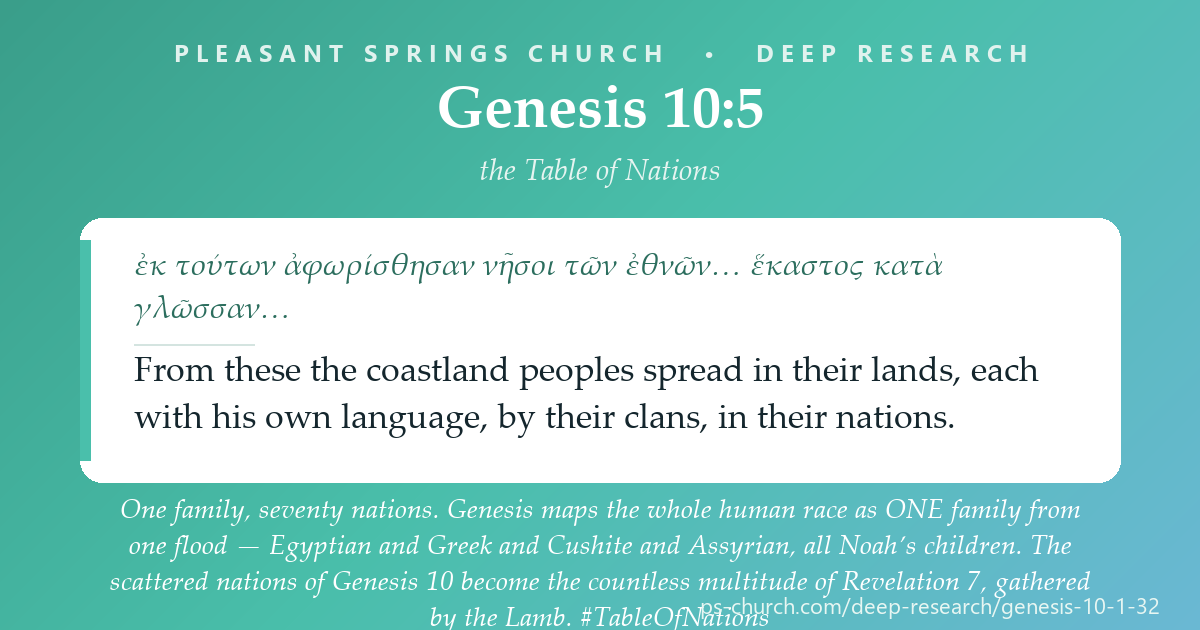
One family, seventy nations. From Noah’s three sons the whole human race is mapped — peoples, clans, lands, and languages, “each with his own language.” It is the Bible’s great atlas, insisting that every nation descends from one man and one flood. In the middle stands one dark figure: Nimrod, the first mighty man, whose kingdom begins at Babel and reaches to Nineveh — the empires that will exile Israel. The Table sets the stage for Babel’s scattering and for the promise that in Abraham all the families of the earth will be blessed. This study works Genesis 10:1–32. See the method →
Genesis 10:1, 5, 8–10, 32
Hebrew · LXX · ESVThe Shape of the Passage
Parallel panelsThe Table of Nations is unique in ancient literature: no other people produced a map of the whole known world as a single family tree. It stands between the flood and the call of Abraham, answering the question, “Where did all the nations come from?” — and quietly setting up the question the rest of the Bible answers: how will they be blessed again?
Author
Moses arranges the descendants of Noah’s three sons into a structured catalog — Japheth’s line (the more distant northern and coastland peoples), Ham’s line (Egypt, Cush, Canaan, and Babel’s Mesopotamia), and Shem’s line (from whom Abraham will come, deliberately placed last and lingered over). A fourfold refrain organizes it all: these spread out “by their clans, their languages, their lands, their nations” (10:5, 20, 31). Jewish tradition counted seventy nations in the list — a number of completeness that will echo later in the seventy who go down to Egypt (Gen 46), the seventy elders (Num 11), and the seventy(-two) Jesus sends out to the nations (Luke 10). The Table’s message is simple and profound: the whole human family, in all its dazzling diversity of tongue and territory, is one — descended from one man, spared through one ark. There is no room here for the idea that some peoples are more or less human than others; all are Noah’s children.
Nimrod — the first empire. Only one individual in the whole Table gets a story rather than a bare name: Nimrod, “the first on earth to be a mighty man” (gibbor), “a mighty hunter before the Lord” (10:8–9). The phrase is ambiguous — it can mean “in the Lord’s estimation” or, as most Jewish and Christian tradition took it, “in defiance before the Lord’s face” — and the Septuagint sharpens the note by calling him a giant (gigas), assimilating him to the violent heroes of before the flood (6:4). His kingdom is significant: it “began” at Babel in the land of Shinar — the very site of the tower in the next chapter — and reached to Nineveh. Babylon and Assyria, the two empires that would one day carry Israel into exile, are both traced back to this first imperial strongman. The Table quietly names the shape of the human problem: not just scattered nations, but nations organized into empire — power gathered against God.
The line of Shem, flagged. The catalog builds to Shem, and one detail stands out: Shem is introduced as “the father of all the children of Eber” (10:21) — Eber (’ever) being the eponym behind the word “Hebrew” (’ivri). And in Eber’s line a son is named Peleg (“division”), “for in his days the earth was divided” (10:25) — a nod ahead to the scattering at Babel. The covenant line is being marked out within the family of nations before it is traced in detail (11:10–26). The nations are the many; the promise will run through the one — through Shem, to Eber, to Abraham, and out again to all.
Audience
Israel — a small nation among the great powers of the earth — is being told two things at once. First, that all the surrounding peoples, however alien or hostile, are their kin: Egypt and Canaan and Assyria and the coastland peoples are all sons of Noah, one family under one God. Second, that the empires they will most fear — Babylon and Assyria — trace their pedigree to Nimrod, a strongman “before the Lord.” The Table both humanizes the nations and demystifies the empires: the peoples are brothers to be blessed, and the empires are not gods but the works of mighty men.
The horizon of the gospel. The Table of Nations is not a dead end; it is a promise waiting to be kept. It comes right before Babel, where the languages are confused and the nations scattered in judgment (ch. 11) — and right before Abraham, to whom God promises that “in you all the families of the earth shall be blessed” (12:3), the very families just listed. The whole Bible then works to gather the scattered nations back. At Pentecost the curse of Babel is answered as people “from every nation under heaven” hear the gospel each in his own language (Acts 2:5–11). And the story ends with the Table of Nations redeemed: a countless multitude “from every nation, from all tribes and peoples and languages,” standing before the throne and the Lamb (Rev 7:9). The seventy nations of Genesis 10 become the innumerable worshipers of Revelation 7 — the map of the scattered world becoming the guest list of the wedding feast.
Orient on the nations, genealogy, Nimrod, and Babel.
Search by topic: Table of Nations, nations / Gentiles, Nimrod, Babel / Babylon, languages.
Which articles are relevant?
- Anchor Bible Dictionary — “Table of Nations,” “Nimrod,” “Babel,” “Nations.”
- Dictionary of the OT: Pentateuch — “Nations, Table of,” “Genealogies,” “Babel.”
- NIDOTTE / TDOT — goy (nation), lashon (tongue/language), gibbor (mighty man), parad (spread/divide).
Bibliography surfaced:
- Gordon Wenham (WBC), Victor Hamilton (NICOT), Kenneth Mathews (NAC), Bruce Waltke, Nahum Sarna (JPS) on Genesis.
- Studies of the Table of Nations as ancient ethnography; the Deuteronomy 32:8 division of the nations; the seventy-nations tradition.
- Beale & Carson, Commentary on the NT Use of the OT (Acts 2; 17).
One family, the first empire, and the division of the nations.
Read the map of nations, the Nimrod excursus, and the “each with his own language” refrain against their Ancient Near Eastern backdrop.
Which parallels shed light on religion and worldview?
A map no one else drew. Ancient peoples told stories of their own origins, and kings listed the nations they had conquered, but no one in the ancient world produced anything like Genesis 10: a map of the whole known world as a single, related family, tracing every people — friend and foe, near and far — back to one common ancestor. The theological claim embedded in the form is enormous. Israel’s neighbors routinely dehumanized their enemies and outsiders in their royal and cultic propaganda. Genesis says the opposite: the Egyptian and the Canaanite, the Greek (Javan) and the Cushite, the Assyrian and the Arabian, are all children of Noah, all bearers of the image of God (1:27; 9:6), all one blood. Paul will draw exactly this conclusion in Athens: God “made from one man every nation of mankind to live on all the face of the earth” (Acts 17:26). The unity of the human race is not a modern discovery; it is written into the Bible’s third chapter of world history.
Nimrod and the birth of empire. The one narrative note in the Table is ominous. Nimrod is the first gibbor — the first “mighty man” — and the word recalls the violent “mighty men” of old before the flood (6:4). His achievement is not a craft (like Cain’s musicians and smiths) but a kingdom: the first empire in the Bible, beginning at Babel in Shinar and extending to the great cities of Assyria. In other words, the two archetypal enemy empires of the Old Testament — Babylon (which destroys Jerusalem and exiles Judah) and Assyria (which destroys Samaria and exiles Israel) — are both, at their fountainhead, the project of one man gathering power “before the Lord.” The Bible is teaching Israel to see empire clearly: it is impressive, it is real, and it is founded on the same proud grasping for greatness that Babel will display in the very next chapter. Nimrod builds the city; God will scatter it.
‘Each with his own language.’ The refrain that the nations spread “each with his own language” (10:5, 20, 31) is placed before the account of Babel (11:1–9), where the one language is confused into many. This is not a contradiction but a signal that Genesis 10 is arranged thematically, not strictly chronologically: it gives us the finished map of the scattered nations first, then goes back in chapter 11 to explain how the scattering happened. The many languages of the earth — a wonder and a barrier — are thus framed from the start as the result of judgment. Which is why it matters so much when, at Pentecost, the barrier is momentarily lifted and the mighty works of God are heard “each in his own language” (Acts 2:6, 8) — the same phrase, now redeemed. Babel scattered the nations by confusing their tongues; the gospel gathers them by speaking every tongue.
- Genesis 11:1–9; Deuteronomy 32:8–9 — Babel and the scattering of the nations; the Most High dividing humanity “according to the number of the sons of God”: how the map of ch. 10 came to be (see Babel).
- Genesis 12:1–3; Acts 17:26 — “all the families of the earth” blessed in Abraham; “from one man every nation”: the nations’ unity and their promised blessing (see the call of Abram).
- Acts 2:5–11; Revelation 5:9; 7:9 — Pentecost’s nations hearing each in his own language; the ransomed from every tribe and tongue: the Table redeemed (see Pentecost, the Lamb).
Genesis 10 is one of the most quietly world-changing chapters in the Bible, and its power lies in what it takes for granted. It simply assumes, and lays out in careful detail, that every nation on earth belongs to a single family — that the peoples who will spend the rest of the Old Testament fighting Israel, and whom Israel will be tempted to despise, are its cousins. This is not sentiment; it is genealogy. The Cushite and the Canaanite, the Ionian Greek and the desert Arab, are Noah’s grandchildren, no less and no more than Israel. And that assumption has consequences the whole rest of Scripture will draw out. It means that when God calls Abraham, the goal is never a single favored nation hoarding blessing, but ‘all the families of the earth’ — the very families just catalogued — being blessed through him. It means the scattering of Babel is a tragedy to be reversed, not a permanent state to be accepted. And it means that the end of the story must look like the beginning of the human family made whole: a great multitude that no one can number, from every nation and tribe and people and language, standing together before the throne. The seventy nations of Genesis 10 are the guest list for a feast that has not yet begun. The chapter that looks like a dry catalog of forgotten names is in fact the Bible’s pledge that God has not forgotten a single people on earth — and its promise that he means to gather them all home.
The vocabulary of nation, tongue, the mighty man, and the first kingdom.
Watch the fourfold “clans / tongues / lands / nations,” the seventy, the first gibbor, and the birth of empire at Babel.
“Generations.” The structural formula of Genesis; here it heads the map of the nations. The whole book is titled from it (Greek Genesis). It narrows the focus each time from the whole race toward the elect line — the many nations here, the one line of Shem next (11:10).
“Nation” / “tongue.” The fourfold refrain (clans / languages / lands / nations) organizes the Table. This “nations and tongues” vocabulary flows straight into the New Testament’s “every tribe and language and people and nation” (Rev 5:9; 7:9).
“Seventy” — the traditional count of the nations in the Table (the LXX lists seventy-two). A number of completeness echoed later in the seventy who go to Egypt (46:27), the seventy elders (Num 11), and the seventy(-two) Jesus sends to the nations (Luke 10:1).
“Mighty man, warrior.” Nimrod is the first gibbor — the word recalls the violent “mighty men” before the flood (6:4). The LXX renders it gigas (“giant”), coloring Nimrod as a titanic rebel and the founder of empire.
“Before the Lord” — deliberately ambiguous: “in the Lord’s estimation” (superlative) or, as most tradition read it, “in defiance before the Lord’s face.” The Babel link (10:10) tilts the phrase toward the darker reading: Nimrod the God-defying strongman.
“Babel” / “Shinar.” The first “kingdom” (mamlakah) in the Bible, and the very site of the tower (11:2). Babel = Babylon; from Nimrod’s kingdom come both Babylon and Nineveh (Assyria) — the two empires that will exile Israel.
How the rest of Scripture fills out the nations:
- Genesis 11:1–9; Deuteronomy 32:8–9 — Babel’s scattering; the division of the nations by the Most High: how the map came to be (see Babel).
- Genesis 12:1–3; Psalm 87; Isaiah 19:23–25 — all families blessed in Abraham; the nations named as God’s people: the promise to the peoples of the Table.
- Acts 2:5–11; 17:26–27 — Pentecost’s nations hearing each in his own tongue; “from one man every nation”: the unity and the ingathering (see Pentecost).
- Revelation 5:9–10; 7:9–10 — the ransomed and the countless multitude “from every nation, tribe, people, and language”: the Table of Nations redeemed (see the Lamb).
From the scattered nations to the gathered multitude.
Trace the nations from their spreading, through Babel and Abraham, to the ingathering of every tribe and tongue.
Which cross-references matter?
- Genesis 9:18–19; 11:1–9 — the sons of Noah from whom the earth was peopled; Babel’s confusion and scattering: the frame around the Table (see Noah’s sons, Babel).
- Genesis 12:1–3; Galatians 3:8, 14 — “all the families of the earth” blessed in Abraham; the blessing of Abraham coming to the Gentiles: the promise to the nations (see the call of Abram).
- Deuteronomy 32:8–9; Acts 17:26–27 — the Most High dividing the nations; “from one man every nation” that they might seek God: the theology of the peoples.
- Acts 2:5–11; Matthew 28:18–20 — the gospel heard in every language; “make disciples of all nations”: the mission to the Table (see Pentecost, the Great Commission).
- Revelation 5:9; 7:9–10; 21:24–26 — every tribe and tongue ransomed and gathered; the nations walking by the light of the city: the Table’s consummation (see the new creation).
The placement of the Table of Nations is a small masterpiece of biblical theology. Genesis could have moved straight from the flood to Abraham, from Noah to the chosen family. Instead it pauses to lay out the whole world — seventy nations, spreading into all their lands and tongues — before it narrows to the one man through whom God will work. And that order is the key to everything that follows. Because we have seen the nations first, in all their breadth, we understand what the call of Abraham is for. God does not choose Abraham because he has lost interest in the seventy nations; he chooses Abraham as the means of reaching them. ‘In you all the families of the earth shall be blessed’ — and the families of the earth are precisely the ones just named in chapter 10. The particular election of Israel is never an end in itself; it is God’s strategy for the universal blessing of the world he has just mapped. This is why the Bible cannot end with Israel alone, and does not. The line that runs from Shem to Abraham to David reaches its goal in a Messiah who commands his people to go and disciple ‘all nations,’ and the vision that closes the canon is the Table of Nations turned into a choir: a great multitude from every nation and tribe and people and language, no longer scattered by Babel but gathered by the Lamb, singing one song before one throne. Genesis 10 is where that global horizon is first drawn on the map.
The scholarship on Genesis 10:1-32.
The commentators on the Table of Nations; the studies of ancient ethnography, Nimrod, and the seventy-nations tradition.
Commentaries & studies:
- Gordon J. Wenham (WBC), Victor P. Hamilton (NICOT), Kenneth A. Mathews (NAC), Bruce K. Waltke, Nahum M. Sarna (JPS) on Genesis.
- Studies of the Table of Nations as ancient ethnography and of Nimrod; the Deuteronomy 32:8 division of the nations.
- G. K. Beale & D. A. Carson, eds., Commentary on the NT Use of the OT (Acts 2; 17).
Interpretation notes worth keeping:
- One family, one blood. The Table maps every nation as descended from Noah — the unity of the human race (Acts 17:26), all image-bearers; no ground here for treating any people as less than human.
- Thematic, not chronological. “Each with his own language” (10:5) precedes Babel (11:1–9): ch. 10 gives the finished map, ch. 11 explains the scattering. The many tongues are framed as the result of judgment — reversed at Pentecost.
- Nimrod and empire. The first gibbor founds the first kingdom at Babel and Nineveh — Babylon and Assyria, Israel’s future oppressors, traced to one strongman “before the Lord” (ambiguous; most read it as defiance; the LXX “giant” sharpens it). Not date-setting; a portrait of proud power.
- The seventy. The traditional count (LXX seventy-two) signals completeness — echoed in the seventy(-two) sent to the nations (Luke 10). Don’t over-specify which names the LXX adds.
- Peleg’s ‘division.’ “The earth was divided” (10:25) most naturally refers to the Babel dispersion of peoples, not a geological/continental splitting — which the text does not teach.
From the map of scattered nations to the guest list of the feast.
Name what you learned, why it matters, and one concrete response.
What should we carry away — and do?
- Every nation is one family. The peoples you find strange or fear are Noah’s children and image-bearers of God, one blood with you (Acts 17:26). The Bible’s map of the world leaves no room for treating any people as less than human.
- Empire is not God. Babylon and Assyria trace to one proud strongman. Human power, however impressive, is the work of mighty men — and God scatters the towers they build.
- The scattered will be gathered. The seventy nations of Genesis 10 become the countless multitude of Revelation 7 — every tribe and tongue before the throne. God has not forgotten a single people on earth.
Step in response: let the Table of Nations shape how you see the peoples of the earth — and your part in God’s plan for them. Pray for a nation not your own. Support the taking of the gospel to a people who have not heard. And refuse every instinct that ranks or despises a people God has mapped as your kin and means to gather to his throne. The map of the scattered world is the guest list of the wedding feast.
Genesis 10:5 · to share
LXX + ESVEvery Deep Research page traces its passage across the whole sweep — the Old Testament, the Second-Temple world between the testaments (historical witnesses, not Scripture), and the New Testament. Follow the thread:
Pleasant Springs Church — Deep Research
Research method after Michael S. Heiser’s Bible Research Method (examine dictionaries → ancient literature → important words → textual connections → academic publications → share), with the Pleasant Springs “Author & Audience” foundation. Scripture set in the Hebrew, the Greek editions named on each page and the ESV (Old Testament), and the Greek New Testament and the ESV (New Testament), per the practice of Pleasant Springs Church. Genesis 10:1–32 research grounded in Wenham, Hamilton, Mathews, Waltke, and Sarna; the Table read as the unique ancient map of the whole human race as one family (Acts 17:26 — the unity of humanity, all image-bearers), arranged thematically (the “each with his own language” of 10:5 preceding Babel, 11:1–9); Nimrod as the first gibbor founding the first empire at Babel and Nineveh (Babylon and Assyria), “before the Lord” read ambiguously (most: defiance; the LXX gigas “giant” sharpening it); the traditional seventy nations (LXX seventy-two) as completeness, echoed in the seventy(-two) sent to the nations (Luke 10); Peleg’s “the earth was divided” as the Babel dispersion of peoples (not continental splitting); the whole framed toward Abraham’s blessing to “all the families of the earth” and the ingathering of every tribe and tongue (Rev 5:9; 7:9); small-caps Lord for the Tetragrammaton at 10:9.
Scripture quotations marked ESV are from the ESV® Bible (The Holy Bible, English Standard Version®), © 2001 by Crossway, a publishing ministry of Good News Publishers. ESV Text Edition: 2016. Used by permission. All rights reserved. The ESV text may not be quoted in any publication made available to the public by a Creative Commons license, and the ESV may not be translated in whole or in part into any other language. www.esv.org
|
Did this study bless you today? 💚 Give to Support PS Church100% of gifts go to the General Fund — thank you. |