The flood is creation run backward: the waters God once separated come crashing together, the breath of life is snuffed out, and the world sinks toward the formless deep. And then, at the exact center of the story, the hinge on which everything turns: “God remembered Noah” — and a wind — the same word (rûaḥ) that echoes the Spirit over the waters of Genesis 1 — passes over the flood, and a new world rises. This study works the deluge as un-creation and new creation, from the bursting deep to the dove’s olive leaf. See the method →
Genesis 7:1–8:19 (selections)
Hebrew · LXX · ESVThe Shape of the Passage
ChiasmSame Author and audience as Genesis 1:1 — and the flood narrative is told with unmistakable echoes of the creation week, run backward and then forward again.
Author
The Torah of Moses shapes the flood as de-creation and re-creation. The waters God had separated on days two and three come crashing back together (7:11); the “breath of life” in every creature is snuffed out (7:22); the world returns toward the watery formlessness of 1:2. Then the hinge: “God remembered Noah” (8:1) — and a wind (רוּחַ) passes over the waters, the same word (rûaḥ) that echoes Genesis 1:2, and a new world emerges: dry land, birds, “be fruitful and multiply.”
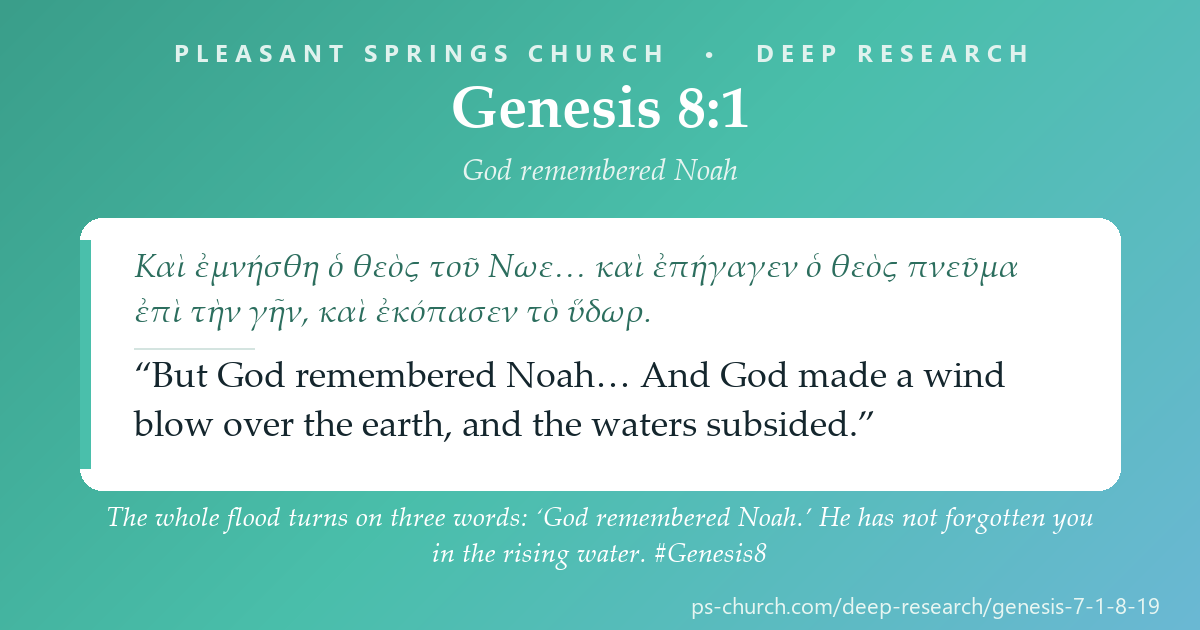
“God remembered.” This is covenant language, not a lapse of divine memory. When God “remembers” (Noah, Abraham, his covenant), he acts to save. The whole flood turns on this word: judgment gives way to rescue the moment God remembers his own.
Audience
Israel — who would themselves pass through waters of judgment on dry ground (the Red Sea, the Jordan) and emerge a new people. The flood teaches them the pattern: God brings his own through the waters, not around them, and makes a new beginning on the far side.
How they heard it. The dove returning with an olive leaf (8:11) — life sprouting again, the storm spent — became forever the emblem of peace after judgment. And the God who “remembered Noah” is the God who will remember them in Egypt (Exod 2:24) and remember mercy in every exile.
Orient on the flood, un-creation, and divine remembering.
Search by topic: flood, deep/tehom, chaos and creation, dove, remembrance.
Which articles are relevant?
- Anchor Bible Dictionary — “Flood (Genesis),” “Deep, The,” “Creation.”
- Dictionary of the OT: Pentateuch — “Flood,” “Creation,” “Cosmology.”
- NIDOTTE / TDOT — תְּהוֹם (təhôm), מָחָה (māḥâ, blot out), זָכַר (zāḵar, remember), רוּחַ (rûaḥ).
Bibliography surfaced:
- Wenham, Genesis 1–15 (WBC) — the chiastic structure of the flood narrative; Hamilton (NICOT); Sarna (JPS).
- David Clines, “The Theology of the Flood Narrative”; Bernhard Anderson on the flood’s structure.
- Warren Gage, The Gospel of Genesis — flood as de-creation/re-creation typology.
The deluge in the ancient world, and the God who remembers.
Set the flood beside the Mesopotamian deluge accounts, then note the Second-Temple readings — and watch the creation-reversal built into the Hebrew.
Which parallels shed light on religion and worldview?
The deluge epics. As in the ark study, the Atrahasis and Gilgamesh XI floods share Genesis’ furniture — the rising waters, the bird sent out, the mountain landing. But note the theology in the details: in Gilgamesh, even the gods are terrified of the flood and “cowered like dogs”; in Genesis, the flood is fully under the one God’s command, opened and closed at his word, turning on his covenant memory.
- Gilgamesh XI & Atrahasis — the deluge, the birds (dove, swallow, raven), the mountain (Nimush / Ararat), the sacrifice: the closest ANE parallels, with a radically different theology.
- Jubilees 5:20–32 (Pseudepigrapha — a witness, not Scripture) — dates the flood precisely within the 364-day calendar; a Second-Temple chronology of the deluge.
- 1 Enoch 6–11; 65–67; 89:1–9 (Pseudepigrapha — likewise not Scripture) — the flood in the Watchers tradition (esp. ch. 10, the warning to Noah), the “Book of Noah,” and the “Animal Apocalypse” retellings.
- Wisdom of Solomon 10:4; 14:6 (Apocrypha — likewise not Scripture) — Wisdom steering the righteous man by “a paltry piece of wood” through the flood.
The Hebrew makes the flood a deliberate reversal of Genesis 1: the separated waters rejoin (7:11 vs. 1:6–10), the breath of life is withdrawn (7:22 vs. 2:7), all is “blotted out.” And then the new creation begins in the same order: a wind/Spirit over the waters (8:1 vs. 1:2), dry land appearing (8:5, 13 vs. 1:9), birds and creatures multiplying, “be fruitful and multiply” (8:17 vs. 1:22). Noah steps out as a new Adam into a washed world. The flood is not the end of the story but the hinge of a fresh beginning — the pattern the New Testament calls baptism (1 Pet 3:21) and, ultimately, resurrection.
The vocabulary of un-creation and new creation.
Watch the deep and the windows (creation reversed), the blotting out, the covenant “remembered,” and the wind/Spirit over the waters.
“The deep” — the primeval waters of 1:2. Its “fountains” burst open: the ordered world dissolving back toward chaos.
“The windows of heaven” — the firmament that held back the waters above, now opened: day two undone.
“Blotted out / wiped away” — total erasure. The same verb for wiping a dish (2 Kgs 21:13) and, mercifully, for blotting out sins (Ps 51:1).
“Remembered” — not recollection but covenant action. When God “remembers” he moves to save (Exod 2:24; Luke 1:54). The flood’s turning point.
“Wind / Spirit” — passing over the waters as at 1:2. The same word, the same scene: new creation beginning again.
“Dove” — sent out over the waters, returning with an olive leaf: the sign of life renewed. The dove will hover again at Jesus’ baptism (Mark 1:10).
How the New Testament reuses the flood:
- 1 Peter 3:20–21 — the flood as the type of baptism: passage through the waters of judgment into new life in Christ.
- Matthew 24:37–39; Luke 17:26–27 — the suddenness of the flood on the heedless: a warning for the day of the Son of Man.
- 2 Peter 3:5–7 — “the world that then existed was deluged… but… kept until the day of judgment”: the flood and the fire to come.
- Mark 1:10 — the Spirit descending “like a dove” on Jesus in the water: the dove of the new creation over the new Adam.
From the waters of judgment to the waters of baptism.
Trace the creation-reversal, the “God remembered” motif, and the passage-through-water pattern — then note the Beale & Carson trajectory.
Which cross-references matter?
- Genesis 1:2; 1:6–10; 2:7 — the creation acts the flood reverses and then repeats.
- Exodus 2:24; 14:21–22 — God “remembered” his covenant, and a “wind” drove back the sea for Israel to pass on dry ground: the exodus as a second flood-deliverance.
- Psalm 29:10; 104:6–9 — the Lord enthroned over the flood, setting bounds the waters may not pass again.
- 1 Peter 3:20–21; 2 Peter 3:5–7; Matthew 24:37–39 — the flood as baptism, as coming judgment, and as the shape of the last day.
- Revelation 21:1 — “the sea was no more”: the final new creation, where the waters of chaos are gone for good.
The Beale–Carson Commentary’s treatment of 1 & 2 Peter reads the flood as a divinely designed pattern: the world purged through water and remade, the righteous carried through, and a covenant sign given after. Peter presses it to baptism and to the final judgment by fire. This study’s de-creation/re-creation reading is the same insight from the Genesis side: the God who once brought a world out of the waters, and a new world out of the flood, will bring the new heavens and new earth out of the last judgment — and carries his people safely through, as he carried Noah.
The scholarship on the flood narrative.
Wenham on the chiastic structure; Clines and Anderson on the theology; Gage on the typology.
Commentaries & studies:
- Wenham (WBC) — the flood’s palistrophe (mirror) structure centered on 8:1 “God remembered Noah”; Hamilton (NICOT); Sarna (JPS).
- Bernhard Anderson, “From Analysis to Synthesis: The Interpretation of Genesis 1–11” (JBL 97, 1978); David Clines, “The Theology of the Flood Narrative.”
- Warren Gage, The Gospel of Genesis; Alexander Heidel, The Gilgamesh Epic and OT Parallels.
Interpretation notes worth keeping:
- “God remembered Noah” (8:1) is the literary center of a carefully mirrored narrative (waters rise / waters fall), marking the turn from judgment to salvation — the theological heart of the flood.
- The creation reversals (deep and windows, breath of life, dry land, wind over waters, be fruitful) are widely recognized (Wenham, Gage): the flood is told as un-creation and new creation.
- Source questions (the doublets and numbers) occupy critical scholarship; the received narrative reads as a unified, artful whole with a clear theological shape — which is where the exegetical payoff lies.
From the flood to your own deep waters.
Name what you learned, why it matters, and one concrete response.
What should we carry away — and do?
- God brings his people through the water, not around it. The ark did not avoid the flood; it rode it. Deliverance often runs straight through the deep — and comes out the other side in a new world.
- ‘God remembered’ is the turning point. He has not forgotten you in the rising water. When God remembers his own, he acts to save — and the waters begin to fall.
- The dove and the olive leaf. After judgment, life sprouts and peace returns. Noah’s dove foreshadows the Spirit, who later descended like a dove on Jesus (Mark 1:10) — the new creation has already begun in him.
Step in response: if you are in deep water this week, hold to the one word the whole flood turns on — “God remembered Noah” — and trust the God who carries his people through the judgment to a washed and waiting world.
Genesis 8:1 · to share
LXX + ESVEvery Deep Research page traces its passage across the whole sweep — the Old Testament, the Second-Temple world between the testaments (historical witnesses, not Scripture), and the New Testament. Follow the thread:
Pleasant Springs Church — Deep Research
Research method after Michael S. Heiser’s Bible Research Method (examine dictionaries → ancient literature → important words → textual connections → academic publications → share), with the Pleasant Springs “Author & Audience” foundation. Scripture set in the Hebrew, the Greek editions named on each page and the ESV (Old Testament), and the Greek New Testament and the ESV (New Testament), per the practice of Pleasant Springs Church. Genesis 7:1–8:19 research grounded in Wenham, Hamilton, Sarna, Anderson, Clines, Gage, and Heidel; ANE deluge parallels from Gilgamesh XI and Atrahasis; Second-Temple flood material per Jubilees 5, 1 Enoch, and Wisdom 10 (read as witnesses, not Scripture).
Scripture quotations marked ESV are from the ESV® Bible (The Holy Bible, English Standard Version®), © 2001 by Crossway, a publishing ministry of Good News Publishers. ESV Text Edition: 2016. Used by permission. All rights reserved. The ESV text may not be quoted in any publication made available to the public by a Creative Commons license, and the ESV may not be translated in whole or in part into any other language. www.esv.org
|
Did this study bless you today? 💚 Give to Support PS Church100% of gifts go to the General Fund — thank you. |