In a world so full of violence that God resolved to wash it clean, one man “walked with God.” To Noah, God announced the coming flood — and in the same breath, the rescue: build an ark, sealed with the very word for atonement, and I will establish my covenant with you. This study works the making of the ark from Noah’s righteousness to the vessel of salvation, following the flood-story the whole ancient world told — and the wholly different God at its center. See the method →
Genesis 6:9–22 (selections)
Hebrew · LXX · ESVThe Shape of the Passage
ConcentricSame Author and audience as Genesis 1:1 — and after the corruption of 6:1–8, one man stands out, and God provides a way through the coming judgment.
Author
The Torah of Moses opens the flood account (a new “toledot”) with three words about Noah: righteous, blameless, and walking with God — the same “walked with God” said of Enoch (5:24). Against a world “filled with violence” (חָמָס, hamas), Noah is the remnant of grace. God announces judgment and, in the same breath, provides rescue: an ark, built to exact command, and a covenant (6:18) — the first occurrence of the word in the Bible.
An ark like a temple, sealed like an atonement. The ark’s three decks and single window/door recall ordered, sacred space; and it is “covered” with pitch by the verb כָּפַר (kāp̄ar) — the word Leviticus uses for making atonement. The vessel that bears salvation through the waters is, at the level of language, an atonement-covered refuge.
Audience
Israel — who knew another tēḇâ (“ark/basket”): the one that carried the infant Moses safely through the Nile’s deadly waters (Exod 2:3). The same rare word links the two rescues: God saves his people through water, in a vessel of his design.
How they heard it. Judgment is real and deserved — but so is the ark. God does not leave the righteous to drown with the violent; he commands a way of salvation and calls Noah to build it in faith, plank by plank, before a single drop falls. “Noah did all that God commanded” (6:22): obedience is the shape of saving faith (Heb 11:7).
Orient on the ark, the flood, and the first covenant.
Search by topic: Noah, ark, flood, covenant, righteousness, atonement/kaphar.
Which articles are relevant?
- Anchor Bible Dictionary — “Noah,” “Ark,” “Flood (Genesis),” “Covenant.”
- Dictionary of the OT: Pentateuch — “Flood,” “Noah,” “Covenant,” “Atonement.”
- NIDOTTE / TDOT — תֵּבָה (tēḇâ), כָּפַר (kāp̄ar), בְּרִית (bərîṯ), חָמָס (ḥāmās).
Bibliography surfaced:
- Wenham, Genesis 1–15 (WBC); Hamilton (NICOT); Sarna (JPS); Kenneth Mathews (NAC).
- Alexander Heidel, The Gilgamesh Epic and Old Testament Parallels — the flood-story comparison.
- William Dumbrell, Covenant and Creation — the Noahic covenant in biblical theology.
The flood stories of the ancient world — and what Genesis does with them.
The ancient Near East had famous flood accounts. Compare them closely, and watch how Genesis transforms the theology while sharing the shape.
Which parallels shed light on religion and worldview?
The Mesopotamian flood epics. In Atrahasis and in Tablet XI of the Epic of Gilgamesh, the gods send a flood — in Atrahasis because humans are too noisy and disturb the gods’ sleep — and one man (Utnapishtim / Atrahasis) is secretly warned, builds a great boat, rides out the deluge, sends out birds, lands on a mountain, and offers sacrifice, at which the hungry gods “gathered like flies.” The shape is strikingly close to Genesis; the theology could not be more different.
What Genesis changes. There is one God, not a squabbling pantheon; the flood comes for moral reasons (violence and corruption), not divine annoyance; God grieves and saves rather than panics; and salvation rests on covenant and righteousness, not on a god’s secret favoritism. Genesis uses the familiar flood-story furniture to tell a wholly different truth about God and humanity.
- Atrahasis Epic — the flood sent because humanity is too numerous and noisy; the hero warned to build a boat.
- Gilgamesh XI — Utnapishtim’s survival, the birds sent out, the mountain landing, the sacrifice: the closest parallel to Genesis 6–8.
- Jubilees 5:20–32 (Pseudepigrapha — a witness, not Scripture) — retells the flood, dating each stage precisely by the jubilee calendar.
- 1 Enoch 6–11; 65–67 (Pseudepigrapha — likewise not Scripture) — ties the flood to the sin of the Watchers: the corruption that makes the flood necessary.
The parallels are real and worth facing honestly: Israel told the flood in the vocabulary its neighbors used. But the differences are the message. Where the pagan gods are capricious and the survival accidental, Genesis shows a holy God who judges real evil, grieves over it, and covenants to save — providing the ark before the rain. The flood is not chaos winning; it is the Creator, who once separated the waters (Gen 1:6–10), letting them back in judgment — and then, remembering Noah, making a new world.
The vocabulary of the righteous remnant and the saving ark.
Watch the “walked with God” of the remnant, the atonement-word sealing the ark, and the Bible’s first “covenant.”
“Righteous, blameless” — not sinless, but of integrity and right standing; the same תָּמִים later required of sacrifices and of Abraham (17:1).
“Walked with God” — the intimate phrase used of Enoch (5:24) and Eden’s God (3:8). Fellowship, not mere obedience, marks the remnant.
“Violence” — cruelty, wrong, bloodshed. The specific corruption that fills the earth and brings the flood: humanity devouring humanity.
“Ark” — a box/chest, not a ship (LXX κιβωτός). Used again only for Moses’ basket (Exod 2:3): God’s vessel of salvation through water.
“Coat it…with pitch” — the Qal “smear with bitumen.” The same consonants spell the atonement verb (kipper) and “ransom” (kōp̄er) — a resonance widely read as wordplay: a covering that keeps out the waters of death.
“Covenant” — the Bible’s first occurrence of the word. God binds himself to save Noah before the flood falls: grace formalized in promise.
How the New Testament reuses Noah and the ark:
- 1 Peter 3:20–21 — “eight persons were brought safely through water… baptism, which corresponds to this, now saves you”: the ark and flood as a type of baptismal salvation in Christ.
- Hebrews 11:7 — “by faith Noah… constructed an ark for the saving of his household”: Noah as an exemplar of faith that acts.
- Matthew 24:37–39; Luke 17:26–27 — “as were the days of Noah”: the flood generation as a warning of the coming of the Son of Man.
- 2 Peter 2:5 — Noah, “a herald of righteousness,” preserved with seven others: God knows how to rescue the godly from judgment.
From the ark of gopher wood to the ark of baptism.
Trace the ark, the covenant, and the “walked with God” remnant — then note the Beale & Carson trajectory at 1 Peter 3.
Which cross-references matter?
- Genesis 5:24; 17:1; 1 Kings 8:23 — “walked with God/before God”: Noah joins Enoch and Abraham in the life of fellowship and integrity.
- Exodus 2:3 — the infant Moses’ תֵּבָה (“ark/basket”), pitched and set on the water: the same word and the same salvation-through-water.
- Leviticus 16; 17:11 — כָּפַר as atonement/covering: the word that seals the ark is the word for the Day of Atonement.
- Genesis 6:18 → 9:8–17; 15; 17 — the first “covenant” opening the Bible’s covenant story that runs to Abraham, Sinai, David, and the New.
- 1 Peter 3:20–21; Matthew 24:37–39; 2 Peter 3:5–7 — the flood as type of baptism, of the last judgment, and of the world kept for fire.
The commentary’s 1 Peter treatment reads the ark and flood as a divinely intended type: as Noah’s family was carried safely through the waters of judgment, so baptism marks the believer’s passage through judgment into new life — “not as a removal of dirt from the body but as an appeal to God for a good conscience, through the resurrection of Jesus Christ” (1 Pet 3:21). The ark saves no one by its timber; it saves because God commanded and God covenanted — and its true and final counterpart is Christ, in whom we pass through death to a new world.
The scholarship on Noah, the ark, and the flood.
Heidel and the commentaries for the ANE flood comparison; Dumbrell for the covenant.
Commentaries & studies:
- Wenham (WBC), Hamilton (NICOT), Sarna (JPS), Mathews (NAC), Cassuto, Noah to Abraham.
- Alexander Heidel, The Gilgamesh Epic and Old Testament Parallels; Tikva Frymer-Kensky on the flood’s theology.
- William Dumbrell, Covenant and Creation — the first covenant and the sustaining of creation.
Interpretation notes worth keeping:
- “Blameless in his generation” — not sinlessness (Noah later fails, 9:21), but covenant integrity; Ezekiel 14:14, 20 lists Noah with Daniel and Job as paradigmatically righteous.
- The kaphar/pitch wordplay is widely noted (Cassuto, Sarna): the ark’s waterproofing (Qal, “smear with pitch”) sounds exactly like the atonement verb (kipper) — a resonance read as an early hint of salvation by a divinely provided covering (though some, e.g. Wenham, are cautious).
- “Establish my covenant” (6:18) uses הֵקִים (“confirm/uphold”), which some take to imply an already-existing bond being maintained — the covenant of creation carried through the flood.
From the ark to your own refuge.
Name what you learned, why it matters, and one concrete response.
What should we carry away — and do?
- Grace provides the ark before the rain. God announced rescue in the same breath as judgment. He does not leave the righteous to drown; he commands a way through — and finally, that way is a Person.
- Faith builds before it sees. Noah hammered planks for decades with no cloud in the sky, because God had spoken. Obedience before evidence is the shape of saving faith (Heb 11:7).
- Salvation is a covering God provides. The ark was sealed with the atonement-word; we are sealed in Christ, our כֹּפֶר (ransom, Mark 10:45). Safety is not in our timber but in his covenant.
Step in response: obey one thing God has clearly said before you can see how it turns out — build your plank of the ark this week — and rest that your refuge is not your own righteousness but the covering God has provided in Christ.
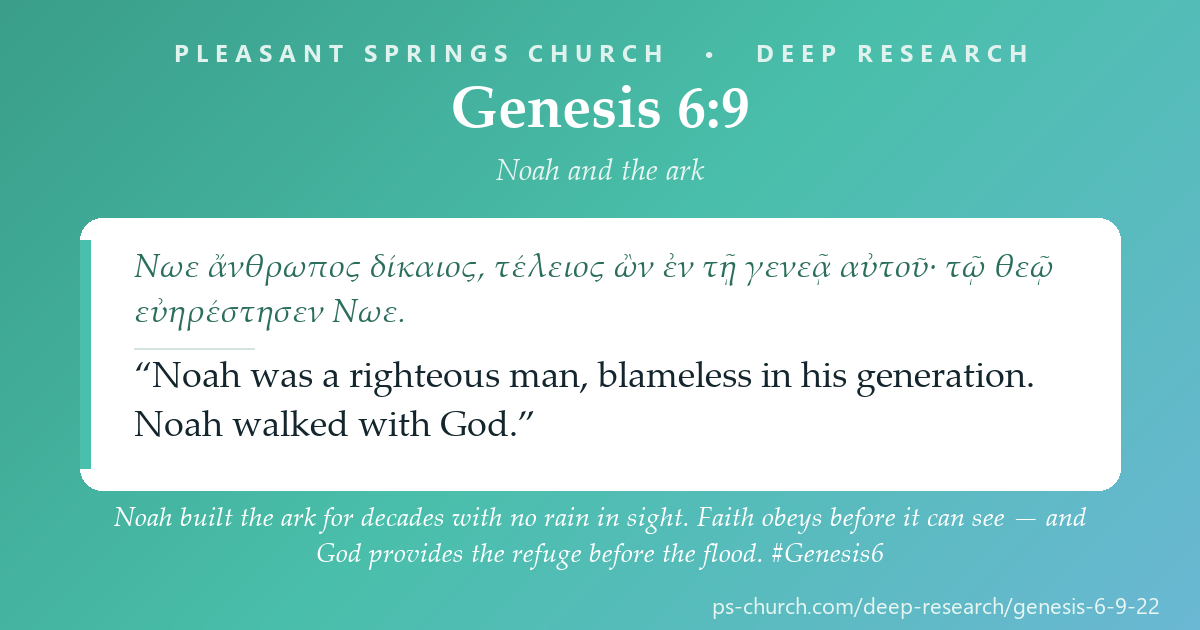
Genesis 6:9 · to share
LXX + ESVEvery Deep Research page traces its passage across the whole sweep — the Old Testament, the Second-Temple world between the testaments (historical witnesses, not Scripture), and the New Testament. Follow the thread:
Pleasant Springs Church — Deep Research
Research method after Michael S. Heiser’s Bible Research Method (examine dictionaries → ancient literature → important words → textual connections → academic publications → share), with the Pleasant Springs “Author & Audience” foundation. Scripture set in the Hebrew, the Greek editions named on each page and the ESV (Old Testament), and the Greek New Testament and the ESV (New Testament), per the practice of Pleasant Springs Church. Genesis 6:9–22 research grounded in Wenham, Hamilton, Sarna, Cassuto, Heidel, and Dumbrell; ANE flood parallels from the Atrahasis Epic and Gilgamesh XI; Second-Temple flood material per Jubilees 5 and 1 Enoch (read as witnesses, not Scripture).
Scripture quotations marked ESV are from the ESV® Bible (The Holy Bible, English Standard Version®), © 2001 by Crossway, a publishing ministry of Good News Publishers. ESV Text Edition: 2016. Used by permission. All rights reserved. The ESV text may not be quoted in any publication made available to the public by a Creative Commons license, and the ESV may not be translated in whole or in part into any other language. www.esv.org
|
Did this study bless you today? 💚 Give to Support PS Church100% of gifts go to the General Fund — thank you. |