In eight of the strangest verses in the Bible, “sons of God” take human wives, giants walk the earth, and God — grieved to his heart — resolves to judge a world gone wholly corrupt. Who were the sons of God? Who were the Nephilim? This study weighs the three great readings honestly, listens to how Jesus’ contemporaries heard it (the Watchers of 1 Enoch, echoed in 2 Peter and Jude), and keeps Christ — not the giants — at the center. See the method →
Genesis 6:1–8 (selections)
Hebrew · LXX · ESVThe Shape of the Passage
Parallel panelsSame Author and audience as Genesis 1:1 — and here Genesis gives its briefest, strangest, and most-debated scene: the prelude to the flood.
Author
The Torah of Moses compresses a vast, dark episode into eight verses to explain why the flood came: creation had corrupted itself to the root, “every intention… only evil continually” (6:5). The scene is bounded by grace — it ends “but Noah found favor” (6:8). The famous crux is verse 2: who are the “sons of God” (בְּנֵי הָאֱלֹהִים) who take wives, and who are the Nephilim?
Three readings. (1) Divine beings — members of the heavenly host who transgress the Creator’s order (elsewhere “sons of God” = divine council members, Job 1:6; 38:7). This is the oldest attested Jewish reading and the one the New Testament seems to reflect. (2) The line of Seth — the godly Sethites intermarrying with ungodly Cainites (Augustine and much later church tradition). (3) Dynastic rulers — tyrant-kings claiming divine status and seizing harems. Faithful readers hold different views; we lay them out below and let the whole canon weigh in.
Audience
Israel — heading toward a land whose inhabitants would be described in the very terms of this passage: the Nephilim / Anakim, before whom the spies felt like grasshoppers (Num 13:33). This scene tells them that the giants of Canaan are not invincible demigods but part of a corruption God has judged before and will judge again.
How they heard it. By the Second-Temple period the divine-beings reading was dominant, elaborated at length in the Book of the Watchers (1 Enoch 6–16). Whatever the exact identity, the point stands: a boundary was violated, corruption spread, and God — grieved to his heart (6:6) — moved to judge, while preserving a remnant of grace in Noah.
Orient on the sons of God, the Nephilim, and the divine council.
Search by topic: sons of God, Nephilim/giants, divine council, Watchers, flood.
Which articles are relevant?
- Anchor Bible Dictionary — “Sons of God,” “Nephilim,” “Giants,” “Divine Assembly.”
- Dictionary of Deities and Demons in the Bible (DDD) — “Sons of God,” “Watcher,” “Nephilim,” “Demons.”
- Dictionary of the OT: Pentateuch — “Sons of God,” “Nephilim,” “Flood.”
Bibliography surfaced:
- Wenham, Genesis 1–15 (WBC) — a careful survey of the three views; Hamilton (NICOT); Sarna (JPS).
- Michael Heiser, The Unseen Realm and Reversing Hermon — the divine-beings/Watchers reading and its NT echoes.
- Archie Wright, The Origin of Evil Spirits; Loren Stuckenbruck, The Myth of Rebellious Angels — the Watchers tradition.
The Watchers, the giants, and the Second-Temple reading — weighed, not swallowed.
The Second-Temple literature around this passage is vast. We read it to understand how Jesus’ contemporaries heard Genesis 6 — and we test every claim by the canon (Acts 17:11).
Which parallels shed light on religion and worldview?
The Watchers tradition. The Book of the Watchers (1 Enoch 6–16) expands Genesis 6 into a full narrative: two hundred heavenly “Watchers,” led by Shemihazah and Asael, descend on Mount Hermon, take human wives, father the violent giants, and teach humanity forbidden arts (weapons, sorcery, cosmetics). Their sin is a chief cause of the flood, and the origin of evil spirits. This was the standard Jewish reading of Genesis 6 in the centuries before Christ — and it shapes how the New Testament writers speak.
- 1 Enoch 6–16, the Book of the Watchers (Pseudepigrapha — a valued Second-Temple witness, not Scripture) — the fullest ancient elaboration of the divine-beings reading; among the oldest Enochic material, well attested at Qumran (Aramaic).
- The Book of Giants (Dead Sea Scrolls — a non-sectarian Enochic work, not Scripture) — on the giants born of the Watchers; shows the tradition’s reach across the caves.
- Jubilees 5:1–11 (Pseudepigrapha — likewise not Scripture) — retells Genesis 6 with the angelic descent and the binding of the Watchers.
- Mesopotamian apkallu traditions — antediluvian sage-figures and semi-divine heroes, a cultural backdrop to “the mighty men… of renown.”
The New Testament does not treat these stories as fable. 2 Peter 2:4 speaks of “angels who sinned” cast into chains of gloom, set right beside the flood; Jude 6 names “angels who did not stay within their own position of authority but left their proper dwelling” — language that fits the Watchers, not the line of Seth. And Jude 14–15 quotes 1 Enoch by name as prophecy. That does not make 1 Enoch Scripture — a New Testament writer can cite a non-canonical source truly (as Paul quotes pagan poets, Acts 17:28; Titus 1:12) — but it shows the apostles knew the tradition and read Genesis 6 in its light. Pleasant Springs affirms the reality of the unseen realm and reads this passage with that seriousness — while keeping Christ, not the giants, at the center, and holding our conclusions with the humility a hard text deserves.
The vocabulary of the crux — watched carefully, held humbly.
Watch the “sons of God” usage across the OT, the Nephilim/giants, the debated verb of v.3, and the grief of God.
“Sons of God” (LXX var. ἄγγελοι τοῦ θεοῦ) — elsewhere members of God’s heavenly court (Job 1:6; 2:1; 38:7; Ps 29:1 · LXX 28:1). Also read as Seth’s line or as royal tyrants.
“Nephilim” (LXX γίγαντες, “giants”) — likely from נָפַל (“fall”), the “fallen ones” or those who make others fall; reappear as the Anakim (Num 13:33).
“Mighty men / warriors” — “men of renown” (lit. “men of the name”): the celebrated heroes of the old world, echoing the apkallu-heroes of Mesopotamian legend.
“Shall not abide / strive” — a rare, debated verb. Either God’s Spirit will not remain in mortal flesh forever, or will not contend with it — a limit set on human life or a countdown to the flood.
“120 years” — read either as a new cap on the human lifespan, or as the grace-period before the flood falls (cf. 1 Pet 3:20, God’s patience “in the days of Noah”).
“And he was grieved” (to his heart) — God’s pain over human sin. Not weakness but holy sorrow; the flood is a grieved, not a casual, judgment.
How the New Testament reuses Genesis 6:
- 2 Peter 2:4–5 — “God did not spare angels when they sinned, but cast them into hell (ταρταρώσας) and committed them to chains of gloom” — placed immediately beside the flood: on the majority reading, the sin of Genesis 6 seen as angelic (though some refer it to an original angelic fall).
- Jude 6 — “angels who did not stay within their own position of authority, but left their proper dwelling” — kept in eternal chains for “the judgment of the great day.”
- Jude 14–15 — quotes 1 Enoch 1:9 as prophecy: evidence the apostles knew the Watchers tradition (though this does not make 1 Enoch canonical).
- 1 Peter 3:19–20 — Christ’s proclamation to “the spirits in prison… when God’s patience waited in the days of Noah”: often linked (debated) to the imprisoned Watchers.
From the giants of old to the judgment of the great day.
Trace “sons of God” and the Nephilim across the canon, and the flood-and-angels pairing into the NT — then note Beale & Carson at 2 Peter and Jude.
Which cross-references matter?
- Job 1:6; 2:1; 38:7; Psalm 29:1; 89:6–7 — “sons of God” as the heavenly council: the OT usage that most shapes the divine-beings reading of 6:2.
- Numbers 13:33; Deuteronomy 2:10–11; 3:11 — the Nephilim / Anakim / Rephaim of the conquest: the giants reappear, and are defeated.
- Genesis 6:5–8 → 6:9–22 — the corruption that brings the flood, and the grace that preserves Noah: this passage is the flood’s prologue.
- 2 Peter 2:4–10; Jude 6–7, 14–15 — the angels’ sin, the flood, and the coming judgment, read together by the apostles.
- Matthew 24:37–39 — “as were the days of Noah”: the pre-flood corruption as a type of the world before the Son of Man returns.
The commentary’s treatment of 2 Peter 2 and Jude shows both writers drawing on the Second-Temple reading of Genesis 6 — the sinning angels, the Watchers, the flood — to warn their churches that God judges rebellion, angelic or human, and rescues the righteous (Noah, Lot). The reassurance for the reader is not a fascination with giants but the same gospel this library keeps finding: God has always preserved a people of grace through judgment, and will do so at “the judgment of the great day” — through Christ, before whom every power in the unseen realm must bow (Phil 2:10; Col 2:15).
The scholarship on the sons of God and the Watchers.
Wenham for the three-views survey; Heiser for the divine-beings reading; Stuckenbruck and Wright for the Watchers tradition.
Commentaries & studies:
- Wenham, Genesis 1–15 (WBC) — balanced survey; Hamilton (NICOT); Sarna (JPS); von Rad.
- Michael Heiser, The Unseen Realm / Reversing Hermon — the divine-beings reading and its NT reception; Meredith Kline (the “dynastic rulers” view).
- Loren Stuckenbruck, The Myth of Rebellious Angels; Archie Wright, The Origin of Evil Spirits; George Nickelsburg, 1 Enoch 1 (Hermeneia).
Weighing the three views — notes worth keeping:
- Divine-beings view — strengths: the OT usage of “sons of God,” the LXX “angels” variant, the unanimous Second-Temple reading, and 2 Peter/Jude. It is the oldest and, many argue, the most contextual reading.
- Sethite view — strengths: it keeps the marriages human (avoiding angel-human offspring), fits the Seth/Cain contrast of chs. 4–5, and has deep church pedigree (Augustine). Weakness: “sons of God” is not used elsewhere of Seth’s line.
- Dynastic-rulers view — strengths: ancient kings did claim divine sonship and seize women; “fell” fits tyrants. Weakness: less direct lexical support.
- Held humbly. Godly interpreters differ; the passage’s point — boundary-breaking corruption, grievous to God, judged in the flood, survived by grace — is clear on every view.
From the days of Noah to today.
Name what you learned, why it matters, and one concrete response.
What should we carry away — and do?
- The unseen realm is real — and under Christ. Scripture takes the rebellion of spiritual powers seriously (2 Pet 2:4; Jude 6); so should we — without fear, because every such power is already defeated and disarmed at the cross (Col 2:15).
- God grieves over sin. The flood is not a tantrum; it is the act of a God “grieved to his heart” (6:6). Sin genuinely pains the One we sin against.
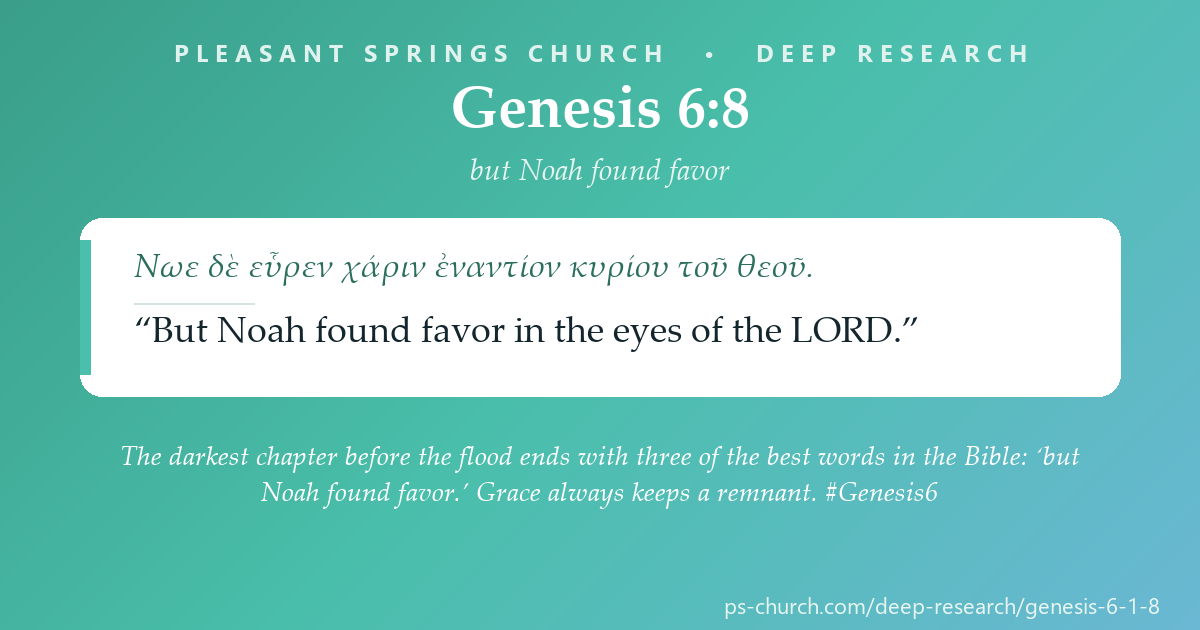
- Grace runs through judgment. The darkest chapter ends “but Noah found favor.” God has always kept a people of grace through the flood — and keeps one still (1 Pet 3:20–21).
Step in response: let a hard, strange passage teach humility — hold your view on the “sons of God” with charity toward those who differ — and rest in the settled fact the text drives at: whatever powers are loose in the world, Christ has already won, and grace still finds the Noahs.
Genesis 6:8 · to share
LXX + ESVEvery Deep Research page traces its passage across the whole sweep — the Old Testament, the Second-Temple world between the testaments (historical witnesses, not Scripture), and the New Testament. Follow the thread:
Pleasant Springs Church — Deep Research
Research method after Michael S. Heiser’s Bible Research Method (examine dictionaries → ancient literature → important words → textual connections → academic publications → share), with the Pleasant Springs “Author & Audience” foundation. Scripture set in the Hebrew, the Greek editions named on each page and the ESV (Old Testament), and the Greek New Testament and the ESV (New Testament), per the practice of Pleasant Springs Church. Genesis 6:1–8 research grounded in Wenham, Hamilton, Heiser, Stuckenbruck, Wright, and Nickelsburg; Second-Temple Watchers material per 1 Enoch 6–16, the Book of Giants, and Jubilees 5 (read as valued witnesses, not Scripture). Three interpretive views are presented; godly readers differ, and the passage is held with humility.
Scripture quotations marked ESV are from the ESV® Bible (The Holy Bible, English Standard Version®), © 2001 by Crossway, a publishing ministry of Good News Publishers. ESV Text Edition: 2016. Used by permission. All rights reserved. The ESV text may not be quoted in any publication made available to the public by a Creative Commons license, and the ESV may not be translated in whole or in part into any other language. www.esv.org
|
Did this study bless you today? 💚 Give to Support PS Church100% of gifts go to the General Fund — thank you. |