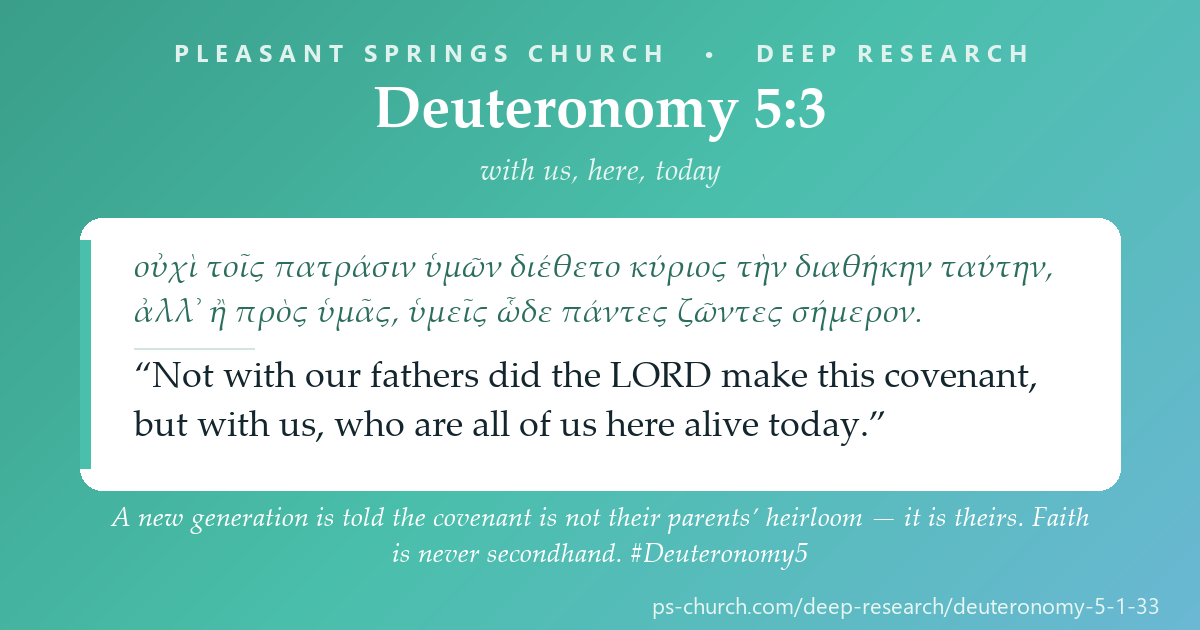
Forty years later, on the plains of Moab, Moses says the Ten Words again — and the saying of them is itself a sermon. He begins by collapsing the years: “Not with our fathers did the Lord make this covenant, but with us, who are all of us here alive today” (5:3). Then the Words, opening with a rescue already accomplished (5:6) — and one command visibly re-preached: where Exodus grounds the Sabbath in creation, Deuteronomy grounds it in redemption, “you shall remember that you were a slave in the land of Egypt” (5:15), and adds a clause Exodus does not have — that the servants may rest as well as you (5:14). Then the terror at the voice out of the fire, the mediator the people themselves request, and the ache in God’s own voice: “Oh that they had such a heart as this always” (5:29). This study works Deuteronomy 5:1–33 — law grounded in grace, rest as mercy for the powerless, and the tenderest verse about God’s desire in the Torah. See the method →
Deuteronomy 5:2–33 (selections)
Hebrew · LXX · ESVThe Shape of the Passage
InclusioDeuteronomy 5 is the second sermon’s foundation stone. Behind it lie the review of the wilderness years (chs 1–3) and the great appeal to what Israel heard without seeing at Horeb (ch 4). Ahead of it lie the purpose of the law and the Shema (ch 6, with 6:4–9 in its own study). The Words themselves were first given at Sinai in Exodus 20, out of the fire of Exodus 19.
Author
The Torah of Moses, and here Moses is unmistakably preaching. He does not simply reproduce the tablets; he introduces them, applies them, and then tells the story of the day they were given. The tell is in 5:3: “Not with our fathers did the Lord make this covenant, but with us, who are all of us here alive today.” Taken as bare chronology that is not quite right — most of that congregation had not stood at Horeb, only those who had been children then. Taken as preaching it is exactly right, and it is the engine of the whole book: the covenant is not an heirloom in the family archive but a bond that is being made with the people in front of him, now. Deuteronomy’s favourite adverb is today.
Repetition with variation. When Scripture repeats a speech, the changes carry the message — and the changes here are few and pointed. The Sabbath command is introduced with “observe” rather than “remember,” the Sabbath and the honour-of-parents commands (the fourth and fifth on the Jewish and Reformed count — see Stage 5 for the three traditions) each pick up “as the Lord your God commanded you” (5:12, 16) — a phrase Exodus 20 never uses, and one that only makes sense on the lips of someone quoting an earlier occasion — the ox and the donkey are named among those who rest, the servants are given a reason of their own, and the ground of the day shifts from creation to the exodus. None of that is a correction of Exodus. It is a pastor putting the same command where this congregation lives.
Audience
The second generation, on the plains of Moab. They are about to cross a river, take land, build houses, hire labour, and own servants of their own. That last fact is why the Sabbath is preached to them the way it is. A people who have never been slaves can hear “rest” as leisure; a people who were slaves, told to remember it, will hear something else — and will be far less able to work another human being to the bone on the seventh day. Deuteronomy 5:14 does not merely permit the servant’s rest; it makes the servant’s rest the point of the clause, and 5:15 supplies the reason: you were the servant once.
How they heard it. As terror turned into trust. Their parents had begged not to hear the voice again (5:25), and God did not scold them for it — “they are right in all that they have spoken” (5:28). He gave them a mediator, and then said the most tender sentence in the Torah: “Oh that they had such a heart as this always” (5:29). The commands that follow are not a ladder up to a God who is hard to please. They are the shape of life with a God who wants to be near, and whose only complaint is that his people do not stay as they were on the day they were afraid of him.
Orient on the Decalogue, Horeb, covenant renewal, Sabbath, and mediation.
Search by topic: Decalogue / Ten Commandments, Horeb and Sinai, covenant, Sabbath, rest, slavery and manumission in Israel, mediator, theophany, fear of God.
Which articles are relevant?
- Anchor Bible Dictionary — “Ten Commandments,” “Deuteronomy, Book of,” “Horeb,” “Covenant,” “Sabbath,” “Slavery (OT),” “Theophany.”
- Dictionary of the OT: Pentateuch — “Ten Commandments,” “Decalogue,” “Law,” “Sabbath,” “Rest,” “Preaching / Sermon (Deuteronomy),” “Prophets and Prophecy.”
- NIDOTTE / TDOT — דָּבָר (dāḇār, word), שָׁמַר (šāmar, keep/guard), זָכַר (zāḵar, remember), נוּחַ (nûaḥ, rest), קוֹל (qôl, voice), לֵבָב (lēḇāḇ, heart).
Bibliography surfaced:
- Peter C. Craigie (NICOT), Daniel I. Block (NIVAC), J. G. McConville (Apollos), Jeffrey H. Tigay (JPS), Duane Christensen (WBC), Moshe Weinfeld (Anchor) on Deuteronomy.
- Studies of the two Decalogue recensions (Exod 20 // Deut 5) and of the Sabbath commandment’s two motives.
- Meredith Kline, Treaty of the Great King; Weinfeld, Deuteronomy and the Deuteronomic School, on the covenant-treaty form.
Treaty, tablet, amulet and liturgy — how the Ten Words were carried.
Read the chapter against the ANE covenant documents it resembles, then follow the Decalogue through the oldest physical witnesses and the earliest Jewish worship, and let the New Testament set the terms.
Which parallels shed light on religion and worldview?
The covenant document. Ancient Near Eastern suzerain–vassal treaties follow a recognizable order: the great king names himself, recites what he has already done for the vassal, lays down stipulations, calls witnesses, and attaches blessings and curses. The Hittite treaty between Mursilis and Duppi-Tessub of Amurru (ANET 203–206, in the section of Egyptian and Hittite treaties beginning at ANET 199) is a textbook case, and the Neo-Assyrian Esarhaddon Succession Treaty shows the same furniture centuries later. Deuteronomy as a whole has that shape, and Deuteronomy 5 has it in miniature: self-identification and rescue (5:6), then stipulations (5:7–21). Kline and Weinfeld both made the observation; they drew opposite conclusions about the book’s date from it, and the treaty argument is in fact used on both sides of that debate. We report the shape and leave the dating question where the scholars have it.
The oldest copies we can hold. The Nash Papyrus (Egypt, c. 150–100 BC) carries the Decalogue followed immediately by the Shema — and its Decalogue is a blend, Exodus 20 with readings pulled in from Deuteronomy 5, with a preamble drawn from Deut 4:45 standing between the Ten and the Shema — a line the Septuagint also has in that spot. Its commands run adultery, murder, steal — the order of the Septuagint’s Deuteronomy 5, and the one echoed at Luke 18:20, Romans 13:9 and James 2:11. From Qumran, 4QDeutn (4Q41, the “All Souls Deuteronomy”) preserves Deut 5:1–6:1 with the Sabbath commandment expanded to carry both motives — Deuteronomy’s slavery and Exodus’s creation, folded into one text. Ancient scribes copying the two versions side by side plainly did not think they were rivals. And the phylactery and mezuzah slips from Qumran bind Deut 5 and 6 together with Exod 13 — the Words and the Shema worn on the body and nailed to the door.
Ten Words in worship. According to the Mishnah (Tamid 5:1) the priests in the Temple recited the Decalogue every morning alongside the Shema, before the daily offering — exactly the pairing the Nash Papyrus shows. The recitation was later dropped from the liturgy “because of the murmurings of the minim,” who were using the daily reading to argue that only these ten were spoken at Sinai. Even the withdrawal is a testimony to how central the Ten had become. Earlier still, the silver Ketef Hinnom amulets (Jerusalem, late 7th c. BC) carry the priestly blessing of Num 6:24–26 — the oldest biblical text yet found — and one of them adds a line whose covenant language (“those who love him and keep his commandments”) is the language of Deut 7:9, twin of Deut 5:10.
- Hittite suzerain–vassal treaty of Mursilis and Duppi-Tessub (ANET 203–206; the Egyptian–Hittite treaty section opens at ANET 199) — historical prologue, stipulations, divine witnesses: the documentary shape Deuteronomy wears.
- Esarhaddon Succession Treaty (VTE) (Neo-Assyrian, 672 BC; ANET, vassal-treaty section) — the same covenant form in the first millennium; the reason the treaty argument cannot by itself settle a date.
- Nash Papyrus (c. 150–100 BC, Cambridge) — Decalogue + Shema on one sheet, harmonized across Exodus and Deuteronomy, in the Septuagint’s order of commands.
- 4QDeutn (4Q41, “All Souls Deuteronomy”) (Dead Sea Scrolls — a witness, not Scripture) — Deut 5:1–6:1 with a Sabbath command that carries both the exodus motive and the creation motive together.
- Qumran phylacteries and mezuzot (4QPhyl, 4QMez) — Deut 5 and 6 bound with Exod 13: the Ten Words and the Shema worn and posted.
- Mishnah, Tamid 5:1; and the later note that the daily Decalogue was dropped “because of the murmurings of the minim” (rabbinic-era — witnesses, not Scripture).
- Ketef Hinnom silver amulets KH1–KH2 (late 7th c. BC) — Num 6:24–26, the oldest biblical text recovered; KH1 also echoes the covenant formula of Deut 7:9 // 5:10.
- Philo, On the Decalogue; Josephus, Antiquities 3.89–92 and 4.176–331 (Second-Temple — witnesses, not Scripture) — Philo divides the ten five-and-five across two tablets; Josephus summarizes the Ten at Sinai but declines to set them down word for word (3.90), and then gives Moses’ farewell address on the plains of Moab at length in book 4.
Set the two Sabbath commands side by side and the difference is unmistakable. Exodus: “for in six days the Lord made heaven and earth… therefore the Lord blessed the Sabbath day” (Exod 20:11). Deuteronomy: “you shall remember that you were a slave in the land of Egypt, and the Lord your God brought you out… therefore the Lord your God commanded you to keep the Sabbath day” (5:15). Creation in one, redemption in the other. That is not a seam to be explained away, and it is not an error. It is a preacher choosing his ground. To slaves newly out of Egypt, the Sabbath is God’s own rhythm written into the world. To their children, who are about to become employers, the same day is the memory of the whip — and so the command grows a clause it did not have before: the servant, the maid, the ox, the donkey and the immigrant inside your gates all stop working, “that your male servant and your female servant may rest as well as you” (5:14). It is a labour law whose warrant is not efficiency or public order but a memory: you were the servant once — and nothing in the older law collections of the ancient Near East grounds a worker’s rest that way. 4QDeutn shows an ancient scribe who simply wrote both reasons into one text, which is the right instinct. The Sabbath rests on what God made and on what God did.
Words rather than laws; guarding and remembering; rest, voice, and longing.
Watch haddəḇārîm (the Words), the swap of šāmôr for zāḵôr and where remember lands instead, the servant’s nûaḥ (rest), the sevenfold qôl, and God’s own mî-yittēn.
“The words” — not “the laws.” Deuteronomy calls them ʿăśereṯ haddəḇārîm, “the Ten Words” (4:13; 10:4) — hence Decalogue. The LXX has τὰ ῥήματα ταῦτα at 5:22, τὰ δέκα ῥήματα at 4:13, and τοὺς δέκα λόγους at 10:4 — the phrase from which “Decalogue” comes. A word is something a person speaks to another person; the Ten are covenant speech before they are legislation.
“Observe / guard” — Deuteronomy’s verb for the Sabbath, where Exodus 20:8 has zāḵôr, “remember” (LXX: φύλαξαι here, μνήσθητι there). The same root runs the chapter’s frame — “you shall be careful (šāmar) to do them” (5:1, 32). Later Jewish tradition would say that šāmôr and zāḵôr “were spoken in a single utterance” — a rabbinic way of refusing to pit the two texts against each other.
“And you shall remember” — the verb Exodus attaches to the day, Deuteronomy attaches to the slavery (LXX καὶ μνησθήσῃ). Nothing is lost; it is moved. It becomes one of the great Deuteronomic imperatives — remember, and do not forget (8:2, 11, 18; 15:15; 16:12; 24:18, 22) — and it is memory of grace, never of merit.
“May rest” (LXX ἵνα ἀναπαύσηται) — the purpose clause Exodus does not have: “that your male servant and your female servant may rest as well as you” (kāmôḵā, “like you”). The Sabbath is holy time and a protection for the people with the least power to protect themselves — including “the sojourner who is within your gates.”
“Voice / sound” (LXX φωνή) — the chapter’s Leitwort. It does not appear once in 5:1–21 and then falls seven times in 5:22–28: a great voice out of the fire, the voice they heard, the voice they cannot bear to hear again, the voice of a living God — and then, twice in one verse (5:28), God hears qôl diḇrêḵem, “the voice of your words,” and qôl diḇrê hāʿām hazzeh, “the voice of the words of this people” (ESV: “your words”… “the words of this people”). The listening runs both ways.
Literally “who will give?” — the Hebrew idiom of longing, rendered word-for-word by the LXX as τίς δώσει and by the ESV as “Oh that…” It is the syntax of a wish that the speaker does not simply reach out and take. On the lips of God, about the heart of his people, it is one of the most disarming sentences in the Torah.
How the New Testament takes up the Ten Words:
- Luke 18:20; Romans 13:9; James 2:11 — the second table quoted, in the Septuagint’s order (adultery before murder); Mark 10:19 has the same order in the Byzantine manuscripts but murder first in the critical text and the ESV. Paul then gathers it: “love your neighbor as yourself” (see Leviticus 19:18).
- Matthew 22:37–40 — Jesus joins Deut 6:5 to Lev 19:18 and hangs the Law and the Prophets on the pair — the two tables in two sentences (see Deuteronomy 6:4–9).
- Romans 7:7–8 — “I would not have known what it is to covet if the law had not said, ‘You shall not covet’”: the coveting command reaching past the hand to the heart.
- Ephesians 6:2–3 — “the first commandment with a promise,” quoted in the fuller form that includes “that it may go well with you” — a clause the Hebrew of Exod 20:12 does not have and Deut 5:16 does (the Greek of both carries it; cf. Ephesians 2:1–10 on grace before works).
- Hebrews 12:18–25 — the fire, the darkness, the tempest, and “a voice whose words made the hearers beg that no further messages be spoken to them”: Deuteronomy 5:22–27 read as the church’s own backdrop (see Hebrews 1:1–4 on God speaking at last by his Son).
From Horeb to the plains of Moab — and from the ache of 5:29 to the promise of a new heart.
Trace three threads: the two recensions of the Ten Words; the mediator the people themselves requested; and the heart God wished for and afterward promised to give.
Which cross-references matter?
- Exodus 19:1–25; 20:1–17; 24:12; 31:18 — the mountain, the Words, the two tablets of stone (see Exodus 19, Exodus 20, Exodus 31). Read the two Decalogues in parallel columns; the differences are few and every one of them preaches.
- Deuteronomy 4:9–20, 32–40 — “you heard the sound of words, but saw no form”: the theological ground of the prohibition of images, argued in the sermon just before this one (see Deuteronomy 4).
- Deuteronomy 18:15–19 — God’s answer to the request of 5:22–27, quoted back almost verbatim: “just as you desired of the Lord your God at Horeb… ‘Let me not hear again the voice of the Lord my God’… I will raise up for them a prophet like you” (see Deuteronomy 18:15–19).
- Deuteronomy 5:9–10; 24:16; Ezekiel 18:20; Jeremiah 31:29–30 — “visiting the iniquity of the fathers on the children” is covenant language about a household’s trajectory, not a verdict of inherited guilt: the same book forbids executing a son for his father’s sin (24:16), and the prophets retire the proverb outright (Ezek 18:20). Note also the asymmetry the verse itself builds in — iniquity to the third and fourth, steadfast love to thousands (5:10).
- Genesis 2:1–3; Exodus 20:11; Exodus 31:12–17 — the creation ground of the Sabbath, which Deuteronomy does not deny but does not repeat (see Genesis 2:1–3).
- Deuteronomy 15:12–15; 16:12; 24:17–22 — the same motive clause working through the rest of the book: release your servant, keep the feast, leave the gleanings, do justice for the sojourner and the widow, “you shall remember that you were a slave in Egypt” (cf. Leviticus 19).
- Jeremiah 31:31–34; Ezekiel 36:26–27 — “I will give you a new heart… and cause you to walk in my statutes”: the heart of Deut 5:29 promised outright (see Ezekiel 36:24–28).
- Hebrews 12:18–29; Romans 3:21–26 — the mountain that could not be touched, and the righteousness of God now revealed apart from the law (see Romans 3:21–26).
It is worth noticing who proposed the arrangement. God did not impose a middleman on a people who wanted direct access; the people, terrified by the voice, begged for one: “Go near and hear all that the Lord our God will say, and speak to us all that the Lord our God will speak to you, and we will hear and do it” (5:27). And God agreed — not grudgingly, but with approval: “They are right in all that they have spoken” (5:28). Deuteronomy 18:16 will quote this very request back and answer it with a promise: a prophet like you, from among their brothers. So the office of the mediator is not a concession to sin so much as a mercy fitted to creatures who cannot survive the unmediated voice — and the New Testament reads the promise as running through Moses to Christ. Hebrews takes up the same scene and says that the church has come, not to the mountain of fire and darkness and the voice they could not bear, but to Jesus, “the mediator of a new covenant” (Heb 12:24). The people at Horeb were right to be afraid, and right to ask. They were answered better than they knew.
The scholarship on the two Decalogues, the Sabbath motive, and the numbering traditions.
Craigie, Block, McConville, Tigay, Christensen and Weinfeld for Deuteronomy; Kline and Weinfeld for the treaty form; the standard treatments of the Decalogue’s reception.
Commentaries & studies:
- Peter C. Craigie, The Book of Deuteronomy (NICOT); Daniel I. Block, Deuteronomy (NIVAC); J. G. McConville, Deuteronomy (Apollos); Jeffrey H. Tigay, Deuteronomy (JPS); Duane L. Christensen, Deuteronomy 1:1–21:9 (WBC); Moshe Weinfeld, Deuteronomy 1–11 (Anchor).
- Studies of the two Decalogue recensions and of the Sabbath commandment’s two motives; the Nash Papyrus and 4QDeutn in the textual histories of the Decalogue.
- Meredith G. Kline, Treaty of the Great King; Moshe Weinfeld, Deuteronomy and the Deuteronomic School; Patrick D. Miller, The Ten Commandments.
Interpretation notes worth keeping:
- The numbering of the Ten differs, and no tradition is being sloppy. Jewish reckoning takes 5:6 (“I am the Lord your God, who brought you out”) as the first Word and joins “no other gods” and “no image” as the second. The Reformed, Anglican and Eastern Orthodox reckoning treats 5:6 as a preamble, makes “no other gods” the first and “no image” the second, and keeps all of 5:21 as the tenth. The Lutheran and Roman Catholic reckoning (following Augustine) joins “no other gods” with “no image” as the first and splits 5:21 into a ninth and a tenth. All three count ten; all three have the same text; each is answering a real question the text leaves open. Describe them; do not adjudicate them. One observation is worth adding without scoring a point: Deuteronomy 5:21 names the neighbour’s wife first and uses a different verb for her (חָמַד, ḥāmaḏ) than for the house and field (הִתְאַוָּה, hiṯʾawwāh), where Exod 20:17 puts the house first and repeats one verb. The Deuteronomic form is what makes a two-part tenth commandment natural.
- The Sabbath motive is a sermon, not a correction. Creation (Exod 20:11) and redemption (Deut 5:15) are two grounds for one command, and 4QDeutn shows an ancient scribe writing both. Preach the difference; do not manufacture a contradiction, and do not flatten it either — the redemption motive is what generates the mercy clause of 5:14.
- Deuteronomy 5:3 is rhetoric, and rhetoric is not falsehood. Moses knows perfectly well what has happened to the Horeb generation — 2:14–16 has just buried the men of war. And yet in the very next breath he says “The Lord spoke with you face to face” (5:4). Both sentences stand; the second explains the first. “Not with our fathers… but with us” is the preacher’s collapse of time, making the covenant present tense — the same move every faithful sermon makes with the same texts.
- 5:29 must not be tidied up. “Oh that they had such a heart as this always” expresses a genuine desire of God for the obedience and good of his people. Scripture does not here explain the relation between that desire and his sovereign purposes, and neither should we; the honest reading holds the ache as real and stops where the text stops. What Scripture does go on to say is that the heart God wished for he later promises to give (Jer 31:33; Ezek 36:26–27) — which is the gospel’s answer, and it is a gift, not an achievement.
- How Christians keep the fourth Word is genuinely debated. Evangelicals divide over whether the Sabbath command binds as a weekly day of rest transferred to the Lord’s Day, or is fulfilled in Christ as the substance to which the day pointed (Col 2:16–17; Heb 4:9–10). Both readings honour the text. What neither can dodge is 5:14–15: whatever else the day means, it means that the people who work for you are not machines, and that you know it because you remember being one.
From “not with our fathers, but with us” to “walk in all the way.”
Name what you learned, why it matters, and one concrete response.
What should we carry away — and do?
- The covenant is present tense. “Not with our fathers… but with us, who are all of us here alive today” (5:3). Inherited religion is a museum; today is where God makes covenants. Ask what you are keeping because your family kept it, and what you are keeping because you have heard him.
- Grace speaks first. The Ten Words begin with a rescue already accomplished (5:6). Nothing in the list buys the exodus; the whole list assumes it. Obedience is the shape of a freed life, never the price of freedom.
- Rest is a justice issue. Deuteronomy will not let the Sabbath be private piety: the servant, the maid, the animals and the immigrant stop too, “that they may rest as well as you” (5:14) — because “you were a slave” (5:15). Whoever works for you is on the list.
- God wanted to be heard. The people asked for distance and were not scolded for it — but listen to what he says when they are out of earshot: “Oh that they had such a heart as this always” (5:29). The God of the fire is not reluctant. He aches for us.
- The heart he wished for, he promised to give. Deuteronomy 5:29 is answered in Jeremiah 31 and Ezekiel 36 and given in Christ — a new heart, and the Spirit to walk in his statutes. What the law could not create in us, grace supplies.
Step in response: keep one full day this week the Deuteronomy way. Before it begins, write down two things: one rescue God has actually accomplished in your life (that is 5:15), and the name of one person whose work depends on you — an employee, a spouse, a volunteer, a child — who will also rest because you did (that is 5:14). Then read 5:29 out loud and let it land: this is what God says about you when you are not in the room.
Deuteronomy 5:29 · to share
LXX + ESVEvery Deep Research page traces its passage across the whole sweep — the Old Testament, the Second-Temple world between the testaments (historical witnesses, not Scripture), and the New Testament. Follow the thread:
Pleasant Springs Church — Deep Research
Research method after Michael S. Heiser’s Bible Research Method (examine dictionaries → ancient literature → important words → textual connections → academic publications → share), with the Pleasant Springs “Author & Audience” foundation. Scripture set in the Hebrew, the Greek editions named on each page and the ESV (Old Testament), and the Greek New Testament and the ESV (New Testament), per the practice of Pleasant Springs Church. Deuteronomy 5 research grounded in Craigie, Block, McConville, Tigay, Christensen and Weinfeld, with Kline and Weinfeld on the covenant-treaty form and Beale & Carson on the New Testament use; ANE background from the Hittite suzerain-vassal treaty of Mursilis and Duppi-Tessub (ANET 203–206) and the Neo-Assyrian Esarhaddon Succession Treaty; textual witnesses from the Nash Papyrus, 4QDeutⁿ (4Q41) and the Qumran phylacteries, with the Ketef Hinnom amulets and Mishnah Tamid 5:1 — all read as witnesses, not Scripture. Versification: Deuteronomy 1–11 carries no offset, so MT, Rahlfs’ LXX and the English agree at 5:1–33; but Rahlfs numbers the sixth to eighth Words in the Septuagint’s order (5:17 adultery, 5:18 murder, 5:19 steal), and Hebrew editions following the public-reading tradition group 5:17–21 into two verses and so run three behind from 5:22. The three great numbering traditions of the Ten (Jewish; Reformed/Anglican/Orthodox; Lutheran/Catholic) are described, not adjudicated; the two Sabbath motives are handled as preaching rather than contradiction; and 5:29 is allowed to stand as a real desire of God without being tidied into a system.
Scripture quotations marked ESV are from the ESV® Bible (The Holy Bible, English Standard Version®), © 2001 by Crossway, a publishing ministry of Good News Publishers. ESV Text Edition: 2016. Used by permission. All rights reserved. The ESV text may not be quoted in any publication made available to the public by a Creative Commons license, and the ESV may not be translated in whole or in part into any other language. www.esv.org
|
Did this study bless you today? 💚 Give to Support PS Church100% of gifts go to the General Fund — thank you. |