The tabernacle blueprint is finished off here and then sealed. The golden altar of incense burns before the veil — “a regular incense offering before the Lord,” the Bible’s own picture of prayer ascending (Ps 141:2 / LXX Ps 140:2; Rev 5:8). Every counted Israelite lays down the same half-shekel ransom — rich and poor alike, one price for every soul. Then Bezalel becomes the first person “filled with the Spirit of God” — and it is for art and skill. And over all the holy work God sets the Sabbath as the covenant sign: “that you may know that I, the Lord, sanctify you,” before handing Moses the tablets “written with the finger of God.” This study works Exodus 30:1–31:18. See the method →
Exodus 30:8, 15; 31:3, 13, 18
Hebrew · LXX · ESVThe Shape of the Passage
Sevenfold refrainSame Author and audience as Exodus 25 — the tabernacle instructions run to their close: the last furnishings, the workers who will build it, and the Sabbath seal set over the whole.
Author
The Torah of Moses here brings the tabernacle blueprint (chs. 25–31) to its finish and its seal. After the ark, table, lampstand, curtains, altar, court, priestly garments, and ordination, four last things are commanded: the golden altar of incense before the veil (30:1–10); the census ransom, a half-shekel of “atonement money” from every counted man (30:11–16); the bronze laver for the priests’ washing (30:17–21); and the recipes for the holy anointing oil and the sacred incense — holy to the Lord, and forbidden to be imitated for common use (30:22–38). Only then does the Lord name the builders (31:1–11) and set the Sabbath as the covenant sign over all this holy work (31:12–17), before handing Moses “the two tablets of the testimony… written with the finger of God” (31:18).
Prayer, ransom, washing, holiness. These four final commands are not random. The incense altar makes worship fragrant and continual — “a regular incense offering before the Lord” morning and evening (30:8), which Scripture itself reads as prayer (Ps 141:2 / LXX Ps 140:2; Luke 1:10; Rev 5:8). The ransom teaches that every life is owed and every life is the same: the same half-shekel for rich and poor, “to make atonement for your lives” (30:15). The laver teaches that no one draws near to serve unwashed (30:20). And the holy oil and incense, on pain of being “cut off,” teach that worship is God-patterned, not self-invented — its very fragrance may not be counterfeited (30:32–33, 37–38).
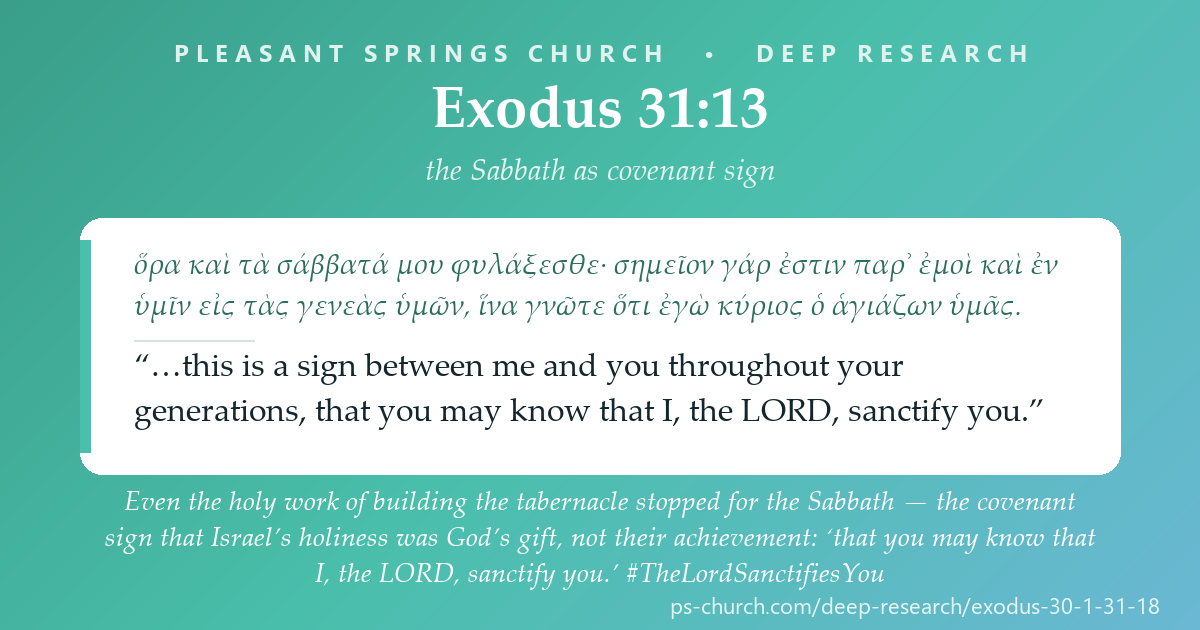
The Spirit for skill; the Sabbath over the work. Two theological surprises crown the section. First, the first man ever said to be “filled with the Spirit of God” is not a prophet or king but a craftsman, Bezalel, gifted “with ability and intelligence, with knowledge and all craftsmanship” (31:3) — the Spirit endowing art for God’s dwelling. Second, over the whole enterprise of holy building God sets the Sabbath as the covenant sign: even this sacred work stops on the seventh day, for the sign is not what Israel builds but what God gives — “that you may know that I, the Lord, sanctify you” (31:13). The tablets “written with the finger of God” (31:18) close the mountain speech — and set the stage, in dark irony, for the golden calf below (ch. 32).
Audience
Israel — the redeemed people at Sinai, being taught how a holy God is to be approached. Every detail carried assurance and awe. There is a place where prayer rises before God continually. There is a ransom that levels every worshiper: the merchant and the day-laborer lay down the identical coin, for no soul is worth more or purchased for less. There is water for the unclean hands that would serve. And there is a rhythm of rest woven into the covenant itself — a weekly sign that Israel’s holiness is a gift, the work of the sanctifying Lord, not the achievement of their own hands (31:13).
The dignity of skilled work, and worship not self-invented. For the church, this passage guards two truths at once. Read soberly, the Spirit’s filling of Bezalel is not regeneration but endowment for skill — yet it dignifies craftsmanship, artistry, and honest labor as fit vessels for God’s glory: the Spirit gifts not only prophecy but beauty and competence in the service of worship. And the guarded oil and incense, with the Sabbath sign, together insist that worship is God-initiated and God-patterned — the exact opposite of the self-willed worship Israel is about to invent at the foot of the mountain (32:1–6). The incense that rises, the ransom that redeems, the washing that cleanses, the rest that sanctifies — each, held as the devotional-typological analogy Scripture itself draws, whispers of the greater High Priest whose intercession never ceases (Heb 7:25), the one ransom paid “not with… silver or gold… but with the precious blood of Christ” (1 Pet 1:18–19), the washing of regeneration (Titus 3:5), and the Sabbath rest that remains for the people of God (Heb 4:9–10).
Orient on the incense altar, the census ransom, the laver, anointing oil, and the Sabbath.
Search by topic: altar of incense, incense, atonement money / half shekel, ransom, laver / basin, anointing oil, Bezalel, Sabbath, sign, holiness.
Which articles are relevant?
- Anchor Bible Dictionary — “Altar,” “Incense,” “Money / Weights,” “Ransom,” “Sabbath,” “Anointing.”
- Dictionary of the OT: Pentateuch — “Tabernacle,” “Sacred Space,” “Priests and Levites,” “Sabbath,” “Atonement,” “Holiness.”
- NIDOTTE / TDOT — קְטֹרֶת (qĕṭōreṯ, incense), כֹּפֶר (kōp̄er, ransom), כִּפֶּר (kipper, atone), רוּחַ (rûaḥ, spirit), אוֹת (’ôṯ, sign), קדשׁ (qdš, holy / sanctify).
Bibliography surfaced:
- Childs (OTL), Durham (WBC), Stuart (NAC), Sarna (JPS) on Exodus.
- G. K. Beale, The Temple and the Church’s Mission; T. D. Alexander, From Eden to the New Jerusalem; Menahem Haran, Temples and Temple-Service in Ancient Israel.
- Studies of Sabbath in the Pentateuch (the sign-covenant of 31:12–17; cf. Gen 2:1–3) and of incense and prayer in the Old Testament and Second Temple period.
Incense and the gods, the census that could kill, and a rest woven into a covenant.
Read the incense altar, the ransom, and the Sabbath sign against ancient temple custom, and note how Second-Temple writers and the New Testament expound them.
Which parallels shed light on religion and worldview?
Incense in the ancient world. Fragrant smoke rose in every ancient sanctuary — Egyptian, Mesopotamian, Canaanite — often conceived as food or pleasure for the gods. Israel’s incense altar shares the craft (a compounded, salted, fragrant blend, 30:34–35) but bends it to a wholly different theology: the God of Israel needs nothing (Ps 50:12–13), and the rising smoke is read not as his dinner but as the ascent of prayer — “Let my prayer be counted as incense before you” (Ps 141:2 / LXX Ps 140:2). The blend is guarded: to make it for common use is to be “cut off” (30:37–38). Holiness is not a fragrance to be bottled and sold; worship belongs to God on God’s terms.
The census that could kill. To the ancient (and biblical) mind, numbering a people was dangerous — an act of ownership and pride that could provoke wrath (so David’s census brings plague, 2 Sam 24). Exodus 30:12 meets this head-on: whenever Israel is counted, “each shall give a ransom (כֹּפֶר) for his life… that there be no plague among them.” The genius of the law is its equality: the same half-shekel from every man, rich or poor (30:15). Before God, no life is priced higher and none is redeemed for less; the atonement money confesses that every counted head is a forfeited life, bought back at one fixed price. The silver, tradition and text suggest, went to the service of the sanctuary (30:16; cf. 38:25–28) — redemption money built the place of meeting.
How the section was read. Second-Temple writers dwelt on these details. Josephus (Antiquities 3.143–150, 197–198) describes the incense altar and the compounding of the thirteen spices; Philo (Life of Moses 2.101–108) allegorizes the incense as thanksgiving rising from all creation. Sirach praises Aaron’s priestly ministry of “a pleasing odor” (Sir 45:16). The book of Jubilees (2:17–33) makes the Sabbath the sign given first in heaven and then to Israel — the era’s intense meditation on the seventh day. Their expansions can overreach, but they witness an old and right instinct the New Testament shares: incense means prayer (Rev 5:8; 8:3–4), and the Sabbath means rest in the sanctifying God (Heb 4:9–10).
- Josephus, Antiquities 3.143–198; Philo, Life of Moses 2.101–108; Sirach 45:6–22; Jubilees 2:17–33 — Second-Temple expositions of the incense, the priesthood, and the Sabbath (witnesses to interpretation, not Scripture).
- Genesis 2:1–3 — the seventh-day rest built into creation, now made Israel’s covenant sign (31:17).
- 2 Samuel 24:1–15; Numbers 1–4 — the danger of the census and the ransom that guards it; the counted people redeemed.
Of all the tabernacle’s furniture, the altar of incense is the one Scripture most openly interprets for us. It stood just before the veil, nearest the ark, and on it Aaron burned fragrant smoke ‘every morning’ and again ‘at twilight,’ so that a sweet cloud rose before God without ceasing — ‘a regular incense offering before the Lord throughout your generations’ (30:8). What did it mean? The Psalter answers plainly: ‘Let my prayer be counted as incense before you, and the lifting up of my hands as the evening sacrifice’ (Ps 141:2 / LXX Ps 140:2). By Luke’s day the connection was fixed in Israel’s worship: ‘the whole multitude of the people were praying outside at the hour of incense’ (Luke 1:10). And the Revelation seals it, held here as the New Testament’s own reading and not devotional embroidery: the golden bowls of incense ‘are the prayers of the saints’ (Rev 5:8), and an angel offers much incense ‘with the prayers of all the saints’ so that the smoke rises before God (Rev 8:3–4). Read as the analogy Scripture itself draws, the altar preaches a tender gospel: the prayers of ordinary, struggling believers are received in heaven like fragrant smoke — continual, welcome, dear to God — because they ascend through a great High Priest who ‘always lives to make intercession’ for us (Heb 7:25). The fire on that little golden altar never went out; neither does his prayer for you.
The vocabulary of the finish: incense, ransom, washing, the Spirit for skill, and the sign.
Watch the rising incense, the equal ransom, the laver’s washing, the Spirit-gift for craftsmanship, and the Sabbath sign of the sanctifying Lord.
“Incense” — fragrant smoke rising from the golden altar, morning and twilight. LXX θυμίαμα. Scripture reads it as prayer ascending (Ps 141:2 / LXX Ps 140:2; Luke 1:10; Rev 5:8; 8:3–4). The blend is holy, not to be copied for common use (30:37–38).
“Ransom” — the price that buys back a forfeited life (root כפר, to cover / atone). “Each shall give a ransom for his life… that there be no plague” (30:12). The New Testament’s own word for Christ’s work (Mark 10:45; 1 Tim 2:6).
“Half shekel” — the fixed atonement money: “the rich shall not give more, and the poor shall not give less” (30:15). LXX “half of the δίδραχμον.” One price for every soul; no life valued above another.
“Laver” / basin — the bronze stand of water where Aaron and his sons wash hands and feet before serving, “so that they may not die” (30:20). None draws near to minister unwashed (cf. Heb 10:22; Titus 3:5).
“Spirit of God” — Bezalel is the first person Scripture says is “filled” with it, and it is for skill: “ability… intelligence… knowledge and all craftsmanship.” Not regeneration but endowment for art in God’s service. LXX πνεῦμα θεῖον, “a divine spirit.”
“Sign” — the Sabbath as covenant marker between the Lord and Israel (like the rainbow, Gen 9:12; circumcision, 17:11). It points not to what Israel achieves but to the God “who sanctifies you” (מְקַדִּשְׁכֶם, 31:13).
How the New Testament takes these up:
- Revelation 5:8; 8:3–4; Luke 1:10; Psalm 141:2 (LXX Ps 140:2) — the incense as the prayers of the saints, rising before God; Christ our intercessor (Heb 7:25; see the great High Priest).
- Mark 10:45; Matthew 20:28; 1 Timothy 2:6; 1 Peter 1:18–19 — the one ransom: not silver or gold, but the precious blood of Christ, “a ransom for many” (cf. the propitiation).
- Titus 3:5; Ephesians 5:26; Hebrews 10:22 — the washing of regeneration; drawing near with bodies washed — the laver’s fulfillment.
- Mark 2:27–28; Hebrews 4:9–10; Colossians 2:16–17 — the Lord of the Sabbath; the rest that remains; the sign whose substance is Christ.
From the golden altar to the prayers of the saints; from the half-shekel to the one ransom.
Trace the incense, the ransom, the washing, the Spirit-gift, and the Sabbath sign across the canon.
Which cross-references matter?
- Exodus 25:1–40; 27:20–21; 40:34–38 — the blueprint of the dwelling; the lamps Aaron tends alongside the incense (30:7–8); the glory that fills the finished tent (see the tabernacle and the glory fills the tabernacle).
- Exodus 35:1–40:38 — the construction: the Sabbath charge repeated first (35:1–3), Bezalel and Oholiab named again (35:30–35), and the work done “as the Lord commanded” (see the tabernacle built).
- Leviticus 16:12–13 — on the Day of Atonement the high priest brings the incense within the veil, its cloud covering the mercy seat “so that he does not die” (see the Day of Atonement).
- Exodus 20:8–11; Genesis 2:1–3 — the Sabbath command and the creation rest behind the covenant sign (see the Ten Words).
- Exodus 32:1–6 — the tablets “written with the finger of God” (31:18) set against the calf Israel makes below: God-patterned worship versus self-willed worship (see the golden calf).
There is a quiet astonishment in the ransom law that is easy to miss. When Israel is counted, every man from twenty years old must pay atonement money for his life — and the amount is fixed: half a shekel, no more, no less. ‘The rich shall not give more, and the poor shall not give less, than the half shekel, when you give the Lord’s offering to make atonement for your lives’ (30:15). In a world that measured a person by his wealth, God levels every soul at the sanctuary door. The reason is not economics but theology: the ransom is not a gift scaled to your means, it is the price of a life — and a life is a life, the merchant’s no dearer to God and no cheaper than the beggar’s. Every counted head confessed the same debt and was bought back at the same fixed cost. Held as the analogy the New Testament itself makes, the half-shekel looks straight down the corridor of Scripture to the one price paid for all: ‘you were ransomed… not with perishable things such as silver or gold… but with the precious blood of Christ’ (1 Pet 1:18–19) — the Son of Man who came ‘to give his life as a ransom for many’ (Mark 10:45). At the cross the leveling is complete: there is no first-class redemption and no discount rate; every soul that is saved is bought back at exactly the same infinite price. The half-shekel taught Israel to hold the beggar and the prince as equals before God; Calvary teaches the church the same, and forever.
The scholarship on Exodus 30–31.
The commentators on the tabernacle’s finish; the studies of incense and prayer, the census ransom, Spirit-endowment for skill, and the Sabbath covenant sign.
Commentaries & studies:
- Brevard Childs (OTL), John Durham (WBC), Douglas Stuart (NAC), Nahum Sarna (JPS) on Exodus.
- G. K. Beale, The Temple and the Church’s Mission; T. Desmond Alexander, From Eden to the New Jerusalem; studies of Sabbath (the sign-covenant of 31:12–17) and of incense / prayer across the canon.
- Beale & Carson, Commentary on the NT Use of the OT (Rev 5:8; 8:3–4; Heb 4; 1 Pet 1:18–19).
Interpretation notes worth keeping:
- “Filled with the Spirit of God” (31:3). The first such filling in Scripture, and it is for craftsmanship — Spirit-endowment for skill, not a description of regeneration. Read soberly it dignifies art and skilled labor in worship; it does not license reading every gifted worker as regenerate. The LXX’s πνεῦμα θεῖον (“a divine spirit”) sharpens the point toward endowed wisdom and skill.
- The census ransom (30:11–16). A kōp̄er guarding the counted people from plague, equal for rich and poor; the silver funds the sanctuary (38:25–28). A genuine, load-bearing atonement motif, echoed at Mark 10:45; 1 Tim 2:6; 1 Pet 1:18–19 — the type is the canon’s own.
- The Sabbath as sign (31:12–17). The Sabbath is set as the ’ôṯ of the covenant, grounded in creation’s rest (31:17; Gen 2:1–3). Its abiding weight for the church is debated (Rom 14:5; Col 2:16–17; Heb 4:9–10); handle it soberly — the sign’s deepest note is that holiness is God’s gift: “I, the Lord, sanctify you.”
- Devotional typology, disciplined. Incense→prayer (Rev 5:8), ransom→the blood of Christ (1 Pet 1:18–19), laver→washing (Titus 3:5), Sabbath→rest in Christ (Heb 4) are rich and well-grounded in the New Testament’s own readings — held as canon-trajectory and analogy, not allegory read into every spice and pole. The house discipline for typology throughout this library.
From incense and a fixed ransom to the rest of the sanctifying Lord.
Name what you learned, why it matters, and one concrete response.
What should we carry away — and do?
- Your prayers rise like incense. The little golden altar burned day and night — and the Revelation says the incense “is the prayers of the saints” (Rev 5:8). Struggling, ordinary prayer is welcome in heaven, carried by a High Priest who never stops interceding (Heb 7:25).
- One ransom, one price, for every soul. Rich and poor laid down the same half-shekel; at the cross the leveling is final — not silver or gold, but the precious blood of Christ (1 Pet 1:18–19). No one is redeemed for more, and no one for less.
- Skill is a gift for worship. The first Spirit-filling in the Bible made a man a better craftsman (31:3). Your competence, your art, your honest work can be laid on the altar — the Spirit dignifies skilled hands in the service of God.
- Rest is a sign of grace. Even the holy work stopped on the Sabbath, “that you may know that I, the Lord, sanctify you” (31:13). Your holiness is God’s gift, not your achievement; there remains a rest for the people of God (Heb 4:9).
Step in response: this week, light one habit of “incense” — a fixed morning-and-evening moment of prayer, offered in confidence through Christ our intercessor. Give one gift to God’s work not scaled to impress but simply because your life was ransomed. Offer some real skill of your hands in the service of worship. And keep one deliberate rest — a stopping that confesses your holiness is not your doing but the gift of the Lord who sanctifies you.
Exodus 31:13 · to share
LXX + ESVEvery Deep Research page traces its passage across the whole sweep — the Old Testament, the Second-Temple world between the testaments (historical witnesses, not Scripture), and the New Testament. Follow the thread:
Pleasant Springs Church — Deep Research
Research method after Michael S. Heiser’s Bible Research Method (examine dictionaries → ancient literature → important words → textual connections → academic publications → share), with the Pleasant Springs “Author & Audience” foundation. Scripture set in the Hebrew, the Greek editions named on each page and the ESV (Old Testament), and the Greek New Testament and the ESV (New Testament), per the practice of Pleasant Springs Church. Exodus 30:1–31:18 research grounded in Childs, Durham, Stuart, and Sarna, with Beale (The Temple and the Church’s Mission) and Alexander (From Eden to the New Jerusalem); the incense read as prayer per Scripture’s own reading (Ps 141:2 / LXX Ps 140:2; Luke 1:10; Rev 5:8; 8:3–4); the equal half-shekel kōp̄er (30:11–16) as an atonement / ransom motif echoed at Mark 10:45; 1 Pet 1:18–19; the Spirit’s filling of Bezalel (31:3; LXX πνεῦμα θεῖον) held soberly as endowment for skill, not regeneration; the Sabbath as the covenant ’ôṯ grounded in creation’s rest (31:17; Gen 2:1–3) with its abiding weight held per Rom 14:5; Col 2:16–17; Heb 4:9–10; Second-Temple exposition per Josephus (Antiquities 3), Philo (Life of Moses 2), Sirach 45, and Jubilees 2 read as witnesses, not Scripture; and the incense→prayer, ransom→blood, laver→washing, Sabbath→rest lines held as the canon’s own devotional-typological trajectory, per the house discipline for typology.
Scripture quotations marked ESV are from the ESV® Bible (The Holy Bible, English Standard Version®), © 2001 by Crossway, a publishing ministry of Good News Publishers. ESV Text Edition: 2016. Used by permission. All rights reserved. The ESV text may not be quoted in any publication made available to the public by a Creative Commons license, and the ESV may not be translated in whole or in part into any other language. www.esv.org
|
Did this study bless you today? 💚 Give to Support PS Church100% of gifts go to the General Fund — thank you. |