The covenant is sealed in blood, and Moses has climbed into the glory-cloud — and there God draws the plans for the most astonishing thing in Exodus: a house, so that the holy God may dwell in the midst of a redeemed people. It begins with a freewill gift “from every man whose heart moves him,” and it centers on the ark and its golden mercy seat — the blood-sprinkled throne where God meets sinners, the very word (ἱλαστήριον) Paul will use of Christ. Built “according to the pattern shown on the mountain,” the tabernacle is a copy of a heavenly reality. This study works Exodus 25:1–40. See the method →
Exodus 25:2, 8, 9, 22, 40
Hebrew · LXX · ESVThe Shape of the Passage
InclusioSame Author and audience as Exodus 20 — but now the God who gave the law prepares to move in: the covenant sealed (ch. 24), he draws the plans for his dwelling.
Author
The Torah of Moses turns, at ch. 25, from law to sanctuary. It is no accident of arrangement. Sinai’s covenant has just been ratified in blood (24:8); Moses has gone up into the glory-cloud (24:15–18); and there, on the mountain, the Lord gives a blueprint. The whole second half of Exodus (chs. 25–40) is given to it — a striking allocation of narrative space that tells us how much this matters: the point of the exodus was not merely to get Israel out of Egypt but to bring God in, to dwell in their midst (29:45–46). The plans begin, tellingly, not with walls but with a gift: a terumah, a freewill contribution “from every man whose heart moves him” (25:2). God’s house is built of willing hearts.
From the inside out. The instructions proceed from the Most Holy Place outward — first the ark (25:10–22): acacia wood overlaid with gold, the Testimony (the tablets) inside, and over it the kapporet, the golden mercy seat, with two cherubim of hammered gold facing each other, wings overshadowing. This is the throne of the invisible King, “enthroned on the cherubim” (1 Sam 4:4; Ps 80:1) — and it is the place of meeting and atonement: “there I will meet with you, and from above the mercy seat… I will speak with you” (25:22). Then the table of the bread of the Presence (25:23–30), and the golden lampstand (menorah, 25:31–40) — a tree of light worked in almond blossoms, seven lamps burning before the Lord.
Pattern and copy. Twice Moses is charged to build strictly “according to the pattern (tabnit) shown you on the mountain” (25:9, 40). The earthly tent is a copy of a heavenly reality — the point Hebrews will press: the priests “serve a copy and shadow of the heavenly things” (Heb 8:5, quoting 25:40). The tabernacle is theology in gold and wood and cloth: a portable Sinai, a movable Eden, God’s dwelling carried at the center of the camp.
Audience
Israel — a freed-slave people, camped at Sinai, learning that their God intends not to visit but to reside. Every detail carried assurance and awe: the King has a throne (the mercy seat) in their midst, a table set in his house, a lamp always burning. The terumah gave every household a share in it — gold, silver, bronze, yarn, skins, oil, gems — the plunder of Egypt (12:35–36) now returned as worship. To build the tabernacle was to answer grace with glad generosity.
The goal of the whole story. For the church, Exodus 25 opens the Bible’s great thread of God dwelling with his people. Read as devotional-typological arc — the shape Scripture itself traces — the line runs from Eden (where God walked with man) through this tabernacle and the temple, to the Word who “became flesh and dwelt (ἐσκήνωσεν, tabernacled) among us” (John 1:14), to the church as God’s temple (1 Cor 3:16), to the New Jerusalem where at last “the dwelling place of God is with man” (Rev 21:3). And the mercy seat — the blood-sprinkled throne where a holy God meets sinners — is the exact word (ἱλαστήριον) Paul reaches for when he says God “put forward” Christ “as a propitiation by his blood” (Rom 3:25). The tabernacle is God’s own initiative to be with us; its every furnishing whispers of the greater meeting-place to come.
Orient on the tabernacle, ark, mercy seat, cherubim, and lampstand.
Search by topic: tabernacle, ark of the covenant, mercy seat / atonement cover, cherubim, lampstand / menorah, sanctuary, pattern, glory / Shekinah.
Which articles are relevant?
- Anchor Bible Dictionary — “Tabernacle,” “Ark of the Covenant,” “Mercy Seat,” “Cherubim,” “Lampstand.”
- Dictionary of the OT: Pentateuch — “Tabernacle,” “Ark of the Covenant,” “Sacred Space,” “Presence of God,” “Priests and Levites.”
- NIDOTTE / TDOT — מִשְׁכָּן (mishkān, dwelling), שָׁכַן (shākan, dwell), מִקְדָּשׁ (miqdāsh, sanctuary), כַּפֹּרֶת (kappōreṯ, mercy seat), תַּבְנִית (taḇnîṯ, pattern).
Bibliography surfaced:
- Childs (OTL), Durham (WBC), Stuart (NAC), Sarna (JPS) on Exodus.
- G. K. Beale, The Temple and the Church’s Mission; T. D. Alexander, From Eden to the New Jerusalem.
- Menahem Haran, Temples and Temple-Service in Ancient Israel; Frank M. Cross on the tent of meeting.
Portable shrines, the pattern-and-copy motif, and a God who tents with his people.
Read the tabernacle against ancient sanctuary custom, and note how Second-Temple writers and the New Testament expound the tent and its mercy seat.
Which parallels shed light on religion and worldview?
The portable sanctuary. Tent-shrines and portable divine dwellings were known across the ancient Near East — Egyptian processional shrines and gilded acacia furniture (compare Tutankhamun’s gold-overlaid chests carried on poles), and West-Semitic tent-shrines. Israel’s tabernacle shares the craft of its age — acacia and gold, curtains and cherubim — and bends it all to a singular claim: this tent houses no image, for its God cannot be imaged (20:4). The empty space above the mercy seat, guarded by cherubim, is the throne of an unseen King — a deliberate counter to every idol-shrine around it.
Pattern and copy. The charge to build “according to the tabnit shown you on the mountain” (25:9, 40) belongs to an ancient idea — that a true temple corresponds to a heavenly archetype. Scripture takes it up soberly: the tent is a “copy and shadow” of the heavenly reality (Heb 8:5), not the reality itself. The cherubim recall Eden’s guardians at the gate of the garden (Gen 3:24): the way back to God’s presence, once barred, is now — carefully, through blood and mediation — reopened at the mercy seat.
How the tabernacle was read. Second-Temple writers lingered over it. Josephus (Antiquities 3.122–133, 179–187) and Philo (Life of Moses 2.71–145) both expound the tent, its furniture, and the high priest’s vestments as a symbolic cosmos — the lampstand for the heavenly lights, the twelve loaves for the year, the veil for the elements. Their cosmic allegory can be overpressed, but it witnesses to an old instinct the New Testament shares: the sanctuary is a microcosm, heaven and earth meeting in one tent. The church, however, reads its center not as astronomy but as atonement — the blood-sprinkled throne where God meets sinners (Lev 16; Heb 9).
- Josephus, Antiquities 3.122–187; Philo, Life of Moses 2.71–145 — first-century Jewish expositions of the tabernacle and its furnishings (witnesses to interpretation, not Scripture).
- Genesis 2–3 — Eden as the first sanctuary; the cherubim guarding the way (3:24) reappear over the ark (25:18–22).
- Egyptian and West-Semitic tent-shrines — gilded acacia furniture borne on poles; the craft of the age turned to the worship of the unseen God.
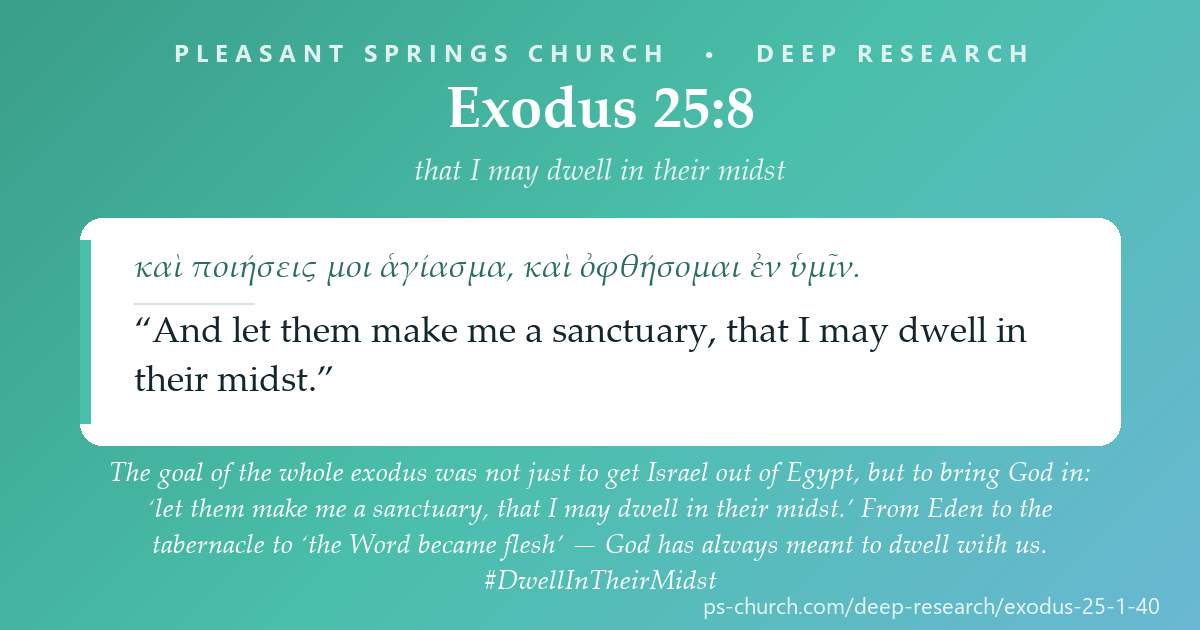
The single most astonishing sentence in the chapter is its purpose clause: ‘let them make me a sanctuary, that I may dwell in their midst’ (25:8). The God who had just filled the mountain with fire and forbidden the people to touch its base now announces that he will pitch his tent in the middle of the camp — not on the summit, not at a safe distance, but at the center of their daily life, his glory-cloud over the tent, his throne between the cherubim. This is the goal toward which the whole exodus has been driving: not merely a redeemed people, but a redeemed people indwelt. Held as the devotional-typological arc Scripture itself lays down, the thread is unmistakable and glorious: Eden, where God walked with man; the tabernacle, where he tented in the camp; the temple, where his glory filled the house; and then the Word who ‘became flesh and tabernacled among us, and we have seen his glory’ (John 1:14) — the true sanctuary in a human body (John 2:19–21); and the church, ‘God’s temple,’ his Spirit dwelling in her (1 Cor 3:16; Eph 2:22); until the vision closes where it began, the dwelling of God with man, no temple needed for ‘the Lord God the Almighty and the Lamb are its temple’ (Rev 21:3, 22). Exodus 25 is the hinge of that story: the moment the holy God says he will come down and stay.
The vocabulary of the dwelling: sanctuary, the mercy seat, and the pattern.
Watch the willing gift, the God who comes to dwell, the atonement-cover throne, and the heavenly pattern behind the copy.
“Sanctuary” — a holy place, set apart for God (root קדשׁ, “holy”). LXX ἁγίασμα. Not a shrine Israel builds to reach up to God, but the house God plans so he may come down to them.
“Dwell” / “dwelling” — the same root gives the tent its name (mishkān) and, later, the rabbinic Shekhinah, the “dwelling” glory. John 1:14 echoes it: the Word ἐσκήνωσεν, “tabernacled,” among us. (LXX 25:8 reads instead “I will appear among you.”)
“Contribution” — a gift “lifted out” and set apart, given “from every man whose heart moves him” (יִדְּבֶנּוּ לִבּוֹ). The willing heart, not the assessed tax: “God loves a cheerful giver” (2 Cor 9:7).
“Mercy seat” / atonement cover — from כִּפֶּר (kipper, to atone/cover). The gold lid over the ark where blood was sprinkled (Lev 16). LXX ἱλαστήριον — Paul’s word for Christ in Rom 3:25; cf. Heb 9:5.
“Pattern” / model — the earthly tent built to match what Moses was “shown” on the mountain. LXX παράδειγμα (25:9) / τύπος (25:40, quoted at Heb 8:5): a copy and shadow of the heavenly reality.
“Lampstand” — a single beaten-gold tree of light, worked in almond blossoms and buds, with seven lamps. Light burning perpetually before the Lord (cf. Zech 4; Rev 1:12–20).
How the New Testament reuses the tabernacle:
- Hebrews 8:1–5; 9:1–14, 23–24 — the tent as “a copy and shadow” (8:5, quoting Ex 25:40); Christ the high priest of the true, heavenly sanctuary, entering “by his own blood.”
- Romans 3:25 — God “put forward” Christ as a ἱλαστήριον (propitiation / mercy seat) “by his blood”: the meeting-place of holiness and grace (see Romans 3:21–26).
- John 1:14; 2:19–21 — the Word “tabernacled among us”; his body the true temple.
- 1 Corinthians 3:16; Ephesians 2:19–22; Revelation 21:3, 22 — the church as God’s temple; the dwelling of God with man, the final goal.
From Eden’s garden to the dwelling of God with man.
Trace the dwelling-presence and the mercy seat from Eden through the tabernacle to the temple, the incarnation, and the New Jerusalem.
Which cross-references matter?
- Genesis 2:8–3:24 — Eden, the first sanctuary; the cherubim guarding the way to God’s presence (3:24), now overshadowing the mercy seat.
- Exodus 24:1–18; 40:34–38 — the covenant sealed in blood, then the glory filling the finished tent (see the glory fills the tabernacle).
- Leviticus 16:11–16 — the Day of Atonement: blood sprinkled on the mercy seat, the day the meeting-place became the atoning-place (see the Day of Atonement).
- 1 Kings 8:10–13; Psalm 80:1; 99:1 — the temple filled with glory; the Lord “enthroned on the cherubim.”
- John 1:14; Romans 3:25; Hebrews 8–9; Revelation 21:1–3, 22 — tabernacled among us; the propitiation; the copy and the true; the dwelling of God with man.
Set the two words side by side and the gospel appears in miniature. The lid over the ark is the kapporet, from the verb ‘to atone’ — the ‘place of atonement.’ Inside the ark lay the Testimony, the tablets of a law Israel had already broken; over it, the pure-gold cover; above it, the cherubim and the empty space where the glory dwelt. On the Day of Atonement the high priest sprinkled blood there (Lev 16:14–15) — so that between the broken law below and the holy God above stood a blood-covered throne. That is why God can say, at this exact spot, ‘there I will meet with you’ (25:22): holiness and mercy meet where blood has been shed. When the Greek Old Testament called this lid the ἱλαστήριον, it handed Paul the very word for what God did in Christ: ‘whom God put forward as a ἱλαστήριον by his blood, to be received by faith’ (Rom 3:25). The New Testament is not straining the type; it is reading the LXX. The tabernacle’s golden throne was always a shadow — and the substance is a crucified and risen Lord, the true meeting-place where a holy God receives sinners in peace. Not devotional embroidery, but the apostle’s own exegesis: the mercy seat was pointing here all along.
The scholarship on the tabernacle.
The commentators on Exodus 25–40; the studies of sacred space, the mercy seat, and the temple theme across the canon.
Commentaries & studies:
- Brevard Childs (OTL), John Durham (WBC), Douglas Stuart (NAC), Nahum Sarna (JPS) on Exodus.
- G. K. Beale, The Temple and the Church’s Mission; T. Desmond Alexander, From Eden to the New Jerusalem; Menahem Haran, Temples and Temple-Service in Ancient Israel.
- Studies of the mercy seat / hilastērion (on Rom 3:25) and of Hebrews’ use of Exodus 25:40 (Beale & Carson, Commentary on the NT Use of the OT).
Interpretation notes worth keeping:
- Pattern and copy (25:9, 40). The tabnit is a genuine, load-bearing motif: Hebrews 8:5 quotes 25:40 to argue the earthly sanctuary is a “copy and shadow of the heavenly.” The type is the text’s own, not imposed on it.
- The mercy seat and Romans 3:25. The LXX renders kapporet as ἱλαστήριον, the word Paul uses of Christ — a strong lexical bridge, whether one translates “propitiation,” “place of atonement,” or “mercy seat.”
- The LXX at 25:8. “That I may dwell” (MT wə-shākantî) becomes “I will appear among you” (ὀφθήσομαι) — a shift from indwelling to manifestation worth noting; the ESV, following the Hebrew, keeps “dwell.”
- Devotional typology, disciplined. The Eden→tabernacle→temple→incarnation→church→New Jerusalem arc is rich and well-grounded (Beale, Alexander), but held as the canon’s trajectory and analogy, not as allegory read into every clasp and curtain — the house discipline for typology throughout this library.
From a tent in the wilderness to God dwelling with us.
Name what you learned, why it matters, and one concrete response.
What should we carry away — and do?
- God wants to dwell with you. The tabernacle is God’s idea, not Israel’s — the goal of the whole rescue: “that I may dwell in their midst.” He still comes to make his home with his people (John 14:23; Rev 21:3).
- The mercy seat is the meeting-place. A holy God meets sinners where blood has covered the broken law — the throne of grace. In Christ, our hilastērion (Rom 3:25), that meeting is opened for good (Heb 4:16).
- Bring a willing heart. The house was built “from every man whose heart moves him.” Worship and generosity are the response of a rescued, indwelt people — glad, not grudging (2 Cor 9:7).
Step in response: come this week to the true mercy seat — draw near “with confidence to the throne of grace” (Heb 4:16) through the blood of Christ, and let the wonder settle in: the holy God chose to dwell in your midst, and now, by his Spirit, to dwell in you (1 Cor 3:16). Then answer him with one glad, willing gift — of time, of substance, of self — from a heart that moves you.
Exodus 25:8 · to share
LXX + ESVEvery Deep Research page traces its passage across the whole sweep — the Old Testament, the Second-Temple world between the testaments (historical witnesses, not Scripture), and the New Testament. Follow the thread:
Pleasant Springs Church — Deep Research
Research method after Michael S. Heiser’s Bible Research Method (examine dictionaries → ancient literature → important words → textual connections → academic publications → share), with the Pleasant Springs “Author & Audience” foundation. Scripture set in the Hebrew, the Greek editions named on each page and the ESV (Old Testament), and the Greek New Testament and the ESV (New Testament), per the practice of Pleasant Springs Church. Exodus 25:1–40 research grounded in Childs, Durham, Stuart, and Sarna, with Beale (The Temple and the Church’s Mission) and Alexander (From Eden to the New Jerusalem) on the dwelling-presence theme; the tabnit pattern read with Hebrews 8:5 (quoting 25:40); the kapporet / ἱλαστήριον mercy seat with Leviticus 16 and Romans 3:25; the LXX divergence at 25:8 (ὀφθήσομαι, “I will appear,” for MT “I will dwell”) noted; Second-Temple exposition per Philo (Life of Moses 2) and Josephus (Antiquities 3) read as witnesses, not Scripture; and the Eden→tabernacle→temple→incarnation→church→New Jerusalem arc held as the canon’s own devotional-typological trajectory (John 1:14; 1 Cor 3:16; Rev 21:3), per the house discipline for typology.
Scripture quotations marked ESV are from the ESV® Bible (The Holy Bible, English Standard Version®), © 2001 by Crossway, a publishing ministry of Good News Publishers. ESV Text Edition: 2016. Used by permission. All rights reserved. The ESV text may not be quoted in any publication made available to the public by a Creative Commons license, and the ESV may not be translated in whole or in part into any other language. www.esv.org
|
Did this study bless you today? 💚 Give to Support PS Church100% of gifts go to the General Fund — thank you. |