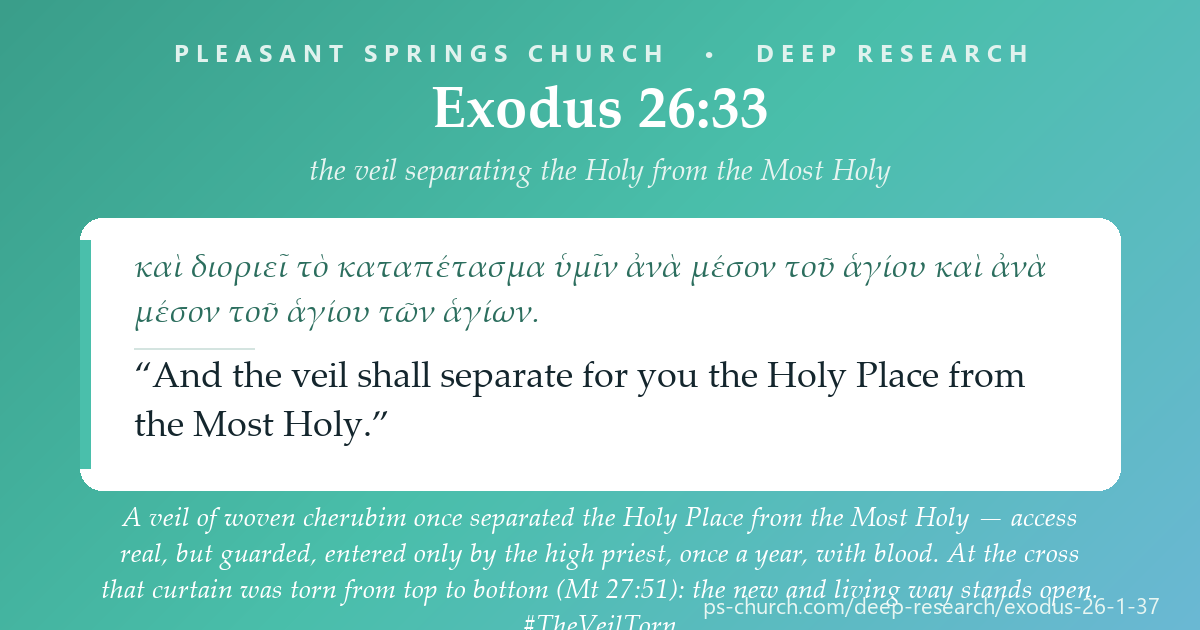
The furniture named, God now draws the tent that will house it: ten inner curtains of fine linen worked with cherubim, a goats’-hair tent and skin coverings over them, upright acacia frames overlaid with gold in silver bases — and, at the center, the veil that “shall separate for you the Holy Place from the Most Holy.” It is a map of graded, guarded holiness: God has come near, but not casually. The woven cherubim recall Eden’s guarded gate (Gen 3:24); and the New Testament reads this veil as the barrier torn in Christ’s flesh (Mt 27:51; Heb 10:19–20), opening the new and living way. This study works Exodus 26:1–37. See the method →
Exodus 26:1, 15, 31, 33, 36
Hebrew · LXX · ESVThe Shape of the Passage
SequenceSame Author and audience as Exodus 25 — the furniture named, God now specifies the tent that will house it: curtains, frames, and the veil that guards his presence.
Author
The Torah of Moses moves, in ch. 26, from the sacred furniture to the structure that shelters it. Where ch. 25 began at the center — the ark, the mercy seat — ch. 26 builds outward: first the ten inner curtains (yeriʿot) of fine twined linen, embroidered in blue, purple, and scarlet with cherubim (26:1–6); then a coarser tent of goats’ hair spread over them (26:7–13), and above that protective coverings of ram skins dyed red and goatskins (26:14). The most beautiful work faces inward, toward God; the plain, weatherproof layer faces the world. Then the walls: upright frames of acacia overlaid with gold, each standing in two bases of silver, held rigid by bars running through gold rings (26:15–30) — a tent that is also a house, splendid and portable at once.
The veil. At the structural and theological center stands the veil (pārōket, 26:31–35): woven of the same royal colors, and, like the innermost curtains, worked with cherubim. It hangs on four gold-overlaid pillars and does one decisive thing: “the veil shall separate for you the Holy Place from the Most Holy” (26:33). Behind it, alone, sits the ark with its mercy seat; before it stand the table and the lampstand. A second, simpler screen of needlework closes the tent’s entrance (26:36–37). The chapter is thus a map of graded holiness: from the world outside, to the courtyard, to the Holy Place, to the Most Holy — each threshold a curtain, each step inward more restricted. The God who says “that I may dwell in their midst” (25:8) also says, by every hanging, not casually, and not on your own terms.
Cherubim at the threshold. The woven cherubim are not decoration only. They are the same guardians stationed “at the east of the garden of Eden” to guard the way to the tree of life (Gen 3:24). Embroidered into the inner curtains and the veil, they announce what the whole tabernacle assumes: that the way back into God’s presence, barred at Eden, is now — carefully, through blood and mediation — reopened, but still guarded. Held as the devotional-typological arc Scripture itself traces, the veil becomes one of the Bible’s great signs: the barrier that says “so far and no further,” until the day it is torn.
Audience
Israel — a redeemed people learning the geometry of holiness. To a nation freshly out of Egypt, where anyone might wander into a temple’s outer courts, the tabernacle taught a careful lesson in the very cloth of its walls: the holy God has come near, but he is holy. The concentric zones — court, Holy Place, Most Holy — and the veil between them were not meant to keep Israel at arm’s length so much as to school her in reverence: access is real (God dwells here, at the center of the camp) and access is mediated (only the priests in the Holy Place; only the high priest, once a year, with blood, behind the veil, Lev 16). Awe and nearness held together in one tent.
The beauty and the movable tent. For the church, three notes ring. First, beauty: the fine linen, the gold, the color, the skilled “cherubim worked” — worship engages the senses and spares no craft, for the King is glorious and his house should say so. Second, the movable tent: this is no fixed temple but a tabernacle, poles and curtains, made to be struck and pitched again — the God who travels with his pilgrim people, present in the wilderness, not only at a shrine (cf. 40:36–38). Third, the veil — which the New Testament reads as the great barrier of separation, torn from top to bottom at the death of Christ (Mt 27:51), so that we may “enter the holy places by the blood of Jesus, by the new and living way that he opened for us through the curtain, that is, through his flesh” (Heb 10:19–20). What Exodus 26 hangs, the gospel opens.
Orient on the tabernacle curtains, the frames, the veil, sacred space, and the cherubim.
Search by topic: tabernacle, curtains / hangings, veil (paroketh), sacred space, holy of holies, cherubim, acacia, colors and dyes (blue / purple / scarlet), fine linen.
Which articles are relevant?
- Anchor Bible Dictionary — “Tabernacle,” “Veil,” “Cherubim,” “Holy of Holies,” “Colors,” “Linen.”
- Dictionary of the OT: Pentateuch — “Tabernacle,” “Sacred Space,” “Holiness,” “Presence of God,” “Priests and Levites.”
- NIDOTTE / TDOT — מִשְׁכָּן (mishkān, dwelling), פָּרֹכֶת (pārōket, veil), יְרִיעָה (yərîʿâ, curtain), קֶרֶשׁ (qeresh, frame/board), כְּרוּב (kərûb, cherub).
Bibliography surfaced:
- Childs (OTL), Durham (WBC), Stuart (NAC), Sarna (JPS) on Exodus.
- G. K. Beale, The Temple and the Church’s Mission; T. D. Alexander, From Eden to the New Jerusalem.
- Menahem Haran, Temples and Temple-Service in Ancient Israel; Philip Jenson, Graded Holiness.
Graded sacred space, the guarded threshold, and the beauty of the holy tent.
Read the curtains, frames, and veil against ancient sanctuary custom, the Eden imagery of the cherubim, and how the New Testament expounds the veil.
Which parallels shed light on religion and worldview?
Graded holiness. Ancient temples across the Near East were built in zones of ascending restriction — outer courts open to many, inner rooms to few, the innermost cella to the priesthood alone. Israel’s tent shares the grammar and bends it to a theology: the concentric holiness of court → Holy Place → Most Holy is matched by graded materials (bronze at the perimeter, silver and gold within), graded access (people, priests, high priest), and graded time (daily, and the one Day of Atonement). The veil of ch. 26 is the sharpest of these gradations — the line the ordinary priest may not cross. The message is not that God is distant but that he is holy, and that nearness to him is a gift to be received on his terms, not seized.
The guarded way and the cherubim. That the same cherubim woven into the inner curtains (26:1) and the veil (26:31) are the guardians of Eden’s gate (Gen 3:24) is one of Scripture’s quiet masterstrokes. Eden was the first sanctuary, where God walked with man; expelled, humanity found the way back barred by cherubim and a flaming sword. Now, in the tabernacle, the cherubim reappear — on the mercy seat above the ark, and here on the veil before it — marking a way back into the presence that is real but still guarded. The tent is a portable Eden, its innermost room the place where heaven and earth touch again, its veil the honest reminder that the return is not yet casual or complete.
How the tent was read. Second-Temple writers dwelt on the fabric and colors. Josephus (Antiquities 3.122–133 for the description; the cosmic reading at 3.179–187) and Philo (Life of Moses 2.71–108) both read the four materials — linen, blue, purple, scarlet — as the four elements, and the veil as the boundary of the visible cosmos; Josephus notes that the inner sanctuary, screened by the veil, was “unapproachable” and represented heaven itself. Their cosmic allegory can be overpressed, but it preserves a true instinct the New Testament shares: the veil marks the border of the holy, and behind it is heaven. The church, however, reads the veil not chiefly as astronomy but as access — the barrier that the torn curtain of Christ’s flesh has opened (Heb 10:19–20).
- Genesis 3:24 — the cherubim set to guard the way to the tree of life; the same guardians now woven on the inner curtains and the veil (26:1, 31) — see the expulsion from Eden.
- Josephus, Antiquities 3.122–133, 179–187; Philo, Life of Moses 2.71–108 — first-century Jewish readings of the tabernacle’s fabrics, colors, and veil as a symbolic cosmos (witnesses to interpretation, not Scripture).
- Ancient Near Eastern temple plans — zoned sanctuaries of ascending restriction; Israel’s tent uses the shared grammar to teach graded holiness before the unseen God.
One object dominates the chapter’s theology: the pārōket, the veil, and its single stated function — ‘the veil shall separate for you the Holy Place from the Most Holy’ (26:33). Everything about it says both nearness and distance at once. It is woven of the royal colors and the same cherubim that guard Eden’s gate, so that to look at it was to be reminded: God dwells here, just on the other side — and you may not simply walk in. Only the high priest passed it, and only once a year, and never without blood (Lev 16:2, 14–15). The veil was Israel’s honest theology hung in cloth: the holy God has come near, but sin still stands between; access is real, but mediated; the way is open, but guarded. Held as the devotional-typological arc Scripture itself lays down, the veil is pointing somewhere. For when Jesus died, ‘the curtain of the temple was torn in two, from top to bottom’ (Mt 27:51) — torn from God’s side down, not ripped by human hands — and the letter to the Hebrews reads it exactly so: we now ‘enter the holy places by the blood of Jesus, by the new and living way that he opened for us through the curtain, that is, through his flesh’ (Heb 10:19–20). The barrier that Exodus 26 so carefully hangs, the cross so deliberately opens. Not devotional embroidery read into the cloth, but the New Testament’s own reading of it: the veil was always a door waiting to be opened.
The vocabulary of the tent: the dwelling, the curtains, and the separating veil.
Watch the dwelling that names the tent, the beautiful inner curtains, the cherubim of Eden, the veil that separates, and the innermost holy place.
“Tabernacle” / dwelling — from שָׁכַן (shākan, to dwell). The tent takes its name from what it is for: God dwelling among his people. LXX σκηνή, “tent” — echoed at John 1:14, the Word who ἐσκήνωσεν, “tabernacled,” among us.
“Curtains” — the ten inner panels of fine twined linen, embroidered in blue, purple, and scarlet with cherubim, joined into one. The most beautiful work faces inward, toward the presence. LXX αὐλαῖαι.
“Veil” — the woven barrier that “separates” (הִבְדִּיל, the verb of Gen 1’s dividing) the Holy Place from the Most Holy. LXX καταπέτασμα — the very word for the curtain torn at Christ’s death (Mt 27:51; Heb 10:20).
“Cherubim” — the winged guardians of God’s throne and of Eden’s gate (Gen 3:24). Woven into the inner curtains and the veil, they mark the presence as holy and the way in as guarded — a portable Eden.
“Most Holy Place” — literally “the holy of holies,” a Hebrew superlative. The innermost room, behind the veil, where the ark and mercy seat rest. LXX ἅγιον τῶν ἁγίων (cf. Heb 9:3, “the Holy of Holies”).
“Frames” / boards — the upright acacia planks overlaid with gold, standing in silver bases, that form the tent’s rigid walls. The LXX renders them στῦλοι, “pillars,” and so hangs the veil “on the pillars” (26:33).
How the New Testament reuses the tent and the veil:
- Matthew 27:50–51; Mark 15:38; Luke 23:45 — at Christ’s death “the curtain (καταπέτασμα) of the temple was torn in two, from top to bottom”: the barrier opened from God’s side.
- Hebrews 9:1–12; 10:19–22 — the two rooms and the veil; Christ our high priest passing through “the greater and more perfect tent”; access to the holy places “by the new and living way… through the curtain, that is, through his flesh.”
- Genesis 3:24 — the cherubim guarding the way to the tree of life, now woven on curtains and veil: the guarded presence (see the expulsion from Eden).
- John 1:14; Revelation 21:3, 22 — the Word who tabernacled among us; the dwelling of God with man, where at last no temple and no veil are needed.
From Eden’s guarded gate to the veil torn open.
Trace the guarded presence and the separating veil from Eden through the tent to the cross and the New Jerusalem.
Which cross-references matter?
- Genesis 3:22–24 — the cherubim and the guarded way to the tree of life; the tent’s woven cherubim reopen the theme (see the expulsion from Eden).
- Exodus 25:1–40; 40:34–38 — the furniture the tent houses, and the glory that fills the finished dwelling (see the ark, table, and lampstand and the glory fills the tabernacle).
- Leviticus 16:2, 12–16 — the one day the high priest may pass the veil, with blood and incense: the Day of Atonement (see the Day of Atonement).
- Matthew 27:51; Hebrews 9–10 — the veil torn; the new and living way opened through the flesh of Christ — drawing near “to the throne of grace” (see our great high priest).
- Revelation 21:1–3, 22 — the dwelling of God with man, where the veil is gone for good: “I saw no temple in the city, for its temple is the Lord God the Almighty and the Lamb.”
It is easy, reading pages of curtains and frames and clasps, to miss how beautiful this tent was meant to be. Fine twined linen, dyed in blue and purple and scarlet — the costliest colors of the ancient world — embroidered with cherubim by a skilled hand; acacia framed and sheathed in gold; the whole interior glowing in lamplight, a jewel-box of a room whose finest work faced inward, toward God, where no crowd would ever see it. The tabernacle teaches that worship engages the senses and spares no craft, not because God needs our gold but because beauty is a fitting answer to glory. Yet the beauty is disciplined by the veil: all this loveliness leads the eye inward, toward a room curtained off, a presence too holy to be casually entered. And it is a movable beauty — poles and hangings, struck at the trumpet and pitched again at the next camp — because the God of this tent does not wait at a shrine for pilgrims to come to him; he travels with them, his glory-cloud over the tent, through every stage of the wilderness. A beautiful house, a guarded presence, a God on the move with his people: the whole gospel of the tabernacle is already here in cloth and wood and gold, waiting for the day the veil is torn and the dwelling becomes, at last, a man — ‘the Word became flesh and tabernacled among us, and we have seen his glory’ (John 1:14).
The scholarship on the tabernacle structure and the veil.
The commentators on Exodus 25–31; the studies of sacred space, graded holiness, the veil, and the Eden-temple theme.
Commentaries & studies:
- Brevard Childs (OTL), John Durham (WBC), Douglas Stuart (NAC), Nahum Sarna (JPS) on Exodus.
- Philip P. Jenson, Graded Holiness; Menahem Haran, Temples and Temple-Service in Ancient Israel.
- G. K. Beale, The Temple and the Church’s Mission; T. Desmond Alexander, From Eden to the New Jerusalem; Beale & Carson, Commentary on the NT Use of the OT (Hebrews 9–10).
Interpretation notes worth keeping:
- The veil and the torn curtain. The Gospels’ καταπέτασμα (Mt 27:51) is the LXX word for the pārōket; Hebrews 10:19–20 reads the tearing as opened access — a genuine, text-grounded typology, not an imposed one. (Which temple curtain the Gospels mean — inner or outer — is debated; the theology of opened access is not.)
- Graded holiness (Jenson). The concentric zones and graded materials, access, and time are the tabernacle’s own logic, not a modern overlay: the tent teaches holiness by its architecture. The veil is the decisive gradation between Holy and Most Holy.
- Cherubim and Eden (Beale, Alexander). The woven cherubim (26:1, 31), echoing Gen 3:24, tie the tent to Eden as sanctuary and to the temple-theme running to Revelation 21–22 — well-grounded biblical theology held as trajectory, not allegory read into each clasp.
- LXX divergences. The frames (qərāshim) become στῦλοι, “pillars” (26:15), so the LXX hangs the veil “on the pillars” where the MT reads “under the clasps” (26:33); the ESV follows the Hebrew. The Greek also numbers and orders some fittings differently — noted, not resolved here.
From a veil that separates to a veil torn open.
Name what you learned, why it matters, and one concrete response.
What should we carry away — and do?
- God is holy, and he draws near. The graded tent holds both truths: the King has pitched his tent at the center of the camp, and the veil says his presence is not to be entered casually. Reverence and nearness belong together.
- The veil was always pointing here. The cherubim-woven curtain that barred the way is the one torn “from top to bottom” at the cross (Mt 27:51). In Christ’s flesh the new and living way stands open (Heb 10:19–20) — the barrier removed from God’s side.
- Give God your best and beautiful. Fine linen, gold, skilled cherubim — the finest work faced inward, toward God. Worship spares no craft; offer him your skill, your beauty, your best, not your leftovers.
Step in response: the veil is torn — so “let us draw near with a true heart in full assurance of faith” (Heb 10:22). Come this week through the opened way, in the confidence the blood of Christ has purchased, and yet come with the reverence the veil taught: the God you approach is holy, and near, at once. Then answer his beauty with beauty — one deliberate offering of your best craft, your best hour, your best gift — given inward, toward him, whether or not anyone else ever sees it.
Exodus 26:33 · to share
LXX + ESVEvery Deep Research page traces its passage across the whole sweep — the Old Testament, the Second-Temple world between the testaments (historical witnesses, not Scripture), and the New Testament. Follow the thread:
Pleasant Springs Church — Deep Research
Research method after Michael S. Heiser’s Bible Research Method (examine dictionaries → ancient literature → important words → textual connections → academic publications → share), with the Pleasant Springs “Author & Audience” foundation. Scripture set in the Hebrew, the Greek editions named on each page and the ESV (Old Testament), and the Greek New Testament and the ESV (New Testament), per the practice of Pleasant Springs Church. Exodus 26:1–37 research grounded in Childs, Durham, Stuart, and Sarna, with Jenson (Graded Holiness) and Haran on sacred space, and Beale (The Temple and the Church’s Mission) and Alexander (From Eden to the New Jerusalem) on the Eden-tabernacle theme; the woven cherubim (26:1, 31) read with Genesis 3:24; the veil (pārōket / καταπέτασμα) with Leviticus 16, Matthew 27:51, and Hebrews 10:19–20 as a text-grounded typology of opened access; the LXX divergences noted — the frames rendered στῦλοι (26:15) and the veil hung “on the pillars” (26:33) for the MT’s “under the clasps”; Second-Temple exposition per Philo (Life of Moses 2) and Josephus (Antiquities 3) read as witnesses, not Scripture; and the Eden→tabernacle→temple→incarnation→New Jerusalem arc held as the canon’s own devotional-typological trajectory, per the house discipline for typology.
Scripture quotations marked ESV are from the ESV® Bible (The Holy Bible, English Standard Version®), © 2001 by Crossway, a publishing ministry of Good News Publishers. ESV Text Edition: 2016. Used by permission. All rights reserved. The ESV text may not be quoted in any publication made available to the public by a Creative Commons license, and the ESV may not be translated in whole or in part into any other language. www.esv.org
|
Did this study bless you today? 💚 Give to Support PS Church100% of gifts go to the General Fund — thank you. |