Moving outward from the golden tent into the open court, the blueprint builds first the one thing a worshiper must meet before all else: the bronze altar of burnt offering, horned at the corners, set at the gate — for there is no approach to God without atonement. Around it runs a fence of fine linen with a single door of blue, purple, and scarlet; access to God is real, and it is one. And through every night a lamp burns continually, evening to morning, tended “before the Lord” — a light that does not fail. Bronze, linen, and oil preach the gospel’s shape. This study works Exodus 27:1–21. See the method →
Exodus 27:1, 2, 8, 9, 20, 21
Hebrew · LXX · ESVThe Shape of the Passage
SequenceSame Author and audience as Exodus 25 — but the camera now pulls back from the golden interior to the courtyard gate: the altar you meet first, the fence with one door, and the lamp that never goes dark.
Author
The Torah of Moses continues the tabernacle blueprint given on the mountain (25:9, 40). Chapters 25–26 worked from the inside out — the ark and the mercy seat, the table, the lampstand, the curtains and the veil. Now ch. 27 crosses the threshold into the open court, and the order is theologically loaded: the very first furnishing built for the courtyard is the altar of burnt offering (27:1–8). Acacia wood overlaid with bronze (not gold — this is the metal of the outer court, of judgment borne in the open), five cubits square, with a horn rising at each corner, a bronze grating (mikbar) to hold the fire, and poles to carry it. It stood just inside the gate, so that no one could come toward the holy tent without first passing the place where blood was shed. The sequence preaches: atonement is the ground of all approach.
The bounded court. Around the whole compound Moses is to hang a fence of “fine twined linen” — a hundred cubits on the long sides, fifty on the short — on pillars set in bronze bases with silver hooks and bands (27:9–19). It is a graded holiness made visible: common ground outside, sacred space within, and one way in. For the entrance is a single gate (27:16), a twenty-cubit screen woven of blue and purple and scarlet yarns — the same royal colors as the veil, marking the one door into God’s dwelling. Access is real, and it is singular: the court has walls, and the walls have one opening.
A light that never fails. The chapter ends not with a structure but with a rhythm (27:20–21). Israel is to bring “pure beaten olive oil” — the clearest, first-pressed oil — so that the lamp of the sanctuary may burn continually (tamid; ESV “regularly”). Aaron and his sons are to tend it “from evening to morning before the Lord”: a nightly priestly vigil, keeping the light of God’s house alive through the dark. It is “a statute forever throughout their generations” — the first of the priestly perpetual ordinances, and a fitting hinge into ch. 28, where Aaron and his sons are clothed for that very service.
Audience
Israel — a redeemed people learning how a holy God may be safely approached. Every detail of ch. 27 answered the deepest question of a camp with God’s glory-cloud in its center: how do we come near without being consumed? The answer met them at the gate. First the altar: come with a sacrifice, for the fire that fell on Sinai now burns on a bronze hearth where a substitute dies in the sinner’s place. Then the fence: this ground is holy; there is a boundary, and there is a door. And the lamp burning through every night told them their God does not sleep and his house is never dark — the light of his presence tended faithfully by the priests he appointed.
The pattern the church still reads. Held as the New Testament’s own devotional-typological reading — not allegory pressed onto every peg and cord — ch. 27 sketches the shape of the gospel in bronze, linen, and oil. The altar at the gate declares what Hebrews states plainly: “without the shedding of blood there is no forgiveness” (Heb 9:22); the true and final sacrifice was offered outside the camp, on the cross that the bronze altar foreshadowed. The one gate into the court is the shape of Jesus’ own claim, “I am the door” (John 10:9) — access to God is gloriously open and gloriously singular. And the ever-burning lamp, tended through the night, is the light of God’s presence that does not fail — the light Christ is (John 8:12) and the light his church is called to keep burning, her lampstands standing before the Lord (Rev 1:12–20). Worship here is God-initiated and God-patterned, met at an altar, entered by one door, lit by a lamp he commands to be kept.
Orient on the altar of burnt offering, the horns, the court, and the sanctuary lamp.
Search by topic: altar of burnt offering, horns of the altar, bronze / brazen, court of the tabernacle, gate / screen, lamp / menorah, olive oil, ner tamid (perpetual lamp), priesthood.
Which articles are relevant?
- Anchor Bible Dictionary — “Altar,” “Tabernacle,” “Court,” “Lamp / Lampstand,” “Oil,” “Sacrifice and Offerings.”
- Dictionary of the OT: Pentateuch — “Tabernacle,” “Altar,” “Sacred Space,” “Sacrifices and Offerings,” “Priests and Levites.”
- NIDOTTE / TDOT — מִזְבֵּחַ (mizbeach, altar), קֶרֶן (qeren, horn), נְחֹשֶׁת (nechosheth, bronze), חָצֵר (chatzer, court), תָּמִיד (tamid, continually).
Bibliography surfaced:
- Childs (OTL), Durham (WBC), Stuart (NAC), Sarna (JPS) on Exodus.
- G. K. Beale, The Temple and the Church’s Mission; T. D. Alexander, From Eden to the New Jerusalem.
- Menahem Haran, Temples and Temple-Service in Ancient Israel; studies of the horned altar and sacred space.
Horned altars, bounded precincts, and a lamp kept through the night.
Read the altar, court, and lamp against ancient sanctuary custom, and note how Josephus, Philo, and the New Testament expound them.
Which parallels shed light on religion and worldview?
The horned altar. Stone altars with projecting horns at the corners have been unearthed across the Levant (Megiddo, Beersheba, Tel Dan) — the horn was the altar’s holiest point, the place blood was daubed in atonement rites (Lev 4:7) and the place a fugitive grasped for asylum (1 Kgs 1:50; 2:28). Israel’s bronze altar shares the form of its age and fills it with covenant meaning: the horns are “of one piece with it” (27:2), an integral part of the place where sin is covered. That the outer altar is bronze, not gold, is deliberate — bronze is the metal of the open court, sturdy against fire, the material of judgment borne in the sight of all (compare the bronze serpent, Num 21:9).
Bounded space, one door. Ancient temples were typically walled precincts of graded holiness, with controlled entrance — the more sacred the zone, the more restricted the access. Israel’s court works within that grammar and sharpens it to a single point of grace: the whole fence of plain white linen has one gate, and that gate blazes with the royal blue, purple, and scarlet of the veil (27:16). The message is not exclusion for its own sake but ordered welcome: there is a way in, and it is the way God has appointed — not many doors of human devising, but one.
How the tabernacle was read. Second-Temple writers dwelt on these furnishings. Josephus (Antiquities 3.143–150, 199–209) describes the bronze altar, the court hangings, and the perpetual lamps in loving detail; Philo (Life of Moses 2.101–108, 146ff.) reads the seven-lamped light and the sacrificial fire as a symbolic cosmos. Their cosmic allegory can be overpressed, but it preserves a true instinct: the sanctuary is a meeting of heaven and earth, and its light is meant never to go out. The book of Hebrews, reading the same tent, fixes on its center — the blood, the veil, the priesthood — and finds there the shadow of Christ’s own atoning work (Heb 9–10).
- Josephus, Antiquities 3.143–150, 199–209; Philo, Life of Moses 2.101–108, 146–158 — first-century Jewish descriptions of the altar, court, and lamps (witnesses to interpretation, not Scripture).
- Beersheba & Tel Dan horned altars; 1 Kings 1:50; 2:28 — the horns as the altar’s holiest point and place of asylum, illuminating “the horns… of one piece with it” (27:2).
- Leviticus 1–7; 6:8–13 — the offerings burned on this altar, and the fire that was never to go out (Lev 6:13): the altar’s daily life.
Notice the order of the blueprint, for it is a sermon in sequence. God begins inside — ark, mercy seat, table, lampstand (ch. 25) — because the dwelling is his idea and his glory is its center. But when the plans cross into the courtyard where the worshiper actually walks, the very first thing built is the altar (27:1). It stands just inside the one gate, so that an Israelite coming to God cannot take a single step toward the holy tent without passing the place of blood. This is not an accident of engineering; it is the geography of grace. Before the table, before the lamp, before the mercy seat — the altar. Held as the New Testament’s own reading (not allegory strained from the cords and pegs), the shape is the gospel’s: ‘without the shedding of blood there is no forgiveness’ (Heb 9:22). The bronze altar at the gate says what the cross says — that the road to a holy God runs past a substitute, that atonement is not one option among many but the ground of all approach. And when the true sacrifice was offered ‘outside the camp’ (Heb 13:11–12), the shadow met its substance: the altar was always pointing to a hill outside a city wall, where the Lamb of God was slain that we might come in.
The vocabulary of approach: the place of slaughter, the horns, the court, and the continual light.
Watch the altar met first, the horns of atonement and refuge, the bronze of the open court, the one gate, and the lamp that burns continually before the Lord.
“Altar” — literally “place of slaughter” (root זבח, zabach, to slaughter/sacrifice). The bronze altar of burnt offering, met first inside the gate. LXX θυσιαστήριον, the “place of sacrifice.”
“Horns” — the four projections “of one piece with” the altar, its holiest point: blood was daubed on them in atonement (Lev 4:7), and fugitives grasped them for refuge (1 Kgs 1:50). LXX κέρατα.
“Bronze” — the metal of the outer court, sturdy against fire: altar, grating, pillar-bases, pegs. Gold within, bronze without — a graded holiness worked in metal. LXX χαλκός.
“Court” — the bounded enclosure of fine linen around the tent, a hundred cubits long, with one gate. Sacred space set off from common ground, entered by a single door. LXX αὐλή.
“Pure beaten olive oil” — the clearest, first-pressed oil, without lees, for the light. LXX ἔλαιον… ἄτρυγον καθαρὸν κεκομμένον — the best given to keep God’s house alight.
“Continually” / regularly — the lamp “to burn continually,” tended from evening to morning. LXX διὰ παντός. A perpetual light, and a perpetual statute (chuqqath ‘olam, 27:21) — God’s presence that does not fail.
How the New Testament reuses the altar, gate, and lamp:
- Hebrews 9:22; 13:10–12 — “without the shedding of blood there is no forgiveness”; the true sacrifice offered “outside the camp,” the altar’s reality.
- Hebrews 4:14–16; 7:25 — through the great High Priest we “draw near… to the throne of grace”: the access the altar and gate opened, now made complete (see the throne of grace).
- John 8:12; 10:9 — “I am the light of the world”; “I am the door” — the ever-burning lamp and the one gate, read as devotional analogy on the tent’s own shape.
- Revelation 1:12–20; 2:1–5 — the churches as golden lampstands before the Lord, called to keep their light burning — the ner tamid carried into the age of the Spirit.
From the bronze altar at the gate to the Lamb slain outside the wall.
Trace the altar, the one door, and the continual light from the tabernacle through the temple to their fulfillment in Christ and his church.
Which cross-references matter?
- Exodus 25:1–40; 26:1–37 — the ark, table, and lampstand within, and the tent and veil: the interior this court surrounds (see the ark, the table, and the lampstand).
- Leviticus 1:1–9; 6:8–13; 16:11–19 — the burnt offering ascending on this altar, the fire never going out, and the Day of Atonement blood carried within (see the Day of Atonement).
- Exodus 28:1–43 — Aaron and his sons, who tend this lamp, now clothed for the priesthood (see the priestly garments).
- Exodus 40:34–38 — when the court and its furnishings are finished, the glory fills the tent that this altar guards (see the glory fills the tabernacle).
- John 8:12; 10:9; Hebrews 9:22; 13:10–12; Revelation 1:12–20 — the light, the door, the shed blood, the lampstands: the tabernacle’s court read in Christ and his church.
Set the court’s two most preachable features side by side — the single gate and the perpetual lamp — and the wilderness enclosure quietly opens onto the whole gospel. The fence was a hundred cubits of plain white linen, and in all that length there was exactly one door: a twenty-cubit screen woven in the royal blue and purple and scarlet of the veil (27:16). A worshiper could not invent his own way in; access was real, welcoming, wide enough for a nation — and singular. Read as the tent’s own devotional shape, it is the very grammar of Jesus’ ‘I am the door. If anyone enters by me, he will be saved’ (John 10:9) — not many gates of human religion, but one appointed door blazing with a King’s colors. And just inside, through every night of the wilderness, a lamp burned continually. Aaron and his sons kept the vigil ‘from evening to morning before the Lord’ (27:21), feeding it pure beaten oil so the house of God was never dark. That light is the presence that does not fail — the light Christ is (John 8:12), and the light his church is charged to keep, her lampstands standing before the Lord until he comes (Rev 1:12–20; 2:5). One door to enter; one light to keep burning. The courtyard preaches the Christian life in bronze and linen and oil.
The scholarship on the altar, the court, and the lamp.
The commentators on Exodus 27; the studies of the horned altar, sacred space, and the perpetual lamp; the LXX’s renderings of the outer court.
Commentaries & studies:
- Brevard Childs (OTL), John Durham (WBC), Douglas Stuart (NAC), Nahum Sarna (JPS) on Exodus.
- G. K. Beale, The Temple and the Church’s Mission; T. Desmond Alexander, From Eden to the New Jerusalem; Menahem Haran, Temples and Temple-Service in Ancient Israel.
- Studies of the Israelite horned altar (Beersheba, Tel Dan) and of graded sacred space; Beale & Carson, Commentary on the NT Use of the OT (Hebrews 9).
Interpretation notes worth keeping:
- The order of construction. The court’s first-built furnishing is the altar (27:1–8): the sequence itself teaches that atonement precedes access — a point Hebrews 9–10 draws out, not one imposed on the text.
- Bronze, not gold. The consistent gold-within / bronze-without pattern marks a graded holiness; the outer altar’s bronze fits the open court and the fire of judgment borne in public (cf. Num 21:9).
- The LXX at 27:21. Where the MT’s veil stands before “the testimony” (‘edut), the LXX reads “the covenant” (διαθήκη) — and renders the “tent of meeting” as “tent of the testimony” (σκηνὴ τοῦ μαρτυρίου) throughout. At 27:16 the LXX gives the gate-screen’s twenty cubits as its “height” where the MT reads “length” — a minor divergence; the ESV follows the Hebrew.
- Devotional typology, disciplined. The altar→cross, one-gate→“I am the door,” and lamp→light-of-Christ / lampstand-church readings are rich and NT-grounded (Heb 9:22; John 8:12; 10:9; Rev 1–2), but held as the canon’s trajectory and analogy, not as allegory read into every peg and cord — the house discipline for typology throughout this library.
From a bronze altar at the gate to a light that never goes out.
Name what you learned, why it matters, and one concrete response.
What should we carry away — and do?
- Atonement is the ground of all approach. The altar was built first and stood at the gate: no one came near without passing the place of blood. In Christ, the true sacrifice offered outside the camp, that way is opened for good (Heb 9:22; 13:12).
- There is one door — and it is wide open. The court’s single gate, blazing with a King’s colors, is real access and singular access: “I am the door” (John 10:9). Come by the way God appointed, and come freely.
- Keep the lamp burning. The light was tended “from evening to morning,” a nightly priestly vigil. God’s presence does not fail; his church is a lampstand charged to keep her light (Rev 1:12–20). Tend it with the best oil you have.
Step in response: come this week by the one door and past the altar — draw near “with confidence to the throne of grace” (Heb 4:16) through the blood of Christ, refusing every self-made path and every attempt to approach God without a sacrifice. Then take up the priestly vigil in your own house: keep a lamp burning — a daily, faithful, evening-to-morning walk with God — and give him your best oil, first and pure, that the light of his presence in you may not go dark.
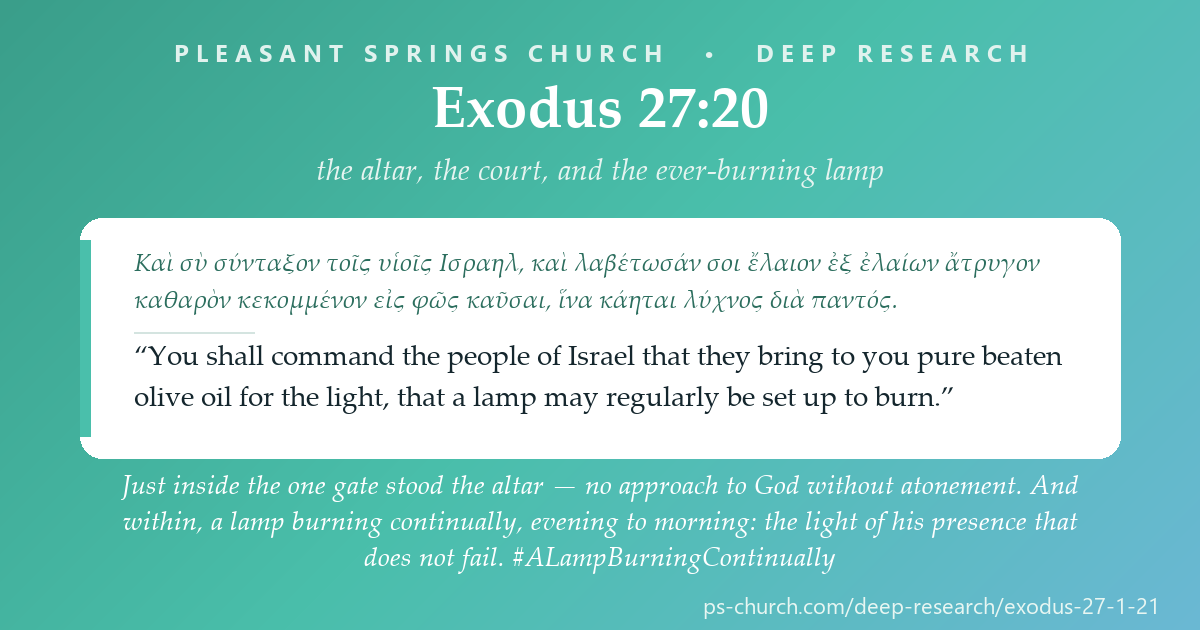
Exodus 27:20 · to share
LXX + ESVEvery Deep Research page traces its passage across the whole sweep — the Old Testament, the Second-Temple world between the testaments (historical witnesses, not Scripture), and the New Testament. Follow the thread:
Pleasant Springs Church — Deep Research
Research method after Michael S. Heiser’s Bible Research Method (examine dictionaries → ancient literature → important words → textual connections → academic publications → share), with the Pleasant Springs “Author & Audience” foundation. Scripture set in the Hebrew, the Greek editions named on each page and the ESV (Old Testament), and the Greek New Testament and the ESV (New Testament), per the practice of Pleasant Springs Church. Exodus 27:1–21 research grounded in Childs, Durham, Stuart, and Sarna, with Beale (The Temple and the Church’s Mission) and Alexander (From Eden to the New Jerusalem) on sacred space; the bronze altar and its horns read with the archaeology of the Israelite horned altar (Beersheba, Tel Dan) and the asylum texts (1 Kgs 1:50; 2:28); the LXX’s renderings noted — θυσιαστήριον / κέρατα, “tent of the testimony” (σκηνὴ τοῦ μαρτυρίου), and “covenant” (διαθήκη) at 27:21 for MT “testimony” (‘edut); Second-Temple exposition per Josephus (Antiquities 3) and Philo (Life of Moses 2) read as witnesses, not Scripture; and the altar→cross, one-gate→“I am the door,” and lamp→light-of-Christ / lampstand-church readings held as the canon’s own devotional-typological trajectory (Heb 9:22; 13:12; John 8:12; 10:9; Rev 1:12–20), per the house discipline for typology.
Scripture quotations marked ESV are from the ESV® Bible (The Holy Bible, English Standard Version®), © 2001 by Crossway, a publishing ministry of Good News Publishers. ESV Text Edition: 2016. Used by permission. All rights reserved. The ESV text may not be quoted in any publication made available to the public by a Creative Commons license, and the ESV may not be translated in whole or in part into any other language. www.esv.org
|
Did this study bless you today? 💚 Give to Support PS Church100% of gifts go to the General Fund — thank you. |