The sanctuary has a house; now it must have a priest. God designs the vestments of Aaron down to the thread, made “for glory and for beauty” — and every piece preaches mediation. Two onyx stones on the ephod’s shoulders and twelve gems on the breastpiece over the heart carry the twelve tribes, engraved by name, into God’s presence: the high priest bears the whole people on his shoulders (strength) and over his heart (love). On his turban a golden plate reads “Holy to the Lord,” so that even the people’s worship may be borne and accepted. It is the wardrobe of the great High Priest who “always lives to make intercession” (Heb 7:25). This study works Exodus 28:1–43. See the method →
Exodus 28:2, 12, 29, 36, 38
Hebrew · LXX · ESVThe Shape of the Passage
InclusioSame Author and audience as the tabernacle chapters (see Exodus 25) — but the plans now turn from the house to the man who enters it: the mediator who bears the people in.
Author
The Torah of Moses, still on the mountain, moves from the sanctuary (chs. 25–27) to its priesthood. A dwelling requires a servant to minister in it, and God will not have Israel improvise one: Aaron and his sons are named and set apart (28:1), and their garments are designed down to the thread. Twice the chapter frames the whole wardrobe with a phrase that governs everything after: the holy garments are made “for glory and for beauty” (lə-khavod u-lə-tif’eret, 28:2, 40). This is not vanity but vocation — the office of standing between a holy God and a sinful people is clothed in splendor to teach the people what nearness to God costs and means.
The bearing priest. The chapter’s theology hangs on one verb — nasa’, “to bear, carry.” On the ephod, two onyx stones on the shoulder pieces are engraved with the twelve tribes: “Aaron shall bear their names before the Lord… on his two shoulders for remembrance” (28:12). Over his heart hangs the breastpiece of judgment (choshen ha-mishpat), set with twelve precious stones, each engraved with a tribe: “Aaron shall bear the names… on his heart… for a regular remembrance” (28:29). Folded inside the breastpiece are the Urim and Thummim, by which the priest “shall bear the judgment of the people of Israel on his heart before the Lord” (28:30). Shoulders and heart, strength and love: the high priest carries the whole nation, name by name, into the presence of God.
Robe, plate, and acceptance. The blue robe is hemmed with golden bells and woven pomegranates, so that the sound of the priest is heard as he enters and leaves the Holy Place, “lest he die” (28:35). And on the turban, tied with a blue cord, hangs a plate of pure gold engraved like a signet: “Holy to the Lord” (qodesh la-YHWH, 28:36). It sits on Aaron’s forehead so that he “may bear any guilt from the holy things that the people of Israel consecrate” — that their worship, imperfect as it is, may be “accepted before the Lord” (28:38). Even Israel’s gifts need a mediator to make them acceptable.
Audience
Israel — a people who had just heard the terror of Sinai and learned they could not approach God directly (20:18–19). Now they are given a man who can: one of their own, dressed in gold and gems and blue and scarlet, who walks into the sanctuary wearing their names. Every tribe was engraved on him — the small with the great, none left off the stones. When Aaron went in, Reuben went in, and Simeon, and Levi, and all of them — borne on his shoulders and held over his heart. The vestments preached a sermon in gold: you have a representative before God; you are remembered there; your worship is carried by another and made acceptable.
The great High Priest. For the church, Exodus 28 is the wardrobe of mediation — and the New Testament reads it as a portrait of Christ, held as devotional analogy grounded in the argument of Hebrews itself. Aaron bore twelve names on his shoulders and heart into an earthly Holy Place, year by year; Jesus, our great high priest, has “passed through the heavens” (Heb 4:14) into the true sanctuary, bearing his people not on engraved stones but in his own heart, and “he always lives to make intercession for them” (Heb 7:25). Aaron’s golden plate declared him “Holy to the Lord” and let him bear the guilt of the people’s gifts; Christ, himself holy and without sin (Heb 7:26), bears not merely the guilt of our worship but our very sins, “that we may hold fast our confession” and “draw near to the throne of grace” (Heb 4:14–16; 9:11–14, 24). The beauty of the priesthood was always pointing to him: worship made acceptable by a mediator who carries us in.
Orient on the priesthood, the ephod, the breastpiece, the Urim and Thummim, and the golden plate.
Search by topic: priest / high priest, priestly garments / vestments, ephod, breastpiece of judgment, Urim and Thummim, onyx / precious stones, turban / diadem, holiness.
Which articles are relevant?
- Anchor Bible Dictionary — “Priests and Levites,” “Ephod,” “Breastpiece,” “Urim and Thummim,” “Dress and Ornamentation.”
- Dictionary of the OT: Pentateuch — “Priesthood,” “Aaron,” “Priestly Garments,” “Holiness,” “Sacred Space.”
- NIDOTTE / TDOT — אֵפוֹד (’ēphôd, ephod), חֹשֶׁן (ḥōshen, breastpiece), נָשָׂא (nāsā’, bear/carry), זִכָּרוֹן (zikkārôn, remembrance), קֹדֶשׁ (qōdesh, holiness).
Bibliography surfaced:
- Childs (OTL), Durham (WBC), Stuart (NAC), Sarna (JPS) on Exodus.
- Menahem Haran, Temples and Temple-Service in Ancient Israel; Cornelis Houtman, Exodus (HCOT).
- Studies of the Urim and Thummim (Cornelis Van Dam, The Urim and Thummim) and of the high-priestly office in Hebrews.
Vested priesthood, sacred lots, and a mediator who wears the people’s names.
Read the vestments against ancient priestly custom, and note how Second-Temple writers and the New Testament expound the high priest and his robes.
Which parallels shed light on religion and worldview?
The vested priest. Across the ancient Near East, those who served in a god’s house wore prescribed regalia — special linen, headgear, and insignia marking them off from common life. Israel’s priesthood shares that instinct and transforms it. The materials are the very ones used for the tabernacle itself (gold, blue, purple, scarlet, fine linen, 28:5–6) — the priest is, in effect, dressed to match the sanctuary, a walking piece of holy space. But where pagan regalia often deified the wearer, Aaron’s vestments do the opposite: they load him with the names of the people and stamp his brow with allegiance to another — “Holy to the Lord.” He is not a god; he is a bearer.
The sacred lot. The Urim and Thummim (28:30) belong to an old practice of seeking divine decision by sacred lot — but hedged, in Israel, within the breastpiece of the anointed priest and used to discern the Lord’s will, not to coerce it (Num 27:21; 1 Sam 28:6; Ezra 2:63). The Hebrew names likely evoke “lights” and “perfections”; the LXX, strikingly, renders them δήλωσις καὶ ἀλήθεια — “manifestation and truth” — hearing in them not magic but the clear, true word of God given through his priest. Guidance in Israel came bound to the mediator’s heart.
How the vestments were read. The high priest’s robes fascinated Second-Temple Judaism. Sirach praises Aaron, whom God “clothed… with the perfection of exultation,” robes “for glory and beauty” (Sir 45:6–13). The Wisdom of Solomon says of the high priest that “on his long robe the whole world was depicted, and the glories of the fathers were engraved on the four rows of stones, and your majesty was on the diadem upon his head” (Wis 18:24) — the vestments as a cosmos and a memorial of the patriarchs. Josephus (Antiquities 3.151–187) and Philo (Life of Moses 2.109–135) expound each piece as a symbol of the universe: the robe for the air, the bells for thunder, the twelve stones for the zodiac or the months. The cosmic allegory can be overpressed, but it witnesses to an old and true instinct: when the high priest went in, all Israel — indeed all creation — went in with him. The church reads the center not as astronomy but as intercession: one man bearing the many into the presence of God (Heb 9).
- Sirach 45:6–13; Wisdom of Solomon 18:24 — Second-Temple praise of Aaron’s vestments “for glory and beauty,” the robe as a cosmos, the stones a memorial of the fathers (witnesses to interpretation, not Scripture).
- Josephus, Antiquities 3.151–187; Philo, Life of Moses 2.109–135 — detailed first-century expositions of the high priest’s robes as a symbolic universe.
- Numbers 27:21; 1 Samuel 28:6; Ezra 2:63 — the Urim and Thummim in use: the sacred lot seeking the Lord’s decision through the priest.
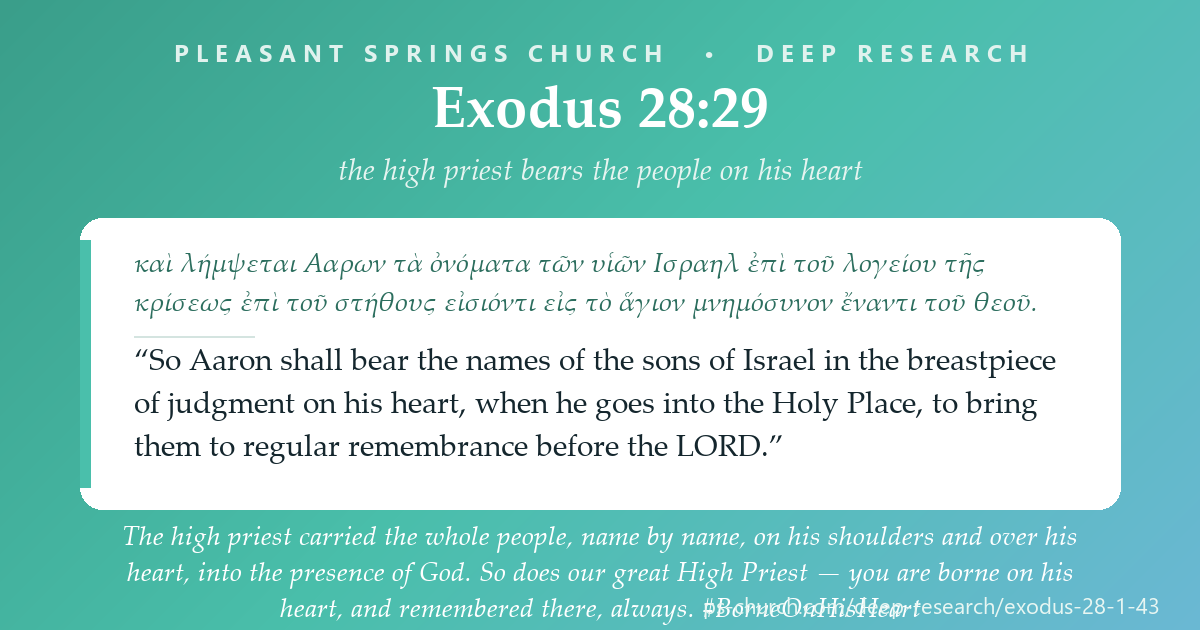
The most tender detail in the chapter is a matter of engraving. Twelve names are cut into stone twice over — once on the two onyx stones set on the shoulders of the ephod (28:9–12), and once on the twelve gems of the breastpiece worn over the heart (28:17–21, 29). The rabbis noticed the arrangement and the church has never tired of it: the high priest carried the whole people into the sanctuary in the two places a burden is best borne — on the shoulders, the seat of strength, and over the heart, the seat of love. Not the mighty tribes only, and not the favorites; every name, the failures with the faithful, Reuben who lost his birthright beside Judah who kept the scepter, all of them cut into gold and gemstone and carried in together. And it is done ‘for a remembrance before the Lord’ — not because God forgets, but because this is how God appointed his people to be held before him: represented, named, kept. Read as the devotional analogy Hebrews itself invites, the picture rises to its fulfillment. There is a great High Priest who has gone into the true sanctuary bearing his people not on engraved stones but graven on his hands (Isa 49:16) and carried in his heart, who ‘always lives to make intercession’ (Heb 7:25), whose very scars are the names he bears before the Father. If you belong to him, you are not waiting outside the veil hoping to be noticed. You went in on his shoulders. You are held over his heart. You are remembered there, by name, always.
The vocabulary of mediation: glory and beauty, the ephod and breastpiece, and the bearing priest.
Watch the framing “glory and beauty,” the shoulder-and-heart bearing, the oracle of the breastpiece, the sacred lot, and the golden plate’s “Holy to the Lord.”
“For glory and for beauty” — the phrase that frames every vestment. The priesthood is clothed in splendor, not for the man’s sake but for the office’s: the beauty of holiness made visible. LXX εἰς τιμὴν καὶ δόξαν, “for honor and glory.”
The ephod — a richly woven vestment of gold, blue, purple, and scarlet, with two shoulder pieces bearing onyx stones engraved with the twelve tribes. The garment on which the people are carried into God’s presence.
The breastpiece of judgment — a square pouch set with twelve engraved gems, worn over the heart, holding the Urim and Thummim. “Judgment” because by it the priest bears the people’s cause and seeks God’s decision. LXX λογεῖον (the oracle-piece).
“To bear, carry” — the theological hinge of the chapter. Aaron bears the names on his shoulders (28:12) and heart (28:29), bears the judgment of the people (28:30), and bears their guilt (28:38). The mediator’s work is a carrying (cf. Isa 53:4, 12; Heb 9:28).
The Urim and Thummim — likely “lights and perfections,” the sacred means of discerning the Lord’s will, kept in the breastpiece over the heart. LXX δήλωσις καὶ ἀλήθεια, “manifestation and truth” (Num 27:21; 1 Sam 28:6).
“Holy to the Lord” — engraved on the golden plate (tsits) on the turban, like a signet. The priest’s brow bears the sanctuary’s watchword, that he may bear the guilt of the holy things and the people be accepted. LXX Ἁγίασμα κυρίου.
How the New Testament reuses the priesthood:
- Hebrews 4:14–16; 7:23–28 — the “great high priest” who has passed through the heavens, holy and permanent, who “always lives to make intercession” (see the throne of grace).
- Hebrews 9:6–14, 24–28 — the earthly high priest entering the Holy Place with blood; Christ entering “the true holy places” by his own blood, appearing in God’s presence for us.
- John 17 — the great high-priestly prayer: Jesus bearing his people, by name and need, before the Father.
- Revelation 1:12–13; 21:19–21 — the Son of Man robed to the feet; the breastpiece jewels reappearing in the city’s twelve foundations while the tribes’ names are written on its gates (Rev 21:12, 19–21), the whole city a memorial of God’s people.
From engraved names on a priest to the great High Priest who bears us in.
Trace the bearing priest, the remembered people, and the acceptable worship toward their fulfillment in Christ our High Priest.
Which cross-references matter?
- Exodus 25:1–40; 27:1–21; 29:1–46 — the sanctuary that requires a priesthood, the altar and the lamp the priest tends, and the ordination that consecrates him (see the altar and the courtyard and the ordination of the priests).
- Leviticus 16:1–34 — the Day of Atonement: the same high priest, now in linen, carrying blood past the veil for the people (see the Day of Atonement).
- Isaiah 49:16; 53:4, 11–12 — names graven on the palms; the Servant who bears the sin of many: the priestly “bearing” (nasa’) carried to the cross.
- Numbers 27:21; 1 Samuel 28:6; Ezra 2:63 — the Urim and Thummim seeking the Lord’s decision through the priest.
- Hebrews 4:14–16; 7:23–28; 9:6–28; Revelation 21:12–21 — the great High Priest bearing his people into the true sanctuary; the twelve tribes’ names carried to the end.
There is a quiet problem buried in the golden plate. Aaron wears ‘Holy to the Lord’ on his forehead, we are told, so that he may ‘bear the guilt of the holy things’ — and there is the surprise. Not the guilt of Israel’s crimes; the guilt of Israel’s worship. Even the offerings the people consecrate, their best and holiest gifts, are stained by the hands that bring them, and would be rejected but for a mediator who bears their fault and makes them ‘accepted before the Lord’ (28:38). The lesson is bracing: our very devotion needs atoning. Our prayers come mixed with wandering, our giving with pride, our praise with distraction — there is no gift we bring that could stand on its own merit before a holy God. And that is precisely why the golden plate is such good news. It says that God provided, from the beginning, a way for flawed worship to be received: through one who is himself ‘Holy to the Lord’ and bears what is wrong with what we offer. Held as the analogy the New Testament draws, the plate points straight to Christ, the truly Holy One, through whom we ‘offer up spiritual sacrifices acceptable to God’ (1 Pet 2:5) — our worship carried in on the merit of another, and welcomed. The Christian never brings a perfect offering; he brings it through a perfect Priest, and it is received for his sake.
The scholarship on the priestly garments.
The commentators on Exodus 28; the studies of the priesthood, the Urim and Thummim, and the high-priestly Christology of Hebrews.
Commentaries & studies:
- Brevard Childs (OTL), John Durham (WBC), Douglas Stuart (NAC), Nahum Sarna (JPS), Cornelis Houtman (HCOT) on Exodus.
- Menahem Haran, Temples and Temple-Service in Ancient Israel; Cornelis Van Dam, The Urim and Thummim: A Means of Revelation in Ancient Israel.
- Studies of Hebrews’ use of the tabernacle and priesthood (Beale & Carson, Commentary on the NT Use of the OT); on “bearing” (nasa’) and atonement.
Interpretation notes worth keeping:
- ‘For glory and for beauty’ (28:2, 40). The phrase governs the whole wardrobe and frames priesthood as an office of dignity, not the priest’s personal honor. The Second-Temple witnesses (Sir 45; Wis 18:24) already read it this way.
- The bearing verb (nasa’). Names on the shoulders (28:12), names on the heart (28:29), judgment (28:30), and guilt (28:38) are all “borne” — the same verb used of the Servant who “bore the sin of many” (Isa 53:12) and of Christ who “bore our sins” (Heb 9:28; 1 Pet 2:24). The priestly type is the text’s own vocabulary.
- The Urim and Thummim. Their exact form is unknown; their function — discerning the Lord’s decision through the anointed priest — is clear. The LXX δήλωσις καὶ ἀλήθεια (“manifestation and truth”) is an interpretive gloss worth noting (Van Dam).
- Devotional typology, disciplined. The high-priest→Christ reading is not imposed; it is the sustained argument of Hebrews (4–10), which quotes and expounds the tabernacle service directly. Held as the canon’s own trajectory — not allegory pressed onto every bell and stone — per the house discipline for typology throughout this library.
From engraved names on a priest to a name-bearing Savior.
Name what you learned, why it matters, and one concrete response.
What should we carry away — and do?
- You are carried in. The high priest bore every tribe on his shoulders and over his heart into God’s presence. In Christ, your name is borne there still — strength and love together, “a regular remembrance before the Lord” (28:29; Heb 7:25).
- Even your worship needs a Mediator. The golden plate let Aaron bear “the guilt of the holy things.” Bring your offerings, but bring them through Christ, who makes them “acceptable to God” (1 Pet 2:5; 28:38).
- Holiness is beautiful. The garments were “for glory and for beauty.” A life set apart to God is not drab duty but splendor — the beauty of holiness, worn like a robe (Ps 96:9; Rev 19:8).
Step in response: come this week as one who is already carried in. Draw near “with confidence to the throne of grace” (Heb 4:16), knowing your great High Priest bears your name over his heart and ever lives to intercede for you. Then bring one offering — a prayer, a gift, an act of obedience — consciously through him, trusting not its perfection but his, and let it be “accepted before the Lord.” And wear, gladly, the watchword of the plate: Holy to the Lord.
Exodus 28:29 · to share
LXX + ESVEvery Deep Research page traces its passage across the whole sweep — the Old Testament, the Second-Temple world between the testaments (historical witnesses, not Scripture), and the New Testament. Follow the thread:
Pleasant Springs Church — Deep Research
Research method after Michael S. Heiser’s Bible Research Method (examine dictionaries → ancient literature → important words → textual connections → academic publications → share), with the Pleasant Springs “Author & Audience” foundation. Scripture set in the Hebrew, the Greek editions named on each page and the ESV (Old Testament), and the Greek New Testament and the ESV (New Testament), per the practice of Pleasant Springs Church. Exodus 28:1–43 research grounded in Childs, Durham, Stuart, Sarna, and Houtman, with Haran on temple service and Van Dam on the Urim and Thummim; the framing “for glory and for beauty” (28:2, 40; LXX εἰς τιμὴν καὶ δόξαν) and the bearing verb nasa’ (names on shoulders and heart, 28:12, 29; judgment, 28:30; guilt, 28:38) traced as the vocabulary of mediation; the Urim and Thummim (LXX δήλωσις καὶ ἀλήθεια) and the golden plate “Holy to the Lord” (28:36; LXX Ἁγίασμα κυρίου) noted, with the LXX “before God” at 28:29 for MT “before the Lord”; Second-Temple exposition per Sirach 45, Wisdom 18:24, Josephus (Antiquities 3) and Philo (Life of Moses 2) read as witnesses, not Scripture; and the high-priest→Christ reading held as the sustained argument of Hebrews 4–10 (4:14–16; 7:25; 9:11–28), per the house discipline for typology.
Scripture quotations marked ESV are from the ESV® Bible (The Holy Bible, English Standard Version®), © 2001 by Crossway, a publishing ministry of Good News Publishers. ESV Text Edition: 2016. Used by permission. All rights reserved. The ESV text may not be quoted in any publication made available to the public by a Creative Commons license, and the ESV may not be translated in whole or in part into any other language. www.esv.org
|
Did this study bless you today? 💚 Give to Support PS Church100% of gifts go to the General Fund — thank you. |