While Moses is on the mountain receiving the covenant, the people below break it — melting their gold into a calf and crying, “These are your gods, O Israel!” It is apostasy at the summit of grace. Yet the chapter’s heart is not the calf but the mediator: Moses stands in the breach and offers himself — “blot me out of your book” — a love that foreshadows a greater Mediator still. This study works Exodus 32 from Horeb’s idolatry to Paul’s anguish and the one who was “numbered with the transgressors.” See the method →
Exodus 32:1–35 (selections)
Hebrew · LXX · ESVThe Shape of the Passage
Parallel panelsThe same Author and audience as Exodus 24 — and the covenant the people just swore (“we will do”) is broken almost before the ink is dry.
Author
The Torah of Moses places the golden calf at the worst possible moment: Moses is on the mountain receiving the very tablets and the pattern for God’s dwelling, and below, the people fall into idolatry. The narrative is built as a collision — God’s gracious covenant-making above, Israel’s covenant-breaking below — and it turns on intercession. Twice Moses stands between God and the people (32:11–14, 30–32), and the chapter’s deepest note is not judgment but a mediator’s costly love.
Sin at the summit of grace. The placement is theological: Israel breaks the first two commandments (no other gods, no image) days after hearing them thundered from the mountain. The story exposes the human heart — and sets up the long biblical search for a Mediator who can not only plead for sinners but actually bear their sin.
Audience
Israel — the redeemed, covenant-bound people, now shown at their worst. Anxious at Moses’ delay, they demand a god they can see and control, and Aaron gives it to them, even calling it “a feast to the Lord” (32:5). The account spares no one: not the people, not Aaron, whose excuse (“I threw it into the fire, and out came this calf,” 32:24) is almost comic in its evasion.
How they heard it. Later Israel read this as the paradigm of apostasy and the ground of grateful awe that they survived it at all — because a mediator stood in the breach (Ps 106:19–23). The church reads it as both warning (1 Cor 10:7) and gospel foreshadow: Moses’ “blot me out” anticipates a greater Mediator who would actually be “numbered with the transgressors” (Isa 53:12).
Orient on idolatry, the calf, intercession, and atonement.
Search by topic: golden calf, idolatry, images, intercession, atonement, Aaron.
Which articles are relevant?
- Anchor Bible Dictionary — “Calf, Golden,” “Idolatry,” “Intercession,” “Atonement.”
- Dictionary of the OT: Pentateuch — “Golden Calf,” “Idolatry,” “Aaron,” “Moses.”
- NIDOTTE / TDOT — עֵגֶל (ʿēḡel, calf), מַסֵּכָה (massēḵâ, molten image), נָחַם (nāḥam, relent), כִּפֶּר (kipper, make atonement).
Bibliography surfaced:
- Childs (OTL), Durham (WBC), Stuart (NAC) on Exodus.
- R. W. L. Moberly, At the Mountain of God (Exod 32–34); Herbert Chanan Brichto, “The Worship of the Golden Calf.”
- Beale & Carson, Commentary on the NT Use of the OT (1 Cor 10; Acts 7).
The bull-image, the debate over the calf, and the mediator in the breach.
Read the calf against ANE bull-imagery, weigh what the calf was meant to be, then follow the intercession forward.
Which parallels shed light on religion and worldview?
The bull in the ancient world. Across the ancient Near East, the bull symbolized power and fertility, and storm-gods such as Baal-Hadad were often depicted standing on a bull — the animal serving as the god’s pedestal or mount. In Egypt, the Apis bull was venerated. Israel had just left that world, and reached for its imagery in a moment of fear.
What was the calf meant to be? Interpreters differ, and the text lets the debate stand. Some read it as turning to a different god; others, noting Aaron’s “a feast to the Lord” (32:5), as an attempt to picture the true God as a visible bull-mount — worship of the Lord by a forbidden image. Either way it breaks the commandments just given (no other gods; no carved image, 20:3–4): it collapses the living God into something made, seen, and managed. Jeroboam later echoes almost the same words over his calves (1 Kgs 12:28: “Behold your gods, O Israel”), confirming how the tradition read the sin.
- Ugaritic and Canaanite iconography — the storm-god astride a bull; the bull as symbol of divine strength: the visual vocabulary Israel borrows and is forbidden.
- The Apis bull (Egypt) — the sacred bull of Memphis: the recently-left culture whose habits resurface under pressure.
- 1 Kings 12:26–33 — Jeroboam’s calves at Bethel and Dan, with Exodus 32:4’s words: the golden calf as the archetype of Israel’s idolatry.
- Philo, Life of Moses 2.161–173 (a witness, not Scripture) — first-century retelling of the apostasy and Moses’ response.
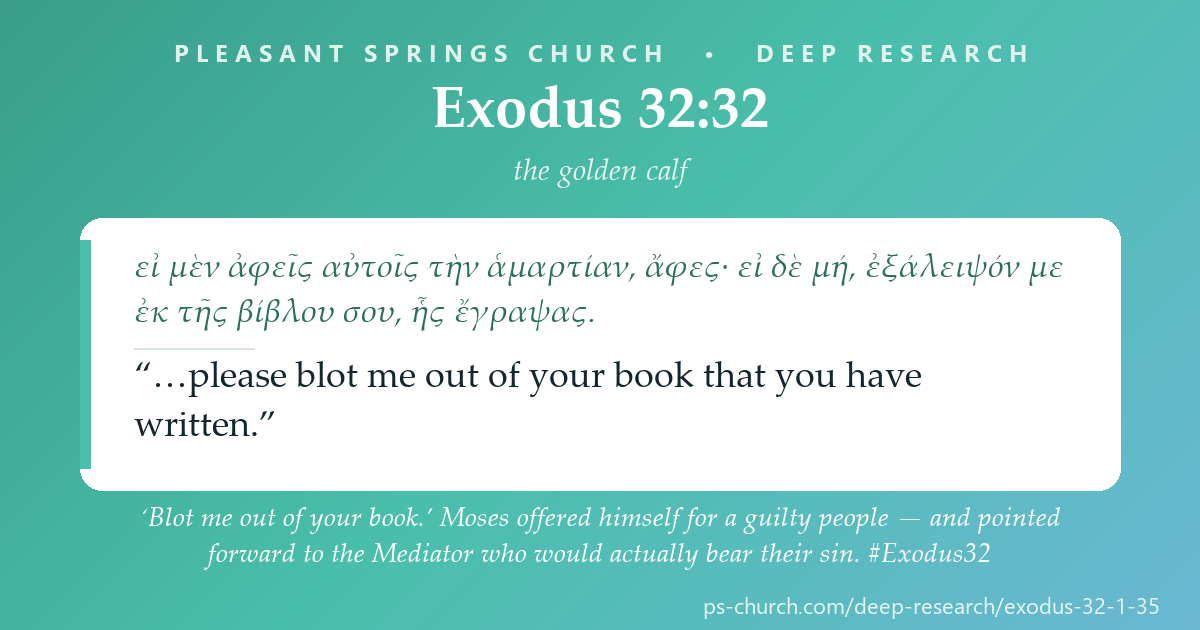
The chapter’s heart is intercession. When God’s wrath is kindled, Moses pleads God’s own name, reputation, and promises (32:11–13), and “the Lord relented” (32:14). Then Moses returns and offers something staggering: “if you will forgive their sin—but if not, blot me out of your book” (32:32). Psalm 106 remembers it: God “said he would destroy them—had not Moses… stood in the breach before him” (106:23). Paul feels the same anguish for his people: “I could wish that I myself were accursed… for the sake of my brothers” (Rom 9:3). Moses foreshadows the true Mediator — yet with a crucial difference: God does not blot out Moses for Israel. The substitution Moses offers, only Christ can actually make: “numbered with the transgressors” (Isa 53:12), becoming a curse for us (Gal 3:13), one Mediator between God and men who gave himself as a ransom (1 Tim 2:5–6).
The vocabulary of idolatry, relenting, and atonement.
Watch the calf, the “these are your gods” formula, the Lord who relents, and Moses’ costly plea.
“A molten calf” — a cast metal bull-image. Whether meant as another god or as a visible mount for the Lord, it breaks the command against images (20:4).
“These are your gods, O Israel” — crediting the calf with the exodus. Jeroboam echoes it almost verbatim (1 Kgs 12:28: “Behold” for “These are”); the archetypal formula of Israel’s idolatry.
“And he relented” (nāḥam) — God’s response to intercession, told in human terms. It reveals his mercy within his unchanging character and purpose (cf. Num 23:19); the LXX renders it ἱλάσθη, “showed mercy.”
“Blot me out” — from “your book.” Moses offers himself for the guilty; Paul echoes the cry (Rom 9:3); Christ alone fulfills the substitution.
“Perhaps I can make atonement” (kipper) — Moses goes back up seeking to cover their sin (a plague still falls, 32:35); the language of atonement whose true and saving answer is the cross (Rom 3:25; Heb 9).
How the New Testament reuses the golden calf:
- 1 Corinthians 10:7 — “Do not be idolaters as some of them were; as it is written, ‘The people sat down to eat and drink and rose up to play’” (quoting Exod 32:6): the calf as a warning to the church.
- Acts 7:39–41 — Stephen: “in their hearts they turned to Egypt… and they made a calf… and were rejoicing in the works of their hands”: idolatry as Israel’s recurring rebellion.
- Romans 9:3 — Paul’s “I could wish that I myself were accursed… for the sake of my brothers”: Moses’ intercession echoed in the apostle’s heart.
- 1 Timothy 2:5; Isaiah 53:12; Galatians 3:13 — the one Mediator who does what Moses only offered: bearing the sin he intercedes for.
From the calf at Horeb to the Mediator who bears the curse.
Trace the calf through Israel’s memory and the intercession forward to Christ the Mediator.
Which cross-references matter?
- Exodus 20:3–6; 24:3–8 — the commands (no other gods, no image) and the oath (“we will do”) that this chapter breaks (see Exodus 20, Exodus 24).
- Deuteronomy 9:7–29 — Moses’ own retelling of the calf and his forty-day intercession.
- Psalm 106:19–23; Nehemiah 9:18 — “they made a calf in Horeb”; “Moses… stood in the breach.”
- 1 Kings 12:26–33; Hosea 8:5–6; 13:2 — the calf as the pattern of the northern kingdom’s idolatry, denounced by the prophets.
- 1 Corinthians 10:1–14; Acts 7:39–43; Romans 9:3 — the calf as warning, indictment, and the model of an interceding heart.
The New Testament makes the golden calf a mirror for the church. Paul warns the Corinthians — who were flirting with idol-feasts — that Israel’s calf and its consequences were “written down for our instruction” (1 Cor 10:11); the sin is not ancient history but a live temptation of the human heart. Stephen, on trial, names the calf as the moment Israel’s heart “turned to Egypt” (Acts 7:39), exposing a rebellion that ran from the wilderness to the rejection of the Messiah. And against that backdrop, Moses’ “blot me out” shines: the true and final answer to idolatry is not merely a mediator who pleads, but one who takes the guilt away — the Mediator of a better covenant whose blood “speaks a better word” (Heb 12:24).
The scholarship on the calf and Moses’ intercession.
Moberly on Exodus 32–34; the commentators on the calf; Beale & Carson on the NT use.
Commentaries & studies:
- Brevard Childs (OTL), John Durham (WBC), Douglas Stuart (NAC) on Exodus.
- R. W. L. Moberly, At the Mountain of God: Story and Theology in Exodus 32–34.
- G. K. Beale & D. A. Carson, eds., Commentary on the New Testament Use of the Old Testament.
Interpretation notes worth keeping:
- What the calf was is debated — a rival god, or a forbidden image of the Lord (Aaron’s “feast to the Lord,” 32:5). Held either way, the sin is imaging and controlling God, against the commandment just given.
- “The Lord relented” (32:14) is told in human terms (nāḥam). Scripture holds this together with “God is not man, that he should lie, or a son of man, that he should change his mind” (Num 23:19): God genuinely responds to the intercession he himself moves Moses to make, without changing his character or ultimate purpose.
- Moses as mediator foreshadows Christ but does not equal him: God declines to blot out Moses for Israel. The substitution Moses offers awaits the One who is actually “numbered with the transgressors.”
- The Levites’ judgment (32:25–29) is a sobering covenant-court act within the story, not a template for the church; the New Testament’s weapons are “not of the flesh” (2 Cor 10:4).
From the calf at the mountain to the idols of the heart.
Name what you learned, why it matters, and one concrete response.
What should we carry away — and do?
- Idolatry is a heart under pressure. Israel fell not in Egypt but at the mountain, when God seemed slow. We, too, reach for visible, controllable gods when God delays — and the remedy is to wait on the real God, not to manufacture a manageable one.
- Intercession moves the heart of God. Moses “stood in the breach.” Prayer for others is not a formality; God works through the pleading of those who love his name and his people.
- Only Christ can be blotted out for us. Moses offered; Jesus accomplished. Our hope is not a better resolve after failure but a Mediator who bore the failure and rose.
Step in response: name one “calf” you reach for when God feels distant — a comfort, a control, an image of God shaped to your liking — and bring it honestly to Christ. Then stand in the breach for someone: pray by name this week for a person whose heart has turned away, as Moses prayed for Israel.
Exodus 32:32 · to share
LXX + ESVEvery Deep Research page traces its passage across the whole sweep — the Old Testament, the Second-Temple world between the testaments (historical witnesses, not Scripture), and the New Testament. Follow the thread:
Pleasant Springs Church — Deep Research
Research method after Michael S. Heiser’s Bible Research Method (examine dictionaries → ancient literature → important words → textual connections → academic publications → share), with the Pleasant Springs “Author & Audience” foundation. Scripture set in the Hebrew, the Greek editions named on each page and the ESV (Old Testament), and the Greek New Testament and the ESV (New Testament), per the practice of Pleasant Springs Church. Exodus 32:1–35 research grounded in Childs, Durham, Stuart, and Moberly, with Beale & Carson on the New Testament use; ANE bull-iconography background; Second-Temple material per Philo (read as a witness, not Scripture).
Scripture quotations marked ESV are from the ESV® Bible (The Holy Bible, English Standard Version®), © 2001 by Crossway, a publishing ministry of Good News Publishers. ESV Text Edition: 2016. Used by permission. All rights reserved. The ESV text may not be quoted in any publication made available to the public by a Creative Commons license, and the ESV may not be translated in whole or in part into any other language. www.esv.org
|
Did this study bless you today? 💚 Give to Support PS Church100% of gifts go to the General Fund — thank you. |