Moses gives Israel its confession — “Hear, O Israel: the Lord our God, the Lord is one” — and then spends the rest of the chapter guarding it. Not from armies. From a good harvest. You are going into a land of cities you did not build, houses you did not fill, cisterns you did not dig, vineyards you did not plant: “and when you eat and are full, then take care lest you forget the Lord” (6:12). Do not chase other gods; do not put him on trial as at Massah. And when your child finally asks what any of this means, the answer God puts in your mouth is not a rule — it is a story: “We were Pharaoh’s slaves in Egypt, and the Lord brought us out.” This study works the whole of Deuteronomy 6:1–25; the Shema itself has its own page, Deuteronomy 6:4–9. See the method →
Deuteronomy 6:2–25 (selections)
Hebrew · LXX · ESVThe Shape of the Passage
InclusioDeuteronomy is Moses’ preaching on the plains of Moab — the covenant renewed with the children of the generation that died in the wilderness. Chapter 6 follows the restatement of the Ten Words (ch 5) and the great sermon on hearing without seeing (ch 4); it is answered by the chosen-in-love sermon of ch 7 and the wilderness-schooling of ch 8, which repeats this chapter’s warning almost word for word.
Author
The Torah of Moses reaches its heart here. Deuteronomy’s verbs are hear, remember, love, choose, today — it is law preached, forty years on, by a man who will not cross the river himself (1:37; 3:23–29). Chapter 6 does what a good sermon does: it states the purpose (6:1–3), lays down the confession (6:4–9), and then spends the rest of its breath on the one thing most likely to undo it.
And that thing is not an army. The chapter names three threats in order — forgetting in prosperity (6:10–12), other gods (6:13–15), and testing God the way Israel did at Massah (6:16). Only the second looks like what we usually call temptation. The first is a full barn, and the third is a bad memory of a thirsty day. Moses is not warning a persecuted people; he is warning a people about to be comfortable.
Audience
The second generation, standing where their parents refused to stand (Numbers 13–14). They are about to inherit a country built by other hands. Everything in 6:10–11 is a gift they did not earn: the cities, the houses, the cisterns cut out of limestone, the olive trees that take a generation to bear. The text is blunt about it four times over — you did not build, you did not fill, you did not dig, you did not plant — and that is precisely why the danger is amnesia. Gratitude has a short half-life once the harvest is in.
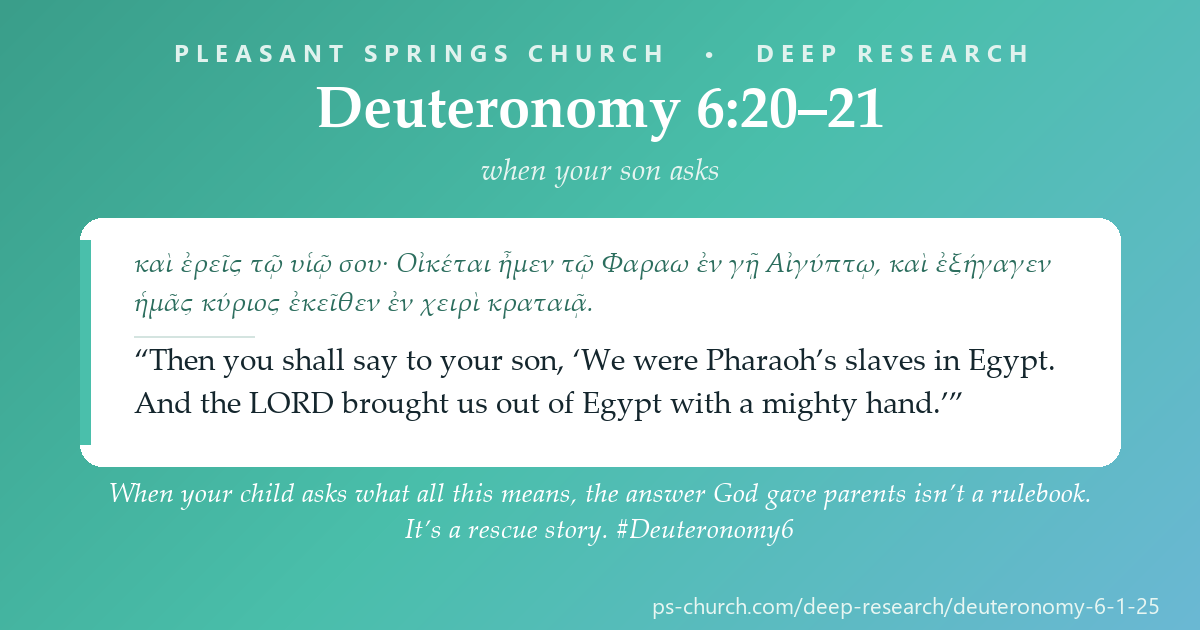
How they heard it. As householders, not as a congregation. The teaching commanded here is domestic and constant — sitting, walking, lying down, rising (6:7) — not a class but a climate. And when the child finally asks the question, the father is not handed a catechism of definitions. He is handed a testimony: “We were Pharaoh’s slaves in Egypt, and the Lord brought us out with a mighty hand” (6:21) — we, not they, though the man saying it was born in the desert. The faith is handed on as a rescue in which the hearer is included.
Orient on the Shema, covenant love, catechesis, remembering and forgetting, and Massah.
Search by topic: Shema, love (of God), covenant, catechesis / education, memory and forgetting, prosperity, Massah and Meribah, mezuzah and phylacteries, Deuteronomy.
Which articles are relevant?
- Anchor Bible Dictionary — “Shema,” “Deuteronomy,” “Love,” “Covenant,” “Massah and Meribah,” “Phylacteries,” “Mezuzah,” “Education (Israel).”
- Dictionary of the OT: Pentateuch — “Deuteronomy,” “Love,” “Memory,” “Education,” “Idolatry,” “Land,” “Testing.”
- NIDOTTE / TDOT — שָׁמַר (šāmar, keep/guard), שָׁכַח (šāḵaḥ, forget), זָכַר (zāḵar, remember), נָסָה (nāsāh, test), צְדָקָה (ṣəḏāqāh, righteousness).
Bibliography surfaced:
- Peter C. Craigie (NICOT), Daniel I. Block (NIVAC), J. G. McConville (Apollos), Jeffrey H. Tigay (JPS), Duane Christensen (WBC), Moshe Weinfeld (Anchor) on Deuteronomy.
- Meredith Kline, Treaty of the Great King, and Weinfeld, Deuteronomy and the Deuteronomic School, on the covenant/treaty form.
- Studies of the Shema’s reception, the phylactery and mezuzah texts from Qumran, and the “when your son asks” catechism texts.
- Beale & Carson, Commentary on the NT Use of the OT (Matthew; Mark; Luke).
Commanded love, words worn on the body, and a faith handed on by telling.
Read the chapter against the ANE treaty form and the physical evidence for wearing and inscribing Scripture, then watch how Second-Temple and rabbinic Judaism turned 6:20 into a liturgy of storytelling — and let the New Testament set the terms.
Which parallels shed light on religion and worldview?
Love you can command. Deuteronomy as a whole carries the shape of an ancient Near Eastern suzerainty treaty: preamble, historical prologue, stipulations, witnesses, blessings and curses. The Hittite treaties (ANET 199–206) and the Neo-Assyrian Succession Treaty of Esarhaddon (VTE; ANET 534–541) both require a vassal to “love” his sovereign with a whole heart, and to bind future generations to the oath — the very idiom of 6:5–7. W. L. Moran made this case in a 1963 article that still governs the discussion, and Moshe Weinfeld pressed it further; Meredith Kline read the same form as the book’s architecture. It is worth saying plainly that scholars run this argument in both directions on the question of the book’s date — the Hittite form is second-millennium, the Assyrian seventh-century — and this study does not adjudicate that. What the parallel does establish is the grammar: commanded love here is covenant loyalty, allegiance owed to one lord and to no other. And Deuteronomy transfigures it, because this suzerain came down and carried his vassals out of a brickyard first (6:21–23).
Words worn and words nailed up. 6:8–9 was taken literally and early. The two tiny silver amulets from Ketef Hinnom in Jerusalem (late 7th c. BC) — the oldest known fragments of biblical text — carry the Priestly Blessing (Num 6:24–26) rolled up to be worn on the body. From Qumran come actual phylacteries and mezuzot, whose slips pair Deuteronomy 6:4–9 and 11:13–21 with Exodus 13:1–16 (several also carry the Ten Words of Deut 5, a combination the later rabbis did not keep). And the Nash Papyrus (2nd c. BC), from Egypt, sets the Decalogue and the Shema side by side on one sheet — introduced by the same extra sentence the Septuagint prints at the head of 6:4, which shows that the Greek plus was translated from a Hebrew text and not invented in Alexandria.
The question and the story. Deuteronomy 6:20 belongs to a small family of texts in which a child asks and a parent answers with history rather than doctrine (Exod 12:26–27; 13:8, 14; Josh 4:6–7, 21–24). Later Judaism gathered four of these — Exod 12:26; 13:8; 13:14 and our verse — into the four sons of the Passover Haggadah, with Deut 6:20 assigned to the wise son. The Mishnah is blunt about the method: at the seder “he begins with disgrace and ends with glory,” expounding the old creed of Deut 26:5–9 (m. Pesachim 10:4). That is Deuteronomy 6:21 turned into liturgy — the faith rehearsed as a rescue story every year, in a house, with a child asking.
- Hittite suzerainty treaties (ANET 199–206) and the Vassal-Treaties / Succession Treaty of Esarhaddon (ANET 534–541) (ANE documents — witnesses, not Scripture) — the covenant form, the commanded “love” of a sovereign, and the binding of sons to the oath.
- The Ketef Hinnom silver amulets (late 7th c. BC) — the Priestly Blessing worn on the body: hard evidence that Israelites really did carry Scripture as 6:8 says.
- Qumran phylacteries and mezuzot (4QPhyl, 8QPhyl, XQPhyl; 4QMez) (Dead Sea Scrolls — witnesses, not Scripture) — Deut 6:4–9 and 11:13–21 with Exod 13:1–16, several also including Deut 5.
- The Nash Papyrus (2nd c. BC) — Decalogue and Shema on one sheet, with the introductory sentence the LXX also has before 6:4.
- Josephus, Antiquities 4.212–213 (Second-Temple — a witness, not Scripture) — Israel is to give thanks for the deliverance from Egypt twice each day, at daybreak and at bedtime, and to inscribe God’s benefits on their doors and wear them on their arms.
- Letter of Aristeas 158–160 (Second-Temple — a witness, not Scripture) — the sign on hand and doorpost read as a discipline of continual remembrance.
- Mishnah, Berakhot 1–2 (rabbinic-era — witnesses, not Scripture) — when the Shema is recited evening and morning, and R. Joshua ben Korchah’s reason for its order: one takes on “the yoke of the kingdom of heaven” first, and only then the yoke of the commandments.
- Mishnah, Pesachim 10:4; Mekhilta de-Rabbi Ishmael, Pisha 18 (rabbinic-era — witnesses, not Scripture) — the child’s question, the rule to “begin with disgrace and end with glory,” and the four sons drawn from Exod 12:26; 13:8, 14 and Deut 6:20.
Persecution is the danger every believer expects. Deuteronomy 6 warns about the other one. Read 6:10–11 slowly and notice that nothing in it is bad: great cities, good houses, full pantries, cut cisterns, vines and olives. It is a description of blessing — and it is the setup for the sharpest imperative in the chapter. The hinge is the little phrase repeated four times, which you did not: did not build, did not fill, did not dig, did not plant. The peril is not the wealth; it is the two-generation lag in which a gift starts to feel like an achievement. Whoever eats from a vineyard he planted himself may still remember God. Whoever eats from one he inherited has to be told. That is why the same chapter that commands love commands telling — and why the antidote Moses prescribes is not austerity but memory: “take care lest you forget the Lord” (6:12). Chapter 8 will say it again with the self-made man’s sentence attached — “my power and the might of my hand have gotten me this wealth” (8:17). Deuteronomy never calls the barn evil. It calls the memory fragile.
Keeping, forgetting, testing, and the words for what God gave.
Watch shamar (keep / take care) thread the whole chapter and then turn on the hearer at 6:12; note that shakach (forget) is a loyalty word; see how the LXX handles Massah and how it renders tsedaqah at 6:25.
“To keep, guard, watch” (LXX φυλάσσω) — the chapter’s Leitwort. It carries two senses at once: keep the commandment, and keep an eye on yourself. In 6:12 the reflexive form hiššāmer ləḵā (“take care for yourself”) swings the verb around from the law to the hearer, and the LXX catches it with πρόσεχε σεαυτῷ, “pay attention to yourself.”
“To forget” (LXX ἐπιλανθάνομαι) — in Deuteronomy this is not a lapse of memory but a failure of loyalty; it is the opposite of covenant faithfulness, and its cure is not concentration but rehearsal. Its twin, zāḵar (“remember”), is one of the book’s governing verbs.
“Massah” — the place-name means Testing, from nāsāh, “to test”; the LXX declines to transliterate and simply translates, ἐν τῷ Πειρασμῷ. The reference is Exodus 17:1–7, where thirsty Israel asked, “Is the Lord among us or not?” To test God is to demand that he prove himself on our terms — and it is the temptation Jesus refused on the temple pinnacle.
“Testimonies · statutes · rules” (LXX μαρτύρια · δικαιώματα · κρίματα) — the child’s exact triad at 6:20, answering the sermon’s opening triad at 6:1, where the first term is the commandment (הַמִּצְוָה) rather than testimonies; 6:17 sounds the same vocabulary again — commandments, testimonies and statutes. A testimony is not a rule at all but a witness: something that testifies to what happened. The vocabulary itself is already pointing toward the answer.
“Slaves” — the same word stands in “the house of slaves” (6:12, ESV “house of slavery”; LXX οἴκου δουλείας) and in the father’s answer, “we were slaves to Pharaoh” (6:21; the LXX has οἰκέται, household servants). The catechism begins where the warning began. You cannot tell the story without saying what you were.
“Righteousness” — “it will be righteousness for us” (6:25). The LXX renders it ἐλεημοσύνη, “mercy” and then “almsgiving,” a translation habit that shaped Greek-speaking Judaism and left its mark on the New Testament, where Jesus can move between “your righteousness” and “when you give to the needy” in a single paragraph (Matthew 6:1–4).
How the New Testament takes up Deuteronomy 6:
- Mark 12:28–31; Matthew 22:34–40; Luke 10:25–28 — Jesus names 6:4–5 the first and greatest commandment and joins it to Lev 19:18 (in Luke it is the lawyer who recites the pair and Jesus who approves the answer) — and in Mark’s wording the Shema’s three faculties become four, “with all your mind” added to heart, soul and strength (Mark 12:30; Deut 6:5 LXX has καρδίας, ψυχῆς, δυνάμεως). See Leviticus 19 and the Shema study.
- Matthew 4:7 // Luke 4:12 — 6:16, verbatim from the LXX: οὐκ ἐκπειράσεις κύριον τὸν θεόν σου, “You shall not put the Lord your God to the test.”
- Matthew 4:10 // Luke 4:8 — 6:13: “You shall worship the Lord your God and him only shall you serve.” Jesus’ wording follows the Greek witnesses that read μόνῳ (“only”), and replaces Rahlfs’ φοβηθήσῃ (“fear”) with προσκυνήσεις (“worship”) — an evangelist’s rendering, not an attested Greek variant, and one faithful to a Hebrew line whose grammar already puts the stress on him.
- Matthew 4:4 // Luke 4:4 — the third answer comes from the next great sermon, Deuteronomy 8:3. All three of Jesus’ replies in the wilderness are drawn from Deuteronomy 6–8.
- 1 Corinthians 10:9 — “We must not put Christ to the test, as some of them did and were destroyed by serpents”: Paul uses the same verb as the LXX of 6:16 (ἐκπειράζω) and turns the prohibition on testing God into a warning for the church — though the incident he points to is Numbers 21, not Massah itself.
From the Passover question to the wilderness temptation.
Trace three threads: the “when your child asks” catechism texts; the warning against prosperity amnesia; and the Deuteronomy 6–8 material Jesus quotes back at the tempter.
Which cross-references matter?
- Exodus 12:26–27; 13:8, 14 — the Passover catechism, and the identical answer-by-story: “It is the sacrifice of the Lord’s Passover…” and “By a strong hand the Lord brought us out of Egypt” (see Exodus 12 and Exodus 13).
- Joshua 4:6–7, 21–24 — twelve stones from the riverbed, set up so that “when your children ask… you shall let your children know.” Israel builds memory devices on purpose.
- Deuteronomy 26:5–9 — “A wandering Aramean was my father…”: the confession recited with the firstfruits — the same rescue told as a creed.
- Exodus 17:1–7; Psalm 95:8–9 (LXX Ps 94:8–9 — from Ps 9/10 on the Greek numbers run one behind the Hebrew) — Massah and Meribah, and the psalm that turns them into a warning for every “today” (see Exodus 17).
- Deuteronomy 8:11–18; 32:15 — the same sermon preached twice more: full houses, forgotten God, “my power and the might of my hand”; and Jeshurun who “grew fat, and kicked” (see the Deuteronomy 32 worldview).
- Deuteronomy 10:12–22; 30:6 — the same demand restated, and the promise that God will circumcise the heart to love him — grace underneath the command.
- Matthew 4:1–11 // Luke 4:1–13 — forty days in a wilderness, and every answer out of Deuteronomy 6–8.
The New Testament’s own reading of this chapter falls into two moves. First, Jesus makes 6:5 the summit: asked which commandment is first, he recites the Shema and then adds Leviticus 19:18 as inseparable from it (Mark 12:29–31). Second — and this is the labeled, textual point, not a devotional guess — when he is led into the wilderness he answers the tempter three times, and all three answers come from these two sermons: Deut 8:3, then Deut 6:16, then Deut 6:13. The pattern is hard to miss once you see it. Israel went into a wilderness, was hungry, tested God at Massah, and was warned about other gods; the Son goes into a wilderness, is hungry, refuses to test God, and refuses the kingdoms. Beale and Carson observe that the citations follow the Septuagint closely — 6:16 is quoted word for word — and that Jesus is not merely picking apt proof-texts but standing where Israel stood and keeping the covenant Israel broke. Note too what he does not do: he never appeals to his own status to win the argument. He answers as a son under the covenant, out of the same book any Israelite child was to have taught him. That is Deuteronomy 6:7 in operation.
The scholarship on Deuteronomy 6, the treaty form, and Israel’s catechesis.
Craigie, Tigay, Block, McConville, Christensen and Weinfeld on Deuteronomy; Kline and Weinfeld on the covenant form; Beale & Carson on the New Testament use.
Commentaries & studies:
- Peter C. Craigie, The Book of Deuteronomy (NICOT); Jeffrey H. Tigay, Deuteronomy (JPS); Daniel I. Block, Deuteronomy (NIVAC); J. G. McConville, Deuteronomy (Apollos); Duane L. Christensen, Deuteronomy 1:1–21:9 (WBC); Moshe Weinfeld, Deuteronomy 1–11 (Anchor).
- W. L. Moran, “The Ancient Near Eastern Background of the Love of God in Deuteronomy,” CBQ 25 (1963) 77–87 — the foundational study of commanded “love” as treaty loyalty; Meredith G. Kline, Treaty of the Great King; Moshe Weinfeld, Deuteronomy and the Deuteronomic School — the suzerainty-treaty form and the vocabulary of commanded “love.”
- Studies of the Nash Papyrus and the Qumran phylactery and mezuzah texts; work on the “when your son asks” catechism form and its place in the Passover liturgy.
- G. K. Beale & D. A. Carson, eds., Commentary on the New Testament Use of the Old Testament (Matthew; Mark; Luke).
Interpretation notes worth keeping:
- The treaty form is a real observation, not a dating argument. Deuteronomy’s architecture matches the ANE suzerainty treaty, and commanded “love” is that world’s word for loyalty. Scholars use the same evidence on both sides of the question of when the book was written; report the form, and do not smuggle a date in with it.
- Prosperity is the subtler danger. 6:10–12 (and 8:11–18) treat comfort, not opposition, as the likelier solvent of faith. Preach it as the text does — the wealth is never called sin, and no promise is made that faithfulness produces barns. The warning runs the other way.
- Teaching here is domestic and constant. “When you sit… when you walk… when you lie down… when you rise” is a merism — two opposite extremes standing for everything between. It describes a household climate, not an institution. Church programs are good; this text is talking about supper and the car and bedtime.
- Catechesis by narrative. The son asks what the testimonies mean and receives a testimony. This is why Passover is told and not merely defined — and why the apostolic gospel is a report of events (1 Cor 15:3–5) before it is a system. Doctrine is not opposed to story here; the doctrine is carried in the story.
- ‘We were slaves’ — said by a man who never was. The speaker in 6:21 was born after the exodus, and still says we. Corporate memory is not a fiction; it is how a covenant people receives a past that is genuinely theirs. Say this carefully and do not turn it into a claim that anyone may rewrite history at will.
- Do not read 6:25 as salvation by law-keeping. The verse is the last line of a story that began with slaves being rescued for nothing (6:21–23); obedience is the response of the already-redeemed, and Deuteronomy itself will say that the heart needed for it is God’s own gift (30:6). The LXX’s ἐλεημοσύνη at this verse is a translator’s choice, not a doctrine of merit.
From a full barn to a told story.
Name what you learned, why it matters, and one concrete response.
What should we carry away — and do?
- Love is the central command. Not one rule among many but the ground of all of them — and Jesus said so (Mark 12:29–30). Everything in this chapter is either the confession, or the protection of the confession.
- Watch the full barn. The chapter’s sharpest warning is aimed at a good day, not a bad one. Ask what in your life you did not build, did not fill, did not dig, did not plant — and say so out loud to God before the harvest makes you forget.
- Teach where you already are. Sitting, walking, lying down, rising. The command is not for a curriculum but for a climate; the most formative theology most children ever hear is said in a kitchen.
- When the question comes, tell the story. God put a testimony in the father’s mouth, not a definition. “We were slaves… and the Lord brought us out.” If you cannot say what you were rescued from, you will struggle to say what you were rescued for.
- Do not test him; trust him. Massah was not doubt in the abstract — it was thirsty people demanding proof on their terms. Jesus refused that on the pinnacle, and it is still the difference between asking God for help and putting him on trial.
Step in response: this week, take one ordinary moment — a meal, a drive, the last ten minutes before lights-out — and tell one person younger than you a true story of something God did. Not a principle: a thing that happened, with a date on it. Then name one good thing in your house that you did not build, and thank him for it by name.
Deuteronomy 6:12 · to share
LXX + ESVEvery Deep Research page traces its passage across the whole sweep — the Old Testament, the Second-Temple world between the testaments (historical witnesses, not Scripture), and the New Testament. Follow the thread:
Pleasant Springs Church — Deep Research
Research method after Michael S. Heiser’s Bible Research Method (examine dictionaries → ancient literature → important words → textual connections → academic publications → share), with the Pleasant Springs “Author & Audience” foundation. Scripture set in the Hebrew, the Greek editions named on each page and the ESV (Old Testament), and the Greek New Testament and the ESV (New Testament), per the practice of Pleasant Springs Church. Deuteronomy 6 research grounded in Craigie, Tigay, Block, McConville, Christensen and Weinfeld, with Kline and Weinfeld on the suzerainty-treaty form and Beale & Carson on the New Testament use (Matthew; Mark; Luke). ANE background from the Hittite treaties (ANET 199–206) and the Succession Treaty of Esarhaddon (ANET 534–541); material and Second-Temple witnesses from the Ketef Hinnom amulets, the Qumran phylacteries and mezuzot, the Nash Papyrus, Josephus and the Letter of Aristeas, with rabbinic reception from Mishnah Berakhot and Pesachim and the Mekhilta — all read as witnesses, never leveled with Scripture. Greek is Rahlfs; the LXX’s plus at the head of 6:4, its extra clause at 6:13 and its rendering of Massah and of צְדָקָה are flagged in the codex. Deuteronomy 6 carries no versification offset — MT, LXX and English agree verse for verse through this chapter. (They do not everywhere: inside the Ten Words of ch 5 the MT compresses English 5:17–21 into two verses, so MT 5:19–30 = English/LXX 5:22–33; and later in the book English 12:32 = MT/LXX 13:1; 22:30 = 23:1; 29:1 = 28:69.) The Shema itself is treated at length on its own page and only summarized here. The chapter is preached as the text preaches it: love as the covenant’s central command, prosperity as the subtler danger, and the faith handed on as a rescue story — with no prosperity-gospel inversion and no suggestion that wealth is itself sin.
Scripture quotations marked ESV are from the ESV® Bible (The Holy Bible, English Standard Version®), © 2001 by Crossway, a publishing ministry of Good News Publishers. ESV Text Edition: 2016. Used by permission. All rights reserved. The ESV text may not be quoted in any publication made available to the public by a Creative Commons license, and the ESV may not be translated in whole or in part into any other language. www.esv.org
|
Did this study bless you today? 💚 Give to Support PS Church100% of gifts go to the General Fund — thank you. |