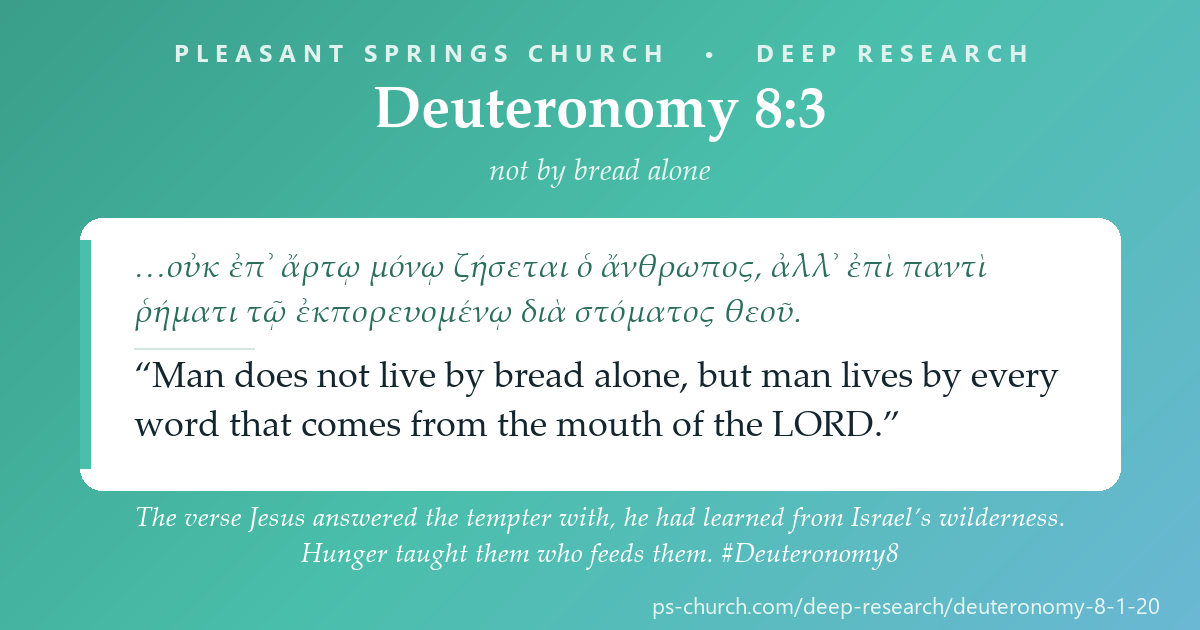
Remember the whole way he led you. Forty years, and every one of them on purpose: “that he might humble you, testing you to know what was in your heart” (8:2). He let them go hungry and then fed them manna — food nobody in the world knew how to grow — “that he might make you know that man does not live by bread alone” (8:3). Their clothes never wore out. It was a father’s work: “as a man disciplines his son” (8:5). And then Moses describes the land — brooks and springs, wheat and barley, vines and figs and pomegranates, olive oil and honey, stones of iron and hills of copper — and gives the command that goes with a full table: “you shall eat and be full, and you shall bless the Lord” (8:10). Then comes the sharpest warning in the book: take care lest you forget — lest, housed and fed and moneyed, your heart be lifted up and you say in it, “My power and the might of my hand have gotten me this wealth” (8:17). This study works Deuteronomy 8:1–20 — the wilderness as schooling, the verse Jesus quoted to the tempter, and the discovery that abundance is a harder exam than scarcity. See the method →
Deuteronomy 8:2–18 (selections)
Hebrew · LXX · ESVThe Shape of the Passage
ConcentricDeuteronomy 8 sits inside Moses’ second address (chs 5–11), the long sermon on the first commandment: the Ten Words (ch 5), the Shema and the catechism of the fathers (ch 6; and 6:4–9 in full), Israel chosen not for its greatness but in love (ch 7) — and now the wilderness re-read as a classroom, with the plainest warning in the book attached to the gift.
Author
Moses, preaching on the plains of Moab. Deuteronomy is not a law code read out; it is preached law — sermons delivered at the end of a life, forty years on, to the children of the people who came out of Egypt. Its verbs are the preacher’s verbs: remember, hear, take care, choose, love, today. Chapter 8 is one complete sermon, and its craft shows: it circles from “remember” (8:2) around to “remember” (8:18), with “forget” planted at the turn.
A book shaped like a treaty. Deuteronomy as a whole follows the pattern of an ancient Near Eastern suzerainty treaty — preamble, historical prologue, stipulations, witnesses, blessings and curses — a genuine and useful observation about the shape of the book (Kline, Weinfeld; and note that the treaty-form argument has been pressed on both sides of the dating debate, which we are not going to settle here). Chapter 8 is what a treaty’s historical prologue does when it becomes a sermon: the great King recounts his benefactions — food, clothing, water from rock — and then asks for the one thing a vassal owes a benefactor. Not payment. Memory.
Audience
A generation about to stop being poor. These are the people who grew up on manna. They have never sown a field or pressed an olive or owned a house with a roof. In a matter of weeks they will cross a river into brooks and springs and wheat and barley and vines and figs and pomegranates, and within a generation they will have herds, silver and gold, and good houses to live in (8:12–13). Moses is preaching to people on the last morning of their scarcity.
And that is exactly why he is frightened for them. Not one word of this chapter says the land is a trap or the wealth is a sin. The land is God’s gift and the command is to eat, be full, and bless him (8:10). But Moses has watched what hunger did to Israel, and he knows what fullness will do: the wilderness produced grumbling, and the good land will produce something quieter and worse — a heart lifted up (8:14), and a sentence spoken privately, “in your heart” (8:17), that nobody else ever hears. Scarcity tests whether God will provide; abundance tests whether you still think he did.
Orient on manna, wilderness testing, divine discipline, the good land, and wealth.
Search by topic: manna, wilderness / testing, discipline (musar), the good land, seven species, remembering and forgetting, wealth and riches, pride, covenant.
Which articles are relevant?
- Anchor Bible Dictionary — “Manna,” “Wilderness,” “Temptation, Testing,” “Land,” “Wealth and Poverty,” “Covenant,” “Mining and Metals.”
- Dictionary of the OT: Pentateuch — “Deuteronomy, Book of,” “Manna,” “Wilderness, Desert,” “Land,” “Blessings and Curses,” “Memory,” “Wealth and Prosperity.”
- NIDOTTE / TDOT — זָכַר (zāḵar, remember), שָׁכַח (šāḵaḥ, forget), עָנָה (ʿānāh, humble/afflict), נָסָה (nāsāh, test), יָסַר (yāsar, discipline), חַיִל (ḥayil, strength/wealth).
Bibliography surfaced:
- Peter C. Craigie (NICOT), Daniel I. Block (NIVAC), J. G. McConville (Apollos), Jeffrey H. Tigay (JPS), Duane L. Christensen (WBC), Moshe Weinfeld (Anchor) on Deuteronomy.
- Norbert Lohfink, Das Hauptgebot — the classic study of Deuteronomy 5–11 as a single sustained exposition of the first commandment, and the source of the concentric reading of ch 8.
- Beale & Carson, Commentary on the NT Use of the OT (Matthew; Luke) on the wilderness temptation.
Bread from heaven, a land of seven fruits, copper in the hills — and the oldest boast in the world.
Read the chapter against the treaty rhetoric of benefaction and loyalty, then against what the land and its metals actually were, then against how later Jewish practice and the New Testament heard it.
Which parallels shed light on religion and worldview?
Remembering as a covenant obligation. In the ANE treaties the great king does not begin with demands; he begins with a historical prologue reciting what he has already done for the vassal — rescued him, installed him, fed him — and the stipulations follow as gratitude owed. The Hittite treaties (ANET 199–206, e.g. Mursilis and Duppi-Tessub at 203–205) and, later, Esarhaddon’s vassal-treaties (ANET 534–541) are built this way. Deuteronomy 8 is that logic preached: forty years of provision recited (8:2–4, 15–16), and then the one demand — do not forget the benefactor. In treaty language, amnesia is not a lapse of attention. It is breach of covenant.
A real land, described accurately. The seven fruits of 8:8 — wheat, barley, vine, fig, pomegranate, olive, and honey — are exactly the agricultural signature of the Levantine hill country, and they became a fixed list in Jewish practice: the Mishnah rules that first-fruits are brought only from these “seven kinds” (Bikkurim 1:3), and the order of the verse still governs which blessing is said first over which fruit (b. Berakhot 41a). Verse 9 is equally concrete: “a land whose stones are iron, and out of whose hills you can dig copper.” The copper is not poetry — the Arabah, on Israel’s southern edge, holds the Timna and Faynan ore fields, among the largest ancient copper-working districts in the region, smelted on an industrial scale in the Iron Age.
“My power and the might of my hand.” The sentence Moses forbids in 8:17 is the standing self-portrait of ancient royal pride, and Scripture puts it in the mouths of the great powers in almost these words: the Assyrian king says “By the strength of my hand I have done it, and by my wisdom, for I have understanding” (Isa 10:13); Pharaoh says of the Nile, “My Nile is my own; I made it for myself” (Ezek 29:3); and of the prince of Tyre the Lord God says, “by your wisdom and your understanding you have made wealth for yourself… and your heart has become proud in your wealth” (Ezek 28:4–5). Deuteronomy 8 says this is not merely a royal vice. It is what a farmer with a full barn says too, quietly, where no one can hear.
- Hittite suzerainty treaties (ANET 199–206; Mursilis–Duppi-Tessub, 203–205) and the Vassal-Treaties of Esarhaddon (ANET 534–541) (ANE documents — witnesses, not Scripture) — the historical prologue of benefactions and the demand for undivided loyalty; the form Deuteronomy preaches from.
- 4QDeutn (4Q41, the “All Souls Deuteronomy”) (Dead Sea Scrolls — a witness, not Scripture) — a small first-century-BC scroll containing only Deut 8:5–10 and Deut 5:1–6:1. Because it is excerpted and out of order, it is generally read as a devotional or liturgical text rather than a Bible scroll: our passage’s good-land paragraph was already being copied out to be prayed.
- Mishnah, Bikkurim 1:3; Berakhot 6–7; b. Berakhot 21a, 41a, 48b (rabbinic-era — witnesses, not Scripture) — the “seven kinds” of 8:8 as the first-fruits list and the order of blessings; and 8:10 (“you shall eat and be full and bless”) taken as the Torah warrant for the grace after meals, Birkat ha-Mazon, with the four clauses of the verse mapped onto four blessings.
- Philo, Allegorical Interpretation 3.162–176 (Second-Temple — a witness, not Scripture) — manna read as the divine word, the heavenly food by which the soul is fed; the earliest surviving extended meditation on the lesson of 8:3.
- Josephus, Antiquities 4.176–193 (Second-Temple — a witness, not Scripture) — Moses’ farewell address, including the charge not to let the good land and its abundance make Israel careless of the God who gave it.
We assume scarcity is the hard test and abundance is the reward. Deuteronomy 8 says the opposite, and says it as a pastor who has seen both. The wilderness test was severe but legible: when there is no bread, everyone knows who is feeding them. The manna even arrived in a form that could not be farmed, stored, or taken credit for — food nobody in the world knew how to grow (8:3, 16). It was a forty-year lesson in a single sentence: you do not live on bread; you live on the word of a God who speaks and there is bread.
The land is the harder exam, because in the land the lesson goes invisible. God still gives the rain and the seed and the strength in the arm, but now it arrives through your own plowing, and the receipt has your name on it. Nothing has changed except that the causal chain got long enough to hide him in. That is why the warning is not against wealth but against a sentence — six words said inwardly (8:17) — and why the antidote is not poverty but blessing: eat, be full, and bless the Lord (8:10). Gratitude is the memory-work that keeps a full man honest.
Remember and forget, humble and test, manna, discipline, and the word for wealth.
Watch the pair zakhar / shakhach frame the sermon; ʿanah and nasah name what the wilderness was for; yasar makes God a father rather than a warden; and chayil quietly answers the boast of 8:17 in 8:18.
“To remember” (LXX μιμνῄσκομαι) — not nostalgia but covenant memory: holding on to what God has actually done so that it governs what you do next. The verb appears exactly twice in the chapter, and they are the two ends of the ring: “you shall remember the whole way” (8:2) and “you shall remember the Lord your God” (8:18).
“To forget” (LXX ἐπιλανθάνομαι) — the chapter’s villain, and Deuteronomy’s. It is never presented as absent-mindedness: to forget the Lord is to stop keeping his commandments (8:11) and to go after other gods (8:19). 8:19 doubles the verb (šāḵōaḥ tiškaḥ, “if you utterly forget”) — the Hebrew way of leaning on a word.
“To humble” and “to test.” Paired twice, at 8:2 and 8:16, each time with a stated purpose: to know what was in your heart (8:2) and to do you good in the end (8:16; LXX εὖ σε ποιήσῃ); ʿānāh stands once more alone at 8:3, where the humbling is hunger. God’s testing is never an experiment to satisfy his curiosity; it is a diagnosis performed for the patient’s sake, and 8:16 states the outcome he is after.
“Manna” (LXX μαννα; see Exodus 16) — described here by what it is not: food “which you did not know, nor did your fathers know.” No seed, no season, no technique, no storage. The whole point of the diet was that it could not be mastered, only received — daily.
“To discipline, train, instruct” (LXX παιδεύω, the verb behind paideia, a child’s whole upbringing). The noun mūsār is Proverbs’ word for a father’s formation of a son. 8:5 is therefore not “God punished you” but “God was raising you” — the reading Hebrews 12:5–11 presses on the church.
“Strength, capacity, wealth” — the same noun can mean an army, a virtue (the ʾēšet ḥayil of Prov 31:10), or a fortune. Here the ESV renders it “wealth,” the LXX δύναμις, “power.” Both are in it, which is the point: what a man calls my net worth is only ever strength he was given — “it is he who gives you power to get wealth” (8:18).
“My power and the might of my hand” — the confession of the self-made man, quoted by Moses so that Israel can hear it out loud before it says it silently. Note where it is spoken: bilḇāḇeḵā, “in your heart.” This is not a boast made at the gate; it is the private accounting nobody audits.
How the New Testament takes up Deuteronomy 8:
- Matthew 4:1–4; Luke 4:1–4 — led by the Spirit into the wilderness, forty days, hungry, and tempted to make bread; Jesus answers with 8:3 in the Greek of the Septuagint: “Man shall not live by bread alone, but by every word that comes from the mouth of God” (διὰ στόματος θεοῦ). All three of his answers come from these chapters — 8:3, then Deut 6:16 and 6:13 (see Deuteronomy 6). Where Israel was tested in the wilderness and failed, the Son is tested in the wilderness and holds.
- Hebrews 12:5–11 — “the Lord disciplines the one he loves… God is treating you as sons”: the theology of 8:5, quoted from Proverbs 3 and applied to suffering Christians. The Greek verb is παιδεύω — the LXX’s word in 8:5.
- Luke 12:16–21 — the rich fool: my crops, my barns, my grain, my goods, my soul. Deuteronomy 8:17 with a first-century accent, and the same verdict.
- 1 Corinthians 4:7 — “What do you have that you did not receive? If then you received it, why do you boast as if you did not receive it?” The apostolic form of 8:18.
- 1 Timothy 6:17–19 — the balance Deuteronomy 8 itself keeps: charge the rich “not to be haughty, nor to set their hopes on the uncertainty of riches, but on God, who richly provides us with everything to enjoy.” Not poverty — open-handed gratitude.
- Revelation 3:17 — “I am rich, I have prospered, and I need nothing”: prosperity amnesia, diagnosed in a church.
From manna to the good land, and from the good land to the human heart.
Trace three threads: the wilderness as school; the repeated warning of the full barn; and the boast that Scripture keeps putting in kings’ mouths and then hands to ordinary people.
Which cross-references matter?
- Exodus 16 — the manna itself: gathered daily, spoiling if hoarded, doubled before the Sabbath. Deuteronomy 8:3 is the sermon on what that diet was teaching (see Exodus 16; and the craving for meat in Numbers 11).
- Exodus 17:1–7; Numbers 20:1–13; Numbers 21:4–9 — the water from the rock and the serpents that 8:15 gathers up in a single clause (see Exodus 17, Numbers 20, Numbers 21:4–9). Deuteronomy remembers the wilderness with the hard parts left in.
- Numbers 13–14 — why there were forty years at all (see Numbers 13–14). Deuteronomy 8 does not deny the judgment; it insists the judgment was also a schooling.
- Deuteronomy 6:10–12 — the same warning in the same sermon-series, one chapter earlier: cities you did not build, cisterns you did not dig, “then take care lest you forget the Lord” (see Deuteronomy 6). Chapter 8 is Moses saying it again, harder.
- Deuteronomy 9:4–6 — the twin lie, answered next: not “my power got me this wealth” but “my righteousness got me this land.” Deuteronomy pulls both props away in consecutive chapters.
- Deuteronomy 32:13–18 — the Song: fed with the produce of the field, honey from the rock, curds and wheat — “then he forsook God who made him… you were unmindful of the Rock that bore you” (see the Deuteronomy 32 worldview).
- Hosea 13:6 — the prophetic verdict, almost quoting our text: “But when they had grazed, they became full, they were filled, and their heart was lifted up; therefore they forgot me.”
- Proverbs 30:8–9 — Agur’s prayer, the chapter turned into a petition: “feed me with the food that is needful for me, lest I be full and deny you and say, ‘Who is the Lord?’”
The Gospel writers do not quote Deuteronomy 8:3 as a handy proverb about spirituality. They stage the whole scene as a deliberate re-run. Israel is called God’s son (Exod 4:22) and led into the wilderness for forty years to be humbled and tested; Jesus is declared the beloved Son at his baptism and is immediately led into the wilderness for forty days to be tested. The first test is the same test: hunger, and bread. Israel had said, in effect, if God will not give us bread we will not have him; the Son answers with the very sentence Israel had been taught in the desert and had not learned — and answers it, Matthew and Luke both note, in the words of the Greek Old Testament. His next two answers come from Deuteronomy 6:16 and 6:13, the same sermon block.
The payoff is not merely that Jesus is a good example of resisting temptation. It is that where the son of God after the flesh failed the school of the wilderness, the Son of God has passed it — and the church that hears Deuteronomy 8 today hears it standing inside his obedience, not out on the sand alone.
The scholarship on Deuteronomy 8, the wilderness paraenesis, and the theology of memory.
Craigie, Block, McConville, Tigay, Christensen and Weinfeld for Deuteronomy; Lohfink for the structure; Kline and Weinfeld for the treaty form; Beale & Carson for the Gospels’ use.
Commentaries & studies:
- Peter C. Craigie, The Book of Deuteronomy (NICOT); Daniel I. Block, Deuteronomy (NIVAC); J. G. McConville, Deuteronomy (Apollos); Jeffrey H. Tigay, Deuteronomy (JPS); Duane L. Christensen, Deuteronomy 1:1–21:9 (WBC); Moshe Weinfeld, Deuteronomy 1–11 (Anchor).
- Norbert Lohfink, Das Hauptgebot: Eine Untersuchung literarischer Einleitungsfragen zu Dtn 5–11 — chs 5–11 read as one sustained exposition of the first commandment; the standard source for the concentric analysis of ch 8.
- Meredith G. Kline, Treaty of the Great King; Moshe Weinfeld, Deuteronomy and the Deuteronomic School — on the suzerainty-treaty form and its historical prologue of benefactions.
- Sidnie White Crawford and others on the excerpted Deuteronomy scrolls (4QDeutn, 4QDeutj) and their liturgical use.
- G. K. Beale & D. A. Carson, eds., Commentary on the New Testament Use of the Old Testament (Matthew; Luke) on the temptation narrative.
Interpretation notes worth keeping:
- The wilderness is presented as pedagogy, not merely punishment. The forty years were judgment (Num 14:34), and Deuteronomy 8 never pretends otherwise — but it insists the same years were a father’s formation (8:5) aimed at a good end (8:16). Both are true at once, and flattening either one distorts the chapter.
- The chapter does not condemn wealth or the land. Read it as written: the land is God’s gift (8:7–10), abundance is described lyrically, and the commanded response to a full stomach is a blessing, not an apology. What is forbidden is forgetting and self-attribution — not owning things.
- And it is not a prosperity text. “He gives you power to get wealth” (8:18) is the answer to a boast, not a promise of returns; its stated purpose is covenant (“that he may confirm his covenant”), not enrichment. To read 8:18 as a formula for getting rich is to make it say precisely what it was written to forbid — and the same sermon ends at 8:19–20 with perishing, not portfolios.
- “Man does not live by bread alone” is not a slight on bread. The verse says bread is not the source: what keeps a person alive is the word of the God who commands bread to exist. God fed them with manna in order to teach it — the lesson came through the food, not instead of it.
- The boast is quoted, and it is quoted as private speech. “You say in your heart” (8:17). Moses is not policing public arrogance; he is naming the inner ledger where a comfortable person silently assigns the credit. That is where this chapter does its work.
- The LXX is worth watching here. Its “mouth of God” in 8:3 is the form the Gospels quote, and its δύναμις for חַיִל in 8:17–18 pulls the boast toward power rather than money — a reminder that the sin has more than one currency.
From manna to a mortgage — and the six words that have to be unlearned.
Name what you learned, why it matters, and one concrete response.
What should we carry away — and do?
- The hard test may be the comfortable season. Hunger makes dependence obvious; a full pantry makes it invisible. If you have never considered that your good years might be the exam, this chapter was written for you.
- God’s discipline is a father’s, not a warden’s. “As a man disciplines his son” (8:5). That does not make hard years pleasant, and Scripture never asks you to pretend it does — but it does change the question from what did I do to deserve this? to what is my Father forming in me? And Scripture does not promise that every hard season is a correction — sometimes it gives no reason at all (John 9:3) — so where it is silent we should be too.
- Eat and be full — and bless him. The commanded response to abundance is not guilt and not asceticism. It is gratitude out loud (8:10). A house where thanks is said before and after the meal is a house practicing Deuteronomy 8.
- Audit the sentence. “My power and the might of my hand have gotten me this wealth” is almost never said aloud. It shows up as contempt for people who have less, anxiety when the numbers dip, and an inability to give freely. Watch for the symptoms; the sentence is underneath them.
- Remember on purpose. Memory does not maintain itself — that is why Deuteronomy commands it. Write things down. Tell your children the story. Keep the record of what God did in the years when you had nothing, and read it back to yourself in the years when you do not.
Step in response: take ten minutes this week and write out a list of what you actually have — house, health, work, skill, family, the strength in your arms — and beside each item write the honest answer to one question: where did the power to get that come from? Then do what 8:10 says: bless the Lord for it out loud. And give something away, so your hands learn what your heart just confessed.
Deuteronomy 8:3 · to share
LXX + ESVEvery Deep Research page traces its passage across the whole sweep — the Old Testament, the Second-Temple world between the testaments (historical witnesses, not Scripture), and the New Testament. Follow the thread:
Pleasant Springs Church — Deep Research
Research method after Michael S. Heiser’s Bible Research Method (examine dictionaries → ancient literature → important words → textual connections → academic publications → share), with the Pleasant Springs “Author & Audience” foundation. Scripture set in the Hebrew, the Greek editions named on each page and the ESV (Old Testament), and the Greek New Testament and the ESV (New Testament), per the practice of Pleasant Springs Church. Deuteronomy 8 research grounded in Craigie, Block, McConville, Tigay, Christensen and Weinfeld, with Lohfink for the concentric structure of the chapter, Kline and Weinfeld on the suzerainty-treaty form (reported as the shape of the book, not as a verdict in the dating debate), and Beale & Carson on the Gospels’ use of 8:3 in the wilderness temptation. ANE background from the Hittite treaties and Esarhaddon’s vassal-treaties (ANET 199–206, 534–541); Second-Temple and rabbinic witnesses (4QDeutn, Philo, Josephus, the Mishnah’s Bikkurim and Berakhot, and the Talmud on Birkat ha-Mazon), all read as witnesses, not Scripture. Numbering: Deuteronomy 1–11 carries no versification offset — MT, LXX and English agree at 8:1–20; offsets appear later in the book (English 12:32 = MT/LXX 13:1; English 29:1 = MT/LXX 28:69) and are not in play here. Greek from Rahlfs. The chapter is preached as it stands — against forgetting and self-attribution — and deliberately not inverted into a prosperity gospel: the good land is God’s gift, 8:18 answers a boast rather than promising returns, and the commanded response to abundance is to eat, be full, and bless him (8:10).
Scripture quotations marked ESV are from the ESV® Bible (The Holy Bible, English Standard Version®), © 2001 by Crossway, a publishing ministry of Good News Publishers. ESV Text Edition: 2016. Used by permission. All rights reserved. The ESV text may not be quoted in any publication made available to the public by a Creative Commons license, and the ESV may not be translated in whole or in part into any other language. www.esv.org
|
Did this study bless you today? 💚 Give to Support PS Church100% of gifts go to the General Fund — thank you. |