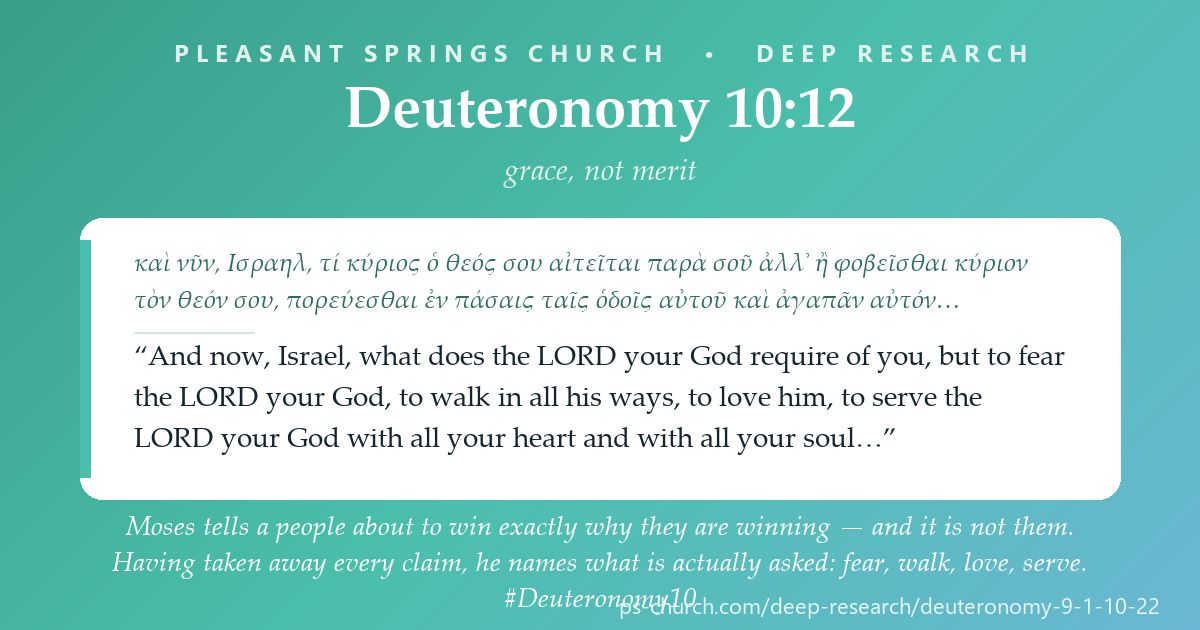
Do not say in your heart. They are one river from the promise, facing nations greater and mightier and cities “fortified up to heaven” and the Anakim everyone has heard about — and Moses, before a single wall falls, takes away the explanation they are going to reach for: “It is because of my righteousness that the Lord has brought me in” (9:4). No. It is the wickedness of those nations, and an oath sworn to Abraham. And then, so no one can misunderstand: “not… because of your righteousness, for you are a stubborn people” (9:6). He proves it with the golden calf — forty days on a mountain without bread or water while they built it, the tablets shattered in front of them, the calf burned and ground to powder and thrown in the brook — and with a list of place-names, and with his own forty days face down praying, “Remember your servants, Abraham, Isaac, and Jacob” (9:27). Then chapter 10: the tablets written out again and laid in an ark of wood, and the summary of everything — “what does the Lord your God require of you, but to fear him, to walk in all his ways, to love him, to serve him” (10:12) — grounded in a God who takes no bribe and loves the sojourner (10:17–19). And so: “Circumcise therefore the foreskin of your heart” (10:16). This study works Deuteronomy 9:1–10:22. See the method →
Deuteronomy 9:1–10:22 (selections)
Hebrew · LXX · ESVThe Shape of the Passage
InclusioThese two chapters stand near the end of Moses’ second address (chs 5–11) — the long sermon on the first commandment: the Ten Words (ch 5), the Shema and the catechism of the fathers (ch 6; 6:4–9), Israel chosen not for its size but in love (ch 7), the wilderness as schooling and the warning against “my power got me this wealth” (ch 8). Chapter 9 pulls away the other prop — my righteousness got me this land — and chapter 10 rebuilds on God’s character instead. The sermon then turns toward the code in ch 11.
Author
Moses, preaching on the plains of Moab — and preaching the hardest sermon a leader ever has to preach: the one about the congregation. Deuteronomy 8 had warned Israel not to credit itself with the wealth; Deuteronomy 9 refuses to let it credit itself with the land. The two chapters are consecutive on purpose. Between them they knock out both legs of the self-made man: what I earned, and what I deserved.
And he argues it like a preacher, not a philosopher. He does not assert that Israel is unrighteous; he proves it, from the record, at length, and with the one incident nobody could spin — the golden calf, told from Moses’ own side (9:7–21; cf. Exodus 32). Forty days on the mountain without bread or water, and while he was up there receiving the covenant, they were down here breaking it. He came down carrying two tablets written by the finger of God and smashed them in front of them, because there was nothing left to deliver them to. Then he lists the other places by name — Taberah, Massah, Kibroth-hattaavah, Kadesh (9:22–23) — and closes the file: “You have been rebellious against the " + SC + " from the day that I knew you” (9:24).
A book shaped like a treaty. Deuteronomy as a whole follows the ancient Near Eastern suzerainty-treaty pattern — preamble, historical prologue, stipulations, witnesses, blessings and curses — a genuine and useful observation about the shape of the book (Kline, Weinfeld), and one pressed on both sides of the dating debate, which we are not going to settle here. What is striking in Deuteronomy 9 is what the historical prologue contains. In the Hittite and Assyrian treaties the prologue recites the great king’s benefactions. Here Moses recites the vassal’s record of breach — and the covenant continues anyway.
Audience
A generation about to win. These are people on the edge of a victory so complete that within a few years they will be telling the story of it. Moses knows exactly what a nation says after a conquest, because every nation says it: we won because we were better. So he plants the sentence in their mouths before they can say it — “Do not say in your heart” (9:4), the private sentence again, as in 8:17 — and answers it twice, and then a third time with the reason spelled out: for you are a stiff-necked people (9:6).
Two reasons are given, and neither one is Israel. The land changes hands because of the wickedness of the nations and because God swore to Abraham, Isaac and Jacob (9:5). Judgment on one side, promise on the other — and the people walking in are, on the text’s own account, the least qualified party in the transaction. That is not cynicism about Israel. It is the definition of grace, long before anyone had a word for it.
How they were meant to hear it. Not as humiliation, and not as despair. The proof of unworthiness ends in a prayer that God answers (10:10), tablets that God writes out again (10:1–4), and a call that begins “And now” (10:12) — the hinge of the whole unit. Israel is told the truth about itself so that it can hear the requirement as a gift rather than an invoice: fear, walk, love, serve. A congregation that has been told the worst about itself and is still being kept is a congregation that can obey without pretending.
Orient on election, righteousness, the golden calf, intercession, the sojourner, and circumcision of the heart.
Search by topic: election, grace and merit, righteousness (tsedaqah), stiff-necked / hardness of heart, golden calf, Anakim, intercession and prayer, ark of the covenant, sojourner (ger), circumcision, impartiality of God.
Which articles are relevant?
- Anchor Bible Dictionary — “Election,” “Righteousness (OT),” “Calf, Golden,” “Anak, Anakim,” “Ark of the Covenant,” “Sojourner,” “Circumcision,” “Intercession.”
- Dictionary of the OT: Pentateuch — “Deuteronomy, Book of,” “Election,” “Grace,” “Golden Calf,” “Sin, Guilt,” “Prayer,” “Aliens and Strangers,” “Heart.”
- NIDOTTE / TDOT — צְדָקָה (ṣəḏāqāh, righteousness), רִשְׁעָה (rišʿāh, wickedness), עֹרֶף (ʿōrep̄, neck), מוּל (mûl, circumcise), גֵּר (gēr, sojourner), שֹׁחַד (šōḥaḏ, bribe).
Bibliography surfaced:
- Peter C. Craigie (NICOT), Daniel I. Block (NIVAC), J. G. McConville (Apollos), Jeffrey H. Tigay (JPS), Duane L. Christensen (WBC), Moshe Weinfeld (Anchor) on Deuteronomy.
- Norbert Lohfink, Das Hauptgebot — chs 5–11 as one sustained exposition of the first commandment.
- Studies of the golden-calf traditions (Exod 32 // Deut 9) and of the “circumcision of the heart” motif from Deuteronomy through Jeremiah to Paul.
- Beale & Carson, Commentary on the NT Use of the OT (Acts; Romans).
Walls to heaven, a bull for a god, a calf destroyed like a corpse — and a God who takes no bribe.
Read the chapters against the treaty rhetoric of loyalty, then against Canaanite bull-religion and the ANE way of annihilating an enemy, then against the ANE king’s standard boast of justice — and finally against how Second-Temple and rabbinic readers heard 10:12 and 10:16.
Which parallels shed light on religion and worldview?
A historical prologue that indicts the vassal. In the second-millennium Hittite treaties the great king opens by reciting what he has done for the vassal — e.g. Mursilis and Duppi-Tessub, with the prologue at ANET 203–205 (text at 199–206) — and then demands undivided loyalty; the later Assyrian treaties, such as Esarhaddon’s vassal-treaties (ANET 534–541, in the Supplement), drop the historical prologue and go straight to the loyalty stipulations. Deuteronomy 9 uses the form and inverts its content: the prologue here is a catalogue of the vassal’s defaults, incident by incident, place by place. No suzerainty treaty in the ancient world reads like this, because no ancient king would sign one. The covenant that survives such a prologue is being held together from the other end.
Why a calf. The bull was the standard ANE image of divine power and fertility, and it was not exotic to Israel: at Ugarit the high god is repeatedly addressed as “Bull El thy father” (Ugaritic myths, ANET 129–142, e.g. at 141), and Egypt had its living Apis bull. The calf was almost certainly not an attempt to swap the Lord for a foreign god but an attempt to picture him — which is exactly what the second commandment had just forbidden (Exod 20:4–6; Deut 5:8–10). Deuteronomy calls the result what it is: “the sinful thing… that you had made” (9:21).
How you destroy a god. The sequence in 9:21 — burned, crushed, ground fine, thrown into running water — is not random vandalism; it is a recognizable ancient formula for total annihilation. The closest parallel is startling: in the Ugaritic Baal cycle the goddess Anath destroys Mot, “With sword she doth cleave him… With fan she doth winnow him — With fire she doth burn him. With hand-mill she grinds him — In the field she doth sow him” (ANET 140). S. E. Loewenstamm’s well-known study set the calf’s destruction beside this text: what Israel had made a god of is treated the way the ancient world treated a defeated deity — unmade to the point where nothing remains to be gathered.
“Not partial, takes no bribe.” Ancient kings claimed to be just: the epilogue of the Code of Hammurabi boasts that the code exists “in order that the strong might not oppress” the weak and “that justice might be dealt the orphan (and) the widow” (ANET 178). Deuteronomy 10:18 takes that familiar pair — orphan and widow — and adds a third who is not in the royal formula: the גֵּר, the resident foreigner. And it does something no royal inscription does: it says the great God loves him, gives him bread and a cloak, and commands Israel to do the same because Israel was one (10:19; cf. Lev 19:34). Impartiality is claimed all over the ancient world; love of the outsider, commanded as covenant obligation, is Deuteronomy’s.
- Hittite suzerainty treaties (ANET 199–206; Mursilis–Duppi-Tessub, prologue at 203–205) and the Vassal-Treaties of Esarhaddon (ANET 534–541, in the Supplement) (ANE documents — witnesses, not Scripture) — the treaty form whose historical prologue — a feature of the Hittite treaties, which the first-millennium Assyrian ones drop — Deuteronomy 9 fills with the vassal’s failures instead of the king’s favours.
- Ugaritic myths and legends (ANET 129–142) (ANE texts — witnesses, not Scripture) — “Bull El thy father” (141) for the bull as an image of the high god; and Anath’s destruction of Mot — cleave, winnow, burn, grind, sow (140) — the closest known parallel to the sequence of unmaking in 9:21.
- Code of Hammurabi, epilogue (ANET 178) (ANE law — a witness, not Scripture) — the king’s claim to protect orphan and widow: the standard pair, to which 10:18 adds the sojourner.
- Josephus, Antiquities 3.95–101 (Second-Temple — a witness, not Scripture) — and here the silence is the datum: Josephus omits the golden calf entirely, has Moses display the tablets rather than break them, and replaces the apostasy with the people’s anxious joy at his return. Writing for a Greco-Roman readership already accusing Jews of strange worship, he simply left it out. Moses, preaching to Israel, put it in.
- Philo, On the Life of Moses 2.161–173 (Second-Temple — a witness, not Scripture) — keeps the calf, calls it imitation of “the most sacred animal in that district,” and dwells on the Levites’ loyalty.
- Rule of the Community, 1QS 5:4–6 (Dead Sea Scrolls — a witness, not Scripture) — the covenanters bind themselves “to circumcise in the Community the foreskin of the inclination and of the stiff neck”: both halves of Deut 10:16, fused into one vow, six centuries before anyone printed a cross-reference.
- Jubilees 1:22–23 (Second-Temple — a witness, not Scripture) — “they will turn to Me… with all their heart and with all their soul, and I will circumcise the foreskin of their heart”: 10:12 and 10:16 read together, and the knife put in God’s hand (as Deut 30:6 does).
- b. Berakhot 33b; b. Menachot 43b (rabbinic-era — witnesses, not Scripture) — on 10:12: R. Hanina’s “everything is in the hands of Heaven except the fear of Heaven,” with the Gemara’s honest objection that fear of Heaven is no small thing; and R. Meir’s playful reading of מָה (mah, “what”) as mēʾāh, “a hundred” — the traditional warrant for a hundred blessings a day.
It is worth stopping over what kind of man says this, and when. Moses is not addressing a defeated people in need of rebuke; he is addressing a people about to win, and he is spending his last strength making sure they cannot misread the victory. He does it by telling a story in which he himself looks foolish — forty days of fasting on a mountain for a covenant that was being broken beneath him while he received it — and in which the audience’s parents look worse. Preachers do not naturally do this. Nations do not pay for it.
Notice also what he does not do. He never says Israel is worse than the Canaanites; the text’s reasons are the nations’ wickedness and the oath to the fathers (9:5), and Israel’s stubbornness is offered as the reason it cannot claim credit, not as a comparative score. He never uses the diagnosis to make them despair — the same sermon that says “stiff-necked” three times ends by saying “fear, walk, love, serve.” And he never leaves them without the evidence that God has already dealt with it: the tablets that were smashed were written again (10:2, 4). That is the pattern for anyone who has to tell people the truth about themselves — say it plainly, say it with the receipts, and never say it without the ark of wood standing at the end of the story.
The neck, the righteousness that is denied, the two rememberings, and the heart that must be cut.
Watch qesheh-ʿoref (stiff-necked) run from the diagnosis at 9:6 to the cure at 10:16; tsedaqah negated three times over; zekhor spoken first to Israel and then to God; and ger, the sojourner God himself is said to love.
“Hard of neck” — the ox that will not turn under the yoke, braced against the driver (LXX σκληροτράχηλος). It is the passage’s key word: God’s verdict at 9:13, Moses’ word for it in prayer at 9:27 (qəšî, “hardness”), and the command that answers it at 10:16, “your neck you shall stiffen no more.” Not weakness — resistance; not ignorance — set.
“Righteousness” — three times in three verses, and all three negated. Rahlfs pluralizes it twice, τὰς δικαιοσύνας, “righteous deeds” (9:4, 6), so the Greek closes the last loophole: not your standing, and not your record either. 9:5 adds the parallel term יֹשֶׁר לְבָבְךָ, “the uprightness of your heart” — motive as well as behaviour, both ruled out.
“Wickedness” (LXX ἀσέβεια, “impiety”) — the stated ground of the dispossession. It is a moral verdict on the nations, not an ethnic one, and it comes only after four centuries of forbearance (Gen 15:16: “the iniquity of the Amorites is not yet complete”). The same standard is turned on Israel in the next breath: the land will spit them out too (Lev 18:28; Deut 8:19–20).
“Remember” — the same imperative twice, pointed in opposite directions. Israel is told, “Remember and do not forget how you provoked” (9:7). Then Moses turns and says it to God: “Remember your servants, Abraham, Isaac, and Jacob” (9:27), immediately followed by “do not regard the stubbornness of this people.” Prayer here is asking God to remember the right thing.
“Circumcise” / “foreskin” — the covenant sign of Genesis 17 turned inward: cut away the covering on the heart. The metaphor is not Deuteronomy’s invention (Lev 26:41 speaks of an “uncircumcised heart”), and it is not anti-ritual — it is a demand that the sign correspond to something. The LXX declines to translate the image at all and gives the meaning instead: τὴν σκληροκαρδίαν ὑμῶν, “your hardness of heart.”
“Sojourner / resident alien” (LXX προσήλυτος) — the outsider living among Israel without land or clan to protect him. Deuteronomy returns to him again and again, always in the same company — the Levite, the fatherless, the widow. Here he is the object of God’s own love (10:18, וְאֹהֵב גֵּר) — one of the very few places Scripture says God loves a category of person — and the ground of the command is memory: “you were sojourners in the land of Egypt.”
“Bribe / gift” — paired with לֹא־יִשָּׂא פָנִים (lōʾ-yiśśāʾ p̄ānîm), “he does not lift the face,” the Hebrew idiom for favouritism (LXX οὐ θαυμάζει πρόσωπον, “he does not marvel at a face”). Applied to God it demolishes the whole ancient economy of sacrifice-as-leverage: the God of gods cannot be bought, which is precisely why he can be trusted by people who have nothing to pay with.
How the New Testament takes up Deuteronomy 9–10:
- Romans 2:28–29 — “circumcision is a matter of the heart, by the Spirit, not by the letter”: Paul is not inventing a metaphor but quoting his Bible (10:16; Jer 4:4; Lev 26:41). See Romans 3:21–26 for where the argument lands.
- Acts 7:51 — Stephen fuses the two phrases of this very passage: “You stiff-necked people, uncircumcised in heart and ears” (Deut 9:6, 13 + 10:16). The last sermon in Acts before the first martyrdom is a Deuteronomy 9 sermon.
- Titus 3:5; Ephesians 2:8–9 — “not because of works done by us in righteousness, but according to his own mercy”; “not a result of works, so that no one may boast.” The New Testament’s formula for salvation is Deuteronomy’s formula for the land (see Ephesians 2:1–10).
- Romans 2:11; Acts 10:34–35; James 2:1–9 — “God shows no partiality”: the impartiality of 10:17 taken up as an argument for Gentile inclusion and against favouritism in the assembly (the New Testament uses its own idiom, prosōpolēmpsia, rather than the LXX wording of 10:17, οὐ θαυμάζει πρόσωπον).
- Colossians 2:11 — “a circumcision made without hands”: the inward cut of 10:16 accomplished in Christ (see Colossians 1:15–20).
- Micah 6:8; Matthew 22:37; Luke 10:27 — “what does the Lord require of you?” (Mic 6:8) is Deuteronomy 10:12 asked again by a prophet, and the fourfold answer here (fear, walk, love, serve) is the seedbed of the great commandment.
From the calf at Sinai to the circumcised heart — the canon’s own trajectory.
Trace three threads: the calf and its retellings; election as grace rather than merit; and the command to circumcise the heart, which the prophets turn into a promise and the apostles into a fact.
Which cross-references matter?
- Exodus 32–34 — the calf as it happened, the shattered tablets, Moses’ intercession and the new tablets (see Exodus 32 and Exodus 33:12–34:9). Deuteronomy 9 is the same events preached forty years later, with Moses telling them on himself.
- Exodus 25:10–22; 37:1–9 — the ark of acacia overlaid with gold (see Exodus 25). Deut 10:1–5 describes a plain “ark of wood” made by Moses; the relation of the two accounts is an old and honest question (Stage 5).
- Numbers 11; Exodus 17:1–7; Numbers 13–14 — the place-names of 9:22–23 unpacked: Taberah and Kibroth-hattaavah (Numbers 11), Massah (Exodus 17), Kadesh-barnea (Numbers 13–14). Moses is not generalizing; he is reading a list.
- Deuteronomy 7:7–8; 8:17–18 — the three great denials of merit in one sermon block: not because you were numerous (ch 7), not because your hand got it (ch 8), not because you were righteous (ch 9). What is left is love and an oath.
- Genesis 15:16; Leviticus 18:24–28 — the moral logic of 9:4–5: long forbearance, then judgment — and the same standard applied to Israel (see Genesis 15 and Leviticus 19 for the sojourner command).
- Leviticus 26:40–42; Jeremiah 4:4; 9:25–26; Ezekiel 44:7–9 — the “uncircumcised heart” across the prophets (see Leviticus 26). Jeremiah repeats Moses’ command; Ezekiel indicts a temple full of the uncircumcised in heart.
- Deuteronomy 30:6; Jeremiah 31:33; Ezekiel 36:26–27 — the command becomes a promise: “the Lord your God will circumcise your heart and the heart of your offspring, so that you will love the Lord your God with all your heart…” What 10:16 tells Israel to do, 30:6 says God will do.
- Deuteronomy 32 — the Song, which tells the same story in poetry and sets it in the wider frame of the nations (see the Deuteronomy 32 worldview).
It is worth labelling clearly what kind of move Paul is making in Romans 2:29, because it is not allegory and it is not novelty. Scripture itself opens this line and Scripture itself carries it forward. Moses commands the inward cut (10:16). Jeremiah repeats the command in the same words — “Circumcise yourselves to the Lord; remove the foreskin of your hearts” (Jer 4:4) — and then diagnoses the whole nation as “uncircumcised in heart” (Jer 9:26). Leviticus had already used the phrase (26:41). And Deuteronomy itself takes the last step: what chapter 10 commands, chapter 30 promises — “the Lord your God will circumcise your heart and the heart of your offspring, so that you will love the Lord your God with all your heart and with all your soul” (30:6). By the Second Temple period the line is public property: the Qumran covenanters vow to circumcise “the foreskin of the inclination and of the stiff neck” (1QS 5:5), and Jubilees has God say “I will circumcise the foreskin of their heart” (1:23).
So when Paul writes that “circumcision is a matter of the heart, by the Spirit, not by the letter” (Rom 2:29), he is finishing a sentence Moses started — and when Stephen calls his hearers “stiff-necked… uncircumcised in heart and ears” (Acts 7:51) he is quoting Deuteronomy 9 and 10 back to back. The New Testament does not spiritualize the Old here. It reports that the promise attached to the command has been kept: what no one could do to his own heart has been done to it (Col 2:11).
The scholarship on Deuteronomy 9–10, the calf retelling, and election as grace.
Craigie, Block, McConville, Tigay, Christensen and Weinfeld for Deuteronomy; Lohfink for the sermon-block; Loewenstamm on the destruction of the calf; Kline and Weinfeld for the treaty form; Beale & Carson for Acts and Romans.
Commentaries & studies:
- Peter C. Craigie, The Book of Deuteronomy (NICOT); Daniel I. Block, Deuteronomy (NIVAC); J. G. McConville, Deuteronomy (Apollos); Jeffrey H. Tigay, Deuteronomy (JPS); Duane L. Christensen, Deuteronomy 1:1–21:9 (WBC); Moshe Weinfeld, Deuteronomy 1–11 (Anchor).
- Norbert Lohfink, Das Hauptgebot: Eine Untersuchung literarischer Einleitungsfragen zu Dtn 5–11 — the standard treatment of chs 5–11 as one argument, within which 9:1–10:11 is the great retrospective.
- S. E. Loewenstamm, “The Making and Destruction of the Golden Calf” (Biblica 48, 1967) — the destruction of the calf set beside the Ugaritic destruction of Mot.
- Meredith G. Kline, Treaty of the Great King; Moshe Weinfeld, Deuteronomy and the Deuteronomic School — the suzerainty-treaty form, and Deuteronomy’s distinctive “humanism,” including its treatment of the ger.
- G. K. Beale & D. A. Carson, eds., Commentary on the New Testament Use of the Old Testament (Acts; Romans).
Interpretation notes worth keeping:
- Election here is pure grace, and the text says so three ways. Not because you were numerous (7:7), not because your hand won it (8:17–18), not because you were righteous (9:4–6). The reasons given are outside Israel altogether: the nations’ wickedness and the oath sworn to the fathers (9:5). Any reading that smuggles merit back in — national, moral, or spiritual — is reading against the grain of the chapter.
- ‘Stubborn’ is a verdict on the elect, not on the outsider. The text never says Israel is better than the Canaanites, and it never says Israel is worse. It says Israel has no claim. Preaching that turns 9:6 into a comparison — in either direction — loses the point, which is that the recipient of grace is disqualified by definition.
- The conquest is presented as bounded, judicial and unrepeatable. It is judgment on specific nations for specific wickedness, after long forbearance (Gen 15:16), at explicit divine command, in one moment of redemptive history — and Israel is placed under the identical standard (Lev 18:28; Deut 8:19–20; and, in the event, the exile). Note too that ANE conquest rhetoric is characteristically sweeping and stereotyped, and Deuteronomy uses that register — a caution against reading every totalizing phrase as a body count, though this is a caution about register, not a way of making the text say less than it says. It is not a warrant for any nation, ethnicity, or church at any later date; the church does not wrestle against flesh and blood (Eph 6:12).
- The ‘ark of wood’ in 10:1–5 is a real question, honestly held. Moses is told to make an ark before the tabernacle account has Bezalel make one of acacia overlaid with gold (Exod 25; 37). Commentators read this variously — a compressed retelling that names the maker by the commander; a provisional container; or simply a sermon summarizing rather than sequencing. Deuteronomy is preaching, not minuting, and it is honest to say the text does not resolve it. The same applies to the itinerary insert at 10:6–9, where Aaron dies at Moserah (cf. Mount Hor, Num 20:22–29; Num 33:38).
- Intercession appeals to the promise, not to the people. Moses offers God no mitigating evidence about Israel — he asks him not to look at them (9:27) — and pleads instead the oath to the patriarchs, the redemption already accomplished, and God’s reputation among the watching nations (9:26–29). That is the shape of biblical prayer, and it is the shape available to people with nothing to plead.
- 10:12–13 is a summary, not a reduction. “What does the Lord require… but” sounds like a shortening, and the rabbis felt the pressure of it (b. Berakhot 33b asks bluntly whether fear of Heaven is really such a small thing). Read in context it is not a lowering of the bar but a naming of the root: fear, walk, love, serve, keep — five verbs that generate the rest of the book.
- The ethics are grounded in God’s character, not in social convenience. Love the sojourner because God loves him (10:18–19), and be impartial because God is (10:17). Deuteronomy does not argue from outcomes; it argues from the nature of the God whose people they are.
From “because of my righteousness” to “fear, walk, love, serve.”
Name what you learned, why it matters, and one concrete response.
What should we carry away — and do?
- You did not get in because you were good. Deuteronomy 9 says it three times so it cannot be missed, and the New Testament says it in the same words about salvation (Titus 3:5; Eph 2:8–9). If your account of your own standing has a “because I” in it, this chapter is aimed at you.
- Watch the sentence you say in your heart. Twice now Moses has quoted the private sentence — “my power…” (8:17), “my righteousness…” (9:4). Neither is ever said out loud. Both are said constantly.
- Grace does not need you to be impressive; it needs you to be honest. The people told “you are a stubborn people” are the same people told “fear, walk, love, serve.” Being told the truth about yourself is not the end of your usefulness to God. It is the beginning of it.
- Stop stiffening. The cure named in 10:16 is not an emotion but a decision about the neck: quit bracing. And what you cannot do to your own heart, God promised to do (Deut 30:6) and has done in Christ (Col 2:11) — which makes the command a door, not a demand you must satisfy alone.
- Love the sojourner. The most concrete thing in these two chapters is bread and a cloak for the outsider (10:18–19). It is grounded in the character of God and in Israel’s own memory of being unwelcome. A church that has understood Deuteronomy 9 has no basis at all for looking down on anyone.
Step in response: write out, in one sentence, the reason you would give if someone asked why God has been good to you — and then check it for the word because I. Cross that out and put 9:5 in its place. Then do one 10:18 thing this week: food, clothing, or a place at a table for somebody who has no claim on you. That is what a circumcised heart looks like from the outside.
Deuteronomy 10:12–13 · to share
LXX + ESVEvery Deep Research page traces its passage across the whole sweep — the Old Testament, the Second-Temple world between the testaments (historical witnesses, not Scripture), and the New Testament. Follow the thread:
Pleasant Springs Church — Deep Research
Research method after Michael S. Heiser’s Bible Research Method (examine dictionaries → ancient literature → important words → textual connections → academic publications → share), with the Pleasant Springs “Author & Audience” foundation. Scripture set in the Hebrew, the Greek editions named on each page and the ESV (Old Testament), and the Greek New Testament and the ESV (New Testament), per the practice of Pleasant Springs Church. Deuteronomy 9–10 research grounded in Craigie, Block, McConville, Tigay, Christensen and Weinfeld, with Lohfink on chs 5–11 as one argument, Loewenstamm on the destruction of the calf, Kline and Weinfeld on the suzerainty-treaty form (reported as the shape of the book, not as a verdict in the dating debate), and Beale & Carson on the New Testament use (Acts; Romans). ANE background from the Hittite treaties, whose historical prologue is the feature in view (ANET 199–206), and Esarhaddon’s vassal-treaties, which drop that prologue (ANET 534–541, in the Supplement), the Ugaritic myths (ANET 129–142, incl. “Bull El” at 141 and the destruction of Mot at 140), and the epilogue of the Code of Hammurabi (ANET 178); Second-Temple and rabbinic witnesses (Josephus’ conspicuous omission of the calf at Ant. 3.95–101, Philo’s Moses 2.161–173, 1QS 5:4–6, Jubilees 1:22–23, and b. Berakhot 33b / b. Menachot 43b on 10:12), all read as witnesses, not Scripture. Numbering: Deuteronomy 1–11 carries no versification offset — MT, LXX and English agree throughout 9:1–10:22; the book’s offsets begin later (English 12:32 = MT/LXX 13:1; English 22:30 = MT/LXX 23:1; English 29:1 = MT/LXX 28:69) and are not in play here. Greek from Rahlfs; where Swete’s Vaticanus text differs materially (the loss of the last clause of 9:4) that is flagged rather than followed. Election is handled as grace and never merit; the conquest is treated as bounded, judicial and unrepeatable, under the house’s conquest discipline, and never as a template for any modern nation, ethnicity or church; and the inward turn of 10:16 is labelled as the canon’s own trajectory (Lev 26:41; Jer 4:4; Deut 30:6; Rom 2:29; Col 2:11), not as an allegory imposed on the text.
Scripture quotations marked ESV are from the ESV® Bible (The Holy Bible, English Standard Version®), © 2001 by Crossway, a publishing ministry of Good News Publishers. ESV Text Edition: 2016. Used by permission. All rights reserved. The ESV text may not be quoted in any publication made available to the public by a Creative Commons license, and the ESV may not be translated in whole or in part into any other language. www.esv.org
|
Did this study bless you today? 💚 Give to Support PS Church100% of gifts go to the General Fund — thank you. |