Your eyes have seen it — and your children’s have not. That is where Deuteronomy 11 begins: Moses charging the people who watched the sea close over Egypt and the ground open under Dathan and Abiram (11:2–7) to hand it all forward to a generation that saw none of it. Then he describes where they are going, and the description is an argument: not like Egypt, where you sowed your seed and watered it by hand like a vegetable garden, but “a land of hills and valleys, which drinks water by the rain from heaven, a land that the Lord your God cares for. The eyes of the Lord your God are always upon it, from the beginning of the year to the end of the year” (11:10–12). Obey and the early and later rain come; turn aside and the heavens shut (11:13–17). Then the Shema again — heart, hand, eyes, children, doorposts (11:18–21) — and finally the sentence the whole book has been walking toward: “See, I am setting before you today a blessing and a curse” (11:26), to be shouted from Gerizim and Ebal once they cross. This study works Deuteronomy 11:1–32 — the hinge between the sermon and the law code, where dependence is built into the geography and the covenant is put in the present tense. See the method →
Deuteronomy 11:7–29 (selections)
Hebrew · LXX · ESVThe Shape of the Passage
SequenceDeuteronomy 11 closes Moses’ second address (chs 5–11), the long sermon on the first commandment: the Ten Words (ch 5), the Shema and the catechism of the fathers (ch 6; and 6:4–9 in full), Israel chosen in love and not for its greatness (ch 7), the wilderness as schooling (ch 8), and the deflation of national pride at the golden calf (chs 9–10). Chapter 11 gathers all of it up and hands it forward — and then chapter 12 begins the code itself (ch 12).
Author
Moses, on the last page of a sermon. Deuteronomy is preached law — addresses given on the plains of Moab at the end of a life, forty years on, to the children of the people who came out of Egypt. Chapter 11 is where the preaching turns into a hand-off. Its verbs are the preacher’s verbs (love, know, remember, take care, hear, teach, see, choose), and its adverb is the preacher’s adverb: today, seven times over — eight, counting “to this day” at 11:4. Everything is put in the present tense because a covenant that is only remembered is already lost.
A book shaped like a treaty. Deuteronomy as a whole follows the pattern of an ancient Near Eastern suzerainty treaty — preamble, historical prologue, stipulations, witnesses, blessings and curses (Kline, Weinfeld). That is a genuine and useful observation about the shape of the book; note honestly that the treaty-form argument has been pressed on both sides of the dating debate, and we are not going to settle that here. What matters for chapter 11 is that the blessing-and-curse section is exactly where a treaty puts it, and Moses reaches it just as the stipulations are about to begin: 11:26–32 announces the blessings and curses, chapter 12 starts the code, and chapters 27–28 will stage the ceremony this chapter schedules.
Audience
Two generations at once. 11:2–7 is one of the strangest sentences in the Torah, and the ESV keeps its awkwardness: “consider today (since I am not speaking to your children who have not known or seen it), consider the discipline of the Lord your God.” Moses is addressing the people who were there — who watched the sea close over the chariots and the ground open under Dathan and Abiram — and in the same breath he is telling them that the next people in the room did not see any of it. Memory is about to become somebody’s job. That job is handed to parents in 11:19: talk about it sitting, walking, lying down, getting up.
Farmers who have never farmed. They grew up on manna. In a few weeks they will plant, and everything will hang on whether it rains. Moses does not soften that; he preaches it. Egypt was a place where water could be managed — a river, a channel, a foot on a dike — and Canaan is a place where it cannot. The theology is built into the topography. A land of hills and valleys has no Nile; it has a sky. And a people who must look up for rain every single year will find it harder to say what chapter 8 warned them about — “my power and the might of my hand.”
Orient on rain and the agricultural year, the land, memory and teaching, phylacteries and mezuzah, blessing and curse, Gerizim and Ebal.
Search by topic: rain / early and latter rain, agriculture in ancient Israel, irrigation in Egypt, land, memory and instruction of children, phylacteries (tefillin) and mezuzah, Shema, blessing and cursing, Gerizim, Ebal, covenant ceremony.
Which articles are relevant?
- Anchor Bible Dictionary — “Rain,” “Agriculture,” “Irrigation,” “Palestine, Climate of,” “Land,” “Phylacteries,” “Mezuzah,” “Shema,” “Blessings and Curses,” “Gerizim, Mount,” “Ebal, Mount,” “Samaritans.”
- Dictionary of the OT: Pentateuch — “Deuteronomy, Book of,” “Land,” “Agriculture,” “Blessings and Curses,” “Memory,” “Education,” “Love,” “Covenant.”
- NIDOTTE / TDOT — מָטָר (māṭār, rain), יוֹרֶה / מַלְקוֹשׁ (yôreh / malqôš, early and later rain), דָּרַשׁ (dāraš, seek / care for), עַיִן (ʿayin, eye), בְּרָכָה / קְלָלָה (berāḵāh / qelālāh, blessing / curse), טוֹטָפֹת (ṭôṭāpōṯ, frontlets).
Bibliography surfaced:
- Peter C. Craigie (NICOT), Daniel I. Block (NIVAC), J. G. McConville (Apollos), Jeffrey H. Tigay (JPS), Duane L. Christensen (WBC), Moshe Weinfeld (Anchor) on Deuteronomy.
- Norbert Lohfink, Das Hauptgebot — chs 5–11 read as one sustained exposition of the first commandment, of which ch 11 is the peroration.
- Studies of the Qumran phylacteries and mezuzot, and of the history of the Shema’s three paragraphs.
- Beale & Carson, Commentary on the NT Use of the OT, for the apostolic echoes of the rain-giving God (Acts 14:17) and the “today” of Hebrews.
A river you can manage, a sky you cannot — and the god everyone else thanked for rain.
Read 11:10–12 against how Egypt and Canaan actually got their water; then against the Canaanite storm-god whose department rain was; then against how Jewish practice turned 11:13–21 into a daily prayer and a doorpost.
Which parallels shed light on religion and worldview?
Two water systems, two theologies. Egypt is a desert with a river running through it. The Nile flooded on a schedule, and Egyptian farming was a matter of catching, storing and steering that water — basin fields, dikes, channels, and lifting devices. Deuteronomy 11:10 names the labor with a curious phrase, וְהִשְׁקִיתָ בְרַגְלְךָ, “and you watered it with your foot” (the ESV smooths this to “irrigated it” and drops the Hebrew into a footnote; the LXX keeps the feet). Commentators are divided on the picture — a foot-worked water-lifting device, or the everyday business of kicking open and stopping up the little earthen dikes between beds (so Tigay, JPS) — and the ambiguity does not matter much, because either way the point is the same. In Egypt the water came up from a river, through human effort, on the ground. In Canaan it comes down. “A land of hills and valleys, which drinks water by the rain from heaven” (11:11) is a description of hill-country agriculture that any Levantine farmer would recognize, and it is also, exactly, a doctrine of dependence.
Whose rain is it? This is not an abstract question in the Late Bronze Levant. At Ugarit the great mythological cycle stars Baal, whom the standard edition introduces in so many words as “the rain- and fertility-god” (ANET 129). In the tablets Asherah pleads for him a house, and the argument is the weather: “Now, too, the seasons of his rains will Baal observe… And (he will) peal his thunder in the clouds” (ANET 133); elsewhere the sign that Baal lives again is a dream in which “the heavens fat did rain” and “the wadies flow with honey” (ANET 140). Israel is walking into a country where every neighbour knows which god turns on the sky — and Deuteronomy 11 answers before the question is asked: the rain in its season is the Lord’s to give (11:14) and his to withhold (11:17), and going after other gods is precisely what shuts the heavens (11:16–17). Centuries later Elijah will stage that sentence as a drought (1 Kings 17–18) on Mount Carmel, in Baal’s own specialty.
How 11:13–21 became a prayer, a box and a doorpost. The Masoretic paragraph 11:13–21 is the second paragraph of the Shema, recited after Deut 6:4–9. The Mishnah says why in that order: one first accepts “the yoke of the kingdom of heaven” and only then “the yoke of the commandments” (Berakhot 2:2). The tefillin and mezuzot recovered from the Qumran caves already pair these same passages — Deut 5–6 and 10:12–11:21 with Exod 12:43–13:16 (see Exodus 13) — which means the practice this chapter commands was being done, in these words, before the New Testament was written. Josephus describes it plainly for a Greek-speaking public: the benefits of God are to be inscribed on the doors and carried on the arm (Antiquities 4.212–213). And because rain was covenant business, the Mishnah’s tractate Ta’anit is built on it: when the rains fail, Israel fasts and prays, on the theology of Deuteronomy 11:17.
Gerizim and Ebal. The two mountains face each other across the pass at Shechem, in the middle of the country — a natural amphitheatre, and the same place where Abram first heard the land promised (Gen 12:6–7; see Genesis 12). Deuteronomy 27 gives the liturgy, and Joshua 8:30–35 reports it done. The Mishnah preserves a vivid reconstruction: six tribes on one mountain and six on the other, priests, Levites and the ark below in the middle, the blessing said toward Gerizim and the curse toward Ebal (Sotah 7:5). The Samaritan Pentateuch makes Gerizim the centre of everything — it reads “Gerizim” where the Masoretic Text has “Ebal” at Deut 27:4 (with an Old Latin witness agreeing), and it expands the Ten Words with a commandment to build the altar there, drawing on 11:29–30. That is a textual dispute about chapter 27, not chapter 11: every witness agrees here that the blessing goes on Gerizim.
- Ugaritic “Poems about Baal and Anath” (ANET 129–142; the rains at 133, the raining heavens at 140) (ANE texts — witnesses, not Scripture) — Baal introduced as “the rain- and fertility-god”; the religion Deuteronomy 11:16–17 is preaching against before Israel meets it.
- Hittite suzerainty treaties (ANET 199–206) and the Vassal-Treaties of Esarhaddon (ANE documents — witnesses, not Scripture) — the blessings-and-curses section of a covenant document, which is exactly what 11:26–28 announces and Deut 27–28 delivers.
- Qumran phylacteries and mezuzot (e.g. 4QPhyl, 4QMez; Dead Sea Scrolls — witnesses, not Scripture) — tiny slips containing Deut 5–6 and 10:12–11:21 alongside Exod 12:43–13:16: 11:18–20 being obeyed, literally, in the first century BC.
- Mishnah, Berakhot 2:2; Ta’anit 1–3; Sotah 7:5 (rabbinic-era — witnesses, not Scripture) — why the Shema’s second paragraph follows the first (“the yoke of the kingdom of heaven,” then “the yoke of the commandments”); the fasts called when the rain does not come; and the reconstruction of the Gerizim–Ebal ceremony.
- Josephus, Antiquities 4.212–213 (Second-Temple — a witness, not Scripture) — the twice-daily acknowledgment of God’s benefits, inscribed on the doors and borne on the arm: 11:18–20 as lived practice.
- Samaritan Pentateuch (a textual tradition — a witness, not Scripture) — Gerizim read at Deut 27:4 and written into an expanded Decalogue; the long afterlife of 11:29 in a rival worship.
It is worth sitting with how odd this argument is. Moses is selling them a country, and his pitch is that it is less controllable than the one they left. Egypt had the most reliable water supply in the ancient world. Canaan has weather. And Moses presents this as the upgrade.
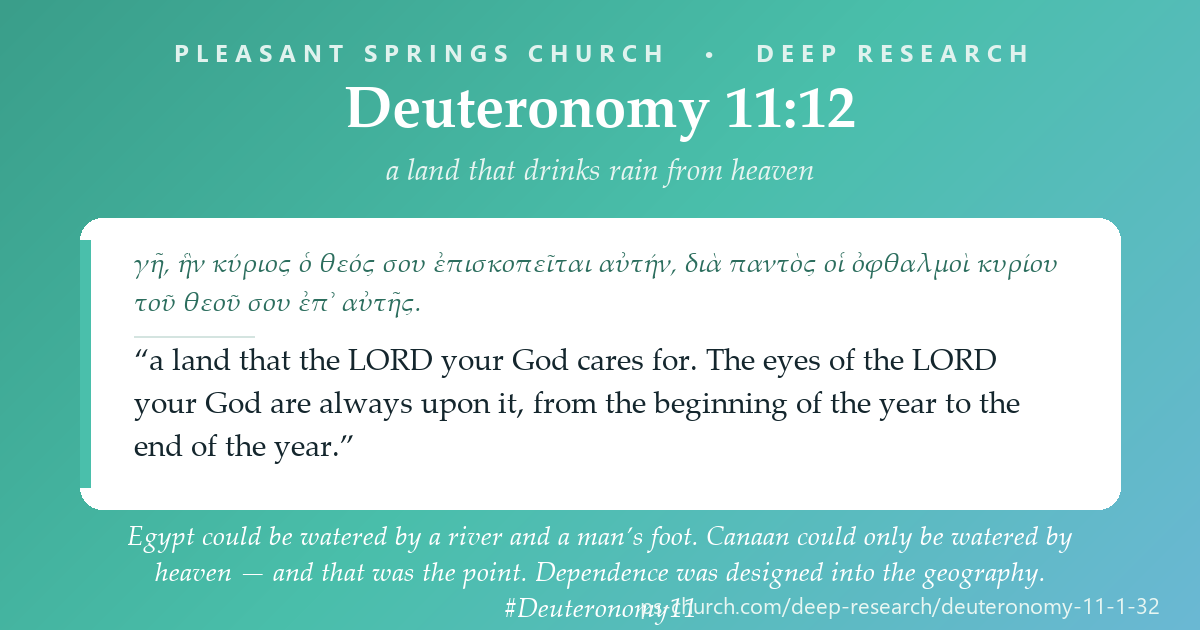
The reason is in 11:12, and it is the sentence the whole chapter is built on: this is “a land that the Lord your God cares for” — דֹּרֵשׁ, the verb usually used of people seeking God, turned around so that God is the one doing the seeking — and “the eyes of the Lord your God are always upon it, from the beginning of the year to the end of the year.” Egypt was watered by a river and by a man’s foot. Canaan is watered by a God who is watching. The insecurity is not a bug in the arrangement; it is the arrangement. A field that depends on rain is a field that has to be prayed over every autumn, and a people who must ask each year for the yoreh and again each spring for the malqosh are a people who cannot quietly forget who feeds them.
Which is why 11:13–17 is not a mechanical rain-for-obedience contract, and should not be preached as one. It is the same pastoral logic as chapter 8 running the other direction: there Moses feared that a full barn would hide God behind a long causal chain; here he points out that God has settled them somewhere the chain stays short. The geography is catechesis. Every harvest in that country is an answered prayer, and every drought is a question.
Today, the eye, the God who seeks a field, the two rains, and the blessing set on the table.
Watch hayyom (today) knit the panels together; the three ʿayin (eye) sightings move from the fathers to God to the children; darash put God in the farmer’s place; yoreh and malqosh make dependence an annual appointment; and natan lipnekem (“setting before you”) frame the choice at 11:26 and 11:32.
“Today” (LXX σήμερον) — the chapter’s drumbeat, seven times, plus “to this day” at 11:4. Deuteronomy’s favourite word does a specific job: it collapses the forty years between Sinai and Moab so that a covenant made with the fathers is offered to the sons now. The children in 11:2 did not see the sea open — and they are still handed a real choice, in the present tense, in 11:26.
“Eye” (LXX ὀφθαλμός) — three occurrences, and they tell the chapter’s whole story. Your eyes have seen what God did (11:7); the Lord’s eyes are on the land all year (11:12); and the words are to sit “between your eyes” (11:18). Sight given, sight returned, sight trained.
“To seek, enquire after, care for” — ordinarily what people do toward God (“seek the Lord”). Here the subject is God and the object is a patch of ground: “a land that the Lord your God cares for.” The LXX chooses ἐπισκοπεῖται, “oversees, keeps watch over” — the verb behind episkopos, overseer. God is the resident farmer of Canaan.
“Early rain and later rain” (LXX πρόιμον καὶ ὄψιμον) — not poetry but a farming calendar. The yoreh falls in October–November and softens ground baked by a rainless summer so it can be ploughed and sown; the malqosh falls in March–April and fills out the grain just before harvest. Miss either one and the year fails. Two prayers a year, minimum, for as long as you live in that land.
“To be enticed, deceived, taken in” — “take care lest your heart be deceived.” Not lest you decide to apostatize; the Hebrew assumes nobody plans it. Apostasy is presented as something you are talked into, in the heart, gradually. The LXX pictures it differently — μὴ πλατυνθῇ ἡ καρδία σου, “lest your heart be widened” — the heart that has grown roomy enough to hold other gods too.
“Frontlets” — a rare word of uncertain origin, occurring only here, Exod 13:16 and Deut 6:8. Second-Temple Judaism read it literally and made tefillin, small boxes of scripture bound on the arm and head; the Qumran caves have produced them. The LXX declines the image and renders the clause “it shall be ἀσάλευτον, unshakeable, before your eyes.” Both readings are after the same thing: words you cannot get out of your field of vision.
“A blessing and a curse” (LXX εὐλογίαν καὶ κατάραν) — the standing pair that closes an ANE treaty and closes Deuteronomy (chs 27–28). Note the grammar of 11:26: Moses does not pronounce them, he sets them (נֹתֵן, “giving, placing”) before the people, and the identical clause returns at 11:32 for the statutes themselves. What is laid on the table today is not a verdict. It is a choice.
How the New Testament takes up this chapter’s themes:
- Acts 14:17 — Paul and Barnabas at Lystra, preaching to pagan farmers: God “did not leave himself without witness, for he did good by giving you rains from heaven and fruitful seasons, satisfying your hearts with food and gladness.” That is Deuteronomy 11:14–15 addressed to Gentiles who had never read it.
- Matthew 5:45 — “he makes his sun rise on the evil and on the good, and sends rain on the just and on the unjust.” Jesus keeps the doctrine that rain is God’s gift and forbids reading any particular rainfall as a verdict on a particular person.
- James 5:7–8 — “the farmer waits for the precious fruit of the earth, being patient about it, until it receives the early and the late rains” — the two rains of 11:14, turned into a picture of waiting for Christ.
- Luke 4:25; James 5:17–18; Revelation 11:6 — the shut heaven of 11:17 in the hands of Elijah, and again at the end.
- Hebrews 3:7–15; 4:7 — “Today, if you hear his voice…” (quoting Psalm 95 · LXX 94): Deuteronomy’s adverb becomes the New Testament’s word for the open window of grace, and the church is told to say it to one another “every day, as long as it is called ‘today.’”
- Ephesians 6:4 — “bring them up in the discipline and instruction of the Lord”: the parental job description of 11:19 handed to Christian fathers (see Ephesians 2 for the letter’s frame).
From Dathan and Abiram to Gerizim — and from “today” to “today.”
Trace three threads: what the eyes saw and how it gets taught; rain as covenant currency; and the setting-before that Deuteronomy will say twice more.
Which cross-references matter?
- Numbers 16 — Dathan and Abiram, the ground opening, “every living thing that followed them” (11:6). Deuteronomy 11 names the one wilderness judgment that happened to Israelites and puts it in the same list as the Red Sea (see Numbers 16–17).
- Deuteronomy 6:4–9 — 11:18–20 repeats it almost word for word: heart, hand, eyes, children, sitting and walking and lying down and rising, doorposts and gates. The change is instructive — ch 6 is singular (“you”) throughout, while ch 11 puts the commands in the plural (“you all”) and then slips back to the singular for the sitting and walking and the doorpost: the same discipleship, now laid on a whole community (see Deuteronomy 6:4–9).
- Deuteronomy 8:7–18 — the same good land, the same danger. There the risk was a full barn hiding the giver; here the sky keeps the giver in view (see Deuteronomy 8).
- Leviticus 26:3–4, 19–20 — “then I will give you your rains in their season” and, in the curse, “I will make your heavens like iron”: the sanctuary book’s version of 11:13–17 (see Leviticus 26).
- Deuteronomy 27–28; Joshua 8:30–35 — the ceremony 11:29 schedules: the tribes on the two mountains, the altar, the law read aloud “before all the assembly of Israel, and the women, and the little ones, and the sojourners.”
- Deuteronomy 30:15–20 — Moses says it a third and final time, and adds the imperative: “I have set before you life and death, blessing and curse. Therefore choose life.” 11:26 is where that sentence is first laid on the table.
- 1 Kings 8:35–36; 17–18; Jeremiah 5:24; Hosea 6:3; Joel 2:23; Amos 4:7 — prophets and kings reasoning from exactly this chapter: withheld rain as summons, restored rain as mercy, and Baal humiliated on his own mountain.
- Deuteronomy 12 — what comes next. Chapter 11 ends “the statutes and the rules that I am setting before you today”; chapter 12 begins “these are the statutes and rules that you shall be careful to do” (see Deuteronomy 12).
The hardest verse in the chapter is not the curse; it is 11:2. Moses says he is not speaking to the children, who have not known or seen it — and then, twenty-four hours of preaching later, he tells the adults to talk about it when they sit and when they walk and when they lie down and when they get up (11:19). Put those together and you have the whole doctrine of transmission in two moves. First, an honest admission: experience does not inherit. Whatever your eyes saw, your children’s eyes did not. Second, an assignment: therefore the seeing generation has to become a speaking generation, and the speaking has to be ordinary. Not a ceremony — a household. Meals, roads, bedtimes, mornings.
Notice what is not here. Moses does not tell the parents to manufacture the experience for their children, and he does not tell the children to make do with somebody else’s memory. He gives the children something better than a story about the past: a choice of their own, set before them, today (11:26). The second generation is not asked to remember the Red Sea as if they had been there. They are asked to answer God for themselves, in a land whose every rainfall will make the same case the sea once made. Faith is taught, and it is never inherited. Both halves of that are in this chapter, and a church that drops either one will lose its children in a different way.
The scholarship on the peroration of Deuteronomy 5–11, the rain theology, and the Gerizim tradition.
Craigie, Block, McConville, Tigay, Christensen and Weinfeld for Deuteronomy; Lohfink for the shape of chs 5–11; the Qumran phylactery studies for 11:18–20; Kline and Weinfeld on the treaty form.
Commentaries & studies:
- Peter C. Craigie, The Book of Deuteronomy (NICOT); Daniel I. Block, Deuteronomy (NIVAC); J. G. McConville, Deuteronomy (Apollos); Jeffrey H. Tigay, Deuteronomy (JPS) — especially on “watered with your foot” at 11:10; Duane L. Christensen, Deuteronomy 1:1–21:9 (WBC); Moshe Weinfeld, Deuteronomy 1–11 (Anchor), the standard technical treatment of exactly this block.
- Norbert Lohfink, Das Hauptgebot — Deuteronomy 5–11 as one sustained exposition of the first commandment; ch 11 read as its peroration and bridge to the code.
- Meredith G. Kline, Treaty of the Great King; Moshe Weinfeld, Deuteronomy and the Deuteronomic School — the suzerainty-treaty form and its blessings-and-curses section.
- Studies of the Qumran tefillin and mezuzot (their passage-selection, including Deut 10:12–11:21) and of the Samaritan Pentateuch’s Gerizim readings.
- G. K. Beale & D. A. Carson, eds., Commentary on the New Testament Use of the Old Testament (Acts; Hebrews; James).
Interpretation notes worth keeping:
- 11:10–12 is theology done with geography. The contrast with Egypt is not a slur on Egyptian farming; it is an observation that the two countries teach different lessons about where water comes from. Preach the dependence, not a hierarchy of nations.
- The rain promises are covenantal, not mechanical. Deuteronomy addresses a nation under a specific covenant in a specific land; it is not issuing a formula by which any individual’s obedience produces any particular weather, harvest, or income. Job exists, and so does Matthew 5:45. Read 11:13–17 as the shape of Israel’s national life with God, and resist every attempt to run it as a private prosperity engine.
- “Today” is doing theological work. The word is not filler. It is how Deuteronomy makes a past covenant present to a generation that was not there — the same move Hebrews makes on the church (Heb 3:13; 4:7). Where the sermon says today, the preacher should too.
- 11:18–21 is 6:4–9 in the plural. The repetition is deliberate and the number changes: the private catechism of ch 6 becomes a communal one. Alter’s rule of thumb applies — when something is repeated, look at what changed.
- The blessing and the curse are announced here and enacted later. 11:26–32 is a heading, not the ceremony; chs 27–28 supply the liturgy and Joshua 8 the performance. Do not read 11:29 as though the mountains were the point — the point is that a covenant gets ratified publicly, out loud, by a whole people.
- Do not over-read the Samaritan question. The Gerizim/Ebal textual dispute belongs to Deut 27:4, not to 11:29, where the witnesses agree. It is worth knowing because it explains the woman at the well’s “our fathers worshiped on this mountain” — and worth handling without polemic.
From a river you can steer to a sky you cannot — and a choice with a date on it.
Name what you learned, why it matters, and one concrete response.
What should we carry away — and do?
- Dependence was designed in. God did not put his people in the most controllable country available. He put them where the water falls out of the sky, and then told them his eyes were on the field all year (11:12). If your life feels less manageable than you would like, do not assume that is a failure of arrangement.
- What your eyes saw, your children’s did not. That is not a tragedy; it is the job description. Talk about it sitting and walking and lying down and rising (11:19). Ordinary speech in an ordinary house is the method Scripture actually prescribes.
- And you cannot hand them your faith. Moses gives the second generation their own today and their own choice (11:26). Teach everything you know; then let them answer God themselves. Both halves.
- Nobody plans to drift. “Take care lest your heart be deceived” (11:16) — the Hebrew assumes apostasy is something you get talked into, not something you decide. Watch the heart that is quietly getting roomy.
- The choice is dated. Seven times “today.” Not someday, not in principle, not when the questions are settled. “See, I am setting before you today a blessing and a curse” — and Hebrews says the window is still open and still called by the same name (Heb 3:13).
Step in response: pick the one thing in your life you have been trying hardest to irrigate with your own foot — the outcome you keep managing, steering, and worrying into place — and this week hand it up to the sky instead: pray for it out loud, by name, and then do the next ordinary faithful thing and leave the rain to God. Then, at one meal, tell somebody younger than you one true story of something your own eyes have seen him do.
Deuteronomy 11:12 · to share
LXX + ESVEvery Deep Research page traces its passage across the whole sweep — the Old Testament, the Second-Temple world between the testaments (historical witnesses, not Scripture), and the New Testament. Follow the thread:
Pleasant Springs Church — Deep Research
Research method after Michael S. Heiser’s Bible Research Method (examine dictionaries → ancient literature → important words → textual connections → academic publications → share), with the Pleasant Springs “Author & Audience” foundation. Scripture set in the Hebrew, the Greek editions named on each page and the ESV (Old Testament), and the Greek New Testament and the ESV (New Testament), per the practice of Pleasant Springs Church. Deuteronomy 11 research grounded in Craigie, Block, McConville, Tigay, Christensen and Weinfeld, with Lohfink on chs 5–11 as one sustained sermon, Kline and Weinfeld on the suzerainty-treaty form (reported as the shape of the book, not as a verdict in the dating debate), and Beale & Carson for the apostolic echoes (Acts; Hebrews; James). ANE background from the Ugaritic Baal texts (ANET 129–142; the rains at 133 and 140) and the Hittite treaties (ANET 199–206); Second-Temple and rabbinic witnesses (the Qumran phylacteries and mezuzot, Josephus Ant. 4.212–213, and the Mishnah’s Berakhot, Ta’anit and Sotah), plus the Samaritan Pentateuch as a textual tradition — all read as witnesses, not Scripture. Numbering: Deuteronomy 1–11 carries no versification offset — MT, LXX and English agree throughout 11:1–32, and no verse cited here sits in an offset zone; the offsets begin in the next chapter (English 12:32 = MT/LXX 13:1, hence English 13:1–18 = MT/LXX 13:2–19) and later at English 22:30 = MT/LXX 23:1 and English 29:1 = MT/LXX 28:69. Greek from Rahlfs. The literary structure is presented as a sequence keyed to the Masoretic paragraph divisions, not as a chiasm. The rain promises are preached as covenantal — the shape of Israel’s national life with God in that land — and deliberately not converted into a private prosperity formula; Matthew 5:45 is kept in view.
Scripture quotations marked ESV are from the ESV® Bible (The Holy Bible, English Standard Version®), © 2001 by Crossway, a publishing ministry of Good News Publishers. ESV Text Edition: 2016. Used by permission. All rights reserved. The ESV text may not be quoted in any publication made available to the public by a Creative Commons license, and the ESV may not be translated in whole or in part into any other language. www.esv.org
|
Did this study bless you today? 💚 Give to Support PS Church100% of gifts go to the General Fund — thank you. |