The law code opens by tearing down and building up. Destroy the places where the nations served their gods — on the high mountains, under every green tree; break the altars, dash the pillars, burn the Asherim, chop down the images — and then the sentence the whole chapter turns on: “You shall not worship the Lord your God in that way” (12:4). Instead, “the place that the Lord your God will choose” — six times over (12:5, 11, 14, 18, 21, 26), three of them adding that his name is put or made to dwell there (12:5, 11, 21). This study works Deuteronomy 12:1–32: worship on God’s terms rather than “everyone doing whatever is right in his own eyes” (12:8); the one place as both a discipline and a mercy; the blood that is never eaten and the meat that now may be; the landless Levite written into every feast; and joy given as an actual command — you shall eat before the Lord and rejoice. (Numbering note: the versification split starts here — English 12:32 = MT/LXX 13:1.) See the method →
Deuteronomy 12:2–32 (selections)
Hebrew · LXX · ESVThe Shape of the Passage
Parallel panelsDeuteronomy 12 opens the law code (chs 12–26). Everything before it has been sermon: the historical prologue (chs 1–3), the Ten Words (ch 5), the Shema (6:4–9), the ban and the love that chose the fewest (ch 7), the warning against forgetting in plenty (ch 8), “not because of your righteousness” (chs 9–10), and the blessing and curse set before them (ch 11). Now the stipulations begin — and they begin, as the Ten Words did, with worship. Chapter 13 will guard the same loyalty against the prophet, the family member and the city.
Author
The Torah of Moses, still preaching. Deuteronomy is not a filing cabinet of statutes but a sermon delivered forty years on, east of the Jordan, to the children of the generation that died in the wilderness; its verbs are remember, hear, love, choose, today. The book’s overall architecture follows the ancient Near-Eastern suzerainty treaty — preamble, historical prologue, stipulations, witnesses, blessings and curses (so Kline and Weinfeld) — and chapter 12 is where the stipulations start. That observation is genuinely useful for reading the book; it is also pressed on both sides of the dating debate, and this study does not try to settle that.
What the chapter actually does. It gives one law, four times over, and adds something each time. The law is: worship where God says, in the way God says. The additions are joy (12:7), the Levite (12:12), the freedom to eat ordinary meat at home (12:15, 20–22), and the blood that is never eaten (12:16, 23). Notice the order of the two halves. The demolition comes first — altars, pillars, Asherim, images, and the very name of the shrine (12:2–3) — and then the hinge: “You shall not worship the Lord your God in that way” (12:4). The danger is not only that Israel will serve other gods. It is that Israel will serve the right God in the wrong way, on borrowed furniture, at the old high places, with the Lord’s name written over a Canaanite altar. That is what the chapter is built to prevent.
Audience
A people about to stop camping. In the wilderness the tabernacle moved with them, and 12:8 concedes that things had been improvised: “everyone doing whatever is right in his own eyes.” That sentence is not praise. It is the phrase Judges will pick up twice, almost word for word, as the epitaph of a nation with no king and no centre (Judg 17:6; 21:25). Once the people settle, scattered across towns and a day’s walk from anywhere, the improvisation has to end — and it ends not by everyone building a shrine on his own hill but by everyone going, together, to one place.
Mercy and discipline in the same command. One place is a discipline: it costs a journey, it removes the convenient local altar, and it puts your worship under someone else’s roof. But it is also a mercy. It keeps the poor family and the rich family at the same table; it makes the whole nation one congregation instead of a hundred private cults; it protects worship from drifting into whatever the neighbours are doing; and it forces every household, three times a year, to be in the same room as everyone else’s. And it is the landless Levite — who has “no portion or inheritance” (12:12) — who is written into every single feast by name. A worship that leaves out the man with no land is not the worship this chapter commands.
The demolition, read honestly. The command to smash the shrines belongs with the conquest material and gets the same treatment here as in chapter 7: it is bounded — to one land, at one moment, by explicit divine command, against the cult objects of peoples whose practices the text names without euphemism (12:31, children burned in the fire). It is aimed at altars and images, not at persons. It is not a template for any nation, church, or person today, and the New Testament closes the door: “the weapons of our warfare are not of the flesh” (2 Cor 10:4), “we do not wrestle against flesh and blood” (Eph 6:12), and when two disciples proposed fire from heaven on an unwelcoming village, “he turned and rebuked them” (Luke 9:54–55). Nobody may pick this up.
Orient on the high place, centralization, the chosen place, Name theology, the Levite, and blood.
Search by topic: high place (bamah), pillar (massebah), Asherah, centralization of worship, the chosen place, Name theology, Levites and their portion, tithe, profane slaughter, blood, joy / feasting, Shiloh and Jerusalem.
Which articles are relevant?
- Anchor Bible Dictionary — “High Place,” “Pillar (Maṣṣebah),” “Asherah,” “Centralization of the Cult,” “Name of God,” “Levites,” “Tithe,” “Blood,” “Sacrifice and Offerings.”
- Dictionary of the OT: Pentateuch — “Worship,” “Altars,” “Sacred Space,” “Idolatry,” “Levites,” “Blood,” “Feasts and Festivals,” “Land.”
- NIDOTTE / TDOT — מָקוֹם (māqôm, place), בָּחַר (bāḥar, choose), שֵׁם (šēm, name), שָׂמַח (śāmaḥ, rejoice), יָשָׁר (yāšār, right/upright), בָּמָה (bāmāh, high place), דָּם (dām, blood).
Bibliography surfaced:
- Peter C. Craigie (NICOT), Daniel I. Block (NIVAC), J. G. McConville (Apollos), Jeffrey H. Tigay (JPS), Duane L. Christensen (WBC), Moshe Weinfeld (Anchor) on Deuteronomy.
- J. G. McConville, Law and Theology in Deuteronomy — the classic argument that “the place” is a theological claim about God’s freedom to choose, not a code word for one later sanctuary.
- Sandra L. Richter, The Deuteronomistic History and Name Theology (BZAW 318) — the ANE idiom behind “to place his name there.”
- Studies of the bamah (high place) in text and archaeology (Arad, Beersheba, Tel Dan); and of the Samaritan Pentateuch’s “has chosen” readings.
- Beale & Carson, Commentary on the NT Use of the OT (John; Acts; Hebrews).
High places, the god’s name on a monument, and what later readers did with “the place.”
Read the demolition list and the “chosen place” against the Iron-Age evidence for shrines and for “placing a name,” then follow the one place through the Second-Temple world — where it was fought over — and let the New Testament set the terms.
Which parallels shed light on religion and worldview?
The high place was ordinary. The furniture of 12:2–3 — an altar, standing stones (מַצֵּבוֹת), a wooden Asherah, carved images, on a hilltop or under a spreading tree — is exactly what Iron-Age Levantine worship looked like. The Mesha Inscription (the Moabite Stone, c. 840 BC) says so in its own words: the king records the making of “this high place for Chemosh in Qarhoh” because the god “saved me from all the kings,” and later boasts, “I built Beth-bamoth” — the “house of high places” (ANET 320). Archaeology adds the physical side: the Judahite sanctuary inside the fortress at Arad, with its altar and standing stones, was deliberately dismantled and buried; the great horned altar at Beersheba was taken apart and its stones reused. Scholars debate whether those dismantlings belong to Hezekiah’s reform or Josiah’s or neither — that argument is not settled here — but they show a real world in which Deuteronomy 12’s command had something concrete to demolish.
“To put his name there” is not a euphemism. Moshe Weinfeld famously read the phrase as a demythologizing move: God dwells in heaven and only his name is at the sanctuary. Sandra Richter has argued, with a large body of Akkadian evidence, that ləšakkēn šəmô šām corresponds to the standard idiom šuma šakānu — what a king does when he sets up a monument in conquered territory: he places his name there, and the place is now his. Read that way, 12:5 is a claim of ownership and presence together, and it stands in deliberate contrast to 12:3, where the nations’ shrines lose their name from that place. One name comes down; another goes up.
Which place — and when? Deuteronomy never names it: “the place that the Lord will choose” (imperfect), which the Greek renders ὃν ἂν ἐκλέξηται, “whichever he may choose.” The Samaritan Pentateuch reads the perfect — “the place the Lord your God has chosen” — in some twenty-one places in Deuteronomy, and for Samaritans that place is Mount Gerizim, chosen from creation. Most text critics (Tov; Anderson and Giles) treat the perfect as a sectarian harmonization; a minority (Schorch) argue from scattered Greek, Latin and Coptic witnesses that it is original. The debate is live and is reported here, not settled — but the reader should notice how much rides on a single verb, and that the woman at the well raised precisely this question with Jesus (John 4:20).
- Mesha Inscription / Moabite Stone (Moabite, c. 840 BC; ANET 320–321) — a king builds “this high place for Chemosh” and rebuilds “Beth-bamoth”: the bamah in its own world, and for another god. A witness, not Scripture.
- Ugaritic texts (the Baal Cycle) — the god’s house on the heights of Zaphon, and Athirat/Asherah in the pantheon: the religious imagination behind “on the high mountains… and under every green tree” (12:2) and the Asherim of 12:3.
- Assyrian and Babylonian royal inscriptions (the “placing of a name” on monuments and cities; cf. the historical texts at ANET 274–301, and the temple-repair ritual at ANET 339–342) — the idiom behind ləšakkēn šəmô šām (Richter). Cited for the idiom; individual page references beyond the Mesha text are not verified here.
- Samaritan Pentateuch, Deut 12:5 etc. — the perfect “has chosen” against the Masoretic imperfect “will choose,” and Mount Gerizim. A textual witness, and the fault line of John 4:20.
- Temple Scroll (11QT) cols. 52–53 (Dead Sea Scrolls — a witness, not Scripture) — re-legislates the profane-slaughter concession of 12:15, 20–22 and restricts it to those living more than a three days’ journey from the sanctuary (11QT 52:13–16). An early attempt to tighten a text that had loosened something.
- Josephus, Antiquities 4.199–201 (Second-Temple — a witness, not Scripture) — “Let there be one holy city… and let there be one temple therein, and one altar,” with the reason: because God is one and the nation is one. Deuteronomy 12 turned into a constitutional principle.
- Philo, Special Laws 1.66–70 (Second-Temple — a witness, not Scripture) — there is one temple because there is one God; the singleness of the sanctuary is an argument about monotheism.
- Mishnah, Zevaḥim 14:4–8 (rabbinic-era — a witness, not Scripture) — the rabbis map the whole history of the bamot from Deut 12:8–9 (“you have not as yet come to the rest and to the inheritance”): high places permitted at Gilgal, forbidden at Shiloh, permitted again at Nob and Gibeon, forbidden for good at Jerusalem.
- The Elephantine papyri (ANET 491–492) and Josephus, Ant. 13.62–73 (the temple of Onias at Leontopolis) — Jewish temples that existed outside the chosen place: the law’s hardest test case, reported as history.
It is easy to read Deuteronomy 12 as a zoning ordinance. It is not. Look at where the sermon puts its two warnings. The first is 12:4: after smashing the altars, “you shall not do so to the Lord your God” — that is, do not take the Canaanite kit and re-label it. The second is 12:30, at the very end, and it is not about armies or idols at all: it is about a question. “Do not inquire about their gods, saying, How did these nations serve their gods? — that I also may do the same.” The sin named here is religious curiosity that has quietly changed its aim: it is no longer asking what God wants, but shopping for what works.
And notice what is being protected. In 12:8 Israel’s own improvisation gets the same verdict: “everyone doing whatever is right in his own eyes.” So the alternatives are not “their way” and “my way.” They are their way, my way, and his way — and the chapter says the first two collapse into each other. Then, having closed off the two roads we would have taken, it does something no zoning ordinance ever does: it commands us to be glad. You shall eat before the Lord and rejoice. Worship on God’s terms turns out to be a feast.
Place, choosing, name, joy, “right in whose eyes,” and blood.
Watch maqom (their places, his place); bachar (he chooses — six times); shem (their name out, his name in); samach (rejoice — a command); yashar (right in whose eyes?); and dam, the blood that is never ours.
“Place” (LXX τόπος) — the chapter’s Leitwort, and it works by contrast of number. The places (plural) of the nations are to be utterly destroyed (12:2), their name blotted out “from that place” (12:3); and against that stands the place (singular, definite) that the Lord will choose. Deuteronomy never names it. The point is not the address; it is that God, not the worshipper, picks it.
“To choose” — the refrain, six times over: hammāqôm ʾăšer-yiḇḥar YHWH, “the place that the Lord will choose” (LXX ὃν ἂν ἐκλέξηται, “whichever he may choose”). The same verb chose Israel in 7:6–7 and the Levites in 18:5. Election language, applied to a location: the God who chose a people for no reason in them also chooses the ground they will meet him on. The Samaritan Pentateuch reads the perfect, “has chosen” — Gerizim — which is the whole argument of John 4:20.
“Name” (LXX ὄνομα) — the hinge of the exchange. Israel is to “destroy their name out of that place” (12:3), and God will “put his name there” (lāśûm ʾeṯ-šəmô šām, 12:5) and “make his name dwell there” (ləšakkēn šəmô šām, 12:11). Weinfeld read this as God keeping his distance — heaven for him, only the name below. Richter answers from the Akkadian idiom šuma šakānu: to place your name somewhere is to claim it as yours. Not absence — possession.
“To rejoice, be glad” (LXX εὐφραίνω) — and here it is an imperative. “You shall eat before the Lord your God and you shall rejoice” — with your sons and daughters, your servants, and the Levite. Deuteronomy uses this verb of worship more than any other book in the Torah (and again three times in 16:11, 14, 15: “you shall be altogether joyful”). A religion of duty without gladness has not obeyed this chapter.
“Right, straight, upright” — the chapter’s sharpest word-play. In the wilderness each man did “all that was right in his own eyes” (hayyāšār bəʿênāyw, 12:8); in the land they are to do “what is right in the eyes of the Lord” (12:25, 28). Same word, two pairs of eyes. The Greek keeps the pairing with τὸ ἀρεστόν, “what is pleasing,” in both. Judges will pick up the first phrase and make it a nation’s epitaph (Judg 17:6; 21:25).
“Blood” (LXX αἷμα) — the one thing the concession does not touch. Meat may now be eaten anywhere; blood may never be eaten anywhere, “for the blood is the life” (12:23) — poured out on the ground “like water,” the same gesture as the sacrificial altar but without the altar. The rule is older than Sinai (Gen 9:4) and is spelled out with its reason in Leviticus 17:11: the blood makes atonement because it is the life. Life belongs to God even on a weekday table.
How the New Testament takes up Deuteronomy 12:
- John 4:19–24 — the Samaritan woman raises this exact chapter (“our fathers worshiped on this mountain, but you say that in Jerusalem is the place where people ought to worship”), and Jesus answers that the hour is coming when it will be neither: “the true worshipers will worship the Father in spirit and truth.” The chosen place is not abolished but fulfilled — and the Father is still the one who chooses the terms; he is “seeking such people to worship him.”
- John 2:19–21 — “Destroy this temple, and in three days I will raise it up… he was speaking about the temple of his body.” The place where the Name dwells turns out to be a person.
- Acts 7:48–50 — “Yet the Most High does not dwell in houses made by hands,” says Stephen — his own words — and then he quotes Isaiah 66: “Heaven is my throne, and the earth is my footstool. What kind of house will you build for me…?” Deuteronomy 12 never taught otherwise; it taught that God chooses where he meets us.
- Hebrews 9:11–12; 10:19–22 — one sanctuary, one sacrifice, one entry “by his own blood”: the chapter’s two great themes — the one place and the blood that is not ours to take — meeting in Christ (see Hebrews 4:14–16).
- Acts 15:20, 29 — the Jerusalem council asks Gentile believers to abstain “from blood.” Whatever else that decree does, it shows the blood rule of Deut 12:16, 23 was not felt to be a mere dietary preference.
- Revelation 21:22 — “And I saw no temple in the city, for its temple is the Lord God the Almighty and the Lamb.” The refrain ends not with a better address but with no distance left.
One place, one manner, one joy — across the canon.
Trace four threads: the altar law before and after; the refrain of the chosen place; the Levite who has no land; and the blood that belongs to God.
Which cross-references matter?
- Exodus 20:24–26 — the earlier altar law: “in every place where I cause my name to be remembered I will come to you and bless you.” The relation between that and Deuteronomy 12 is one of the classic questions of Pentateuchal study; McConville argues that Deuteronomy is not contradicting it but insisting that the choosing is God’s, wherever and whenever he does it.
- Leviticus 17:1–9 — the tabernacle-era rule that an ox, lamb or goat be brought to the tent of meeting rather than slaughtered in or outside the camp (17:3; hunted game is handled separately at 17:13, its blood poured out and covered with earth); Deuteronomy 12:15, 20–22 permits ordinary butchery once the people are spread across a land (see Leviticus 17). How the two relate is another of the classic questions — Milgrom and Levinson read Deuteronomy 12 as revising an earlier rule, McConville and others as one law adapting to a new geography. This page reports the question and does not settle it.
- Genesis 9:4; Leviticus 17:10–14 — the blood prohibition, older than Israel and grounded in the life it carries (Genesis 9). Deuteronomy repeats it three times in one chapter.
- Numbers 33:50–56 — the parallel command to destroy the figured stones, molten images and high places on entering the land (Numbers 33); and Deuteronomy 7:5, the same four objects in almost the same words.
- Numbers 18:20–24; Deuteronomy 18:1–2 — “they shall have no inheritance… I am your portion”: why the Levite is written into every feast in this chapter (see Numbers 18 and Deuteronomy 18), and why 14:27–29 gives him the third-year tithe.
- Leviticus 23; Deuteronomy 16:1–17 — the feasts that fill the chosen place, and the repeated command to rejoice there with servants, Levites, sojourners, orphans and widows (Leviticus 23; Deuteronomy 16).
- Deuteronomy 4:2; Proverbs 30:5–6; Revelation 22:18–19 — “you shall not add to it or take from it” (12:32 · MT/LXX 13:1) is the same guard already set in 4:2, and it is a treaty formula before it is a doctrine of Scripture: you do not edit your sovereign’s terms.
- Judges 17:6; 21:25; 1 Kings 3:2; 2 Kings 18:4; 22–23 — the sequel: “everyone did what was right in his own eyes”; “the people were sacrificing at the high places”; and the two kings who took them down.
Of all the Old Testament texts a Samaritan could have raised with a Jewish teacher, Deuteronomy 12 is the one, and she raised it: “Our fathers worshiped on this mountain, but you say that in Jerusalem is the place where people ought to worship” (John 4:20). Behind her sentence lies a single Hebrew verb tense — her Bible said God has chosen, and it meant Gerizim; his Bible said God will choose, and history had said Jerusalem. Jesus does not split the difference and he does not dodge. He says plainly, “salvation is from the Jews” — the Samaritan reading was wrong — and then he says something neither side expected: “the hour is coming, and is now here, when the true worshipers will worship the Father in spirit and truth, for the Father is seeking such people to worship him” (4:23).
Notice how thoroughly that keeps Deuteronomy 12 rather than cancelling it. The chapter’s point was never the map. Its point was that the terms of worship are God’s to set and not ours to invent — and that clause survives untouched: the Father seeks. What changes is where the Name now dwells. John has already said it: “Destroy this temple, and in three days I will raise it up… he was speaking about the temple of his body” (2:19–21). The one place has become one person. Hebrews works out the rest — one sanctuary, one sacrifice, entered “by his own blood” (Heb 9:11–12) — and Revelation gives the last word on the refrain: “I saw no temple in the city, for its temple is the Lord God the Almighty and the Lamb” (Rev 21:22). Six times Deuteronomy says the place he will choose. The New Testament answers: he has, and his name is Jesus.
The scholarship on centralization, Name theology, and the profane-slaughter concession.
Craigie, Block, McConville, Tigay, Christensen and Weinfeld on Deuteronomy; McConville and Richter on “the place” and the Name; Milgrom on blood and profane slaughter; Beale & Carson on the New Testament use.
Commentaries & studies:
- Peter C. Craigie, The Book of Deuteronomy (NICOT); Daniel I. Block, Deuteronomy (NIVAC); J. G. McConville, Deuteronomy (Apollos); Jeffrey H. Tigay, Deuteronomy (JPS); Duane L. Christensen, Deuteronomy (WBC); Moshe Weinfeld, Deuteronomy and the Deuteronomic School.
- J. G. McConville, Law and Theology in Deuteronomy, and Time and Place in Deuteronomy (with J. G. Millar) — against reading “the place” as a cipher for a single later shrine.
- Sandra L. Richter, The Deuteronomistic History and Name Theology: lešakkēn šəmô šām in the Bible and the Ancient Near East (BZAW 318).
- Jacob Milgrom, Leviticus 17–22 (Anchor) — on blood, sacral versus profane slaughter, and the relation of Lev 17 to Deut 12.
- Meredith G. Kline, Treaty of the Great King — the treaty form, and the “add nothing, take nothing away” clause as a standard covenant-document safeguard.
- Emanuel Tov, Textual Criticism of the Hebrew Bible, and Stefan Schorch on the Samaritan “has chosen” readings — the two sides of a live text-critical debate.
- G. K. Beale & D. A. Carson, eds., Commentary on the New Testament Use of the Old Testament (John; Acts; Hebrews).
Interpretation notes worth keeping:
- The chapter is about manner as much as place. Its frame is not “worship here” but “you shall not do so to the Lord your God” (12:4, 31). The nightmare it is guarding against is not atheism; it is syncretism — the true God served with the neighbours’ furniture.
- “The place” is unnamed on purpose. Deuteronomy says “will choose,” not “Jerusalem.” That leaves room for Shiloh and Shechem and Gibeon before Zion, and it keeps the emphasis where the text puts it: on God’s freedom to choose, not on a piece of real estate. Where Scripture does not name it, we do not name it either.
- The dating debate is not adjudicated here. Since de Wette, many have identified “the book of the law” found in Josiah’s reform (2 Kgs 22–23) with a form of Deuteronomy, and read chapter 12 as its charter; others hold the Mosaic setting the book itself claims and read Josiah as a re-discovery. Both are serious readings held by serious scholars. This page reports the question and does not settle it.
- The concession is genuine and generous. Nothing is gained by pretending 12:15, 20–22 is a minor footnote. God grants Israel the freedom to eat meat at home, in ordinary towns, unclean and clean alike, “as much as you desire.” A law that centralizes worship also decentralizes dinner. Centralization was never about controlling ordinary life.
- Joy is legislated. Three times in one chapter the command is to rejoice (12:7, 12, 18). This is not decoration; it is the stated goal of the pilgrimage. Any exposition of Deuteronomy 12 that leaves the reader feeling policed has misread it.
- The Levite is not a footnote either. He appears in every feast list, with the reason attached — “he has no portion or inheritance with you” (12:12, cf. 12:19). Worship that leaves out the landless is disobedient worship, and the text says so before anyone had to be told.
- Handle the demolition with the conquest discipline. 12:2–3 is aimed at cult objects in one land at one moment under explicit divine command, and 12:31 states the practices in view. It is not a warrant for vandalism, coercion, or contempt toward anyone’s place of worship today; the New Testament makes the church’s weapons non-physical (2 Cor 10:4; Eph 6:12) and Jesus rebuked the disciples who reached for fire (Luke 9:54–55).
From “right in his own eyes” to a feast at the place he chose.
Name what you learned, why it matters, and one concrete response.
What should we carry away — and do?
- God chooses the terms of his own worship. Six times: “the place that the Lord your God will choose.” Not the place with the best view, the shortest drive, or the strongest feeling. The first question in worship is never “what do I like?” but “what has he said?”
- ‘Right in his own eyes’ is not freedom. Deuteronomy uses that phrase for the wilderness improvisation; Judges uses it for a nation coming apart. Sincerity is not the same as obedience, and preference is not the same as conscience.
- Beware the question of 12:30. “How did these nations serve their gods? — that I also may do the same.” The danger the chapter ends on is not persecution but borrowing: importing whatever seems to be working elsewhere, without asking whether God asked for it.
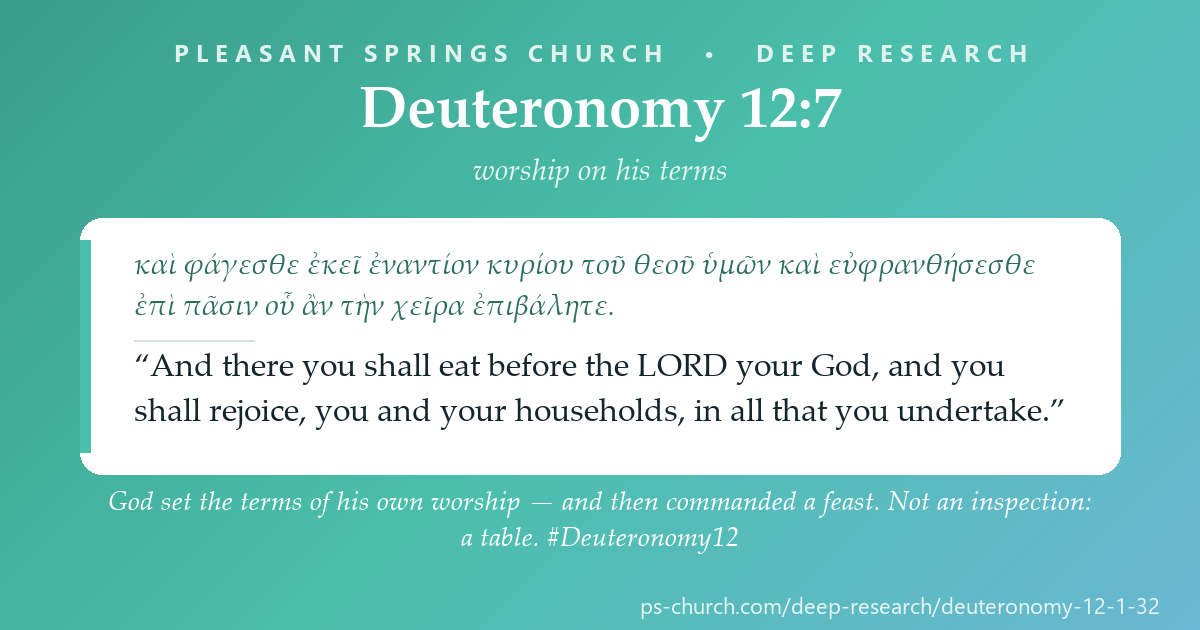
- Joy is commanded. “You shall eat before the Lord your God and you shall rejoice.” God did not gather his people to one place to inspect them. He gathered them to feed them. If your worship has no gladness in it, something has been lost that the text expects you to have.
- Count the Levite in. Every feast list in this chapter names the man with no land. Look around the table you set — literal or otherwise — and ask who has no portion and no inheritance, and whether they were invited.
- The blood is not ours. Meat, yes, anywhere, as much as you desire. Blood, never — “for the blood is the life.” Life belongs to God, and the New Testament says the one blood we live by was not taken but given (Heb 9:12).
- And the place has a name now. “Neither on this mountain nor in Jerusalem… the true worshipers will worship the Father in spirit and truth” (John 4:21–23). The refrain was answered, not repealed.
Step in response: take one thing in your own devotional or church life that you do simply because you like it or because it seems to work, and ask honestly where it came from — God’s word, or 12:30’s question. Keep it if it stands; let it go if it does not. Then do the other half of the chapter, which is harder for most of us: go to worship this week expecting a feast rather than an inspection, and take someone with no portion with you.
Deuteronomy 12:7 · to share
LXX + ESVEvery Deep Research page traces its passage across the whole sweep — the Old Testament, the Second-Temple world between the testaments (historical witnesses, not Scripture), and the New Testament. Follow the thread:
Pleasant Springs Church — Deep Research
Research method after Michael S. Heiser’s Bible Research Method (examine dictionaries → ancient literature → important words → textual connections → academic publications → share), with the Pleasant Springs “Author & Audience” foundation. Scripture set in the Hebrew, the Greek editions named on each page and the ESV (Old Testament), and the Greek New Testament and the ESV (New Testament), per the practice of Pleasant Springs Church. Deuteronomy 12 research grounded in Craigie, Block, McConville, Tigay, Christensen and Weinfeld, with McConville’s Law and Theology in Deuteronomy and Sandra Richter’s work on “placing the name,” Milgrom on blood and profane slaughter, Kline on the treaty form, and Beale & Carson on the New Testament use (John; Acts; Hebrews). ANE background from the Mesha Inscription (ANET 320–321, the “high place for Chemosh” and Beth-bamoth), the Ugaritic Baal texts, and the Assyrian “placing of a name” idiom (cited for the idiom, not by verified page); Second-Temple and rabbinic witnesses (the Temple Scroll 11QT 52–53, Josephus, Philo, m. Zevaḥim 14, the Elephantine papyri at ANET 491–492) read as witnesses, not Scripture. Greek is Rahlfs; the Vaticanus/Swete reading πόλεων (“cities”) at 12:5 against Rahlfs’ φυλῶν (“tribes,” with the MT) is flagged in the codex foot. Versification: the offset between the English Bible and the Hebrew begins in this chapter — English 12:32 = MT/LXX 13:1, and English 13:1–18 = MT/LXX 13:2–19 in the next chapter; Deuteronomy 1–11 had no offset at all. The Samaritan “has chosen” variant and the Josianic dating question are both reported as live debates and not adjudicated. The demolition of the shrines is handled with the house’s conquest discipline — bounded, redemptive-historical, aimed at cult objects and not persons, and no warrant for coercion or violence by anyone today (2 Cor 10:4; Eph 6:12; Luke 9:54–55).
Scripture quotations marked ESV are from the ESV® Bible (The Holy Bible, English Standard Version®), © 2001 by Crossway, a publishing ministry of Good News Publishers. ESV Text Edition: 2016. Used by permission. All rights reserved. The ESV text may not be quoted in any publication made available to the public by a Creative Commons license, and the ESV may not be translated in whole or in part into any other language. www.esv.org
|
Did this study bless you today? 💚 Give to Support PS Church100% of gifts go to the General Fund — thank you. |