Three times a year Israel was to leave the farm and walk. Passover in the month of Abib, with the bread of affliction, “that all the days of your life you may remember the day when you came out” (16:3). Weeks, counted from the first swing of the sickle, with an offering sized to the harvest. Booths, kept seven days once the threshing floor and the winepress were full. And at two of the three — Weeks and Booths — the same command, sounded three times over: you shall rejoice — “you shall be altogether joyful” (16:15). Passover is the exception: no guest list, no command to rejoice; it is a night, in haste, with plain bread. Read who is standing there: you, your son, your daughter, your male and female servants, the Levite, the sojourner, the fatherless, the widow (16:11). Then, without changing the subject, the chapter turns to the gate and seats judges in it: “You shall not pervert justice… you shall not accept a bribe… Justice, and only justice, you shall follow” (16:18–20). This study works Deuteronomy 16:1–22 — commanded joy with the poor written into it, and a courthouse in the same breath. See the method →
Deuteronomy 16:1–22 (selections) — MT = LXX = English
Hebrew · LXX · ESVThe Shape of the Passage
SequenceDeuteronomy 16 sits in the middle of the central law code (chs 12–26). Behind it: the one chosen place for worship (ch 12), the test of loyalty (ch 13), and the tithes, the seventh-year release and the freed servant (chs 14–15). Ahead of it, beginning at 16:18: the offices of the nation — judges, king, priests, and the prophet like Moses (18:15–19). For the same feasts from the sanctuary side, see Leviticus 23.
Author
Moses, preaching on the plains of Moab. Deuteronomy is not a statute book read out by a clerk; it is preached law, delivered forty years on to the children of the generation that died in the wilderness. Its verbs are remember, hear, love, choose, today — and in this chapter one more: rejoice. The book as a whole carries the shape of an ancient suzerainty treaty (preamble, historical prologue, stipulations, witnesses, blessings and curses), and chapter 16 belongs to the stipulations; that observation is about the form of the book, and scholars on every side of the dating question have used it, so we report the shape and leave the date where the text leaves it.
Why the feasts and the courts share a chapter. Modern readers instinctively file worship and civil justice in different drawers. Deuteronomy does not. The three pilgrim feasts are commanded, then the judges are appointed, with no seam of transition and no change of subject — because both are answers to the same memory, named here and a dozen times over in the book: you were a slave in Egypt (16:12; cf. 15:15; 24:18, 22). A people whose gladness was bought out of a brickyard feasts with its servants at the table; a people who know what a rigged court did to them takes no bribe. The memory of slavery is the engine of both halves.
Audience
Farmers about to become landowners. Every date in this chapter is an agricultural date. Passover falls in Abib, when the barley is in the ear; Weeks is counted “from the time the sickle is first put to the standing grain” (16:9); Booths comes “when you have gathered in the produce from your threshing floor and your winepress” (16:13). This is a calendar you could only keep if you had a field. Israel is being handed a year whose rhythm will not let it forget who gave the harvest — three times over, walking away from the farm to the chosen place, arriving not empty-handed (16:16).
And the people who owned nothing. Read the guest list slowly: “you and your son and your daughter, your male servant and your female servant, the Levite who is within your towns, the sojourner, the fatherless, and the widow who are among you” (16:11; again in 16:14). Four of those nine had no land: the Levite by design, the sojourner by birth, the fatherless and the widow by loss. The feast is not a householders’ banquet with a charity table at the back — the landless are named inside the command. Note the tension exactly. The pilgrimage requirement, as 16:16 states it, falls on the men — “three times a year all your males shall appear before the Lord your God,” the formula Deuteronomy inherits from Exod 23:17 and 34:23. The command to rejoice is not held to that boundary: 16:11 and 16:14 name the daughter, the female servant, the sojourner and the widow inside it. Deuteronomy states the minimum requirement and then legislates straight past it. And what is commanded to all nine alike is not attendance but gladness: “you shall rejoice before the Lord your God.”
Orient on the pilgrim feasts, the chosen place, the city gate, and the law of the judge.
Search by topic: Passover / Unleavened Bread, Abib, Feast of Weeks (Pentecost), Feast of Booths (Tabernacles), pilgrimage, festivals and calendar, gate, judge, elders, bribe, partiality, Asherah, pillar (massebah).
Which articles are relevant?
- Anchor Bible Dictionary — “Passover,” “Weeks, Feast of,” “Booths, Feast of,” “Calendars,” “Pilgrimage,” “Gate,” “Judge,” “Bribery,” “Asherah,” “Pillar.”
- Dictionary of the OT: Pentateuch — “Festivals and Feasts,” “Worship,” “Sacred Space,” “Judges / Justice,” “Poor and Poverty,” “Aliens and Strangers,” “Law.”
- NIDOTTE / TDOT — חַג (ḥag, pilgrim feast), שָׂמַח (śāmaḥ, rejoice), שַׁעַר (šaʿar, gate), מִשְׁפָּט (mišpāṭ, judgment), צֶדֶק (ṣeḏeq, justice), שֹׁחַד (šōḥaḏ, bribe).
Bibliography surfaced:
- Peter C. Craigie (NICOT), Daniel I. Block (NIVAC), J. G. McConville (Apollos), Jeffrey H. Tigay (JPS), Duane Christensen (WBC), Moshe Weinfeld (Anchor) on Deuteronomy.
- Studies of the Israelite festival calendar and its agricultural base; the “centralization” formula and its bearing on the feasts; the law of the judiciary in Deut 16:18–17:13.
- Beale & Carson, Commentary on the NT Use of the OT (the Gospels; Acts; 1 Corinthians).
A farmer’s year, a pilgrim road, and a bench at the city gate.
Set the feasts against the agricultural year the ancient Levant actually kept, then sit down where an Israelite lawsuit was actually heard — the gate — and read the bribery law beside the ANE law and wisdom that shares its concern.
Which parallels shed light on religion and worldview?
The farmer’s year. The Gezer Calendar (ANET 320), a schoolboy’s limestone tablet from the tenth century BC and one of the oldest pieces of written Hebrew we have, lists the months of the agricultural year as a jingle: two months of olive harvest, two of planting, two of late planting, a month of hoeing flax, a month of barley harvest, “his month is harvest and feasting,” two months of vine-tending, a month of summer fruit. That is exactly the year Deuteronomy 16 punctuates — the sickle in the standing grain (16:9) and the gathering from threshing floor and winepress (16:13). Israel’s worship was not bolted onto its work; it was fitted into it, so that the moments of greatest natural self-congratulation became the moments of greatest thanksgiving.
Justice at the gate. “In all your gates” (16:18) is not a figure of speech. Excavated Iron Age gate complexes at Dan, Gezer, Beersheba and Megiddo have chambers and stone benches inside the gateway — the shaded, public, unavoidable space where an ancient town did its business and heard its cases. Boaz convenes ten elders there and settles a redemption before witnesses (Ruth 4:1–11); Amos indicts those who “hate him who reproves in the gate” and pleads, “establish justice in the gate” (Amos 5:10, 15). Deuteronomy puts judges in that doorway in every town — not a single supreme court at the sanctuary, but local courts everywhere, so that ordinary people could get a hearing without a journey.
Bribes, in law and in wisdom. The ancient world knew the problem and legislated against it. The Code of Hammurabi §5 (ANET 166) rules that a judge who alters a verdict he has already sealed pays twelvefold and is expelled from his seat “and he shall never again sit with the judges in a case”; the same code’s prologue and epilogue advertise the king as the one who keeps the strong from oppressing the weak and gives right judgment to the orphan and the widow. Egyptian wisdom presses the same point — the Instruction of Amenemope (ANET 421–425), the ANE text closest to Proverbs, warns against the moved boundary-stone, the false balance, and the oppression of the widow. Israel shares the moral furniture and re-founds it: the judge is not protecting the king’s order but imitating a God who “is not partial and takes no bribe… executes justice for the fatherless and the widow, and loves the sojourner” (Deut 10:17–18). The judge is told to be like him.
- The Gezer Calendar (ANET 320; c. 10th c. BC — an ancient witness, not Scripture) — the eight-line agricultural year of a Judean schoolboy: barley harvest, “harvest and feasting,” vine-tending, summer fruit. The seasons Deut 16 turns into worship.
- Code of Hammurabi §5 (ANET 166) — the judge who reverses a sealed verdict is fined twelvefold and removed from the bench for life: the ANE world’s own horror at a corrupted court, grounded in royal order rather than in the character of God.
- Instruction of Amenemope (ANET 421–425; Egyptian wisdom) — against false weights, moved boundary-stones, and the exploiting of the widow; the closest ANE parallel to the biblical wisdom tradition.
- The Elephantine “Passover letter” (Cowley 21 / TAD A4.1, 419 BC; among the Elephantine Aramaic papyri, ANET 491–492 — a witness, not Scripture) — instructions to a Jewish garrison in Upper Egypt about keeping the days of unleavened bread in Nisan: Deuteronomy’s calendar still being kept many centuries later, a thousand miles from the chosen place.
- Temple Scroll (11Q19) col. 51 and the Damascus Document (Dead Sea Scrolls — witnesses, not Scripture) — a Second-Temple community rewriting and tightening Deut 16:18–20 on judges, partiality and bribes; Deuteronomy is among the most-copied books at Qumran (the 4QDeut manuscripts).
- Josephus, Antiquities 3.244–254; 4.214–218 (Second Temple — a witness, not Scripture) — the three feasts described for a Roman readership, and a paraphrase of 16:18–20 that sets seven judges in every city with Levites as their officers and forbids gifts that bend a verdict.
- Philo, Special Laws 2 (the feasts) and 4 (the duties of the judge) (Second Temple — a witness, not Scripture) — the festivals read as schools of gratitude and equality, and the judge forbidden to look at the face of either rich or poor.
- Mishnah, Pesaḥim, Bikkurim 3, Sukkah 4–5, Sanhedrin 1 (rabbinic-era — witnesses, not Scripture) — the pilgrim procession with pipe and garlanded ox; the water-drawing at Booths, of which Sukkah 5:1 says that whoever never saw that rejoicing never saw rejoicing in his life; and the courts of three and twenty-three built out of “judges… in all your gates.”
Three times in fifteen verses the imperative falls: you shall rejoice (16:11), you shall rejoice in your feast (16:14), you shall be altogether joyful (16:15). We are not used to gladness being an obligation, and the reflex is to hear it as a demand to manufacture a feeling. It is not. What is commanded is a set of concrete acts — stop work, travel, bring an offering sized to the harvest, kill and roast and eat it in God’s presence, and do it with these particular people at the table — and the gladness is what happens in that room. Deuteronomy legislates the occasion and trusts the joy to follow.
And notice who is legislated into the room. Two of the nine named are your slaves. One is a landless Levite from your own town. Three more — the sojourner, the fatherless, the widow — are precisely the people a subsistence economy leaves out. Israel is not told to remember the poor at the feast; the poor are the feast’s guest list. Which means a household could keep every rule of the calendar, arrive at the right place on the right day with the right offering, and still have failed — because it came alone. Joy that has no room in it for the servant and the stranger is not the joy the Lord commanded.
Pilgrimage, plain bread, commanded gladness, the gate, the gift, and the chase.
Watch chag (a feast you walk to), lechem oni (bread that remembers), samach (gladness under orders), shaar (the gate that ties the halves together), shochad (the gift with no label), and tsedeq (justice, pursued). Verse numbers here need no conversion: Hebrew, LXX and English agree throughout Deuteronomy 16.
“Pilgrim feast” — from a root meaning to make a round or a procession; the word for the three festivals that required a journey (LXX ἑορτή). The related Arabic ḥajj preserves the sense. A ḥag is not a service you attend but a road you walk. The obligation as 16:16 states it falls on the men — “three times a year all your males shall appear before the Lord your God,” the same formula as Exod 23:17 and 34:23 — and three times a year the farm was left and the harvest stood unguarded while the household went up.
“Bread of affliction” (LXX ἄρτον κακώσεως) — unleavened bread named for what it tastes like, not for what it is made of. ʿōnî is the noun behind ʿānî, “the poor,” and the same root describes Israel’s affliction in Egypt (Exod 3:7). The one food at the feast that is deliberately plain is the one that carries the memory: gladness here is not amnesia.
“To rejoice, be glad” (LXX εὐφραίνομαι) — in Deuteronomy a covenant word, characteristically before the Lord and never alone (12:7, 12, 18; 14:26; 26:11). The climax is 16:15, wəhāyîṯā ʾaḵ śāmēaḥ, literally “and you shall be only glad” — ESV’s “altogether joyful,” LXX ἔσῃ εὐφραινόμενος.
“Gate” — rendered “towns” by the ESV, because the gate stood for the town (LXX simply πόλις). It is this chapter’s hinge word: the Passover may not be sacrificed in your gates (16:5); the Levite and the widow who rejoice are the ones in your gates (16:11, 14); the judges sit in your gates (16:18). Worship leaves the gate and takes the gate with it — the Levite, the sojourner, the fatherless and the widow “in your gates” are the ones named as going up and rejoicing at the chosen place (16:11, 15) — and then justice is seated back in the gate they came from.
“Bribe, gift” (LXX δῶρον, plainly “a present”) — the neutral Greek word is the point: it never arrives labelled. Deuteronomy does not argue that bribery is unfair; it says what it does — it “blinds the eyes of the wise and subverts the cause of the righteous” (ESV) — where the Hebrew and the Greek both say the words of the righteous (דִּבְרֵי / λόγους). The danger is not to the fool but to the wise man, who will still be able to explain his verdict.
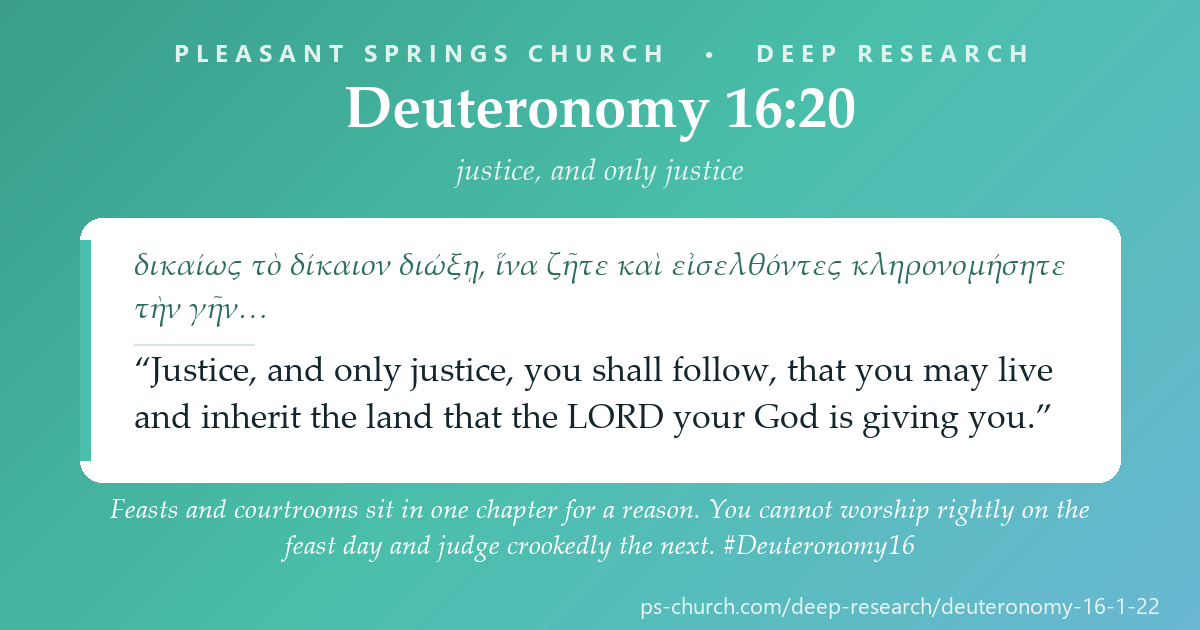
“Justice, rightness” — the judges render mišpaṭ-ṣeḏeq, “a judgment of righteousness” (16:18), and then the doubled imperative: ṣeḏeq ṣeḏeq tirdōf, “justice, justice you shall pursue” (16:20; LXX δικαίως τὸ δίκαιον διώξῃ, “justly you shall pursue what is just”). The verb is chase — the same word used for pursuing an enemy. Justice is not a standard you keep; it is a thing you run after.
Where the New Testament stands in this calendar:
- 1 Corinthians 5:7–8 — “For Christ, our Passover lamb, has been sacrificed. Let us therefore celebrate the festival… with the unleavened bread of sincerity and truth.” The apostle’s own reading of 16:1–8, and the warrant for reading the feast toward Christ.
- Acts 2:1–4 — “When the day of Pentecost arrived…” The Greek name means “fiftieth” — and it is Leviticus that supplies the number (Lev 23:15–16, “you shall count fifty days”), Deuteronomy the count itself: “seven weeks… from the time the sickle is first put to the standing grain” (16:9). The Spirit falls on the feast of firstfruits, with pilgrims from every nation already in the city because of this law.
- John 7:2, 37–39 — Jesus stands up “on the last day of the feast, the great day” of Booths and cries, “If anyone thirsts, let him come to me and drink” — spoken into the week of 16:13–15 and its water ceremony.
- 2 Corinthians 9:7 — “Each one must give as he has decided in his heart… for God loves a cheerful giver.” The freewill offering of 16:10, 17 — sized to the blessing, given gladly — is the same instinct carried into the church’s collection.
- James 2:1–9 — “show no partiality… you have dishonored the poor man.” The bench in the gate has become a seat in the assembly, and the sin has not changed its name.
The feasts across the Torah, and justice across the canon — and, for the first time on this shelf, the Greek of those Torah parallels measured rather than quoted.
Run two threads. First the calendar: the same three feasts in Exodus, Leviticus and Numbers, each from a different angle. Then the courts: the charge to judges from Sinai to the prophets, and where the New Testament sets it down. Greek Exodus, Leviticus and Numbers came onto this shelf on 30 August 2026, taking the Greek Old Testament held here to 64 CATSS files and 30,637 verse units. Every Greek run reported below was measured that day; before it, none of these parallels could be measured at all.
Which cross-references matter?
- Exodus 23:14–17; 34:18–24 — the oldest form of the three-feast law: “Three times in the year you shall keep a feast to me… none shall appear before me empty-handed” (see Exodus 23). Deuteronomy 16 is that law preached — and expanded, twice, with a guest list.
- Exodus 12:1–28; 13:3–10 — the first Passover and the unleavened bread “that you may remember the day when you came out” (see Exodus 12 and Exodus 13).
- Leviticus 23:1–44 — the full sanctuary calendar: the sheaf, the counting of fifty days, the trumpets, the Day of Atonement, and the booths “that your generations may know that I made the people of Israel dwell in booths” (see Leviticus 23). Leviticus gives the liturgy; Deuteronomy gives the household — but Deuteronomy’s Passover law is not simply a repetition of Exodus. It lets the victim be taken from the flock or the herd (16:2, where Exod 12:3–5 specifies a lamb, “from the sheep or from the goats”); it says ûḇiššaltā, “you shall cook it” (16:7), using the very verb Exod 12:9 forbids (“not boiled in water, but roasted”) — the LXX already feels the difficulty and renders it twice over, καὶ ἑψήσεις καὶ ὀπτήσεις, “you shall boil and roast,” and 2 Chr 35:13 simply combines them (“they boiled the Passover with fire”); and it says six days of unleavened bread (16:8) where 16:3 and Lev 23:6 say seven. Readers have explained these as broader usage (bāšal = “cook”), as the Passover proper distinguished from the festival offerings eaten alongside it (the later ḥagigah, cf. the herd of 16:2), and as a seventh-day assembly counted apart. We report the difference and do not pretend it is not there.
- Numbers 28–29 — the offerings prescribed for each of these days, feast by feast (see Numbers 28–29).
- Deuteronomy 12:5–18; 14:22–29; 15:12–18 — “the place that the Lord your God will choose,” the third-year tithe for the Levite and the widow, and the servant released and furnished liberally: the near context that makes 16:11 sound like a summary rather than a surprise (see Deut 12 and Deut 14–15).
- Exodus 23:1–9; Leviticus 19:15; Deuteronomy 1:16–17 — the same judicial charge three times over: no false report, no partiality to great or poor, “you shall not take a bribe, for a bribe blinds the clear-sighted,” “you shall not be partial in judgment… for the judgment is God’s” (see Leviticus 19 and Deuteronomy 1).
- Deuteronomy 10:17–19 — the theological ground of 16:19: God “is not partial and takes no bribe… executes justice for the fatherless and the widow, and loves the sojourner.” The court is to look like its God (see Deut 8 for the same sermon’s memory-and-blessing logic).
- 2 Chronicles 19:5–7; Isaiah 1:17; Amos 5:10–15; Micah 6:8; Proverbs 17:23 — Jehoshaphat appointing judges “in all the fortified cities… city by city” with this very charge, and the prophets holding the nation to it: “seek justice, correct oppression,” “establish justice in the gate.”
The New Testament does not treat this calendar as a museum. It stands inside it. Paul reaches for Passover and unleavened bread not as a metaphor he invented but as the feast’s own logic pressed to its end: “Christ, our Passover lamb, has been sacrificed. Let us therefore celebrate the festival” (1 Cor 5:7–8) — and the leaven he wants swept out is malice and evil. Luke dates the giving of the Spirit by this calendar — Leviticus’ fifty days (Lev 23:15–16) laid over Deuteronomy’s seven weeks (16:9) — so that the day of firstfruits becomes the day of the first harvest of the nations (Acts 2). John sets Jesus’ cry about living water on the last, great day of Booths (John 7:37–39). This is the one kind of typology worth the name — not a pattern we impose, but a reading the apostles perform in front of us.
What the New Testament does not do is drop the second half of the chapter. “Justice, and only justice” is never quoted and never revoked; it is assumed, and its concrete edge — no partiality, no gift, no favour to the strong — is turned on the church itself (Jas 2:1–9). Deuteronomy 16 will not let worship and justice be sold separately. The same chapter that hands us a table hands us a bench, and the same Lord stands over both.
The Pentateuch parallels, measured in Greek for the first time
Everything in the list above was read out of printed editions. Until 30 August 2026 none of it could be measured on this shelf, because Greek Exodus, Leviticus and Numbers were not held. All three are on disk now — the Greek Old Testament here is 64 CATSS files, 30,637 verse units — so the chapter was screened against them, verse by verse, on the shelf’s standard rule: contiguous runs of whole word forms, never lemmas, tie band reported beside every run.
The pilgrimage formula at 16:16 is inherited word for word, and the run stops at a single preposition.
LXX Deuteronomy 16:16 τρεῖς καιροὺς τοῦ ἐνιαυτοῦ ὀφθήσεται πᾶν ἀρσενικόν σου ἐναντίον κυρίου τοῦ θεοῦ σου
LXX Exodus 23:17 τρεῖς καιροὺς τοῦ ἐνιαυτοῦ ὀφθήσεται πᾶν ἀρσενικόν σου ἐνώπιον κυρίου τοῦ θεοῦ σου
LXX Exodus 34:23 τρεῖς καιροὺς τοῦ ἐνιαυτοῦ ὀφθήσεται πᾶν ἀρσενικόν σου ἐνώπιον κυρίου τοῦ θεοῦ Ισραηλ
Eight consecutive words, identical, against both Exodus verses. The run breaks at exactly one word: Deuteronomy writes ἐναντίον where both Exodus verses write ἐνώπιον. Both mean before, in front of. Nothing turns on the difference and that is the point: the one word that stops an eight-word run is a synonym, and a contiguous-run screen cannot tell a synonym from a contradiction. Exodus 23:14 supplies the same opening four, τρεῖς καιροὺς τοῦ ἐνιαυτοῦ, and then goes its own way. Four rows on the whole shelf share eight consecutive words with Deuteronomy 16:16: the two Exodus verses on the pilgrimage formula, and Deuteronomy 14:23 and 31:11 on a different eight, κυρίου τοῦ θεοῦ σου ἐν τῷ τόπῳ ᾧ. Only 2 Chronicles 8:13 goes deeper, at fifteen — and that is a chronicler quoting this law back, not a source behind it.
| row | deepest partner in the Greek Old Testament | run | tie band | the shared words |
|---|---|---|---|---|
| 16:11 and 16:14 — the guest list | Deuteronomy 12:18 | 18 | 1 | σὺ καὶ ὁ υἱός σου καὶ ἡ θυγάτηρ σου ὁ παῖς σου καὶ ἡ παιδίσκη σου καὶ ὁ… |
| 16:16 — the three feasts named | 2 Chronicles 8:13 | 15 | 1 | ἐν τῇ ἑορτῇ τῶν ἀζύμων καὶ ἐν τῇ ἑορτῇ τῶν ἑβδομάδων καὶ ἐν τῇ ἑορτῇ |
| 16:16 — the pilgrimage formula | Exodus 23:17 and Exodus 34:23 — both new to the shelf | 8 | — | τρεῖς καιροὺς τοῦ ἐνιαυτοῦ ὀφθήσεται πᾶν ἀρσενικόν σου |
| 16:2 and 16:15 | Deuteronomy 15:20 | 10 | 1 | ἐν τῷ τόπῳ ᾧ ἐὰν ἐκλέξηται κύριος ὁ θεός σου |
| 16:17 | Deuteronomy 12:15 | 10 | 1 | κατὰ τὴν εὐλογίαν κυρίου τοῦ θεοῦ σου ἣν ἔδωκέν σοι |
Across the twenty-two rows of the chapter against every other verse unit on the shelf: all twenty-two reach three, twenty-one reach four, twenty reach five, sixteen reach six, twelve reach nine, ten reach ten, three reach fifteen, two reach eighteen, and nothing reaches nineteen. Deuteronomy 16 is one of the most heavily self-quoting chapters this library has screened — but the deepest partners are almost all inside Deuteronomy itself, which is a fact about the book’s house style and not about its sources.
Two places this page argued from a printed edition and can now argue from the shelf
The cooking verb. The note above says Deuteronomy 16:7 uses the very verb Exodus 12:9 forbids, and that the LXX renders it twice over. Both columns are now on this disk and both read exactly as claimed. Greek Exodus 12:9: οὐκ ἔδεσθε ἀπ’ αὐτῶν ὠμὸν οὐδὲ ἡψημένον ἐν ὕδατι ἀλλ’ ἢ ὀπτὰ πυρί — not raw, nor boiled in water, but roasted with fire. Greek Deuteronomy 16:7: καὶ ἑψήσεις καὶ ὀπτήσεις καὶ φάγῃ — you shall boil and you shall roast and you shall eat. The Greek Deuteronomy keeps the forbidden verb and adds the required one beside it. The difficulty is in the text, in both languages, and the translator did not hide it.
The animal. Greek Exodus 12:5 has πρόβατον τέλειον ἄρσεν ἐνιαύσιον… ἀπὸ τῶν ἀρνῶν καὶ τῶν ἐρίφων, a lamb or a kid. Greek Deuteronomy 16:2 has πρόβατα καὶ βόας, sheep and oxen. The divergence this page reported from the Hebrew stands in the Greek too.
The six days and the seven. Greek Deuteronomy 16:8 reads ἓξ ἡμέρας φάγῃ ἄζυμα, six days; Greek Leviticus 23:6 and Greek Numbers 28:17 both read ἑπτὰ ἡμέρας ἄζυμα ἔδεσθε, seven days, and so does Deuteronomy 16:3 five verses earlier. Leviticus and Numbers were not on this shelf when the note above was written; they are now, and they say what it said they say. The page reports the difference and does not pretend it is not there.
The scholarship on the festival law and the law of the judiciary.
Craigie, Block, McConville, Tigay, Christensen and Weinfeld on Deuteronomy; Kline on the treaty form; Beale & Carson for the New Testament use; ANET for the ANE comparanda.
Commentaries & studies:
- Peter C. Craigie, The Book of Deuteronomy (NICOT); Daniel I. Block, Deuteronomy (NIVAC); J. G. McConville, Deuteronomy (Apollos); Jeffrey H. Tigay, Deuteronomy (JPS); Duane L. Christensen (WBC); Moshe Weinfeld, Deuteronomy (Anchor).
- Meredith G. Kline, Treaty of the Great King, on the suzerainty-treaty shape of the book (reported as literary form; the dating debate is not settled by it).
- Studies of the pilgrim festivals and the agricultural calendar; of Deut 16:18–18:22 as the “law of the offices”; and of the proposal (Kaufman, Braulik) that the code of chs 12–26 unfolds in the order of the Ten Words.
- J. B. Pritchard, ed., Ancient Near Eastern Texts (ANET) — the Gezer Calendar (320), the Code of Hammurabi (163–180), Amenemope (421–425), the Elephantine papyri (491–492).
- G. K. Beale & D. A. Carson, eds., Commentary on the New Testament Use of the Old Testament (John; Acts; 1 Corinthians).
Interpretation notes worth keeping:
- Joy is commanded, and it is corporate. Deuteronomy does not ask how anyone feels; it prescribes a gathering and expects gladness there. Preach it as an obligation of the calendar, not a test of temperament — and remember that the grieving and the exhausted are carried to the table by the command rather than shut out by it. Nobody in 16:11 is required to produce joy alone.
- The poor are inside the liturgy, not beside it. The Levite, the sojourner, the fatherless and the widow are named in the command itself (16:11, 14), as they are in the third-year tithe (14:28–29). Any use of this chapter that turns their inclusion into optional benevolence has inverted the text.
- Worship and justice are one fabric. The chapter’s two halves are joined by a word — the gate — and by a memory: “you were a slave in Egypt” (16:12). A church that keeps the feast and tolerates a rigged bench has kept half a chapter.
- ‘Justice, and only justice’ is a charge to courts, not a licence for zeal. The verse governs judges, officers and witnesses, and its content is spelled out in the verse before it: no perverting, no partiality, no gift. It is not a warrant for private retaliation or for treating our own preferred causes as self-evidently the just ones — the whole point of 16:19 is that a wise man’s eyes can be bought without his knowing it.
- Israel’s civil order is not a template for church or state. Deuteronomy legislates for a covenant nation in a land under a specific tenure. The moral substance — impartial courts, honest judges, protection of the powerless, incorruptible witness — carries; the constitutional arrangements do not transfer, and the New Testament does not transfer them.
- The Asherah and the pillar (16:21–22) belong to the same argument. They are not an appendix but the negative of the whole chapter: worship on God’s terms at God’s place, not with the furniture of Canaanite fertility religion imported to the edge of his altar. The command is addressed to Israel’s own worship — it is not, and has never been, a mandate for anyone to go and vandalize a neighbour’s shrine.
From a table with the widow at it to a bench that cannot be bought.
Name what you learned, why it matters, and one concrete response.
What should we carry away — and do?
- Gladness can be commanded because it is mostly a set of actions. Stop, travel, bring, eat, remember, and do it with these people — the joy is what grows in that room. If you have been waiting to feel like worshipping, Deuteronomy 16 says: keep the feast, and see.
- Check the guest list before you check the menu. Nine people are named at Weeks and again at Booths, and four of them own nothing. A celebration that only includes the people who could host one is not the celebration commanded here.
- Plain bread at a glad table. The one deliberately joyless food at Passover is the one that carries the memory of the brickyard. Remembered affliction does not spoil the joy; it is what the joy is about.
- Justice is a chase, not a fence. Tsedeq tsedeq tirdof — the verb is “pursue.” Not merely refrain from injustice; go after what is right, at cost, when it would be easier to let it go.
- The bribe never arrives labelled. The Greek says simply “a present.” It blinds the eyes of the wise — people who will still have a reasonable-sounding explanation for the verdict. Ask what gift, favour, or fear is quietly weighting your judgment about a person right now.
Step in response: pick the next meal your household or church already has on the calendar and do two things to it — invite one person who could not return the invitation, and say out loud, before you eat, what God brought you out of. Then take the second half of the chapter home: name one situation where you have been quietly partial, and do the harder, fairer thing this week.
Deuteronomy 16:20 · to share
LXX + ESVEvery Deep Research page traces its passage across the whole sweep — the Old Testament, the Second-Temple world between the testaments (historical witnesses, not Scripture), and the New Testament. Follow the thread:
Pleasant Springs Church — Deep Research
Research method after Michael S. Heiser’s Bible Research Method (examine dictionaries → ancient literature → important words → textual connections → academic publications → share), with the Pleasant Springs “Author & Audience” foundation. Scripture set in the Hebrew, the Greek editions named on each page and the ESV (Old Testament), and the Greek New Testament and the ESV (New Testament), per the practice of Pleasant Springs Church. Deuteronomy 16 research grounded in Craigie, Block, McConville, Tigay, Christensen and Weinfeld, with Kline on the treaty form (reported as the book’s literary shape, not as a settled argument about its date) and Beale & Carson on the New Testament use (John; Acts; 1 Corinthians). ANE comparanda from the Gezer Calendar (ANET 320), the Code of Hammurabi §5 (ANET 166), the Instruction of Amenemope (ANET 421–425) and the Elephantine papyri (ANET 491–492), with Second-Temple and rabbinic witnesses (the Temple Scroll and the 4QDeut manuscripts; Josephus; Philo; the Mishnah’s Pesaḥim, Bikkurim, Sukkah and Sanhedrin) — all read as witnesses, never leveled with Scripture. Versification: Deuteronomy 16 has no MT/LXX offset — Hebrew, Rahlfs LXX and English all number 16:1–22 alike; the offsets in this book lie on either side (English 12:32 = MT/LXX 13:1, so English 13:1–18 = MT/LXX 13:2–19; English 22:30 = MT/LXX 23:1; English 29:1 = MT/LXX 28:69). Measurement scope: the Greek runs in stage 4 were taken over the 64 CATSS Greek Old Testament files, 30,637 verse units, held here as of 30 August 2026 — Greek Exodus, Leviticus, Numbers and Joshua arrived that day, and until they did none of this chapter’s Torah parallels could be measured in Greek at all. Contiguous runs of whole word forms, never lemmas; tie band reported beside every run; exhaustive and deterministic. CATSS is a Rahlfs-based diplomatic transcription, not the Göttingen critical editions, and its apparatus was not consulted, so a run reported here is a run against these files. The deuterocanonical books now on the shelf are held as witnesses, not Scripture and are named as such wherever a hit lands in one. The chapter’s civil legislation is read as law for a covenant nation in its land, not as a constitutional template for the church or any modern state; its moral substance — impartial courts, incorruptible judges, and a joy with the poor named inside it — is held as abiding.
Scripture quotations marked ESV are from the ESV® Bible (The Holy Bible, English Standard Version®), © 2001 by Crossway, a publishing ministry of Good News Publishers. ESV Text Edition: 2016. Used by permission. All rights reserved. The ESV text may not be quoted in any publication made available to the public by a Creative Commons license, and the ESV may not be translated in whole or in part into any other language. www.esv.org
|
Did this study bless you today? 💚 Give to Support PS Church100% of gifts go to the General Fund — thank you. |