Before a word about food, Moses says who they are: “You are the sons of the Lord your God… you are a people holy to the Lord your God, and the Lord has chosen you to be a people for his treasured possession” (14:1–2). Identity first; the table, the tithe and the ledger follow. This study works Deuteronomy 14:1–15:23 — the clean and the unclean as boundary-markers of belonging, the tithe eaten before the Lord with joy and the third-year tithe stored for the Levite, the sojourner, the fatherless and the widow, and then the social heart of the book: the seventh-year release of debts, the warning against a grudging eye, and the servant sent out not empty-handed — “for you were a slave in the land of Egypt.” See the method →
Deuteronomy 14:1–15:15 (selections)
Hebrew · LXX · ESVThe Shape of the Passage
Parallel panelsThese two chapters sit inside the Deuteronomic code that began with the one chosen place of worship (ch 12) and the test of covenant loyalty (ch 13), and they run straight on into the pilgrim feasts and the courts in the gate (ch 16). Their identity language — holy, chosen, treasured possession — is taken over almost verbatim from Deuteronomy 7:6; their memory of Egypt and their warning about a full stomach come from ch 8; and the food list itself is a preached re-issue of Leviticus 11, as the seventh-year laws are of Leviticus 25.
Author
Moses on the plains of Moab, preaching law rather than filing it. Notice the order, because it is the whole argument: Deuteronomy does not begin with a diet and reason back to a doctrine. It begins with “you are the sons of the Lord your God” (14:1) — a phrase found nowhere else in the Torah in quite this form — and only then says what such people do with their bodies in grief, their animals at the table, their harvest at the sanctuary, their loans at the seventh year, and their servants at the door. Identity first; behaviour follows. Every command in these two chapters is an answer to a question already settled. (Whether the book reached its present form on the plains of Moab or was re-preached and re-issued later — the argument that runs through Josiah’s reform, 2 Kgs 22 — is not settled here; the setting the book itself gives is Moab, and that is the setting these chapters are read in.)
Law with the sermon left in. The Levitical version of the food laws gives the list; Deuteronomy gives the list with a congregation in front of it — not a copy: Deuteronomy names ten clean animals Leviticus does not (14:4–5), drops Leviticus’ swarming creatures and carcass-purity rules, and at 14:21 disposes of the carcass in terms that sit awkwardly beside Lev 17:15. The relation of the two lists is a real question, not a transcription. It adds motive clauses everywhere — that you may learn to fear (14:23), that the Lord your God may bless you (14:29; 15:10, 18), you were a slave in the land of Egypt (15:15). And it legislates against a mood: not merely “lend to your brother,” but “take care lest there be an unworthy thought in your heart… and your eye look grudgingly” (15:9). Very little ancient law bothers to police the inside of a lender’s head.
Audience
A landless generation about to become landowners. That is the pressure these laws are built for. In a few months these people will have fields, flocks, threshing floors, winepresses, harvests — and neighbours who fail. Deuteronomy legislates the generosity in advance, on a calendar, so that it cannot quietly be dropped when the harvest is good and the memory of Egypt is thin. A tithe every third year; a cancellation every seventh; a release of servants in the seventh year of their service; and a hand that opens whenever the need appears.
And the poor are addressed too. The law speaks of the needy man as your brother — seven times over — and gives him a right of appeal that goes over the lender’s head: “he cry to the Lord against you, and you be guilty of sin” (15:9). The servant walking out at the seventh year does not walk out empty; he leaves with flock, grain and wine, because release without capital is only a nicer word for abandonment. Deuteronomy assumes a covenant community in which the vulnerable have a voice, a claim, and a way back.
Orient on holiness and election, clean and unclean, tithe, the sabbatical release, and debt-servitude.
Search by topic: holiness, election, treasured possession (segullah), clean and unclean animals, food laws, tithe, sabbatical year / shemittah, debt and interest, poverty and the poor, slavery in the Old Testament, Levite, sojourner, widow and orphan.
Which articles are relevant?
- Anchor Bible Dictionary — “Clean and Unclean,” “Dietary Laws,” “Tithe,” “Sabbatical Year,” “Debt,” “Slavery (Old Testament),” “Poor, Poverty,” “Levites,” “Sojourner.”
- Dictionary of the OT: Pentateuch — “Holiness,” “Election,” “Clean and Unclean,” “Sacrifices and Offerings,” “Sabbath and Sabbatical Year,” “Servant, Slave,” “Social Justice,” “Wealth and Poverty.”
- NIDOTTE / TDOT — סְגֻלָּה (səgullāh, treasured possession), תּוֹעֵבָה (tôʿēḇāh, abomination), מַעֲשֵׂר (maʿăśēr, tithe), שְׁמִטָּה (šəmiṭṭāh, release), אֶבְיוֹן (ʾeḇyôn, needy), בְּלִיַּעַל (bəliyyaʿal, worthless).
Bibliography surfaced:
- Peter C. Craigie (NICOT), Daniel I. Block (NIVAC), J. G. McConville (Apollos), Jeffrey H. Tigay (JPS), Duane Christensen (WBC), Moshe Weinfeld (Anchor) on Deuteronomy.
- Studies of the sabbatical release and its ANE analogues; of Deuteronomy’s tithe alongside the Levitical tithe of Numbers 18; and of the food laws (Douglas, Milgrom, Houston).
- Beale & Carson, Commentary on the NT Use of the OT (Mark; Luke; Acts; 2 Corinthians).
Gashing for the dead, kings who cancelled debts, and three tithes in a Jewish household.
Read the mourning prohibition against Canaanite practice, the release against the royal debt-edicts of Mesopotamia, and the tithe against how Second-Temple Jews actually kept it.
Which parallels shed light on religion and worldview?
Cutting for the dead. Deuteronomy 14:1 forbids gashing the body and shaving the forehead in grief. This is not a comment on grief itself — the Bible mourns loudly — but on a specific ritual repertoire. The Ugaritic Baal cycle shows the god El learning of Baal’s death and responding exactly so: he sits on the ground, pours dust on his head, and “cuts a gash with a stone… he gashes his cheeks and his chin” (ANET 139). The prophets of Baal do the same on Carmel (1 Kgs 18:28), and Israel is told not to (also Lev 19:28; 21:5; cf. Jer 16:6). The reason given is not squeamishness but sonship: you are the sons of the Lord your God — children of the living God do not mourn as those who manipulate the dead.
Kings who cancelled debts. Periodic debt-remission was a real institution in the ancient Near East. Old Babylonian kings proclaimed a mīšarum (“equity”) at their accession or in a crisis, wiping out consumer debts and restoring pledged land and persons; the Edict of Ammi-ṣaduqa is the best-preserved example. And Hammurabi legislated a limit on debt-servitude: if a man sold his wife, son or daughter for a debt, “they shall work (in) the house of their purchaser or obligee for three years, with their freedom re-established in the fourth year” (§117; ANET 170–171). Israel’s law shares the moral furniture and then moves the ground under it. The release is not a king’s gracious act at a date of his choosing but a fixed calendar belonging to the Lord — “the Lord’s release has been proclaimed” (15:2) — and the freed servant leaves loaded rather than merely loosed (15:13–14).
Three tithes in one household. Reconciling Deuteronomy’s tithe — eaten by the giver before the Lord (14:22–27), then stored locally every third year (14:28–29) — with the tithe given to the Levites in Numbers 18 is an old question. Second-Temple Judaism answered it by keeping all of them: Tobit describes paying a first tithe to the sons of Levi, converting a second to spend in Jerusalem, and giving a third “to those to whom it was fitting” (Tob 1:6–8), and Josephus reports the same three-tithe practice, the third “every third year… to be distributed to those that want; to women that are widows, and to children that are orphans” (Ant. 4.240). Report the practice; the harmonization is a historical answer, not a biblical statement.
- The Baal Cycle (Ugaritic, 14th–13th c. BC; ANET 129–142, El’s mourning at 139) — a witness, not Scripture: the god gashes his cheeks and chin for the dead Baal — the very rite forbidden in Deut 14:1.
- Code of Hammurabi §117 (ANET 170–171) — debt-servitude limited to three years; Deuteronomy sets six, and then adds a severance the Babylonian law never imagines (15:13–14).
- The Edict of Ammi-ṣaduqa and the Old Babylonian mīšarum proclamations (ANET, supplementary texts) — royal cancellations of debt and restoration of pledged persons: the practice exists, but as a king’s occasional decree rather than a fixed covenant calendar.
- Tobit 1:6–8; Sirach 35:1–11 (Apocrypha — witnesses, not Scripture in the Protestant canon) — the three tithes as lived practice, and almsgiving as covenant piety.
- Josephus, Antiquities 4.240–243 (Second-Temple — a witness, not Scripture) — the third-year tithe for widows and orphans, described as ordinary Jewish custom.
- Philo, On the Special Laws 2.71–73, 79–85 (Second-Temple — a witness, not Scripture) — the seventh-year remission of debts “assisting the poor, and inviting the rich to humanity,” and the freeing of servants.
- Letter of Aristeas 128–171 (Second-Temple — a witness, not Scripture) — the high priest Eleazar defends the food laws as a “fence” of separation and reads the parted hoof and the chewed cud as figures of moral discrimination and meditation.
- Mishnah, Shevi’it 10:3–4 (rabbinic-era — a witness, not Scripture) — Hillel’s prozbul, enacted “when he observed people refraining from lending to one another, and thus transgressing what is written in the Torah, ‘Beware, lest you harbor the base thought…’” — a direct citation of Deut 15:9.
Deuteronomy 15:9 anticipates the exact way its own law would be evaded: as year six turns to year seven, the lender does the arithmetic, decides the loan will never be repaid, and finds a reason to say no. Roughly fifteen centuries later that is precisely what was happening, and the Mishnah says so plainly — Hillel the Elder “observed people refraining from lending to one another, and thus transgressing what is written in the Torah” (m. Shevi’it 10:3), and enacted the prozbul, a legal instrument assigning debts to the court so that they survived the release year and credit kept flowing to the poor. Read it either way you like — a merciful repair that kept the poor lendable-to, or the loophole that finally undid the law — the striking thing is that the Torah had already named the temptation, and named it as a matter of the heart: not “do not withhold” only, but “take care lest there be an unworthy thought in your heart… and your eye look grudgingly.” Legislation can compel a payment. Deuteronomy is after the calculation that precedes it.
Treasured possession, abomination, release, the needy brother, and a heart that calculates.
Watch segullah (what a king keeps for himself), toevah (a boundary, not a poison), shemittah → aphesis (release becoming forgiveness), evyon (the brother who must ask), and beliyya’al (the sum you do in your head).
“Treasured possession” — a king’s own private hoard, as distinct from the property of the crown; the cognate sikiltu / sglt is used in Akkadian and Ugaritic letters of a vassal a great king calls peculiarly his. The LXX renders it λαὸς περιούσιος — the phrase Titus 2:14 lifts for the church. Israel is not God’s state treasury; Israel is what he keeps for himself.
“Abomination” — something offensive to a relationship, not a substance with a poison in it (LXX βδέλυγμα). Deuteronomy uses the word for idols, for occult practice, and here for the forbidden animals, which tells you what kind of category this is: a boundary-marker of loyalty. What is tôʿēḇāh is what does not belong at the table of this God’s household.
“Release” — from שָׁמַט, to let drop, let fall, let go (as a hand lets go of a rope). The LXX makes it ἄφεσις — the same noun the Greek Old Testament uses for the jubilee “liberty” of Lev 25:10 and the same one the New Testament uses for the forgiveness of sins. Israel’s word for cancelling a debt became the church’s word for being forgiven.
“Needy, destitute” — the poorest word in the Hebrew vocabulary of poverty, one who has nothing and must ask (LXX ἐνδεής, ἐπιδεόμενος). It occurs six times in Deuteronomy 15, and four of those six stand next to your brother (15:7 twice, 9, 11) — the two that do not are the flat statements of fact at 15:4 and 15:11a. Wherever the law gives a command, the needy man is your brother. Luke seems to hear 15:4 exactly (οὐκ ἔσται ἐν σοὶ ἐνδεής) when he writes of the first church, “there was not a needy person among them” (οὐδὲ… ἐνδεής τις ἦν ἐν αὐτοῖς, Acts 4:34).
“Worthless, good-for-nothing” — the ESV’s “unworthy thought” is literally a word of bəliyyaʿal with your heart. It is a strong term: elsewhere it labels scoundrels, ruinous men, the flood-waters of destruction. Deuteronomy attaches it not to a crime but to a calculation — the quiet inner sum that ends with a closed hand. (In the Second-Temple period the word hardens into a name, Belial / Beliar, at Qumran and in 2 Corinthians 6:15.)
“You shall furnish him liberally” — from עֲנָק, a neck-chain. The picture is of hanging a load about someone’s neck: deck him out, send him away wearing his severance. The infinitive absolute doubles it for emphasis, as pātōaḥ tiptaḥ (“opening you shall open”) does with the hand in 15:8, 11. Freedom in Deuteronomy comes with capital.
Where the New Testament picks these words up:
- Titus 2:14 — “a people for his own possession” (λαὸν περιούσιον), the Greek of Deut 14:2 / Exod 19:5 laid on the church; 1 Peter 2:9 makes the same move with a different phrase (λαὸς εἰς περιποίησιν).
- Luke 4:18–19 — Jesus reads Isaiah 61 in Nazareth and proclaims ἄφεσις to captives — the Septuagint’s word for the release of Deut 15 and the liberty of Lev 25.
- Matthew 6:12 — “forgive (ἄφες) us our debts (ὀφειλήματα)”: the Lord’s Prayer uses the same two roots as LXX Deut 15:2, ἀφήσεις πᾶν χρέος… ὃ ὀφείλει σοι.
- Acts 4:34 — “There was not a needy person among them”: Luke’s deliberate echo of LXX Deut 15:4.
- Mark 7:19; Acts 10:9–16; Colossians 2:16–17; Romans 14:14, 17 — the food boundary declared fulfilled and set aside in Christ.
From the table and the seventh year across the canon.
Trace three threads: holiness and the clean table; the tithe and the poor; and the release — kept, broken, and finally preached by Jesus.
Which cross-references matter?
- Leviticus 11:1–47; 20:24–26 — the parallel clean-and-unclean list, with the reason stated: “I have separated you from the peoples” (see Leviticus 11).
- Leviticus 19:9–10; 25:1–55 — the gleanings left for the poor and the sojourner, and the sabbatical and jubilee years with their dərôr, “liberty” (see Leviticus 19 and Leviticus 25).
- Exodus 21:2–6; 23:10–11 — the earlier form of both laws: six years of service, then freedom, and a fallow seventh year “that the poor of your people may eat” (see Exodus 21). Deuteronomy adds two things: the woman is treated the same, and no one leaves empty-handed.
- Leviticus 27:30–33; Numbers 18:21–32 — the tithe declared holy to the Lord and the tithe assigned to the Levites, alongside which Deuteronomy’s eaten tithe and third-year tithe must be read (see Numbers 18).
- Deuteronomy 7:6; 26:12–15 — the near-identical ‘holy… treasured possession’ formula (Deuteronomy 7), and the confession made when the third-year tithe has been given away.
- Jeremiah 34:8–22; Nehemiah 5:1–13; 10:31 — the release law in real history: Zedekiah proclaims liberty and then the people take their servants back, and God answers with a bitter irony (“I proclaim to you liberty… to the sword”); Nehemiah cancels debts and makes the nobles swear; the returned community binds itself to forgo “the exaction of every debt” in the seventh year.
- Mark 14:7 // Matthew 26:11; John 12:8 — “For you always have the poor with you”: Jesus quoting Deut 15:11, whose next clause is “therefore… you shall open wide your hand.”
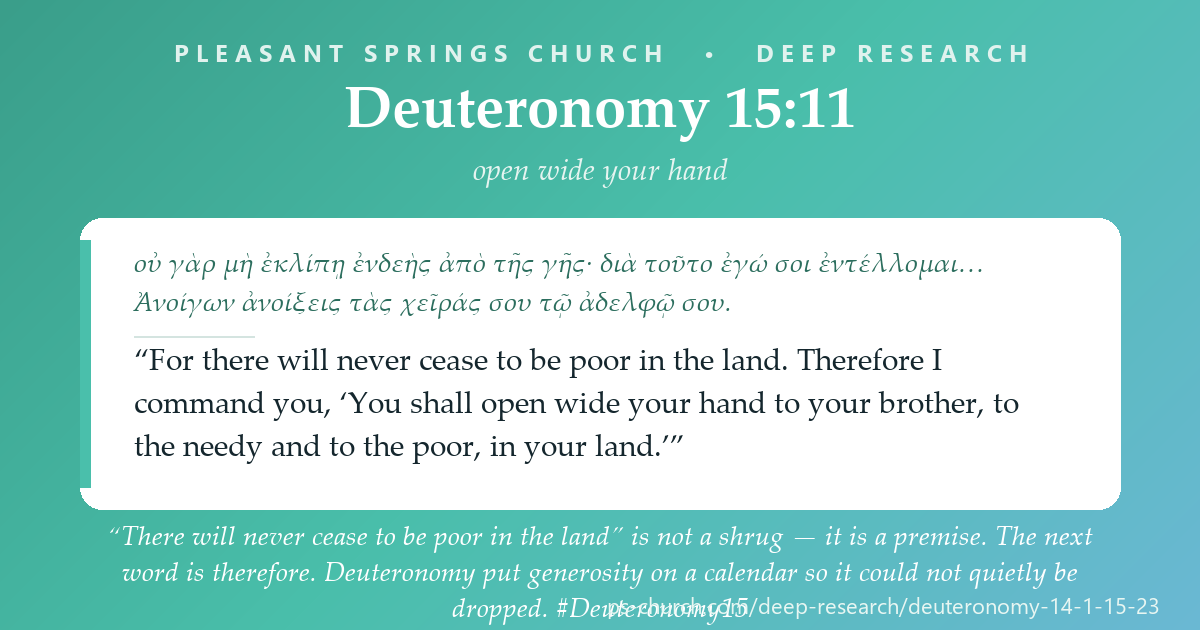
This is one of the most misused sentences in the Gospels. Taken as a shrug, it becomes a reason to do nothing: poverty is permanent, so why try? But Jesus is quoting Scripture at a table full of people who knew the verse, and in Deuteronomy the clause is not a conclusion — it is a premise. “For there will never cease to be poor in the land. Therefore I command you, ‘You shall open wide your hand to your brother’” (15:11). The permanence of need is the reason for permanent generosity. Mark even preserves the second half of the thought on Jesus’ own lips: “and whenever you want, you can do good for them” (Mark 14:7). What he is defending is not indifference to the poor but the once-only appropriateness of one woman’s extravagance toward a body about to be buried.
And the two statements of Deuteronomy 15 are not in contradiction either. “There will be no poor among you” (15:4) is a promise, and the very next verse attaches the condition: “if only you will strictly obey the voice of the Lord your God” (15:5). “There will never cease to be poor in the land” (15:11) is realism about a world in which that obedience is never complete. Held together they produce neither utopia nor fatalism, but an open hand: aim at 15:4, live in 15:11. Luke thought he had seen the promise land once — “there was not a needy person among them” (Acts 4:34) — and even that lasted only as long as the generosity did.
The scholarship on the food laws, the tithe, and the seventh-year release.
Craigie, Block, McConville, Tigay, Christensen and Weinfeld for Deuteronomy; the purity-law debate for chapter 14; the ANE debt-edicts for chapter 15; Beale & Carson for the New Testament use.
Commentaries & studies:
- Peter C. Craigie, The Book of Deuteronomy (NICOT); Daniel I. Block, Deuteronomy (NIVAC); J. G. McConville, Deuteronomy (Apollos); Jeffrey H. Tigay, Deuteronomy (JPS); Duane L. Christensen (WBC); Moshe Weinfeld, Deuteronomy (Anchor).
- On the food laws: Mary Douglas, Purity and Danger and Leviticus as Literature; Jacob Milgrom, Leviticus 1–16 (Anchor); Walter Houston, Purity and Monotheism — symbolic, reverence-for-life, and separation readings, none of which the text itself states.
- On the release: studies of the Old Babylonian mīšarum and andūrarum edicts beside Deut 15 and Lev 25; and of the reception of the release in Second-Temple texts (11QMelchizedek) and rabbinic law (the prozbul).
- G. K. Beale & D. A. Carson, eds., Commentary on the New Testament Use of the Old Testament (Mark; Luke; Acts; 2 Corinthians).
Interpretation notes worth keeping:
- The food laws are boundary-markers, and the New Testament says so. The text gives no hygienic reason and no moral one; the reason it gives is holiness — belonging. This house reads them as ceremonial signs that taught Israel to live set apart, fulfilled and set aside in Christ: “Thus he declared all foods clean” (Mark 7:19); “What God has made clean, do not call common” (Acts 10:15); “let no one pass judgment on you in questions of food and drink… these are a shadow of the things to come, but the substance belongs to Christ” (Col 2:16–17). The call the list embodied does not lapse: “as he who called you is holy, you also be holy” (1 Pet 1:15–16). Christians are not under this menu; Christians are under this vocation.
- Deuteronomy’s tithe and the Levitical tithe are not obviously the same tithe. Leviticus 27 declares every tithe of land and herd holy to the Lord; Numbers 18 assigns a tenth to the Levites; Deuteronomy 14 has the worshipper eat his tithe before the Lord and store it locally every third year. The three-tithe harmonization of Tobit, Josephus and the rabbis is a real historical practice; whether it is what Moses legislated is a separate question, and the honest answer is that Scripture does not spell it out. What Scripture does say is who the tithe must reach: the Levite, the sojourner, the fatherless, the widow.
- No prosperity inversion. “For this the Lord your God will bless you” (15:10) is a covenant promise to a nation in a land, not a mechanism for extracting returns. Giving is not an investment vehicle, and 15:4–5 makes the blessing conditional on the whole obedience of the whole people, not on the size of a single gift.
- And no blaming the poor. The realism of 15:11 is never turned into an accusation. Deuteronomy nowhere tells the lender to audit his brother’s choices before opening his hand; the one heart the law inspects is the giver’s (15:7–10). Poverty in this chapter is an occasion for mercy, not for a verdict.
- Debt-servitude, honestly. Deuteronomy 15:12–18 regulates an institution the ancient world already had, and everything it adds pushes toward release: a fixed term, the same terms for women, a mandatory severance, and a reason drawn from redemption (“you were a slave in the land of Egypt”). It is not a defence of slavery, and it is not chattel slavery — kidnapping a person to sell him is a capital crime in the same book (Deut 24:7; Exod 21:16). The trajectory runs toward Philemon and toward Galatians 3:28, and the church that later read these texts against the slave trade was reading them rightly.
From “you are the sons” to an open hand.
Name what you learned, why it matters, and one concrete response.
What should we carry away — and do?
- Identity comes before instruction. The chapter does not argue from a diet to a doctrine; it argues from sonship to a life. “You are the sons of the Lord your God… a people holy… his treasured possession.” Every command that follows is downstream of a settled belonging — which is exactly how the New Testament reasons too.
- Generosity was put on a calendar. A tithe every third year and a cancellation every seventh: Deuteronomy did not leave mercy to mood. Feelings are unreliable and harvests are seasonal; a date is neither. Whatever your version of the third year is, put it on the calendar before you feel like it.
- God legislates against arithmetic. “Take care lest there be an unworthy thought in your heart… and your eye look grudgingly” (15:9). The sin named is not theft but a quiet calculation that ends in a closed hand — and the poor man’s appeal goes straight past you to God.
- Release without capital is not release. The servant leaves furnished from flock, floor and winepress. Real mercy asks not only “is he free to go?” but “can he live once he has gone?”
- Remember what you were. “You shall remember that you were a slave in the land of Egypt, and the Lord your God redeemed you” (15:15). Redeemed people open their hands because they know what it cost to have theirs opened.
Step in response: find the sum you have quietly been doing about somebody — the loan you know will not come back, the help you have been rationing, the person you have decided is a bad investment — and do the thing the text says instead: open your hand. Then look at your calendar and set a date, so the next one does not depend on how you feel that morning.
Deuteronomy 15:11 · to share
LXX + ESVEvery Deep Research page traces its passage across the whole sweep — the Old Testament, the Second-Temple world between the testaments (historical witnesses, not Scripture), and the New Testament. Follow the thread:
Pleasant Springs Church — Deep Research
Research method after Michael S. Heiser’s Bible Research Method (examine dictionaries → ancient literature → important words → textual connections → academic publications → share), with the Pleasant Springs “Author & Audience” foundation. Scripture set in the Hebrew, the Greek editions named on each page and the ESV (Old Testament), and the Greek New Testament and the ESV (New Testament), per the practice of Pleasant Springs Church. Deuteronomy 14–15 research grounded in Craigie, Block, McConville, Tigay, Christensen and Weinfeld, with Beale & Carson on the New Testament use (Mark; Luke; Acts; 2 Corinthians); ANE background from the Ugaritic Baal cycle (ANET 129–142, El’s mourning at 139), the Code of Hammurabi §117 (ANET 170–171) and the Old Babylonian debt-edicts; Second-Temple and rabbinic witnesses (Tobit, Josephus Ant. 4.240–243, Philo Spec. Leg. 2.71–85, the Letter of Aristeas, 11QMelchizedek, and m. Shevi’it 10:3–4), all read as witnesses, not Scripture. Versification: Deuteronomy 14 and 15 show no divergence — MT, Rahlfs LXX and English agree verse for verse throughout 14:1–15:23 (the book’s offsets lie on either side: English 12:32 = MT/LXX 13:1, and English 22:30 = MT/LXX 23:1). The food laws are handled as ceremonial boundary-markers fulfilled and set aside in Christ (Mark 7:19; Acts 10:15; Col 2:16–17) whose call to holiness abides; the blessing promises of 15:4–10 are read as covenant promises to a nation in a land, not as a prosperity formula, and the realism of 15:11 is never turned into a verdict on the poor; and the debt-servitude law is reported as regulation and limitation of an existing institution, never as a warrant for slavery.
Scripture quotations marked ESV are from the ESV® Bible (The Holy Bible, English Standard Version®), © 2001 by Crossway, a publishing ministry of Good News Publishers. ESV Text Edition: 2016. Used by permission. All rights reserved. The ESV text may not be quoted in any publication made available to the public by a Creative Commons license, and the ESV may not be translated in whole or in part into any other language. www.esv.org
|
Did this study bless you today? 💚 Give to Support PS Church100% of gifts go to the General Fund — thank you. |