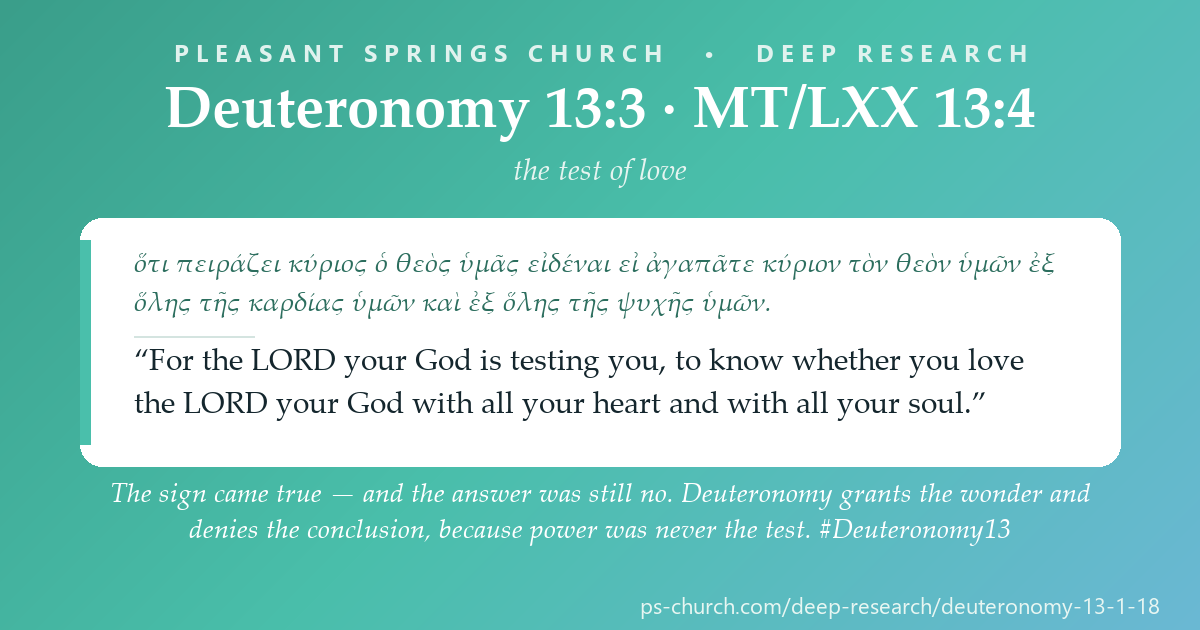
A prophet stands up among you. He gives a sign or a wonder — and it comes true. Then he says: “Let us go after other gods and serve them.” Moses does not say the man is a fraud. He says: do not listen — “for the Lord your God is testing you, to know whether you love the Lord your God with all your heart and with all your soul” (13:3). This study works Deuteronomy 13:1–18: three cases of enticement — the prophet whose sign lands, the brother or child or spouse who whispers it, the town that goes over — and the one sentence that runs through all three. ⚠ The whole chapter carries a versification offset: English 13:1–18 = MT/LXX 13:2–19, and every Hebrew and Greek line here is labelled accordingly. This is capital, theocratic criminal law in a covenant nation whose King was God himself; it is reported plainly, and it is not a template for the church or any modern state, and never a warrant for coercion, shunning or violence today. What lasts is the chapter’s own logic: a true sign does not authenticate a false god — and the whole thing was a test of love. See the method →
Deuteronomy 13:1–18 · MT/LXX 13:2–19 (selections)
Hebrew · LXX · ESVThe Shape of the Passage
Parallel panelsDeuteronomy 13 is the second half of a single argument. Chapter 12 has just said where Israel may worship — the place the Lord chooses — and closed with the warning against asking “how did these nations serve their gods?” (12:30) and the command not to add or take away (12:32 · MT/LXX 13:1). Chapter 13 asks the next question: what if the invitation to another god comes from someone you trust? Then chapter 14 turns to the marks of a people holy to the Lord. ⚠ Because English 12:32 = MT/LXX 13:1, every verse of this chapter is numbered one higher in the Hebrew and Greek than in your English Bible.
Author
The Torah of Moses, still preaching on the plains of Moab. Deuteronomy’s overall shape follows the ancient Near-Eastern suzerainty treaty — preamble, historical prologue, stipulations, witnesses, blessings and curses (so Mendenhall and Kline; Weinfeld for the Neo-Assyrian loyalty-oath and curse parallels) — and chapter 13 is where that shape becomes hard to miss, because the loyalty oaths of the ancient world regularly carried a clause built the same way: the vassal must report sedition, must not conceal it, and must not be bought by the closeness of the one who speaks it. That the form is a treaty form is a genuine and useful observation about the book; it is also pressed on both sides of the dating debate, and this study does not try to settle that.
What the chapter actually does. Three cases, arranged from the outside in. A public religious figure whose credentials are impeccable (13:1–5). Then someone at your own table (13:6–11). Then a whole town (13:12–18). The verbs are the same each time and so is the sentence put in the seducer’s mouth, which is how you can tell the three are one argument. And in the very first case Moses concedes the thing an apologist would most want to deny: the sign comes true. He does not say the prophet is a fraud, or that the wonder was staged. He says it happened — and that it settles nothing, because the question was never whether power is real but whom you are being asked to worship. That is the chapter’s permanent contribution, and it is why 13:3 is the verse to carry away.
Audience
Israel, on the edge of a land already full of shrines — and under a form of government that has never existed since. In the covenant nation God was not merely worshipped; he was the immediate King. Turning the nation to another god was not a difference of private opinion; it was, in that constitution, treason against the head of state, and Deuteronomy 13 is capital criminal law. This study reports that plainly. It also refuses to dress it up: the penalties are death, and the third case reaches an entire city.
⚠ How this chapter must not be read. Deuteronomy 13 is not a template for the church, and not a template for any modern state. It is never a warrant for coercion, for shunning, for informing on, or for violence against a family member, a neighbour, or anyone else, for any reason, today. There is no version of this page that leaves that ambiguous. The church is not a nation, holds no sword, and was never given one: “the weapons of our warfare are not of the flesh” (2 Cor 10:4). When two disciples proposed fire from heaven on a village that would not receive Jesus, “he turned and rebuked them” (Luke 9:54–55). The New Testament answer to false teaching is doctrinal and pastoral: test the spirits (1 John 4:1), let a false gospel be anathema — accursed, God’s business, not ours to execute (Gal 1:8–9) — and discipline by exhortation and, at the very most, exclusion from the table, with restoration as the goal (1 Cor 5; 2 Cor 2:6–8). If someone you love has walked away from Christ, this chapter gives you no permission to harden toward them; Paul’s instruction for exactly that household is the opposite — stay, love, do not leave (1 Cor 7:12–16; 1 Pet 3:1–2).
Orient on false prophecy, signs and wonders, testing, enticement, and the condemned city.
Search by topic: prophecy (false), prophet, dream and dream-interpretation, sign and wonder, divination, apostasy, idolatry, temptation / testing, Belial, herem / ban, capital law in Israel, city of apostasy.
Which articles are relevant?
- Anchor Bible Dictionary — “Prophecy (False Prophecy),” “Dreams,” “Signs and Wonders,” “Apostasy,” “Belial,” “Ban (ḥerem),” “Punishments and Crimes,” “Treaty.”
- Dictionary of the OT: Pentateuch — “Prophets and Prophecy,” “Idolatry,” “Apostasy,” “Testing,” “Law,” “Blessings and Curses,” “Deuteronomy, Book of.”
- NIDOTTE / TDOT — נָסָה (nāsāh, test), מוֹפֵת (môp̄ēt, wonder), סוּת (sût, entice), נָדַח (nāḏaḥ, draw away), בָּעַר (bāʿar, burn out / purge), בְּלִיַּעַל (bəliyyaʿal).
Bibliography surfaced:
- Peter C. Craigie (NICOT), Daniel I. Block (NIVAC), J. G. McConville (Apollos), Jeffrey H. Tigay (JPS), Duane L. Christensen (WBC) on Deuteronomy; Moshe Weinfeld, Deuteronomy 1–11 (Anchor) — which does not reach ch. 13, so for this chapter see his Deuteronomy and the Deuteronomic School.
- Studies of the Neo-Assyrian and Hittite loyalty-oath parallels to Deuteronomy 13 (Weinfeld; Dion; Steymans; Levinson; Berman).
- Studies of true and false prophecy in Israel, read together with Deuteronomy 18:15–22.
- Beale & Carson, Commentary on the NT Use of the OT (Matthew; 1 Corinthians; Galatians).
Loyalty oaths, prophets who were believed, and what later readers did with this chapter.
Read the three cases against the ANE loyalty-oath clauses that look startlingly like them, then watch how Second-Temple and rabbinic readers handled a law they could not perform — and let the New Testament set the terms.
Which parallels shed light on religion and worldview?
The treaty clause behind the chapter. Ancient sovereigns bound their vassals with oaths whose most sensitive clauses concerned speech. In the Succession Treaty of Esarhaddon (Neo-Assyrian, 672 BC), the vassal swears that if he hears an improper word about the crown prince — and the text lists the mouths it might come from, including a prophet, an ecstatic, and a dream-interpreter, and also a brother, a son, a daughter — he will not conceal it but report it, and will seize the one who speaks rebellion and put him to death. Set beside Deuteronomy 13 the resemblance is hard to miss: the same three sources of danger, the same refusal to let kinship buy silence, the same “you shall not conceal him” (13:8). What Deuteronomy does with the form is the interesting part: the sovereign is God, and the loyalty demanded is not political but the love of the Shema (13:3).
A live scholarly argument — reported, not adjudicated. Because the parallel is so close, some scholars (Weinfeld; Dion; Steymans; and Bernard Levinson, who argues that the “do not add or take away” formula at MT/LXX 13:1 is drawn straight from the Assyrian oath) read Deuteronomy 13 as a seventh-century composition modelled on Assyrian material. Others — notably Joshua Berman, who points to the second-millennium Hittite loyalty oath CTH 133 — argue that the shared form is much older and that the Hittite evidence fits Deuteronomy better. The treaty argument runs on both sides of the dating debate; this page reports it as the shape of the book and does not settle the question.
Prophets, dreams, and signs were normal. Israel’s neighbours had prophets who spoke in the name of their gods, dream-oracles collected and interpreted by professionals, and omens read in livers and stars; the Mari letters preserve prophetic messages sent to the king, and Egypt and Mesopotamia both produced dream-manuals. Deuteronomy does not deny the phenomena; it subordinates them. Its two tests are complementary rather than competing: chapter 18 disqualifies the prophet whose word does not come to pass (18:21–22), and chapter 13 disqualifies the prophet whose sign does — if it is used to move you to another god. Between them there is no gap. Content and fulfilment must both be right, and content is the senior test.
- Succession Treaty (Vassal Treaties) of Esarhaddon (Neo-Assyrian, 672 BC; ANET 534–541 — past our locally verified range, so cited without page verification) — a witness, not Scripture: sedition heard from a prophet, an ecstatic, a dream-interpreter, or from a brother, son or daughter must be reported and not concealed; the speaker is to be seized and put to death.
- Hittite treaties and loyalty oaths (ANET 199–206; the Mursilis–Duppi-Tessub treaty, ANET 203–205, with the loyalty clause at 204, partly restored) — the older form of the same exclusive-loyalty language: “with my friend you shall be friend, and with my enemy you shall be enemy.” Joshua Berman presses CTH 133 as the closer parallel to Deuteronomy 13.
- Mari prophetic letters (Old Babylonian, 18th c. BC) — a witness, not Scripture: messages delivered to the king in a god’s name, with the sender vouching for the speaker. Prophecy was a recognized institution, which is exactly why Israel needed a test for it.
- Temple Scroll, 11QTa cols. 54–55 (Dead Sea Scrolls — a witness, not Scripture) — rewrites Deuteronomy 13 at length in the first person, God speaking directly, and tightens the procedure; evidence that the chapter was studied intensively at Qumran alongside the 4QDeut manuscripts.
- Philo, On the Special Laws 1.315–318 (Second-Temple — a witness, not Scripture) — restates the law of the false prophet and the enticer: the nearness of the tempter (a brother, a child, a wife, a friend) is precisely what makes the loyalty test sharp, and a claim to divine revelation is no cover.
- Mishnah, Sanhedrin 7:10 and 10:4–6 (rabbinic-era — witnesses, not Scripture; the last chapter is numbered 11 in some printings) — the mēsît (“enticer”) and the ʿîr hanniddaḥat (the “condemned city”) are given elaborate procedural safeguards that make conviction all but impossible.
- b. Sanhedrin 71a (rabbinic-era — a witness, not Scripture) — the famous verdict on the condemned city: “It never was and never will be; it was written only that you might expound it and receive reward.” The rabbis kept the text and closed the door on the practice.
Read 13:1–3 slowly, because Moses gives away more than most defenders of the faith would. He does not say the prophet is a charlatan. He does not say the wonder was a trick of the light. He says: and the sign or wonder that he tells you comes to pass — and then, without a pause, you shall not listen. Scripture itself has therefore settled a question people still argue about: supernatural power is not self-authenticating. The magicians of Egypt matched Aaron sign for sign at the beginning (Exod 7:11, 22) before they ran out of road; Balaam delivered oracles that were true and God-given while being exactly the wrong sort of man (Numbers 22–24). Jesus said the last-days deceivers would “perform great signs and wonders, so as to lead astray, if possible, even the elect” (Matt 24:24) — and the Greek verb he used, πλανῆσαι, is the LXX’s own word here for what the false prophet is trying to do (13:5 · MT/LXX 13:6: πλανῆσαί σε). Paul says the lawless one comes “with all power and false signs and wonders” (2 Thess 2:9). And most soberingly, Jesus pictures people at the judgment listing genuine miracles done in his name and hearing, “I never knew you” (Matt 7:22–23). So the test is never did something happen? It is always who is being worshipped at the end of it? That is not scepticism about the miraculous. It is the reason the miraculous can never be the last word.
Testing, signs, enticement, drawing away, purging — and the demand for evidence.
Watch nasah (test, not tempt); the ʾot / môp̄ēt pair that God’s own acts share with the deceiver’s; sut whispered bassēṯer, in secret; nadach, the crime of pulling others; baʿar, the formula Paul reuses without the sword; and the three verbs of investigation.
“To test, prove, put to the proof” — the participle mənasseh, “is testing” (LXX πειράζει). This is assay-language: not an experiment to inform God, but a pressure applied so that what is really there comes out. The same verb: God tested Abraham (Gen 22:1); the manna and the wilderness were to test Israel “to know what was in your heart” (Deut 8:2, 16); at Sinai “God has come to test you” (Exod 20:20). Note carefully what it is not: God never solicits evil — “God cannot be tempted with evil, and he himself tempts no one” (Jas 1:13). He permits the false prophet’s pull; he does not author it.
“Sign” and “wonder” (LXX σημεῖον ἢ τέρας) — the very pair used of the plagues and the exodus (Deut 4:34; 6:22; 26:8). Deuteronomy will not let the vocabulary of God’s own mighty acts function as a certificate: the same words can be spoken over a wonder that leads you away. The New Testament uses the same pair for the deceptions of the last days (Matt 24:24; 2 Thess 2:9; Rev 13:13–14).
“To entice, incite, lure” — yəsîṯəḵā, “if he entices you” (LXX flattens it to παρακαλέσῃ, “urges”). A word of persuasion by someone with leverage: Jezebel incited Ahab (1 Kgs 21:25) — and in Job 2:3 the Lord says to the Satan that Job still holds his integrity “although you incited me against him to destroy him without reason.” It is coupled here with bassēṯer, “in secret” — the tell-tale of the whole chapter. What has to be whispered has already conceded something.
“To drive off, thrust aside, draw away” — in the causative, to push someone off the road. It names the crime in all three cases and so binds them together: the prophet “spoke to draw you away” (13:5 · MT/LXX 13:6), the relative “sought to draw you away” (13:10 · MT/LXX 13:11), the worthless men “have drawn away” a whole city (13:13 · MT/LXX 13:14). The LXX renders it at 13:5 · MT/LXX 13:6 with ἐξῶσαι, “to thrust out” (and with ἀποστῆσαι / ἀπέστησαν at 13:10, 13 · MT/LXX 13:11, 14) — while the same verse describes the prophet’s aim as πλανῆσαί σε ἀπὸ κυρίου, “to lead you astray from the Lord,” the verb Jesus takes up in Matt 24:24. Note the object: the offence is not private unbelief but the pulling of other people.
“To burn out, sweep away, purge” — ûḇiʿartā hārāʿ miqqirbeḵā, “so you shall purge the evil from your midst,” Deuteronomy’s standing formula (13:5; 17:7; 19:19; 21:21; 22:21, 24; 24:7). The LXX here reads καὶ ἀφανιεῖς τὸν πονηρὸν ἐξ ὑμῶν αὐτῶν and elsewhere ἐξαρεῖς τὸν πονηρὸν ἐξ ὑμῶν αὐτῶν — and it is that Greek sentence Paul quotes to the Corinthians, with the verb unchanged and the penalty utterly changed (1 Cor 5:13).
“Inquire · search out · ask” — three verbs piled up and then capped with hêṭēḇ, “thoroughly” (LXX καὶ ἐρωτήσεις καὶ ἐραυνήσεις σφόδρα). Before anything is done to the city, the rumour must be run to the ground: “and behold, if it be true and certain.” The most sobering feature of the harshest case in the chapter is that it opens with a demand for evidence — the same instinct that produced the two-or-three-witness rule (Deut 17:6; 19:15) and the ruthless investigation of false witnesses (19:18–19).
How the New Testament takes up Deuteronomy 13:
- Matthew 24:24; Mark 13:22 — “false christs and false prophets will arise and perform great signs and wonders, so as to lead astray (πλανῆσαι), if possible, even the elect.” Jesus assumes Deuteronomy 13’s premise: the wonders may be real.
- Matthew 7:15–23 — false prophets known by their fruit, and men who list genuine mighty works and hear “I never knew you.” Power is not the credential.
- 2 Thessalonians 2:9–12; Revelation 13:13–14 — “false signs and wonders” and a beast who “makes fire come down from heaven”; the chapter’s logic runs to the end of the canon.
- 1 John 4:1–3 — “do not believe every spirit, but test the spirits… every spirit that confesses that Jesus Christ has come in the flesh is from God.” Deuteronomy’s test, now christological.
- Galatians 1:8–9 — even an angel preaching another gospel is to be anathema: accursed — a verdict handed to God, not a sentence carried out by the church.
- 1 Corinthians 5:1–13 — Paul quotes Deuteronomy’s own formula, “Purge the evil person from among you” (5:13), and the sanction is exclusion from the table, aimed at rescue (5:5; cf. 2 Cor 2:6–8).
The test of love, the two prophet-tests, and the formula that crosses the covenants.
Trace three threads: 13:3 as the Shema put on a scale; chapters 13 and 18 as one complete test for prophecy; and “purge the evil from your midst” from Moses to Paul.
Which cross-references matter?
- Deuteronomy 6:4–5 — the words 13:3 puts on trial: “you shall love the Lord your God with all your heart and with all your soul” (see the Shema and Deuteronomy 6). The test is not of doctrine in the abstract; it is of love.
- Deuteronomy 18:15–22 — the other half of the prophetic test: the word that does not come to pass marks a prophet the Lord has not spoken through (see Deuteronomy 18:15–19). Chapter 13 covers the case chapter 18 does not.
- Genesis 22:1; Deuteronomy 8:2, 16; Exodus 20:20 — the vocabulary of testing: God tested Abraham (Genesis 22), and the wilderness was a test “to know what was in your heart” (Deuteronomy 8).
- Exodus 7:8–13, 22; 8:7 — Pharaoh’s magicians duplicate the signs (see Exodus 7:1–13): the biblical precedent for a wonder that proves nothing about whom to worship.
- Numbers 22–24; 25:1–18 — Balaam speaks true oracles and then teaches Israel into Baal-Peor (Numbers 22–24; the seduction at Numbers 25, credited to his counsel at Num 31:16; cf. Rev 2:14): the gift authenticates nothing, and the seduction was domestic before it was theological.
- Deuteronomy 12:8, 30–32; 17:2–7 — the chapter before, on worship on God’s terms rather than “whatever is right in his own eyes” (see Deuteronomy 12), and the chapter after, which supplies the courtroom safeguards this one presumes.
- Leviticus 27:28–29; Deuteronomy 7:1–5, 25–26 — the ḥerem vocabulary borrowed for an Israelite city in 13:15–17 (see Leviticus 27 and Deuteronomy 7): the standard cuts both ways, and Israel is not exempt from it.
- Matthew 24:24; 1 John 4:1–3; Galatians 1:8–9; 1 Corinthians 5:13; 2 Corinthians 10:3–5 — the New Testament’s own handling: the tests kept, the sword laid down.
The single clearest answer to “does the church do what Deuteronomy 13 says?” is that an apostle already answered it, in writing, using this chapter’s own words. Deuteronomy’s standing formula, stamped on case after case, is ûḇiʿartā hārāʿ miqqirbeḵā — “so you shall purge the evil from your midst” (13:5; 17:7; 19:19; 21:21; 22:21, 24; 24:7), which the Greek renders ἐξαρεῖς τὸν πονηρὸν ἐξ ὑμῶν αὐτῶν. In 1 Corinthians 5 Paul faces a case of open, unrepented sin in the congregation, and he ends the paragraph by quoting that sentence verbatim: ἐξάρατε τὸν πονηρὸν ἐξ ὑμῶν αὐτῶν — “Purge the evil person from among you” (5:13). The formula carries over. The penalty does not. In Deuteronomy the sanction was execution by the community; in Corinth it is “not to associate,” “not even to eat with such a one” (5:11) — and even that is aimed at rescue, “so that his spirit may be saved in the day of the Lord” (5:5), with the follow-up letter urging the church to “forgive and comfort him” and “reaffirm your love for him” (2 Cor 2:6–8). That is the whole shape of the change. The covenant community still guards its confession; it does so with words, with the table, and with the door held open, because its weapons “are not of the flesh” (2 Cor 10:4). Anyone who reads Deuteronomy 13 as licence to threaten, coerce, disown or harm has stepped straight over the apostle who read it first.
The scholarship on Deuteronomy 13, the loyalty oaths, and false prophecy.
Craigie, Block, McConville, Tigay, Christensen and Weinfeld on Deuteronomy; Weinfeld, Dion, Steymans, Levinson and Berman on the treaty parallels; Beale & Carson on the New Testament use.
Commentaries & studies:
- Peter C. Craigie, The Book of Deuteronomy (NICOT); Daniel I. Block, Deuteronomy (NIVAC); J. G. McConville, Deuteronomy (Apollos); Jeffrey H. Tigay, Deuteronomy (JPS); Duane L. Christensen, Deuteronomy (WBC); Moshe Weinfeld, Deuteronomy 1–11 (Anchor) — which does not reach ch. 13; for this chapter see his Deuteronomy and the Deuteronomic School.
- Moshe Weinfeld, Deuteronomy and the Deuteronomic School — the classic presentation of the Neo-Assyrian loyalty-oath parallels; Meredith G. Kline, Treaty of the Great King — the covenant form read as the architecture of the book.
- Bernard M. Levinson, “Esarhaddon’s Succession Treaty as the Source for the Canon Formula in Deuteronomy 13:1,” JAOS 130 (2010) — note that his “13:1” is the Hebrew verse, English 12:32.
- Joshua A. Berman, “CTH 133 and the Hittite Provenance of Deuteronomy 13,” JBL 130 (2011) — the case for a second-millennium Hittite rather than Neo-Assyrian model. The two articles are a good place to see the same evidence argued both ways.
- G. K. Beale & D. A. Carson, eds., Commentary on the New Testament Use of the Old Testament (Matthew; 1 Corinthians; Galatians).
Interpretation notes worth keeping:
- Show the numbering, every time. English 12:32 = MT/LXX 13:1, so English 13:1–18 = MT/LXX 13:2–19 without exception. Commentaries, Hebrew editions, the Septuagint and most Jewish sources use the higher number; a citation of “Deut 13:1” may mean either the canon formula or the false prophet, and only the context will tell you which.
- The chapter concedes the miracle. 13:1–2 grants that the sign comes to pass. Do not preach it as though the wonder were fraudulent; the whole force of the passage depends on it being real, and on truth being decided by content rather than by power.
- ‘Testing’ is not ‘tempting.’ Nāsāh / πειράζω here means to prove, as metal is assayed. God is not the author of the enticement; he is the one who turns it into a disclosure of what a heart actually loves. Hold this next to James 1:13, and do not let it drift into making God the seducer.
- It is theocratic criminal law, and it does not transfer. Israel was a nation with God as its immediate King; apostasy was treason in that constitution. The church is not a nation and holds no sword (2 Cor 10:4; Eph 6:12), and no modern state stands where Israel stood. This chapter is not a model for church discipline, for civil law, or for family life today, and any use of it to justify coercion, shunning or violence is a misuse.
- Even the hardest case demands evidence first. The city is not touched until “you shall inquire and make search and ask diligently” has been satisfied and the matter is “true and certain” (13:14). Rumour is not grounds. The rabbis pressed the safeguards until the case became unperformable (m. Sanh. 10:4–6; b. Sanh. 71a) — a Jewish reading worth knowing, and a reminder that the text’s own instinct is toward restraint.
- The standard cuts both ways. The ḥerem language of chapter 7, aimed there at Canaanite shrines, is turned here on an Israelite town. Deuteronomy will not let Israel be the exception to its own law — which is precisely why the chapter cannot be read as a charter for “us” against “them.”
- Do not sensationalize the penalties. Report them, locate them, and move on. The chapter’s enduring subject is the test of love and the insufficiency of signs — and its last word is not execution but mercy (13:17).
From a sign that came true to the question it could not answer.
Name what you learned, why it matters, and one concrete response.
What should we carry away — and do?
- A wonder is not an argument. Deuteronomy grants the miracle and still says no. Whatever happened — the healing, the prophecy, the uncanny accuracy — the question is where it is pointing you. “Test the spirits” (1 John 4:1) is not cynicism; it is obedience.
- The test is of love, not of information. “For the Lord your God is testing you, to know whether you love the Lord your God with all your heart and with all your soul” (13:3). The Shema is not a slogan; it is a claim that gets weighed.
- The pull usually comes from someone you love. That is the second case, and it is the honest one. Almost no one is argued out of Christ by a stranger; people drift because of a voice at the kitchen table. Name the pull without demonizing the person.
- What has to be secret is already suspect. Bassēṯer — “secretly” — is the tell. Whatever cannot be said in the light, in front of the people who love you, is worth examining before it is worth following.
- And the sword is not ours. This is capital law for a nation whose King was God, and it is not a template for the church, for any state, or for your family. Paul quotes this chapter’s own formula and hands the church words, the table, and an open door (1 Cor 5:13; 2 Cor 2:6–8; 10:4). If someone you love has walked away, you have no permission here to harden — only to stay, to pray, and to keep loving them (1 Cor 7:12–16; 1 Pet 3:1–2).
Step in response: think of one thing you have been half-persuaded by because it worked — a teacher, a book, a movement, a result — and ask Deuteronomy’s question about it rather than the impressive one: where does this end up putting my worship? Then do the other half. Pick the person whose drift from Christ grieves you most, and instead of arguing, call them — not to win, but so they know the door is still open. The chapter’s own last word is mercy (13:17), and mercy is the one thing you are actually authorized to enforce.
Deuteronomy 13:3 · MT/LXX 13:4 · to share
LXX + ESVEvery Deep Research page traces its passage across the whole sweep — the Old Testament, the Second-Temple world between the testaments (historical witnesses, not Scripture), and the New Testament. Follow the thread:
Pleasant Springs Church — Deep Research
Research method after Michael S. Heiser’s Bible Research Method (examine dictionaries → ancient literature → important words → textual connections → academic publications → share), with the Pleasant Springs “Author & Audience” foundation. Scripture set in the Hebrew, the Greek editions named on each page and the ESV (Old Testament), and the Greek New Testament and the ESV (New Testament), per the practice of Pleasant Springs Church. Deuteronomy 13 research grounded in Craigie, Block, McConville, Tigay, Christensen and Weinfeld, with Kline and Weinfeld on the covenant/treaty form, Levinson (JAOS 130) and Berman (JBL 130) presented as the two sides of the Neo-Assyrian / Hittite parallel debate rather than adjudicated, and Beale & Carson on the New Testament use (Matthew; 1 Corinthians; Galatians). ANE background from the Hittite treaties (ANET 199–206, the Mursilis–Duppi-Tessub loyalty clause at 204, partly restored) and Esarhaddon’s Succession Treaty (ANET 534–541, cited beyond our verified range); Second-Temple, Qumran and rabbinic witnesses (Philo, Special Laws 1.315–318; the Temple Scroll 11QTa 54–55; m. Sanhedrin 7:10 and 10:4–6; b. Sanhedrin 71a) read as witnesses, not Scripture. ⚠ Versification: English 12:32 = MT/LXX 13:1, so English 13:1–18 = MT/LXX 13:2–19 throughout, and every Hebrew and Greek line is labelled with both; Deuteronomy 1–11 has no offset, and the later divergences are English 22:30 = MT/LXX 23:1 and English 29:1 = MT/LXX 28:69. Greek is Rahlfs. The chapter’s penalties are reported as capital, theocratic criminal law in a covenant nation under God as its immediate King — stated unmistakably to be no template for the church or any modern state, and never a warrant for coercion, shunning or violence against family or neighbour today (Gal 1:8–9; 1 John 4:1; 1 Cor 5:13; 2 Cor 2:6–8; 10:4; Luke 9:54–55) — and the study lands where the chapter itself lands: a true sign does not authenticate a false god, and the whole was a test of love.
Scripture quotations marked ESV are from the ESV® Bible (The Holy Bible, English Standard Version®), © 2001 by Crossway, a publishing ministry of Good News Publishers. ESV Text Edition: 2016. Used by permission. All rights reserved. The ESV text may not be quoted in any publication made available to the public by a Creative Commons license, and the ESV may not be translated in whole or in part into any other language. www.esv.org
|
Did this study bless you today? 💚 Give to Support PS Church100% of gifts go to the General Fund — thank you. |