The long duel with Pharaoh begins with a pattern and a purpose. Moses is made “like God to Pharaoh,” Aaron is his “prophet,” and God announces the end before the first sign: “the Egyptians shall know that I am the Lord.” Aaron’s staff becomes a serpent; Egypt’s magicians match it by their secret arts — and then Aaron’s staff swallows theirs. Held with it: the hardening of Pharaoh, whose own defiance comes first and whom God then judicially confirms — sovereign freedom that never overrides real guilt, and always runs toward mercy. This study works Exodus 7:1–13. See the method →
Exodus 7:1, 3, 5, 12, 13
Hebrew · LXX · ESVThe Shape of the Passage
Parallel panelsWith the name newly experienced (6:2–8) behind him and his own reluctance answered, Moses is re-commissioned; here the long duel with Pharaoh begins, and the narrator frames its whole meaning in advance.
Author
The Torah of Moses opens the plague narrative not with a plague but with a pattern. “I have made you like God to Pharaoh, and your brother Aaron shall be your prophet” (7:1) — a rare, luminous definition embedded in the story: a prophet is one who carries another’s word (cf. 4:16). Moses is not deified; he stands in God’s stead before the king, and Aaron speaks Moses’ word as a נָבִיא speaks the Lord’s. The contest that follows is a war of words made visible in signs.
The stated purpose. Before a single wonder, God announces the end: “I will harden Pharaoh’s heart… and the Egyptians shall know that I am the Lord” (7:3–5). The recognition formula — “that you/they may know that I am the Lord” — is the engine of the whole book (6:7 to Israel; 7:5, 17; 8:22; 14:4, 18 to Egypt). The plagues are not a tantrum but a self-revelation: judgment that teaches, wrath that unveils the living God to a world that said, “Who is the Lord?” (5:2).
The first sign. When Pharaoh demands credentials, Aaron throws down the staff and it becomes a serpent (תַּנִּין, tannin — not the smaller נָחָשׁ of 4:3, but the dragon-serpent of chaos, the very creature coiled on Pharaoh’s crown). Egypt’s wise men and sorcerers replicate it “by their secret arts” — the text does not pretend their power is nothing — but then “Aaron’s staff swallowed up their staffs” (7:12). The verb is בָּלַע, swallow: the same word by which the earth will swallow rebels (Num 16:32) and swallow Egypt’s army (15:12). The opening move already names the ending.
Audience
Israel — and, over their shoulder, Egypt — is being taught to read the plagues rightly. Not luck, not the strength of the Nile’s gods, not Moses’ magic against Egypt’s magic, but the Lord alone, sovereign over the greatest empire and its whole pantheon. A people who had cried, “the Lord has led us into worse trouble” (5:21–23), needed to know that the coming wonders were his from the first, working toward a fixed end: “I will bring out my hosts… by great acts of judgment” (7:4).
The hardening — read carefully. Scripture does not flatten this. Across the fuller narrative Pharaoh hardens his own heart first — the text either leaves the agent unstated (“his heart was hard,” 7:13, 22; 8:19) or names Pharaoh himself (8:15, 32; 9:34) — and only later does God harden him (9:12; 10:1) — judicial hardening that confirms a settled defiance, never overriding an innocent will. The two are held together with Pharaoh’s real, culpable responsibility. When Paul cites this very story (“For this very purpose I have raised you up”, Rom 9:17–18), he means God’s righteous freedom over a vessel that made itself fit for destruction, not the arbitrary reprobation of the guiltless. God bends even Pharaoh’s hardness to mercy’s ends — that his name be proclaimed in all the earth, and a people set free.
Orient on prophecy, the hardening, the magicians, and the serpent-sign.
Search by topic: prophet / prophecy, hardening of the heart, magic and magicians in Egypt, signs and wonders, serpent / tannin, the plagues.
Which articles are relevant?
- Anchor Bible Dictionary — “Prophecy (Preexilic),” “Magic (OT),” “Plagues of Egypt,” “Aaron,” “Serpent.”
- Dictionary of the OT: Pentateuch — “Signs and Wonders,” “Hardening,” “Egypt, Egyptians,” “Moses,” “Aaron.”
- NIDOTTE / TDOT — נָבִיא (nāḇîʾ, prophet), קָשָׁה/חָזַק/כָּבֵד (the three hardening verbs), תַּנִּין (tannîn, serpent-dragon), בָּלַע (bālaʿ, swallow), מוֹפֵת (môp̄ēṯ, wonder).
Bibliography surfaced:
- Brevard Childs, The Book of Exodus (OTL); Douglas Stuart, Exodus (NAC); John Durham, Exodus (WBC); Peter Enns, Exodus (NIVAC).
- Studies on the hardening of Pharaoh (e.g., R. R. Wilson; G. K. Beale) and on the recognition formula “you shall know that I am the Lord” (W. Zimmerli).
- John Currid, Ancient Egypt and the Old Testament — Egyptian magic, serpents, and the plagues.
Egyptian magic, the royal serpent, and the war of the gods.
Read the staff-serpent contest against Egyptian magical practice and royal symbolism, then hear the Second-Temple witnesses on the magicians and the plagues.
Which parallels shed light on religion and worldview?
The serpent on the crown. Egypt did not fear the sign lightly: the rearing cobra (the uraeus) sat on Pharaoh’s brow as the emblem of his sovereignty and the goddess Wadjet’s protection, and the chaos-dragon Apophis threatened the sun-god’s nightly voyage. For Aaron’s staff to become a תַּנִּין and then swallow the magicians’ serpents is a targeted taunt: the Lord masters the very symbol of Pharaoh’s power and the creature Egypt most feared. It is the opening shot in what 12:12 will call judgment “on all the gods of Egypt.”
Real power, greater power. The narrative grants that the magicians “did the same by their secret arts” (7:11) — it does not rationalize their feat away. Egypt’s ḥry-tp (chief lector-priests) were renowned for exactly such demonstrations. But imitation is not mastery: their serpents are eaten. Scripture’s worldview is neither naive nor dualist — dark powers are real and really outmatched. Later the magicians themselves confess, “This is the finger of God” (8:19), and finally cannot even stand before Moses (9:11).
- Egyptian magical texts & royal iconography — the uraeus cobra of kingship; the serpent Apophis (Apep) as chaos; lector-priest wonder-working: the world in which the sign lands as a challenge to Pharaoh’s gods.
- Wisdom of Solomon 11–19 (Second-Temple Jewish reflection — a witness, not Scripture in the Protestant canon) — a meditation on the plagues as measured, revelatory judgment: Egypt punished “by the very things by which it sinned.”
- Jubilees 48 (2nd c. BC — witness, not Scripture) — retells the signs and plagues, casting the opposition as the work of Mastema, the prince of hostility; the sorcerers stand behind him.
- Josephus, Antiquities 2.284–287; Philo, Life of Moses 1.90–94 (1st c. AD — witnesses) — expand the staff-and-serpent duel and the magicians’ discomfiture before Moses.
The magicians go unnamed in Exodus, but Jewish tradition gave them names — Jannes and Jambres — and Paul reaches for exactly that tradition: “Just as Jannes and Jambres opposed Moses, so these men also oppose the truth… But they will not get very far, for their folly will be plain to all” (2 Tim 3:8–9). Paul’s point is our chapter’s point: counterfeit power can mimic for a while, but it is exposed and swallowed. The imitators of 7:11 who cannot stand in 9:11 become Paul’s picture of every opposition to the gospel that dazzles briefly and then collapses. The staff that swallowed the serpents still stands over every rival to the word of God.
The vocabulary of prophecy, hardening, and the swallowing staff.
Watch the prophet-pattern of 7:1, the three hardening verbs, the recognition formula, the dragon-serpent tannin, and the ominous verb “swallow.”
“Like God to Pharaoh” — elohim here is ordinary “God/god,” not the covenant name: Moses is God’s representative before the king (cf. 4:16), invested with his authority, not deified.
“Prophet” — Aaron as Moses’ navi defines the office: one who carries and speaks another’s word. The God→prophet→word pattern, embedded in the story (cf. Deut 18:18).
“I will harden” — root qashah, make hard/stubborn (LXX σκληρυνῶ). One of three hardening verbs (with chazaq, kaved); in the narrative Pharaoh hardens himself first (7:13), God confirms it later (9:12).
“I am the Lord” — the recognition formula: “they/you shall know that I am the Lord.” The plagues aim at knowledge, not just pain (6:7; 7:17; 14:4, 18; and 70+ times in Ezekiel).
“Serpent / sea-dragon” — not the nachash of 4:3 but the chaos-monster (LXX δράκων); the creature of Pharaoh’s crown and Egypt’s dread. The Lord’s staff-serpent devours Egypt’s.
“And it swallowed” — balaʿ, the swallowing verb: the earth swallows Korah’s rebels (Num 16:32) and Egypt’s army (Ex 15:12). The first sign forecasts the last: Egypt’s power devoured.
How the rest of Scripture fills out the scene:
- Exodus 4:16; 7:1; Deuteronomy 18:18 — the prophet as mouth for God’s word: Moses’ office defined, then promised to a coming prophet (see the prophet like Moses).
- Exodus 6:7; 7:5, 17; 8:22; 14:4, 18 — the recognition formula sweeping Israel and Egypt alike toward the knowledge of the Lord (see the sea).
- Exodus 8:15, 19, 32; 9:12; 10:1; Romans 9:17–18 — Pharaoh’s self-hardening and God’s judicial hardening, and Paul’s reading of them.
- Exodus 15:12; Numbers 16:32; Jonah 1:17 — the verb “swallow” (balaʿ): the earth swallowing Egypt’s army and Korah’s rebels, the great fish swallowing Jonah — God’s swallowing of what opposes him, foreshadowed by Aaron’s staff.
From the swallowing staff to the finger of God and the freedom of mercy.
Trace the sign, the hardening, and the recognition formula across the book and into the New Testament’s reading of Pharaoh.
Which cross-references matter?
- Exodus 4:1–9, 21 — the first staff-serpent (a nachash) given to Moses, and the first word that God would harden Pharaoh: the seeds of chapter 7.
- Exodus 5:1–2 — “Who is the Lord, that I should obey his voice?” The question the whole contest answers.
- Exodus 8:19; 9:11 — “This is the finger of God,” and the magicians who could not stand: the imitators exposed (cf. Luke 11:20).
- Exodus 12:12; 15:11 — judgment “on all the gods of Egypt”; “Who is like you… among the gods?” — the swallowing staff’s theme fulfilled (see the Passover).
- Romans 9:17–18; 2 Timothy 3:8–9 — Pharaoh “raised up” for God’s proclaimed name; Jannes and Jambres as the type of exposed opposition.
Paul’s hardest paragraph (Romans 9) leans its whole weight on Exodus 7–14: “For the Scripture says to Pharaoh, ‘For this very purpose I have raised you up, that I might show my power in you, and that my name might be proclaimed in all the earth’… So then he has mercy on whomever he wills, and he hardens whomever he wills” (Rom 9:17–18). Read against the story Paul is quoting, this is not the arbitrary damnation of an innocent. Exodus is careful and public: Pharaoh hardens his own heart through the early plagues (7:13, 22; 8:15, 32) before the text ever says God hardened him (9:12). God’s hardening is judicial — the confirming of a defiance long chosen, the handing of a man over to the self he insisted on becoming (cf. Rom 1:24, 26, 28). The vessel “made for destruction” (Rom 9:22) is one that fitted itself for it. And even that hardness God overrules for mercy: the more Pharaoh resists, the more the plagues multiply, the louder God’s name is proclaimed, and the more gloriously Israel — and a watching world — comes to “know that I am the Lord.” God is never the author of a sinner’s sin, and never at a loss before it. He is free, and his freedom runs toward mercy: the same sovereignty that hardens a self-hardened king raises up, in the fullness of time, a people not his own to be called sons of the living God (Rom 9:25–26; cf. Romans 8).
The scholarship on the hardening, the magicians, and the sign.
Childs and Durham for the exegesis; Currid on Egyptian background; the studies of the hardening motif and the recognition formula.
Commentaries & studies:
- Brevard Childs, The Book of Exodus (OTL); John Durham, Exodus (WBC); Douglas Stuart, Exodus (NAC); Peter Enns, Exodus (NIVAC).
- John D. Currid, Ancient Egypt and the Old Testament; studies on Egyptian magic and the uraeus serpent.
- On the hardening: G. K. Beale, “An Exegetical and Theological Consideration of the Hardening of Pharaoh’s Heart”; on the recognition formula: Walther Zimmerli, I Am Yahweh.
Interpretation notes worth keeping:
- Three hardening verbs. Hebrew uses chazaq (be strong/firm), kaved (be heavy/dull), and qashah (be hard). The distribution matters: Pharaoh’s own hardening dominates chs. 7–8; God’s active hardening is announced (7:3) but first narrated at 9:12 — the order safeguards Pharaoh’s responsibility.
- “Like God to Pharaoh” (7:1). Representative authority, not apotheosis; the same idiom as 4:16 (Moses “as God” to Aaron). The Bible’s prophets speak for God without being God.
- The magicians’ power. The text neither denies nor glorifies it; it is granted, then decisively outmatched and finally paralyzed (8:19; 9:11). A sober biblical realism about counterfeit power.
- 7:5’s πάντες. The LXX’s “all the Egyptians” heightens the universal scope of the knowledge the plagues aim to produce — a small window into the translators’ theology of revelation.
From a swallowed serpent to the knowledge of the living God.
Name what you learned, why it matters, and one concrete response.
What should we carry away — and do?
- The plagues are revelation. “That the Egyptians may know that I am the Lord.” God’s judgments are never mere wrath; they unveil him. Read hard providences for what they are meant to teach.
- Counterfeit power is real — and outmatched. Egypt’s magicians really imitated the sign, then their serpents were swallowed and they could not stand. Do not fear the dazzle; the staff of God still swallows every rival.
- The hardening warns. Pharaoh hardened himself long before God confirmed it. A heart set against God is not overruled into innocence; it is handed over. “Today, if you hear his voice, do not harden your hearts” (Ps 95:7–8; Heb 3:15).
Step in response: where is your heart resisting a word you already know is God’s? Name it before it sets like Pharaoh’s. And where God is at work in power you cannot match, stop competing and start worshiping: bow to the Lord whose staff swallows serpents, that you too may know that he is the Lord.
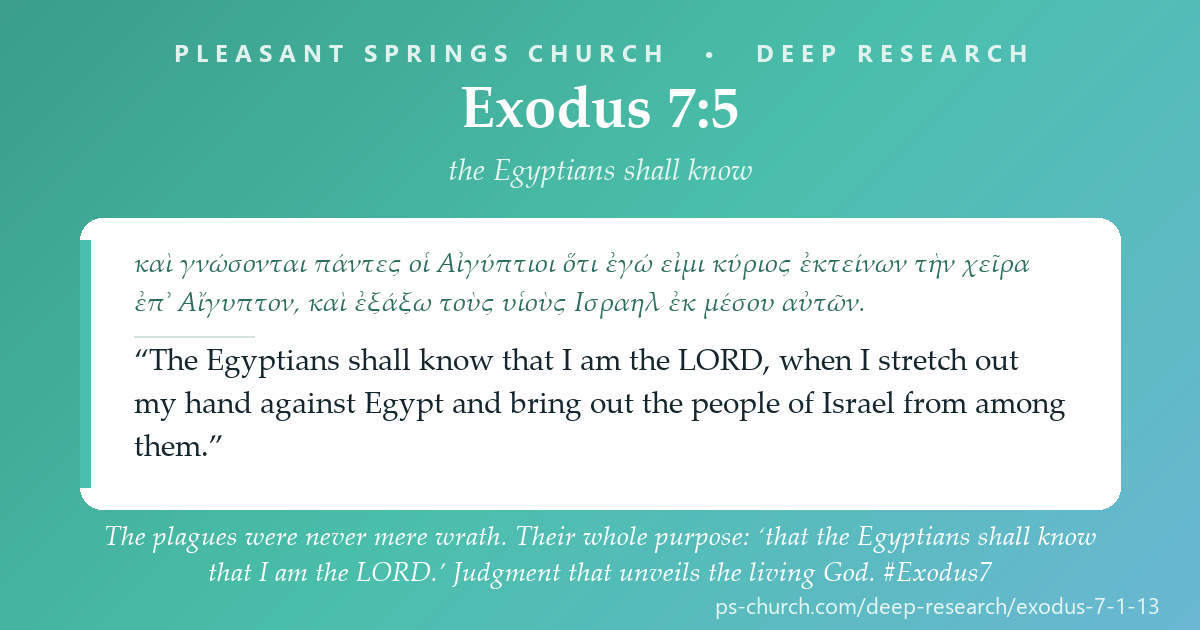
Exodus 7:5 · to share
LXX + ESVEvery Deep Research page traces its passage across the whole sweep — the Old Testament, the Second-Temple world between the testaments (historical witnesses, not Scripture), and the New Testament. Follow the thread:
Pleasant Springs Church — Deep Research
Research method after Michael S. Heiser’s Bible Research Method (examine dictionaries → ancient literature → important words → textual connections → academic publications → share), with the Pleasant Springs “Author & Audience” foundation. Scripture set in the Hebrew, the Greek editions named on each page and the ESV (Old Testament), and the Greek New Testament and the ESV (New Testament), per the practice of Pleasant Springs Church. Exodus 7:1–13 research grounded in Childs, Durham, Stuart, and Enns, with Currid on the Egyptian background (the uraeus serpent, lector-priest magic); the hardening read across its three Hebrew verbs and its narrative order — Pharaoh’s self-hardening (7:13, 22; 8:15, 32) preceding God’s judicial hardening (9:12; 10:1), and Paul’s use of it (Rom 9:17–18) as God’s righteous freedom over a self-fitted vessel, not arbitrary reprobation; the recognition formula (6:7; 7:5, 17; 14:4, 18; Zimmerli) as the plagues’ revelatory purpose; the magicians’ real-but-outmatched power (7:11; 8:19; 9:11), named Jannes and Jambres in later tradition (2 Tim 3:8); Wisdom 11–19, Jubilees 48, Josephus, and Philo read as witnesses, not Scripture.
Scripture quotations marked ESV are from the ESV® Bible (The Holy Bible, English Standard Version®), © 2001 by Crossway, a publishing ministry of Good News Publishers. ESV Text Edition: 2016. Used by permission. All rights reserved. The ESV text may not be quoted in any publication made available to the public by a Creative Commons license, and the ESV may not be translated in whole or in part into any other language. www.esv.org
|
Did this study bless you today? 💚 Give to Support PS Church100% of gifts go to the General Fund — thank you. |