The plague-cycle begins — and the first blow announces its purpose before it falls: “By this you shall know that I am the Lord.” God meets Pharaoh at the Nile in the morning, at the very source of Egypt’s life and the seat of a god; the staff strikes the water, and the river runs with blood — the fish die, it stinks, and Egypt digs along the bank for water; seven days. The court magicians copy the sign by their secret arts but cannot undo a drop of it, and Pharaoh hardens his own heart. Not blind wrath, but revelation and polemic: the God who is struck at the source of a tyrant’s trust. This study works Exodus 7:14–25. See the method →
Exodus 7:16–22 (selections)
Hebrew · LXX · ESVThe Shape of the Passage
Parallel panelsAfter the credential-sign of the staff and serpent (Exodus 7:1–13), the plagues begin — and the very first blow announces their purpose: not blind wrath, but revelation. God strikes Egypt precisely where Egypt trusts.
Author
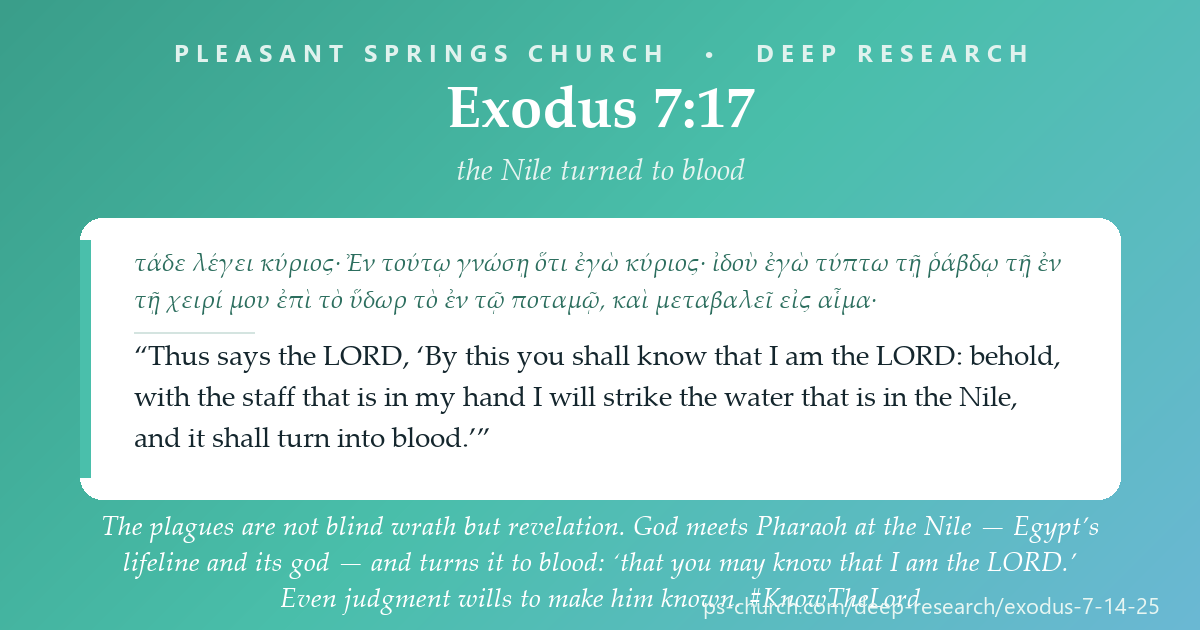
The Torah of Moses opens the contest of the plagues with a deliberate stage-setting: Moses is to meet Pharaoh “in the morning, as he is going out to the water” (7:15) — the king comes to the Nile, and there the word of the Lord is waiting for him. The purpose is spoken before the plague strikes: “By this you shall know that I am the Lord” (7:17). Every plague is aimed at that knowledge — and the whole cycle is framed by it (7:5; 8:22; 9:14; 14:4, 18). The plagues are not merely punitive; they are self-revelation under judgment, addressed to a king who had sneered, “Who is the Lord, that I should obey his voice?” (5:2).
A blow at a god. The Nile (יְאֹר, an Egyptian loanword) was Egypt’s lifeline — its water, its harvest, its highway — and it was worshiped: its inundation personified in Hapi, its waters bound up with Osiris and the sun-born order of the land. To turn the river to blood is to strike the source of Egypt’s security and to expose its god as no god. This is the first move in a running polemic against “all the gods of Egypt” on whom the Lord will “execute judgments” (12:12). The plague speaks: the river you deified cannot save you, and the God you mocked holds even the Nile in his hand.
The magicians and the hardening. Pharaoh’s חַרְטֻמִּים “did the same by their secret arts” (7:22) — and that mattered to Pharaoh far more than the miracle itself. Yet notice what they can and cannot do: they can add to the ruin (more blood), but they cannot reverse a drop of it; evil can imitate a sign but never undo the judgment or heal the river. On this basis — a copied trick — “Pharaoh’s heart remained hardened” (וַיֶּחֱזַק, “grew strong”) and “he did not take even this to heart” (7:23). Through these early plagues the text is careful: Pharaoh hardens his own heart. Only later (from 9:12) will it say “the Lord hardened” him — the judicial confirming of a defiance already settled and self-chosen.
Audience
Israel — slaves who had cried out under the lash and whose infant sons Pharaoh had ordered drowned in this very river (1:22) — needed to know that the God of their fathers was not distant but was even now bending Egypt’s pride at its proudest point. The Nile that had been made a grave for Hebrew children now runs with blood before the king’s eyes: a sober, measured beginning of justice on a genocidal tyranny, not a spectacle for cheering. And the refrain is for Israel too: “that you may know that I am the Lord your God” (6:7).
How later Israel read it. The plague-psalms sing it back — “He turned their rivers to blood, so that they could not drink of their streams” (Ps 78:44; cf. 105:29). The Egyptians are not caricatured: the narrative simply records a real people digging along the riverbank for water (7:24), and later chapters will note the Egyptians who came to fear the Lord (9:20). The point is never Egypt’s humiliation for its own sake, but the making-known of the one true God — a name to be “proclaimed in all the earth” (9:16; cf. Rom 9:17). Judgment here has a missionary edge.
Orient on the Nile, the plagues, Egyptian magic, and the hardening.
Search by topic: Nile, plagues of Egypt, magic / magicians, hardening of the heart, recognition formula (‘that you may know’), Egyptian religion (Hapi, Osiris).
Which articles are relevant?
- Anchor Bible Dictionary — “Plagues of Egypt,” “Nile,” “Magic (OT),” “Egypt, Religion of,” “Pharaoh.”
- Dictionary of the OT: Pentateuch — “Signs and Wonders,” “Plagues,” “Egypt, Egyptians,” “Hardening.”
- NIDOTTE / TDOT — יְאֹר (yə’ōr, the Nile), דָּם (dām, blood), חַרְטֹם (charṭōm, magician), חָזַק (chāzaq, be strong / harden).
Bibliography surfaced:
- Brevard Childs, The Book of Exodus (OTL); Douglas Stuart, Exodus (NAC); John Durham, Exodus (WBC); Peter Enns, Exodus (NIVAC).
- Nahum Sarna, Exploring Exodus — the plagues against Egyptian religion and nature.
- Studies on the “recognition formula” (Walther Zimmerli) and on Egyptian magic and the chartummim.
The deified Nile, the measured recompense, and the enchanters’ craft.
Read the first plague against Egyptian Nile-religion, the Second-Temple readings of the plagues as fitting justice, and the ancient world of court magic.
Which parallels shed light on religion and worldview?
The Nile as life and as god. Egypt was, in Herodotus’ famous phrase, the gift of the river: the annual flood of the יְאֹר laid down the black soil that fed the nation, and that flood was worshiped as the god Hapi, its life bound up with Osiris and the whole sacred order of the land. To strike the Nile first is therefore no random opening: it is a theological blow at the very heart of Egypt’s confidence and cult — the source you trusted and adored, turned to death before your eyes. The plague is polemic: “on all the gods of Egypt I will execute judgments” (12:12).
The recognition formula. “By this you shall know that I am the Lord” (7:17) is not a throwaway line but the engine of the cycle — the same words open and punctuate the plagues (7:5; 8:10, 22; 9:14, 29; 14:4, 18). The plagues are a sustained act of self-revelation: their aim is knowledge of God, wrung even from a hostile court and confirmed to Israel. What Pharaoh had denied (“I do not know the Lord,” 5:2) the whole earth will come to know.
The enchanters. Pharaoh’s חַרְטֻמִּים were the learned priest-magicians of the court (the LXX calls them ἐπαοιδοί, “enchanters,” working φαρμακείαις, “by sorceries”). That they could mimic the sign is telling: counterfeit power is real enough to deceive and to harden, but it is impotent where it matters — it can multiply the plague, never lift it; imitate a wonder, never save. Later tradition even named these opponents (Jannes and Jambres, 2 Tim 3:8; cf. the Damascus Document), the standing type of a cleverness that resists the truth.
- Wisdom of Solomon 11:5–7 (Second-Temple wisdom — a witness, not Scripture) — reads the bloodied river as fitting recompense: the stream troubled with blood rebukes “the decree to slay the infants,” God punishing “by the very things by which” the guilty sinned.
- Psalm 78:43–44; 105:29 (Scripture) — the plague-psalms: “He turned their rivers to blood, so that they could not drink of their streams.”
- Josephus, Antiquities 2.294–295; Philo, Life of Moses 1.98–101 (Jewish historians — witnesses) — retell the first plague: the Nile turned bloody and foul, undrinkable, the fish dead.
- Egyptian Nile-religion — Hapi (the inundation) and the river’s ties to Osiris; the plague as judgment on a deified river (cf. Exod 12:12).
It is easy to read the plagues as sheer catastrophe — and the suffering is real, never to be cheapened. But the text refuses to let us read them as mere wrath. Before the first drop of the Nile turns, God states the point: ‘By this you shall know that I am the Lord.’ The plagues are a kind of terrible preaching — a self-disclosure aimed at a court, a nation, and a watching Israel, and finally at ‘all the earth’ (9:16). And the aim is precise. Egypt trusted the Nile and worshiped it; so the Nile is struck — not to gloat, but to unmask, to show that the river is a creature and the Lord is God. Every idol we build promises life and cannot finally give it; grace often begins where the false security fails. That the Egyptians dig along the bank for water (7:24), and that some of them will later fear the Lord (9:20), is part of the mercy hidden in the judgment: even here, God is making himself known so that some may live.
The vocabulary of the first plague: the Nile, the knowing, the counterfeit, the hardening.
Watch the deified Nile, the “that you may know” formula, the magicians’ “secret arts,” the self-hardening chāzaq, and blood as the sign of death and, later, of rescue.
“The Nile” — an Egyptian loanword for the great river; Egypt’s lifeline, deified as Hapi and bound to Osiris. The plague strikes the nation’s source of life and its god at once.
“By this you shall know” — the recognition formula that drives the whole cycle (7:5; 8:22; 14:4). The plagues aim at knowledge of God, not mere ruin.
“Magicians” — the court’s priest-scholars; LXX ἐπαοιδοί (“enchanters”). They can copy the sign — and add to the plague — but never reverse it.
“By their secret arts” — hidden, occult craft; LXX ταῖς φαρμακείαις (“by sorceries”). Counterfeit power, real enough to deceive and to harden.
“Remained hardened” — from chāzaq, “be strong.” Here Pharaoh’s heart hardens itself; only from 9:12 does the text say the Lord hardened him — judicial confirming of a settled, self-chosen defiance.
“Blood” — the river of life becomes a river of death. The last plague-echo of blood will run the other way at Passover (12:13) and, in judgment, at Revelation 16:4–6.
How the rest of Scripture takes up the plague:
- Exodus 4:9 — the earlier private sign already pointed here: Nile-water poured out becomes blood on the dry ground (see the call confirmed).
- Exodus 7:5; 8:22; 9:14; 14:4, 18 — “that you [/the Egyptians] may know that I am the Lord”: the refrain that frames the whole deliverance (see the sea).
- Psalm 78:43–44; 105:29 — Israel’s worship remembers the plague: “he turned their rivers to blood.”
- 2 Timothy 3:8; Revelation 16:3–6 — the magicians who “oppose the truth,” and the last-days waters turned to blood in righteous judgment.
From the struck Nile to the blood of the Lamb and the bowls of wrath.
Trace the recognition formula, the polemic against false gods, the counterfeit sign, and the theme of blood across the canon.
Which cross-references matter?
- Exodus 5:2; 6:7; 7:5, 17; 14:4, 18 — from “I do not know the Lord” to “the Egyptians shall know that I am the Lord”: the plagues as revelation (see the second call).
- Exodus 12:12–13 — “on all the gods of Egypt I will execute judgments”; and the blood that saves at the Passover, the counter-sign to the blood that judges here (see the Passover).
- Wisdom of Solomon 11:5–16; 16–19 — the Second-Temple meditation on the plagues as measured recompense (a witness, not Scripture).
- Romans 9:16–18 — Paul on Pharaoh: “that my name might be proclaimed in all the earth” (Exod 9:16); God’s righteous freedom over a self-made vessel of wrath — not the reprobation of the innocent.
- Revelation 8:8–9; 16:3–6 — the trumpet and bowl plagues echo Exodus: seas and rivers to blood, “for they have shed the blood of saints… It is what they deserve!”
The most sobering figures in the chapter are the magicians. They watch the Nile run with blood — and their response is not repentance but replication: ‘they did the same by their secret arts.’ It is worth weighing what that imitation actually accomplishes. They cannot cleanse a single cupful of the river; they cannot raise one dead fish; they can only deepen the ruin by turning more water to blood. This is the abiding pattern of counterfeit power: it can copy a sign, impress a court, and harden a heart, but it can never undo a judgment or heal what sin has poisoned. Paul names these men as the type of all who ‘oppose the truth’ (2 Tim 3:8), and John sees the pattern run to its end when the world’s waters are turned to blood in the bowls of Revelation. Against every such counterfeit stands the one sign that truly saves — not more blood spilled in judgment, but blood applied in mercy: the lamb’s blood on the doorpost (12:13), and the blood of the true Passover Lamb ‘who takes away the sin of the world’ (Jn 1:29). Evil can mimic a wonder. Only God can redeem. (Held as the plain reading of the text and, at Passover, as the devotional analogy this library owns as analogy, not proof.)
The scholarship on the plague narratives.
Childs and Durham for the exegesis; Sarna on the polemic against Egyptian religion; the studies of the recognition formula and the structure of the plagues.
Commentaries & studies:
- Brevard Childs, The Book of Exodus (OTL); John Durham, Exodus (WBC); Douglas Stuart, Exodus (NAC); Peter Enns, Exodus (NIVAC).
- Nahum Sarna, Exploring Exodus; Ziony Zevit, “Three Ways to Look at the Ten Plagues”; studies of the plague structure (three triads and a climax).
- Walther Zimmerli on the “recognition formula” (“that you may know that I am the Lord”) across Exodus and Ezekiel.
Interpretation notes worth keeping:
- Blood, or blood-red? Some read a natural substrate (the red-silt inundation, or a toxic algal bloom killing the fish) taken up as an intensified sign at God’s word and timing; others read it plainly as blood. Either way the text presents it as a wonder — announced, purposive, and undeniable to the court.
- The hardening. In 7:13, 14, 22 Pharaoh’s heart is “strong/hard” of itself; the Lord’s hardening is announced (4:21; 7:3) and then enacted from 9:12 — the judicial ratifying of a will already set. Culpability and divine sovereignty are held together, not played off (Rom 9:17–18).
- Polemic, not caricature. The plagues target Egypt’s gods and pride, not the ordinary Egyptian; the narrative records real suffering soberly and later notes God-fearing Egyptians (9:20). The aim throughout is that God’s name be “known” and “proclaimed in all the earth” (9:16).
- Magicians’ imitation. That the chartummim replicate the first signs but are undone by the third (8:18–19, “the finger of God” — there Elohim, ordinary “God”) marks the limit of counterfeit power and the escalation of the contest.
From the struck Nile to the God who wills to be known.
Name what you learned, why it matters, and one concrete response.
What should we carry away — and do?
- Judgment aims at knowing. The plague is not blind wrath: “by this you shall know that I am the Lord.” Even his severity is a form of self-revelation — a mercy to any who will see and turn.
- God meets us at the Nile. He confronts Pharaoh at the very source of his security. The false trusts we deify — wealth, power, the river we think keeps us alive — are exactly where God presses, that we might know him as God.
- Counterfeits copy; only God saves. The magicians could imitate the sign and multiply the ruin, but they could not heal one drop. Evil mimics wonders; it never redeems. The blood that saves is not spilled in imitation but applied in mercy (12:13; Jn 1:29).
Step in response: name one “Nile” in your own life — a security you half-worship — and hand it back to God before he has to strike it, praying the plague’s own purpose over your heart: “that I may know that you are the Lord.”
Exodus 7:17 · to share
LXX + ESVEvery Deep Research page traces its passage across the whole sweep — the Old Testament, the Second-Temple world between the testaments (historical witnesses, not Scripture), and the New Testament. Follow the thread:
Pleasant Springs Church — Deep Research
Research method after Michael S. Heiser’s Bible Research Method (examine dictionaries → ancient literature → important words → textual connections → academic publications → share), with the Pleasant Springs “Author & Audience” foundation. Scripture set in the Hebrew, the Greek editions named on each page and the ESV (Old Testament), and the Greek New Testament and the ESV (New Testament), per the practice of Pleasant Springs Church. Exodus 7:14–25 research grounded in Childs, Durham, Stuart, Enns, and Sarna; the recognition formula (Zimmerli) framing the plagues as revelation (7:5, 17; 14:4, 18); the first plague as polemic against the deified Nile (Hapi) and “all the gods of Egypt” (12:12); Wisdom of Solomon 11 and Josephus/Philo read as witnesses (not Scripture) and the plague-psalms (Ps 78; 105) as Scripture; the hardening held with Pharaoh’s real culpability — self-hardening here (7:22–23), the Lord’s hardening announced (4:21; 7:3) and enacted from 9:12, per Romans 9:16–18 (God’s righteous freedom over a self-made vessel, not arbitrary reprobation); the Passover blood-that-saves and the Lamb held as devotional analogy, labeled — per the house discipline for typology.
Scripture quotations marked ESV are from the ESV® Bible (The Holy Bible, English Standard Version®), © 2001 by Crossway, a publishing ministry of Good News Publishers. ESV Text Edition: 2016. Used by permission. All rights reserved. The ESV text may not be quoted in any publication made available to the public by a Creative Commons license, and the ESV may not be translated in whole or in part into any other language. www.esv.org
|
Did this study bless you today? 💚 Give to Support PS Church100% of gifts go to the General Fund — thank you. |