Moses’ first attempt only made the slavery worse, and a crushed people turned on him. God answers not with a rebuke but with his name: “I am the Lord… by my name the Lord I did not make myself known” to the fathers — not the word, but its redeeming reality, now about to be experienced. Then come the seven “I will’s” of grace — bring out, deliver, redeem, take, be, bring in, give — the anatomy of salvation, all God’s initiative, signed front and back with “I am the Lord.” This study works Exodus 6:2–30. See the method →
Exodus 6:2–9, 29–30 (selections)
Hebrew · LXX · ESVThe Shape of the Passage
Ring compositionAfter Moses’ first attempt only made the slavery worse and Israel turned on him, God answers not with a rebuke but with his name — and a cascade of promises entirely in the first person: “I will… I will… I will.”
Author
The Torah of Moses places this speech at the darkest hour of the exodus story. Moses had gone to Pharaoh; Pharaoh had answered by doubling the labor; and Israel had cried out against Moses, who in turn cried out against God (5:22–23 — his “O Lord” there is Adonai, honest lament, not rebellion). God’s reply is the great covenant self-revelation: “I am the Lord. I appeared to Abraham, to Isaac, and to Jacob, as God Almighty (אֵל שַׁדָּי, El Shaddai), but by my name the Lord (יְהוָה, YHWH) I did not make myself known to them” (6:2–3).
The interpretive crux. Genesis plainly uses the name YHWH throughout the patriarchal narratives (e.g., Gen 15:7; 28:13). So 6:3 does not mean the word was unknown. The verb is nôdaʿtî — “I made myself known” — and Hebrew “knowing” is experiential, not merely verbal. The patriarchs heard the name as a promise; Israel is about to experience its reality — the covenant-keeping God who now acts to redeem. A name in Scripture is unveiled in the deeds that fill it: the meaning of “the Lord” will be spelled out in the exodus itself.
The seven “I will’s.” What follows (6:6–8) is the anatomy of salvation, and every verb is God’s: I will bring you out from under the burdens; I will deliver you from slavery; I will redeem you (gāʾal — the kinsman’s costly buying-back) with an outstretched arm; I will take you to be my people; I will be your God; I will bring you into the land; I will give it to you for a possession. The whole is bracketed — “I am the Lord” opens 6:6 and closes 6:8 — so that redemption is signed, front and back, with the Redeemer’s name.
Audience
Israel — slaves whose spirit was broken. The narrator records the tragedy honestly: “they did not listen to Moses, because of their broken spirit (קֹצֶר רוּחַ, “shortness of breath/spirit”) and harsh slavery” (6:9). The most magnificent gospel in the Old Testament is preached — and crushed people cannot yet take it in. Scripture neither scolds them nor pretends the word failed: grace is fully true even in the hour it cannot be felt. The promise does not wait on Israel’s strength to receive it; it rests on the God who is the Lord.
The genealogy of Levi. The chapter then pauses for a family record (6:14–27), running through Reuben and Simeon only far enough to reach Levi — and there it stops and lingers: Kohath, Amram and Jochebed, and their sons Aaron and Moses (6:20), down to Aaron’s line and Phinehas (6:25). This is not idle record-keeping. The narrative is credentialing its two spokesmen at the moment they are commissioned: “These are the Aaron and Moses to whom the Lord said, ‘Bring out the people of Israel’… It was they who spoke to Pharaoh” (6:26–27). The line that will hold Israel’s priesthood is rooted here, in the family of the deliverer. Then the resumptive frame returns us to the story: “I am the Lord; tell Pharaoh…” (6:29) — and Moses, still “of uncircumcised lips,” still hesitant, is carried forward on the strength of the name, not his own eloquence.
Orient on the divine name, redemption, covenant, and the priestly line.
Search by topic: YHWH / divine name, El Shaddai, redemption / go’el, covenant formula, Levi and the priesthood.
Which articles are relevant?
- Anchor Bible Dictionary — “Yahweh,” “God, Names of,” “Redemption,” “Covenant,” “Levi / Levites,” “Aaron.”
- Dictionary of the OT: Pentateuch — “God, Names of,” “Redemption,” “Covenant,” “Genealogies,” “Priests and Levites.”
- NIDOTTE / TDOT — יהוה (the Tetragrammaton), שַׁדַּי (šadday), גָּאַל (gāʾal, redeem), יָדַע (yādaʿ, know), מוֹרָשָׁה (môrāšâ, possession).
Bibliography surfaced:
- Brevard Childs, The Book of Exodus (OTL); John Durham, Exodus (WBC); Douglas Stuart, Exodus (NAC); Peter Enns, Exodus (NIVAC).
- R. W. L. Moberly, The Old Testament of the Old Testament — the name YHWH, El Shaddai, and patriarchal religion.
- Studies on gāʾal and the kinsman-redeemer, and on the covenant formula “I will be your God, and you shall be my people.”
The name of the Redeemer, the kinsman’s buy-back, and the genealogy as credential.
Read the self-revelation against ANE ideas of divine names and kinship-redemption, then note the Second-Temple witnesses to the exodus and the reverence for the Name.
Which parallels shed light on religion and worldview?
The name unveiled in the deed. In the ancient Near East a god’s name and a god’s acts were inseparable; to say “I am the Lord” and then to rescue is to fill the name with content the world can read. Where Exodus 3 gave the name at a bush, Exodus 6 gives its meaning in action: the God who is is now the God who redeems. Israel’s neighbors named gods to leverage their power; the Lord names himself to commit his power — seven times over, all in the first person.
Redemption and the kinsman. The verb gāʾal (6:6) belongs to family law: the near kinsman (gōʾēl) who buys back a relative’s forfeited land, freedom, or life (Lev 25:25, 47–49; Ruth 4). To call God Israel’s Redeemer is to say he acts as next-of-kin — the exodus is not a transaction with Pharaoh but a family rescue at cost. The LXX chose λυτρόω (“ransom”), the very word-field the New Testament will use for the cross (Mark 10:45; 1 Pet 1:18–19).
- Kinsman-redeemer law — Leviticus 25:25, 47–49; Ruth 3–4: the gōʾēl who buys back kin; the background to “I will redeem you” (6:6).
- Second-Temple retellings of the exodus — Jubilees 46–48 and Josephus, Antiquities 2, expand the oppression and deliverance; Wisdom 10–19 celebrates the Lord leading his people out. Historical witnesses to how the era read the story — not Scripture.
- Reverence for the Name — by the Second-Temple period Jews avoided pronouncing YHWH, reading Adonai (“Lord”); hence “the Lord” in small capitals in English Bibles.
It is worth weighing what kind of self-revelation this is. God does not answer Moses’ despair with a definition of his essence, a proof of his existence, or a lecture on his attributes. He answers with a name and seven verbs — and every verb has himself as its subject and Israel as its object. “I am the Lord” is unfolded not as “I am pure being” (though at the bush the name reaches that deep) but as “I am the one who brings out, delivers, redeems, takes, is, brings in, gives.” The covenant name is the name of a Redeemer, and its content is grace in the future tense. This is why the passage can be preached to people who cannot yet believe it: the promises do not rest on the hearer’s spirit but on the speaker’s name. When a New Testament writer wants the shape of salvation he reaches for the same grammar — “you shall be my people, and I will be your God” runs from here (6:7) through the prophets (Jer 31:33; Ezek 36:28) to the last page of the Bible: “they will be his people, and God himself will be with them” (Rev 21:3). The exodus is the first draft of that sentence; the cross is its fair copy.
The vocabulary of the Name and the seven “I will’s.”
Watch the framing refrain “I am the Lord,” the experiential “made known,” the kinsman’s “redeem,” the “outstretched arm,” and the “broken spirit” that could not yet receive grace.
“I am the Lord” — the refrain that frames and fills the chapter. Not a boast but a signature: the name of the covenant-keeping Redeemer, sealing every promise, front and back.
“God Almighty” — the name by which God met the patriarchs (Gen 17:1; 35:11). The LXX does not transliterate it here but reads θεὸς ὢν αὐτῶν, “being their God.” An ordinary title for God — not the Tetragrammaton.
“I made myself known” (niphal of yādaʿ). Hebrew “knowing” is experiential. The word YHWH was known to the fathers; its covenant-keeping reality is what Israel is now about to experience in the rescue.
“Redeem” — the kinsman’s costly buy-back of forfeited kin (Lev 25; Ruth 4). God rescues Israel as next-of-kin. LXX λυτρώσομαι — the “ransom” word later used of Christ (1 Pet 1:18–19).
“With an outstretched arm” — the exodus idiom for God’s bared, saving power (Deut 4:34; 26:8). The LXX renders it ἐν βραχίονι ὑψηλῷ, “with a high arm” — the raised arm of the warrior.
“Broken spirit” — literally “shortness of breath/spirit”: the suffocation of the crushed. LXX ὀλιγοψυχία, “faint-heartedness.” Why Israel could not yet hear the gospel — recorded with compassion, not blame.
How the covenant formula travels through Scripture:
- Genesis 17:1–8 — “I am God Almighty (El Shaddai)… to be God to you and to your offspring”: the patriarchal name and the seed of the covenant formula (see the covenant of circumcision).
- Leviticus 26:12; Jeremiah 31:33; Ezekiel 36:28 — “I will be your God, and you shall be my people”: the formula of Exodus 6:7 carried to the new covenant.
- Deuteronomy 4:34; 26:8; 1 Kings 8:42 — “a mighty hand and an outstretched arm”: the exodus vocabulary of Exodus 6:6 becomes Israel’s confession.
- Revelation 21:3 — “they will be his people, and God himself will be with them”: the covenant formula at the end of all things.
From the name at the bush to the ransom of the cross.
Trace the divine name, the seven-fold redemption, and the covenant formula — then note the New Testament’s ransom-language and “my people” theology.
Which cross-references matter?
- Exodus 3:13–15 — the name given at the bush (“I AM WHO I AM”); Exodus 6 gives the same name its meaning in the deed of redemption.
- Genesis 15:13–21; 17:1–8 — El Shaddai, the land oath “I lifted my hand” (Exod 6:8), and the promise the exodus keeps.
- Leviticus 25:47–49; Ruth 4:1–10 — the kinsman-redeemer (gōʾēl) whose buy-back stands behind “I will redeem you” (6:6).
- Mark 10:45; 1 Peter 1:18–19; Titus 2:14 — the ransom (λύτρον / λυτρόω) that redeems a people for God: the exodus vocabulary at the cross.
- Exodus 12:1–14 — the Passover by which the seven “I will’s” begin to come true; the redemption “with an outstretched arm” enacted.
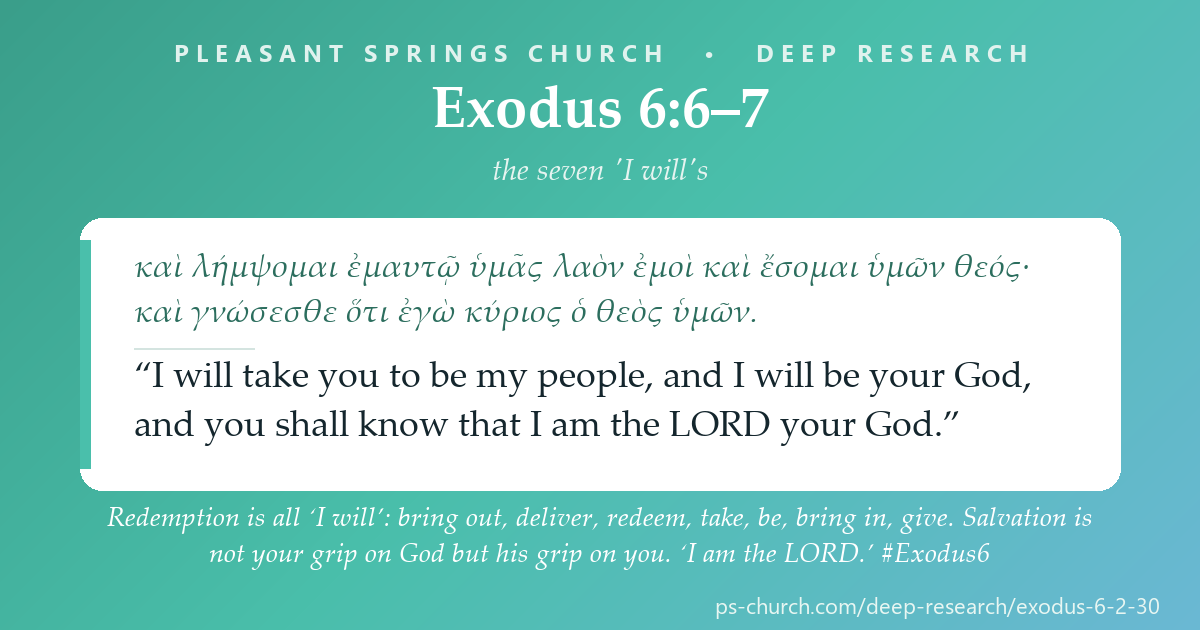
Exodus 6:7 gives the covenant its heartbeat in eight words: “I will take you to be my people, and I will be your God.” It is worth tracing how far that one sentence runs. It is planted in the promise to Abraham — “to be God to you and to your offspring” (Gen 17:7). It is stamped on Sinai (Lev 26:12) and re-spoken by the prophets when Israel has broken it past mending, now as sheer gift: “I will write it on their hearts… and I will be their God, and they shall be my people” (Jer 31:33; Ezek 36:28). Paul lifts it whole into the church’s charter (2 Cor 6:16). And John hears it thunder over the new creation, the covenant finally kept without remainder: “Behold, the dwelling place of God is with man… they will be his people, and God himself will be with them as their God” (Rev 21:3). The seven “I will’s” of Exodus 6 are the first full statement of a purpose God will not abandon — to have a people who are his, and to be their God — and every “I will” is finally underwritten by the one who says, at the last, “It is done… I am the Alpha and the Omega” (Rev 21:6).
The scholarship on the name, the redemption, and the genealogy.
Childs and Durham for the exegesis; Moberly on the name and patriarchal religion; the studies on gāʾal and the covenant formula.
Commentaries & studies:
- Brevard Childs, The Book of Exodus (OTL); John Durham, Exodus (WBC); Douglas Stuart, Exodus (NAC); Peter Enns, Exodus (NIVAC); Nahum Sarna, Exodus (JPS).
- R. W. L. Moberly, The Old Testament of the Old Testament; studies on Exodus 6:3 and the relation of El Shaddai to YHWH (and the older source-critical “P” reading of the name’s revelation).
- Studies of gāʾal / gōʾēl (the kinsman-redeemer) and of the biblical covenant formula (Rendtorff, The Covenant Formula).
Interpretation notes worth keeping:
- “Not made known” (6:3) — best read experientially: the fathers knew the name YHWH as a word (Genesis uses it), but its full redemptive reality is unveiled now, in the doing of the exodus. It is the name’s meaning, newly experienced, not the word itself, that was “not known.”
- The seven verbs (6:6–8) — commonly counted as seven redemptive “I will’s”; later Jewish tradition tied the first four to the four cups of Passover. All are God’s initiative — salvation as pure gift.
- The genealogy (6:14–27) — a purposeful interruption: it runs only to Levi in order to credential Aaron and Moses at their commissioning (6:26–27), grounding the priestly line in the deliverer’s family. The resumptive frame (6:28–30) rejoins the narrative of ch. 7.
- “Broken spirit” (6:9) — the honest realism of the text: even the fullest gospel meets crushed people who cannot yet receive it. The word’s truth does not depend on the hearer’s capacity to feel it.
From the name of the Redeemer to your own broken spirit.
Name what you learned, why it matters, and one concrete response.
What should we carry away — and do?
- Redemption is all ‘I will.’ Seven times God makes himself the subject and you the object: bring out, deliver, redeem, take, be, bring in, give. Salvation is not your grip on God but his grip on you.
- The name is a Redeemer’s name. “I am the Lord” is not a definition but a rescue — the kinsman who buys back his own at cost. The exodus fills the name; the cross fills it to the brim.
- Grace is true even when you can’t feel it. Israel “did not listen… because of their broken spirit.” The promise does not wait on your strength to receive it. When despair cannot hold the word, the word still holds you.
Step in response: take the seven “I will’s” of 6:6–8 and pray them back to God this week, one per day — slowly, as promises made to you in Christ. And if your own spirit is short and crushed, do not try first to feel the gospel; simply rest on the name that signs it front and back: “I am the Lord.”
Exodus 6:7 · to share
LXX + ESVEvery Deep Research page traces its passage across the whole sweep — the Old Testament, the Second-Temple world between the testaments (historical witnesses, not Scripture), and the New Testament. Follow the thread:
Pleasant Springs Church — Deep Research
Research method after Michael S. Heiser’s Bible Research Method (examine dictionaries → ancient literature → important words → textual connections → academic publications → share), with the Pleasant Springs “Author & Audience” foundation. Scripture set in the Hebrew, the Greek editions named on each page and the ESV (Old Testament), and the Greek New Testament and the ESV (New Testament), per the practice of Pleasant Springs Church. Exodus 6:2–30 research grounded in Childs, Durham, Stuart, Enns, Sarna, and Moberly; the divine name read as unveiled in the deed of redemption (6:3 “made known” taken experientially, not that the word YHWH was unknown to the patriarchs); gāʾal as the kinsman-redeemer’s costly buy-back (Lev 25; Ruth 4; LXX λυτρόω, the New Testament’s ransom-word); the seven redemptive “I will’s” (6:6–8) as pure divine initiative; the covenant formula (6:7) traced to Jeremiah 31, Ezekiel 36, and Revelation 21:3; the Levi genealogy (6:14–27) as a purposeful credentialing of Aaron and Moses; and the Second-Temple retellings of the exodus (Jubilees, Wisdom, Josephus) read as historical witnesses, not Scripture.
Scripture quotations marked ESV are from the ESV® Bible (The Holy Bible, English Standard Version®), © 2001 by Crossway, a publishing ministry of Good News Publishers. ESV Text Edition: 2016. Used by permission. All rights reserved. The ESV text may not be quoted in any publication made available to the public by a Creative Commons license, and the ESV may not be translated in whole or in part into any other language. www.esv.org
|
Did this study bless you today? 💚 Give to Support PS Church100% of gifts go to the General Fund — thank you. |