Moses and Aaron carry God’s word to Pharaoh — “Let my people go” — and the throne answers with a boast that will define the whole plague-cycle: “Who is the Lord…? I do not know the Lord.” Then comes straw withheld, quotas held, foremen beaten, and a deliverer’s raw lament — “why have you done evil to this people?” The first result of obedience is heavier bondage. God’s answer is unhurried and total: “Now you shall see what I will do to Pharaoh.” This study works Exodus 5:1–6:1. See the method →
Exodus 5:1–6:1 (selections)
Hebrew · LXX · ESVThe Shape of the Passage
ConcentricThe first move of obedience makes the load heavier, not lighter — and the deliverer’s first prayer is a complaint. Exodus 5 is where the exodus almost dies in the crib, and where Scripture teaches how faith speaks when God’s promise seems to backfire.
Author
The Torah of Moses tells the story with unflinching honesty. Fresh from the burning bush and his signs (ch. 4), Moses and Aaron carry God’s word to Pharaoh: “Thus says the Lord… Let my people go, that they may hold a feast to me in the wilderness” (5:1). Pharaoh’s reply is the theological heart of the chapter and the seed of everything that follows: “Who is the Lord, that I should obey his voice…? I do not know the Lord” (5:2). He knows plenty of gods; he does not know this one — and the entire plague sequence is God’s answer to that boast, repeated like a drumbeat: “that you may know that I am the Lord” (7:5, 17; 8:22; 14:4, 18).
Bricks without straw. Pharaoh does not debate; he retaliates. Branding the people “idle” (5:8, 17 — the tyrant’s reflex, that the oppressed have too much time to think about God), he orders the taskmasters to withhold straw while holding the brick-quota fixed. The people scatter to gather stubble (5:12); the quota cannot be met; the Hebrew foremen are beaten and appeal to Pharaoh in vain (5:15–19); and, leaving his presence, they round on Moses and Aaron: “The Lord look on you and judge, because you have made us stink in the sight of Pharaoh… and have put a sword in their hand to kill us” (5:21). Deliverance, so far, has only deepened the wound.
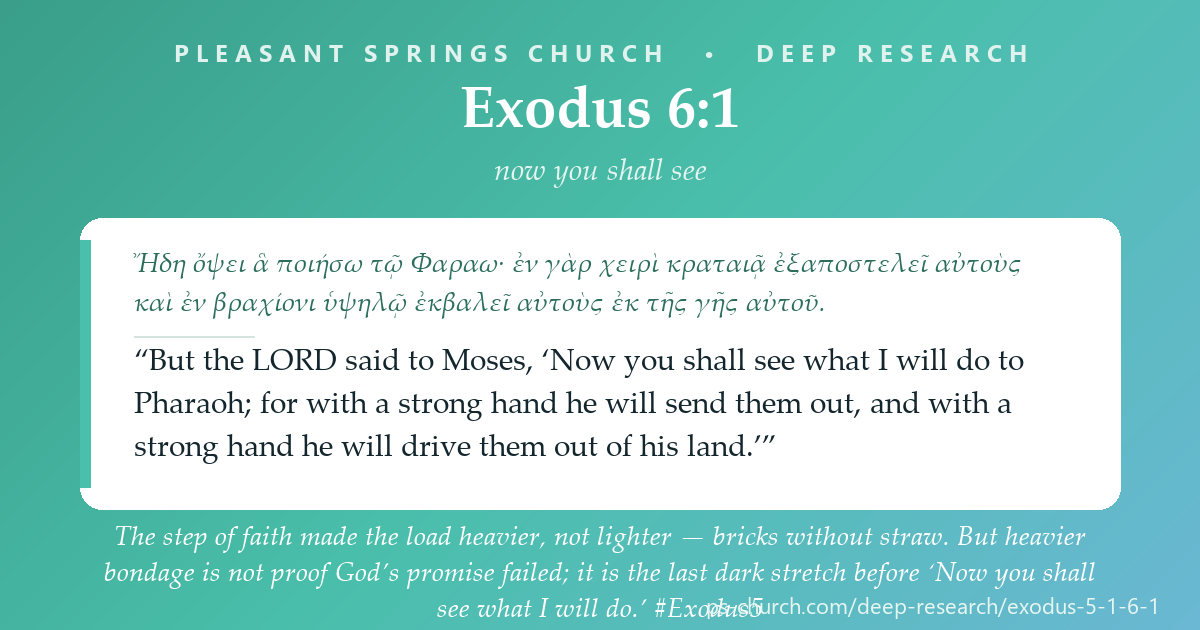
The deliverer’s lament. Moses does the right thing with his disappointment: he takes it to God. “O Lord, why have you done evil to this people? Why did you ever send me? For since I came to Pharaoh… he has done evil to this people, and you have not delivered your people at all” (5:22–23). It is raw — it edges on accusation — and yet it is prayer, addressed to the God he still trusts enough to argue with. Scripture records it without a rebuke, in the honest company of Jeremiah, Job, and the psalms of lament. God’s reply neither scolds nor hurries: “Now you shall see what I will do to Pharaoh; for with a strong hand he will send them out” (6:1) — the promise of a deliverance so decisive that Pharaoh will not merely release them but drive them out.
Audience
Israel — and every later generation that found obedience made things worse before it made them better. The exodus generation needed to know that the darkest hour of their slavery fell after Moses came, not before; that God’s promise was not failing when the straw ran out, but ripening. The pattern is written deep into redemption: the road out of Egypt runs first deeper into the brickyard.
How they were to hear it. First, Pharaoh’s “I do not know the Lord” is the disease the whole book sets out to heal — the plagues are not divine tantrum but a sustained lesson in the identity of God (see 6:2–8, 7:1–5). Second, Moses’ lament is permitted — even modeled: faith is allowed to bring God its bewilderment, provided it brings it to God. And third, God’s “now you shall see” teaches a patient people to read delay as the runway of deliverance, not its cancellation. The heavier bondage was labor pains, not a death.
Orient on Egyptian brick-making, corvée labor, the knowledge of God, and the lament.
Search by topic: bricks / brickmaking, corvée and forced labor, taskmasters and foremen, ‘knowing’ God, lament / complaint prayer.
Which articles are relevant?
- Anchor Bible Dictionary — “Brick, Brickmaking,” “Labor (Corvée),” “Pharaoh,” “Exodus, The.”
- Dictionary of the OT: Pentateuch — “Egypt,” “Slavery,” “Moses,” “Knowledge of God.”
- NIDOTTE / TDOT — יָדַע (yādaʿ, to know), לְבֵנָה (lə˃ēnāh, brick), תֶּבֶן (teben, straw), נָצַל (nāṣal, deliver, hiphil).
Bibliography surfaced:
- Brevard Childs, The Book of Exodus (OTL); Douglas Stuart, Exodus (NAC); John Durham, Exodus (WBC).
- Nahum Sarna, Exodus (JPS) and Exploring Exodus — Egyptian brick labor and the historical setting.
- Studies on the biblical lament (Westermann, Brueggemann) and on the “recognition formula” (“that you may know…”).
Egyptian brickyards, the tyrant’s logic, and arguing with God.
Read the brick-quota against Egyptian labor practice and royal ideology, then set Pharaoh’s “who is the Lord?” and Moses’ lament in their ancient frames.
Which parallels shed light on religion and worldview?
Straw, mud, and quota. Egyptian mud-bricks were bound with chopped straw, whose decay released binding acids that strengthened the brick — withholding the straw while fixing the tally (5:8) is a technically real, deliberately crushing order. Tomb paintings (e.g., the vizier Rekhmire’s at Thebes) show gangs of Semitic and foreign laborers making bricks under the rod of overseers, with daily quotas recorded — the very world of Exodus 5. Pharaoh’s sneer that the people are “idle” (5:8, 17) is the perennial logic of the oppressor: worship is dismissed as laziness, and the cure for a slave who talks about God is more work.
‘Who is the Lord?’ Pharaoh was himself reckoned divine, the earthly Horus, guarantor of ma’at (cosmic order); his gods were many and named. His “I do not know the Lord” is thus not simple atheism but the imperial refusal to reckon with a God outside his pantheon and above his throne. The whole contest that follows — each plague striking at a sphere Egyptian religion claimed (Nile, sun, livestock, the firstborn heir) — is God’s patient, terrible tutorial answering that one arrogant question.
- Egyptian brick-labor iconography — the tomb of Rekhmire and the Papyrus Anastasi texts (foreigners making bricks, straw deliveries, and fixed quotas): the documentary backdrop to Exodus 5.
- Pharaonic ideology — the king as divine upholder of ma’at: why “let my people go” sounds to Pharaoh like cosmic treason, and why “I do not know the Lord” is a claim of ultimate authority.
- The recognition formula — “that you may know that I am the Lord” (Exod 7:5, 17; 8:22; 14:4, 18; later saturating Ezekiel): the plagues as revelation, aimed straight at Pharaoh’s ignorance.
- The lament tradition — Jeremiah’s “confessions” (Jer 20:7–18), Job, and the psalms of complaint (Ps 44; 88): honest protest addressed to God is a recognized form of faith, not its failure — Moses stands in this company.
It is one of the hardest lessons in the life of faith, and Exodus 5 teaches it without softening: the first result of obedience was heavier bondage. Moses did exactly what God commanded, spoke exactly the words God gave, and the immediate consequence was that his people were beaten harder and hated him for it. Nothing had gone wrong; this was the road. The same shape recurs across Scripture — Joseph obeys and lands in prison, the disciples obey and row into the storm, the Lord himself is obedient unto a cross before a resurrection — and it recurs in ordinary discipleship, where the step of faith so often makes life harder before the promise ripens. Pharaoh’s spite was real, and God let it run its course a while, because a deliverance that merely eased the pressure would have taught Israel nothing about who their God was. Instead they would learn it in a brickyard gone dark, so that when the “strong hand” finally fell they would never mistake their rescue for good fortune or Egyptian mercy. The lesson for the church is not that heavier bondage means we heard God wrong, but that we may have heard him exactly right — and that the darkness after obedience is often the last darkness before the dawn God named from the start: “now you shall see what I will do.”
The vocabulary of the brickyard and the boast.
Watch Pharaoh’s “who” and “I do not know,” the straw and the slander of “idleness,” the foremen’s recoil, and God’s answering “strong hand.”
“Who is the Lord?” — Pharaoh’s challenge, the book’s central question. Not ignorance of gods in general but refusal of this God; the plagues are the answer he demanded.
“I do not know” — from yādaʿ, to know by acquaintance and acknowledgment. Pharaoh’s ignorance is willful; the recognition formula (“that you may know…”) will overturn it.
“Straw” — chopped straw bound Egyptian mud-bricks and strengthened them. Withholding it while holding the quota is a real, calculated cruelty, not mere symbolism.
“Idle / slack” — Pharaoh’s slander that the people have too much leisure to think of worship. The tyrant reframes devotion as laziness and prescribes more work.
“Made our scent stink” — the foremen’s bitter charge against Moses: his mission has made them repugnant to Pharaoh. Obedience has cost them, and they blame the messenger.
“With a strong hand” — God’s answer to the brick-hand of Pharaoh. So forceful that Pharaoh will not just release Israel but drive them out (LXX: “with a high arm he will cast them out”).
How the rest of Scripture fills out the scene:
- Exodus 7:5, 17; 8:22; 14:4, 18 — “that you may know that I am the Lord”: the recognition formula that directly answers Pharaoh’s “I do not know” (see 7:1–13, 14:1–31).
- Exodus 6:2–8 — God’s reply to the lament: “I am the Lord… I will deliver… and you shall know that I am the Lord your God” (see 6:2–30).
- Jeremiah 20:7–9; Job 3; Psalm 88 — the lament tradition Moses joins: honest protest brought to God, not against him.
- Psalm 105:25–45; Nehemiah 9:9–11 — Israel’s memory of the “strong hand” that finally answered the brickyard.
From “Who is the LORD?” to “that they may know you.”
Trace the boast and its cure, the lament and its answer, and the “strong hand” through the exodus and beyond.
Which cross-references matter?
- Exodus 3:19–20; 6:1; 13:3, 14–16 — the promised “strong hand” and “mighty hand”: God foretold the resistance and the rescue (see 3:1–15).
- Exodus 7–14 — the plagues and the sea as the sustained answer to “who is the Lord?” — even Pharaoh’s own magicians come to say “this is the finger of God” (8:19; see the Passover).
- Romans 9:17–18 — Paul cites Exodus (9:16): God “raised up” Pharaoh “that my name might be proclaimed in all the earth” — the boast turned, in the end, into a herald of God’s power.
- 1 Samuel 6:6; Nehemiah 9:9–11; Psalm 106:7–12 — later Israel remembers Pharaoh’s hardness and the mighty hand that broke it.
Exodus is careful about the sequence of Pharaoh’s heart, and so must we be. Here in chapter 5 no one hardens Pharaoh — he hardens himself, freely, by spite: “I do not know the Lord, and… I will not let Israel go.” Through the first plagues the text either leaves the agent unstated (“his heart was hard,” 7:13, 22; 8:19) or names Pharaoh hardening his own heart (8:15, 32; 9:34); only later, when his defiance is settled and repeated, does it say the Lord hardened it (9:12; 10:1, 20, 27) — a judicial confirming of a man in the choice he has already made his own. When Paul takes this up in Romans 9:17–18, quoting God’s word to Pharaoh, he is not describing an arbitrary damning of the innocent but God’s righteous freedom over a vessel that had made itself fit for destruction — and even then bending Pharaoh’s stubbornness to a public end: “that my name might be proclaimed in all the earth.” God’s sovereignty and Pharaoh’s guilt are held together, not traded off. The man who sneered “who is the Lord?” would answer his own question at the bottom of the sea — and the world would learn the name he refused to know.
The scholarship on Exodus 5:1-6:1.
Childs and Durham for the exegesis; Sarna and the Egyptological studies for the brickyard; Westermann and Brueggemann on the lament.
Commentaries & studies:
- Brevard Childs, The Book of Exodus (OTL); John Durham, Exodus (WBC); Douglas Stuart, Exodus (NAC); Peter Enns, Exodus (NIVAC).
- Nahum Sarna, Exodus (JPS) and Exploring Exodus; studies of Egyptian brick-labor (Rekhmire; Papyrus Anastasi) and the historical setting.
- Claus Westermann, Praise and Lament in the Psalms; Walter Brueggemann on complaint and the “recognition formula.”
Interpretation notes worth keeping:
- “I do not know the Lord” (5:2) is programmatic: the book’s answer is the repeated “that you may know….” The plagues are revelation before they are judgment.
- The LXX at 5:21 reads ὁ θεός (“God”) where the Hebrew has the Tetragrammaton (“the Lord look on you”) — a translational softening of the divine name on the foremen’s angry lips; and at 6:1 the LXX renders the second “strong hand” as “a high arm” (ἐν βραχίονι ὑψηλῷ).
- Moses’ lament (5:22–23) is not censured. Scripture models bringing bewilderment to God as an act of faith — the alternative to abandoning him, not a form of it.
- Pharaoh’s “idle” (5:8, 17) exposes the ideology of forced labor: the demand to worship is recast as laziness, and devotion is punished with more bricks.
From the dark brickyard to “now you shall see.”
Name what you learned, why it matters, and one concrete response.
What should we carry away — and do?
- Obedience can make things harder first. The step of faith led straight into a heavier load. Heavier bondage is not proof you heard God wrong — it may be the last dark stretch before “now you shall see.”
- Take your complaint to God. Moses’ “why have you done evil to this people?” was raw — and it was prayer. Faith is allowed to argue with God; it is not allowed to walk away from him.
- The question the plagues answer is still ours. “Who is the Lord?” Pharaoh meant it as a boast; God spent ten plagues and a sea answering it — “that you may know that I am the Lord.” To know him is the whole point.
Step in response: if obedience has just made your load heavier, resist the two easy exits — blaming the messenger and abandoning the mission. Do what Moses did: bring the honest complaint to God, and then wait for the “strong hand.” Write down the promise you are standing on, and under it write God’s reply to Moses: “Now you shall see what I will do.”
Exodus 6:1 · to share
LXX + ESVEvery Deep Research page traces its passage across the whole sweep — the Old Testament, the Second-Temple world between the testaments (historical witnesses, not Scripture), and the New Testament. Follow the thread:
Pleasant Springs Church — Deep Research
Research method after Michael S. Heiser’s Bible Research Method (examine dictionaries → ancient literature → important words → textual connections → academic publications → share), with the Pleasant Springs “Author & Audience” foundation. Scripture set in the Hebrew, the Greek editions named on each page and the ESV (Old Testament), and the Greek New Testament and the ESV (New Testament), per the practice of Pleasant Springs Church. Exodus 5:1–6:1 research grounded in Childs, Durham, Stuart, Enns, and Sarna; Egyptian brick-labor background (Rekhmire; Papyrus Anastasi); Pharaoh’s “who is the Lord?” read as the question the recognition formula answers (Exod 7:5, 17; 8:22; 14:4, 18); the self-hardening of Pharaoh in ch. 5 held together with God’s later judicial hardening and Paul’s Romans 9:17–18 (God’s righteous freedom, not arbitrary reprobation); Moses’ lament honored within the biblical complaint tradition (Jer 20; Job; Ps 88), modeled not rebuked; LXX divergences at 5:21 (ὁ θεός for YHWH) and 6:1 (βραχίονι ὑψηλῷ) noted; Second-Temple retellings (Jubilees, Wisdom, Josephus) read as witnesses, not Scripture.
Scripture quotations marked ESV are from the ESV® Bible (The Holy Bible, English Standard Version®), © 2001 by Crossway, a publishing ministry of Good News Publishers. ESV Text Edition: 2016. Used by permission. All rights reserved. The ESV text may not be quoted in any publication made available to the public by a Creative Commons license, and the ESV may not be translated in whole or in part into any other language. www.esv.org
|
Did this study bless you today? 💚 Give to Support PS Church100% of gifts go to the General Fund — thank you. |